Chapter IV
Immunopharmacology
YEAR III Pharm.D
Dr. V. Chitra
The Immune Response - why and how ?
{ Discriminate: Self / Non self
{ Destroy:
z Infectious invaders
z Dysregulated self (cancers)
{ Immunity:
z Innate, Natural
z Adaptive, Learned
Who are involved ?
{ Innate
z Complement
z Granulocytes
z Monocytes/macrophages
z NK cells
z Mast cells
z Basophils
{ Adaptive:
z B and T
lymphocytes
z B: antibodies
z T : helper,
cytolytic,
suppressor.
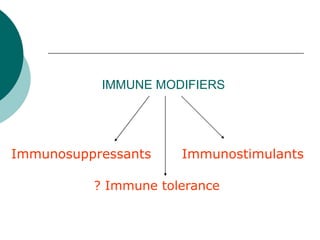
IMMUNE MODIFIERS
Immunosuppressants Immunostimulants
? Immune tolerance
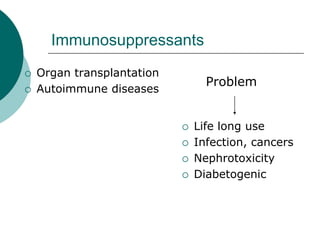
Immunosuppressants
{ Organ transplantation
{ Autoimmune diseases
{ Life long use
{ Infection, cancers
{ Nephrotoxicity
{ Diabetogenic
Problem
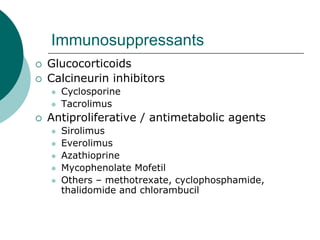
Immunosuppressants
{ Glucocorticoids
{ Calcineurin inhibitors
z Cyclosporine
z Tacrolimus
{ Antiproliferative / antimetabolic agents
z Sirolimus
z Everolimus
z Azathioprine
z Mycophenolate Mofetil
z Others – methotrexate, cyclophosphamide,
thalidomide and chlorambucil
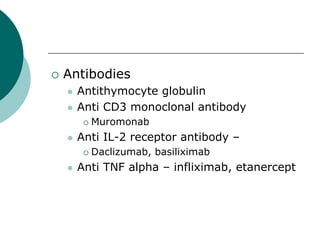
{ Antibodies
z Antithymocyte globulin
z Anti CD3 monoclonal antibody
{ Muromonab
z Anti IL-2 receptor antibody –
{ Daclizumab, basiliximab
z Anti TNF alpha – infliximab, etanercept
Glucocorticoids
{ Induce redistribution of lymphocytes –
decrease in peripheral blood lymphocyte
counts
{ Intracellular receptors – regulate gene
transcription
{ Down regulation of IL-1, IL-6
{ Inhibition of T cell proliferation
{ Neutrophils, Monocytes display poor
chemotaxis
{ Broad anti-inflammatory effects on
multiple components of cellular immunity
USES - Glucocorticoids
{ Transplant rejection
{ GVH – BM transplantation
{ Autoimmune diseases – RA, SLE,
Hematological conditions
{ Psoriasis
{ Inflammatory Bowel Disease, Eye
conditions
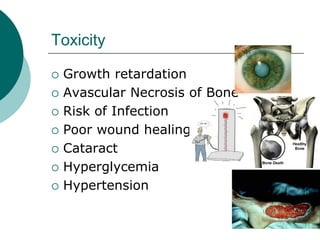
Toxicity
{ Growth retardation
{ Avascular Necrosis of Bone
{ Risk of Infection
{ Poor wound healing
{ Cataract
{ Hyperglycemia
{ Hypertension
Calcineurin inhibitors
z Cyclosporine
z Tacrolimus
{ Most effective immunosuppressive
drugs
{ Target intracellular signaling
pathways
{ Blocks Induction of cytokine genes
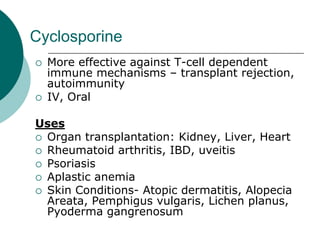
Cyclosporine
{ More effective against T-cell dependent
immune mechanisms – transplant rejection,
autoimmunity
{ IV, Oral
Uses
{ Organ transplantation: Kidney, Liver, Heart
{ Rheumatoid arthritis, IBD, uveitis
{ Psoriasis
{ Aplastic anemia
{ Skin Conditions- Atopic dermatitis, Alopecia
Areata, Pemphigus vulgaris, Lichen planus,
Pyoderma gangrenosum
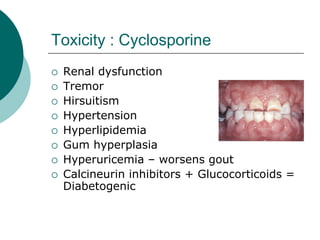
Toxicity : Cyclosporine
{ Renal dysfunction
{ Tremor
{ Hirsuitism
{ Hypertension
{ Hyperlipidemia
{ Gum hyperplasia
{ Hyperuricemia – worsens gout
{ Calcineurin inhibitors + Glucocorticoids =
Diabetogenic
Drug Interaction : Cyclosporine
{ CYP 3A4
z Inhibitors: CCB, Antifungals,
Antibiotics, HIV PI, Grape juice
z Inducers: Rifampicin, Phenytoin
{ Additive nephrotoxicity: NSAIDs
Tacrolimus
{ Inhibits T-cell activation by
inhibiting calcineurin
{ Use
z Prophylaxis of solid-organ allograft
rejection
Toxicity - Tacrolimus
{ Nephrotoxicity
{ Neurotoxicity-Tremor, headache, motor
disturbances, seizures
{ GI Complaints
{ Hypertension
{ Hyperglycemia
{ Risk of tumors, infections
{ Drug interaction
z Synergistic nephrotoxicity with cyclosporine
z CYP3A4
Antiproliferative and Antimetabolic
drugs
{ Sirolimus
{ Everolimus
{ Azathioprine
{ Mycophenolate Mofetil
{ Others:
z Methotrexate
z Cyclophosphamide
z Thalidomide
z Chlorambucil
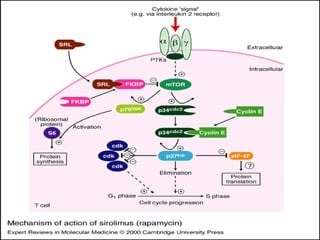
Sirolimus
{ Inhibits T-cell activation and
Proliferation
{ Complexes with an immunophilin,
Inhibits a key enzyme in cell cycle
progression – mammalian target of
rapamycin (mTOR)
Sirolimus
Uses
{ Prophylaxis of organ transplant rejection
along with other drugs
Toxicity
{ Increase in serum cholesterol, Triglycerides
{ Anemia
{ Thrombocytopenia
{ Hypokalemia
{ Fever
{ GI effects
{ Risk of infection, tumors
{ Drug Interactions: CYP 3A4
Everolimus
{ Shorter half life compared to
sirolimus
{ Shorter time taken to reach steady
state
{ Similar toxicity, drug interactions
Azathioprine
{ Purine antimetabolite
{ Incorporation of false nucleotide
6 Thio-IMP 6Thio-GMP 6Thio-GTP
{ Inhibition of cell proliferation
{ Impairment of lymphocyte function
Uses
{ Prevention of organ transplant
rejection
{ Rheumatoid arthritis
Toxicity - Azathioprine
{ Bone marrow suppression-
leukopenia, thrombocytopenia,
anemia
{ Increased susceptibility to infection
{ Hepatotoxicity
{ Alopecia
{ GI toxicity
{ Drug interaction: Allopurinol
Mycophenolate Mofetil
{ Prodrug Ɔ Mycophenolic acid
{ Inhibits IMPDH – enzyme in guanine
synthesis
{ T, B cells are highly dependent on
this pathway for cell proliferation
{ Selectively inhibits lymphocyte
proliferation, function – Antibody
formation, cellular adhesion,
migration
Uses - Mycophenolate Mofetil
{ Prophylaxis of transplant rejection
{ Combination: Glucocorticoids
Calcineurin Inhibitors
{ Toxicity
{ GI, Hematological
z Diarrhea, Leucopenia
{ Risk of Infection
Drug Interaction
{ Decreased absorption when co-
administered with antacids
{ Acyclovir, Gancyclovir compete with
mycophenolate for tubular secretion
FTY720
{ S1P-R agonist – sphingosine 1 receptor
{ Reduce recirculation of lymphocytes from
lymphatic system to blood and peripheral
tissues
{ ā€œLymphocyte homingā€ – periphery into
lymph node
{ Protects graft from T-cell-mediated attack
Uses
{ Combination immunosuppression therapy
in prevention of acute graft rejection
Toxicity
{ Lymphopenia
{ Negative chronotropic effect
z S1P-receptor on human atrial myocytes
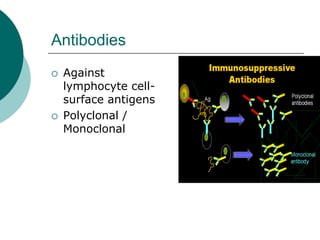
Antibodies
{ Against
lymphocyte cell-
surface antigens
{ Polyclonal /
Monoclonal
Antibodies
{ Antithymocyte Globulin
{ Monoclonal antibodies
z Anti-CD3 Monoclonal antibody (Muromonab-CD3)
z Anti-IL-2 Receptor antibody (Daclizumab,
Basiliximab)
z Campath-1H (Alemtuzumab)
{ Anti-TNF Agents
z Infliximab
z Etanercept
z Adalimumab
{ LFA-1 Inhibitor (lymphocyte function associated)
z Efalizumab
Anti-thymocyte Globulin
{ Purified gamma globulin from serum of
rabbits immunized with human thymocytes
{ Cytotoxic to lymphocytes & block lymphocyte
function
Uses
{ Induction of immunosuppression –
transplantation
{ Treatment of acute transplant rejection
Toxicity
{ Hypersensitivity
{ Risk of infection, Malignancy
Anti-CD3 Monoclonal Antibody
{ Muromonab-CD3
{ Binds to CD3, a component of T-cell
receptor complex involved in
z antigen recognition
z cell signaling & proliferation
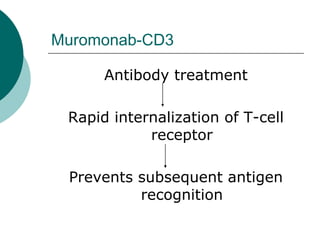
Muromonab-CD3
Antibody treatment
Rapid internalization of T-cell
receptor
Prevents subsequent antigen
recognition
Uses
{ Treatment of acute organ transplant
rejection
Toxicity
{ ā€œCytokine release syndromeā€
{ High fever, Chills, Headache,
Tremor, myalgia, arthralgia,
weakness
{ Prevention: Steroids
Anti-IL-2 Receptor Antibodies
{ Daclizumab and Basiliximab
{ Bind to IL-2 receptor on surface of
activated T cells Ɔ Block IL-2 mediated
T-cell activation
Uses
{ Prophylaxis of Acute organ rejection
Toxicity
{ Anaphylaxis, Opportunistic Infections
Campath-1H (Alemtuzumab)
{ Targets CD52 – expressed on
lymphocytes, monocytes, Macrophages
{ Extensive lympholysis – Prolonged T &
B cell depletion
Uses
{ Renal transplantation
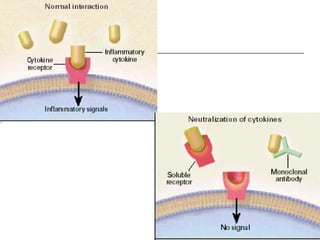
Anti-TNF Agents
{ TNF – Cytokine at site of inflammation
{ Infliximab
{ Etanercept
{ Adalimumab
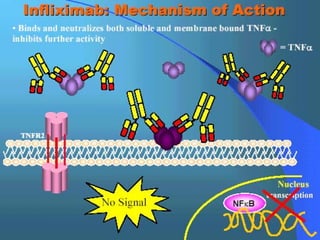
Infliximab
Uses
{ Rheumatoid arthritis
{ Chron’s disease – fistulae
{ Psoriasis
{ Psoriatic arthritis
{ Ankylosing spondylosis
Toxicity
{ Infusion reaction – fever, urticaria,
hypotension, dyspnoea
{ Opportunistic infections – TB, RTI, UTI
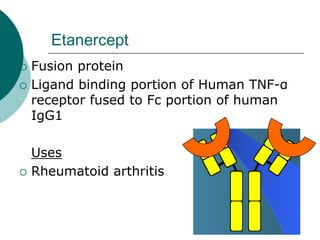
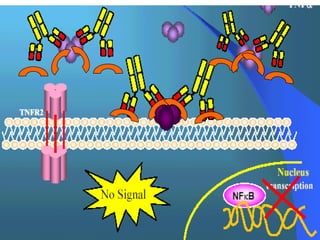
Etanercept
{ Fusion protein
{ Ligand binding portion of Human TNF-α
receptor fused to Fc portion of human
IgG1
Uses
{ Rheumatoid arthritis
Moderate to severely active crohn’s disease
Adalimumab
Recombinant human anti-TNF mAb
LFA-1 Inhibitor - Efalizumab
{ Monoclonal Ab Targeting
Lymphocyte Function Associated
Antigen
{ Blocks T-cell Adhesion, Activation,
Trafficking
Uses
{ Organ transplantation
{ Psoriasis
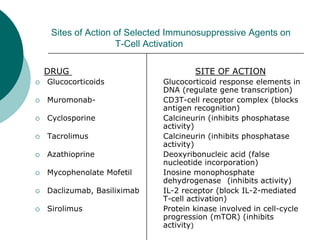
Sites of Action of Selected Immunosuppressive Agents on
T-Cell Activation
DRUG SITE OF ACTION
{ Glucocorticoids Glucocorticoid response elements in
DNA (regulate gene transcription)
{ Muromonab- CD3T-cell receptor complex (blocks
antigen recognition)
{ Cyclosporine Calcineurin (inhibits phosphatase
activity)
{ Tacrolimus Calcineurin (inhibits phosphatase
activity)
{ Azathioprine Deoxyribonucleic acid (false
nucleotide incorporation)
{ Mycophenolate Mofetil Inosine monophosphate
dehydrogenase (inhibits activity)
{ Daclizumab, Basiliximab IL-2 receptor (block IL-2-mediated
T-cell activation)
{ Sirolimus Protein kinase involved in cell-cycle
progression (mTOR) (inhibits
activity)
Immunostimulants
{ Levamisole
{ Thalidomide
{ BCG
{ Recombinant Cytokines
z Interferons
z Interleukin-2
Levamisole
{ Antihelminthic
{ Restores depressed immune
function of B, T cells, Monocytes,
Macrophages
{ Adjuvant therapy with 5FU in colon
cancer
Toxicity
{ Agranulocytosis
Thalidomide
{ Birth defect
{ Contraindicated in women with
childbearing potential
{ Enhanced T-cell production of
cytokines – IL-2, IFN-γ
{ NK cell-mediated cytotoxicity against
tumor cells
USE:
{ Multiple myeloma
Bacillus Calmette-Guerin
{ Live, attenuated culture of BCG
strain of Mycobacterium Bovis
{ Carcinoma Bladder
Adverse Effects
z Hypersensitivity
z Shock
z Chills
Interferons
{ Antiviral
{ Immunomodulatory activity
{ Bind to cell surface receptors –
initiate intracellular events
z Enzyme induction
z Inhibition of cell proliferation
z Enhancement of immune activities
z Increased Phagocytosis
Interferon alpha-2b
{ Hairy cell leukemia
{ Malignant melanoma
{ Kaposi sarcoma
{ Hepatitis B
Adverse reactions
{ Flu-like symptoms – fever, chills,
headache
{ CVS- hypotension, Arrhythmia
{ CNS- depression, confusion
Interleukin-2 (aldesleukin)
{ Proliferation of cellular immunity –
Lymphocytosis, eosinophilia, release of
multiple cytokines – TNF, IL-1, IFN-γ
Uses
{ Metastatic renal cell carcinoma
{ Melanoma
{ Toxicity
{ Cardiovascular: capillary leak syndrome,
Hypotension
Immunization
{ Vaccines
{ Immune Globulin
{ Rho (D) Immune
Globulin
Immunization
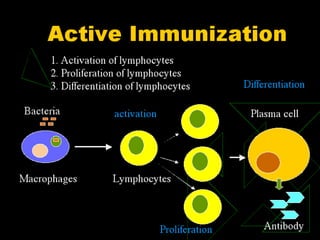
{ Active – Stimulation with an Antigen
{ Passive – Preformed antibody
Active immunization
Vaccines
{ Administration of antigen as a
whole, killed organism, or a specific
protein or peptide constituent of an
organism
{ Booster doses
{ Anticancer vaccines – immunizing
patients with APCs expressing
tumor antigen.
Immune Globulin
Indications
{ Individual is deficient in antibodies
– immunodeficiency
{ Individual is exposed to an agent,
inadequate time for active
immunization
z Rabies
z Hepatitis B
{ Nonspecific immunoglobulins
z Antibody-deficiency disorders
{ Specific immune globulins
z High titers of desired antibody
z Hepatitis B, Rabies, Tetanus
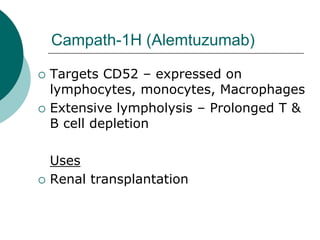
Rho (D) Immune Globulin
{ Antibodies against Rh(D)
antigen on the surface of
RBC
{ Rh-negative women may be
sensitized to ā€œForeignā€ Rh
antigen on fetal RBC
{ Anti-RH Antibodies
produced in mother can
damage subsequent fetuses
by lysing RBC’s
{ Hemolytic disease of
newborn

Immunopharmacology.pdf

  • 1.
  • 2.
    The Immune Response- why and how ? { Discriminate: Self / Non self { Destroy: z Infectious invaders z Dysregulated self (cancers) { Immunity: z Innate, Natural z Adaptive, Learned
  • 3.
    Who are involved? { Innate z Complement z Granulocytes z Monocytes/macrophages z NK cells z Mast cells z Basophils { Adaptive: z B and T lymphocytes z B: antibodies z T : helper, cytolytic, suppressor.
  • 5.
  • 6.
    Immunosuppressants { Organ transplantation {Autoimmune diseases { Life long use { Infection, cancers { Nephrotoxicity { Diabetogenic Problem
  • 7.
    Immunosuppressants { Glucocorticoids { Calcineurininhibitors z Cyclosporine z Tacrolimus { Antiproliferative / antimetabolic agents z Sirolimus z Everolimus z Azathioprine z Mycophenolate Mofetil z Others – methotrexate, cyclophosphamide, thalidomide and chlorambucil
  • 8.
    { Antibodies z Antithymocyteglobulin z Anti CD3 monoclonal antibody { Muromonab z Anti IL-2 receptor antibody – { Daclizumab, basiliximab z Anti TNF alpha – infliximab, etanercept
  • 9.
    Glucocorticoids { Induce redistributionof lymphocytes – decrease in peripheral blood lymphocyte counts { Intracellular receptors – regulate gene transcription { Down regulation of IL-1, IL-6 { Inhibition of T cell proliferation { Neutrophils, Monocytes display poor chemotaxis { Broad anti-inflammatory effects on multiple components of cellular immunity
  • 10.
    USES - Glucocorticoids {Transplant rejection { GVH – BM transplantation { Autoimmune diseases – RA, SLE, Hematological conditions { Psoriasis { Inflammatory Bowel Disease, Eye conditions
  • 11.
    Toxicity { Growth retardation {Avascular Necrosis of Bone { Risk of Infection { Poor wound healing { Cataract { Hyperglycemia { Hypertension
  • 12.
    Calcineurin inhibitors z Cyclosporine zTacrolimus { Most effective immunosuppressive drugs { Target intracellular signaling pathways { Blocks Induction of cytokine genes
  • 14.
    Cyclosporine { More effectiveagainst T-cell dependent immune mechanisms – transplant rejection, autoimmunity { IV, Oral Uses { Organ transplantation: Kidney, Liver, Heart { Rheumatoid arthritis, IBD, uveitis { Psoriasis { Aplastic anemia { Skin Conditions- Atopic dermatitis, Alopecia Areata, Pemphigus vulgaris, Lichen planus, Pyoderma gangrenosum
  • 15.
    Toxicity : Cyclosporine {Renal dysfunction { Tremor { Hirsuitism { Hypertension { Hyperlipidemia { Gum hyperplasia { Hyperuricemia – worsens gout { Calcineurin inhibitors + Glucocorticoids = Diabetogenic
  • 16.
    Drug Interaction :Cyclosporine { CYP 3A4 z Inhibitors: CCB, Antifungals, Antibiotics, HIV PI, Grape juice z Inducers: Rifampicin, Phenytoin { Additive nephrotoxicity: NSAIDs
  • 17.
    Tacrolimus { Inhibits T-cellactivation by inhibiting calcineurin { Use z Prophylaxis of solid-organ allograft rejection
  • 18.
    Toxicity - Tacrolimus {Nephrotoxicity { Neurotoxicity-Tremor, headache, motor disturbances, seizures { GI Complaints { Hypertension { Hyperglycemia { Risk of tumors, infections { Drug interaction z Synergistic nephrotoxicity with cyclosporine z CYP3A4
  • 19.
    Antiproliferative and Antimetabolic drugs {Sirolimus { Everolimus { Azathioprine { Mycophenolate Mofetil { Others: z Methotrexate z Cyclophosphamide z Thalidomide z Chlorambucil
  • 20.
    Sirolimus { Inhibits T-cellactivation and Proliferation { Complexes with an immunophilin, Inhibits a key enzyme in cell cycle progression – mammalian target of rapamycin (mTOR)
  • 22.
    Sirolimus Uses { Prophylaxis oforgan transplant rejection along with other drugs Toxicity { Increase in serum cholesterol, Triglycerides { Anemia { Thrombocytopenia { Hypokalemia { Fever { GI effects { Risk of infection, tumors { Drug Interactions: CYP 3A4
  • 23.
    Everolimus { Shorter halflife compared to sirolimus { Shorter time taken to reach steady state { Similar toxicity, drug interactions
  • 24.
    Azathioprine { Purine antimetabolite {Incorporation of false nucleotide 6 Thio-IMP 6Thio-GMP 6Thio-GTP { Inhibition of cell proliferation { Impairment of lymphocyte function Uses { Prevention of organ transplant rejection { Rheumatoid arthritis
  • 25.
    Toxicity - Azathioprine {Bone marrow suppression- leukopenia, thrombocytopenia, anemia { Increased susceptibility to infection { Hepatotoxicity { Alopecia { GI toxicity { Drug interaction: Allopurinol
  • 26.
    Mycophenolate Mofetil { ProdrugƆ Mycophenolic acid { Inhibits IMPDH – enzyme in guanine synthesis { T, B cells are highly dependent on this pathway for cell proliferation { Selectively inhibits lymphocyte proliferation, function – Antibody formation, cellular adhesion, migration
  • 27.
    Uses - MycophenolateMofetil { Prophylaxis of transplant rejection { Combination: Glucocorticoids Calcineurin Inhibitors { Toxicity { GI, Hematological z Diarrhea, Leucopenia { Risk of Infection
  • 28.
    Drug Interaction { Decreasedabsorption when co- administered with antacids { Acyclovir, Gancyclovir compete with mycophenolate for tubular secretion
  • 29.
    FTY720 { S1P-R agonist– sphingosine 1 receptor { Reduce recirculation of lymphocytes from lymphatic system to blood and peripheral tissues { ā€œLymphocyte homingā€ – periphery into lymph node { Protects graft from T-cell-mediated attack Uses { Combination immunosuppression therapy in prevention of acute graft rejection
  • 30.
    Toxicity { Lymphopenia { Negativechronotropic effect z S1P-receptor on human atrial myocytes
  • 31.
    Antibodies { Against lymphocyte cell- surfaceantigens { Polyclonal / Monoclonal
  • 32.
    Antibodies { Antithymocyte Globulin {Monoclonal antibodies z Anti-CD3 Monoclonal antibody (Muromonab-CD3) z Anti-IL-2 Receptor antibody (Daclizumab, Basiliximab) z Campath-1H (Alemtuzumab) { Anti-TNF Agents z Infliximab z Etanercept z Adalimumab { LFA-1 Inhibitor (lymphocyte function associated) z Efalizumab
  • 33.
    Anti-thymocyte Globulin { Purifiedgamma globulin from serum of rabbits immunized with human thymocytes { Cytotoxic to lymphocytes & block lymphocyte function Uses { Induction of immunosuppression – transplantation { Treatment of acute transplant rejection Toxicity { Hypersensitivity { Risk of infection, Malignancy
  • 34.
    Anti-CD3 Monoclonal Antibody {Muromonab-CD3 { Binds to CD3, a component of T-cell receptor complex involved in z antigen recognition z cell signaling & proliferation
  • 35.
    Muromonab-CD3 Antibody treatment Rapid internalizationof T-cell receptor Prevents subsequent antigen recognition
  • 36.
    Uses { Treatment ofacute organ transplant rejection Toxicity { ā€œCytokine release syndromeā€ { High fever, Chills, Headache, Tremor, myalgia, arthralgia, weakness { Prevention: Steroids
  • 37.
    Anti-IL-2 Receptor Antibodies {Daclizumab and Basiliximab { Bind to IL-2 receptor on surface of activated T cells Ɔ Block IL-2 mediated T-cell activation Uses { Prophylaxis of Acute organ rejection Toxicity { Anaphylaxis, Opportunistic Infections
  • 38.
    Campath-1H (Alemtuzumab) { TargetsCD52 – expressed on lymphocytes, monocytes, Macrophages { Extensive lympholysis – Prolonged T & B cell depletion Uses { Renal transplantation
  • 39.
    Anti-TNF Agents { TNF– Cytokine at site of inflammation { Infliximab { Etanercept { Adalimumab
  • 42.
    Infliximab Uses { Rheumatoid arthritis {Chron’s disease – fistulae { Psoriasis { Psoriatic arthritis { Ankylosing spondylosis Toxicity { Infusion reaction – fever, urticaria, hypotension, dyspnoea { Opportunistic infections – TB, RTI, UTI
  • 43.
    Etanercept { Fusion protein {Ligand binding portion of Human TNF-α receptor fused to Fc portion of human IgG1 Uses { Rheumatoid arthritis
  • 45.
    Moderate to severelyactive crohn’s disease Adalimumab Recombinant human anti-TNF mAb
  • 46.
    LFA-1 Inhibitor -Efalizumab { Monoclonal Ab Targeting Lymphocyte Function Associated Antigen { Blocks T-cell Adhesion, Activation, Trafficking Uses { Organ transplantation { Psoriasis
  • 47.
    Sites of Actionof Selected Immunosuppressive Agents on T-Cell Activation DRUG SITE OF ACTION { Glucocorticoids Glucocorticoid response elements in DNA (regulate gene transcription) { Muromonab- CD3T-cell receptor complex (blocks antigen recognition) { Cyclosporine Calcineurin (inhibits phosphatase activity) { Tacrolimus Calcineurin (inhibits phosphatase activity) { Azathioprine Deoxyribonucleic acid (false nucleotide incorporation) { Mycophenolate Mofetil Inosine monophosphate dehydrogenase (inhibits activity) { Daclizumab, Basiliximab IL-2 receptor (block IL-2-mediated T-cell activation) { Sirolimus Protein kinase involved in cell-cycle progression (mTOR) (inhibits activity)
  • 48.
    Immunostimulants { Levamisole { Thalidomide {BCG { Recombinant Cytokines z Interferons z Interleukin-2
  • 49.
    Levamisole { Antihelminthic { Restoresdepressed immune function of B, T cells, Monocytes, Macrophages { Adjuvant therapy with 5FU in colon cancer Toxicity { Agranulocytosis
  • 50.
    Thalidomide { Birth defect {Contraindicated in women with childbearing potential { Enhanced T-cell production of cytokines – IL-2, IFN-γ { NK cell-mediated cytotoxicity against tumor cells USE: { Multiple myeloma
  • 51.
    Bacillus Calmette-Guerin { Live,attenuated culture of BCG strain of Mycobacterium Bovis { Carcinoma Bladder Adverse Effects z Hypersensitivity z Shock z Chills
  • 52.
    Interferons { Antiviral { Immunomodulatoryactivity { Bind to cell surface receptors – initiate intracellular events z Enzyme induction z Inhibition of cell proliferation z Enhancement of immune activities z Increased Phagocytosis
  • 53.
    Interferon alpha-2b { Hairycell leukemia { Malignant melanoma { Kaposi sarcoma { Hepatitis B Adverse reactions { Flu-like symptoms – fever, chills, headache { CVS- hypotension, Arrhythmia { CNS- depression, confusion
  • 54.
    Interleukin-2 (aldesleukin) { Proliferationof cellular immunity – Lymphocytosis, eosinophilia, release of multiple cytokines – TNF, IL-1, IFN-γ Uses { Metastatic renal cell carcinoma { Melanoma { Toxicity { Cardiovascular: capillary leak syndrome, Hypotension
  • 55.
    Immunization { Vaccines { ImmuneGlobulin { Rho (D) Immune Globulin
  • 56.
    Immunization { Active –Stimulation with an Antigen { Passive – Preformed antibody
  • 58.
    Active immunization Vaccines { Administrationof antigen as a whole, killed organism, or a specific protein or peptide constituent of an organism { Booster doses { Anticancer vaccines – immunizing patients with APCs expressing tumor antigen.
  • 59.
    Immune Globulin Indications { Individualis deficient in antibodies – immunodeficiency { Individual is exposed to an agent, inadequate time for active immunization z Rabies z Hepatitis B
  • 60.
    { Nonspecific immunoglobulins zAntibody-deficiency disorders { Specific immune globulins z High titers of desired antibody z Hepatitis B, Rabies, Tetanus
  • 61.
    Rho (D) ImmuneGlobulin { Antibodies against Rh(D) antigen on the surface of RBC { Rh-negative women may be sensitized to ā€œForeignā€ Rh antigen on fetal RBC { Anti-RH Antibodies produced in mother can damage subsequent fetuses by lysing RBC’s { Hemolytic disease of newborn