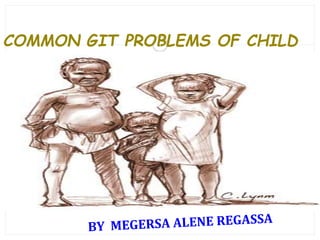
COMMON GIT PROBLEMS OF CHILD1
Mr. Vinod VB. pedi dept
1
Common GI Problems in children
● Diarrhoea
● Vomiting
● Constipation
● Acute abdominal pain
● Pica
● Worm infestation
2
Mr. Vinod VB. pedi dept
Diarrhoea
3
Mr. Vinod VB. pedi dept
Diarrhoea
• Definition:
An increase in the fluidity, volume and frequency of
stools.
• Acute diarrhea:
Short in duration (less than 2 weeks).
• Chronic diarrhea:
4 weeks or more
4
Mr. Vinod VB. pedi dept
Diarrhoea
Annual incidence of Diarrhoeal episodes in children ≤5
year old in developing countries
3.2 episodes per child ,
2 billion episodes globally
Annual mortality from diarrhoea in children ≤ 5 Years
in developing countries
1.8 million deaths
Decreased from 4.5 million deaths in last 20
years
5
Mr. Vinod VB. pedi dept
Etiology of Diarrhea(infant)
Acute Diarrhea Chronic Diarrhea
Gastroenteritis Post infections
Systemic infection Secondary disaccaridase
deficiency
Antibiotic association Irritable colon syndrome
Overfeeding Milk protein intolerance
6
Mr. Vinod VB. pedi dept
Types of Diarrhoea
• Acute watery diarrhea: (80% of cases)
Dehydration
Malnutrition
• Dysentery: (10% of cases)
Anorexia/weight loss
Damage to the mucosa
• Persistent diarrhea: (10% of cases)
Dehydration
Malnutrition
7
Mr. Vinod VB. pedi dept
Mechanism of Diarrhoea
• Osmotic
• Secretory
• Exudative
• Motility disorders
8
Mr. Vinod VB. pedi dept
Assessment of Dehydration
9
Mr. Vinod VB. pedi dept
Degree of Dehydration
Factors Mild < 5% Moderate
5-10%
Severe >10%
General Condition Well, alert Restless, thirsty,
irritable
Drowsy, cold
extremities, lethargic
Eyes Normal Sunken Very sunken, dry
Anterior fontanelle Normal depressed Very depressed
Tears Present Absent Absent
Mouth + tongue Moist Sticky Dry
Skin turgor Slightly decrease Decreased Very decreased
Pulse (N=110-120
beat/min)
Slightly increase Rapid, weak Rapid, sometime
impalpable
BP (N=90/60 mm
Hg)
Normal Deceased Deceased, may be
unrecordable
Respiratory rate Slightly increased Increased Deep, rapid
Urine output Normal Reduced Markedly reduced
10
Mr. Vinod VB. pedi dept
Compications of diarrhoea
• Dehydration
• Metabolic Acidosis
• Gastrointestinal complications
• Nutritional complications
11
Mr. Vinod VB. pedi dept
Treatment of Diarrhoea
● Plenty of fluids
oral rehydration solution using ingredients found in household
can be given.
Ideally these drinks should contain:
. starches and/or sugars as a source of glucose and energy,
. some sodium and
. preferably some potassium.
Breastmilk
Gruels (diluted mixtures of cooked cereals and water)
Carrot Soup
Rice water - congee
12
Mr. Vinod VB. pedi dept
Treatment of Diarrhoea
● Home made ORS recipe
Preparing a 1 (one) litre oral rehydration solution [ORS]
using Salt, Sugar and Water at Home
Mix an oral rehydration solution using one of the following recipes;
depending on ingredients and container availability:
Ingredients:
● one level teaspoon of salt
● eight level teaspoons of sugar
● one litre of clean drinking or boiled water and then cooled
5 cupfuls (each cup about 200 ml.)
● Preparation Method:
● Stir the mixture till the salt and sugar dissolve.
13
Mr. Vinod VB. pedi dept
Preparation of ORS
Preparation of glassful of ORS Preparation of 1 Litre ORS
Taste the drink before giving! It should be no more salty than tears.
14
Mr. Vinod VB. pedi dept
ORS
The formula for ORS recommended by WHO/ UNICEF
contains
15
Mr. Vinod VB. pedi dept
Prevention
● Wash your hands frequently,
especially after using the toilet,
changing diapers.
● Wash your hands before and after
preparing food.
● Wash diarrhea-soiled clothing in
detergent and chlorine bleach.
● Never drink unpasteurized milk or
untreated water.
● Drink only boiled/filtered water.
● Proper hygiene.
16
Mr. Vinod VB. pedi dept
Vomiting
17
Mr. Vinod VB. pedi dept
Vomiting in children
● Definition:
The forceful expulsion of contents of the stomach and
often, the proximal small intestine.
18
Mr. Vinod VB. pedi dept
Causes of vomiting
• Neonate/ Infant
– With fever
• Sepsis, meningitis,
UTI
• Tonsillitis, otitis
media, gastroenteritis
– If no signs sepsis
• Pyloric stenosis/
outlet obstruction
• Metabolic
• Neurologic
• Endocrine
• Child/ adolescents
– With fever (but
otherwise well)
• Gastroenteritis, esp if
also have diarrhoea
– With lethargy/ altered
mental status
• Neurologic
• Metabolic
• Endocrine
• Drugs, toxins, alcohol
19
Mr. Vinod VB. pedi dept
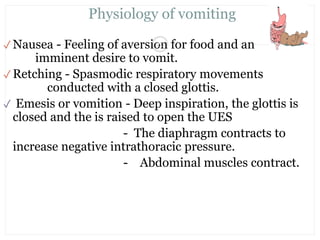
Physiology of vomiting
✓ Nausea - Feeling of aversion for food and an
imminent desire to vomit.
✓ Retching - Spasmodic respiratory movements
conducted with a closed glottis.
✓ Emesis or vomition - Deep inspiration, the glottis is
closed and the is raised to open the UES
- The diaphragm contracts to
increase negative intrathoracic pressure.
- Abdominal muscles contract.
20
Mr. Vinod VB. pedi dept
Investigations for Acute Vomiting
• Thorough examination
• “Septic workup” – blood
cultures, urine, FBC, CRP,
LP
• Upper GI radiology – Barium
swallow/ meal, AXR,
ultrasound abdomen,
endoscopy
• Metabolic investigations –
blood gas, ammonia, blood
and urine organic acids
21
Mr. Vinod VB. pedi dept
Management
• Depends on specific cause
• While investigating/ treating underlying
pathology – replace lost fluids, maintain
hydration
• If mild and child able to drink, can try oral
rehydration. Intravenous may also be required
• Pharmacologic agents not usually
recommended
– May mask signs of serious disease
– Undesirable side-effects in children
22
Mr. Vinod VB. pedi dept
Constipation
23
Mr. Vinod VB. pedi dept
Constipation in Children
● Defined as a delay or difficulty in defecation, present for
two or more weeks and sufficient to cause significant
distress to the patient.
NASPGAN 2006
● Stool frequency of < 3 per week is also defined as
constipation
● Prevalence: 3% of visits to Pediatricians
● 25% of Pediatric Gastroenterology consultations( Molnar D,
Arch Dis Child 1983)
24
Mr. Vinod VB. pedi dept
Etiology of Constipation
● Congenital
1. Anorectal defects
2. Neurogenic
3. Colonic neuropathies
4. Colonic defects
● Acquired
1. Functional
2. Anal lesions
3. Neurologic conditions
4. Metabolic
5. Endocrine
6. Drug induced
7. Low fiber diet
8. Psychiatric problems
25
Mr. Vinod VB. pedi dept
Drugs causing constipation
● Antimotility drugs
● Anticholinergics
● Antidepressants
● Opiates
● Antacids
● Phenothiazines
● Methylphenidate
26
Mr. Vinod VB. pedi dept
History
● Constipation history: Frequency, consistency of
stools, pain/ bleeding with passing stools, age of
onset, fecal soiling, withholding behaviour, nausea/
vomiting, weight loss.
● Family H/o:
● Other important points; Time of passage of
meconium, allergies, surgeries, sensitivity to cold,
dry skin, Medications.
27
Mr. Vinod VB. pedi dept
Physical Findings
● GPE:
● Abdomen: Distension, fecal mass
● Anal Inspection: Position, stool present around anus
or on clothes, anal fissures.
● Rectal Examination: Anal tone, Fecal mass, presence
of stool, consistency of stool, other masses, Explosive
stool on withdrawal of finger
● Back and Spine:
● Neurological Examination.
28
Mr. Vinod VB. pedi dept
Physical findings to distinguish between
functional and organic constipation
● Failure to thrive
● Abdominal distension
● Lack of lumbosacral curve, pilonidal dimple
● Sacral agenesis
● Anteriorly displaced anus
● Gush of liquid stool and air from rectum on withdrawal of
finger
● Decreased lower extremity tone and strength.
29
Mr. Vinod VB. pedi dept
P
Voluntary
Withholding
More pain
Prolonged fecal stasis
Re-absorption of fluids
↑ in size & consistency
Painful defecation
Pathogenesis of functional constipation
30
Mr. Vinod VB. pedi dept
Treatment
● Precise,well-organized plan:to clear fecal
retention,prevent future retention & promote
regular bowel habits.
● 1.Disimpaction:enema or lavage solutions
● 2.Maintenance:prevention of re-accumulation
● I. Diet
● II. Toilet training
● III. Laxative
31
Mr. Vinod VB. pedi dept
Management in Children
• Disimpaction: Either by oral or rectal
medication,including enemas
• Maintenance:
• Diet: a balanced diet,containing whole grains, fruits,
vegetables
• Laxative:lactulose,sorbitol,magnesium hydroxide,
mineral oil are safe & effective
• Behavioral therapy:toilet training (5-10min after meal)
• Rescue therapy:short course of stimulant laxative
• Intractable constipation:Bio-feedback therapy (after
6mo to 1 yr. of intensive medical therapy
32
Mr. Vinod VB. pedi dept
Disimpaction
● Fecal impaction: a hard mass in the lower abdomen on
physical exam.(seen in 50%),P/R, AXR
● Necessary step before initiating maintenance therapy.
● Oral route: non-invasive,gives a sense of power to the
child but compliance is a problem.
● Rectal approach: faster but invasive (likely to add fear &
discomfort that the child already has,may intensify stool
withholding)
● Choice: should be discussed with parents & child
33
Mr. Vinod VB. pedi dept
Maintenance
● After removing impaction: prevention of recurrence
● Dietary intervention:increased intake of fluids &
absorbable and non-absorbable carbohydrate.
● Behavioral modification:
● Toilet training(unhurried time in the toilet for 5-10 min
after each meal) for initial months (2-3 yrs of age)
● Keep diary of stool frequency, consistency, pain, soiling,
laxative dose
● Reward system (positive re-inforcement)
34
Mr. Vinod VB. pedi dept
Maintenance
● Osmotic laxatives
● Lactulose/sorbitol/magnesium hydroxide:
● 1-3 ml/kg/day,1-2 dose/s (increment:5ml every 3 d)
● Osmotic enema:
● Phosphate enema:<2 yrs to be avoided
● >2 yrs: 6ml/kg (upto 135ml)
● Lavage:
● PEG solution:disimpaction: 25ml/kg/hr by NG tube until
clear output or 20ml/kg/hr for 4 hr/day
● Maintenance: 5-10 ml/kg/day (non-electrolyte PEG)
35
Mr. Vinod VB. pedi dept
Maintenance
● PEG without electrolytes as maintenance therapy
● PEG as lavage solution: due to large volumes,no absorption
or secretion of electrolytes.
● PEG in low volume: near complete absorption of
electrolytes.
● Advantages of PEG over other laxatives:
● Inert substance,no enzymatic or bacterial degradation
● No flatulence and no loss of activity
● Tasteless or odorless ,colorless,mix well in fluid
36
Mr. Vinod VB. pedi dept
Maintenance
● Lubricant:
● Mineral oil: <1 yr: not recommended
● Disimpaction:15-30 ml/yr of age(240ml daily)
● Maintenance: 1-3 ml/kg/day
● Stimulants:
● Senna:
● 2-6 yrs:2.5-7.5 ml/day(8.8mg/5ml of Sennosides)
● 6-12 yrs: 5-15 ml/day
● Bisacodyl:
● >2 yrs: 0.5-1 suppository(10mg)
● 1-3 tabs/dose(5mg)
37
Mr. Vinod VB. pedi dept
Pica
38
Mr. Vinod VB. pedi dept
Pica
● Definition - Persistent ingestion of nonnutritive,
unedible substances for a period of at least 1 month
at an age at which this behavior is developmentally
inappropriate.
● Common in children between 18 mths – 2 Yrs , after
2nd year needs investigation
● Children usually slow in motor and mental
development
39
Mr. Vinod VB. pedi dept
Pica
● Mental retardation, lack of parental nurturing
predisposing factors
● Increased risk of Lead poisoning, Iron Deficiency
anemia, parasitic infection.
● Screening lead poisoning, parasitic infection
required
40
Mr. Vinod VB. pedi dept
Abdominal Pain
41
Mr. Vinod VB. pedi dept
Abdominal pain in Children
● Acute abdomen: Severe acute onset of pain which
results in urgent need for diagnosis and treatment.
May indicate a medical or surgical emergency
● Less acute pain : common symptom, may be difficult
to elicit and interpret objectively
42
Mr. Vinod VB. pedi dept
Approach to Abdominal Pain
● Detailed history
Relationship to feeding, vomiting and diarrhoea,
fever, micturition
Onset, duration, aggravating and relieving factors,
prior treatment
● Decide on the type of pain
Visceral pain: dull, aching, midline, not necessarily
over site of disease
Somatic : localized, sharp, from parietal pleura,
abdominal wall, retroperitoneal muscles
Referred pain : from parietal pleura to abdominal
43
Mr. Vinod VB. pedi dept
Visceral Pain
● Typically felt in the midline according to level of
dermatome innervation
Epigastric
Peri-umbilical
Suprapubic
● Small intestinal pain felt peri-umbilical and mid-
epigastric
● Colon felt over the site because of short mesentery
● Visceral pain becomes somatic if the affected viscus
involves a somatic organ eg peritoneum or abdominal
wall
44
Mr. Vinod VB. pedi dept
Approach to Abdominal Pain
● Restlessness versus immobility
Colic (visceral) vs peritonitis (somatic)
● Assess degree of pain
Even babies feel pain
Assessment has 3 components
what the child says (self report),
how the child behaves (behavioural)
how the child is reacting (physiological)
“Faces Pain Scale” used from age 4 onwards
45
Mr. Vinod VB. pedi dept
Some Medical Disorders with Abdominal Pain
● Mesenteric adenitis : associated with ARI
● Enterocolitis and food poisoning : often diffuse
pain before diarrhoea
● Pneumonia: referred from pleura, associated
respiratory symptoms and signs
● Inflammatory bowel disorders
● Biliary tract, liver disease and congestion
● Dyspepsia : ulcer and non-ulcer
● Systemic diseases: HSP, DKA, Sickle cell disease
● Peritonitis
46
Mr. Vinod VB. pedi dept
Recurrent Abdominal Pain
● Very common 10 – 15% of children
● Duration longer than 3 months, affecting normal
activity
● Organic cause found in <10% of these
● RAP is defined by four basic criteria:
• History of at least 3 episodes of pain
• Pain sufficient to affect activity
• Episodes over a period of 3 months
• No known organic cause
○ Family history often positive for GI complaints.
○ Growth and development normal
47
Mr. Vinod VB. pedi dept
Causes of Recurrent Abdominal Pain
● Common:
Parasites
Faecal loading
Functional abdominal pain
● Less common:
Infections
Inflammatory disorders
Renal cause
48
Mr. Vinod VB. pedi dept
Functional Abdominal Pain
● Typically 5 – 14 years old
● Unrelated to meals or activity
● Clustering of pain episodes: several times per day
to once a week, recurring at days to weeks intervals
● Physical or psychological stressful stimuli
● Personality type obsessive, compulsive, achiever
● Family history of functional disorders :
reinforcement of pain behaviour
49
Mr. Vinod VB. pedi dept
Functional Abdominal Pain
● Vague, constant, peri-umbilical or epigastric pain
more often than colic
● Duration <3 hours in 90%, variable intensity
● Associated symptoms: headache, pallor, dizziness,
low-grade fever, fatiguability
● May delay sleep, but does not wake the child
● Well-grown and healthy
● Normal FBC, ESR, Urinalysis, Stool microscopy for
blood, ova, parasites
50
Mr. Vinod VB. pedi dept
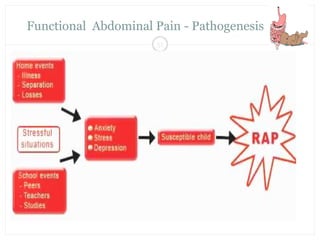
Functional Abdominal Pain - Pathogenesis
51
Mr. Vinod VB. pedi dept
Management of Functional Abdominal Pain
● Positive clinical diagnosis: careful history
● Do not over-investigate: more anxiety
● FBC, ESR, Urinalysis and culture, Stool for occult
blood, ova and parasites
● Positive reassurance that no organic pathology is
present
● Little place for drugs
● Dietary modification
● Reassuring follow-up
52
Mr. Vinod VB. pedi dept
Pointers to Organic Pain in Children
● Age of onset <5 or >14 years
● Localized pain away from umbilicus
● Nocturnal pain waking the patient
● Aggravated or relieved by meals (dyspepsia)
● Loss of appetite and weight
● Alteration in bowel habit
● Associated findings: fever, rash, joint pain
● Abdominal distension, mass, visceromegaly
● Occult blood in stools, anaemia, high ESR
53
Mr. Vinod VB. pedi dept
Worm Infestation
54
Mr. Vinod VB. pedi dept
Worm Infestation in Children
□ Medical term- “Helminthiasis”
□ Most common infection worldwide
□ >2000 million people affected worldwide*
□ Includes different worms like
■ Hookworm (Ancylostoma duodenale)
■ Roundworm (Ascaris lumbricodes)
■ Pin worms (Enterobium vermicularis)
*Ref: WHO & UNICEF Joint Statement (2004)
55
Mr. Vinod VB. pedi dept
Global Distribution
56
Mr. Vinod VB. pedi dept
How are Helminths Transmitted
□ Contaminated food
□ Contaminated water
□ Through piercing the
skin (Hookworms)
□ Habits like eating
mud in children
(“Pica”)
57
Mr. Vinod VB. pedi dept
Predisposing Factors
□ Unsanitary
conditions
□ Malnutrition
□ Improperly cooked
meals
□ Improper hygiene
58
Mr. Vinod VB. pedi dept
VULNERABLE GROUPS
□ Pre-school
□ School going
children
□ Adolescent girls
□ Women of child-
bearing age
59
Mr. Vinod VB. pedi dept
WORM INFESTATION- SYMPTOMS
□ Abdominal pain
□ Nausea/vomiting
□ Diarrhea
□ General malaise &
weakness
□ Anemia
■ Retarded physical growth
& development in
children
□ Intestinal obstruction
60
Mr. Vinod VB. pedi dept
CONTROL & PREVENTION OF WORM INFESTATION
□ Treat following groups once or twice per year
■ Pre-school & school age children
■ Women of child-bearing age (including 2nd &
3rd trimester of pregnancy)
■ Workers in high risk profession- Miners, tea-
pickers, etc
Maximum risk – In children 5 - 14 years of age
61
Mr. Vinod VB. pedi dept
BEST STRATEGY
“Deworming school-aged children is probably
the most economically efficient public health
activity that can be implemented in any low-
income country were soil-transmitted helminths
are endemic”
62
Mr. Vinod VB. pedi dept
Ideal Time for Deworming
□ For children, ideally done every 6 months after 1
year of age
□ Dosing intervals of 2-3 months if protein-energy
malnutrition is prevalent
63
Mr. Vinod VB. pedi dept
DEWORM INDIA 64
BENEFITS OF DEWORMING
□ Beneficial effects on growth
□ Better nutrition- shown to improve iron & Vitamin
A status
□ Improves school performance
□ Reduces morbidity
64
Mr. Vinod VB. pedi dept
Drugs used for Deworming
□ Albendazole
□ Mebendazole
□ Levamisole
□ Pyrantel pamoate
□ Ivermectin
65
Mr. Vinod VB. pedi dept
DEWORM INDIA 66
ALBENDAZOLE- ADVANTAGES
□ Highly effective
□ Safe
□ Single dose
■ Dose:
□ 400 mg (>10 kg body weight)
□ 200 mg (< 10 kg body weight)
□ Relatively inexpensive
□ Easy to administer
66
Mr. Vinod VB. pedi dept
DEWORM INDIA
67
Drugs for Deworming
Drug Available strengths Mode of action
Albendazole 200, 400 mg
Absorbed by intestinal cells of the worms; blocks glucose
uptake & inhibits formation of ATP
Levamisole Tablets 40 mg; Syrup 40 mg/5ml
Binds to acetylcholine receptors & inhibits production of
succinate dehydrogenase, causing spastic paralysis &
passive
elimination of worms
Mebendazole
100 & 500 mg tablets
Suspension 100 mg/5 ml
Same as albendazole
Pyrantel
Chewable tablets 250 mg
Suspension 50 mg/ml
Binds to acetylcholine receptors & paralyses the worms by
depolarizing neuromuscular junctions
Ivermectin Chewable tablets 6 mg
Causes paralysis in many nematodes through influx of
chloride ions across cell membranes & disruption of neural
transmission mediated by GABA
67
Mr. Vinod VB. pedi dept
THANK YOU

Common GIT problem

  • 1.
    COMMON GIT PROBLEMSOF CHILD1 Mr. Vinod VB. pedi dept 1
  • 2.
    Common GI Problemsin children ● Diarrhoea ● Vomiting ● Constipation ● Acute abdominal pain ● Pica ● Worm infestation 2 Mr. Vinod VB. pedi dept
  • 3.
  • 4.
    Diarrhoea • Definition: An increasein the fluidity, volume and frequency of stools. • Acute diarrhea: Short in duration (less than 2 weeks). • Chronic diarrhea: 4 weeks or more 4 Mr. Vinod VB. pedi dept
  • 5.
    Diarrhoea Annual incidence ofDiarrhoeal episodes in children ≤5 year old in developing countries 3.2 episodes per child , 2 billion episodes globally Annual mortality from diarrhoea in children ≤ 5 Years in developing countries 1.8 million deaths Decreased from 4.5 million deaths in last 20 years 5 Mr. Vinod VB. pedi dept
  • 6.
    Etiology of Diarrhea(infant) AcuteDiarrhea Chronic Diarrhea Gastroenteritis Post infections Systemic infection Secondary disaccaridase deficiency Antibiotic association Irritable colon syndrome Overfeeding Milk protein intolerance 6 Mr. Vinod VB. pedi dept
  • 7.
    Types of Diarrhoea •Acute watery diarrhea: (80% of cases) Dehydration Malnutrition • Dysentery: (10% of cases) Anorexia/weight loss Damage to the mucosa • Persistent diarrhea: (10% of cases) Dehydration Malnutrition 7 Mr. Vinod VB. pedi dept
  • 8.
    Mechanism of Diarrhoea •Osmotic • Secretory • Exudative • Motility disorders 8 Mr. Vinod VB. pedi dept
  • 9.
  • 10.
    Degree of Dehydration FactorsMild < 5% Moderate 5-10% Severe >10% General Condition Well, alert Restless, thirsty, irritable Drowsy, cold extremities, lethargic Eyes Normal Sunken Very sunken, dry Anterior fontanelle Normal depressed Very depressed Tears Present Absent Absent Mouth + tongue Moist Sticky Dry Skin turgor Slightly decrease Decreased Very decreased Pulse (N=110-120 beat/min) Slightly increase Rapid, weak Rapid, sometime impalpable BP (N=90/60 mm Hg) Normal Deceased Deceased, may be unrecordable Respiratory rate Slightly increased Increased Deep, rapid Urine output Normal Reduced Markedly reduced 10 Mr. Vinod VB. pedi dept
  • 11.
    Compications of diarrhoea •Dehydration • Metabolic Acidosis • Gastrointestinal complications • Nutritional complications 11 Mr. Vinod VB. pedi dept
  • 12.
    Treatment of Diarrhoea ●Plenty of fluids oral rehydration solution using ingredients found in household can be given. Ideally these drinks should contain: . starches and/or sugars as a source of glucose and energy, . some sodium and . preferably some potassium. Breastmilk Gruels (diluted mixtures of cooked cereals and water) Carrot Soup Rice water - congee 12 Mr. Vinod VB. pedi dept
  • 13.
    Treatment of Diarrhoea ●Home made ORS recipe Preparing a 1 (one) litre oral rehydration solution [ORS] using Salt, Sugar and Water at Home Mix an oral rehydration solution using one of the following recipes; depending on ingredients and container availability: Ingredients: ● one level teaspoon of salt ● eight level teaspoons of sugar ● one litre of clean drinking or boiled water and then cooled 5 cupfuls (each cup about 200 ml.) ● Preparation Method: ● Stir the mixture till the salt and sugar dissolve. 13 Mr. Vinod VB. pedi dept
  • 14.
    Preparation of ORS Preparationof glassful of ORS Preparation of 1 Litre ORS Taste the drink before giving! It should be no more salty than tears. 14 Mr. Vinod VB. pedi dept
  • 15.
    ORS The formula forORS recommended by WHO/ UNICEF contains 15 Mr. Vinod VB. pedi dept
  • 16.
    Prevention ● Wash yourhands frequently, especially after using the toilet, changing diapers. ● Wash your hands before and after preparing food. ● Wash diarrhea-soiled clothing in detergent and chlorine bleach. ● Never drink unpasteurized milk or untreated water. ● Drink only boiled/filtered water. ● Proper hygiene. 16 Mr. Vinod VB. pedi dept
  • 17.
  • 18.
    Vomiting in children ●Definition: The forceful expulsion of contents of the stomach and often, the proximal small intestine. 18 Mr. Vinod VB. pedi dept
  • 19.
    Causes of vomiting •Neonate/ Infant – With fever • Sepsis, meningitis, UTI • Tonsillitis, otitis media, gastroenteritis – If no signs sepsis • Pyloric stenosis/ outlet obstruction • Metabolic • Neurologic • Endocrine • Child/ adolescents – With fever (but otherwise well) • Gastroenteritis, esp if also have diarrhoea – With lethargy/ altered mental status • Neurologic • Metabolic • Endocrine • Drugs, toxins, alcohol 19 Mr. Vinod VB. pedi dept
  • 20.
    Physiology of vomiting ✓Nausea - Feeling of aversion for food and an imminent desire to vomit. ✓ Retching - Spasmodic respiratory movements conducted with a closed glottis. ✓ Emesis or vomition - Deep inspiration, the glottis is closed and the is raised to open the UES - The diaphragm contracts to increase negative intrathoracic pressure. - Abdominal muscles contract. 20 Mr. Vinod VB. pedi dept
  • 21.
    Investigations for AcuteVomiting • Thorough examination • “Septic workup” – blood cultures, urine, FBC, CRP, LP • Upper GI radiology – Barium swallow/ meal, AXR, ultrasound abdomen, endoscopy • Metabolic investigations – blood gas, ammonia, blood and urine organic acids 21 Mr. Vinod VB. pedi dept
  • 22.
    Management • Depends onspecific cause • While investigating/ treating underlying pathology – replace lost fluids, maintain hydration • If mild and child able to drink, can try oral rehydration. Intravenous may also be required • Pharmacologic agents not usually recommended – May mask signs of serious disease – Undesirable side-effects in children 22 Mr. Vinod VB. pedi dept
  • 23.
  • 24.
    Constipation in Children ●Defined as a delay or difficulty in defecation, present for two or more weeks and sufficient to cause significant distress to the patient. NASPGAN 2006 ● Stool frequency of < 3 per week is also defined as constipation ● Prevalence: 3% of visits to Pediatricians ● 25% of Pediatric Gastroenterology consultations( Molnar D, Arch Dis Child 1983) 24 Mr. Vinod VB. pedi dept
  • 25.
    Etiology of Constipation ●Congenital 1. Anorectal defects 2. Neurogenic 3. Colonic neuropathies 4. Colonic defects ● Acquired 1. Functional 2. Anal lesions 3. Neurologic conditions 4. Metabolic 5. Endocrine 6. Drug induced 7. Low fiber diet 8. Psychiatric problems 25 Mr. Vinod VB. pedi dept
  • 26.
    Drugs causing constipation ●Antimotility drugs ● Anticholinergics ● Antidepressants ● Opiates ● Antacids ● Phenothiazines ● Methylphenidate 26 Mr. Vinod VB. pedi dept
  • 27.
    History ● Constipation history:Frequency, consistency of stools, pain/ bleeding with passing stools, age of onset, fecal soiling, withholding behaviour, nausea/ vomiting, weight loss. ● Family H/o: ● Other important points; Time of passage of meconium, allergies, surgeries, sensitivity to cold, dry skin, Medications. 27 Mr. Vinod VB. pedi dept
  • 28.
    Physical Findings ● GPE: ●Abdomen: Distension, fecal mass ● Anal Inspection: Position, stool present around anus or on clothes, anal fissures. ● Rectal Examination: Anal tone, Fecal mass, presence of stool, consistency of stool, other masses, Explosive stool on withdrawal of finger ● Back and Spine: ● Neurological Examination. 28 Mr. Vinod VB. pedi dept
  • 29.
    Physical findings todistinguish between functional and organic constipation ● Failure to thrive ● Abdominal distension ● Lack of lumbosacral curve, pilonidal dimple ● Sacral agenesis ● Anteriorly displaced anus ● Gush of liquid stool and air from rectum on withdrawal of finger ● Decreased lower extremity tone and strength. 29 Mr. Vinod VB. pedi dept
  • 30.
    P Voluntary Withholding More pain Prolonged fecalstasis Re-absorption of fluids ↑ in size & consistency Painful defecation Pathogenesis of functional constipation 30 Mr. Vinod VB. pedi dept
  • 31.
    Treatment ● Precise,well-organized plan:toclear fecal retention,prevent future retention & promote regular bowel habits. ● 1.Disimpaction:enema or lavage solutions ● 2.Maintenance:prevention of re-accumulation ● I. Diet ● II. Toilet training ● III. Laxative 31 Mr. Vinod VB. pedi dept
  • 32.
    Management in Children •Disimpaction: Either by oral or rectal medication,including enemas • Maintenance: • Diet: a balanced diet,containing whole grains, fruits, vegetables • Laxative:lactulose,sorbitol,magnesium hydroxide, mineral oil are safe & effective • Behavioral therapy:toilet training (5-10min after meal) • Rescue therapy:short course of stimulant laxative • Intractable constipation:Bio-feedback therapy (after 6mo to 1 yr. of intensive medical therapy 32 Mr. Vinod VB. pedi dept
  • 33.
    Disimpaction ● Fecal impaction:a hard mass in the lower abdomen on physical exam.(seen in 50%),P/R, AXR ● Necessary step before initiating maintenance therapy. ● Oral route: non-invasive,gives a sense of power to the child but compliance is a problem. ● Rectal approach: faster but invasive (likely to add fear & discomfort that the child already has,may intensify stool withholding) ● Choice: should be discussed with parents & child 33 Mr. Vinod VB. pedi dept
  • 34.
    Maintenance ● After removingimpaction: prevention of recurrence ● Dietary intervention:increased intake of fluids & absorbable and non-absorbable carbohydrate. ● Behavioral modification: ● Toilet training(unhurried time in the toilet for 5-10 min after each meal) for initial months (2-3 yrs of age) ● Keep diary of stool frequency, consistency, pain, soiling, laxative dose ● Reward system (positive re-inforcement) 34 Mr. Vinod VB. pedi dept
  • 35.
    Maintenance ● Osmotic laxatives ●Lactulose/sorbitol/magnesium hydroxide: ● 1-3 ml/kg/day,1-2 dose/s (increment:5ml every 3 d) ● Osmotic enema: ● Phosphate enema:<2 yrs to be avoided ● >2 yrs: 6ml/kg (upto 135ml) ● Lavage: ● PEG solution:disimpaction: 25ml/kg/hr by NG tube until clear output or 20ml/kg/hr for 4 hr/day ● Maintenance: 5-10 ml/kg/day (non-electrolyte PEG) 35 Mr. Vinod VB. pedi dept
  • 36.
    Maintenance ● PEG withoutelectrolytes as maintenance therapy ● PEG as lavage solution: due to large volumes,no absorption or secretion of electrolytes. ● PEG in low volume: near complete absorption of electrolytes. ● Advantages of PEG over other laxatives: ● Inert substance,no enzymatic or bacterial degradation ● No flatulence and no loss of activity ● Tasteless or odorless ,colorless,mix well in fluid 36 Mr. Vinod VB. pedi dept
  • 37.
    Maintenance ● Lubricant: ● Mineraloil: <1 yr: not recommended ● Disimpaction:15-30 ml/yr of age(240ml daily) ● Maintenance: 1-3 ml/kg/day ● Stimulants: ● Senna: ● 2-6 yrs:2.5-7.5 ml/day(8.8mg/5ml of Sennosides) ● 6-12 yrs: 5-15 ml/day ● Bisacodyl: ● >2 yrs: 0.5-1 suppository(10mg) ● 1-3 tabs/dose(5mg) 37 Mr. Vinod VB. pedi dept
  • 38.
  • 39.
    Pica ● Definition -Persistent ingestion of nonnutritive, unedible substances for a period of at least 1 month at an age at which this behavior is developmentally inappropriate. ● Common in children between 18 mths – 2 Yrs , after 2nd year needs investigation ● Children usually slow in motor and mental development 39 Mr. Vinod VB. pedi dept
  • 40.
    Pica ● Mental retardation,lack of parental nurturing predisposing factors ● Increased risk of Lead poisoning, Iron Deficiency anemia, parasitic infection. ● Screening lead poisoning, parasitic infection required 40 Mr. Vinod VB. pedi dept
  • 41.
  • 42.
    Abdominal pain inChildren ● Acute abdomen: Severe acute onset of pain which results in urgent need for diagnosis and treatment. May indicate a medical or surgical emergency ● Less acute pain : common symptom, may be difficult to elicit and interpret objectively 42 Mr. Vinod VB. pedi dept
  • 43.
    Approach to AbdominalPain ● Detailed history Relationship to feeding, vomiting and diarrhoea, fever, micturition Onset, duration, aggravating and relieving factors, prior treatment ● Decide on the type of pain Visceral pain: dull, aching, midline, not necessarily over site of disease Somatic : localized, sharp, from parietal pleura, abdominal wall, retroperitoneal muscles Referred pain : from parietal pleura to abdominal 43 Mr. Vinod VB. pedi dept
  • 44.
    Visceral Pain ● Typicallyfelt in the midline according to level of dermatome innervation Epigastric Peri-umbilical Suprapubic ● Small intestinal pain felt peri-umbilical and mid- epigastric ● Colon felt over the site because of short mesentery ● Visceral pain becomes somatic if the affected viscus involves a somatic organ eg peritoneum or abdominal wall 44 Mr. Vinod VB. pedi dept
  • 45.
    Approach to AbdominalPain ● Restlessness versus immobility Colic (visceral) vs peritonitis (somatic) ● Assess degree of pain Even babies feel pain Assessment has 3 components what the child says (self report), how the child behaves (behavioural) how the child is reacting (physiological) “Faces Pain Scale” used from age 4 onwards 45 Mr. Vinod VB. pedi dept
  • 46.
    Some Medical Disorderswith Abdominal Pain ● Mesenteric adenitis : associated with ARI ● Enterocolitis and food poisoning : often diffuse pain before diarrhoea ● Pneumonia: referred from pleura, associated respiratory symptoms and signs ● Inflammatory bowel disorders ● Biliary tract, liver disease and congestion ● Dyspepsia : ulcer and non-ulcer ● Systemic diseases: HSP, DKA, Sickle cell disease ● Peritonitis 46 Mr. Vinod VB. pedi dept
  • 47.
    Recurrent Abdominal Pain ●Very common 10 – 15% of children ● Duration longer than 3 months, affecting normal activity ● Organic cause found in <10% of these ● RAP is defined by four basic criteria: • History of at least 3 episodes of pain • Pain sufficient to affect activity • Episodes over a period of 3 months • No known organic cause ○ Family history often positive for GI complaints. ○ Growth and development normal 47 Mr. Vinod VB. pedi dept
  • 48.
    Causes of RecurrentAbdominal Pain ● Common: Parasites Faecal loading Functional abdominal pain ● Less common: Infections Inflammatory disorders Renal cause 48 Mr. Vinod VB. pedi dept
  • 49.
    Functional Abdominal Pain ●Typically 5 – 14 years old ● Unrelated to meals or activity ● Clustering of pain episodes: several times per day to once a week, recurring at days to weeks intervals ● Physical or psychological stressful stimuli ● Personality type obsessive, compulsive, achiever ● Family history of functional disorders : reinforcement of pain behaviour 49 Mr. Vinod VB. pedi dept
  • 50.
    Functional Abdominal Pain ●Vague, constant, peri-umbilical or epigastric pain more often than colic ● Duration <3 hours in 90%, variable intensity ● Associated symptoms: headache, pallor, dizziness, low-grade fever, fatiguability ● May delay sleep, but does not wake the child ● Well-grown and healthy ● Normal FBC, ESR, Urinalysis, Stool microscopy for blood, ova, parasites 50 Mr. Vinod VB. pedi dept
  • 51.
    Functional Abdominal Pain- Pathogenesis 51 Mr. Vinod VB. pedi dept
  • 52.
    Management of FunctionalAbdominal Pain ● Positive clinical diagnosis: careful history ● Do not over-investigate: more anxiety ● FBC, ESR, Urinalysis and culture, Stool for occult blood, ova and parasites ● Positive reassurance that no organic pathology is present ● Little place for drugs ● Dietary modification ● Reassuring follow-up 52 Mr. Vinod VB. pedi dept
  • 53.
    Pointers to OrganicPain in Children ● Age of onset <5 or >14 years ● Localized pain away from umbilicus ● Nocturnal pain waking the patient ● Aggravated or relieved by meals (dyspepsia) ● Loss of appetite and weight ● Alteration in bowel habit ● Associated findings: fever, rash, joint pain ● Abdominal distension, mass, visceromegaly ● Occult blood in stools, anaemia, high ESR 53 Mr. Vinod VB. pedi dept
  • 54.
  • 55.
    Worm Infestation inChildren □ Medical term- “Helminthiasis” □ Most common infection worldwide □ >2000 million people affected worldwide* □ Includes different worms like ■ Hookworm (Ancylostoma duodenale) ■ Roundworm (Ascaris lumbricodes) ■ Pin worms (Enterobium vermicularis) *Ref: WHO & UNICEF Joint Statement (2004) 55 Mr. Vinod VB. pedi dept
  • 56.
  • 57.
    How are HelminthsTransmitted □ Contaminated food □ Contaminated water □ Through piercing the skin (Hookworms) □ Habits like eating mud in children (“Pica”) 57 Mr. Vinod VB. pedi dept
  • 58.
    Predisposing Factors □ Unsanitary conditions □Malnutrition □ Improperly cooked meals □ Improper hygiene 58 Mr. Vinod VB. pedi dept
  • 59.
    VULNERABLE GROUPS □ Pre-school □School going children □ Adolescent girls □ Women of child- bearing age 59 Mr. Vinod VB. pedi dept
  • 60.
    WORM INFESTATION- SYMPTOMS □Abdominal pain □ Nausea/vomiting □ Diarrhea □ General malaise & weakness □ Anemia ■ Retarded physical growth & development in children □ Intestinal obstruction 60 Mr. Vinod VB. pedi dept
  • 61.
    CONTROL & PREVENTIONOF WORM INFESTATION □ Treat following groups once or twice per year ■ Pre-school & school age children ■ Women of child-bearing age (including 2nd & 3rd trimester of pregnancy) ■ Workers in high risk profession- Miners, tea- pickers, etc Maximum risk – In children 5 - 14 years of age 61 Mr. Vinod VB. pedi dept
  • 62.
    BEST STRATEGY “Deworming school-agedchildren is probably the most economically efficient public health activity that can be implemented in any low- income country were soil-transmitted helminths are endemic” 62 Mr. Vinod VB. pedi dept
  • 63.
    Ideal Time forDeworming □ For children, ideally done every 6 months after 1 year of age □ Dosing intervals of 2-3 months if protein-energy malnutrition is prevalent 63 Mr. Vinod VB. pedi dept
  • 64.
    DEWORM INDIA 64 BENEFITSOF DEWORMING □ Beneficial effects on growth □ Better nutrition- shown to improve iron & Vitamin A status □ Improves school performance □ Reduces morbidity 64 Mr. Vinod VB. pedi dept
  • 65.
    Drugs used forDeworming □ Albendazole □ Mebendazole □ Levamisole □ Pyrantel pamoate □ Ivermectin 65 Mr. Vinod VB. pedi dept
  • 66.
    DEWORM INDIA 66 ALBENDAZOLE-ADVANTAGES □ Highly effective □ Safe □ Single dose ■ Dose: □ 400 mg (>10 kg body weight) □ 200 mg (< 10 kg body weight) □ Relatively inexpensive □ Easy to administer 66 Mr. Vinod VB. pedi dept
  • 67.
    DEWORM INDIA 67 Drugs forDeworming Drug Available strengths Mode of action Albendazole 200, 400 mg Absorbed by intestinal cells of the worms; blocks glucose uptake & inhibits formation of ATP Levamisole Tablets 40 mg; Syrup 40 mg/5ml Binds to acetylcholine receptors & inhibits production of succinate dehydrogenase, causing spastic paralysis & passive elimination of worms Mebendazole 100 & 500 mg tablets Suspension 100 mg/5 ml Same as albendazole Pyrantel Chewable tablets 250 mg Suspension 50 mg/ml Binds to acetylcholine receptors & paralyses the worms by depolarizing neuromuscular junctions Ivermectin Chewable tablets 6 mg Causes paralysis in many nematodes through influx of chloride ions across cell membranes & disruption of neural transmission mediated by GABA 67 Mr. Vinod VB. pedi dept
  • 68.
    Mr. Vinod VB.pedi dept THANK YOU