CLINICAL AUDIT CONDUCTED
ON NCD EXAMPLE
STAGE 1. PLANNING
 Identifying stakeholder
 Stake holders for this audit
 OPD Director
 OPD case manager
 Internist
 Chief resident
 GP
 head nurse
 Clinical pharmacist
 Quality focal
 Team was established from the above mentioned disciplines and leadership
PLANNING CONT’D ….
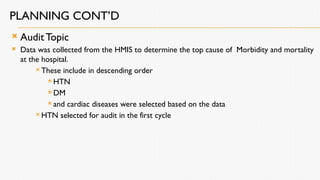
 AuditTopic
 Data was collected from the HMIS to determine the top cause of Morbidity and mortality
at the hospital.
 These include in descending order
 HTN
 DM
 and cardiac diseases were selected based on the data
 HTN selected for audit in the first cycle
PLANNING CONT’D ….
 Audit field work
 Objective of the audit cycle
 Determining major Gaps in HTN care and treatment
 Propose alternative change ideas for the identified gaps
 To plan and execute QI plan
 Retrospective Chart audit and client interview were selected as a methodology for the
audit
 Action plan was developed
PLANNING CONT’D ….
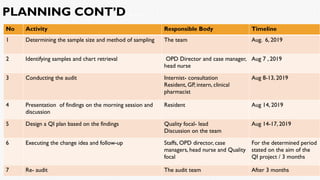
No Activity Responsible Body Timeline
1 Determining the sample size and method of sampling The team Aug. 6, 2019
2 Identifying samples and chart retrieval OPD Director and case manager,
head nurse
Aug 7 , 2019
3 Conducting the audit Internist- consultation
Resident, GP, intern, clinical
pharmacist
Aug 8-13, 2019
4 Presentation of findings on the morning session and
discussion
Resident Aug 14, 2019
5 Design a QI plan based on the findings Quality focal- lead
Discussion on the team
Aug 14-17, 2019
6 Executing the change idea and follow-up Staffs, OPD director, case
managers, head nurse and Quality
focal
For the determined period
stated on the aim of the
QI project / 3 months
7 Re- audit The audit team After 3 months
STAGE 2. STANDARD & CRITERIA SELECTION
The team decided to utilize the standards
stated on the HSTQ
NCD standards
Standard 1 to 6
STAGE-3: MEASURING PERFORMANCES
 Data collection
Data source :- patient chart, client interview
Method :- retrospective chart review , prospective client interview
Sample selection :- Systematic random sampling was used to select
patient record number from the Appointment log book
Sample size
19 charts were selected
Data collection tool
Checklist stated on the HSTQ was utilized to collect data
STAGE-3: MEASURING PERFORMANCES CONT’D……
Data Analysis :- Excel was used for the data entry
Standard Checklist Weight MRN 1 MRN 2 ---19 Average
score
NCD6.1The health
facility has a
hypertension
management protocol
and maintains
competency of HCWs
The health facility has written, up-to-date,
clinical protocols for management of
hypertension (can be endorsed/customized
National STG)
1
Health-care staff in the facility receive in-
service training or regular refresher sessions
1
NCD6.3 Diagnosis of
Hypertension is made
based on standard
criteria and all evidences
are documented in
legible handwriting
Diagnosis is based on repeated BP
measurements
10
stage of HTN and Cardiovascular risk
stratification is documented
(See annexed HTN classification and Risk
Stratification criteria.)
10
On entry into care a newly diagnosed patient
with hypertension should be assessed using
relevant history, focused physical exam
10
STAGE-3: MEASURING PERFORMANCES CONT’D……
NCD6.1
hypertension
management
protocol
a
NCD6.2
routinely
screened
NCD6.3
Diagnosis
of
Hypertension
NCD6.4
Evidence
based
management
plan
and
follow
up
scheme
is
outlined
for
all
hypertensive
patients
NCD6.5
controlled
BP
52.60%
57.89%
89.00%
26.30%
42.00%
HTN management
STAGE-3: MEASURING PERFORMANCES CONT’D……
 Drawing Conclusion
 Major gaps identified during the audit were
 Lack of standardized protocol
 poor control of HTN
 Underperformance screening of NCD complication
 Thorough evaluation and documentation of patient Hx
 appointment and patient tracing mechanism
 Health education is not regularly given
 Interruption of basic Ix modalities
 Report Writing and Presenting Results
 Results were presented on the morning session
STAGE 4. LINKING CLINICAL AUDIT FINDINGS WITH
QUALITY IMPROVEMENT
Title: Improving HTN control in St. Peter Specialized
Hospital
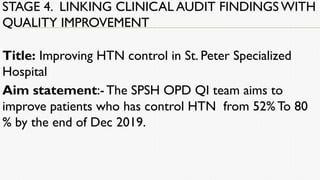
Aim statement:- The SPSH OPD QI team aims to
improve patients who has control HTN from 52% To 80
% by the end of Dec 2019.
To improve
patients who has
control HTN from
52% to 80 %
People
System/process
Supplies
Poor engagement of senior
physicians
Knowledge and skill gap
Infrastructure
Introducing EMR system in the
chronic clinic
Lack of adequate clinics
for chronic follow-up
Patient appointment was
not well documented an
d tracing
Poor recording keeping
-Regular trainings and awareness
creation
Some Equipment’s, drugs
and supplies not available
Interruption of Ix
Introducing scope based practice
Task shifting to cluster health
centers
Implementing PPP
Implementing the IPLS
Managing appointment system
electronically
Treatment guideline not
readily available
Starting patient tracing
Preparing locally developed
treatment guideline for common
disease
Lack of regular health
education for patients
Implementing regular H/E
program with scheduling
Conducting a regular re-audits
and feedback for chronic clinic
Clinical audits are not
regularly done for
learning
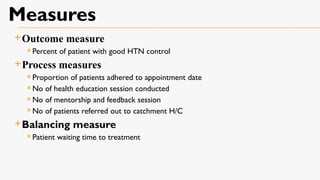
Measures
Outcome measure
 Percent of patient with good HTN control
Process measures
 Proportion of patients adhered to appointment date
 No of health education session conducted
 No of mentorship and feedback session
 No of patients referred out to catchment H/C
Balancing measure
 Patient waiting time to treatment
No Plan Responsible Body Timeline Remark
1 Orienting the QIT QI focal personnel Every month
2 Hold discussions internist to
have a standard protocol
QI focal personnel End of
meskerem
3 Avail monitoring and
screening equipment’s at st
peter
tikimit
4. Hold mettings with cluster
health centrs
QI focal personnel Every month
5. Start a linkage system with
health center with monitoring
schedule
QI focal person Every month
THANK YOU

Sample Clinical audit Stages example.pptx

  • 1.
  • 2.
    STAGE 1. PLANNING Identifying stakeholder  Stake holders for this audit  OPD Director  OPD case manager  Internist  Chief resident  GP  head nurse  Clinical pharmacist  Quality focal  Team was established from the above mentioned disciplines and leadership
  • 3.
    PLANNING CONT’D …. AuditTopic  Data was collected from the HMIS to determine the top cause of Morbidity and mortality at the hospital.  These include in descending order  HTN  DM  and cardiac diseases were selected based on the data  HTN selected for audit in the first cycle
  • 4.
    PLANNING CONT’D …. Audit field work  Objective of the audit cycle  Determining major Gaps in HTN care and treatment  Propose alternative change ideas for the identified gaps  To plan and execute QI plan  Retrospective Chart audit and client interview were selected as a methodology for the audit  Action plan was developed
  • 5.
    PLANNING CONT’D …. NoActivity Responsible Body Timeline 1 Determining the sample size and method of sampling The team Aug. 6, 2019 2 Identifying samples and chart retrieval OPD Director and case manager, head nurse Aug 7 , 2019 3 Conducting the audit Internist- consultation Resident, GP, intern, clinical pharmacist Aug 8-13, 2019 4 Presentation of findings on the morning session and discussion Resident Aug 14, 2019 5 Design a QI plan based on the findings Quality focal- lead Discussion on the team Aug 14-17, 2019 6 Executing the change idea and follow-up Staffs, OPD director, case managers, head nurse and Quality focal For the determined period stated on the aim of the QI project / 3 months 7 Re- audit The audit team After 3 months
  • 6.
    STAGE 2. STANDARD& CRITERIA SELECTION The team decided to utilize the standards stated on the HSTQ NCD standards Standard 1 to 6
  • 7.
    STAGE-3: MEASURING PERFORMANCES Data collection Data source :- patient chart, client interview Method :- retrospective chart review , prospective client interview Sample selection :- Systematic random sampling was used to select patient record number from the Appointment log book Sample size 19 charts were selected Data collection tool Checklist stated on the HSTQ was utilized to collect data
  • 8.
    STAGE-3: MEASURING PERFORMANCESCONT’D…… Data Analysis :- Excel was used for the data entry Standard Checklist Weight MRN 1 MRN 2 ---19 Average score NCD6.1The health facility has a hypertension management protocol and maintains competency of HCWs The health facility has written, up-to-date, clinical protocols for management of hypertension (can be endorsed/customized National STG) 1 Health-care staff in the facility receive in- service training or regular refresher sessions 1 NCD6.3 Diagnosis of Hypertension is made based on standard criteria and all evidences are documented in legible handwriting Diagnosis is based on repeated BP measurements 10 stage of HTN and Cardiovascular risk stratification is documented (See annexed HTN classification and Risk Stratification criteria.) 10 On entry into care a newly diagnosed patient with hypertension should be assessed using relevant history, focused physical exam 10
  • 9.
    STAGE-3: MEASURING PERFORMANCESCONT’D…… NCD6.1 hypertension management protocol a NCD6.2 routinely screened NCD6.3 Diagnosis of Hypertension NCD6.4 Evidence based management plan and follow up scheme is outlined for all hypertensive patients NCD6.5 controlled BP 52.60% 57.89% 89.00% 26.30% 42.00% HTN management
  • 10.
    STAGE-3: MEASURING PERFORMANCESCONT’D……  Drawing Conclusion  Major gaps identified during the audit were  Lack of standardized protocol  poor control of HTN  Underperformance screening of NCD complication  Thorough evaluation and documentation of patient Hx  appointment and patient tracing mechanism  Health education is not regularly given  Interruption of basic Ix modalities  Report Writing and Presenting Results  Results were presented on the morning session
  • 11.
    STAGE 4. LINKINGCLINICAL AUDIT FINDINGS WITH QUALITY IMPROVEMENT Title: Improving HTN control in St. Peter Specialized Hospital Aim statement:- The SPSH OPD QI team aims to improve patients who has control HTN from 52% To 80 % by the end of Dec 2019.
  • 12.
    To improve patients whohas control HTN from 52% to 80 % People System/process Supplies Poor engagement of senior physicians Knowledge and skill gap Infrastructure Introducing EMR system in the chronic clinic Lack of adequate clinics for chronic follow-up Patient appointment was not well documented an d tracing Poor recording keeping -Regular trainings and awareness creation Some Equipment’s, drugs and supplies not available Interruption of Ix Introducing scope based practice Task shifting to cluster health centers Implementing PPP Implementing the IPLS Managing appointment system electronically Treatment guideline not readily available Starting patient tracing Preparing locally developed treatment guideline for common disease Lack of regular health education for patients Implementing regular H/E program with scheduling Conducting a regular re-audits and feedback for chronic clinic Clinical audits are not regularly done for learning
  • 13.
    Measures Outcome measure  Percentof patient with good HTN control Process measures  Proportion of patients adhered to appointment date  No of health education session conducted  No of mentorship and feedback session  No of patients referred out to catchment H/C Balancing measure  Patient waiting time to treatment
  • 14.
    No Plan ResponsibleBody Timeline Remark 1 Orienting the QIT QI focal personnel Every month 2 Hold discussions internist to have a standard protocol QI focal personnel End of meskerem 3 Avail monitoring and screening equipment’s at st peter tikimit 4. Hold mettings with cluster health centrs QI focal personnel Every month 5. Start a linkage system with health center with monitoring schedule QI focal person Every month
  • 15.