By : Dr. Sonali Paradhi Mhatre
Immunization
Pediatric
Basics
 Immunity – The ability of the body to recognize indigenous bo
dy material as ‘SELF’ and foreign material as ‘Non-self’ and to
eliminate the foreign material to protect the body.
 Antigen – It is a live (virus / bacteria) or inactivated substance
(protein / polysaccharide) capable of producing an immune
response.
 Antibody – These are protein molecules (Immunoglobulin)
which are produced by the B lymphocytes to help eliminate
antigens
©Dr. Sonali Paradhi Mhatre
Immunity
Innate Immunity
(Inherent mechanism to fight foreign
material)
Acquired Immunity
(Immunity evolved by the body on
being exposed to infectious agent or
vaccine or conferred by means of
antibody administration)
Active Immunity
(Actively evolved by stimulation of the
immune system to produce antigen
specific humoral and cellular immunity)
Natural disease
/ infection
induced
Vaccine
induced
Passive Immunity
(Acquired by transfer of antibodies
formed in an animal or human to other
person & includes maternal antibody
transfer across placenta)
©Dr. Sonali Paradhi Mhatre
 It is an antigen derived from bacteria,
viruses, toxins or fraction of the
organism.
 Made in a way that it retains its
antigenicity
 But loses its virulence.
Vaccine
©Dr. Sonali Paradhi Mhatre
Live attenuated
•Produced by modifying
the disease causing ‘wild
virus or bacteria’.
•Usually effective as a
single dose (except oral)
•Long lasting protection.
•Both humoral and cellular
immunity produced.
•Prone to severe or fatal
reactions.
•Eg. MMR, Varicella, Yellow
fever, Oral polio,
Rotaviral, intranasal
influenza.
•Bacterial – BCG, Oral
typhoid.
Inactivated
•Composed of whole
virus/bacteria or fractions
of either.
•Can be protein based
(organism protein or
inactivated bacterial
toxin) OR polysaccharide
based (Pure cell wall
polysaccharide of
bacteria)
•Inactivate vaccines cannot
replicate and generally
require 3-5 doses.
•Less Reactogenic.
•Immunity mostly
humoral, less cellular.
•Eg. Whole cell pertussis,
IPV, Influenza (whole cell),
Hepatitis A.
Recombinant
•Vaccine antigens
produced by genetic
engineering technology.
•Behave like live vaccines.
•Lead to synthesis of
antigen by host cell , in
turn evolving immunity.
•Produce both cellular &
humoral immunity.
•Eg. Hepatitis B
©Dr. Sonali Paradhi Mhatre
Age
►
Vaccine ▼
Birth –
2 wee
ks
6 wk 10 wk 14 wk 18 wk 6 mo 9 mo 12 mo 1
5
m
o
18 mo 19-23 m
o
2-3 Yr 4-6
Yr
7-10Yr 11-12 Yr 13-18Yr
BCG BCG
Hep B Hep B1 Hep B2 Hep B3
Polio OPV 0 IPV1 IPV2 IPV3 OPV1 OPV2 IPV B1 OPV3
DTP DTP 1 DTP 2 DTP 3 DTP B1
DTP
B2
Tdap Tdap
Hib Hib 1 Hib 2 Hib 3 Hib-booster
Pneumococcal PCV 1 PCV 2 PCV 3 PCV -booster PCV
PPSV23 PPSV
Rotavirus RV 1 RV 2 RV 3
MMR MMR 1 MMR 2
MMR
3
Varicella VAR 1
VAR
2
Hep A Hep A1 & Hep A2
Typhoid Typhoid CV (TCV) Booster
Influenza Influenza (yearly)
HPV HPV
Meningococca
l
Meningococcal
Cholera Cholera 1 & 2
JE Japanese Encephalitis
Rabies Rabies (Pre-EP & PEP)
Vaccine Preventable Diseases
TB Diptheria Pertusis Tetanus Polio
Measles Mumps Rubella Rotavirus Varicella
Hepatitis HIB Cholera Typhoid
Pneumococc
us
Meningococ
cus
Rabies
Japaneese
Encephalitis
HPV
©Dr. Sonali Paradhi Mhatre
Vaccine Preventable Diseases
TB Diptheria Pertusis Tetanus Polio
Measles Mumps Rubella Rotavirus Varicella
Hepatitis HIB Cholera Typhoid
Pneumococc
us
Meningococ
cus
Rabies
Japaneese
Encephalitis
HPV
©Dr. Sonali Paradhi Mhatre
 Bacille-Calmette-Guerin vaccine.
 Freeze dried live bovine strain of tubercle bacilli containing 0.1-0.4 million viable
bacilli per dose, rendered avirulent by repeated subculturing.
 Administration : 0.1 ml (0.1mgBCG) intradermal in left upper arm at insertion of
deltoid.
 Precautions – Need to be protected from heat & light and used within 4 - 6 hrs of
reconstitution.
 Efficacy of BCG is controversial. Protective efficacy varies from 0-80%. But still adv
ocated to continue as it prevents disease progress to severe forms.
BCG
©Dr. Sonali Paradhi Mhatre
BCG Scar formation
10-15 days : Small nodule appears at the
site of vaccination.
4 wks – Nodule becomes pustule and
breaks down to form an ulcer.
3 months : ulcer heals and scar remains.
©Dr. Sonali Paradhi Mhatre
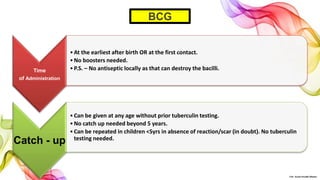
Time
of Administration
•At the earliest after birth OR at the first contact.
•No boosters needed.
•P.S. – No antiseptic locally as that can destroy the bacilli.
Catch - up
•Can be given at any age without prior tuberculin testing.
•No catch up needed beyond 5 years.
•Can be repeated in children <5yrs in absence of reaction/scar (in doubt). No tuberculin
testing needed.
BCG
©Dr. Sonali Paradhi Mhatre
Special
cases
•Should not be administered in severely immunocompromised person.
•Children with cancer or those receiving steroids or other immunosuppressive therapy
can be given BCG in remission phase or off chemo/radio for atleast 90 days.
•Contraindicated in severe primary immune deficiencies.
•Contraindicated in chronic granulomatous disease, leucocyte adhesion defect.
•Can be safely administered in preterm / LBW babies after stabilization and preferably
before discharge.
•BCG can be safely administered in newborns of kochs positive mother.
BCG
©Dr. Sonali Paradhi Mhatre
Diptheria
• Toxoid form.
• Toxoid is 3-4 times in
pediatric preparation than
in adult formulations.
Pertusis
• Whole cell (wP)
• Acellular (aP)
Tetanus
• Toxoid form.
• TT / Combination
vaccine.
DPT
©Dr. Sonali Paradhi Mhatre
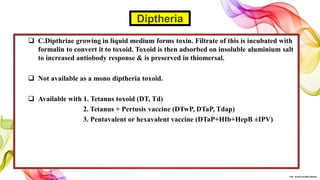
 C.Dipthriae growing in liquid medium forms toxin. Filtrate of this is incubated with
formalin to convert it to toxoid. Toxoid is then adsorbed on insoluble aluminium salt
to increased antiobody response & is preserved in thiomersal.
 Not available as a mono diptheria toxoid.
 Available with 1. Tetanus toxoid (DT, Td)
2. Tetanus + Pertusis vaccine (DTwP, DTaP, Tdap)
3. Pentavalent or hexavalent vaccine (DTaP+HIb+HepB ±IPV)
Diptheria
©Dr. Sonali Paradhi Mhatre
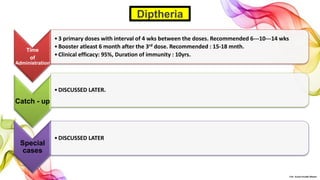
Time
of
Administration
•3 primary doses with interval of 4 wks between the doses. Recommended 6---10---14 wks
•Booster atleast 6 month after the 3rd dose. Recommended : 15-18 mnth.
•Clinical efficacy: 95%, Duration of immunity : 10yrs.
Catch - up
•DISCUSSED LATER.
Special
cases
•DISCUSSED LATER
Diptheria
©Dr. Sonali Paradhi Mhatre
 Vaccine consists of organism or cellular components which act as antigens.
 Available in 2 forms:
 IAP endorses the use of wP vaccine in EPI due to its proven efficacy and safety.
 Practically : wP vaccine for primary dose (unless strong indications for aP) & booster can be aP as p
er the affordability.
Pertusis
Whole cell pertussis vaccine (wP)
• Composed of formalin inactivated B.
pertussis cells from 20000million
killed bacteria.
• 70-90% effective in preventing
serious disease.
• Serious side effects like prolonged
crying, seizures, hypotonia,
hyporesponsiveness,
encephalopathy.
• Therefore, acellular vaccine was
developed.
Acellular Pertusis vaccine (aP)
• Sub unit vaccines that contain
purified inactivated components of B.
Pertusis
• Was developed as a safer substitute
to wP.
• Contains a combination of 5
components – pertussis toxin(PT),
filamentous hemagglutinin (FHA),
pertactin and fimbriae types 2&3.
• Incidence of all major and minor
adverse effects are reduced by 2/3
with acellular vaccine.
 No pertussis vaccine available as a single antigen vaccine.
 Combinations available are –DPT, DaPT, Tdap (Tdap is for adolescents and adults w
here the dose of pertussis toxin and diptheria toxoid is reduced)
 Precautions/ Relative contraindications :
1. Seizures within 3 days
2. Persistent & inconsolable crying >3hrs within 48 hrs of vaccine administration.
3. HHE within 48 hrs.
4. Temperature >104F and progressive neurological disorder.
 The contraindications and precautions are same for aP & wP.
 But aP can be preferred over wP in children with history of adverse effects to wP or with neur
ologic deficit (if resources permit).
Pertusis
©Dr. Sonali Paradhi Mhatre
Time
of
Administration
•3 doses 0.5ml given IM at 4-8 wks interval (min 4 wks) beginning at 6-8wks of age.
•Next dose: Booster1 should be given not before 6 months of the 3rd dose. Recommended at 15-
18 mths.
•Second booster to be given at 4-5yrs.
Catch - up
•Till 7 yrs of age.
•Duration of immunity is short lasting and wanes off in 5-10 yrs. Therefore boosters can be given
>7 yrs also.
•DISCUSSED LATER.
Special
cases
•DISCUSSED LATER
Pertusis
©Dr. Sonali Paradhi Mhatre
Tetanus toxoid containing vaccine.
Available as a single antigen toxoid vaccine (TT) or in combination with Diptheria ± pertussis
(DPT,DT,Td,Tdap, Pentavalent, hexavalent vaccines)
Strength of toxoid is 40IU inTT / more than 40 IU in Tdap or Td.
Tetanus toxoid needs to be given before birth, continued during infancy and sustained by rein
forcing doses in older individuals every 10 years.
Administration: 0.5ml IM of vaccine or combination vaccine.
Adverse effects: erythema,pain, Arthus like reactions, Rare: anaphylaxis, GBS, Brachial neur
itis.
Tetanus
©Dr. Sonali Paradhi Mhatre
Time
of
Administration
•Primary: <7 yrs :4 doses & >7yrs 3 doses (minimum 4 wk interval between 1,2,3 doses) and 6
mnth interval between 3rd dose and booster.
•2nd booster at 4-6 yrs for those who have received first booster before 4 yrs age.
•Efficacy 100% & duration of protection :10yrs.
Catch - up
•Discussed Later.
Special
cases
•Previously unimmunized women should receive 2 doses of TT or Td during first pregnancy
1 month apart, with final dose atleast 2 wks before delivery.
•In subsequent pregnancies, a single dose is needed for each pregnancy. (Max 5 doses)
Tetanus
©Dr. Sonali Paradhi Mhatre
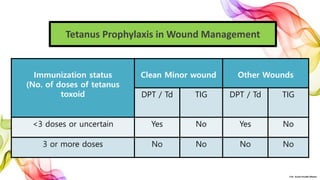
Tetanus Prophylaxis in Wound Management
Immunization status
(No. of doses of tetanus
toxoid
Clean Minor wound Other Wounds
DPT / Td TIG DPT / Td TIG
<3 doses or uncertain Yes No Yes No
3 or more doses No No No No
©Dr. Sonali Paradhi Mhatre
<12months
• For lapsed vaccination, If the child was <12mnths at the first dose, he/she should
receive a total of 3 primary doses.
• 1st booster after 6 months of the 3rd dose.
>12 months
• If the child was >12month at the first dose of DTaP/DTwP, 3 doses separated by atleast 4 wks as a primary series and 1st
booster 6 month after DPT3 is given.
Booster
schedule
• If the 1st booster given before 4 yrs of age, a 2nd booster needed at 4-6 yrs age.
• If 1st booster given after 4 yrs, no 2nd booster needed.
Unvaccinate
d >7 yrs
• >7yrs and unvaccinated , a primary series is 3 doses. – 1st and 2nd dose at 4 wks apart & 3rd dose given at 6-12 months
after the 2nd.
• Tdap/ Td recommended above 7 yrs.
Boosters
• A booster dose of Tdap or Td recommended every 10 yrs.
Diptheria – Pertusis - Tetanus catch up
©Dr. Sonali Paradhi Mhatre
Special
cases
•No contraindication in Immunocompromised patients. (But the response may be
suboptimal)
•Vaccine doses in Preterm and Low birth weight babies are same as those given to
fullterms and should receive DPT at the same chronological age, irrespective of the
birth weight or gestation.
•Exception: Child with progressive CNS disorder. Vaccination with DTaP should be
deferred till the child’s neurologic status has been clarified and is stable.
DPT
©Dr. Sonali Paradhi Mhatre
Currently available vaccine is the RECOMBINANT VACCINE derived from yeast and
adjuvanted with aluminium salts.
Both thiomersal preserved and thiomersal free vaccines are available.
Needs to be stored at 2-8°C.
Dose: In children & adolescent <18yrs – 0.5ml/10mcg IM
Adults >18yrs -1ml/20mcg IM
Seroconversion rates are 90% after a 3 dose schedule.
Seroconversion rates being lower in elderly, immunocompromised and those with renal
failure – 4 dose schedule with 0,1,2,12 months can be given.
Hepatitis B
©Dr. Sonali Paradhi Mhatre
Time
of Administration
•3 doses recommended. Classical schedule is 0,1,6 months.
•Monovalent Hep B recommended for all newborns within 48hrs of birth.
•4 vaccine administration is permissible when a combination vaccine is administered after
birth dose.
•IAP recommends – Birth ---- 6 wks ---- 6months.
•Other options are : 1. Birth—1-6 months. 2. birth—6—14wks 3. birth—6—10—14 wks, etc.
•Routine boosters not needed. Boosters may be needed in immunocompromised children
or whenever HBsAg level drops below protective levels.
Catch - up
•Infants who have not received the birth dose should be started on the 3 dose schedule (at
the earliest) with minimum duration between 1 & 2 nd dose being 4 weeks and the
duration between 2nd and 3rd dose being 8 weeks.
•Ideally , the final dose (3rd/4th ) of hep B vaccine should be administered not earlier than 24
wks.
•For unimmunized, catch up is administered as a 0—1—6 month schedule
Hepatitis B
©Dr. Sonali Paradhi Mhatre
Special
cases
•Not contraindications in immunodeficiency, but efficacy may be reduced. (Boostsers
need to be planned as per Hep B titres)
•Preterms & LBW – Birth wt<2kg : may require modifications of timing of first vaccine.
However, at 1 month chronological age ,the efficacy is equivalent.
•If mother is HBsAg positive (and esp if HBeAg positive), baby should receive Hepatitis B
immunoglobulin with HepB vaccine within 12 hrs of birth (using 2 separate syringes at
2 different sites). Dose of HBiG = 0.5ml IM. Can be given till 7 days after birth, but
efficacy unknown.
•Hep B vaccine should be offered routinely to all healthcare workers, safety workers,
laboratory workers, lab technicians and other allied health professionals. Schedule is
0---1----6 mnths.
Hepatitis B
©Dr. Sonali Paradhi Mhatre
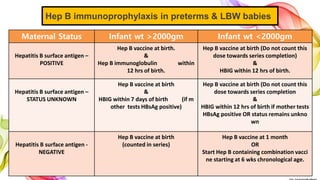
Hep B immunoprophylaxis in preterms & LBW babies
Maternal Status Infant wt >2000gm Infant wt <2000gm
Hepatitis B surface antigen –
POSITIVE
Hep B vaccine at birth.
&
Hep B immunoglobulin within
12 hrs of birth.
Hep B vaccine at birth (Do not count this
dose towards series completion)
&
HBIG within 12 hrs of birth.
Hepatitis B surface antigen –
STATUS UNKNOWN
Hep B vaccine at birth
&
HBIG within 7 days of birth (if m
other tests HBsAg positive)
Hep B vaccine at birth (Do not count this
dose towards series completion
&
HBIG within 12 hrs of birth if mother tests
HBsAg positive OR status remains unkno
wn
Hepatitis B surface antigen -
NEGATIVE
Hep B vaccine at birth
(counted in series)
Hep B vaccine at 1 month
OR
Start Hep B containing combination vacci
ne starting at 6 wks chronological age.
 Live attenuated vaccine which is safe, effective and reasonably inexpensive.
 Derived from Edmonston – Zagreb strain grown on human diploid cells or purified
chick embryo cells.
 Each dose contains atleast 1000 infective unit and has no preservatives.
 Available as a freeze dried vaccine in a single dose or multidose vial with distilled water
as diluent.
 Reconstituted vaccine to be kept in 2 – 8° C and used within 4-6 hrs.
 Seroconversion rates are 60% at 6 month, 80-85% at 9 months, beyond 98% at 12-15mo
nths.
Measles
 Administration : 0.5ml SC / IM over upper arm or anterolateral thigh.
 Adverse reactions : local pain and tenderness, mild measle like illness 7-12 days after va
ccination, contraindicated in pregnancy.
 IAP Recommendations:
1. 1st dose at completed 9 months age.
2. 2nd dose at 15-18 months.
 Current guidelines advocate MMR vaccine instead of standalone measles vaccine.
Measles
Mumps vaccine virus strain include Leningrad-Zagreb, Leningrad-3, Jeryl Lynn, RIT 4
385 or Urabe AM9 strains and are grown in chick embryo / human diploid cell cultures.
Seroconversion rates against Mumps are >90% but clinical efficacy and long term prote
ction with a single dose is 60-90%.
Atleast 2 doses are recommended.
Administration: As MMR Vaccine 0.5 ml given SC.
Adverse reactions: Transient parotitis, Rare: Aseptic meningitis 2-3 wks after
vaccination.
Mumps
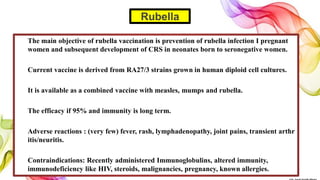
The main objective of rubella vaccination is prevention of rubella infection I pregnant
women and subsequent development of CRS in neonates born to seronegative women.
Current vaccine is derived from RA27/3 strains grown in human diploid cell cultures.
It is available as a combined vaccine with measles, mumps and rubella.
The efficacy if 95% and immunity is long term.
Adverse reactions : (very few) fever, rash, lymphadenopathy, joint pains, transient arthr
itis/neuritis.
Contraindications: Recently administered Immunoglobulins, altered immunity,
immunodeficiency like HIV, steroids, malignancies, pregnancy, known allergies.
Rubella
Time
of
Administration
•1st dose at 9 months completed age. (Currently recommended is MMR instead of Measles
vaccine).
•Additional MMR to be given in the 2nd year of life.
•However, it can be given at anytime 4-8 wks after the first dose.
Catch - up
•Vaccine can be given irrespective of prior history of measles.
•Catchup vaccine beyond 12 months should also be MMR.
•Catchup can be done till any age with 2 doses of MMR, 4 wks apart.
•If previously vaccinated with 1 dose, give only 1 dose.
Special
cases
•Measles vaccine can be administered to infants aged 6-11 months during outbreaks.
These kids should be revaccinated with 2 doses of measles containing vaccine, the first at
age 12 months and atleast 4 wks after the previous dose, and 2nd at ages 4-6 yrs.
MMR
©Dr. Sonali Paradhi Mhatre
Special
cases
•Contraindicated in severely immunocompromised patients.
•Child with cancer can be given vaccine only in remission phase and 90 days post
chemo/radio. If on Rituximab , 180 days post the dose.
•Steroids: Can be administered in previously healthy children receiving low to moderate
dose steroids (<2mkd prednisolone with ceiling dose of 20mg or equivalent & <14 days)
, child receiving alternate day steroid, topical or inhaled steroids.
•With high dose steroids, a minimum gap of >2 wks is needed before vaccine
administration.
•Can be safely given in household contacts of immunocompromised kids as this is non
transmissible.
MMR
©Dr. Sonali Paradhi Mhatre
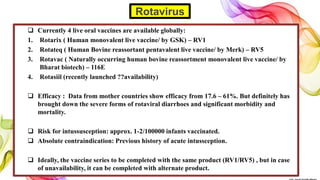
 Currently 4 live oral vaccines are available globally:
1. Rotarix ( Human monovalent live vaccine/ by GSK) – RV1
2. Rotateq ( Human Bovine reassortant pentavalent live vaccine/ by Merk) – RV5
3. Rotavac ( Naturally occurring human bovine reassortment monovalent live vaccine/ by
Bharat biotech) – 116E
4. Rotasiil (recently launched ??availability)
 Efficacy : Data from mother countries show efficacy from 17.6 – 61%. But definitely has
brought down the severe forms of rotaviral diarrhoes and significant morbidity and
mortality.
 Risk for intussusception: approx. 1-2/100000 infants vaccinated.
 Absolute contraindication: Previous history of acute intussception.
 Ideally, the vaccine series to be completed with the same product (RV1/RV5) , but in case
of unavailability, it can be completed with alternate product.
Rotavirus
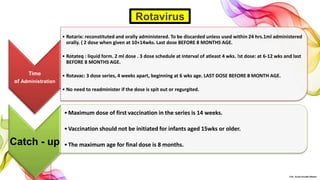
Time
of Administration
• Rotarix: reconstituted and orally administered. To be discarded unless used within 24 hrs.1ml administered
orally. ( 2 dose when given at 10+14wks. Last dose BEFORE 8 MONTHS AGE.
• Rotateq : liquid form. 2 ml dose . 3 dose schedule at interval of atleast 4 wks. !st dose: at 6-12 wks and last
BEFORE 8 MONTHS AGE.
• Rotavac: 3 dose series, 4 weeks apart, beginning at 6 wks age. LAST DOSE BEFORE 8 MONTH AGE.
• No need to readminister if the dose is spit out or regurgited.
Catch - up
•Maximum dose of first vaccination in the series is 14 weeks.
•Vaccination should not be initiated for infants aged 15wks or older.
•The maximum age for final dose is 8 months.
Rotavirus
©Dr. Sonali Paradhi Mhatre
Special
cases
•Still insufficient data on safety and efficacy of rotavirus vaccine in
Immunocompromised children.
•To be avoided for 6 weeks after any antibody containing product.
•Can be given during minor illnesses. (Preferable to hold during diarrhoeas, as
absorption may be affected).
•Can be administered in preterms who are clinically stable at 6 weeks of age , as they
are more susceptible to rotavirus gastroenteritis.
Rotavirus
©Dr. Sonali Paradhi Mhatre
Varicella vaccine is a live attenuated lyophilized vaccine derived from OKA strain.
Administration: 0.5ml SC
Vaccine is 85-90% effective following a single dose. 2nd dose : 3mnths/4-6yrs apart impr
oves seroconversion to 99%.
Breakthrough infections have been reported in 1-4% of immunized people.
Breakthrough – infections that occur >42 days of vaccine (2-5yrs). Commonly seen if va
ccine given <15mnths age, within 28 days of MMR (but not on same day), child on stero
ids or given late in adolescence or adults.
Adverse reactions: local soreness, swelling, mild rash, immunodeficiency, pregnancy.
Varicella
Time
of
Administration
•2 doses: first >15months, 2nd dose at 4-6 yrs.
Catch - up
•Children <13 yrs: Should receive 2 doses, 3 month apart.
•Children >13 yrs : Should receive 2 doses at an interval of 4-8 wks.
Special
cases
• Post exposure prophylaxis: Varicella vaccine can be given within 72 hr of exposure can prevent or
modify disease.
• When given within 36 hrs of exposure, it is known to be 92.5% effective in preventing the disease.
• DISCUSSED LATER.
Varicella
©Dr. Sonali Paradhi Mhatre
Special
cases
•Contraindicated in severely immunocompromised patients.
•Child with cancer can be given vaccine only in remission phase or 90 days post
chemo/radio.
•Steroids: Can be administered in previously healthy children receiving low to moderate
dose steroids (<2mkd prednisolone or equivalent & <14 days) , child receiving alternate
day steroid, topical or inhaled steroids.
•With high dose steroids, a minimum gap of >2 wks is needed before vaccine
administration.
•Can be safely given in household contacts of immunocompromised kids as this is non
transmissible.
Varicella
©Dr. Sonali Paradhi Mhatre

Pediatric immunization (Part 1/4)

  • 1.
    By : Dr.Sonali Paradhi Mhatre Immunization Pediatric
  • 2.
    Basics  Immunity –The ability of the body to recognize indigenous bo dy material as ‘SELF’ and foreign material as ‘Non-self’ and to eliminate the foreign material to protect the body.  Antigen – It is a live (virus / bacteria) or inactivated substance (protein / polysaccharide) capable of producing an immune response.  Antibody – These are protein molecules (Immunoglobulin) which are produced by the B lymphocytes to help eliminate antigens ©Dr. Sonali Paradhi Mhatre
  • 3.
    Immunity Innate Immunity (Inherent mechanismto fight foreign material) Acquired Immunity (Immunity evolved by the body on being exposed to infectious agent or vaccine or conferred by means of antibody administration) Active Immunity (Actively evolved by stimulation of the immune system to produce antigen specific humoral and cellular immunity) Natural disease / infection induced Vaccine induced Passive Immunity (Acquired by transfer of antibodies formed in an animal or human to other person & includes maternal antibody transfer across placenta) ©Dr. Sonali Paradhi Mhatre
  • 4.
     It isan antigen derived from bacteria, viruses, toxins or fraction of the organism.  Made in a way that it retains its antigenicity  But loses its virulence. Vaccine ©Dr. Sonali Paradhi Mhatre
  • 5.
    Live attenuated •Produced bymodifying the disease causing ‘wild virus or bacteria’. •Usually effective as a single dose (except oral) •Long lasting protection. •Both humoral and cellular immunity produced. •Prone to severe or fatal reactions. •Eg. MMR, Varicella, Yellow fever, Oral polio, Rotaviral, intranasal influenza. •Bacterial – BCG, Oral typhoid. Inactivated •Composed of whole virus/bacteria or fractions of either. •Can be protein based (organism protein or inactivated bacterial toxin) OR polysaccharide based (Pure cell wall polysaccharide of bacteria) •Inactivate vaccines cannot replicate and generally require 3-5 doses. •Less Reactogenic. •Immunity mostly humoral, less cellular. •Eg. Whole cell pertussis, IPV, Influenza (whole cell), Hepatitis A. Recombinant •Vaccine antigens produced by genetic engineering technology. •Behave like live vaccines. •Lead to synthesis of antigen by host cell , in turn evolving immunity. •Produce both cellular & humoral immunity. •Eg. Hepatitis B ©Dr. Sonali Paradhi Mhatre
  • 6.
    Age ► Vaccine ▼ Birth – 2wee ks 6 wk 10 wk 14 wk 18 wk 6 mo 9 mo 12 mo 1 5 m o 18 mo 19-23 m o 2-3 Yr 4-6 Yr 7-10Yr 11-12 Yr 13-18Yr BCG BCG Hep B Hep B1 Hep B2 Hep B3 Polio OPV 0 IPV1 IPV2 IPV3 OPV1 OPV2 IPV B1 OPV3 DTP DTP 1 DTP 2 DTP 3 DTP B1 DTP B2 Tdap Tdap Hib Hib 1 Hib 2 Hib 3 Hib-booster Pneumococcal PCV 1 PCV 2 PCV 3 PCV -booster PCV PPSV23 PPSV Rotavirus RV 1 RV 2 RV 3 MMR MMR 1 MMR 2 MMR 3 Varicella VAR 1 VAR 2 Hep A Hep A1 & Hep A2 Typhoid Typhoid CV (TCV) Booster Influenza Influenza (yearly) HPV HPV Meningococca l Meningococcal Cholera Cholera 1 & 2 JE Japanese Encephalitis Rabies Rabies (Pre-EP & PEP)
  • 7.
    Vaccine Preventable Diseases TBDiptheria Pertusis Tetanus Polio Measles Mumps Rubella Rotavirus Varicella Hepatitis HIB Cholera Typhoid Pneumococc us Meningococ cus Rabies Japaneese Encephalitis HPV ©Dr. Sonali Paradhi Mhatre
  • 8.
    Vaccine Preventable Diseases TBDiptheria Pertusis Tetanus Polio Measles Mumps Rubella Rotavirus Varicella Hepatitis HIB Cholera Typhoid Pneumococc us Meningococ cus Rabies Japaneese Encephalitis HPV ©Dr. Sonali Paradhi Mhatre
  • 9.
     Bacille-Calmette-Guerin vaccine. Freeze dried live bovine strain of tubercle bacilli containing 0.1-0.4 million viable bacilli per dose, rendered avirulent by repeated subculturing.  Administration : 0.1 ml (0.1mgBCG) intradermal in left upper arm at insertion of deltoid.  Precautions – Need to be protected from heat & light and used within 4 - 6 hrs of reconstitution.  Efficacy of BCG is controversial. Protective efficacy varies from 0-80%. But still adv ocated to continue as it prevents disease progress to severe forms. BCG ©Dr. Sonali Paradhi Mhatre
  • 10.
    BCG Scar formation 10-15days : Small nodule appears at the site of vaccination. 4 wks – Nodule becomes pustule and breaks down to form an ulcer. 3 months : ulcer heals and scar remains. ©Dr. Sonali Paradhi Mhatre
  • 11.
    Time of Administration •At theearliest after birth OR at the first contact. •No boosters needed. •P.S. – No antiseptic locally as that can destroy the bacilli. Catch - up •Can be given at any age without prior tuberculin testing. •No catch up needed beyond 5 years. •Can be repeated in children <5yrs in absence of reaction/scar (in doubt). No tuberculin testing needed. BCG ©Dr. Sonali Paradhi Mhatre
  • 12.
    Special cases •Should not beadministered in severely immunocompromised person. •Children with cancer or those receiving steroids or other immunosuppressive therapy can be given BCG in remission phase or off chemo/radio for atleast 90 days. •Contraindicated in severe primary immune deficiencies. •Contraindicated in chronic granulomatous disease, leucocyte adhesion defect. •Can be safely administered in preterm / LBW babies after stabilization and preferably before discharge. •BCG can be safely administered in newborns of kochs positive mother. BCG ©Dr. Sonali Paradhi Mhatre
  • 13.
    Diptheria • Toxoid form. •Toxoid is 3-4 times in pediatric preparation than in adult formulations. Pertusis • Whole cell (wP) • Acellular (aP) Tetanus • Toxoid form. • TT / Combination vaccine. DPT ©Dr. Sonali Paradhi Mhatre
  • 14.
     C.Dipthriae growingin liquid medium forms toxin. Filtrate of this is incubated with formalin to convert it to toxoid. Toxoid is then adsorbed on insoluble aluminium salt to increased antiobody response & is preserved in thiomersal.  Not available as a mono diptheria toxoid.  Available with 1. Tetanus toxoid (DT, Td) 2. Tetanus + Pertusis vaccine (DTwP, DTaP, Tdap) 3. Pentavalent or hexavalent vaccine (DTaP+HIb+HepB ±IPV) Diptheria ©Dr. Sonali Paradhi Mhatre
  • 15.
    Time of Administration •3 primary doseswith interval of 4 wks between the doses. Recommended 6---10---14 wks •Booster atleast 6 month after the 3rd dose. Recommended : 15-18 mnth. •Clinical efficacy: 95%, Duration of immunity : 10yrs. Catch - up •DISCUSSED LATER. Special cases •DISCUSSED LATER Diptheria ©Dr. Sonali Paradhi Mhatre
  • 16.
     Vaccine consistsof organism or cellular components which act as antigens.  Available in 2 forms:  IAP endorses the use of wP vaccine in EPI due to its proven efficacy and safety.  Practically : wP vaccine for primary dose (unless strong indications for aP) & booster can be aP as p er the affordability. Pertusis Whole cell pertussis vaccine (wP) • Composed of formalin inactivated B. pertussis cells from 20000million killed bacteria. • 70-90% effective in preventing serious disease. • Serious side effects like prolonged crying, seizures, hypotonia, hyporesponsiveness, encephalopathy. • Therefore, acellular vaccine was developed. Acellular Pertusis vaccine (aP) • Sub unit vaccines that contain purified inactivated components of B. Pertusis • Was developed as a safer substitute to wP. • Contains a combination of 5 components – pertussis toxin(PT), filamentous hemagglutinin (FHA), pertactin and fimbriae types 2&3. • Incidence of all major and minor adverse effects are reduced by 2/3 with acellular vaccine.
  • 17.
     No pertussisvaccine available as a single antigen vaccine.  Combinations available are –DPT, DaPT, Tdap (Tdap is for adolescents and adults w here the dose of pertussis toxin and diptheria toxoid is reduced)  Precautions/ Relative contraindications : 1. Seizures within 3 days 2. Persistent & inconsolable crying >3hrs within 48 hrs of vaccine administration. 3. HHE within 48 hrs. 4. Temperature >104F and progressive neurological disorder.  The contraindications and precautions are same for aP & wP.  But aP can be preferred over wP in children with history of adverse effects to wP or with neur ologic deficit (if resources permit). Pertusis ©Dr. Sonali Paradhi Mhatre
  • 18.
    Time of Administration •3 doses 0.5mlgiven IM at 4-8 wks interval (min 4 wks) beginning at 6-8wks of age. •Next dose: Booster1 should be given not before 6 months of the 3rd dose. Recommended at 15- 18 mths. •Second booster to be given at 4-5yrs. Catch - up •Till 7 yrs of age. •Duration of immunity is short lasting and wanes off in 5-10 yrs. Therefore boosters can be given >7 yrs also. •DISCUSSED LATER. Special cases •DISCUSSED LATER Pertusis ©Dr. Sonali Paradhi Mhatre
  • 19.
    Tetanus toxoid containingvaccine. Available as a single antigen toxoid vaccine (TT) or in combination with Diptheria ± pertussis (DPT,DT,Td,Tdap, Pentavalent, hexavalent vaccines) Strength of toxoid is 40IU inTT / more than 40 IU in Tdap or Td. Tetanus toxoid needs to be given before birth, continued during infancy and sustained by rein forcing doses in older individuals every 10 years. Administration: 0.5ml IM of vaccine or combination vaccine. Adverse effects: erythema,pain, Arthus like reactions, Rare: anaphylaxis, GBS, Brachial neur itis. Tetanus ©Dr. Sonali Paradhi Mhatre
  • 20.
    Time of Administration •Primary: <7 yrs:4 doses & >7yrs 3 doses (minimum 4 wk interval between 1,2,3 doses) and 6 mnth interval between 3rd dose and booster. •2nd booster at 4-6 yrs for those who have received first booster before 4 yrs age. •Efficacy 100% & duration of protection :10yrs. Catch - up •Discussed Later. Special cases •Previously unimmunized women should receive 2 doses of TT or Td during first pregnancy 1 month apart, with final dose atleast 2 wks before delivery. •In subsequent pregnancies, a single dose is needed for each pregnancy. (Max 5 doses) Tetanus ©Dr. Sonali Paradhi Mhatre
  • 21.
    Tetanus Prophylaxis inWound Management Immunization status (No. of doses of tetanus toxoid Clean Minor wound Other Wounds DPT / Td TIG DPT / Td TIG <3 doses or uncertain Yes No Yes No 3 or more doses No No No No ©Dr. Sonali Paradhi Mhatre
  • 22.
    <12months • For lapsedvaccination, If the child was <12mnths at the first dose, he/she should receive a total of 3 primary doses. • 1st booster after 6 months of the 3rd dose. >12 months • If the child was >12month at the first dose of DTaP/DTwP, 3 doses separated by atleast 4 wks as a primary series and 1st booster 6 month after DPT3 is given. Booster schedule • If the 1st booster given before 4 yrs of age, a 2nd booster needed at 4-6 yrs age. • If 1st booster given after 4 yrs, no 2nd booster needed. Unvaccinate d >7 yrs • >7yrs and unvaccinated , a primary series is 3 doses. – 1st and 2nd dose at 4 wks apart & 3rd dose given at 6-12 months after the 2nd. • Tdap/ Td recommended above 7 yrs. Boosters • A booster dose of Tdap or Td recommended every 10 yrs. Diptheria – Pertusis - Tetanus catch up ©Dr. Sonali Paradhi Mhatre
  • 23.
    Special cases •No contraindication inImmunocompromised patients. (But the response may be suboptimal) •Vaccine doses in Preterm and Low birth weight babies are same as those given to fullterms and should receive DPT at the same chronological age, irrespective of the birth weight or gestation. •Exception: Child with progressive CNS disorder. Vaccination with DTaP should be deferred till the child’s neurologic status has been clarified and is stable. DPT ©Dr. Sonali Paradhi Mhatre
  • 24.
    Currently available vaccineis the RECOMBINANT VACCINE derived from yeast and adjuvanted with aluminium salts. Both thiomersal preserved and thiomersal free vaccines are available. Needs to be stored at 2-8°C. Dose: In children & adolescent <18yrs – 0.5ml/10mcg IM Adults >18yrs -1ml/20mcg IM Seroconversion rates are 90% after a 3 dose schedule. Seroconversion rates being lower in elderly, immunocompromised and those with renal failure – 4 dose schedule with 0,1,2,12 months can be given. Hepatitis B ©Dr. Sonali Paradhi Mhatre
  • 25.
    Time of Administration •3 dosesrecommended. Classical schedule is 0,1,6 months. •Monovalent Hep B recommended for all newborns within 48hrs of birth. •4 vaccine administration is permissible when a combination vaccine is administered after birth dose. •IAP recommends – Birth ---- 6 wks ---- 6months. •Other options are : 1. Birth—1-6 months. 2. birth—6—14wks 3. birth—6—10—14 wks, etc. •Routine boosters not needed. Boosters may be needed in immunocompromised children or whenever HBsAg level drops below protective levels. Catch - up •Infants who have not received the birth dose should be started on the 3 dose schedule (at the earliest) with minimum duration between 1 & 2 nd dose being 4 weeks and the duration between 2nd and 3rd dose being 8 weeks. •Ideally , the final dose (3rd/4th ) of hep B vaccine should be administered not earlier than 24 wks. •For unimmunized, catch up is administered as a 0—1—6 month schedule Hepatitis B ©Dr. Sonali Paradhi Mhatre
  • 26.
    Special cases •Not contraindications inimmunodeficiency, but efficacy may be reduced. (Boostsers need to be planned as per Hep B titres) •Preterms & LBW – Birth wt<2kg : may require modifications of timing of first vaccine. However, at 1 month chronological age ,the efficacy is equivalent. •If mother is HBsAg positive (and esp if HBeAg positive), baby should receive Hepatitis B immunoglobulin with HepB vaccine within 12 hrs of birth (using 2 separate syringes at 2 different sites). Dose of HBiG = 0.5ml IM. Can be given till 7 days after birth, but efficacy unknown. •Hep B vaccine should be offered routinely to all healthcare workers, safety workers, laboratory workers, lab technicians and other allied health professionals. Schedule is 0---1----6 mnths. Hepatitis B ©Dr. Sonali Paradhi Mhatre
  • 27.
    Hep B immunoprophylaxisin preterms & LBW babies Maternal Status Infant wt >2000gm Infant wt <2000gm Hepatitis B surface antigen – POSITIVE Hep B vaccine at birth. & Hep B immunoglobulin within 12 hrs of birth. Hep B vaccine at birth (Do not count this dose towards series completion) & HBIG within 12 hrs of birth. Hepatitis B surface antigen – STATUS UNKNOWN Hep B vaccine at birth & HBIG within 7 days of birth (if m other tests HBsAg positive) Hep B vaccine at birth (Do not count this dose towards series completion & HBIG within 12 hrs of birth if mother tests HBsAg positive OR status remains unkno wn Hepatitis B surface antigen - NEGATIVE Hep B vaccine at birth (counted in series) Hep B vaccine at 1 month OR Start Hep B containing combination vacci ne starting at 6 wks chronological age.
  • 28.
     Live attenuatedvaccine which is safe, effective and reasonably inexpensive.  Derived from Edmonston – Zagreb strain grown on human diploid cells or purified chick embryo cells.  Each dose contains atleast 1000 infective unit and has no preservatives.  Available as a freeze dried vaccine in a single dose or multidose vial with distilled water as diluent.  Reconstituted vaccine to be kept in 2 – 8° C and used within 4-6 hrs.  Seroconversion rates are 60% at 6 month, 80-85% at 9 months, beyond 98% at 12-15mo nths. Measles
  • 29.
     Administration :0.5ml SC / IM over upper arm or anterolateral thigh.  Adverse reactions : local pain and tenderness, mild measle like illness 7-12 days after va ccination, contraindicated in pregnancy.  IAP Recommendations: 1. 1st dose at completed 9 months age. 2. 2nd dose at 15-18 months.  Current guidelines advocate MMR vaccine instead of standalone measles vaccine. Measles
  • 30.
    Mumps vaccine virusstrain include Leningrad-Zagreb, Leningrad-3, Jeryl Lynn, RIT 4 385 or Urabe AM9 strains and are grown in chick embryo / human diploid cell cultures. Seroconversion rates against Mumps are >90% but clinical efficacy and long term prote ction with a single dose is 60-90%. Atleast 2 doses are recommended. Administration: As MMR Vaccine 0.5 ml given SC. Adverse reactions: Transient parotitis, Rare: Aseptic meningitis 2-3 wks after vaccination. Mumps
  • 31.
    The main objectiveof rubella vaccination is prevention of rubella infection I pregnant women and subsequent development of CRS in neonates born to seronegative women. Current vaccine is derived from RA27/3 strains grown in human diploid cell cultures. It is available as a combined vaccine with measles, mumps and rubella. The efficacy if 95% and immunity is long term. Adverse reactions : (very few) fever, rash, lymphadenopathy, joint pains, transient arthr itis/neuritis. Contraindications: Recently administered Immunoglobulins, altered immunity, immunodeficiency like HIV, steroids, malignancies, pregnancy, known allergies. Rubella
  • 32.
    Time of Administration •1st dose at9 months completed age. (Currently recommended is MMR instead of Measles vaccine). •Additional MMR to be given in the 2nd year of life. •However, it can be given at anytime 4-8 wks after the first dose. Catch - up •Vaccine can be given irrespective of prior history of measles. •Catchup vaccine beyond 12 months should also be MMR. •Catchup can be done till any age with 2 doses of MMR, 4 wks apart. •If previously vaccinated with 1 dose, give only 1 dose. Special cases •Measles vaccine can be administered to infants aged 6-11 months during outbreaks. These kids should be revaccinated with 2 doses of measles containing vaccine, the first at age 12 months and atleast 4 wks after the previous dose, and 2nd at ages 4-6 yrs. MMR ©Dr. Sonali Paradhi Mhatre
  • 33.
    Special cases •Contraindicated in severelyimmunocompromised patients. •Child with cancer can be given vaccine only in remission phase and 90 days post chemo/radio. If on Rituximab , 180 days post the dose. •Steroids: Can be administered in previously healthy children receiving low to moderate dose steroids (<2mkd prednisolone with ceiling dose of 20mg or equivalent & <14 days) , child receiving alternate day steroid, topical or inhaled steroids. •With high dose steroids, a minimum gap of >2 wks is needed before vaccine administration. •Can be safely given in household contacts of immunocompromised kids as this is non transmissible. MMR ©Dr. Sonali Paradhi Mhatre
  • 34.
     Currently 4live oral vaccines are available globally: 1. Rotarix ( Human monovalent live vaccine/ by GSK) – RV1 2. Rotateq ( Human Bovine reassortant pentavalent live vaccine/ by Merk) – RV5 3. Rotavac ( Naturally occurring human bovine reassortment monovalent live vaccine/ by Bharat biotech) – 116E 4. Rotasiil (recently launched ??availability)  Efficacy : Data from mother countries show efficacy from 17.6 – 61%. But definitely has brought down the severe forms of rotaviral diarrhoes and significant morbidity and mortality.  Risk for intussusception: approx. 1-2/100000 infants vaccinated.  Absolute contraindication: Previous history of acute intussception.  Ideally, the vaccine series to be completed with the same product (RV1/RV5) , but in case of unavailability, it can be completed with alternate product. Rotavirus
  • 35.
    Time of Administration • Rotarix:reconstituted and orally administered. To be discarded unless used within 24 hrs.1ml administered orally. ( 2 dose when given at 10+14wks. Last dose BEFORE 8 MONTHS AGE. • Rotateq : liquid form. 2 ml dose . 3 dose schedule at interval of atleast 4 wks. !st dose: at 6-12 wks and last BEFORE 8 MONTHS AGE. • Rotavac: 3 dose series, 4 weeks apart, beginning at 6 wks age. LAST DOSE BEFORE 8 MONTH AGE. • No need to readminister if the dose is spit out or regurgited. Catch - up •Maximum dose of first vaccination in the series is 14 weeks. •Vaccination should not be initiated for infants aged 15wks or older. •The maximum age for final dose is 8 months. Rotavirus ©Dr. Sonali Paradhi Mhatre
  • 36.
    Special cases •Still insufficient dataon safety and efficacy of rotavirus vaccine in Immunocompromised children. •To be avoided for 6 weeks after any antibody containing product. •Can be given during minor illnesses. (Preferable to hold during diarrhoeas, as absorption may be affected). •Can be administered in preterms who are clinically stable at 6 weeks of age , as they are more susceptible to rotavirus gastroenteritis. Rotavirus ©Dr. Sonali Paradhi Mhatre
  • 37.
    Varicella vaccine isa live attenuated lyophilized vaccine derived from OKA strain. Administration: 0.5ml SC Vaccine is 85-90% effective following a single dose. 2nd dose : 3mnths/4-6yrs apart impr oves seroconversion to 99%. Breakthrough infections have been reported in 1-4% of immunized people. Breakthrough – infections that occur >42 days of vaccine (2-5yrs). Commonly seen if va ccine given <15mnths age, within 28 days of MMR (but not on same day), child on stero ids or given late in adolescence or adults. Adverse reactions: local soreness, swelling, mild rash, immunodeficiency, pregnancy. Varicella
  • 38.
    Time of Administration •2 doses: first>15months, 2nd dose at 4-6 yrs. Catch - up •Children <13 yrs: Should receive 2 doses, 3 month apart. •Children >13 yrs : Should receive 2 doses at an interval of 4-8 wks. Special cases • Post exposure prophylaxis: Varicella vaccine can be given within 72 hr of exposure can prevent or modify disease. • When given within 36 hrs of exposure, it is known to be 92.5% effective in preventing the disease. • DISCUSSED LATER. Varicella ©Dr. Sonali Paradhi Mhatre
  • 39.
    Special cases •Contraindicated in severelyimmunocompromised patients. •Child with cancer can be given vaccine only in remission phase or 90 days post chemo/radio. •Steroids: Can be administered in previously healthy children receiving low to moderate dose steroids (<2mkd prednisolone or equivalent & <14 days) , child receiving alternate day steroid, topical or inhaled steroids. •With high dose steroids, a minimum gap of >2 wks is needed before vaccine administration. •Can be safely given in household contacts of immunocompromised kids as this is non transmissible. Varicella ©Dr. Sonali Paradhi Mhatre
  • 40.
  • 41.