PILE FOUNDATION
By
ADITYA RAGHAW SINGH
5TH SEM. B.ARCH(I.D.)
CONSTRUCTION- PILE FOUNDATION
PPT
P.I.A.D.S. , NAGPUR
FOUNDATIONS
Foundations are structural components used to support
columns and transfer loads to the underlying Soil.
2
Foundation
s
Isolated Combined Strap wall
Raft
Shallow
footing footing footing footing
footing
Caissons
Piles
Deep
PILE FOUNDATION
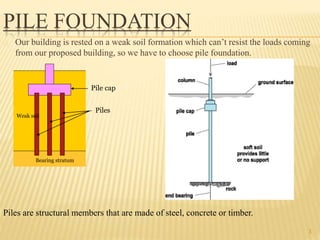
Our building is rested on a weak soil formation which can’t resist the loads coming
from our proposed building, so we have to choose pile foundation.
3
Pile cap
Piles
Weak soil
Bearing stratum
Piles are structural members that are made of steel, concrete or timber.
4
Function of piles
As with other types of foundation, the purpose of a pile foundation is:
To transmit a foundation load to a solid ground
To resist vertical, lateral and uplift load
Piles can be
Timber
Concrete
Steel
Composite
General facts
Usual length: 10m-20m
Usual load: 300kN-3000kN
Advantages
Corrosion resistance
Can be easily combined with a concrete superstructure
Disadvantages
Difficult to achieve proper cutoff
Difficult to transport
Concrete piles
PILE FOUNDATION
Piles can be divided in to two major categories:
1. End Bearing Piles
If the soil-boring records presence
of bedrock at the site within a reasonable depth,
piles can be extended to the
rock surface
2. Friction Piles
When no layer of rock is present depth at a site, point bearing piles
become very long and uneconomical. In this type of subsoil, piles
are driven through the softer material to specified depths.
5
PILE CAP REINFORCEMENT
Pile caps carrying very heavy point loads tend to produce high
tensile stresses at the pile cap.
Reinforcement is thus designed to provide:
Resistance to tensile bending forces in the bottom of
the cap
Resistance to vertical shear
6
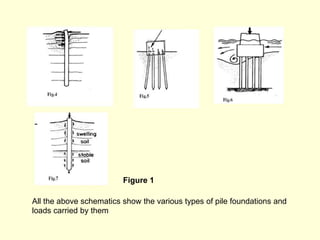
How does a pile look like?
• Before presenting the actual picture of a pile foundation
some schematic pictures of pile foundation are
presented below.
Figure 1
All the above schematics show the various types of pile foundations and
loads carried by them
Schematics of Pile foundations based on method of construction
Figure 2
Displacement Pile (A/D)
Advantage Disadvantages
Pile material can be inspected for
quality before driving
May break during driving
Construction operation affect by
ground water
Noise and vibration problems
Can driven in very long lengths Cannot be driven in condition of
low headroom
Construction operation not affected
by ground water
Noise may prove unacceptable.
Noise permit may be required
Soil disposal is not necessary Vibration may prove unacceptable
due to presence of sensitive
structures, utility installation or
machinery
Replacement Pile (A/D)
Advantage Disadvantages
Less noise or vibration problem Concrete cannot be inspected after
installation
Equipment can break up practically all
kinds of obstructions
Liable to squeezing or necking
Can be installed in conditions of low
headroom
Raking bored pile are difficult to
construct
No ground heave Drilling a number of pile groups may
cause ground loss and settlement of
adjacent structures
Depth and diameter can varied easily Cannot be extended above ground
level without special adaptation

PILE FOUNDATION-INDIA

  • 1.
    PILE FOUNDATION By ADITYA RAGHAWSINGH 5TH SEM. B.ARCH(I.D.) CONSTRUCTION- PILE FOUNDATION PPT P.I.A.D.S. , NAGPUR
  • 2.
    FOUNDATIONS Foundations are structuralcomponents used to support columns and transfer loads to the underlying Soil. 2 Foundation s Isolated Combined Strap wall Raft Shallow footing footing footing footing footing Caissons Piles Deep
  • 3.
    PILE FOUNDATION Our buildingis rested on a weak soil formation which can’t resist the loads coming from our proposed building, so we have to choose pile foundation. 3 Pile cap Piles Weak soil Bearing stratum Piles are structural members that are made of steel, concrete or timber.
  • 4.
    4 Function of piles Aswith other types of foundation, the purpose of a pile foundation is: To transmit a foundation load to a solid ground To resist vertical, lateral and uplift load Piles can be Timber Concrete Steel Composite General facts Usual length: 10m-20m Usual load: 300kN-3000kN Advantages Corrosion resistance Can be easily combined with a concrete superstructure Disadvantages Difficult to achieve proper cutoff Difficult to transport Concrete piles
  • 5.
    PILE FOUNDATION Piles canbe divided in to two major categories: 1. End Bearing Piles If the soil-boring records presence of bedrock at the site within a reasonable depth, piles can be extended to the rock surface 2. Friction Piles When no layer of rock is present depth at a site, point bearing piles become very long and uneconomical. In this type of subsoil, piles are driven through the softer material to specified depths. 5
  • 6.
    PILE CAP REINFORCEMENT Pilecaps carrying very heavy point loads tend to produce high tensile stresses at the pile cap. Reinforcement is thus designed to provide: Resistance to tensile bending forces in the bottom of the cap Resistance to vertical shear 6
  • 7.
    How does apile look like? • Before presenting the actual picture of a pile foundation some schematic pictures of pile foundation are presented below.
  • 8.
    Figure 1 All theabove schematics show the various types of pile foundations and loads carried by them
  • 9.
    Schematics of Pilefoundations based on method of construction Figure 2
  • 10.
    Displacement Pile (A/D) AdvantageDisadvantages Pile material can be inspected for quality before driving May break during driving Construction operation affect by ground water Noise and vibration problems Can driven in very long lengths Cannot be driven in condition of low headroom Construction operation not affected by ground water Noise may prove unacceptable. Noise permit may be required Soil disposal is not necessary Vibration may prove unacceptable due to presence of sensitive structures, utility installation or machinery
  • 11.
    Replacement Pile (A/D) AdvantageDisadvantages Less noise or vibration problem Concrete cannot be inspected after installation Equipment can break up practically all kinds of obstructions Liable to squeezing or necking Can be installed in conditions of low headroom Raking bored pile are difficult to construct No ground heave Drilling a number of pile groups may cause ground loss and settlement of adjacent structures Depth and diameter can varied easily Cannot be extended above ground level without special adaptation