Prepared By:-
MEHUL PATEL (120010741013)
RUSHIN SHAH (120010741006)
DESIGN & IMPLEMENTATION OF MARKER CONTROLLED
SEGMENTATION TECHNIQUE FOR MEDICAL
APPLICATION
1
AGENDA
 Segmentation
 Requirements in medical application
 Introduction
 Watershed transformation
 Over segmentation
 Solutions
 Marker controlled watershed transform
 Morphological reconstruction
 Marker & Mask
 Algorithm & Results
 Conclusion
 References
2
WHAT IS SEGMENTATION ? ? ?
 Segmentation is the process of partitioning a digital
Image into multiple segments/regions. The main aim of
segmentation is to extract the ROI (Region Of Interest)
for image analysis.
 Several methods and approaches are introduced into
the area of segmentation among them a well known
method is watershed algorithm.
3
REQUIREMENT OF
SEGMENTATION IN MEDICAL
APPLICATIONS
 Medical image segmentation is a very important field
for the medical science. In medical images, edge
detection is an important work for object recognition of
the human organs such as brain, heart or kidney etc.
and it is an essential pre-processing step in medical
image segmentation.
 Medical images such as CT, MRI or X-Ray visualizes
the various information’s of internal organs which is very
important for doctors diagnoses as well as medical
teaching, learning and research.
 It is a tough job to locate the internal organs if images
contains noise or rough structure of human body
organs.
4
INTRODUCTION
 Image segmentation is play a vital role in most medical
image analysis task.
 There are two main approaches to segmentation:
1.The frontier approach
2.The region approach
 The segmentation by watershed combine the two
approaches
 The major problem of the watershed transform is over-
segmentation.
5
INTRODUCTION (CONT..)
 Indeed, this algorithm is sensitive to any local
minimum in the image, and tends to define the lines of
the watershed transform where each local minimum
gives rise to a region.
 To avoid this problem, powerful tools adapted to
different problems have been proposed:-
1. Either reduce the number of minima and avoid
calculation of too many regions.
2. Proceed by either filtering techniques by merging
the regions according to similarity criteria after
spectral and spatial application of the watershed.
 We have used ‘MARKERS’ to reduce the number of
regional minima.6
WATERSHED TRANSFORM
 The watershed segmentation technique has been widely
used in medical image segmentation. Watershed
transform is used to segment gray matter, white matter
and cerebrospinal fluid from Magnetic Resonance (MR)
brain images.
 There are two main approaches to segmentation: the
frontier approach and the region approach.
 The segmentation by watershed combine these two
approaches & this is a powerful technique for rapid
detection of both edges and regions.
 The watershed transform is a morphological gradient-
based segmentation technique.
7
 The method originated from mathematical morphology
that deals with the topographic representation of an
image.
 Watersheds are one of the typical regions in the field of
topography.
 A drop of the water falling it flows down until it reaches
the bottom of the region.
 Monochrome image is considered to be a height surface
in which high-altitude pixels correspond to ridges and
low altitude pixels correspond to valleys.
 This suggestion says if we have a minima point, by
falling water, region and the frontier can be achieved.
 Watershed uses image gradient to initial point and
WATERSHED TRANSFORM
(CONT..)
8
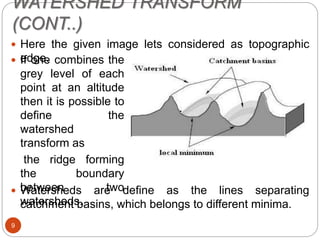
 Here the given image lets considered as topographic
edge.
 Watersheds are define as the lines separating
catchment basins, which belongs to different minima.
WATERSHED TRANSFORM
(CONT..)
 If one combines the
grey level of each
point at an altitude
then it is possible to
define the
watershed
transform as
the ridge forming
the boundary
between two
watersheds.
9
 A watershed can be imaged as a high mountain that
separates two region.
 Each region has its own minimum and if a drop of water
falls on the one side of the watershed, it will reach
minimum of the regions.
 The regions that the watershed separates are called
catchment basins.
 This is to compute the
 watershed of the said relief. Watersheds thus obtained
correspond to regions of the image.
 Watershed represents the boundaries between adjacent
catchments. The minimum can be
 interpreted as markers of watershed regions and the
WATERSHED TRANSFORM
(CONT..)
10
Over - Segmentation
 The image will be over segmented if there are many
more minima in the image than the objects of interest.
 The use of the single watershed algorithm does not
really allow good segmentation because far too many
regions are detected which causes over segmentation
and sensitivity to false edges.
Original image Watershed regions
11
 There are two main methods to limit this over
segmentation:
1. Hierarchical watershed segmentation.
2. Watershed by markers
 The hierarchical segmentation: The hierarchical
approach is to generate a tree of regions from the
result of the watershed. Regions and watershed are
first indexed, and then the process of hierarchical
segmentation process merges the regions whose
borders are the lowest. The result is a tree in which it
is possible to explore the different levels of fusion
regions.
Over – Segmentation (CONT..)
12
Marker Controlled Watershed
Transform
 We have used markers to reduce the number of
regional minima. The concept of markers is a good
approach to control over segmentation.
 The markers are connected component of an image.
There are internal markers and external markers where
internal markers are associated with object of interest
and external markers are associated with the
background.
 Watershed by markers based on morphological
reconstruction.
13
MORPHOLOGICAL
RECONSTRUCTION
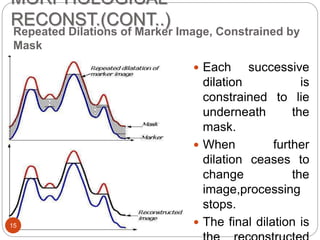
 Morphological reconstruction can be thought of
conceptually as repeated dilations of an image, called
the marker image, until the contour of the marker image
fits under a second image, called the mask
image(original).
 In morphological reconstruction, the peaks in the marker
image "spread out," or dilate.
 Unique properties:
1. Processing is based on two images, a marker and a
mask, rather than one image and a structuring element.
2. Processing is based on the concept of connectivity,
rather than a structuring element.
3. Processing repeats until stability; i.e., the image no
longer changes.
14
Repeated Dilations of Marker Image, Constrained by
Mask
 Each successive
dilation is
constrained to lie
underneath the
mask.
 When further
dilation ceases to
change the
image,processing
stops.
 The final dilation is
MORPHOLOGICAL
RECONST.(CONT..)
15
MARKER AND MASK
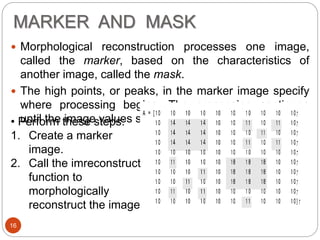
 Morphological reconstruction processes one image,
called the marker, based on the characteristics of
another image, called the mask.
 The high points, or peaks, in the marker image specify
where processing begins. The processing continues
until the image values stop changing.• Perform these steps:
1. Create a marker
image.
2. Call the imreconstruct
function to
morphologically
reconstruct the image
16
MARKER AND MASK (CONT..)
marker = imsubtract(A,2)recon = imreconstruct(marker,
mask)
The choice of the constant h is very important, it depends
on the processed image, and we must choose the right
value of this constant.
17
ALGORITHM
 Now we see the segmentation method based on
morphological operation, and then watershed applied to
grey level images.
 The key points of this method are:
1. Morphological reconstruction
2. Extract the markers of regions
3. Application of watershed transform
 The watershed is the separation lines of greatest
intensity in an image.
 The markers will define the sources from which the
algorithm of the watershed will simulate.
18
 Steps of the method.
1. Read the original image I.
2. Morphological reconstruction of the I.
3. To detect the minimum, compute the complement of
image obtained by the morphological reconstruction, the
result image noted Ic.
4. For markers of the original image, subtract from the
original image I, the image Ic:
 Mr = difference = I – Ic or Mr = I - h
5. Extended and imposed minimum, we obtained the
markers.
6. Compute the watershed transform of the markers
ALGORITHM(CONT..)
19
RESULTS
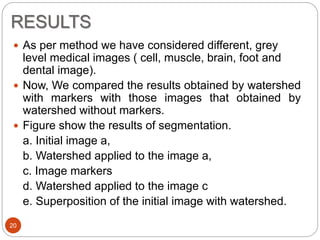
 As per method we have considered different, grey
level medical images ( cell, muscle, brain, foot and
dental image).
 Now, We compared the results obtained by watershed
with markers with those images that obtained by
watershed without markers.
 Figure show the results of segmentation.
a. Initial image a,
b. Watershed applied to the image a,
c. Image markers
d. Watershed applied to the image c
e. Superposition of the initial image with watershed.
20
21
22
OBSERVATION
 The results of segmentation with marker watershed
transforms shows the clarity and detection of objects
(region and contour) marked by the image markers c.
 The result obtained by watershed without markers
(Figure b) gives no information on the regions of the
original image.
 Against the result obtained by watershed with markers
shows the speed of segmentation and no more than 2
seconds in all tests.
 Thus this method detects all objects of the original
image (Figure d and e).
23
OBSERVATION (CONT..)
 In table, the number of regions obtained was decreased; the
value of the constant h used in the reconstruction.
 The problem of local minima is eliminated here. Hence,
the problem of over-segmentation is solved.
 Finally a simple algorithm we shown, that is fast, easy to
implement and get over the problem of
oversegmentation. The algorithm is useful to segment
the objects that touch each other in an image.
Image I1 I2 I3 I4 I5 I6
Value of
constant
14 5 3 30 47 45
Number of
regions without
markers
2772 715 3253 1047 16450
3
8376
Number of
regions with
markers
107 72 143 31 95 51
24
MODIFIED ALGORITHM
 The marker controlled watershed transform is mainly for
the problems where adjacent objects are there in an
image and we have to separate them using image
processing operations.
 In the initial step 1st takes the gray scale image and
compute the gradient magnitude as the segmentation
function where gradient is highest at the borders of the
object and generally low inside the object.
 Now uses the internal marker to distinguish the
foreground of adjacent objects. The background of the
image will then be segregated from the foreground
objects using the external markers.
 Finally aggregate the computed result of the watershed
transform and study the final image.
25
Original image Gradient magnitude from
grayscale image
Estimation of the segmentation function Foreground objects by estimating internal
markers
Background objects by estimating external markers Object boundaries by applying
CONCLUSION
 Segmentation watershed by markers based on
morphological operation is able to segment real
medicals images.
 We have calculated automatically region markers. The
markers are used to control the watershed to obtain
good results.
 The markers are generated automatically positioned
and thereby avoiding the problem of oversegmentation,
and manual marking.
 The results show the good performance of this
approach. This approach may be used in the proper
detection of the region of interest & for problems of
decision support in medical diagnosis.27
REFERENCE
 The International Journal of Multimedia & Its
Applications (IJMA) Vol.4, No.3, June 2012
 International Journal of Emerging Technology and
Advanced Engineering Website: www.ijetae.com
(ISSN 2250-2459, Volume 2, Issue 4, April 2012)
 MATLAB 7/Image processing toolbox/Demos/Image
Segmentation/Marker-Controlled Watershed
Segmentation
 Book:- Digital Image Processing by Rafael C.
Gonzalez & Richard E. Wood [Morphological
Reconstruction(656-679)].
28
29

Marker Controlled Segmentation Technique for Medical application

  • 1.
    Prepared By:- MEHUL PATEL(120010741013) RUSHIN SHAH (120010741006) DESIGN & IMPLEMENTATION OF MARKER CONTROLLED SEGMENTATION TECHNIQUE FOR MEDICAL APPLICATION 1
  • 2.
    AGENDA  Segmentation  Requirementsin medical application  Introduction  Watershed transformation  Over segmentation  Solutions  Marker controlled watershed transform  Morphological reconstruction  Marker & Mask  Algorithm & Results  Conclusion  References 2
  • 3.
    WHAT IS SEGMENTATION? ? ?  Segmentation is the process of partitioning a digital Image into multiple segments/regions. The main aim of segmentation is to extract the ROI (Region Of Interest) for image analysis.  Several methods and approaches are introduced into the area of segmentation among them a well known method is watershed algorithm. 3
  • 4.
    REQUIREMENT OF SEGMENTATION INMEDICAL APPLICATIONS  Medical image segmentation is a very important field for the medical science. In medical images, edge detection is an important work for object recognition of the human organs such as brain, heart or kidney etc. and it is an essential pre-processing step in medical image segmentation.  Medical images such as CT, MRI or X-Ray visualizes the various information’s of internal organs which is very important for doctors diagnoses as well as medical teaching, learning and research.  It is a tough job to locate the internal organs if images contains noise or rough structure of human body organs. 4
  • 5.
    INTRODUCTION  Image segmentationis play a vital role in most medical image analysis task.  There are two main approaches to segmentation: 1.The frontier approach 2.The region approach  The segmentation by watershed combine the two approaches  The major problem of the watershed transform is over- segmentation. 5
  • 6.
    INTRODUCTION (CONT..)  Indeed,this algorithm is sensitive to any local minimum in the image, and tends to define the lines of the watershed transform where each local minimum gives rise to a region.  To avoid this problem, powerful tools adapted to different problems have been proposed:- 1. Either reduce the number of minima and avoid calculation of too many regions. 2. Proceed by either filtering techniques by merging the regions according to similarity criteria after spectral and spatial application of the watershed.  We have used ‘MARKERS’ to reduce the number of regional minima.6
  • 7.
    WATERSHED TRANSFORM  Thewatershed segmentation technique has been widely used in medical image segmentation. Watershed transform is used to segment gray matter, white matter and cerebrospinal fluid from Magnetic Resonance (MR) brain images.  There are two main approaches to segmentation: the frontier approach and the region approach.  The segmentation by watershed combine these two approaches & this is a powerful technique for rapid detection of both edges and regions.  The watershed transform is a morphological gradient- based segmentation technique. 7
  • 8.
     The methodoriginated from mathematical morphology that deals with the topographic representation of an image.  Watersheds are one of the typical regions in the field of topography.  A drop of the water falling it flows down until it reaches the bottom of the region.  Monochrome image is considered to be a height surface in which high-altitude pixels correspond to ridges and low altitude pixels correspond to valleys.  This suggestion says if we have a minima point, by falling water, region and the frontier can be achieved.  Watershed uses image gradient to initial point and WATERSHED TRANSFORM (CONT..) 8
  • 9.
     Here thegiven image lets considered as topographic edge.  Watersheds are define as the lines separating catchment basins, which belongs to different minima. WATERSHED TRANSFORM (CONT..)  If one combines the grey level of each point at an altitude then it is possible to define the watershed transform as the ridge forming the boundary between two watersheds. 9
  • 10.
     A watershedcan be imaged as a high mountain that separates two region.  Each region has its own minimum and if a drop of water falls on the one side of the watershed, it will reach minimum of the regions.  The regions that the watershed separates are called catchment basins.  This is to compute the  watershed of the said relief. Watersheds thus obtained correspond to regions of the image.  Watershed represents the boundaries between adjacent catchments. The minimum can be  interpreted as markers of watershed regions and the WATERSHED TRANSFORM (CONT..) 10
  • 11.
    Over - Segmentation The image will be over segmented if there are many more minima in the image than the objects of interest.  The use of the single watershed algorithm does not really allow good segmentation because far too many regions are detected which causes over segmentation and sensitivity to false edges. Original image Watershed regions 11
  • 12.
     There aretwo main methods to limit this over segmentation: 1. Hierarchical watershed segmentation. 2. Watershed by markers  The hierarchical segmentation: The hierarchical approach is to generate a tree of regions from the result of the watershed. Regions and watershed are first indexed, and then the process of hierarchical segmentation process merges the regions whose borders are the lowest. The result is a tree in which it is possible to explore the different levels of fusion regions. Over – Segmentation (CONT..) 12
  • 13.
    Marker Controlled Watershed Transform We have used markers to reduce the number of regional minima. The concept of markers is a good approach to control over segmentation.  The markers are connected component of an image. There are internal markers and external markers where internal markers are associated with object of interest and external markers are associated with the background.  Watershed by markers based on morphological reconstruction. 13
  • 14.
    MORPHOLOGICAL RECONSTRUCTION  Morphological reconstructioncan be thought of conceptually as repeated dilations of an image, called the marker image, until the contour of the marker image fits under a second image, called the mask image(original).  In morphological reconstruction, the peaks in the marker image "spread out," or dilate.  Unique properties: 1. Processing is based on two images, a marker and a mask, rather than one image and a structuring element. 2. Processing is based on the concept of connectivity, rather than a structuring element. 3. Processing repeats until stability; i.e., the image no longer changes. 14
  • 15.
    Repeated Dilations ofMarker Image, Constrained by Mask  Each successive dilation is constrained to lie underneath the mask.  When further dilation ceases to change the image,processing stops.  The final dilation is MORPHOLOGICAL RECONST.(CONT..) 15
  • 16.
    MARKER AND MASK Morphological reconstruction processes one image, called the marker, based on the characteristics of another image, called the mask.  The high points, or peaks, in the marker image specify where processing begins. The processing continues until the image values stop changing.• Perform these steps: 1. Create a marker image. 2. Call the imreconstruct function to morphologically reconstruct the image 16
  • 17.
    MARKER AND MASK(CONT..) marker = imsubtract(A,2)recon = imreconstruct(marker, mask) The choice of the constant h is very important, it depends on the processed image, and we must choose the right value of this constant. 17
  • 18.
    ALGORITHM  Now wesee the segmentation method based on morphological operation, and then watershed applied to grey level images.  The key points of this method are: 1. Morphological reconstruction 2. Extract the markers of regions 3. Application of watershed transform  The watershed is the separation lines of greatest intensity in an image.  The markers will define the sources from which the algorithm of the watershed will simulate. 18
  • 19.
     Steps ofthe method. 1. Read the original image I. 2. Morphological reconstruction of the I. 3. To detect the minimum, compute the complement of image obtained by the morphological reconstruction, the result image noted Ic. 4. For markers of the original image, subtract from the original image I, the image Ic:  Mr = difference = I – Ic or Mr = I - h 5. Extended and imposed minimum, we obtained the markers. 6. Compute the watershed transform of the markers ALGORITHM(CONT..) 19
  • 20.
    RESULTS  As permethod we have considered different, grey level medical images ( cell, muscle, brain, foot and dental image).  Now, We compared the results obtained by watershed with markers with those images that obtained by watershed without markers.  Figure show the results of segmentation. a. Initial image a, b. Watershed applied to the image a, c. Image markers d. Watershed applied to the image c e. Superposition of the initial image with watershed. 20
  • 21.
  • 22.
  • 23.
    OBSERVATION  The resultsof segmentation with marker watershed transforms shows the clarity and detection of objects (region and contour) marked by the image markers c.  The result obtained by watershed without markers (Figure b) gives no information on the regions of the original image.  Against the result obtained by watershed with markers shows the speed of segmentation and no more than 2 seconds in all tests.  Thus this method detects all objects of the original image (Figure d and e). 23
  • 24.
    OBSERVATION (CONT..)  Intable, the number of regions obtained was decreased; the value of the constant h used in the reconstruction.  The problem of local minima is eliminated here. Hence, the problem of over-segmentation is solved.  Finally a simple algorithm we shown, that is fast, easy to implement and get over the problem of oversegmentation. The algorithm is useful to segment the objects that touch each other in an image. Image I1 I2 I3 I4 I5 I6 Value of constant 14 5 3 30 47 45 Number of regions without markers 2772 715 3253 1047 16450 3 8376 Number of regions with markers 107 72 143 31 95 51 24
  • 25.
    MODIFIED ALGORITHM  Themarker controlled watershed transform is mainly for the problems where adjacent objects are there in an image and we have to separate them using image processing operations.  In the initial step 1st takes the gray scale image and compute the gradient magnitude as the segmentation function where gradient is highest at the borders of the object and generally low inside the object.  Now uses the internal marker to distinguish the foreground of adjacent objects. The background of the image will then be segregated from the foreground objects using the external markers.  Finally aggregate the computed result of the watershed transform and study the final image. 25
  • 26.
    Original image Gradientmagnitude from grayscale image Estimation of the segmentation function Foreground objects by estimating internal markers Background objects by estimating external markers Object boundaries by applying
  • 27.
    CONCLUSION  Segmentation watershedby markers based on morphological operation is able to segment real medicals images.  We have calculated automatically region markers. The markers are used to control the watershed to obtain good results.  The markers are generated automatically positioned and thereby avoiding the problem of oversegmentation, and manual marking.  The results show the good performance of this approach. This approach may be used in the proper detection of the region of interest & for problems of decision support in medical diagnosis.27
  • 28.
    REFERENCE  The InternationalJournal of Multimedia & Its Applications (IJMA) Vol.4, No.3, June 2012  International Journal of Emerging Technology and Advanced Engineering Website: www.ijetae.com (ISSN 2250-2459, Volume 2, Issue 4, April 2012)  MATLAB 7/Image processing toolbox/Demos/Image Segmentation/Marker-Controlled Watershed Segmentation  Book:- Digital Image Processing by Rafael C. Gonzalez & Richard E. Wood [Morphological Reconstruction(656-679)]. 28
  • 29.