Formal and Informal Governance: Powerful Policy Option 
for Harnessing Synergies to Secure Livestock Systems & 
Environment in Marsabit, Northern Kenya 
by 
Dr. George J. Wamwere-Njoroge, BVM, MSc, MA 
Pastoral Policy Advisor – USAID Kenya 
Resilience and Economic Growth in the Arid Lands – Accelerated Growth 
(REGAL-AG) 
E-Mail: 
g.njoroge@regal-ag.org, gwjnjoroge@yahoo.com, 
wamwere.njoroge@gmail.com 
1
Presentation Outline 
• Introduction 
• Quote & Objectives of The Presentation 
• Consequences of Changes in Pastoral Livestock 
Systems & Environment in Northern Kenya 
• Experiences/Lessons Learnt thro’ Formal and 
Informal Management Structures of Pastoral 
Livestock Systems And Environment 
• Leverage on Emerging Policy/Legislative 
Opportunities 
• Research Opportunities and Way Forward 2
Quote 
"Development will bring food security only 
-if it is people-centred, 
-if it is environmentally sound, 
-if it is participatory, and 
-if it builds local and national capacity for self-reliance. 
These are the basic characteristics of 
sustainable human development." 
- James Gustave Speltz (UNDP, 1994) 
3
Objectives of this presentation 
• To share experiences/lessons learnt accrued 
from integration of formal and informal 
management structures of livestock systems 
and environment in Marsabit, Northern Kenya 
• To enumerate the emerging innovative policy & 
legislative options created by the devolution 
structures, especially the county Assembly 
• To highlight possible cutting-edge research 
opportunities 4
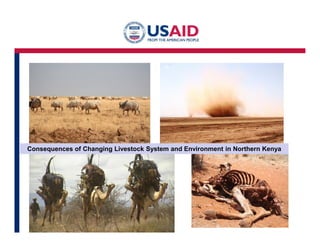
Consequences of Changing Livestock System and Environment in Northern Kenya 
5
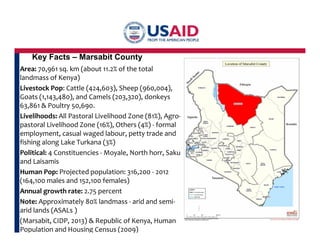
Key Facts – Marsabit County 
Area: 70,961 sq. km (about 11.2% of the total 
landmass of Kenya) 
Livestock Pop: Cattle (424,603), Sheep (960,004), 
Goats (1,143,480), and Camels (203,320), donkeys 
63,861 & Poultry 50,690. 
Livelihoods: All Pastoral Livelihood Zone (81%), Agro-pastoral 
Livelihood Zone (16%), Others (4%) - formal 
employment, casual waged labour, petty trade and 
fishing along Lake Turkana (3%) 
Political: 4 Constituencies - Moyale, North horr, Saku 
and Laisamis 
Human Pop: Projected population: 316,200 - 2012 
(164,100 males and 152,100 females) 
Annual growth rate: 2.75 percent 
Note: Approximately 80% landmass - arid and semi-arid 
lands (ASALs ) 
(Marsabit, CIDP, 2013) & Republic of Kenya, Human 
Population and Housing Census (2009) 
6
Pastoralism & Nomadic pastoralism 
Pastoralism 
• Pastoralism refers to a livelihood approach that 
makes use of domesticated animals - for example, 
sheep, goats, cattle, camels - to provide a variety of 
products such as milk, skins, cash and occasionally 
and meat 
• It is also defined as a model of production where 
livestock makes up to 50 percent or more of 
economic portfolio of a pastoral household 
(UNEP & IUCN, 2013) 7
Pastoralism & Nomadic pastoralism Cont’d 
Nomadic pastoralism 
• A model of production where over 80 
percent of household income is generated 
through regular movement of livestock 
across a well-defined wet and dry season 
grazing areas 
(UNEP & IUCN, 2013) 
8
Why pastoralism is so important 
• Pastoralism systems provides valuable ecosystem 
services, namely:- 
– Maintains high levels of biodiversity, increase vegetation 
soil cover, reduce erosion, prevents wildfires, maintains 
infrastructures, disperse seeds, allocate nutrients, 
defragmenting landscapes, etc. 
• Pastoralism produces necessary goods (meat, dairy, 
leather, manure…), extracted sustainably from low 
productive ecosystems 
• Pastoral culture constitutes a highly valuable cultural 
and intangible living heritage (IFAD, 2009) 9
Why pastoralism is so important 
• Pastoralism systems provides valuable ecosystem 
services 
– Maintains high levels of biodiversity, increase vegetation 
soil cover, reduce erosion, prevents wildfires, maintains 
infrastructures, disperse seeds, allocate nutrients, 
defragmenting landscapes, etc. 
• Pastoralism produces necessary goods (meat, dairy, 
leather, manure…), extracted sustainably from low 
productive ecosystems 
• Pastoral culture constitutes a highly valuable cultural 
and intangible living heritage (IFAD, 2009) 10
Pastoral livestock production systems Classification 
• Pastoral livestock production systems 
– Falls under Solely Livestock Systems (SLS) which is a 
livestock systems in which 
– More than 90% of dry matter fed to animals comes 
from rangelands, pastures, annual forages and 
purchased feeds (very rare in normal conds – my 
own insertion) and 
– Less than 10% of the total value of production comes 
from non-livestock farming activities 
(Sere´ and Steinfeld,1996) 11
System and Livestock Production System (LPS) 
• LPS is considered to be a subset of farming 
systems 
• Systems - regularly interacting or interdependent 
group of items forming a unified whole 
• Forage-livestock systems - productive groupings 
that consider and utilize animals, plants, and soil 
characteristics within an environmental 
perspective (Oregon State University, 2008) 
12
System and Livestock Production System (LPS) 
• Need to understand (Human influences –My 
Own insertion-) on how the animals interact 
with the plants growing in soil 
• Proper management of the plant-animal-soil 
continuum (by Human –My Own insertion-) will 
improve the economics and ecology of the 
unified whole - Human-Livestock-Pasture 
Continuum (Sere´ and Steinfeld,1996) 
13
Formal Rules & Structures in pastoral livestock system 
management 
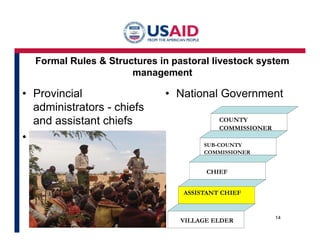
• Provincial 
administrators - chiefs 
and assistant chiefs 
• 
• National Government 
14 
COUNTY 
COMMISSIONER 
SUB-COUNTY 
COMMISSIONER 
CHIEF 
ASSISTANT CHIEF 
VILLAGE ELDER
Formal Rules & Structures In Pastoral Livestock System 
Management 
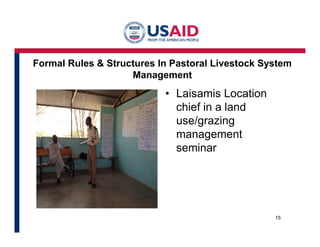
• Laisamis Location 
chief in a land 
use/grazing 
management 
seminar 
15
Informal Rules & Structures In Pastoral Livestock System 
Management 
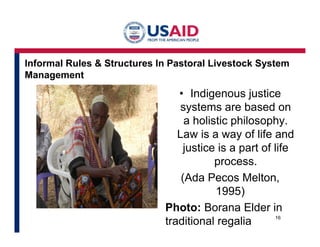
• Indigenous justice 
systems are based on 
a holistic philosophy. 
Law is a way of life and 
justice is a part of life 
process. 
(Ada Pecos Melton, 
1995) 
Photo: Borana Elder in 
traditional regalia 16
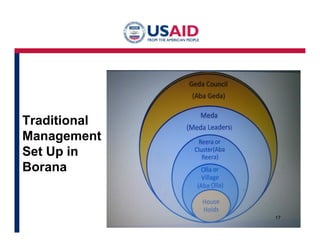
Traditional 
Management 
Set Up in 
Borana 
17
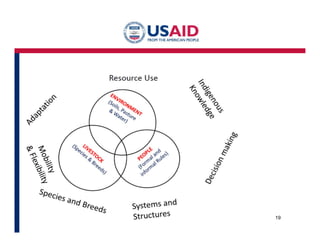
Harnessing Synergy 
Synergy 
• According to Evans (1996), the term synergy refers to the 
developmental multiplier effects of collaboration between 
state and society, or between formal and informal 
arrangements 
• The Author stipulated that synergy requires a combination of 
complementarity and embeddedness between state (formal – 
my insertion) and society (informal – my insertion) 
• Both complementary capacities & relations of trust and mutual 
interest must coincide in order to produce the mutual gains 
associated with synergy 
18
19
Harnessed Synergy Cont’d 
Harnessed energy gives resilience to 
Pastoralists to a confront: 
Four Types Uncertainties 
• Ecological uncertainties 
• Livelihood uncertainties 
• Knowledge uncertainties 
• Social and political uncertainties 
(Mehta et al.1999) 20
Policy and Legislation needs 
• Livestock production and marketing 
• Animal health Care delivery System 
• Disease Control and Prevention 
• Livestock movement 
• Branding and Traceability of livestock 
• Farm-to-Fork Concept 
21
Policy and Legislation Priorities 
• Meat Control and Hygiene 
• Branding of livestock products – Niche Markets 
• Promotion of public-private-partnership (PPP) 
• Organic livestock production 
• Livestock System and Grazing management 
22
Research Opportunities 
• Counties are willing and have some resources to pilot 
innovations in:- 
– Climate smart technologies 
– Improved breeds 
– Product development/Abattoir development 
– Branding 
• Many counties Kajiado, Marsabit etc. – proposing 
establishment of abattoirs 
– Disease control and livestock movement – e.g. Digital pen 
• Upscale and/or Outscale Community conservancy model, to 
integrate livestock marketing/business enterprises 
23
Acknowledgement 
• USAID Kenya Resilience and Economic growth in the Arid 
Lands – Accelerated Growth (REGAL-AG) 
• International Livestock Research Institute (ILRI) 
24
References 
• County Integrated Development Program 
Marsabit,, 2013) 
• Mehta, L., Leach, M., Newell, P., Scoones, I., 
Silvaramakrishnana, K., AND Sally-Ann Way 
(1999) 
• Melton, Ada Pecos (1995). Indigenous justice 
systems and tribal society Judicature 79 
(December). Reprinted online by Tribal Court 
Clearinghouse. 25
References Cont’d 
• Peter Evans (1996): Social Capital - Conceptual 
Frameworks and Empirical Evidence - An Annotated 
Bibliography, Tine Rossing Feldman and Susan 
Assaf. Social Development Family - Environmentally 
and Socially. Sustainable Development Network. 
• Republic of Kenya (2009) - Human Population and 
Housing Census 
• Steinfeld, H and J. Mäki-Hokkonen (2013): Animal 
Production and Health Division, FAO, Rome, Italy. 
26

Formal and informal governance: Powerful policy option for harnessing synergies to secure livestock systems and environment in Marsabit, northern Kenya

  • 1.
    Formal and InformalGovernance: Powerful Policy Option for Harnessing Synergies to Secure Livestock Systems & Environment in Marsabit, Northern Kenya by Dr. George J. Wamwere-Njoroge, BVM, MSc, MA Pastoral Policy Advisor – USAID Kenya Resilience and Economic Growth in the Arid Lands – Accelerated Growth (REGAL-AG) E-Mail: g.njoroge@regal-ag.org, gwjnjoroge@yahoo.com, wamwere.njoroge@gmail.com 1
  • 2.
    Presentation Outline •Introduction • Quote & Objectives of The Presentation • Consequences of Changes in Pastoral Livestock Systems & Environment in Northern Kenya • Experiences/Lessons Learnt thro’ Formal and Informal Management Structures of Pastoral Livestock Systems And Environment • Leverage on Emerging Policy/Legislative Opportunities • Research Opportunities and Way Forward 2
  • 3.
    Quote "Development willbring food security only -if it is people-centred, -if it is environmentally sound, -if it is participatory, and -if it builds local and national capacity for self-reliance. These are the basic characteristics of sustainable human development." - James Gustave Speltz (UNDP, 1994) 3
  • 4.
    Objectives of thispresentation • To share experiences/lessons learnt accrued from integration of formal and informal management structures of livestock systems and environment in Marsabit, Northern Kenya • To enumerate the emerging innovative policy & legislative options created by the devolution structures, especially the county Assembly • To highlight possible cutting-edge research opportunities 4
  • 5.
    Consequences of ChangingLivestock System and Environment in Northern Kenya 5
  • 6.
    Key Facts –Marsabit County Area: 70,961 sq. km (about 11.2% of the total landmass of Kenya) Livestock Pop: Cattle (424,603), Sheep (960,004), Goats (1,143,480), and Camels (203,320), donkeys 63,861 & Poultry 50,690. Livelihoods: All Pastoral Livelihood Zone (81%), Agro-pastoral Livelihood Zone (16%), Others (4%) - formal employment, casual waged labour, petty trade and fishing along Lake Turkana (3%) Political: 4 Constituencies - Moyale, North horr, Saku and Laisamis Human Pop: Projected population: 316,200 - 2012 (164,100 males and 152,100 females) Annual growth rate: 2.75 percent Note: Approximately 80% landmass - arid and semi-arid lands (ASALs ) (Marsabit, CIDP, 2013) & Republic of Kenya, Human Population and Housing Census (2009) 6
  • 7.
    Pastoralism & Nomadicpastoralism Pastoralism • Pastoralism refers to a livelihood approach that makes use of domesticated animals - for example, sheep, goats, cattle, camels - to provide a variety of products such as milk, skins, cash and occasionally and meat • It is also defined as a model of production where livestock makes up to 50 percent or more of economic portfolio of a pastoral household (UNEP & IUCN, 2013) 7
  • 8.
    Pastoralism & Nomadicpastoralism Cont’d Nomadic pastoralism • A model of production where over 80 percent of household income is generated through regular movement of livestock across a well-defined wet and dry season grazing areas (UNEP & IUCN, 2013) 8
  • 9.
    Why pastoralism isso important • Pastoralism systems provides valuable ecosystem services, namely:- – Maintains high levels of biodiversity, increase vegetation soil cover, reduce erosion, prevents wildfires, maintains infrastructures, disperse seeds, allocate nutrients, defragmenting landscapes, etc. • Pastoralism produces necessary goods (meat, dairy, leather, manure…), extracted sustainably from low productive ecosystems • Pastoral culture constitutes a highly valuable cultural and intangible living heritage (IFAD, 2009) 9
  • 10.
    Why pastoralism isso important • Pastoralism systems provides valuable ecosystem services – Maintains high levels of biodiversity, increase vegetation soil cover, reduce erosion, prevents wildfires, maintains infrastructures, disperse seeds, allocate nutrients, defragmenting landscapes, etc. • Pastoralism produces necessary goods (meat, dairy, leather, manure…), extracted sustainably from low productive ecosystems • Pastoral culture constitutes a highly valuable cultural and intangible living heritage (IFAD, 2009) 10
  • 11.
    Pastoral livestock productionsystems Classification • Pastoral livestock production systems – Falls under Solely Livestock Systems (SLS) which is a livestock systems in which – More than 90% of dry matter fed to animals comes from rangelands, pastures, annual forages and purchased feeds (very rare in normal conds – my own insertion) and – Less than 10% of the total value of production comes from non-livestock farming activities (Sere´ and Steinfeld,1996) 11
  • 12.
    System and LivestockProduction System (LPS) • LPS is considered to be a subset of farming systems • Systems - regularly interacting or interdependent group of items forming a unified whole • Forage-livestock systems - productive groupings that consider and utilize animals, plants, and soil characteristics within an environmental perspective (Oregon State University, 2008) 12
  • 13.
    System and LivestockProduction System (LPS) • Need to understand (Human influences –My Own insertion-) on how the animals interact with the plants growing in soil • Proper management of the plant-animal-soil continuum (by Human –My Own insertion-) will improve the economics and ecology of the unified whole - Human-Livestock-Pasture Continuum (Sere´ and Steinfeld,1996) 13
  • 14.
    Formal Rules &Structures in pastoral livestock system management • Provincial administrators - chiefs and assistant chiefs • • National Government 14 COUNTY COMMISSIONER SUB-COUNTY COMMISSIONER CHIEF ASSISTANT CHIEF VILLAGE ELDER
  • 15.
    Formal Rules &Structures In Pastoral Livestock System Management • Laisamis Location chief in a land use/grazing management seminar 15
  • 16.
    Informal Rules &Structures In Pastoral Livestock System Management • Indigenous justice systems are based on a holistic philosophy. Law is a way of life and justice is a part of life process. (Ada Pecos Melton, 1995) Photo: Borana Elder in traditional regalia 16
  • 17.
  • 18.
    Harnessing Synergy Synergy • According to Evans (1996), the term synergy refers to the developmental multiplier effects of collaboration between state and society, or between formal and informal arrangements • The Author stipulated that synergy requires a combination of complementarity and embeddedness between state (formal – my insertion) and society (informal – my insertion) • Both complementary capacities & relations of trust and mutual interest must coincide in order to produce the mutual gains associated with synergy 18
  • 19.
  • 20.
    Harnessed Synergy Cont’d Harnessed energy gives resilience to Pastoralists to a confront: Four Types Uncertainties • Ecological uncertainties • Livelihood uncertainties • Knowledge uncertainties • Social and political uncertainties (Mehta et al.1999) 20
  • 21.
    Policy and Legislationneeds • Livestock production and marketing • Animal health Care delivery System • Disease Control and Prevention • Livestock movement • Branding and Traceability of livestock • Farm-to-Fork Concept 21
  • 22.
    Policy and LegislationPriorities • Meat Control and Hygiene • Branding of livestock products – Niche Markets • Promotion of public-private-partnership (PPP) • Organic livestock production • Livestock System and Grazing management 22
  • 23.
    Research Opportunities •Counties are willing and have some resources to pilot innovations in:- – Climate smart technologies – Improved breeds – Product development/Abattoir development – Branding • Many counties Kajiado, Marsabit etc. – proposing establishment of abattoirs – Disease control and livestock movement – e.g. Digital pen • Upscale and/or Outscale Community conservancy model, to integrate livestock marketing/business enterprises 23
  • 24.
    Acknowledgement • USAIDKenya Resilience and Economic growth in the Arid Lands – Accelerated Growth (REGAL-AG) • International Livestock Research Institute (ILRI) 24
  • 25.
    References • CountyIntegrated Development Program Marsabit,, 2013) • Mehta, L., Leach, M., Newell, P., Scoones, I., Silvaramakrishnana, K., AND Sally-Ann Way (1999) • Melton, Ada Pecos (1995). Indigenous justice systems and tribal society Judicature 79 (December). Reprinted online by Tribal Court Clearinghouse. 25
  • 26.
    References Cont’d •Peter Evans (1996): Social Capital - Conceptual Frameworks and Empirical Evidence - An Annotated Bibliography, Tine Rossing Feldman and Susan Assaf. Social Development Family - Environmentally and Socially. Sustainable Development Network. • Republic of Kenya (2009) - Human Population and Housing Census • Steinfeld, H and J. Mäki-Hokkonen (2013): Animal Production and Health Division, FAO, Rome, Italy. 26