Why should we put pastoralism
   back on the agenda ?


               Michele Nori
     EuropeAID E6 – Quality Support
   natural resources – rural development
Contents
This presentation aims at answering these questions:
• Who are the pastoralists ?
• Which dynamics have characterised pastoral
  regions in recent decade ?
• How could these be redressed ?
• What elements should be considered in such
  process ?
WHO ARE THE PASTORALISTS
Pastoralist are the communities living on arid lands through
  mobile livestock keeping

1) LIVESTOCK as the main livelihood source; the vital
   ‘technology’ that allows translating land resources into valuable
   products for people.
2) MOBILITY as the way to make the best use of marginal natural
   resources, while enabling their recovery through time.
3) FLEXIBLE arrangements regulating access to resources;
   common property rights, negotiations

Pastoralism is an entire way of life, involving ecological, political,
  economic, technological, cultural and social dimensions.
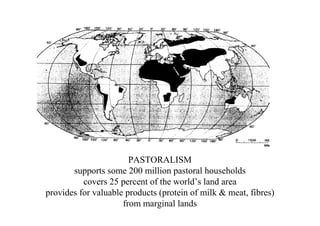
PASTORALISM
       supports some 200 million pastoral households
          covers 25 percent of the world’s land area
provides for valuable products (protein of milk & meat, fibres)
                     from marginal lands
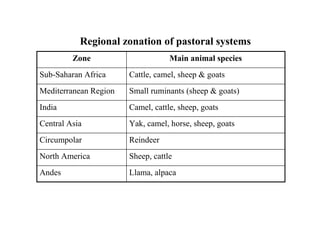
Regional zonation of pastoral systems
         Zone                      Main animal species
Sub-Saharan Africa     Cattle, camel, sheep & goats
Mediterranean Region   Small ruminants (sheep & goats)
India                  Camel, cattle, sheep, goats
Central Asia           Yak, camel, horse, sheep, goats
Circumpolar            Reindeer
North America          Sheep, cattle
Andes                  Llama, alpaca
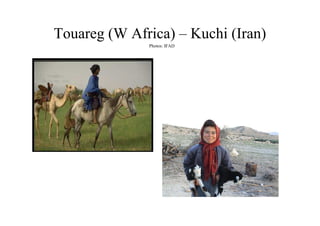
Touareg (W Africa) – Kuchi (Iran)
              Photos: IFAD
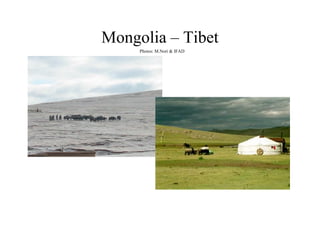
Mongolia – Tibet
     Photos: M.Nori & IFAD
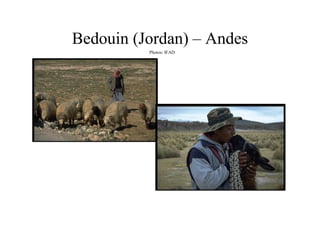
Bedouin (Jordan) – Andes
          Photos: IFAD
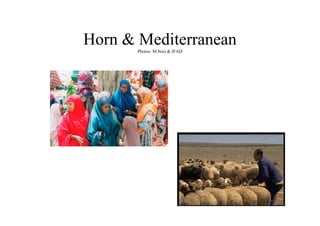
Horn & Mediterranean
       Photos: M.Nori & IFAD
HARSH ENVIRONMENTS

Arid territories (drylands or highlands) with extreme
  climatic patterns. Water limiting factor, not
  allowing continuous crop cultivation.
3 main characterizing features:
- Limitations of overall resource endowment / low
  average biomass production - limited productivity
- Variability of resource distribution through space
  and time – patchy in time and space
- Unpredictability of resource endowment and
  high degree of risk of extreme climatic events
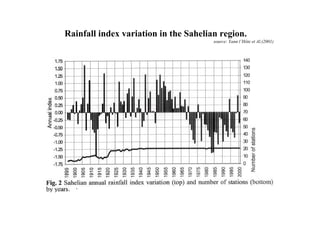
Rainfall index variation in the Sahelian region.
                                       source: Yann l’Hôte et Al.(2001)
socio-political marginality - 1
          FRONTIER LANDS
• Geo-political borders (i.e. mountains or
  deserts),
• ‘divide et impera’, nations mix and
  communities divided
• Limited representativity
• Areas remote from mainstream central state
  decision making – SAPs
• High Transaction Costs
• Poor access to services and infrastructure
socio-political marginality – 2
  (MIS)-CONCEIVED AS UNSUSTAINABLE
• Economically unviable –
Herskovits’ “cattle complex”, 1926
Poor contributors to local economy

• Environmental degradation –
Hardin’s “tragedy of the commons”, 1968
Culprits for Desertification, UN, 1980s
Livestock long Shadow, 2006

Backward agricultural system*
Economically irrational & irrelevant
Environmental damaging
Pastoral modernization…
Pastoral development to be conceived as
the END of mobility and communal land access
  (SEDENTARISATION paradigm),
And the PRIVATISATION of resources (rangelands,
  livestock*) meaning the end of pastoralism.

• Unfavourable policies (land, food, trade)
• Market dynamics (decreasing ToTs)
• External appetites for rangelands – land grabs*
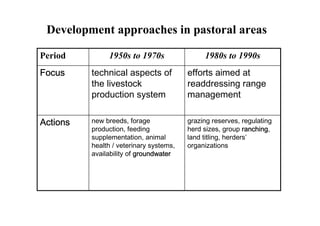
Development approaches in pastoral areas

Period         1950s to 1970s                  1980s to 1990s
Focus     technical aspects of           efforts aimed at
          the livestock                  readdressing range
          production system              management


Actions   new breeds, forage             grazing reserves, regulating
          production, feeding                                ranching,
                                         herd sizes, group ranching
          supplementation, animal        land titling, herders’
          health / veterinary systems,   organizations
          availability of groundwater
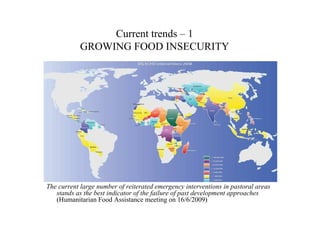
Current trends – 1
            GROWING FOOD INSECURITY


The current large number of reiterated emergency interventions in pastoral areas
   stands as the best indicator of the failure of past development approaches
   (Humanitarian Food Assistance meeting on 16/6/2009)
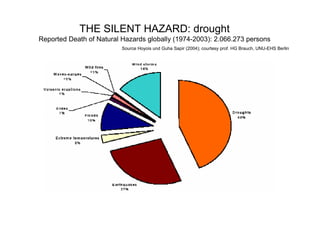
THE SILENT HAZARD: drought
Reported Death of Natural Hazards globally (1974-2003): 2.066.273 persons
                          Source Hoyois und Guha Sapir (2004); courtesy prof. HG Brauch, UNU-EHS Berlin
Current trends – 2
      UPSCALING CONFLICT
• Poor Governance – Fragile States
• Recent trends: where civilizations clash:
  Darfur, Kurdistan, Afghanistan, Somalia,
  SSudan, Middle East, etc…
• But also at smaller scale: Ogaden, South
  Omo, Loliondo, Karamoja, etc…
Current trends – 3
               LOWEST HDI - MDGs

• From better off to those ranking amongst the poorest and
  most destitute agriculture peoples in the world (World
  Bank, 2009)
• A number of development syndromes: poverty,
  desertification, famine, food and social insecurity,
  migration, conflict and recently insurgency
• Most excluded / hardest to reach from primary social
  services (UNICEF/WHO, 2005)
• Regions with deepest endemic poverty, and with the most
  vulnerable people (CGIAR, 2010)
• Not effective integration into state and market dynamics
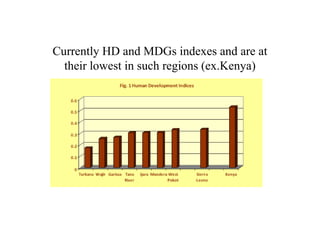
Currently HD and MDGs indexes and are at
  their lowest in such regions (ex.Kenya)
Failure & Neglect
During the 1980s and the 1990s a series of reports clearly showed that the pastoral sector
   experienced the greatest concentration of failed development projects in the world.
Livelihood conditions worsened, rangelands got degraded: Somewhere something had
   gone wrong
Immediate consequences:
1) pastoralists exited the development agenda (20 years ago) - international
2) consistent retrenchment of public investments in marginal areas under SAP - national
3) undermining of pastoral resource management patterns.
Policy frames:
1) No policy (no State or neglect)
2) Unfavourable (e.g. Ethiopia, Uganda)
3) Favourable but not implemented (e.g. Sahelian Pastoral Code)
4) Efforts for implementation (e.g. Mongolia, Kenya)


                      The Modernisation through Sedentarisation
                      paradigm shifted to Disaster and Emergency
Recent acknowledgements - 1
• Effective way of producing food (animal
  proteins) on marginal lands
• Ensuring livelihoods & food security to
  most marginalised communities
• Contributions with livestock *
  environmental services (tourism, water,
  CO2…)
Recent acknowledgements - 2
• Pastoralism is not an intermediate development
  stage but rather the result of a process of
  specialisation in marginal ecosystems
• An effective means of coping with a variable and
  unpredictable climate

• Actually the best possible system to produce while
  protecting drylands
• These contributions are likely to become even
  more important in a Climate Change perspective.
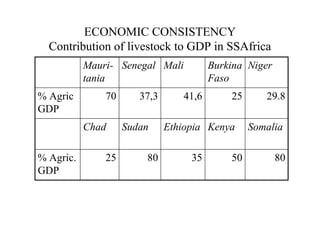
ECONOMIC CONSISTENCY
  Contribution of livestock to GDP in SSAfrica
           Mauri- Senegal Mali          Burkina Niger
           tania                        Faso
% Agric        70      37,3      41,6       25      29.8
GDP
           Chad     Sudan     Ethiopia Kenya     Somalia

% Agric.       25       80         35       50          80
GDP
…despite
• Other important contributions not-
  accounted for, as through informal channels
• Only 3 countries’ PRSP indicate
  investments in livestock for poverty
  reduction
• Average GoV budget to the sector is far
  below 3% (Maputo Decl.)
• Most of this money going to pig and poultry
ENVIRONMENTAL CONSISTENCY
• Arid ecosystems functioning at disequilibrium: rangelands
  are resilient
• Overgrazing not a main problem, rather larger climatic
  shifts
• Environmental degradation higher when mobility is
  hampered / people settle
• Important enviromental services: drylands & mountains
  management, water, biodiversity (i.e. natural parks)
• Extensive livestock production with lower ecological
  footprint
• African and Asian grasslands have vast carbon
  sequestration potential (FAO, 2009).
In a Climate Change perspective…
      as to IPCC: increase in temperature and extreme events,
               raising variability and unpredictability

• Groups inhabiting most exposed and fragile ecosystems
(i.e. mountainous and drylands)

• Potential skills to tackle CChange implications
Itself an adaptive strategy

• Many oil resources found in drylands
Competition and conflict

• Important role of properly managed grasslands as
carbon sinks as well as biodiversity stocks
Reverting cause - effect relationships
            room for discussion

Desertification: Culprits or victims ?
Conflict: Land encroachment, frontiers,
 manipulation ?
Famines: marginal lands, limited investments,
 misconceived policies, unfair markets ?
CChange: doomed or better equipped*?
Operational implications
Cost/benefit analysis
- Political long term engagement

High transaction costs
- Importance of communities active involvement

Mobile livelihoods
- Innovative approaches of service delivery; ICT options

Access to resources
- Governance matters

Exposure to climate vagaries
- LRRD and regional approach
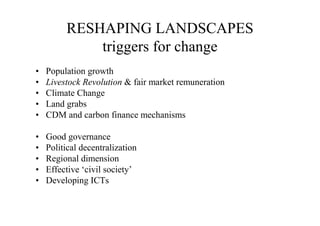
RESHAPING LANDSCAPES
             triggers for change
•   Population growth
•   Livestock Revolution & fair market remuneration
•   Climate Change
•   Land grabs
•   CDM and carbon finance mechanisms

•   Good governance
•   Political decentralization
•   Regional dimension
•   Effective ‘civil society’
•   Developing ICTs
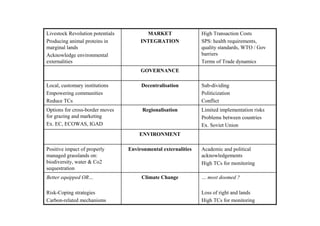
Livestock Revolution potentials          MARKET                 High Transaction Costs
Producing animal proteins in           INTEGRATION              SPS: health requirements,
marginal lands                                                  quality standards, WTO / Gov
Acknowledge environmental                                       barriers
externalities                                                   Terms of Trade dynamics
                                       GOVERNANCE

Local, customary institutions          Decentralisation         Sub-dividing
Empowering communities                                          Politicization
Reduce TCs                                                      Conflict
Options for cross-border moves          Regionalisation         Limited implementation risks
for grazing and marketing                                       Problems between countries
Ex. EC, ECOWAS, IGAD                                            Ex. Soviet Union
                                      ENVIRONMENT

Positive impact of properly       Environmental externalities   Academic and political
managed grasslands on:                                          acknowledgements
biodiversity, water & Co2                                       High TCs for monitoring
sequestration
Better equipped OR…                    Climate Change           … most doomed ?

Risk-Coping strategies                                          Loss of right and lands
Carbon-related mechanisms                                       High TCs for monitoring
Thank you for your attention
             michele.nori@ec.europa.eu

Why Should We Put Pastoralism Back on the Agenda?

  • 1.
    Why should weput pastoralism back on the agenda ? Michele Nori EuropeAID E6 – Quality Support natural resources – rural development
  • 2.
    Contents This presentation aimsat answering these questions: • Who are the pastoralists ? • Which dynamics have characterised pastoral regions in recent decade ? • How could these be redressed ? • What elements should be considered in such process ?
  • 3.
    WHO ARE THEPASTORALISTS Pastoralist are the communities living on arid lands through mobile livestock keeping 1) LIVESTOCK as the main livelihood source; the vital ‘technology’ that allows translating land resources into valuable products for people. 2) MOBILITY as the way to make the best use of marginal natural resources, while enabling their recovery through time. 3) FLEXIBLE arrangements regulating access to resources; common property rights, negotiations Pastoralism is an entire way of life, involving ecological, political, economic, technological, cultural and social dimensions.
  • 4.
    PASTORALISM supports some 200 million pastoral households covers 25 percent of the world’s land area provides for valuable products (protein of milk & meat, fibres) from marginal lands
  • 5.
    Regional zonation ofpastoral systems Zone Main animal species Sub-Saharan Africa Cattle, camel, sheep & goats Mediterranean Region Small ruminants (sheep & goats) India Camel, cattle, sheep, goats Central Asia Yak, camel, horse, sheep, goats Circumpolar Reindeer North America Sheep, cattle Andes Llama, alpaca
  • 6.
    Touareg (W Africa)– Kuchi (Iran) Photos: IFAD
  • 7.
    Mongolia – Tibet Photos: M.Nori & IFAD
  • 8.
    Bedouin (Jordan) –Andes Photos: IFAD
  • 9.
    Horn & Mediterranean Photos: M.Nori & IFAD
  • 10.
    HARSH ENVIRONMENTS Arid territories(drylands or highlands) with extreme climatic patterns. Water limiting factor, not allowing continuous crop cultivation. 3 main characterizing features: - Limitations of overall resource endowment / low average biomass production - limited productivity - Variability of resource distribution through space and time – patchy in time and space - Unpredictability of resource endowment and high degree of risk of extreme climatic events
  • 11.
    Rainfall index variationin the Sahelian region. source: Yann l’Hôte et Al.(2001)
  • 12.
    socio-political marginality -1 FRONTIER LANDS • Geo-political borders (i.e. mountains or deserts), • ‘divide et impera’, nations mix and communities divided • Limited representativity • Areas remote from mainstream central state decision making – SAPs • High Transaction Costs • Poor access to services and infrastructure
  • 13.
    socio-political marginality –2 (MIS)-CONCEIVED AS UNSUSTAINABLE • Economically unviable – Herskovits’ “cattle complex”, 1926 Poor contributors to local economy • Environmental degradation – Hardin’s “tragedy of the commons”, 1968 Culprits for Desertification, UN, 1980s Livestock long Shadow, 2006 Backward agricultural system* Economically irrational & irrelevant Environmental damaging
  • 14.
    Pastoral modernization… Pastoral developmentto be conceived as the END of mobility and communal land access (SEDENTARISATION paradigm), And the PRIVATISATION of resources (rangelands, livestock*) meaning the end of pastoralism. • Unfavourable policies (land, food, trade) • Market dynamics (decreasing ToTs) • External appetites for rangelands – land grabs*
  • 15.
    Development approaches inpastoral areas Period 1950s to 1970s 1980s to 1990s Focus technical aspects of efforts aimed at the livestock readdressing range production system management Actions new breeds, forage grazing reserves, regulating production, feeding ranching, herd sizes, group ranching supplementation, animal land titling, herders’ health / veterinary systems, organizations availability of groundwater
  • 16.
    Current trends –1 GROWING FOOD INSECURITY The current large number of reiterated emergency interventions in pastoral areas stands as the best indicator of the failure of past development approaches (Humanitarian Food Assistance meeting on 16/6/2009)
  • 17.
    THE SILENT HAZARD:drought Reported Death of Natural Hazards globally (1974-2003): 2.066.273 persons Source Hoyois und Guha Sapir (2004); courtesy prof. HG Brauch, UNU-EHS Berlin
  • 18.
    Current trends –2 UPSCALING CONFLICT • Poor Governance – Fragile States • Recent trends: where civilizations clash: Darfur, Kurdistan, Afghanistan, Somalia, SSudan, Middle East, etc… • But also at smaller scale: Ogaden, South Omo, Loliondo, Karamoja, etc…
  • 19.
    Current trends –3 LOWEST HDI - MDGs • From better off to those ranking amongst the poorest and most destitute agriculture peoples in the world (World Bank, 2009) • A number of development syndromes: poverty, desertification, famine, food and social insecurity, migration, conflict and recently insurgency • Most excluded / hardest to reach from primary social services (UNICEF/WHO, 2005) • Regions with deepest endemic poverty, and with the most vulnerable people (CGIAR, 2010) • Not effective integration into state and market dynamics
  • 20.
    Currently HD andMDGs indexes and are at their lowest in such regions (ex.Kenya)
  • 21.
    Failure & Neglect Duringthe 1980s and the 1990s a series of reports clearly showed that the pastoral sector experienced the greatest concentration of failed development projects in the world. Livelihood conditions worsened, rangelands got degraded: Somewhere something had gone wrong Immediate consequences: 1) pastoralists exited the development agenda (20 years ago) - international 2) consistent retrenchment of public investments in marginal areas under SAP - national 3) undermining of pastoral resource management patterns. Policy frames: 1) No policy (no State or neglect) 2) Unfavourable (e.g. Ethiopia, Uganda) 3) Favourable but not implemented (e.g. Sahelian Pastoral Code) 4) Efforts for implementation (e.g. Mongolia, Kenya) The Modernisation through Sedentarisation paradigm shifted to Disaster and Emergency
  • 22.
    Recent acknowledgements -1 • Effective way of producing food (animal proteins) on marginal lands • Ensuring livelihoods & food security to most marginalised communities • Contributions with livestock * environmental services (tourism, water, CO2…)
  • 23.
    Recent acknowledgements -2 • Pastoralism is not an intermediate development stage but rather the result of a process of specialisation in marginal ecosystems • An effective means of coping with a variable and unpredictable climate • Actually the best possible system to produce while protecting drylands • These contributions are likely to become even more important in a Climate Change perspective.
  • 24.
    ECONOMIC CONSISTENCY Contribution of livestock to GDP in SSAfrica Mauri- Senegal Mali Burkina Niger tania Faso % Agric 70 37,3 41,6 25 29.8 GDP Chad Sudan Ethiopia Kenya Somalia % Agric. 25 80 35 50 80 GDP
  • 25.
    …despite • Other importantcontributions not- accounted for, as through informal channels • Only 3 countries’ PRSP indicate investments in livestock for poverty reduction • Average GoV budget to the sector is far below 3% (Maputo Decl.) • Most of this money going to pig and poultry
  • 26.
    ENVIRONMENTAL CONSISTENCY • Aridecosystems functioning at disequilibrium: rangelands are resilient • Overgrazing not a main problem, rather larger climatic shifts • Environmental degradation higher when mobility is hampered / people settle • Important enviromental services: drylands & mountains management, water, biodiversity (i.e. natural parks) • Extensive livestock production with lower ecological footprint • African and Asian grasslands have vast carbon sequestration potential (FAO, 2009).
  • 27.
    In a ClimateChange perspective… as to IPCC: increase in temperature and extreme events, raising variability and unpredictability • Groups inhabiting most exposed and fragile ecosystems (i.e. mountainous and drylands) • Potential skills to tackle CChange implications Itself an adaptive strategy • Many oil resources found in drylands Competition and conflict • Important role of properly managed grasslands as carbon sinks as well as biodiversity stocks
  • 28.
    Reverting cause -effect relationships room for discussion Desertification: Culprits or victims ? Conflict: Land encroachment, frontiers, manipulation ? Famines: marginal lands, limited investments, misconceived policies, unfair markets ? CChange: doomed or better equipped*?
  • 29.
    Operational implications Cost/benefit analysis -Political long term engagement High transaction costs - Importance of communities active involvement Mobile livelihoods - Innovative approaches of service delivery; ICT options Access to resources - Governance matters Exposure to climate vagaries - LRRD and regional approach
  • 30.
    RESHAPING LANDSCAPES triggers for change • Population growth • Livestock Revolution & fair market remuneration • Climate Change • Land grabs • CDM and carbon finance mechanisms • Good governance • Political decentralization • Regional dimension • Effective ‘civil society’ • Developing ICTs
  • 31.
    Livestock Revolution potentials MARKET High Transaction Costs Producing animal proteins in INTEGRATION SPS: health requirements, marginal lands quality standards, WTO / Gov Acknowledge environmental barriers externalities Terms of Trade dynamics GOVERNANCE Local, customary institutions Decentralisation Sub-dividing Empowering communities Politicization Reduce TCs Conflict Options for cross-border moves Regionalisation Limited implementation risks for grazing and marketing Problems between countries Ex. EC, ECOWAS, IGAD Ex. Soviet Union ENVIRONMENT Positive impact of properly Environmental externalities Academic and political managed grasslands on: acknowledgements biodiversity, water & Co2 High TCs for monitoring sequestration Better equipped OR… Climate Change … most doomed ? Risk-Coping strategies Loss of right and lands Carbon-related mechanisms High TCs for monitoring
  • 32.
    Thank you foryour attention michele.nori@ec.europa.eu