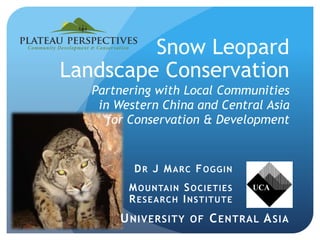
Snow Leopard
Landscape Conservation
Partnering with Local Communities
in Western China and Central Asia
for Conservation & Development
DR J MARC FOGGIN
MOUNTAIN SOCIETIES
RESEARCH INSTITUTE
UNIVERSITY OF CENTRAL ASIA
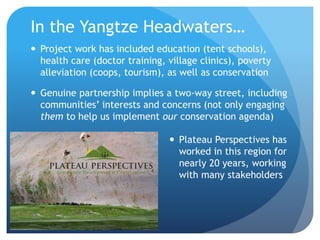
In the Yangtze Headwaters…
 Project work has included education (tent schools),
health care (doctor training, village clinics), poverty
alleviation (coops, tourism), as well as conservation
 Genuine partnership implies a two-way street, including
communities’ interests and concerns (not only engaging
them to help us implement our conservation agenda)
 Plateau Perspectives has
worked in this region for
nearly 20 years, working
with many stakeholders
Tibet Autonomous Region
Under Golmud
Administration
Yushu Tibetan
Autonomous Prefecture
Tsonub Mongolian
and
Tibetan Autonomous Prefecture
Dechen
Tibetan AP
Mili
Tibetan AC
Kartse Tibetan AP
Ngawa Tibetan
and
Qiang AP
Tsojang
Tibetan AP
Tsolho
Tibetan AP
Golog Tibetan AP
Pari
TibetanAC
Haidong
Prefecture
Kanlho
Tibetan
AP
Malho
Tibatan
AP
Xining City
and District
T I B E T A U T O N O M O U S R E G I O N
Q I N G H A I
G A N S U
Y U N N A N
S I C H U A N
China
India
Kazakhstan Mongolia
Myanmar
Thailand
Pakistan
Nepal
Philippines
South
Korea
Area of
detail
Kilometers
0 2,000
Russia
Source: Boundary (Marshall and Cooke, Tibet Outside the TAR, 1997)
Satellite Image (NASA), 2004©Tsering Wangyal Shawa, Princeton University, 2008
Location Map
TIBET
Lhasa
Miles0 150 300
Kilometers0 200 400
X I N J I A N G
I N N E R M O N G O L I A
NINGXIA
AP Autonomous Prefecture
AC Autonomous County
Provincial Boundary
Tibetan Cultural Area
Tibetan Plateau
• Tibet Autonomous
Region (TAR)
• Qinghai Province
• Gansu Province
• Sichuan Province
• Yunnan Province
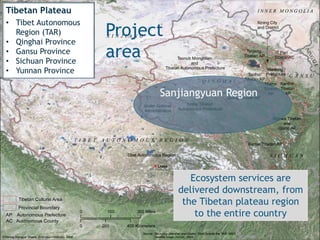
Sanjiangyuan Region
Project
area
Ecosystem services are
delivered downstream, from
the Tibetan plateau region
to the entire country
Sanjiangyuan Nature Reserve
 Ecosystem services are delivered from the Tibetan
plateau region to the entire country – downstream
 Local communities resident inside reserve boundaries
 18 conservation areas, with 3 management zones
 How to incorporate local knowledge into
monitoring, planning, implementation?
Co-management approach
 Building on initiatives that pre-date SNNR
 Translating ‘traditional’ and local knowledge into
‘scientific’ language, and incorporating into plans
 Providing training and capacity building, increasing
awareness of partners’ interests, knowledge, capacities
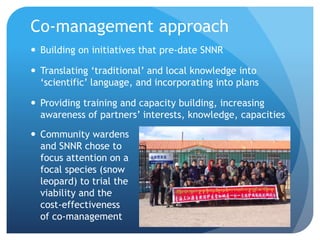
 Community wardens
and SNNR chose to
focus attention on a
focal species (snow
leopard) to trial the
viability and the
cost-effectiveness
of co-management
Snow leopard monitoring
 Seasonal transect surveys by wardens (several wildlife
species) incorporated into SNNR’s standard operations
 Camera traps used to demonstrate gains of partnership
 Finding: one of the world’s highest snow leopard densities
found in local mountain range; leading to further wildlife
research by Chinese universities and other organizations
 However, depth and breadth
of initial partnership difficult
to replicate –requiring time
and commitment beyond
conservation per se
Scaling up the initial success
 Co-management approach scaled up – from initial trial to
provincial PA network (Qinghai Forestry Department)
 Approach integrated into the GEF/UNDP suite of projects
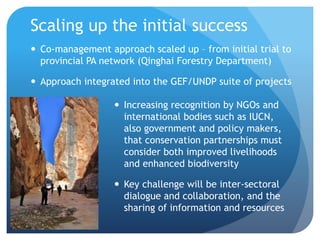
 Increasing recognition by NGOs and
international bodies such as IUCN,
also government and policy makers,
that conservation partnerships must
consider both improved livelihoods
and enhanced biodiversity
 Key challenge will be inter-sectoral
dialogue and collaboration, and the
sharing of information and resources
Highlands of Central Asia
GSLEP Initiative
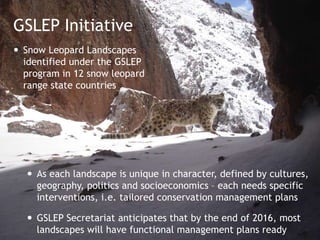
 Snow Leopard Landscapes
identified under the GSLEP
program in 12 snow leopard
range state countries
 As each landscape is unique in character, defined by cultures,
geography, politics and socioeconomics – each needs specific
interventions, i.e. tailored conservation management plans
 GSLEP Secretariat anticipates that by the end of 2016, most
landscapes will have functional management plans ready
23 Snow Leopard Landscapes
However some gaps remain, including
a lack of SLLs on the Tibetan Plateau
Community efforts in Central Asia
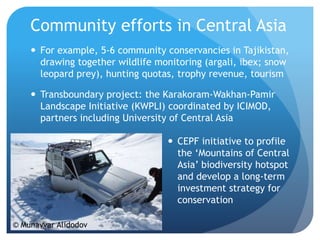
 For example, 5-6 community conservancies in Tajikistan,
drawing together wildlife monitoring (argali, ibex; snow
leopard prey), hunting quotas, trophy revenue, tourism
 Transboundary project: the Karakoram-Wakhan-Pamir
Landscape Initiative (KWPLI) coordinated by ICIMOD,
partners including University of Central Asia
© Munavvar Alidodov
 CEPF initiative to profile
the ‘Mountains of Central
Asia’ biodiversity hotspot
and develop a long-term
investment strategy for
conservation
Contact information
Mountain Societies
Research Institute
msri.ucentralasia.org
Dr J Marc Foggin
Associate Director, MSRI
marc.foggin@ucentralasia.org

Snow Leopard Landscapes

  • 1.
    Snow Leopard Landscape Conservation Partneringwith Local Communities in Western China and Central Asia for Conservation & Development DR J MARC FOGGIN MOUNTAIN SOCIETIES RESEARCH INSTITUTE UNIVERSITY OF CENTRAL ASIA
  • 2.
    In the YangtzeHeadwaters…  Project work has included education (tent schools), health care (doctor training, village clinics), poverty alleviation (coops, tourism), as well as conservation  Genuine partnership implies a two-way street, including communities’ interests and concerns (not only engaging them to help us implement our conservation agenda)  Plateau Perspectives has worked in this region for nearly 20 years, working with many stakeholders
  • 3.
    Tibet Autonomous Region UnderGolmud Administration Yushu Tibetan Autonomous Prefecture Tsonub Mongolian and Tibetan Autonomous Prefecture Dechen Tibetan AP Mili Tibetan AC Kartse Tibetan AP Ngawa Tibetan and Qiang AP Tsojang Tibetan AP Tsolho Tibetan AP Golog Tibetan AP Pari TibetanAC Haidong Prefecture Kanlho Tibetan AP Malho Tibatan AP Xining City and District T I B E T A U T O N O M O U S R E G I O N Q I N G H A I G A N S U Y U N N A N S I C H U A N China India Kazakhstan Mongolia Myanmar Thailand Pakistan Nepal Philippines South Korea Area of detail Kilometers 0 2,000 Russia Source: Boundary (Marshall and Cooke, Tibet Outside the TAR, 1997) Satellite Image (NASA), 2004©Tsering Wangyal Shawa, Princeton University, 2008 Location Map TIBET Lhasa Miles0 150 300 Kilometers0 200 400 X I N J I A N G I N N E R M O N G O L I A NINGXIA AP Autonomous Prefecture AC Autonomous County Provincial Boundary Tibetan Cultural Area Tibetan Plateau • Tibet Autonomous Region (TAR) • Qinghai Province • Gansu Province • Sichuan Province • Yunnan Province Sanjiangyuan Region Project area Ecosystem services are delivered downstream, from the Tibetan plateau region to the entire country
  • 4.
    Sanjiangyuan Nature Reserve Ecosystem services are delivered from the Tibetan plateau region to the entire country – downstream  Local communities resident inside reserve boundaries  18 conservation areas, with 3 management zones  How to incorporate local knowledge into monitoring, planning, implementation?
  • 5.
    Co-management approach  Buildingon initiatives that pre-date SNNR  Translating ‘traditional’ and local knowledge into ‘scientific’ language, and incorporating into plans  Providing training and capacity building, increasing awareness of partners’ interests, knowledge, capacities  Community wardens and SNNR chose to focus attention on a focal species (snow leopard) to trial the viability and the cost-effectiveness of co-management
  • 6.
    Snow leopard monitoring Seasonal transect surveys by wardens (several wildlife species) incorporated into SNNR’s standard operations  Camera traps used to demonstrate gains of partnership  Finding: one of the world’s highest snow leopard densities found in local mountain range; leading to further wildlife research by Chinese universities and other organizations  However, depth and breadth of initial partnership difficult to replicate –requiring time and commitment beyond conservation per se
  • 7.
    Scaling up theinitial success  Co-management approach scaled up – from initial trial to provincial PA network (Qinghai Forestry Department)  Approach integrated into the GEF/UNDP suite of projects  Increasing recognition by NGOs and international bodies such as IUCN, also government and policy makers, that conservation partnerships must consider both improved livelihoods and enhanced biodiversity  Key challenge will be inter-sectoral dialogue and collaboration, and the sharing of information and resources
  • 8.
  • 9.
    GSLEP Initiative  SnowLeopard Landscapes identified under the GSLEP program in 12 snow leopard range state countries  As each landscape is unique in character, defined by cultures, geography, politics and socioeconomics – each needs specific interventions, i.e. tailored conservation management plans  GSLEP Secretariat anticipates that by the end of 2016, most landscapes will have functional management plans ready
  • 10.
    23 Snow LeopardLandscapes However some gaps remain, including a lack of SLLs on the Tibetan Plateau
  • 11.
    Community efforts inCentral Asia  For example, 5-6 community conservancies in Tajikistan, drawing together wildlife monitoring (argali, ibex; snow leopard prey), hunting quotas, trophy revenue, tourism  Transboundary project: the Karakoram-Wakhan-Pamir Landscape Initiative (KWPLI) coordinated by ICIMOD, partners including University of Central Asia © Munavvar Alidodov  CEPF initiative to profile the ‘Mountains of Central Asia’ biodiversity hotspot and develop a long-term investment strategy for conservation
  • 12.
    Contact information Mountain Societies ResearchInstitute msri.ucentralasia.org Dr J Marc Foggin Associate Director, MSRI marc.foggin@ucentralasia.org

Editor's Notes

  • #3 Integrative conservation partnerships for improved livelihoods and enhanced biodiversity Good development is community level development, good conservation is landscape level conservation !!
  • #5 But still need to figure out ‘how to deal with people’
  • #10 GSLEP approach (as stated in endorsed document): “Conservation… with communities”