

Learning Objectives

       Understand   the  challenges           of   international
    performance management.
      Analyze the areas in terms of skills and other traits and
    behaviours to be appraised.
       Understand the conflicting role expectation , difference
    between role and job expectations and expectations from
    different organizations.
      Analyze the variety of appraisers in international
    performance appraisal and determine who should
    appraise the performance?
                                                              1
Chapter Seven        Performance Management
Learning Objectives


      Discuss the system of performance appraisal.

      Understand    the   problems     associated    with   the
    international performance appraisal; and

      Discuss the measures to make the international
    performance management effective.


                                                             2
Chapter Seven       Performance Management
Structure

1)    Introduction
2)    Challenges of international performance management .
3)    Areas to be appraised.
4)    Organizational role expectations.
5)    Who should appraise the performance?
6)    System of performance appraisal.
7)    Problems of performance appraisal.
8)    How to make appraisal effective?
9)    Conclusion
10)    Summary.


                                                             3
Chapter Seven       Performance Management
7.1 Introduction
Managing employee performance based on the organizational
    needs, strategic requirements and customer preferences
    is crucial aspect of international human resource
    management. MNCs incur high cost on human resources
    due to employment of different kinds of foreigners.
    Therefore, they expect the foreigners to perform
    distinctly and create , contribute and add significant
    value to the organizational activities.
Foreign employees are also aware of their cost to MNC and
    are concerned to contribute phenomenally to the
    organization goals and strategies.
MNCs encounter critical challenges in the process of
    international performance management.

                                                        4
Chapter Seven      Performance Management
7.2 Challenges of international performance management

     Total Company versus Parts of it.
     Standard format versus Customized format.
     Uniformity of Data of Performance.
     Environmental variations
     Validity of performance criteria.
     Time and distance variations.
     Varied levels of maturity.
     Rater’s competence.
     Rater’s bias.
     Host environment.
     Cultural adjustments.

                                                            5
Chapter Seven      Performance Management
7.2 Challenges of international performance management

    Total Company versus Parts of it.
MNC consists of headquarters, subsidiaries and its various
    alliance companies. HR manager needs to use different
    type of appraisal technique for each part, as decision
    affects various organs of the MNC differently. Even the
    implementation process of the decision results in
    contrasting outcomes.
The best practice from the point of view of a subsidiary may
    not be the best for HQ or other subsidiaries. Hence
    decisions that benefit most of the parts and on long
    rather than short term basis are to be preferred and
    considered appropriate.
MNCs face similar dichotomy situations in their pricing
    policies.
                                                            6
Chapter Seven      Performance Management
7.2 Challenges of international performance management

    Total Company versus Parts of it.
Now the core issue is how to measure the performance of
    employees working in HQ and subsidiaries , when the HQ
    and subsidiaries follow different strategies and
    implement varied actions. These aspects of dichotomy in
    decision making and implementation also result in
    dichotomy in measuring performance of employees.
Another difficulty of performance appraisal is the time span of
    the impact of the decision or action. Employee makes
    decision in a particular year, but the impact may be in
    other years. Should the performance affected in the year
    of decision or in the year of result of the decision be
    appraised?

                                                             7
Chapter Seven       Performance Management
7.2 Challenges of international performance management
    Standard format versus Customized format.
Normally parameters like profits, return on investment, cash
    flows, productivity, sales per employee, punctuality, rate
    of customer complaints etc are applied to employees in a
    group for measuring their performance. Some MNCs
    additionally apply qualitative parameters like innovation,
    leadership , motivation, judgement , adaptability etc for
    performance appraisal.
Should the HQ and subsidiaries adapt the same and standard
    criteria / performance factors or different criteria.
    Different criteria are appropriate for their individual
    environments but vitiate uniformity of performance
    rating. For a PCN working in a subsidiary should we
    apply HQ or host country criteria is another question that
    has no clear answer.
                                                            8
Chapter Seven       Performance Management
7.2 Challenges of international performance management
     Standard format versus Customized format.
Organizational performance in terms of sales, profits,
     repatriation of profits is influenced by the regulations of
     the host country’s Government like issuing license or
     canceling the issued license, exchange rate controls,
     immigration and migration controls, tariffs, subsidies and
     employment of nationals.
Therefore, increase [or decrease] in profits can’t be always
     attributed to the performance of the employee alone.
In fact MNCs cannot follow a standard format of performance
     rating as the influences of environmental factors vary
     from country to country and hence from subsidiary to
     subsidiary.
                                                              9
Chapter Seven        Performance Management
7.2 Challenges of international performance management

    Uniformity of Data of Performance.
MNCs and their subsidiaries not only work in different
    environment but also carry-out different kinds of
    business including manufacturing, trading, dealing in
    services, construction projects and the like. Therefore
    providing uniform data for appraisal is not feasible. The
    problem can be partially resolved by converting the data
    into [parent company] monetary terms.
But this is not a solution owing to variations in living costs ,
    purchasing power in various countries. Differences in
    accounting standards among countries pose another
    challenge in measuring employee performance on a
    uniform scale.

                                                              10
Chapter Seven        Performance Management
7.2 Challenges of international performance management
     Uniformity of Data of Performance.
Accounting standards differ due to cultural factors that decide
     the degree of conservatism with which accounts are
     prepared. Germans are very conservative while
     Americans optimistic. Accounting system is also oriented
     towards the information requirements of capital
     providers – individual investors or bankers. Political ties
     also determine systems that MNCs follow for accounting.
Historic cost versus inflation accounting provide profits
     numbers that are not comparable. Advanced countries
     procure financial resources from various sources in a
     developed markets through a variety of financial
     instruments and , therefore, follow a sophisticated
     system of accounting. Thus level of economic
     development also impacts data uniformity.

                                                              11
Chapter Seven        Performance Management
7.2 Challenges of international performance management

    Environmental variations
In view of variations in environmental influences among
    subsidiaries as well as different growth rates of
    environments, employees’ performance across the
    subsidiaries cannot be measured using uniform appraisal
    criteria and scale.
Environmental factors became more vibrant after recent
    phase of globalization which initiated trends towards
    erosion of national cultures and formation of global
    culture, establishment of WTO, EU and its currency
    “Euro” , increased mobility of human resource, IT
    revolution, large scale out sourcing, ‘glocal’ strategy etc.


                                                              12
Chapter Seven        Performance Management
7.2 Challenges of international performance management

    Validity of performance criteria.
MNCs use different performance criteria based on end
    contribution to the company and some based on
    employee traits. Former include profits, ROI, cash flows,
    productivity etc. and latter include dynamism,
    decisiveness, initiative, judgement etc. Each of these
    criteria may not be valid for local settings of a subsidiary.
Cultural and social environment, economic system and
    institutional set up , political ideologies and structure that
    influence the business as well as the performance of the
    managers vary from the parent country to the host
    country. Therefore , the performance criteria valid in the
    parent company may not be valid in the host country.

                                                                13
Chapter Seven        Performance Management
7.2 Challenges of international performance management

    Time and distance variations.
Performance of business activities in MNCs is complicated by
    distance and different time zones between parent
    company and subsidiaries.
Measurement of performance of employees working in MNCs
    is challenging compared to those working in domestic
    company as the employees working in the domestic
    companies can meet the colleagues face to face, while
    the employees of the MNCs have a limited choice to do
    so.
The information technology devices like video conferencing,
    emails, fax and telephone, though, have reduced the
    complexities.
                                                            14
Chapter Seven      Performance Management
7.2 Challenges of international performance management

►    Varied levels of maturity.

People of different countries are generally strong in different
    skills, have different levels of maturity and are strong in
    different disciplines. Indians are strong in Mathematics
    and logic, while Americans in systematic analysis.


MNCs should not , therefore, adopt the same performance
   appraisal format and scale to measure the performance
   of employees of home country nationals and different
   host country nationals as well as third country nationals.

                                                             15
Chapter Seven        Performance Management
7.2 Challenges of international performance management

►    Rater’s competence.

The person who appraises the performance of employees of
      the     MNCs, i.e. those who work either in HQ or
      subsidiaries is called the rater. Usually the raters
      executives either in the HQ or in a subsidiary. It is quite
      likely that these raters have no experience of working in
      other countries and they do not know the social,
      business and work challenges that the foreign employees
      face.
It is doubtful if that such raters possess required competence
      to appraise the performance of expatriates.

                                                               16
Chapter Seven        Performance Management
7.2 Challenges of international performance management
►   Rater’s bias.
The problems with subjective measure have opportunity for
    bias. The rater bias include
           Halo effect – the raters have a tendency to
    excessively depend upon rating of one trait or one
    behavioural consideration rather than carry a balanced
    appraisal of all traits or behavioural aspects.
          The Error of Central Tendency – Some raters follow
    the safe policy of rating all employees at the mid point of
    the rating scale and avoid rating at the extreme in spite
    of the employee’s actual performance. Central Tendency
    – Some raters follow the safe policy of rating all
    employees at the mid point of the rating scale and avoid
    rating at the extreme in spite of the employee’s actual
    performance.
                                                             17
Chapter Seven       Performance Management
7.2 Challenges of international performance management
►    Rater’s bias.

           The Leniency and Strictness – The leniency bias
     crops up when some raters consistently assign higher
     rating liberally thereby defeating the whole purpose of
     ratings. Equally damaging one is assigning consistently
     low rates.
           Personal Prejudice – I f the rater dislikes any
     employee or any group , he/she may rate them at the
     lower end , which may distort the rating purpose and
     affect the career of the employee.
          The Recency Effect – The raters remember only the
     recent actions and rate accordingly ignoring employee’s
     performance over the period under appraisal.
                                                             18
Chapter Seven        Performance Management
7.2 Challenges of international performance management

►    Host environment.

Internal environment like structure of the host company
     organization, ownership pattern influence expatriates’
     performance.        100% ownership by parent company,
     against a joint venture, allows PCN to work more
     successfully in the host company.
External environment like social and cultural issues, political
     and economic issues affect the employee performance.
     In addition, availability of school and other educational
     facilities , medical and hospital facilities, recreational
     facilities, security situation & transportation facilities have
     their besring on foreign employee performance.
                                                                  19
Chapter Seven         Performance Management
7.2 Challenges of international performance management

►   Cultural adjustments.
Adjustment of the employee to the organizational culture and
    country’s culture and adjustment of employee’s family
    members to the country’s culture significantly influence
    the employee’s performance.        This fact should be
    considered in evaluation of the performance.

    The analysis of challenges of performance appraisal of
      expatriates reveals that it is rather critical to measure
       expatriate performance. Even it would be difficult to
      measure performance of host country / parent country
       national working in the HQ , as they also encounter
           cultural issues while dealing with foreigners.

                                                              20
Chapter Seven        Performance Management
7.3 Areas to be Appraised

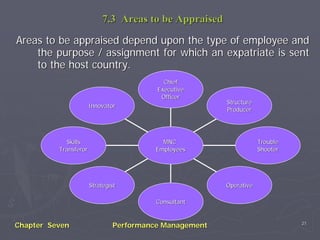
Areas to be appraised depend upon the type of employee and
    the purpose / assignment for which an expatriate is sent
    to the host country.
                                           Chief
                                         Executive
                                          Officer
                                                        Structure
                       Innovator
                                                        Producer


            Skills                         MNC                      Trouble
          Transferor                     Employees                  Shooter


                       Strategist                       Operative

                                         Consultant


                                                                              21
Chapter Seven                  Performance Management
7.3 Areas to be Appraised

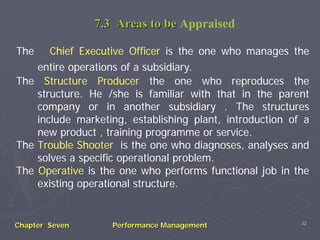
The    Chief Executive Officer is the one who manages the
    entire operations of a subsidiary.
The Structure Producer the one who reproduces the
    structure. He /she is familiar with that in the parent
    company or in another subsidiary . The structures
    include marketing, establishing plant, introduction of a
    new product , training programme or service.
The Trouble Shooter is the one who diagnoses, analyses and
    solves a specific operational problem.
The Operative is the one who performs functional job in the
    existing operational structure.


                                                          22
Chapter Seven      Performance Management
7.3 Areas to be Appraised
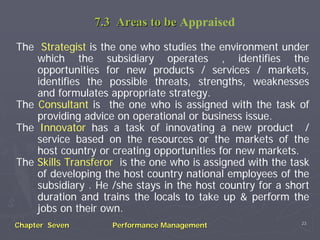
The Strategist is the one who studies the environment under
    which the subsidiary operates , identifies the
    opportunities for new products / services / markets,
    identifies the possible threats, strengths, weaknesses
    and formulates appropriate strategy.
The Consultant is the one who is assigned with the task of
    providing advice on operational or business issue.
The Innovator has a task of innovating a new product /
    service based on the resources or the markets of the
    host country or creating opportunities for new markets.
The Skills Transferor is the one who is assigned with the task
    of developing the host country national employees of the
    subsidiary . He /she stays in the host country for a short
    duration and trains the locals to take up & perform the
    jobs on their own.
                                                            23
Chapter Seven       Performance Management
7.4 Organizational Role Expectations
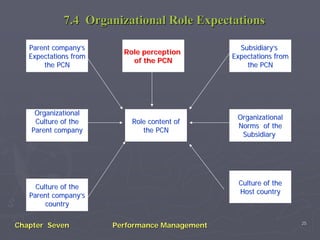
Parent companies predetermine the roles and expectations of
    these roles from the parent country nationals before
    their departure for the host country. The MNC has to
    provide cross culture training along with information
    about of the role expectations to expatriates.

The parent company, the parent company executive and the
    host company should have the common role
    expectations.

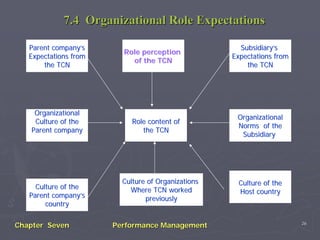
When the third country national is selected for assignment,
   the clear determination of role expectations becomes
   more critical as culture of organizations where the TCN
   worked needs to be considered.

                                                         24
Chapter Seven      Performance Management
7.4 Organizational Role Expectations

   Parent company’s                               Subsidiary’s
                         Role perception
   Expectations from                            Expectations from
                           of the PCN
       the PCN                                      the PCN


    Organizational
                                                 Organizational
    Culture of the         Role content of
                                                 Norms of the
   Parent company             the PCN
                                                  Subsidiary


                                                 Culture of the
     Culture of the
                                                 Host country
   Parent company’s
        country

                                                                    25
Chapter Seven          Performance Management
7.4 Organizational Role Expectations

   Parent company’s                                   Subsidiary’s
                         Role perception
   Expectations from                                Expectations from
                           of the TCN
       the TCN                                          the TCN


    Organizational
                                                     Organizational
    Culture of the          Role content of
                                                     Norms of the
   Parent company              the TCN
                                                      Subsidiary


                         Culture of Organizations    Culture of the
     Culture of the        Where TCN worked          Host country
   Parent company’s             previously
        country

                                                                        26
Chapter Seven          Performance Management
7.4 Organizational Role Expectations

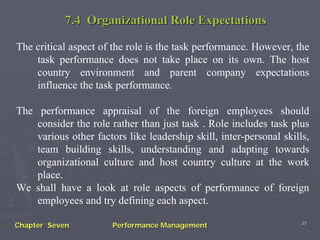
The critical aspect of the role is the task performance. However, the
    task performance does not take place on its own. The host
    country environment and parent company expectations
    influence the task performance.

The performance appraisal of the foreign employees should
    consider the role rather than just task . Role includes task plus
    various other factors like leadership skill, inter-personal skills,
    team building skills, understanding and adapting towards
    organizational culture and host country culture at the work
    place.
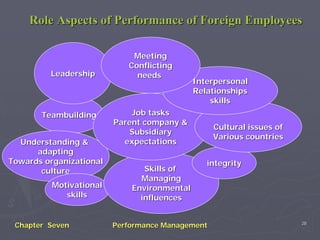
We shall have a look at role aspects of performance of foreign
    employees and try defining each aspect.
                                                                     27
Chapter Seven          Performance Management
Role Aspects of Performance of Foreign Employees

                             Meeting
                            Conflicting
         Leadership           needs
                                             Interpersonal
                                             Relationships
                                                 skills
       Teambuilding          Job tasks
                         Parent company &
                                                  Cultural issues of
                             Subsidiary
                                                  Various countries
  Understanding &          expectations
      adapting
Towards organizational                          integrity
       culture                  Skills of
                               Managing
          Motivational       Environmental
             skills            influences


                                                                       28
 Chapter Seven           Performance Management
7.4 Organizational Role Expectations
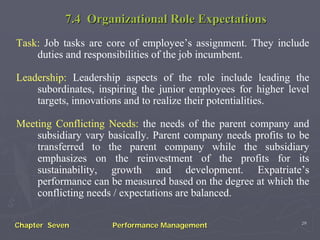
Task: Job tasks are core of employee’s assignment. They include
    duties and responsibilities of the job incumbent.

Leadership: Leadership aspects of the role include leading the
    subordinates, inspiring the junior employees for higher level
    targets, innovations and to realize their potentialities.

Meeting Conflicting Needs: the needs of the parent company and
    subsidiary vary basically. Parent company needs profits to be
    transferred to the parent company while the subsidiary
    emphasizes on the reinvestment of the profits for its
    sustainability, growth and development. Expatriate’s
    performance can be measured based on the degree at which the
    conflicting needs / expectations are balanced.

                                                               29
Chapter Seven        Performance Management
7.4 Organizational Role Expectations

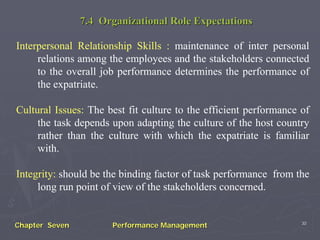
Interpersonal Relationship Skills : maintenance of inter personal
     relations among the employees and the stakeholders connected
     to the overall job performance determines the performance of
     the expatriate.

Cultural Issues: The best fit culture to the efficient performance of
     the task depends upon adapting the culture of the host country
     rather than the culture with which the expatriate is familiar
     with.

Integrity: should be the binding factor of task performance from the
     long run point of view of the stakeholders concerned.


                                                                   30
Chapter Seven         Performance Management
7.4 Organizational Role Expectations
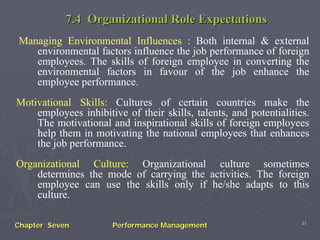
Managing Environmental Influences : Both internal & external
   environmental factors influence the job performance of foreign
   employees. The skills of foreign employee in converting the
   environmental factors in favour of the job enhance the
   employee performance.
Motivational Skills: Cultures of certain countries make the
    employees inhibitive of their skills, talents, and potentialities.
    The motivational and inspirational skills of foreign employees
    help them in motivating the national employees that enhances
    the job performance.
Organizational Culture: Organizational culture sometimes
    determines the mode of carrying the activities. The foreign
    employee can use the skills only if he/she adapts to this
    culture.

                                                                    31
Chapter Seven          Performance Management
7.4 Organizational Role Expectations
Team Building : Team building skills of foreign employee
    invariably enhance their job performance . These skills include
    work along with others, carrying with others, understanding
    the culture and the way others do the work, adjust one’s own
    traits and the way of doing work towards others, skills of
    collaborating with others’ ideas and talents.

These role factors should be taken into account in deciding the areas
    to be appraised of a foreign employee. In addition, to the
    organizational role , the foreign employees’ family roles like
    spouse and parent influences on job performance should also
    be considered. Employee skills and initiative in helping the
    spouse and children in adjustment process forms a part of of
    appraisal of the foreign employee.
.
                                                                   32
Chapter Seven         Performance Management
7.4 Organizational Role Expectations

Areas to be appraised for HCN :

Compared to        domestic company employee measuring
    performance of host country national         is relatively
    difficult as host country nationals work with employees
    of various cultures of parent and third countries . HCN
    have to understand the cultures and predict the
    behaviour of parent country and third country nationals
    and accordingly adjust their interpersonal behaviour.
Therefore, HCN has to be appraised on skills of
    understanding varied cultures and behaviours, cultural
    adaptability and behaviour modification based on others’
    cultures.
                                                            33
Chapter Seven        Performance Management
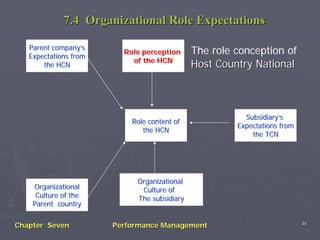
7.4 Organizational Role Expectations

   Parent company’s
   Expectations from
                         Role perception     The role conception of
                           of the HCN
       the HCN                               Host Country National


                                                        Subsidiary’s
                           Role content of
                                                      Expectations from
                              the HCN
                                                          the TCN


                            Organizational
    Organizational           Culture of
     Culture of the         The subsidiary
    Parent country

                                                                          34
Chapter Seven          Performance Management
7.5 Who Should Appraise Performance?

In case of domestic company an employee is appraised by
    the immediate supervisor. In case of a foreign employee
    it is difficult to determine immediate superior as
    managers from the host country as well as the parent
    company supervise / oversee work of a foreign employee
    working in a subsidiary.

Therefore, most of the MNCs use multiple appraisers.
    Performance is appraised by superiors from both the
    parent and host country. In case of PCN appraiser from
    parent country is a must to oversee PCN career
    progression, if not the performance directly.

                                                         35
Chapter Seven      Performance Management
7.5 Who Should Appraise Performance?

Some MNCs adopt 360 degree appraisal process under which
   the foreign employee’s performance is appraised by
   various    stakeholders     like  customers,   bankers,
   government, suppliers, market intermediaries, trade
   unions, subordinates, colleagues, human resource
   professionals, superior in the parent company, superior
   in the subsidiary and certifying officer of the client
   company appraise the performance of the employee.

Even though several persons are party to the appraisal, home
    and host country managers play the key           role in
    appraising.

                                                          36
Chapter Seven      Performance Management
7.6 System of Performance Appraisal.

Performance appraisal of international employees is a 12-step
     process.

i.     Establish performance standards based on job
       description, job specification, cultural requirements, and
       adaptability to foreign environment, talents in enabling
       family members to adjust to foreign environment.
ii.    Communicate standards to employees as well as
       appraisers.
iii.   Decide upon the performance appraisal format.
iv.    Measuring actual performance by the evaluators through
       observation, interviews, records and reports.

                                                               37
Chapter Seven         Performance Management
7.6 System of Performance Appraisal.

Performance appraisal of international employees is a 12-step
     process.

v.      Frequency of appraisal. Normally once a year.
vi.     Adjust actual performance due to environmental
        influence.
vii.     Compare the adjusted performance with that of others
        and the previous performance.
viii.   Compare the actual performance with standards and find
        out deviations , if any.
ix.     Feedback to appraisee. Mutual discussion between the
        appraiser and appraisee, makes appraisal close to
        perfectness in ratings.


                                                            38
Chapter Seven         Performance Management
7.6 System of Performance Appraisal.

Performance appraisal of international employees is a 12-step
     process.

x.     Suggest changes to job analysis and standards to bring
       about improvements in job description, job specification
       and standards of appraisal.
xi.    Consider the appraisal results for contract renewal and
       promotion.
xii.   Plan for employee training and development. Consider
       issues like demonstration of initiatives, realization of
       potentiality, presentation of commitment behaviours,
       exhibiting interpersonal relations, proof of intelligence
       and show casing distinctive capabilities and talents.


                                                              39
Chapter Seven         Performance Management
7.7 Problems in Performance Appraisal.

Performance appraisal of international employees is critical
     and a challenge due to

     Content Bias:- Most MNCs view international
     performance management on the lines of domestic
     performance management and focus on task factors at
     the cost of culture and environment factors when the
     latter play a dominant role in the perfromance of
     international employees.
     Ineffective raters:- MNCs use multiple raters for
     appraisal of foreign employees, but the ratings of the
     rater from the parent company only are considered for
     decisions relating to promotion, revision of compensation
     package or renewal of contract. The rater from parent
     company, sadly, is unaware of the culture of the host
     country or that of the foreign national.
                                                            40
Chapter Seven       Performance Management
7.7 Problems in Performance Appraisal.


     The Recency Effect:- The raters generally remember the
     recent actions of the employee and do not weigh
     employees performance for the period under review.

     Distant Work Place:- Foreign employees working on the
     projects can’t be directly observed even by the host
     country supervisor. Similarly , the performance of other
     employees workers working in the field in different
     places cannot be directly observed by the raters. Added
     to this the parent company superior who never observes
     the employee at work rates the performance.


                                                           41
Chapter Seven       Performance Management
7.7 Problems in Performance Appraisal.

     Appraisal Forms:- MNCs use standard appraisal form for
     the domestic and foreign nationals. Such forms do not
     suit the requirements of PCN, HCN or TCN employees.

     Failure of Superiors in conducting appraisal Interviews:-
     Due to distance factors many raters do not conduct any
     interview with the employee to be appraised.

     Use of Performance Data:- For major decisions like
     promotion, revision to pay package or renewal of
     contract personal opinions or network is used by MNCs
     instead of the data emanating fro performance
     appraisals.
                                                            42
Chapter Seven       Performance Management
7.8 How to Make Performance Appraisal Effective?
The problems discussed could be overcome by adapting

Reliability and Validity:- the appraisal system should provide
     reliable and valid data and information. Techniques of
     appraisal should be designed to assure this.

Appraisal should be relevant:- The technique should be
    designed with the purpose of the appraisal in mind.

Customization of appraisal forms:- Different factors influence
    performance of PCN, HCN and TCN employees. Similarly
    requirements of the parent company and various
    subsidiaries vary significantly. The customized forms
    should cover these and standard forms be discontinued.

                                                            43
Chapter Seven       Performance Management
7.8 How to Make Performance Appraisal Effective?
The problems discussed could be overcome by adapting

Consensus of Appraiser & appraisee:- The appraiser or the
    designer of the appraisal form is not aware of all issues
    affecting job performance, but appraisee knows them .
    Hence the inputs from the appraisee be used in design
    of the form, content of appraisal, technique to be used
    etc.

Open & Continuous Communication:- Foreign employees
    want to know continuously how well they are performing
    on the job. An effective appraisal system should arrange
    for the continuous feedback to the foreign employee.
    Expectations of the appraiser should be clearly indicated
    to employee in advance.
                                                           44
Chapter Seven       Performance Management
7.8 How to Make Performance Appraisal Effective?
The problems discussed could be overcome by adapting

Sensitive to ground realities:- Performance appraisal forms,
    appraisal procedure and evaluators should be sensitive
    to the changing and varying ground realities related to
    culture factors, language, semantics, foreign political
    factors, trade unions. Government policies and
    functioning.

Appraisee’s access to the results:- The employee to be
    appraised must know the rules of the game. He/she
    should receive information and adequate feedback
    about the performance results.

                                                          45
Chapter Seven      Performance Management
7.8 How to Make Performance Appraisal Effective?

The problems discussed could be overcome by adapting

Easy to operate:- Performance appraisal process as well as
    procedure should be easy to operate for the appraiser
    and the employee being appraised.

Rater’s knowledge about the Appraisee:- Rater should be
    provided with information about appraisee’s work,
    behaviour, culture, organizational culture, environmental
    factors affecting appraisee’s work .


                                                           46
Chapter Seven       Performance Management
7.9 Conclusion

International performance appraisal to be effective should be
     close to the ground realities of the country where the
     employee concerned is working. Global performance
     appraisal should not be like local performance appraisal
     for a domestic company.

Therefore, it should be customized for the country, company
    and the employee. Performance management should
    aim at improving the skills rather than making
    employees redundant.


                                                           47
Chapter Seven       Performance Management
7.10 Summary

     International human resource managers as well as
     managements of MNCs face a variety of challenges and
     difficulties in managing the performance of different
     types of employees.
      These challenges include: Total Company versus Parts
     of it, Standard format versus customized format,
     Uniformity of data of performance, Environmental
     variations, Validity of performance criteria, Time and
     distance variations, Varied levels of maturity, Rater’s
     competence, Rater bias, Host environment and cultural
     adjustments.


                                                          48
Chapter Seven      Performance Management
7.10 Summary

     Areas to be appraised vary from one type of the
     employee to other type of employee like parent country
     national, host country national and third country
     national. In addition, it also varies based on the purpose
     / assignment for which expatriate is sent to the host
     country.

     Parent companies predetermine the roles and
     expectations of these roles from the parent country
     nationals before departure for the subsidiary.


                                                             49
Chapter Seven       Performance Management
7.10 Summary

     Performance of the employee is normally appraised by
     the immediate supervisor in case of a domestic
     company.

     International performance management is not that
     effective as it should be , owing to the challenges as well
     as the problems of performance appraisal.


                                                              50
Chapter Seven       Performance Management
Well students
    this brings us to the end of our
  session 07!
            Next we move to session 08
         On “Training & Development”
                         Development
            Chapter eight.

                                         Good Luck!


                                                  51
Chapter Seven   Performance Management
“Like” us on Facebook: 
   p //                 /
http://www.facebook.com/welearnindia 

“Follow” us on Twitter:
http://twitter.com/WeLearnIndia
http://twitter com/WeLearnIndia

Watch informative videos on Youtube: 
http://www.youtube.com/WelingkarDLP