Chapter 4


Staffing International
Operations for
Sustained Global
Growth
       (c) 2009 by Nelson Education Limited.           1
Chapter Learning Objectives

After reading this chapter, you should be able to:
• discuss issues relating to the various approaches to
  staffing foreign operations
• provide reasons for using international assignments:
  filling positions, management development and
  organizational development
• define the various types of international assignments:
  short term, extended and longer term, along with non-
  standard arrangements: commuter, rotator, contractual
  and virtual
                     (c) 2009 by Nelson Education Limited.   2
Chapter Learning Objectives


• describe the role of expatriates and non-expatriates in
  supporting international business activities

• outline the possibilities on a return on investment of
  international assignments

• define the role of the corporate HR function


                      (c) 2009 by Nelson Education Limited.   3
Opening Vignette

  Help!

• IHRM plays a leading role in the staffing of international
  operations by supporting and guiding managers involved
  in assignments in foreign companies.


                      (c) 2009 by Nelson Education Limited.     4
Opening Vignette


• Discuss some of the areas and aspects that should have
  been managed by his company’s HRM team.

• How could the HR function help its Dutch employee?


                     (c) 2009 by Nelson Education Limited.   5
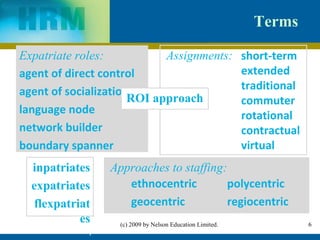
Terms

Expatriate roles:           Assignments:                         short-term
agent of direct control                                          extended
agent of socialization                                           traditional
                      ROI approach                               commuter
language node                                                    rotational
network builder                                                  contractual
boundary spanner                                                 virtual
  inpatriates          Approaches to staffing:
  expatriates             ethnocentric         polycentric
  flexpatriat             geocentric           regiocentric
           es            (c) 2009 by Nelson Education Limited.                 6
      IHRM Chapter 4                                                           6
Approaches to Staffing


•   ethnocentric
•   polycentric
•   geocentric
•   regiocentric


                   (c) 2009 by Nelson Education Limited.   7
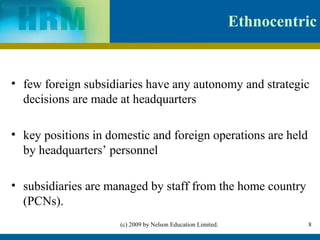
Ethnocentric


• few foreign subsidiaries have any autonomy and strategic
  decisions are made at headquarters

• key positions in domestic and foreign operations are held
  by headquarters’ personnel

• subsidiaries are managed by staff from the home country
  (PCNs).
                     (c) 2009 by Nelson Education Limited.             8
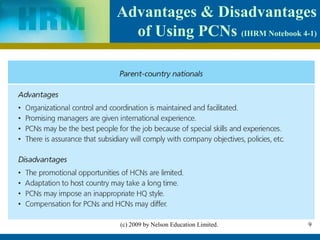
Advantages & Disadvantages
  of Using PCNs (IHRM Notebook 4-1)


(c) 2009 by Nelson Education Limited.   9
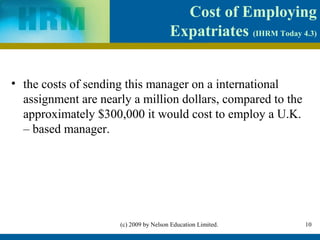
Cost of Employing
                                       Expatriates (IHRM Today 4.3)


• the costs of sending this manager on a international
  assignment are nearly a million dollars, compared to the
  approximately $300,000 it would cost to employ a U.K.
  – based manager.


                     (c) 2009 by Nelson Education Limited.      10
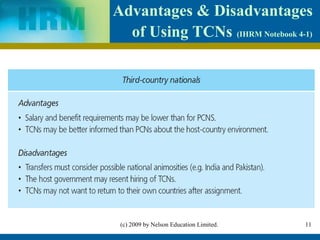
Advantages & Disadvantages
  of Using TCNs (IHRM Notebook 4-1)


 (c) 2009 by Nelson Education Limited.   11
Polycentrism


• subsidiary is treated as a distinct national entity with
  decision‑making autonomy

• subsidiaries are managed by local nationals (HCNs)

• HCNs are seldom promoted to positions at headquarters

• PCNs are rarely transferred to foreign subsidiary
  operations
                       (c) 2009 by Nelson Education Limited.             12
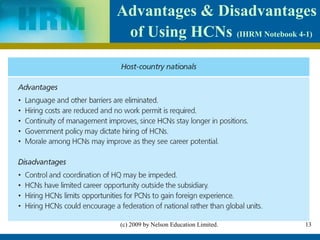
Advantages & Disadvantages
 of Using HCNs (IHRM Notebook 4-1)


(c) 2009 by Nelson Education Limited.   13
Geocentrism


• a global approach to its operations, recognizing that each
  part (subsidiaries and headquarters) makes a unique
  contribution

• world wide integrated business; nationality is ignored in
  favour of ability.


                      (c) 2009 by Nelson Education Limited.            14
Advantages of Geocentrism


• develops international executive teams and internal pools
  of labour

• overcomes federation drawback

• supports cooperation and resource sharing across units


                     (c) 2009 by Nelson Education Limited.   15
Disadvantages of
                                                        Geocentrism


• host governments may utilize immigration controls in
  order to force HCN employment

• companies required to provide extensive documentation

• increased training and relocation costs


                      (c) 2009 by Nelson Education Limited.       16
Disadvantages of
                                                        Geocentrism


• compensation structure with standardized international
  base pay

• large numbers of PCNs, TCNs, and HCNs need to be
  sent abroad

• requires longer lead time and centralized control of the
  staffing process
                      (c) 2009 by Nelson Education Limited.       17
Regiocentrism

• reflects the geographic strategy and structure of the
  MNE

• it utilizes a wider pool of managers but in a limited way

• staff may move outside their countries but only within
  the particular geographic region

• regional managers may not be promoted to headquarters
  positions but enjoy a degree of regional autonomy

                      (c) 2009 by Nelson Education Limited.      18
Advantages of Regiocentrism


• interaction between executives

• sensitivity to local conditions (staffed by HCNs)

• way to gradually move from a purely ethnocentric or
  polycentric approach to a geocentric approach


                     (c) 2009 by Nelson Education Limited.   19
Disadvantages of
                                                      Regiocentrism


• can produce federalism at a regional rather than a country
  basis

• improves career prospects at the national levels


                      (c) 2009 by Nelson Education Limited.       20
A Philosophy Towards
                                               Staffing

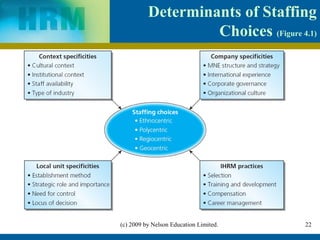
The internal and external contingencies facing an
   internationalizing MNE influence its staffing
   practices
• managerial attitude
• degree of culture differences
• local government requirements
• foreign market
• maturity of operation
• organizational needs
                    (c) 2009 by Nelson Education Limited.   21
Determinants of Staffing
                   Choices (Figure 4.1)


(c) 2009 by Nelson Education Limited.   22
Transferring Staff for International
                                       Business Activities


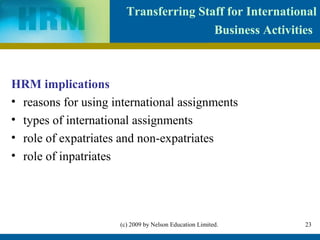
HRM implications
• reasons for using international assignments
• types of international assignments
• role of expatriates and non-expatriates
• role of inpatriates


                     (c) 2009 by Nelson Education Limited.   23
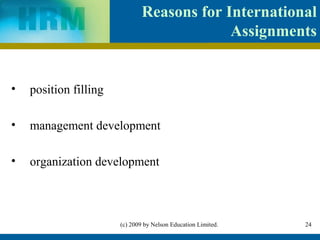
Reasons for International
                                            Assignments


•   position filling

•   management development

•   organization development


                       (c) 2009 by Nelson Education Limited.   24
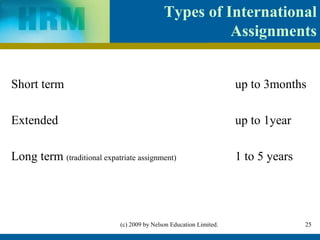
Types of International
                                                       Assignments


Short term                                                           up to 3months

Extended                                                             up to 1year

Long term (traditional expatriate assignment)                        1 to 5 years


                             (c) 2009 by Nelson Education Limited.                  25
Short-term Assignments


• take up to three months

• usually for troubleshooting, project supervision, or a
  stopgap measure


                      (c) 2009 by Nelson Education Limited.   26
Extended Assignments


• up to one year

• may involve similar activities as that for short term
  assignments


                      (c) 2009 by Nelson Education Limited.   27
Long-term Assignments


• traditional expatriate assignment varying from one to five
  years

• involving a clearly defined role in the receiving operation


                      (c) 2009 by Nelson Education Limited.   28
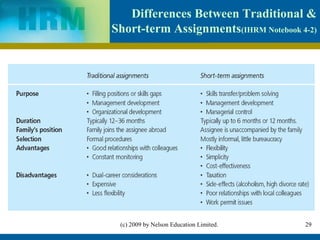
Differences Between Traditional &
Short-term Assignments(IHRM Notebook 4-2)


 (c) 2009 by Nelson Education Limited.   29
Non-standard
               International Assignments

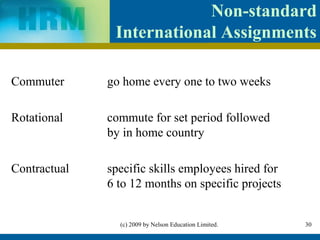
Commuter      go home every one to two weeks

Rotational    commute for set period followed
              by in home country

Contractual   specific skills employees hired for
              6 to 12 months on specific projects


                (c) 2009 by Nelson Education Limited.   30
Non-standard
                      International Assignments
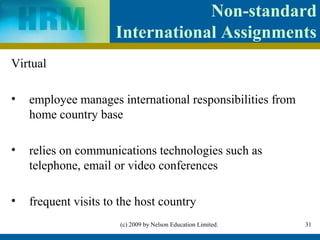
Virtual

•   employee manages international responsibilities from
    home country base

•   relies on communications technologies such as
    telephone, email or video conferences

•   frequent visits to the host country
                       (c) 2009 by Nelson Education Limited.   31
Virtual Assignments

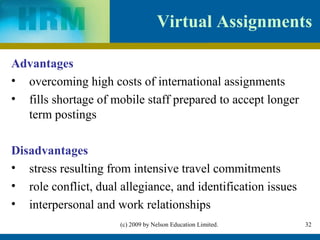
Advantages
• overcoming high costs of international assignments
• fills shortage of mobile staff prepared to accept longer
  term postings

Disadvantages
• stress resulting from intensive travel commitments
• role conflict, dual allegiance, and identification issues
• interpersonal and work relationships
                      (c) 2009 by Nelson Education Limited.   32
The Roles of an Expatriate            (Figure 4.2)


(c) 2009 by Nelson Education Limited.            33
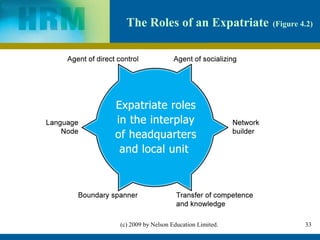
Agent of Direct Control


• subsidiary compliance through direct supervision

• enables strategic objectives for local operations to be
  achieved


                      (c) 2009 by Nelson Education Limited.   34
Agent of Socialization


• the transfer of shared values and beliefs; related to the use
  of corporate culture as an informal control mechanism

• assist in knowledge sharing and competence transfer, and
  adoption of common work practices


                      (c) 2009 by Nelson Education Limited.   35
Network Builders


• develop social capital: fostering interpersonal linkages
  that can be used for informal control and communication
  purposes


                     (c) 2009 by Nelson Education Limited.    36
Boundary Spanners


• collect host country information and act as representatives
  of their firms in the host country

• can influence agents

• bridge internal and external organizational contexts


                      (c) 2009 by Nelson Education Limited.   37
Language Nodes


• many MNEs operate through language standardization –
  or corporate language, usually English.

• employees competent in other languages may be the
  person in which other country representatives preferred to
  conduct queries from the MNE.


                     (c) 2009 by Nelson Education Limited.      38
Transfer of Competence and
                                    Knowledge


• elements from all roles


                     (c) 2009 by Nelson Education Limited.   39
The Role of Non-Expatriates


• travel internationally yet do not relocate to another
  country

• a large proportion of their role involves constant
  international visits to foreign markets, subsidiary units,
  international projects


                      (c) 2009 by Nelson Education Limited.    40
Stress Factors


• the international component of their work is performed
  within the context of their ‘normal’ duties

• a high level of stress involved for those whose job
  responsibilities contain a large proportion of international
  business travel


                      (c) 2009 by Nelson Education Limited.        41
Stress Factors


•   home and family
•   work arrangements
•   travel logistics
•   health concerns
•   host culture issues


                          (c) 2009 by Nelson Education Limited.        42
The Role of Inpatriates


• international assignments of HCNs or TCNs from a
  foreign location to the MNE headquarters

• “linking pins” between the different organizational units


                      (c) 2009 by Nelson Education Limited.   43
Expatriate ROI


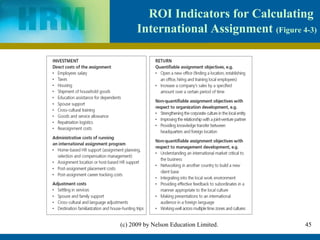
• a calculation in which the financial and non-financial
  benefits to the MNC are compared to the financial and
  non-financial costs of the international assignment


                     (c) 2009 by Nelson Education Limited.    44
ROI Indicators for Calculating
      International Assignment (Figure 4-3)


(c) 2009 by Nelson Education Limited.   45
4-Steps to Calculate
                                                Expatriate ROI


•   identify financial and non-financial costs and benefits.
•   link the costs and benefits to the purpose of the long-term
    assignment.
•   identify the appropriate antecedents from a system’s
    perspective.
•   conduct the calculation at an appropriate time within the
    context of the assignment’s purpose.


                      (c) 2009 by Nelson Education Limited.   46
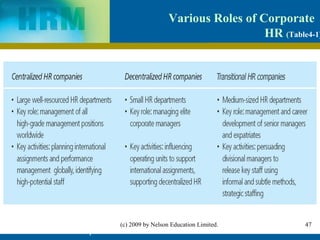
Various Roles of Corporate
                                                     HR (Table4-1)


                 (c) 2009 by Nelson Education Limited.        47
IHRM Chapter 4                                                47
Discussion Questions


1. Outline the main characteristics of the four approaches to
   international staffing.

2. Which factors determine the choice of a staffing approach?
   Would a MNE choose the same staffing approach
   worldwide? Place your arguments in the context of the
   model outlining determinants of staffing choices.


                          (c) 2009 by Nelson Education Limited.   48
         IHRM Chapter 4                                           48
Discussion Questions


3. What are the reasons for using international assignments?

4. What is the role of inpatriates? Do inpatriates guarantee a
   geocentric staffing policy?

5. Why is it important to measure return on investment of
  international assignments? Which indicators can be used?

                           (c) 2009 by Nelson Education Limited.   49
          IHRM Chapter 4                                           49
Discussion Questions


6. As a newly appointed Project Manager of a research team,
   you consider that you will be able to manage the project
   virtually from your office in London, even though the other
   six members are located in Munich. This will solve your
   personal dilemma as your family does not want to be
   relocated. The project has a six-month deadline. What
   factors should you need to consider in order to make this
   virtual assignment effective?


                           (c) 2009 by Nelson Education Limited.   50
          IHRM Chapter 4                                           50
Case: RBC Dexia Investor
                                        Services

Questions PART A
1. When two international companies like RBC and Dexia
   partner up in a joint venture many positions are double
   occupied. From a HR perspective how would you
   approach this problem? What are your options to solve
   this problem?
2. What are some of the other key HR challenges in an
   international partnership such as Canada’s RBC and
   Belgium/Luxembourg Dexia?

                     (c) 2009 by Nelson Education Limited.   51
Case: RBC Dexia Investor
                                        Services

Questions PART A
3. What are your options to fill the 300 additionally
   required jobs in Luxembourg?

4. What kind of impression could the sudden and
   justification lacking announcement of changes at the
   top management level have on employees?


                     (c) 2009 by Nelson Education Limited.   52
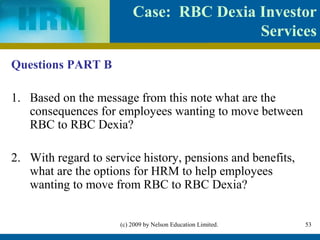
Case: RBC Dexia Investor
                                         Services

Questions PART B

1. Based on the message from this note what are the
   consequences for employees wanting to move between
   RBC to RBC Dexia?

2. With regard to service history, pensions and benefits,
   what are the options for HRM to help employees
   wanting to move from RBC to RBC Dexia?


                     (c) 2009 by Nelson Education Limited.   53

Ihrm chapter4

  • 1.
    Chapter 4 Staffing International Operationsfor Sustained Global Growth (c) 2009 by Nelson Education Limited. 1
  • 2.
    Chapter Learning Objectives Afterreading this chapter, you should be able to: • discuss issues relating to the various approaches to staffing foreign operations • provide reasons for using international assignments: filling positions, management development and organizational development • define the various types of international assignments: short term, extended and longer term, along with non- standard arrangements: commuter, rotator, contractual and virtual (c) 2009 by Nelson Education Limited. 2
  • 3.
    Chapter Learning Objectives •describe the role of expatriates and non-expatriates in supporting international business activities • outline the possibilities on a return on investment of international assignments • define the role of the corporate HR function (c) 2009 by Nelson Education Limited. 3
  • 4.
    Opening Vignette Help! • IHRM plays a leading role in the staffing of international operations by supporting and guiding managers involved in assignments in foreign companies. (c) 2009 by Nelson Education Limited. 4
  • 5.
    Opening Vignette • Discusssome of the areas and aspects that should have been managed by his company’s HRM team. • How could the HR function help its Dutch employee? (c) 2009 by Nelson Education Limited. 5
  • 6.
    Terms Expatriate roles: Assignments: short-term agent of direct control extended agent of socialization traditional ROI approach commuter language node rotational network builder contractual boundary spanner virtual inpatriates Approaches to staffing: expatriates ethnocentric polycentric flexpatriat geocentric regiocentric es (c) 2009 by Nelson Education Limited. 6 IHRM Chapter 4 6
  • 7.
    Approaches to Staffing • ethnocentric • polycentric • geocentric • regiocentric (c) 2009 by Nelson Education Limited. 7
  • 8.
    Ethnocentric • few foreignsubsidiaries have any autonomy and strategic decisions are made at headquarters • key positions in domestic and foreign operations are held by headquarters’ personnel • subsidiaries are managed by staff from the home country (PCNs). (c) 2009 by Nelson Education Limited. 8
  • 9.
    Advantages & Disadvantages of Using PCNs (IHRM Notebook 4-1) (c) 2009 by Nelson Education Limited. 9
  • 10.
    Cost of Employing Expatriates (IHRM Today 4.3) • the costs of sending this manager on a international assignment are nearly a million dollars, compared to the approximately $300,000 it would cost to employ a U.K. – based manager. (c) 2009 by Nelson Education Limited. 10
  • 11.
    Advantages & Disadvantages of Using TCNs (IHRM Notebook 4-1) (c) 2009 by Nelson Education Limited. 11
  • 12.
    Polycentrism • subsidiary istreated as a distinct national entity with decision‑making autonomy • subsidiaries are managed by local nationals (HCNs) • HCNs are seldom promoted to positions at headquarters • PCNs are rarely transferred to foreign subsidiary operations (c) 2009 by Nelson Education Limited. 12
  • 13.
    Advantages & Disadvantages of Using HCNs (IHRM Notebook 4-1) (c) 2009 by Nelson Education Limited. 13
  • 14.
    Geocentrism • a globalapproach to its operations, recognizing that each part (subsidiaries and headquarters) makes a unique contribution • world wide integrated business; nationality is ignored in favour of ability. (c) 2009 by Nelson Education Limited. 14
  • 15.
    Advantages of Geocentrism •develops international executive teams and internal pools of labour • overcomes federation drawback • supports cooperation and resource sharing across units (c) 2009 by Nelson Education Limited. 15
  • 16.
    Disadvantages of Geocentrism • host governments may utilize immigration controls in order to force HCN employment • companies required to provide extensive documentation • increased training and relocation costs (c) 2009 by Nelson Education Limited. 16
  • 17.
    Disadvantages of Geocentrism • compensation structure with standardized international base pay • large numbers of PCNs, TCNs, and HCNs need to be sent abroad • requires longer lead time and centralized control of the staffing process (c) 2009 by Nelson Education Limited. 17
  • 18.
    Regiocentrism • reflects thegeographic strategy and structure of the MNE • it utilizes a wider pool of managers but in a limited way • staff may move outside their countries but only within the particular geographic region • regional managers may not be promoted to headquarters positions but enjoy a degree of regional autonomy (c) 2009 by Nelson Education Limited. 18
  • 19.
    Advantages of Regiocentrism •interaction between executives • sensitivity to local conditions (staffed by HCNs) • way to gradually move from a purely ethnocentric or polycentric approach to a geocentric approach (c) 2009 by Nelson Education Limited. 19
  • 20.
    Disadvantages of Regiocentrism • can produce federalism at a regional rather than a country basis • improves career prospects at the national levels (c) 2009 by Nelson Education Limited. 20
  • 21.
    A Philosophy Towards Staffing The internal and external contingencies facing an internationalizing MNE influence its staffing practices • managerial attitude • degree of culture differences • local government requirements • foreign market • maturity of operation • organizational needs (c) 2009 by Nelson Education Limited. 21
  • 22.
    Determinants of Staffing Choices (Figure 4.1) (c) 2009 by Nelson Education Limited. 22
  • 23.
    Transferring Staff forInternational Business Activities HRM implications • reasons for using international assignments • types of international assignments • role of expatriates and non-expatriates • role of inpatriates (c) 2009 by Nelson Education Limited. 23
  • 24.
    Reasons for International Assignments • position filling • management development • organization development (c) 2009 by Nelson Education Limited. 24
  • 25.
    Types of International Assignments Short term up to 3months Extended up to 1year Long term (traditional expatriate assignment) 1 to 5 years (c) 2009 by Nelson Education Limited. 25
  • 26.
    Short-term Assignments • takeup to three months • usually for troubleshooting, project supervision, or a stopgap measure (c) 2009 by Nelson Education Limited. 26
  • 27.
    Extended Assignments • upto one year • may involve similar activities as that for short term assignments (c) 2009 by Nelson Education Limited. 27
  • 28.
    Long-term Assignments • traditionalexpatriate assignment varying from one to five years • involving a clearly defined role in the receiving operation (c) 2009 by Nelson Education Limited. 28
  • 29.
    Differences Between Traditional& Short-term Assignments(IHRM Notebook 4-2) (c) 2009 by Nelson Education Limited. 29
  • 30.
    Non-standard International Assignments Commuter go home every one to two weeks Rotational commute for set period followed by in home country Contractual specific skills employees hired for 6 to 12 months on specific projects (c) 2009 by Nelson Education Limited. 30
  • 31.
    Non-standard International Assignments Virtual • employee manages international responsibilities from home country base • relies on communications technologies such as telephone, email or video conferences • frequent visits to the host country (c) 2009 by Nelson Education Limited. 31
  • 32.
    Virtual Assignments Advantages • overcominghigh costs of international assignments • fills shortage of mobile staff prepared to accept longer term postings Disadvantages • stress resulting from intensive travel commitments • role conflict, dual allegiance, and identification issues • interpersonal and work relationships (c) 2009 by Nelson Education Limited. 32
  • 33.
    The Roles ofan Expatriate (Figure 4.2) (c) 2009 by Nelson Education Limited. 33
  • 34.
    Agent of DirectControl • subsidiary compliance through direct supervision • enables strategic objectives for local operations to be achieved (c) 2009 by Nelson Education Limited. 34
  • 35.
    Agent of Socialization •the transfer of shared values and beliefs; related to the use of corporate culture as an informal control mechanism • assist in knowledge sharing and competence transfer, and adoption of common work practices (c) 2009 by Nelson Education Limited. 35
  • 36.
    Network Builders • developsocial capital: fostering interpersonal linkages that can be used for informal control and communication purposes (c) 2009 by Nelson Education Limited. 36
  • 37.
    Boundary Spanners • collecthost country information and act as representatives of their firms in the host country • can influence agents • bridge internal and external organizational contexts (c) 2009 by Nelson Education Limited. 37
  • 38.
    Language Nodes • manyMNEs operate through language standardization – or corporate language, usually English. • employees competent in other languages may be the person in which other country representatives preferred to conduct queries from the MNE. (c) 2009 by Nelson Education Limited. 38
  • 39.
    Transfer of Competenceand Knowledge • elements from all roles (c) 2009 by Nelson Education Limited. 39
  • 40.
    The Role ofNon-Expatriates • travel internationally yet do not relocate to another country • a large proportion of their role involves constant international visits to foreign markets, subsidiary units, international projects (c) 2009 by Nelson Education Limited. 40
  • 41.
    Stress Factors • theinternational component of their work is performed within the context of their ‘normal’ duties • a high level of stress involved for those whose job responsibilities contain a large proportion of international business travel (c) 2009 by Nelson Education Limited. 41
  • 42.
    Stress Factors • home and family • work arrangements • travel logistics • health concerns • host culture issues (c) 2009 by Nelson Education Limited. 42
  • 43.
    The Role ofInpatriates • international assignments of HCNs or TCNs from a foreign location to the MNE headquarters • “linking pins” between the different organizational units (c) 2009 by Nelson Education Limited. 43
  • 44.
    Expatriate ROI • acalculation in which the financial and non-financial benefits to the MNC are compared to the financial and non-financial costs of the international assignment (c) 2009 by Nelson Education Limited. 44
  • 45.
    ROI Indicators forCalculating International Assignment (Figure 4-3) (c) 2009 by Nelson Education Limited. 45
  • 46.
    4-Steps to Calculate Expatriate ROI • identify financial and non-financial costs and benefits. • link the costs and benefits to the purpose of the long-term assignment. • identify the appropriate antecedents from a system’s perspective. • conduct the calculation at an appropriate time within the context of the assignment’s purpose. (c) 2009 by Nelson Education Limited. 46
  • 47.
    Various Roles ofCorporate HR (Table4-1) (c) 2009 by Nelson Education Limited. 47 IHRM Chapter 4 47
  • 48.
    Discussion Questions 1. Outlinethe main characteristics of the four approaches to international staffing. 2. Which factors determine the choice of a staffing approach? Would a MNE choose the same staffing approach worldwide? Place your arguments in the context of the model outlining determinants of staffing choices. (c) 2009 by Nelson Education Limited. 48 IHRM Chapter 4 48
  • 49.
    Discussion Questions 3. Whatare the reasons for using international assignments? 4. What is the role of inpatriates? Do inpatriates guarantee a geocentric staffing policy? 5. Why is it important to measure return on investment of international assignments? Which indicators can be used? (c) 2009 by Nelson Education Limited. 49 IHRM Chapter 4 49
  • 50.
    Discussion Questions 6. Asa newly appointed Project Manager of a research team, you consider that you will be able to manage the project virtually from your office in London, even though the other six members are located in Munich. This will solve your personal dilemma as your family does not want to be relocated. The project has a six-month deadline. What factors should you need to consider in order to make this virtual assignment effective? (c) 2009 by Nelson Education Limited. 50 IHRM Chapter 4 50
  • 51.
    Case: RBC DexiaInvestor Services Questions PART A 1. When two international companies like RBC and Dexia partner up in a joint venture many positions are double occupied. From a HR perspective how would you approach this problem? What are your options to solve this problem? 2. What are some of the other key HR challenges in an international partnership such as Canada’s RBC and Belgium/Luxembourg Dexia? (c) 2009 by Nelson Education Limited. 51
  • 52.
    Case: RBC DexiaInvestor Services Questions PART A 3. What are your options to fill the 300 additionally required jobs in Luxembourg? 4. What kind of impression could the sudden and justification lacking announcement of changes at the top management level have on employees? (c) 2009 by Nelson Education Limited. 52
  • 53.
    Case: RBC DexiaInvestor Services Questions PART B 1. Based on the message from this note what are the consequences for employees wanting to move between RBC to RBC Dexia? 2. With regard to service history, pensions and benefits, what are the options for HRM to help employees wanting to move from RBC to RBC Dexia? (c) 2009 by Nelson Education Limited. 53