International
Compensation
Preeti Bhaskar
Symbiosis Center for Management Studies, NOIDA
Objectives of international
compensation
Components of an international
compensation
Approaches to international
compensation
Factors influencing
Compensation,
Theories of compensation
Introduction
Compensation is the amount of remuneration paid to
an employee by the employer in return to the
employee’s services to the company.
Compensation is extrinsic reward for an employee.
Extrinsic rewards include praise from a superior, salary,
employee benefits, career progression etc.
Almost all the employees accept jobs in MNC’s take-up
assignments in various countries, & take-up the risk,
bear inconveniences & discomforts in foreign
assignments mostly based on the compensation
package.
Principles of compensation
• Be legal
• Be adequate
• Be motivating
• Be equitable
• Be cost-benefit effective
• Provide security
Compensation Approach in various countries
• In USA - Compensation package includes: base salary, bonus, long
term incentives & other benefits and peaks. The base salary is the
small part of the total package.
• In Europe – Paid less compensation than that of American
executives, but benefits and Employee perks are much better in
Europe than America.
• In Japan – The compensation levels of CEO’s of large companies
are just one-third of those of American CEO’s. Japanese
compensation is based on seniority of employees.
Compensation- Two issues:
• Pay executives in different countries according
to the standards in each country?
or
Equalize pay on a global basis?
• What should be the Method of payment ?
6
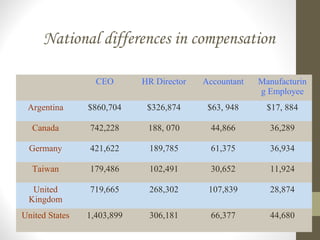
National differences in compensation
CEO HR Director Accountant Manufacturin
g Employee
Argentina $860,704 $326,874 $63, 948 $17, 884
Canada 742,228 188, 070 44,866 36,289
Germany 421,622 189,785 61,375 36,934
Taiwan 179,486 102,491 30,652 11,924
United
Kingdom
719,665 268,302 107,839 28,874
United States 1,403,899 306,181 66,377 44,680
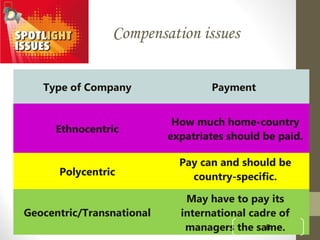
Compensation issues
Type of Company Payment
Ethnocentric
How much home-country
expatriates should be paid.
Polycentric
Pay can and should be
country-specific.
Geocentric/Transnational
May have to pay its
international cadre of
managers the same.8
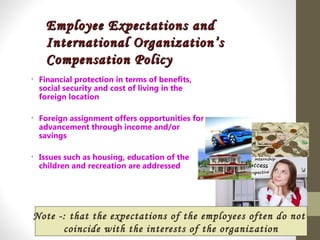
• Financial protection in terms of benefits,
social security and cost of living in the
foreign location
• Foreign assignment offers opportunities for
advancement through income and/or
savings
• Issues such as housing, education of the
children and recreation are addressed
Note -: that the expectations of the employees often do not
coincide with the interests of the organization
Employee Expectations andEmployee Expectations and
International Organization’sInternational Organization’s
Compensation PolicyCompensation Policy
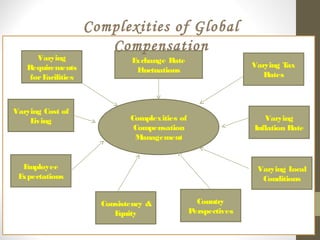
Complexities of
Compensation
Management
Exchange Rate
Fluctuations
Varying Cost of
Living Varying
Inflation Rate
Varying
Requirements
forFacilities
Employee
Expectations
Country
Perspectives
Varying Local
Conditions
Varying Tax
Rates
Consistency &
Equity
Complexities of Global
Compensation
Some Facts about compensation…
• A Chinese manager with 15 years experience costs less than USD
70,000 per annum, A US expatriate manager with corresponding
expertise would cost his or her organization USD 300,000 per year
• Average wage of Chinese worker is only about 3-5% of that of the
U.S. worker.
• Vacation time is not important in benefit to Japanese worker, they
take off 3- 4 days off in a Year. However Vacation and holidays are
important in AFRICA, AMERICA and Asian countries.
• In European countries , efforts are progressing to establish
EUROPAY, by which member nations would develop common
policies regarding compensation practices.
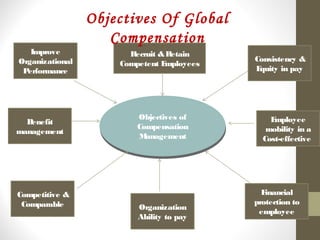
Objectives of
Compensation
Management
Objectives of
Compensation
Management
Recruit &Retain
Competent Employees
Benefit
management
Employee
mobility in a
Cost-effective
Improve
Organizational
Performance
Competitive &
Comparable Organization
Ability to pay
Financial
protection to
employee
Consistency &
Equity in pay
Objectives Of Global
Compensation
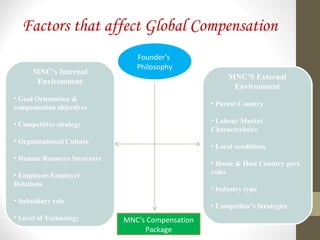
Factors that affect Global Compensation
MNC’s Internal
Environment
• Goal Orientation &
compensation objectives
• Competitive strategy
• Organisational Culture
• Human Resource Structure
• Employee-Employer
Relations
• Subsidiary role
• Level of Technology
MNC’S External
Environment
• Parent Country
• Labour Market
Characteristics
• Local conditions
• Home & Host Country govt.
roles
• Industry type
• Competitor’s Strategies
Founder’s
Philosophy
MNC’s Compensation
Package
Internal Variables influencing International
Compensation Strategy
• Goal orientation
• UK-based foam manufacturer Zotefoam, where equality is a key aspect of
HRM in the company’s mission, the only perks that differentiate executives
from other workers are private health insurance and a car allowance – MD of
the firm sees the internationalizing firm as one with minimal status
differences between levels in the org. hierarchy
• Capacity to pay
• Cost constraints on the enterprise
• Competitive strategy
• If for eg., as part of the MNC competitive strategy, the IHRM strategy is to be
a market leader in employee compensation in order to compete for the most
competent candidates, then the levels of compensation might well be higher
than if the competitive strategy is based on, say, the provision of secure
employment.
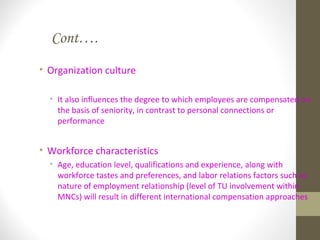
Cont….
• Organization culture
• It also influences the degree to which employees are compensated on
the basis of seniority, in contrast to personal connections or
performance
• Workforce characteristics
• Age, education level, qualifications and experience, along with
workforce tastes and preferences, and labor relations factors such as
nature of employment relationship (level of TU involvement within
MNCs) will result in different international compensation approaches
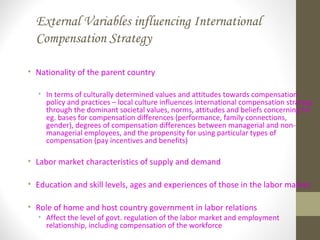
External Variables influencing International
Compensation Strategy
• Nationality of the parent country
• In terms of culturally determined values and attitudes towards compensation
policy and practices – local culture influences international compensation strategy
through the dominant societal values, norms, attitudes and beliefs concerning for
eg. bases for compensation differences (performance, family connections,
gender), degrees of compensation differences between managerial and non-
managerial employees, and the propensity for using particular types of
compensation (pay incentives and benefits)
• Labor market characteristics of supply and demand
• Education and skill levels, ages and experiences of those in the labor market
• Role of home and host country government in labor relations
• Affect the level of govt. regulation of the labor market and employment
relationship, including compensation of the workforce
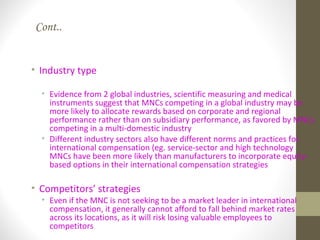
Cont..
• Industry type
• Evidence from 2 global industries, scientific measuring and medical
instruments suggest that MNCs competing in a global industry may be
more likely to allocate rewards based on corporate and regional
performance rather than on subsidiary performance, as favored by MNCs
competing in a multi-domestic industry
• Different industry sectors also have different norms and practices for
international compensation (eg. service-sector and high technology
MNCs have been more likely than manufacturers to incorporate equity-
based options in their international compensation strategies
• Competitors’ strategies
• Even if the MNC is not seeking to be a market leader in international
compensation, it generally cannot afford to fall behind market rates
across its locations, as it will risk losing valuable employees to
competitors
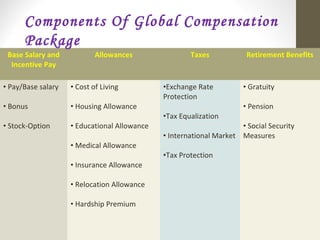
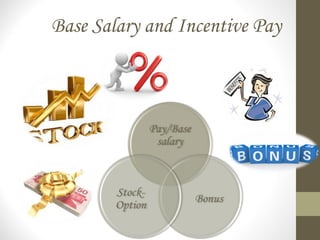
Base Salary and
Incentive Pay
Allowances Taxes Retirement Benefits
• Pay/Base salary
• Bonus
• Stock-Option
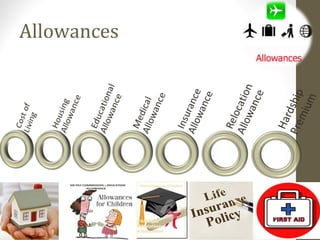
• Cost of Living
• Housing Allowance
• Educational Allowance
• Medical Allowance
• Insurance Allowance
• Relocation Allowance
• Hardship Premium
•Exchange Rate
Protection
•Tax Equalization
• International Market
•Tax Protection
• Gratuity
• Pension
• Social Security
Measures
Components Of Global Compensation
Package
Base Salary and Incentive Pay
Base Salary
• Base salary is a fixed amount of money paid to an employee by
an employer in return for work performed. Base salary does
not include benefits, bonuses or any other potential
compensation from an employer
• The base salary is either paid in the expatriate’s home or
parent country currency, or in the currency of the expatriate’s
host country
Incentives/Variable Pay
• A growing number of MNCs have dropped the ongoing
premium for overseas assignments and replaces it with a
one time, lump- sum premium
• Even in domestic MNCs are preferring one- time premiums
to periodic salaries.
Use of Long Term benefits
• Employee Stock Option Plan (ESOP)
This is plan established by a company wherein a certain
no. of shares are reserved for purchase and issuance to
key employees. Such shares usually vest over a certain
period to serve as an incentive for employees to build
long-term value for the company.
Use of Long Term benefits contd.
Restricted Stock Unit ( RSU)
• This is a plan established by a company, wherein units of stocks are
provided with restrictions on when they can be exercised.
• It is usually issued as partial compensation for employees.
• The restriction generally lifts in 3-5 years when the stock vests.
• IT companies are increasingly using RSUs as incentives since they afford a
lot more flexibility.
Use of Long Term benefits contd
Employee Stock Purchase Plan ( ESPP)
•This is a plan wherein a company sells shares to itsThis is a plan wherein a company sells shares to its
employees usually, at a discount.employees usually, at a discount.
• The company deducts the purchase price of these sharesThe company deducts the purchase price of these shares
every month from employees salary.every month from employees salary.
Allowances
Cost of Living Allowance –
•Payment made to the expatriate with a view to
compensating for differences in expenditure between the
home or parent country and the host country.
•Factors such as inflation differentials and the price level
need to be considered. Often, the cost of living allowance is
difficult to determine
Housing Allowance –
•Payment made to the expatriate with a view to ensuring that
he or she can maintain their home-country living standard in
the host country.
•Alternatively, an organization may provide housing facilities
on a mandatory or optional basis.
•Also, support services may be provided to the expatriate, for
example, by helping sell or rent the expatriate’s house in the
home country
Home Leave Allowance –
•Payment made to the expatriate with a view to facilitating their visit back to
the home country, once or twice a year. Home leave enables the expatriate to
renew business, family and social ties, and thus avoid adjustment problems
subsequent to repatriation
Relocation Allowance –
•Payment made with a view to enable the relocation of the
expatriate to the assignment location. Includes moving, shipping,
storage costs, subsidies for purchase of appliances and (possibly)
an automobile
Education Allowance –
•Payment made with a view to supporting the education of the
expatriate’s children, i.e. tuition, language class, school enrollment
fees, books and supplies, transportation to educational
establishment, room and boarding, school uniforms etc.
•Problems regarding the level of education required and adequacy
of schools in the host country, and transportation to other
localities may pose significant problems for organizations
• Miscellaneous Allowances –
• Depending on the level of seniority of the expatriate,
payments to him or her for club memberships, sport
associations, maintenance of household staff etc. may
be rendered
• In addition, the organization may render financial
assistance to the spouse for her or his loss of income
as a result of the transfer of the expatriate
Benefits –
•Support rendered to an expatriate in addition to the
allowances provided. There are several types of benefits, more
prominent examples being:
•Social Security Benefits (home country or host country?)
•Paid Vacations for expatriate and family
•Rest and Rehabilitation leave (especially for expatriates based
in “hardship” assignment locations)
•Emergency Cases (severe illness, death)
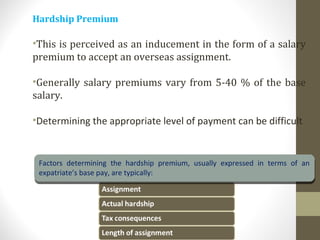
Hardship Premium
•This is perceived as an inducement in the form of a salary
premium to accept an overseas assignment.
•Generally salary premiums vary from 5-40 % of the base
salary.
•Determining the appropriate level of payment can be difficult
Factors determining the hardship premium, usually expressed in terms of an
expatriate’s base pay, are typically:
Factors determining the hardship premium, usually expressed in terms of an
expatriate’s base pay, are typically:
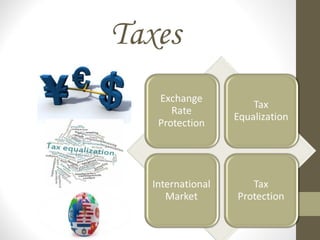
Taxes
Taxation
• Problems , Issues and Challenges
• Dual tax cost : Expatriates paying taxes in both home
and host country.
• Need to consider personal and corporate taxes in
addition to income tax
• Modifying compensation packages to provide the
most tax-effective, appropriate rewards within the
overall compensation framework
Taxation
• Issues while considering benefits
• Whether or not to maintain expatriates in home country programs, particularly if the
company does not receive tax deduction for it.
• Whether companies have the option of enrolling expatriates in host-country benefit
programs and /or making up any difference in coverage
• Whether host-country legislation regarding termination affects benefit entitlement
• Whether expatriates should receive home country or host country social security
benefits
• Whether benefits should be maintained on home country or host country basis, who
is responsible for the cost, whether other benefits should be used to offset any
shortfall and whether home country benefit programs should be exported to local
nationals in foreign countries
TAX EQUALISATION
• Organizations withhold an amount equal to the home country
tax obligation of the PCN and pay all taxes in the host country.
• Firms withhold an amount equal to home country tax
obligation, and pay all taxes in the host country
• By far the more common taxation policy used by multinationals
• Tax payments equal to liability of home country tax payer with
same income and family status are imposed on employee’s
salary and bonus
• Additional premiums or allowances are paid tax free
TAX PROTECTIONTAX PROTECTION
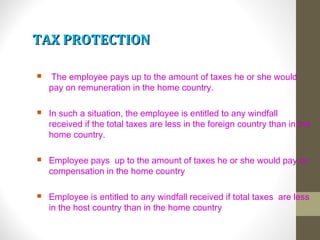
 The employee pays up to the amount of taxes he or she would
pay on remuneration in the home country.
 In such a situation, the employee is entitled to any windfall
received if the total taxes are less in the foreign country than in the
home country.
 Employee pays up to the amount of taxes he or she would pay on
compensation in the home country
 Employee is entitled to any windfall received if total taxes are less
in the host country than in the home country
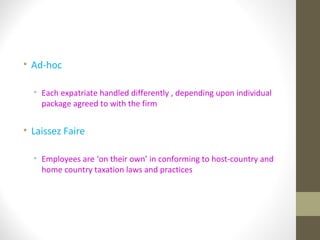
• Ad-hoc
• Each expatriate handled differently , depending upon individual
package agreed to with the firm
• Laissez Faire
• Employees are ‘on their own’ in conforming to host-country and
home country taxation laws and practices
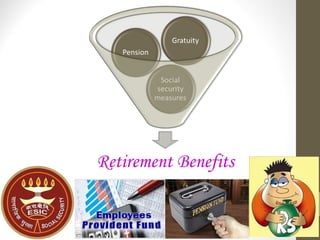
Retirement Benefits
• Gratuity
Gratuity is a defined benefit plan and is one of the many retirement
benefits offered by the employer to the employee upon leaving his job.
An employee may leave his job for various reasons, such as -
retirement/superannuation, for a better job elsewhere, on being
retrenched or by way of voluntary retirement.
Retirement Benefits
• Pension
A pension is a contract for a fixed sum to be paid regularly to a person,
typically following retirement from service.
Types of pensions
• Employment-based pensions (retirement plans)
• Social and state pensions
• Disability pensions
Retirement Benefits
• Social Security Measures
Social Security is a comprehensive approach designed to prevent deprivation,
assure the individual of a basic minimum income for himself and his
dependents and to protect the individual from any uncertainties.
• The Employees’ Provident Funds & Miscellaneous Provisions Act, 195
• The Employees’ State Insurance Act, 1948 (ESI Act)
• The Workmen’s Compensation Act, 1923 (WC Act)
• The Maternity Benefit Act, 1961 (M.B. Act)
• The Payment of Gratuity Act, 1972 (P.G. Act)
International living costs data
• Obtaining upto-date information on international living costs
is a constant issue for MNEs
• The MNEs take the services of consulting firms
• These firms conduct regular surveys calculating a cost-of-living
index that is updated in terms of currency exchange rates
• This data is a very important issue to expatriate employees
and forms the basis of many complaints if there are updating
lags on compensation package rise
Cont….
• MNEs must also respond to unexpected events such as
currency and stock market crash. For eg (Asian crisis)
• Such events have a dramatic impact on prices and the
cost of living
• MNEs must also decide what to include in the ‘basket-of-
goods’ which the consulting firms use to decide the living
costs
Theories of
compensation
Contingency theory
(most popular)
Expats compensation should be based
on particular contingencies or situation
prevailing in a host country. The
compensation Phil. In every
organization is normally de centralized
and allows units to localize the
compensation structure
Resources based theory:
• Human resource is the greatest asset of the MNCs in its
competitive advantage needs good pay and st. salary band for
cont. motivation. The organizations follow this theory, remain
market – sensitive and are constantly reviewing
compensation to retain their position in the hiring and
retaining the talents
The Agency Theory
• This theory focused on the divergent interests and goals of
org.’s stakeholders and the way that employees
compensation can be used to align these interests & goals.
According to this theory, there exists a principle – agency
relationship between the MNCs HQ and its Subsidiaries for
Expats Compensation.
Equity Theory:
• Equity theory suggests that there should be a fair balance
between an expatriate’s contribution to an MNC and what
he / she receives as compensation. Of late, the equity
principle is sought to be compromised with a new approach to
compensation – “ Person based rather job centric” .
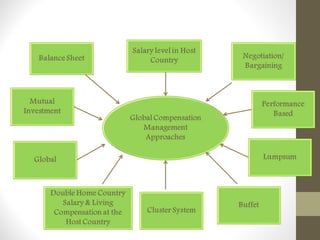
Approaches of
Global Compensation
Management
Salary Level in Host Country
Approach
It is also called Localization Approach
Global compensation is based on salary levels for similar jobs
in comparable organizations in the host country
For example, HSBS in India pays salaries to Indians(host
country nationals), Chinese(parent country nationals) &
Americans(third country nationals)based on: salary levels of
Indian banks like ICICI,IDBI,HDFC or salary levels of foreign
banks operating in India like Citi bank or salary levels of other
Chinese financial institutions operating in India.
Negotiation/Bargaining Approach
• Some employees as well as MNC’s prefer to determine
the compensation package through mutual negotiations
between the employee & the employer.
• It would be possible when –
The number of expatriates is relatively less
The company & prospective employee have full
knowledge of on-going salary levels,
The skills of the prospective employee are in short
supply.
Lumpsum Approach
• Under this, MNC determines the total package in
money value that covers the base salary, all kinds of
allowances and benefits.
• The employee is provided with the freedom of
allocating the money & deciding up on the type and
quality of housing, medical, conveyance, education for
self & family members, air travel, recreational
facilities, taxation, repatriation of savings, seeting-in,
setting-out, exchange rate production etc.
Buffet Approach
• Under this, the total salary level is determined by the
organization & the employee given an option to decide the
cash component & benefits component in the total
compensation package
• Employees normally select more components of benefits
depending upon their needs & remaining portion of the
compensation in the form of cash.
• This option reduces the tax burden
Cluster Systems Approach
• MNC’s segment the countries and/or cities into clusters based
on the cost of living & other factors like hardships & danger
issues that affect the compensation package.
• They determine more or less same compensation package for
each job within the same cluster of cities.
• This approach reduces the cost of complexities in the
compensation administration.
Global Approach
• Under this approach, MNC determine the uniform pay scales
for such jobs throughout all the countries where they
operate. Further, these pay scales are applicable uniformly
for all categories of employees including the host country
nationals
• This approach is based on the concept of national pay scales
with in a country.
Performance Based Approach
• This approach provides the opportunity for best performers to
earn high salary irrespective of nationality including host
country nationals.
• This approach provides a minimum guaranteed base salary
irrespective of performance that would be enough to meet
the basic needs of employees.
• This approach is organisation friendly as it enhances
organisation performance & increases value & productivity.
Double Home Country Salary & LivingDouble Home Country Salary & Living
Compensation at the Host Country ApproachCompensation at the Host Country Approach
• Under this approach, MNC’s determine the package in such a
way that the expatriates get compensation best domestic
salary plus living host country compensation.
• Double home country salary would be the double of the best
salary that a best candidate gets in the home country for a
similar job.
Balance Sheet ApproachBalance Sheet Approach
• Basic objective of global compensation is maintenance of
home-country living standard plus financial inducement
• Home-country pay and benefits are the foundations of this
approach
• Adjustments to home package to balance additional
expenditure in host country
• Financial incentives (expatriate/hardship premium) added
to make the package attractive
• Most common system in usage by multinational firms
Contd…
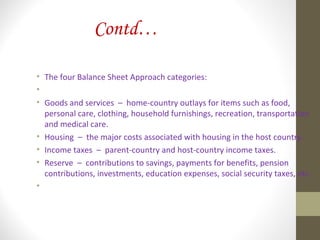
• The four Balance Sheet Approach categories:
•
• Goods and services – home-country outlays for items such as food,
personal care, clothing, household furnishings, recreation, transportation
and medical care.
• Housing – the major costs associated with housing in the host country.
• Income taxes – parent-country and host-country income taxes.
• Reserve – contributions to savings, payments for benefits, pension
contributions, investments, education expenses, social security taxes, etc.
•
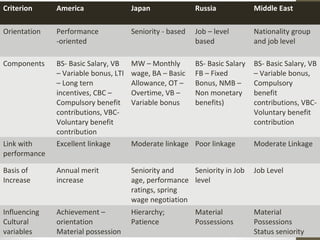
Criterion America Japan Russia Middle East
Orientation Performance
-oriented
Seniority - based Job – level
based
Nationality group
and job level
Components BS- Basic Salary, VB
– Variable bonus, LTI
– Long tern
incentives, CBC –
Compulsory benefit
contributions, VBC-
Voluntary benefit
contribution
MW – Monthly
wage, BA – Basic
Allowance, OT –
Overtime, VB –
Variable bonus
BS- Basic Salary
FB – Fixed
Bonus, NMB –
Non monetary
benefits)
BS- Basic Salary, VB
– Variable bonus,
Compulsory
benefit
contributions, VBC-
Voluntary benefit
contribution
Link with
performance
Excellent linkage Moderate linkage Poor linkage Moderate Linkage
Basis of
Increase
Annual merit
increase
Seniority and
age, performance
ratings, spring
wage negotiation
Seniority in Job
level
Job Level
Influencing
Cultural
variables
Achievement –
orientation
Material possession
Hierarchy;
Patience
Material
Possessions
Material
Possessions
Status seniority
Thank You

Chapter 5 international compensation

  • 1.
  • 2.
    Objectives of international compensation Componentsof an international compensation Approaches to international compensation Factors influencing Compensation, Theories of compensation
  • 3.
    Introduction Compensation is theamount of remuneration paid to an employee by the employer in return to the employee’s services to the company. Compensation is extrinsic reward for an employee. Extrinsic rewards include praise from a superior, salary, employee benefits, career progression etc. Almost all the employees accept jobs in MNC’s take-up assignments in various countries, & take-up the risk, bear inconveniences & discomforts in foreign assignments mostly based on the compensation package.
  • 4.
    Principles of compensation •Be legal • Be adequate • Be motivating • Be equitable • Be cost-benefit effective • Provide security
  • 5.
    Compensation Approach invarious countries • In USA - Compensation package includes: base salary, bonus, long term incentives & other benefits and peaks. The base salary is the small part of the total package. • In Europe – Paid less compensation than that of American executives, but benefits and Employee perks are much better in Europe than America. • In Japan – The compensation levels of CEO’s of large companies are just one-third of those of American CEO’s. Japanese compensation is based on seniority of employees.
  • 6.
    Compensation- Two issues: •Pay executives in different countries according to the standards in each country? or Equalize pay on a global basis? • What should be the Method of payment ? 6
  • 7.
    National differences incompensation CEO HR Director Accountant Manufacturin g Employee Argentina $860,704 $326,874 $63, 948 $17, 884 Canada 742,228 188, 070 44,866 36,289 Germany 421,622 189,785 61,375 36,934 Taiwan 179,486 102,491 30,652 11,924 United Kingdom 719,665 268,302 107,839 28,874 United States 1,403,899 306,181 66,377 44,680
  • 8.
    Compensation issues Type ofCompany Payment Ethnocentric How much home-country expatriates should be paid. Polycentric Pay can and should be country-specific. Geocentric/Transnational May have to pay its international cadre of managers the same.8
  • 9.
    • Financial protectionin terms of benefits, social security and cost of living in the foreign location • Foreign assignment offers opportunities for advancement through income and/or savings • Issues such as housing, education of the children and recreation are addressed Note -: that the expectations of the employees often do not coincide with the interests of the organization Employee Expectations andEmployee Expectations and International Organization’sInternational Organization’s Compensation PolicyCompensation Policy
  • 10.
    Complexities of Compensation Management Exchange Rate Fluctuations VaryingCost of Living Varying Inflation Rate Varying Requirements forFacilities Employee Expectations Country Perspectives Varying Local Conditions Varying Tax Rates Consistency & Equity Complexities of Global Compensation
  • 11.
    Some Facts aboutcompensation… • A Chinese manager with 15 years experience costs less than USD 70,000 per annum, A US expatriate manager with corresponding expertise would cost his or her organization USD 300,000 per year • Average wage of Chinese worker is only about 3-5% of that of the U.S. worker. • Vacation time is not important in benefit to Japanese worker, they take off 3- 4 days off in a Year. However Vacation and holidays are important in AFRICA, AMERICA and Asian countries. • In European countries , efforts are progressing to establish EUROPAY, by which member nations would develop common policies regarding compensation practices.
  • 12.
    Objectives of Compensation Management Objectives of Compensation Management Recruit&Retain Competent Employees Benefit management Employee mobility in a Cost-effective Improve Organizational Performance Competitive & Comparable Organization Ability to pay Financial protection to employee Consistency & Equity in pay Objectives Of Global Compensation
  • 13.
    Factors that affectGlobal Compensation MNC’s Internal Environment • Goal Orientation & compensation objectives • Competitive strategy • Organisational Culture • Human Resource Structure • Employee-Employer Relations • Subsidiary role • Level of Technology MNC’S External Environment • Parent Country • Labour Market Characteristics • Local conditions • Home & Host Country govt. roles • Industry type • Competitor’s Strategies Founder’s Philosophy MNC’s Compensation Package
  • 14.
    Internal Variables influencingInternational Compensation Strategy • Goal orientation • UK-based foam manufacturer Zotefoam, where equality is a key aspect of HRM in the company’s mission, the only perks that differentiate executives from other workers are private health insurance and a car allowance – MD of the firm sees the internationalizing firm as one with minimal status differences between levels in the org. hierarchy • Capacity to pay • Cost constraints on the enterprise • Competitive strategy • If for eg., as part of the MNC competitive strategy, the IHRM strategy is to be a market leader in employee compensation in order to compete for the most competent candidates, then the levels of compensation might well be higher than if the competitive strategy is based on, say, the provision of secure employment.
  • 15.
    Cont…. • Organization culture •It also influences the degree to which employees are compensated on the basis of seniority, in contrast to personal connections or performance • Workforce characteristics • Age, education level, qualifications and experience, along with workforce tastes and preferences, and labor relations factors such as nature of employment relationship (level of TU involvement within MNCs) will result in different international compensation approaches
  • 16.
    External Variables influencingInternational Compensation Strategy • Nationality of the parent country • In terms of culturally determined values and attitudes towards compensation policy and practices – local culture influences international compensation strategy through the dominant societal values, norms, attitudes and beliefs concerning for eg. bases for compensation differences (performance, family connections, gender), degrees of compensation differences between managerial and non- managerial employees, and the propensity for using particular types of compensation (pay incentives and benefits) • Labor market characteristics of supply and demand • Education and skill levels, ages and experiences of those in the labor market • Role of home and host country government in labor relations • Affect the level of govt. regulation of the labor market and employment relationship, including compensation of the workforce
  • 17.
    Cont.. • Industry type •Evidence from 2 global industries, scientific measuring and medical instruments suggest that MNCs competing in a global industry may be more likely to allocate rewards based on corporate and regional performance rather than on subsidiary performance, as favored by MNCs competing in a multi-domestic industry • Different industry sectors also have different norms and practices for international compensation (eg. service-sector and high technology MNCs have been more likely than manufacturers to incorporate equity- based options in their international compensation strategies • Competitors’ strategies • Even if the MNC is not seeking to be a market leader in international compensation, it generally cannot afford to fall behind market rates across its locations, as it will risk losing valuable employees to competitors
  • 18.
    Base Salary and IncentivePay Allowances Taxes Retirement Benefits • Pay/Base salary • Bonus • Stock-Option • Cost of Living • Housing Allowance • Educational Allowance • Medical Allowance • Insurance Allowance • Relocation Allowance • Hardship Premium •Exchange Rate Protection •Tax Equalization • International Market •Tax Protection • Gratuity • Pension • Social Security Measures Components Of Global Compensation Package
  • 19.
    Base Salary andIncentive Pay
  • 20.
    Base Salary andIncentive Pay Base Salary • Base salary is a fixed amount of money paid to an employee by an employer in return for work performed. Base salary does not include benefits, bonuses or any other potential compensation from an employer • The base salary is either paid in the expatriate’s home or parent country currency, or in the currency of the expatriate’s host country
  • 21.
    Incentives/Variable Pay • Agrowing number of MNCs have dropped the ongoing premium for overseas assignments and replaces it with a one time, lump- sum premium • Even in domestic MNCs are preferring one- time premiums to periodic salaries.
  • 22.
    Use of LongTerm benefits • Employee Stock Option Plan (ESOP) This is plan established by a company wherein a certain no. of shares are reserved for purchase and issuance to key employees. Such shares usually vest over a certain period to serve as an incentive for employees to build long-term value for the company.
  • 23.
    Use of LongTerm benefits contd. Restricted Stock Unit ( RSU) • This is a plan established by a company, wherein units of stocks are provided with restrictions on when they can be exercised. • It is usually issued as partial compensation for employees. • The restriction generally lifts in 3-5 years when the stock vests. • IT companies are increasingly using RSUs as incentives since they afford a lot more flexibility.
  • 24.
    Use of LongTerm benefits contd Employee Stock Purchase Plan ( ESPP) •This is a plan wherein a company sells shares to itsThis is a plan wherein a company sells shares to its employees usually, at a discount.employees usually, at a discount. • The company deducts the purchase price of these sharesThe company deducts the purchase price of these shares every month from employees salary.every month from employees salary.
  • 25.
  • 26.
    Cost of LivingAllowance – •Payment made to the expatriate with a view to compensating for differences in expenditure between the home or parent country and the host country. •Factors such as inflation differentials and the price level need to be considered. Often, the cost of living allowance is difficult to determine
  • 27.
    Housing Allowance – •Paymentmade to the expatriate with a view to ensuring that he or she can maintain their home-country living standard in the host country. •Alternatively, an organization may provide housing facilities on a mandatory or optional basis. •Also, support services may be provided to the expatriate, for example, by helping sell or rent the expatriate’s house in the home country
  • 28.
    Home Leave Allowance– •Payment made to the expatriate with a view to facilitating their visit back to the home country, once or twice a year. Home leave enables the expatriate to renew business, family and social ties, and thus avoid adjustment problems subsequent to repatriation Relocation Allowance – •Payment made with a view to enable the relocation of the expatriate to the assignment location. Includes moving, shipping, storage costs, subsidies for purchase of appliances and (possibly) an automobile
  • 29.
    Education Allowance – •Paymentmade with a view to supporting the education of the expatriate’s children, i.e. tuition, language class, school enrollment fees, books and supplies, transportation to educational establishment, room and boarding, school uniforms etc. •Problems regarding the level of education required and adequacy of schools in the host country, and transportation to other localities may pose significant problems for organizations
  • 30.
    • Miscellaneous Allowances– • Depending on the level of seniority of the expatriate, payments to him or her for club memberships, sport associations, maintenance of household staff etc. may be rendered • In addition, the organization may render financial assistance to the spouse for her or his loss of income as a result of the transfer of the expatriate
  • 31.
    Benefits – •Support renderedto an expatriate in addition to the allowances provided. There are several types of benefits, more prominent examples being: •Social Security Benefits (home country or host country?) •Paid Vacations for expatriate and family •Rest and Rehabilitation leave (especially for expatriates based in “hardship” assignment locations) •Emergency Cases (severe illness, death)
  • 32.
    Hardship Premium •This isperceived as an inducement in the form of a salary premium to accept an overseas assignment. •Generally salary premiums vary from 5-40 % of the base salary. •Determining the appropriate level of payment can be difficult Factors determining the hardship premium, usually expressed in terms of an expatriate’s base pay, are typically: Factors determining the hardship premium, usually expressed in terms of an expatriate’s base pay, are typically:
  • 33.
  • 34.
    Taxation • Problems ,Issues and Challenges • Dual tax cost : Expatriates paying taxes in both home and host country. • Need to consider personal and corporate taxes in addition to income tax • Modifying compensation packages to provide the most tax-effective, appropriate rewards within the overall compensation framework
  • 35.
    Taxation • Issues whileconsidering benefits • Whether or not to maintain expatriates in home country programs, particularly if the company does not receive tax deduction for it. • Whether companies have the option of enrolling expatriates in host-country benefit programs and /or making up any difference in coverage • Whether host-country legislation regarding termination affects benefit entitlement • Whether expatriates should receive home country or host country social security benefits • Whether benefits should be maintained on home country or host country basis, who is responsible for the cost, whether other benefits should be used to offset any shortfall and whether home country benefit programs should be exported to local nationals in foreign countries
  • 36.
    TAX EQUALISATION • Organizationswithhold an amount equal to the home country tax obligation of the PCN and pay all taxes in the host country. • Firms withhold an amount equal to home country tax obligation, and pay all taxes in the host country • By far the more common taxation policy used by multinationals • Tax payments equal to liability of home country tax payer with same income and family status are imposed on employee’s salary and bonus • Additional premiums or allowances are paid tax free
  • 37.
    TAX PROTECTIONTAX PROTECTION The employee pays up to the amount of taxes he or she would pay on remuneration in the home country.  In such a situation, the employee is entitled to any windfall received if the total taxes are less in the foreign country than in the home country.  Employee pays up to the amount of taxes he or she would pay on compensation in the home country  Employee is entitled to any windfall received if total taxes are less in the host country than in the home country
  • 38.
    • Ad-hoc • Eachexpatriate handled differently , depending upon individual package agreed to with the firm • Laissez Faire • Employees are ‘on their own’ in conforming to host-country and home country taxation laws and practices
  • 40.
    Retirement Benefits • Gratuity Gratuityis a defined benefit plan and is one of the many retirement benefits offered by the employer to the employee upon leaving his job. An employee may leave his job for various reasons, such as - retirement/superannuation, for a better job elsewhere, on being retrenched or by way of voluntary retirement.
  • 41.
    Retirement Benefits • Pension Apension is a contract for a fixed sum to be paid regularly to a person, typically following retirement from service. Types of pensions • Employment-based pensions (retirement plans) • Social and state pensions • Disability pensions
  • 42.
    Retirement Benefits • SocialSecurity Measures Social Security is a comprehensive approach designed to prevent deprivation, assure the individual of a basic minimum income for himself and his dependents and to protect the individual from any uncertainties. • The Employees’ Provident Funds & Miscellaneous Provisions Act, 195 • The Employees’ State Insurance Act, 1948 (ESI Act) • The Workmen’s Compensation Act, 1923 (WC Act) • The Maternity Benefit Act, 1961 (M.B. Act) • The Payment of Gratuity Act, 1972 (P.G. Act)
  • 43.
    International living costsdata • Obtaining upto-date information on international living costs is a constant issue for MNEs • The MNEs take the services of consulting firms • These firms conduct regular surveys calculating a cost-of-living index that is updated in terms of currency exchange rates • This data is a very important issue to expatriate employees and forms the basis of many complaints if there are updating lags on compensation package rise
  • 44.
    Cont…. • MNEs mustalso respond to unexpected events such as currency and stock market crash. For eg (Asian crisis) • Such events have a dramatic impact on prices and the cost of living • MNEs must also decide what to include in the ‘basket-of- goods’ which the consulting firms use to decide the living costs
  • 45.
  • 46.
    Contingency theory (most popular) Expatscompensation should be based on particular contingencies or situation prevailing in a host country. The compensation Phil. In every organization is normally de centralized and allows units to localize the compensation structure
  • 47.
    Resources based theory: •Human resource is the greatest asset of the MNCs in its competitive advantage needs good pay and st. salary band for cont. motivation. The organizations follow this theory, remain market – sensitive and are constantly reviewing compensation to retain their position in the hiring and retaining the talents
  • 48.
    The Agency Theory •This theory focused on the divergent interests and goals of org.’s stakeholders and the way that employees compensation can be used to align these interests & goals. According to this theory, there exists a principle – agency relationship between the MNCs HQ and its Subsidiaries for Expats Compensation.
  • 49.
    Equity Theory: • Equitytheory suggests that there should be a fair balance between an expatriate’s contribution to an MNC and what he / she receives as compensation. Of late, the equity principle is sought to be compromised with a new approach to compensation – “ Person based rather job centric” .
  • 50.
  • 52.
    Salary Level inHost Country Approach It is also called Localization Approach Global compensation is based on salary levels for similar jobs in comparable organizations in the host country For example, HSBS in India pays salaries to Indians(host country nationals), Chinese(parent country nationals) & Americans(third country nationals)based on: salary levels of Indian banks like ICICI,IDBI,HDFC or salary levels of foreign banks operating in India like Citi bank or salary levels of other Chinese financial institutions operating in India.
  • 53.
    Negotiation/Bargaining Approach • Someemployees as well as MNC’s prefer to determine the compensation package through mutual negotiations between the employee & the employer. • It would be possible when – The number of expatriates is relatively less The company & prospective employee have full knowledge of on-going salary levels, The skills of the prospective employee are in short supply.
  • 54.
    Lumpsum Approach • Underthis, MNC determines the total package in money value that covers the base salary, all kinds of allowances and benefits. • The employee is provided with the freedom of allocating the money & deciding up on the type and quality of housing, medical, conveyance, education for self & family members, air travel, recreational facilities, taxation, repatriation of savings, seeting-in, setting-out, exchange rate production etc.
  • 55.
    Buffet Approach • Underthis, the total salary level is determined by the organization & the employee given an option to decide the cash component & benefits component in the total compensation package • Employees normally select more components of benefits depending upon their needs & remaining portion of the compensation in the form of cash. • This option reduces the tax burden
  • 56.
    Cluster Systems Approach •MNC’s segment the countries and/or cities into clusters based on the cost of living & other factors like hardships & danger issues that affect the compensation package. • They determine more or less same compensation package for each job within the same cluster of cities. • This approach reduces the cost of complexities in the compensation administration.
  • 57.
    Global Approach • Underthis approach, MNC determine the uniform pay scales for such jobs throughout all the countries where they operate. Further, these pay scales are applicable uniformly for all categories of employees including the host country nationals • This approach is based on the concept of national pay scales with in a country.
  • 58.
    Performance Based Approach •This approach provides the opportunity for best performers to earn high salary irrespective of nationality including host country nationals. • This approach provides a minimum guaranteed base salary irrespective of performance that would be enough to meet the basic needs of employees. • This approach is organisation friendly as it enhances organisation performance & increases value & productivity.
  • 59.
    Double Home CountrySalary & LivingDouble Home Country Salary & Living Compensation at the Host Country ApproachCompensation at the Host Country Approach • Under this approach, MNC’s determine the package in such a way that the expatriates get compensation best domestic salary plus living host country compensation. • Double home country salary would be the double of the best salary that a best candidate gets in the home country for a similar job.
  • 60.
    Balance Sheet ApproachBalanceSheet Approach • Basic objective of global compensation is maintenance of home-country living standard plus financial inducement • Home-country pay and benefits are the foundations of this approach • Adjustments to home package to balance additional expenditure in host country • Financial incentives (expatriate/hardship premium) added to make the package attractive • Most common system in usage by multinational firms
  • 61.
    Contd… • The fourBalance Sheet Approach categories: • • Goods and services – home-country outlays for items such as food, personal care, clothing, household furnishings, recreation, transportation and medical care. • Housing – the major costs associated with housing in the host country. • Income taxes – parent-country and host-country income taxes. • Reserve – contributions to savings, payments for benefits, pension contributions, investments, education expenses, social security taxes, etc. •
  • 62.
    Criterion America JapanRussia Middle East Orientation Performance -oriented Seniority - based Job – level based Nationality group and job level Components BS- Basic Salary, VB – Variable bonus, LTI – Long tern incentives, CBC – Compulsory benefit contributions, VBC- Voluntary benefit contribution MW – Monthly wage, BA – Basic Allowance, OT – Overtime, VB – Variable bonus BS- Basic Salary FB – Fixed Bonus, NMB – Non monetary benefits) BS- Basic Salary, VB – Variable bonus, Compulsory benefit contributions, VBC- Voluntary benefit contribution Link with performance Excellent linkage Moderate linkage Poor linkage Moderate Linkage Basis of Increase Annual merit increase Seniority and age, performance ratings, spring wage negotiation Seniority in Job level Job Level Influencing Cultural variables Achievement – orientation Material possession Hierarchy; Patience Material Possessions Material Possessions Status seniority
  • 63.

Editor's Notes

  • #35 Major cause of concern to both HR practitioners and expatriates