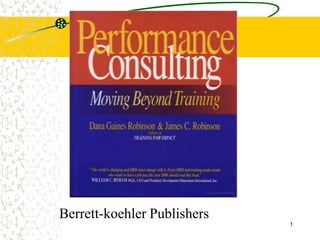
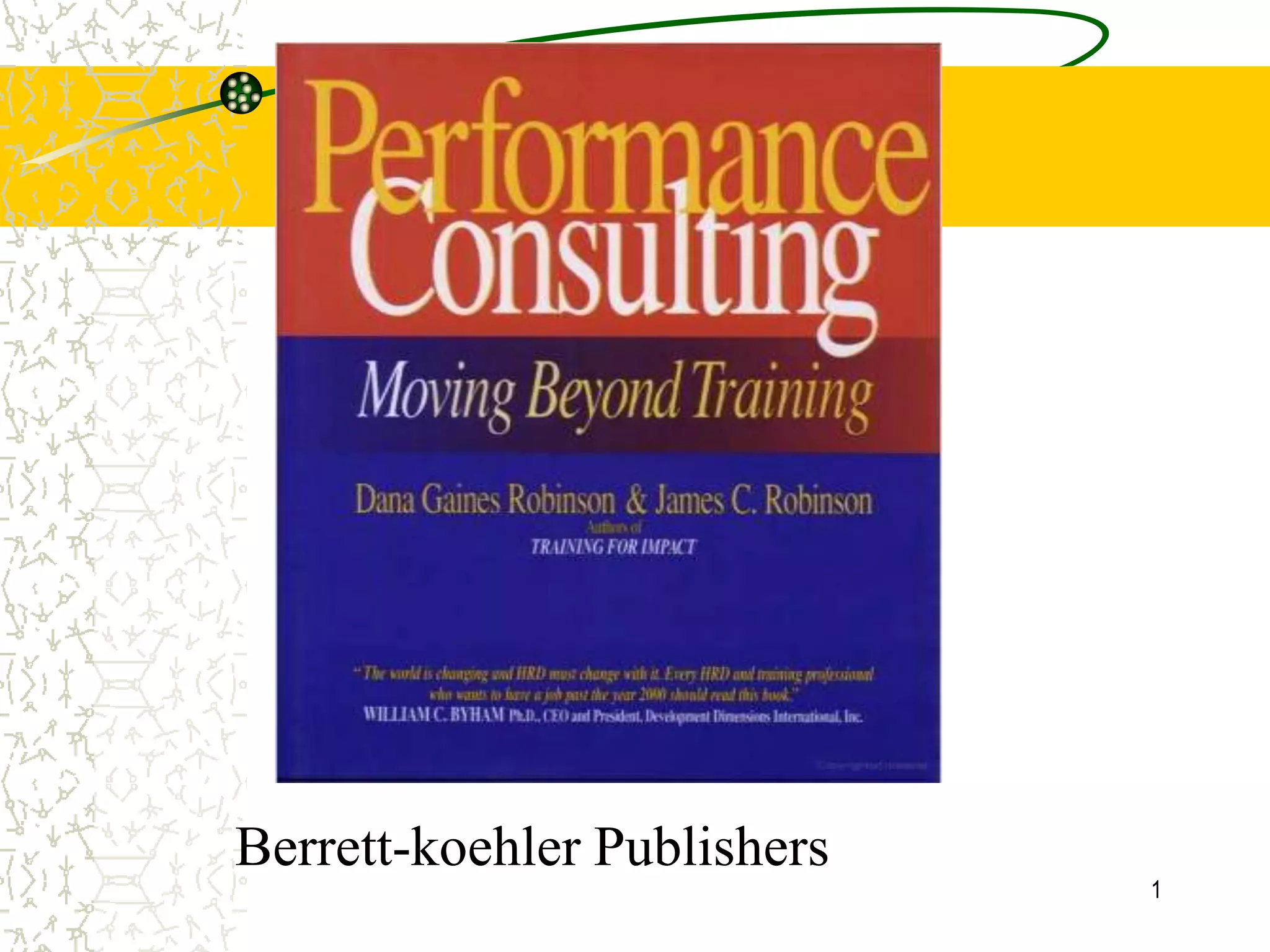
Berrett-koehler Publishers
                             1
Performance consulting.

Performance consulting is a sub discipline of consulting
that seeks to understand and develop a holistic strategy to
change performance; the results typically include changes in
measurement strategy, education, staffing, and toolkits. Its
goals can be summarized in the slogan "work smarter, not
harder".


                                                               2
Types of Performance Consulting

Performance consulting can be divided into three sub-specialties:
Organizational development specialists help organizations
improve the effectiveness of their staff by changing the
psychodynamics of the organization.
professional development specialists help organizations
improve the effectiveness of their staff by providing technical and
professional training.
personal coaches help individuals be more effective in the
personal or workplace lives. The profession draws its inspiration
from sports coaching, psychotherapy, philosophical traditions,
and religious traditions

                                                                  3
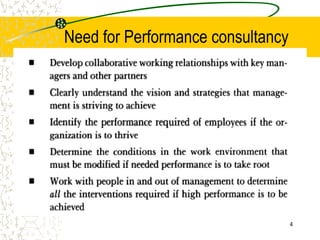
Need for Performance consultancy


                                   4
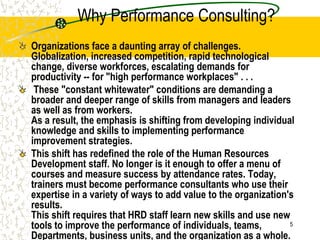
Why Performance Consulting?
Organizations face a daunting array of challenges.
Globalization, increased competition, rapid technological
change, diverse workforces, escalating demands for
productivity -- for "high performance workplaces" . . .
 These "constant whitewater" conditions are demanding a
broader and deeper range of skills from managers and leaders
as well as from workers.
As a result, the emphasis is shifting from developing individual
knowledge and skills to implementing performance
improvement strategies.
This shift has redefined the role of the Human Resources
Development staff. No longer is it enough to offer a menu of
courses and measure success by attendance rates. Today,
trainers must become performance consultants who use their
expertise in a variety of ways to add value to the organization's
results.
This shift requires that HRD staff learn new skills and use new
tools to improve the performance of individuals, teams,         5

Departments, business units, and the organization as a whole.
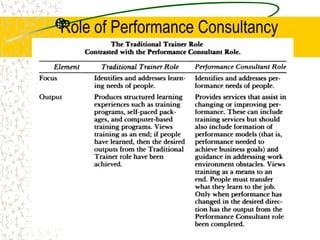
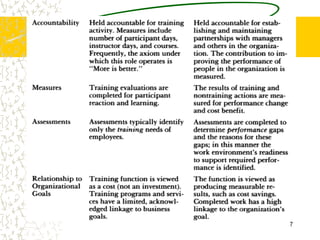
Role of Performance Consultancy


                                  6
7
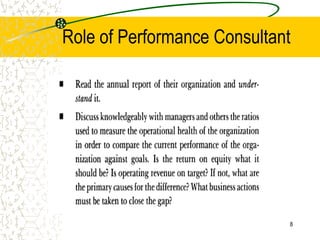
Role of Performance Consultant


                             8
9
10
11
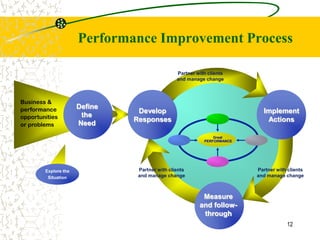
Performance Improvement Process

                                                Partner with clients
                                                and manage change


Business &
performance           Define
                                Develop                                    Implement
opportunities          the
                               Responses                                    Actions
or problems           Need
                                                               Great
                                                           PERFORMANCE


        Explore the             Partner with clients                     Partner with clients
         Situation              and manage change                        and manage change


                                                          Measure
                                                         and follow-
                                                          through
                                                                                     12
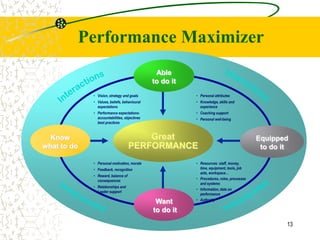
Performance Maximizer
                                               Able
                                              to do it
             • Vision, strategy and goals                • Personal attributes
             • Values, beliefs, behavioural              • Knowledge, skills and
               expectations                                experience
             • Performance expectations-                 • Coaching support
               accountabilities, objectives              • Personal well-being
               best practices


  Know                                  Great                                             Equipped
what to do                          PERFORMANCE                                            to do it

             • Personal motivation, morale               • Resources: staff, money,
             • Feedback, recognition                       time, equipment, tools, job
                                                           aids, workspace…
             • Reward, balance of
               consequences                              • Procedures, roles, processes
                                                           and systems
             • Relationships and
                                                         • Information, data on
               Leader support
                                                           performance
                                                         • Authority
                                               Want
                                              to do it

                                                                                                  13
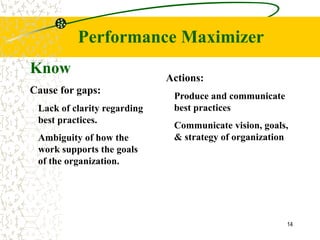
Performance Maximizer
Know
                             Actions:
Cause for gaps:
                              Produce and communicate
 Lack of clarity regarding    best practices
 best practices.
                              Communicate vision, goals,
 Ambiguity of how the         & strategy of organization
 work supports the goals
 of the organization.


                                                        14
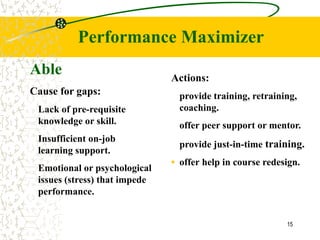
Performance Maximizer
Able                           Actions:
Cause for gaps:                  provide training, retraining,
 Lack of pre-requisite           coaching.
 knowledge or skill.             offer peer support or mentor.
 Insufficient on-job
                                 provide just-in-time training.
 learning support.
                               ▪ offer help in course redesign.
 Emotional or psychological
 issues (stress) that impede
 performance.


                                                           15
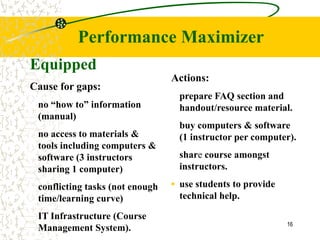
Performance Maximizer
Equipped
                                 Actions:
Cause for gaps:
                                  prepare FAQ section and
 no “how to” information          handout/resource material.
 (manual)
                                  buy computers & software
 no access to materials &         (1 instructor per computer).
 tools including computers &
 software (3 instructors          share course amongst
 sharing 1 computer)              instructors.

 conflicting tasks (not enough   ▪ use students to provide
 time/learning curve)              technical help.

 IT Infrastructure (Course
                                                             16
 Management System).
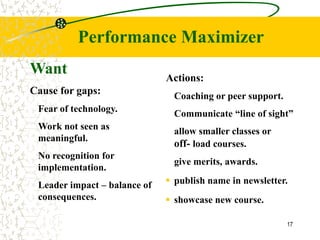
Performance Maximizer
Want                          Actions:
Cause for gaps:                Coaching or peer support.
 Fear of technology.           Communicate “line of sight”
 Work not seen as              allow smaller classes or
 meaningful.
                               off- load courses.
 No recognition for
                               give merits, awards.
 implementation.
 Leader impact – balance of   ▪ publish name in newsletter.
 consequences.                ▪ showcase new course.

                                                           17
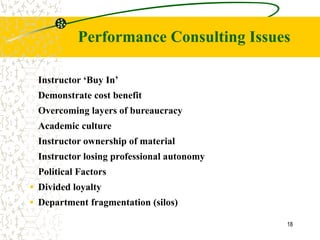
Performance Consulting Issues

 Instructor „Buy In‟
 Demonstrate cost benefit
 Overcoming layers of bureaucracy
 Academic culture
 Instructor ownership of material
 Instructor losing professional autonomy
 Political Factors
▪ Divided loyalty
▪ Department fragmentation (silos)

                                           18

Pm 1

  • 1.
  • 2.
    Performance consulting. Performance consultingis a sub discipline of consulting that seeks to understand and develop a holistic strategy to change performance; the results typically include changes in measurement strategy, education, staffing, and toolkits. Its goals can be summarized in the slogan "work smarter, not harder". 2
  • 3.
    Types of PerformanceConsulting Performance consulting can be divided into three sub-specialties: Organizational development specialists help organizations improve the effectiveness of their staff by changing the psychodynamics of the organization. professional development specialists help organizations improve the effectiveness of their staff by providing technical and professional training. personal coaches help individuals be more effective in the personal or workplace lives. The profession draws its inspiration from sports coaching, psychotherapy, philosophical traditions, and religious traditions 3
  • 4.
    Need for Performanceconsultancy 4
  • 5.
    Why Performance Consulting? Organizationsface a daunting array of challenges. Globalization, increased competition, rapid technological change, diverse workforces, escalating demands for productivity -- for "high performance workplaces" . . . These "constant whitewater" conditions are demanding a broader and deeper range of skills from managers and leaders as well as from workers. As a result, the emphasis is shifting from developing individual knowledge and skills to implementing performance improvement strategies. This shift has redefined the role of the Human Resources Development staff. No longer is it enough to offer a menu of courses and measure success by attendance rates. Today, trainers must become performance consultants who use their expertise in a variety of ways to add value to the organization's results. This shift requires that HRD staff learn new skills and use new tools to improve the performance of individuals, teams, 5 Departments, business units, and the organization as a whole.
  • 6.
    Role of PerformanceConsultancy 6
  • 7.
  • 8.
    Role of PerformanceConsultant 8
  • 9.
  • 10.
  • 11.
  • 12.
    Performance Improvement Process Partner with clients and manage change Business & performance Define Develop Implement opportunities the Responses Actions or problems Need Great PERFORMANCE Explore the Partner with clients Partner with clients Situation and manage change and manage change Measure and follow- through 12
  • 13.
    Performance Maximizer Able to do it • Vision, strategy and goals • Personal attributes • Values, beliefs, behavioural • Knowledge, skills and expectations experience • Performance expectations- • Coaching support accountabilities, objectives • Personal well-being best practices Know Great Equipped what to do PERFORMANCE to do it • Personal motivation, morale • Resources: staff, money, • Feedback, recognition time, equipment, tools, job aids, workspace… • Reward, balance of consequences • Procedures, roles, processes and systems • Relationships and • Information, data on Leader support performance • Authority Want to do it 13
  • 14.
    Performance Maximizer Know Actions: Cause for gaps: Produce and communicate Lack of clarity regarding best practices best practices. Communicate vision, goals, Ambiguity of how the & strategy of organization work supports the goals of the organization. 14
  • 15.
    Performance Maximizer Able Actions: Cause for gaps: provide training, retraining, Lack of pre-requisite coaching. knowledge or skill. offer peer support or mentor. Insufficient on-job provide just-in-time training. learning support. ▪ offer help in course redesign. Emotional or psychological issues (stress) that impede performance. 15
  • 16.
    Performance Maximizer Equipped Actions: Cause for gaps: prepare FAQ section and no “how to” information handout/resource material. (manual) buy computers & software no access to materials & (1 instructor per computer). tools including computers & software (3 instructors share course amongst sharing 1 computer) instructors. conflicting tasks (not enough ▪ use students to provide time/learning curve) technical help. IT Infrastructure (Course 16 Management System).
  • 17.
    Performance Maximizer Want Actions: Cause for gaps: Coaching or peer support. Fear of technology. Communicate “line of sight” Work not seen as allow smaller classes or meaningful. off- load courses. No recognition for give merits, awards. implementation. Leader impact – balance of ▪ publish name in newsletter. consequences. ▪ showcase new course. 17
  • 18.
    Performance Consulting Issues Instructor „Buy In‟ Demonstrate cost benefit Overcoming layers of bureaucracy Academic culture Instructor ownership of material Instructor losing professional autonomy Political Factors ▪ Divided loyalty ▪ Department fragmentation (silos) 18