TOPIC 7 :
GENERAL PRINCIPLES IN TEACHING
      LANGUAGE SKILLS
  Prepared by :
  Nabilla binti Yusof
  Nur Amirah binti Hamzah
  Nur Izzah Athira binti Rosli
Purpose Of Teaching
  Languange Skills
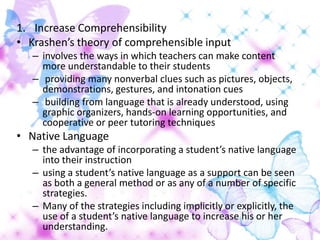
1. Increase Comprehensibility
• Krashen’s theory of comprehensible input
   – involves the ways in which teachers can make content
     more understandable to their students
   – providing many nonverbal clues such as pictures, objects,
     demonstrations, gestures, and intonation cues
   – building from language that is already understood, using
     graphic organizers, hands-on learning opportunities, and
     cooperative or peer tutoring techniques
• Native Language
   – the advantage of incorporating a student’s native language
     into their instruction
   – using a student’s native language as a support can be seen
     as both a general method or as any of a number of specific
     strategies.
   – Many of the strategies including implicitly or explicitly, the
     use of a student’s native language to increase his or her
     understanding.
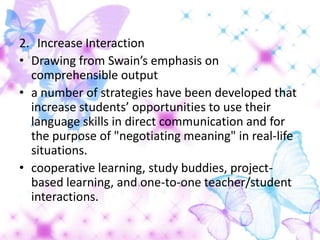
2. Increase Interaction
• Drawing from Swain’s emphasis on
  comprehensible output
• a number of strategies have been developed that
  increase students’ opportunities to use their
  language skills in direct communication and for
  the purpose of "negotiating meaning" in real-life
  situations.
• cooperative learning, study buddies, project-
  based learning, and one-to-one teacher/student
  interactions.
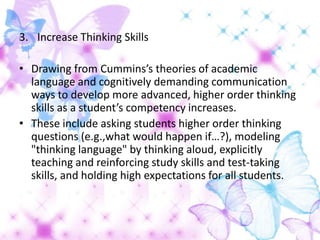
3. Increase Thinking Skills

• Drawing from Cummins’s theories of academic
  language and cognitively demanding communication
  ways to develop more advanced, higher order thinking
  skills as a student’s competency increases.
• These include asking students higher order thinking
  questions (e.g.,what would happen if…?), modeling
  "thinking language" by thinking aloud, explicitly
  teaching and reinforcing study skills and test-taking
  skills, and holding high expectations for all students.
Strategies In Teaching
   Language Skills
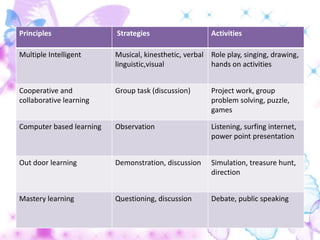
Principles                Strategies                   Activities

Multiple Intelligent      Musical, kinesthetic, verbal Role play, singing, drawing,
                          linguistic,visual            hands on activities


Cooperative and           Group task (discussion)      Project work, group
collaborative learning                                 problem solving, puzzle,
                                                       games

Computer based learning   Observation                  Listening, surfing internet,
                                                       power point presentation


Out door learning         Demonstration, discussion    Simulation, treasure hunt,
                                                       direction


Mastery learning          Questioning, discussion      Debate, public speaking
Learners’ Attitudes And
      Motivation
Attitudes

• Gardner and Lambert’s (1972) defined motivation as
  a construct made up of certain attitudes.
• Positive attitudes toward self, the native language
  group, and the target language group enhanced
  proficiency.
• Negative attitudes may lead to decreased motivation
  and, in all likelihood, because of decreased input and
  interaction, to unsuccessful attainment in
  proficiency.
Successful language learner’s attitude
• Positive towards English and speakers of English
• Motivated to learn English for a few reasons :
   –   to interact with other speakers of English
   –   to further their education
   –   to get a better paid job
   –   to read books, magazines in English
• Make efforts to get into situations where English
  is used and they use English as often as they can.
• Consciously try out new strategies learning
  and remembering new words, phrases and
  sentences and their meaning.
• Prepared to take risks.
  – Dare to make mistakes and learn from mistakes
    that they make.
  – They achieve success and develop competence,
    thus, motivates them to learn more.
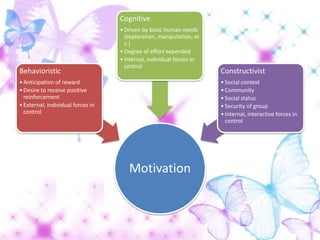
Cognitive
                                   • Driven by basic human needs
                                     (exploration, manipulation, et
                                     c.)
                                   • Degree of effort expended
                                   • Internal, individual forces in
                                     control
Behavioristic                                                         Constructivist
• Anticipation of reward                                              • Social context
• Desire to receive positive                                          • Community
  reinforcement                                                       • Social status
• External, individual forces in                                      • Security of group
  control                                                             • Internal, interactive forces in
                                                                        control


                                      Motivation
Learner’s Motivation

• Motivation is a very important factor in
  successful language acquisition.
• In a group of students of similar intelligence’s
  level, students who are highly motivated will
  achieve greater success compared to less
  motivated students.
• 2 types of motivation
  – Extrinsic
  – Intrinsic
Extrinsic motivation

• Caused by external factors
  – Integrative motivation
     • To be accepted into the culture of the speakers of
       English
  – Instrumental motivation
     • The prospect of gaining entry into a college or
       university or getting a better paid job.
  – To be acknowledged
     • A desire for praise and recognition from fellow students
       and teachers.
Intrinsic motivation

“Intrinsically motivated activities are ones for which
there is no apparent reward except the activity itself.
People seems to engage in the activities for their own
sake and not because they lead to an extrinsic
reward….Intrinsically motivated behaviors are aimed at
bringing about certain internally rewarding
consequences, namely; feelings of competence and self
determination.”
                                 -Edward Deci, 1975
• Desire to learn English for its own sake
  – eg. Student who comes from a family that has a
    very positive attitude towards English will also
    have a love for the language and will want to
    master it to the best of his ability.
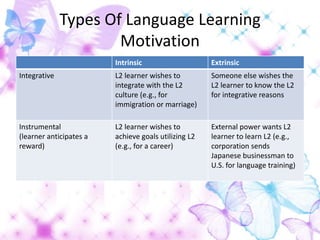
Types Of Language Learning
                      Motivation
                         Intrinsic                    Extrinsic
Integrative              L2 learner wishes to         Someone else wishes the
                         integrate with the L2        L2 learner to know the L2
                         culture (e.g., for           for integrative reasons
                         immigration or marriage)

Instrumental             L2 learner wishes to         External power wants L2
(learner anticipates a   achieve goals utilizing L2   learner to learn L2 (e.g.,
reward)                  (e.g., for a career)         corporation sends
                                                      Japanese businessman to
                                                      U.S. for language training)
Learners’ level of
    abilities
Learner’s level of ability

• Ability refers to an individuals capacity to
  perform the various tasks in a job. It is a
  current assessment of what one can do.
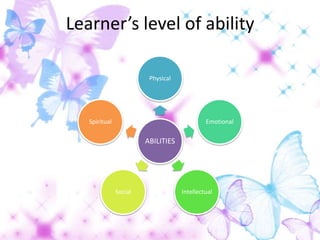
Learner’s level of ability

                         Physical


   Spiritual                                 Emotional

                        ABILITIES


               Social               Intellectual
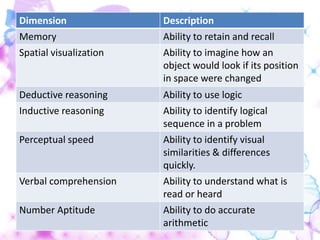
Dimension               Description
Memory                  Ability to retain and recall
Spatial visualization   Ability to imagine how an
                        object would look if its position
                        in space were changed
Deductive reasoning     Ability to use logic
Inductive reasoning     Ability to identify logical
                        sequence in a problem
Perceptual speed        Ability to identify visual
                        similarities & differences
                        quickly.
Verbal comprehension    Ability to understand what is
                        read or heard
Number Aptitude         Ability to do accurate
                        arithmetic
Physical Abilities

• It is the capacity to do tasks demanding
  stamina, dexterity, strength, and similar
  characteristics.
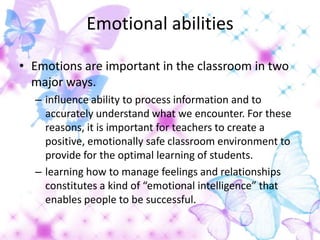
Emotional abilities

• Emotions are important in the classroom in two
  major ways.
  – influence ability to process information and to
    accurately understand what we encounter. For these
    reasons, it is important for teachers to create a
    positive, emotionally safe classroom environment to
    provide for the optimal learning of students.
  – learning how to manage feelings and relationships
    constitutes a kind of “emotional intelligence” that
    enables people to be successful.
Social abilities

• Ability to socialize with others.
  – To fit in
That’s all.
Thank you.

ele3102 general principles in teaching language skills

  • 1.
    TOPIC 7 : GENERALPRINCIPLES IN TEACHING LANGUAGE SKILLS Prepared by : Nabilla binti Yusof Nur Amirah binti Hamzah Nur Izzah Athira binti Rosli
  • 2.
    Purpose Of Teaching Languange Skills
  • 3.
    1. Increase Comprehensibility •Krashen’s theory of comprehensible input – involves the ways in which teachers can make content more understandable to their students – providing many nonverbal clues such as pictures, objects, demonstrations, gestures, and intonation cues – building from language that is already understood, using graphic organizers, hands-on learning opportunities, and cooperative or peer tutoring techniques • Native Language – the advantage of incorporating a student’s native language into their instruction – using a student’s native language as a support can be seen as both a general method or as any of a number of specific strategies. – Many of the strategies including implicitly or explicitly, the use of a student’s native language to increase his or her understanding.
  • 4.
    2. Increase Interaction •Drawing from Swain’s emphasis on comprehensible output • a number of strategies have been developed that increase students’ opportunities to use their language skills in direct communication and for the purpose of "negotiating meaning" in real-life situations. • cooperative learning, study buddies, project- based learning, and one-to-one teacher/student interactions.
  • 5.
    3. Increase ThinkingSkills • Drawing from Cummins’s theories of academic language and cognitively demanding communication ways to develop more advanced, higher order thinking skills as a student’s competency increases. • These include asking students higher order thinking questions (e.g.,what would happen if…?), modeling "thinking language" by thinking aloud, explicitly teaching and reinforcing study skills and test-taking skills, and holding high expectations for all students.
  • 6.
    Strategies In Teaching Language Skills
  • 7.
    Principles Strategies Activities Multiple Intelligent Musical, kinesthetic, verbal Role play, singing, drawing, linguistic,visual hands on activities Cooperative and Group task (discussion) Project work, group collaborative learning problem solving, puzzle, games Computer based learning Observation Listening, surfing internet, power point presentation Out door learning Demonstration, discussion Simulation, treasure hunt, direction Mastery learning Questioning, discussion Debate, public speaking
  • 8.
  • 9.
    Attitudes • Gardner andLambert’s (1972) defined motivation as a construct made up of certain attitudes. • Positive attitudes toward self, the native language group, and the target language group enhanced proficiency. • Negative attitudes may lead to decreased motivation and, in all likelihood, because of decreased input and interaction, to unsuccessful attainment in proficiency.
  • 10.
    Successful language learner’sattitude • Positive towards English and speakers of English • Motivated to learn English for a few reasons : – to interact with other speakers of English – to further their education – to get a better paid job – to read books, magazines in English • Make efforts to get into situations where English is used and they use English as often as they can.
  • 11.
    • Consciously tryout new strategies learning and remembering new words, phrases and sentences and their meaning. • Prepared to take risks. – Dare to make mistakes and learn from mistakes that they make. – They achieve success and develop competence, thus, motivates them to learn more.
  • 12.
    Cognitive • Driven by basic human needs (exploration, manipulation, et c.) • Degree of effort expended • Internal, individual forces in control Behavioristic Constructivist • Anticipation of reward • Social context • Desire to receive positive • Community reinforcement • Social status • External, individual forces in • Security of group control • Internal, interactive forces in control Motivation
  • 13.
    Learner’s Motivation • Motivationis a very important factor in successful language acquisition. • In a group of students of similar intelligence’s level, students who are highly motivated will achieve greater success compared to less motivated students. • 2 types of motivation – Extrinsic – Intrinsic
  • 14.
    Extrinsic motivation • Causedby external factors – Integrative motivation • To be accepted into the culture of the speakers of English – Instrumental motivation • The prospect of gaining entry into a college or university or getting a better paid job. – To be acknowledged • A desire for praise and recognition from fellow students and teachers.
  • 15.
    Intrinsic motivation “Intrinsically motivatedactivities are ones for which there is no apparent reward except the activity itself. People seems to engage in the activities for their own sake and not because they lead to an extrinsic reward….Intrinsically motivated behaviors are aimed at bringing about certain internally rewarding consequences, namely; feelings of competence and self determination.” -Edward Deci, 1975
  • 16.
    • Desire tolearn English for its own sake – eg. Student who comes from a family that has a very positive attitude towards English will also have a love for the language and will want to master it to the best of his ability.
  • 17.
    Types Of LanguageLearning Motivation Intrinsic Extrinsic Integrative L2 learner wishes to Someone else wishes the integrate with the L2 L2 learner to know the L2 culture (e.g., for for integrative reasons immigration or marriage) Instrumental L2 learner wishes to External power wants L2 (learner anticipates a achieve goals utilizing L2 learner to learn L2 (e.g., reward) (e.g., for a career) corporation sends Japanese businessman to U.S. for language training)
  • 18.
  • 19.
    Learner’s level ofability • Ability refers to an individuals capacity to perform the various tasks in a job. It is a current assessment of what one can do.
  • 20.
    Learner’s level ofability Physical Spiritual Emotional ABILITIES Social Intellectual
  • 21.
    Dimension Description Memory Ability to retain and recall Spatial visualization Ability to imagine how an object would look if its position in space were changed Deductive reasoning Ability to use logic Inductive reasoning Ability to identify logical sequence in a problem Perceptual speed Ability to identify visual similarities & differences quickly. Verbal comprehension Ability to understand what is read or heard Number Aptitude Ability to do accurate arithmetic
  • 22.
    Physical Abilities • Itis the capacity to do tasks demanding stamina, dexterity, strength, and similar characteristics.
  • 23.
    Emotional abilities • Emotionsare important in the classroom in two major ways. – influence ability to process information and to accurately understand what we encounter. For these reasons, it is important for teachers to create a positive, emotionally safe classroom environment to provide for the optimal learning of students. – learning how to manage feelings and relationships constitutes a kind of “emotional intelligence” that enables people to be successful.
  • 24.
    Social abilities • Abilityto socialize with others. – To fit in
  • 25.

Editor's Notes

  • #15 2-use language to gain something
  • #23 readiness and grace in physical activity; especially : skill and ease in using the hands <manual dexterity>