SEMINAR ON
WESTERN DHARWAR
CRATON
108/12/17
CONTENTS
 INTRODUCTION
 HISTORY
 WESTERN DHARWAR CRATON
 STRATIGRAPHY
 SARGUR GROUP
 BABABUDAN
 CHITRADURGA
 SCHIST BELTS
 SARGUR SCHIST BELT
 HOLE NARASIPURA SCHIST BELT
 CHARNOCKITES OF WDC
 YOUNGER GRANITES OF WDC
 ECONOMIC IMPORTANCE OF WDC
 CONCLUSION
 REFERENCE
208/12/17
INTRODUCTION
 The Archaean Dharwar craton covers an area of 4.5 lakh sq km
is bounded in the south by the pan pacific Pandyan mobile
belt (pmb)and to the north the Deccan traps underline and
fringed by the Proterozoic (Purana) Kaladgi and Bhima basin.
Towards the east boundary is given by the Eastern Ghat mobile
belt and towards the west it is bounded by the Arabian sea which
separates India from Madagascar.
 The Dharwar craton is one of the best studied terrain of
peninsular India and its renowned for its greenstone schist belt
,grey gneisses charnockites and younger granites.
308/12/17
HISTORY
 The craton is divided in to two tectonic blocks by
Swami Nath (1976 ) et al, they are western and
eastern block.
 Renamed respectively as the Western Dharwar
Craton (WDC) and Eastern Dharwar Craton (EDC)
by Rogers (1986)
408/12/17
WESTERN DHARWAR CRATON
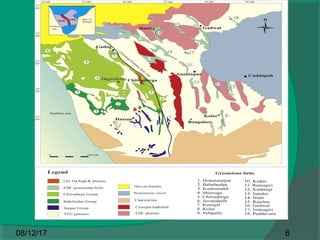
 Western Dharwar Craton is occupied by vast area of
peninsular gneisses
 Two prominent super belts are seen;
1. Bababudhan-Western ghats-shimoga and
2.Chitradurga- Gadag
belonging to the Dharwar Supergroup
 Southern part –narrow linear schist belts belonging to
the older Sargur group , like Holenarsipur , Nuggihalli,
Nagamangala
 The younger granites like Chitradurga , Hosadurga,
Arsikere occur as isolated pluton in the gneissic country
508/12/17
608/12/17
STRATIGRAPHY
708/12/17
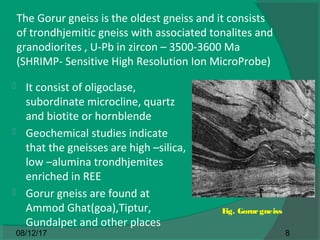
The Gorur gneiss is the oldest gneiss and it consists
of trondhjemitic gneiss with associated tonalites and
granodiorites , U-Pb in zircon – 3500-3600 Ma
(SHRIMP- Sensitive High Resolution Ion MicroProbe)
 It consist of oligoclase,
subordinate microcline, quartz
and biotite or hornblende
 Geochemical studies indicate
that the gneisses are high –silica,
low –alumina trondhjemites
enriched in REE
 Gorur gneiss are found at
Ammod Ghat(goa),Tiptur,
Gundalpet and other places
Fig. Gorurgneiss
808/12/17
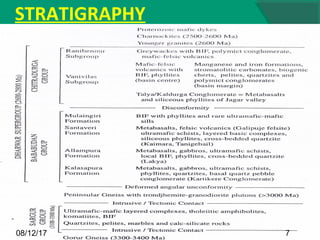
Sargur group
 It occurs as linear Mafic- Ultra mafic belts
 Group of enclaves scattered throughout the
craton
 Rock types –ultra mafic ,mafic intrusive complex,
chert, BIF, garnet- biotite schist, sillimanite gneiss,
kyanite-staurolite gneiss.
908/12/17
STRATIGRAPHY OF SARGUR GROUP
1008/12/17
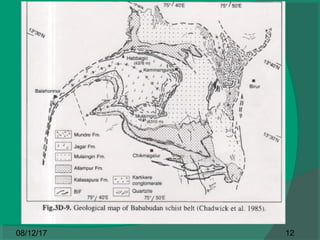
BABABUDAN GROUP
 It overlies the Sargur group of rocks in the stratigraphic column.
 It consists of four formations: Kalasapura formation, Allampura
formation, Santaveri formation and Mullaingiri formation.
 The major rock types are metabasalts, BIF, gabbro, ultramafic
schists, phyllites, quartzites, conglomerate.
1108/12/17
08/12/17 12
SCHIST BELTS
 Sargur Schist Belt
 Holenarasipura schist belt
 Nuggihalli schist belt
 Bababudan schist belt
 Western schist belt
1308/12/17
Sargur Schist Belt
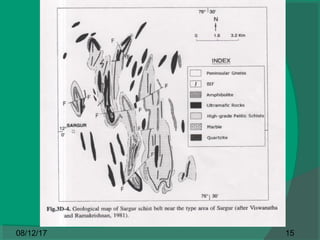
 It is a zone of schist enclaves and narrow bands near Sargur
town , situated 40km south west of Mysore city.
 The zone of enclaves extends from near Mysore to Kerala ,and
up to Nanjangud in the east
 Fresh outcrops of various lithologies were best exposed in the
canals of Kabini river near Sargur, and hence the name of Sargur
group.
 Rock types –Fuchsite quartzite, metapelites, carbonates and
calc-silicate rocks etc
 Mafic – ultra mafic rocks form one of the major components of
Sargur Schist Belt
 Mafic rocks are more abundant than ultra mafic rocks, and are
associated with iron formations.
 The ultra mafic rocks are essentially serpentinites and tremolite
– actinolite-anthophyllite-chlorite schists
1408/12/17
08/12/17 15
Structure
 The earliest recognizable structure in the narrow belts of
Sargur group is widespread schistosity parallel to the bedding,
intrafolial folds and migmatic banding
 Second phase of deformation has given rise to upright , tight to
isoclinal folds
 Third deformational phase has refolded the folds of second
generation
 The Sargur schist belt of WDC consist of several other minor
schist belts
.Manantavadi(Wayanad )schist belt
.Kasargod schist belt
1608/12/17
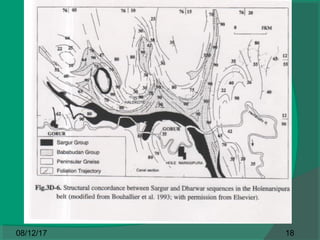
Holenarasipura schist belt
 It is a trident shaped schist belt
 The trident shape of the schist belt is due to the
deflection of schist's around bosses of
mavinkere granodiorite
 The Sargur and Dharwar succession are not well
exposed but deformed and metamorphosed
together during later Dharwar orogeny
1708/12/17
08/12/17 18
Other major schist belts of WDC are as follows
 Nuggihalli Schist belt- altered dunite ,tremolite-
actinolite-cummingtonite-anthophyllite-talc-chlorite-
magnetite schists
 Aladahalli belt
 Krishnarajpet belt
 Hadanur belt
 Melukote and Nagamangala belt
 Kalyadi belt
 Banavara belt
 Western Ghat belt
 Shimoga belt
 Chitradurga schist belt
1908/12/17
Charnockite of WDC
 They are associated with PGC, continue upto Moyar
Bhavani shear zone
 It shows spectacular transformation from the TTG
suite of peninsular gneiss are seen all along the
amphibolite granulite facies boundary from Manglore
and Coorg in the west to the Nanjangud in the east.
2008/12/17
Younger granite in WDC
 There are five types of granites found in
WDC
 Chitradurga
 Jn kotte
 Hosadurga
 Chamundi
 Arsikere
2108/12/17
Other intrusion in WDC
 Thagaduru layered basic intrusion
 Kunduru betta ring intrusion
2208/12/17
08/12/17 23
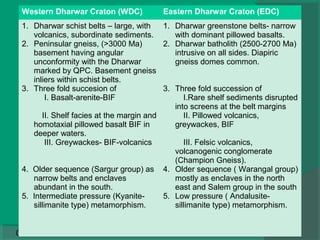
Western Dharwar Craton (WDC) Eastern Dharwar Craton (EDC)
1. Dharwar schist belts – large, with
volcanics, subordinate sediments.
2. Peninsular gneiss, (>3000 Ma)
basement having angular
unconformity with the Dharwar
marked by QPC. Basement gneiss
inliers within schist belts.
3. Three fold succesion of
I. Basalt-arenite-BIF
II. Shelf facies at the margin and
homotaxial pillowed basalt BIF in
deeper waters.
III. Greywackes- BIF-volcanics
4. Older sequence (Sargur group) as
narrow belts and enclaves
abundant in the south.
5. Intermediate pressure (Kyanite-
sillimanite type) metamorphism.
1. Dharwar greenstone belts- narrow
with dominant pillowed basalts.
2. Dharwar batholith (2500-2700 Ma)
intrusive on all sides. Diapiric
gneiss domes common.
3. Three fold succession of
I.Rare shelf sediments disrupted
into screens at the belt margins
II. Pillowed volcanics,
greywackes, BIF
III. Felsic volcanics,
volcanogenic conglomerate
(Champion Gneiss).
4. Older sequence ( Warangal group)
mostly as enclaves in the north
east and Salem group in the south
5. Low pressure ( Andalusite-
sillimanite type) metamorphism.
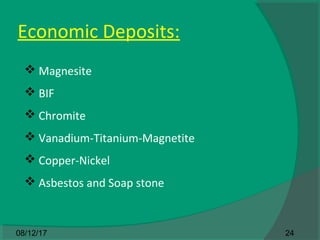
Economic Deposits:
 Magnesite
 BIF
 Chromite
 Vanadium-Titanium-Magnetite
 Copper-Nickel
 Asbestos and Soap stone
2408/12/17
CONCLUSION
25
 Western Dharwar Craton is bounded to the east by the Eastern Dharwar
Craton, to the west by the Arabian Sea, and to the south by a transition
into the so-called ‘‘Southern Granulite Terrane.” The remaining
boundary to the north is buried under younger sediments and the
Cretaceous Deccan Traps.
 The division between the Western and Eastern Dharwar Cratons is
based on the nature and abundance of greenstones, as well as the age
of surrounding basement and degree of regional metamorphism.
 The WDC shows an increase in regional metamorphic grade from
greenschist to amphibolite facies in the north and granulite facies in the
south.
 The metamorphic grade increase corresponds to a paleopressure
increase from 3 to 4 kbar in the amphibolite facies to as much as 9–10
kbar (35 km paleodepth) in the highestgrade granulite-transition zone
along the southern margin of the craton.
 The Dharwar supracrustal rocks uncomformably overlie widespread
gneiss-migmatite of the Peninsular Gneissic Complex (3.0–3.3 Ga) that
encloses the Sargur schist belts08/12/17
REFERENCE
 Radhakrishna, B.P., Naqvi, S.M., (1986). Precambrian continental crust of India and
its evolution. 94, 145–166.
 Ramakrishnan .M and Vaidyanadhan R (2010).Geology of India, Geol.Soc.Ind., v.1,
pp. 189-208.
Websites:
www.springer.com
www.wikipedia.org
2608/12/17

Western dharwar craton

  • 1.
  • 2.
    CONTENTS  INTRODUCTION  HISTORY WESTERN DHARWAR CRATON  STRATIGRAPHY  SARGUR GROUP  BABABUDAN  CHITRADURGA  SCHIST BELTS  SARGUR SCHIST BELT  HOLE NARASIPURA SCHIST BELT  CHARNOCKITES OF WDC  YOUNGER GRANITES OF WDC  ECONOMIC IMPORTANCE OF WDC  CONCLUSION  REFERENCE 208/12/17
  • 3.
    INTRODUCTION  The ArchaeanDharwar craton covers an area of 4.5 lakh sq km is bounded in the south by the pan pacific Pandyan mobile belt (pmb)and to the north the Deccan traps underline and fringed by the Proterozoic (Purana) Kaladgi and Bhima basin. Towards the east boundary is given by the Eastern Ghat mobile belt and towards the west it is bounded by the Arabian sea which separates India from Madagascar.  The Dharwar craton is one of the best studied terrain of peninsular India and its renowned for its greenstone schist belt ,grey gneisses charnockites and younger granites. 308/12/17
  • 4.
    HISTORY  The cratonis divided in to two tectonic blocks by Swami Nath (1976 ) et al, they are western and eastern block.  Renamed respectively as the Western Dharwar Craton (WDC) and Eastern Dharwar Craton (EDC) by Rogers (1986) 408/12/17
  • 5.
    WESTERN DHARWAR CRATON Western Dharwar Craton is occupied by vast area of peninsular gneisses  Two prominent super belts are seen; 1. Bababudhan-Western ghats-shimoga and 2.Chitradurga- Gadag belonging to the Dharwar Supergroup  Southern part –narrow linear schist belts belonging to the older Sargur group , like Holenarsipur , Nuggihalli, Nagamangala  The younger granites like Chitradurga , Hosadurga, Arsikere occur as isolated pluton in the gneissic country 508/12/17
  • 6.
  • 7.
  • 8.
    The Gorur gneissis the oldest gneiss and it consists of trondhjemitic gneiss with associated tonalites and granodiorites , U-Pb in zircon – 3500-3600 Ma (SHRIMP- Sensitive High Resolution Ion MicroProbe)  It consist of oligoclase, subordinate microcline, quartz and biotite or hornblende  Geochemical studies indicate that the gneisses are high –silica, low –alumina trondhjemites enriched in REE  Gorur gneiss are found at Ammod Ghat(goa),Tiptur, Gundalpet and other places Fig. Gorurgneiss 808/12/17
  • 9.
    Sargur group  Itoccurs as linear Mafic- Ultra mafic belts  Group of enclaves scattered throughout the craton  Rock types –ultra mafic ,mafic intrusive complex, chert, BIF, garnet- biotite schist, sillimanite gneiss, kyanite-staurolite gneiss. 908/12/17
  • 10.
    STRATIGRAPHY OF SARGURGROUP 1008/12/17
  • 11.
    BABABUDAN GROUP  Itoverlies the Sargur group of rocks in the stratigraphic column.  It consists of four formations: Kalasapura formation, Allampura formation, Santaveri formation and Mullaingiri formation.  The major rock types are metabasalts, BIF, gabbro, ultramafic schists, phyllites, quartzites, conglomerate. 1108/12/17
  • 12.
  • 13.
    SCHIST BELTS  SargurSchist Belt  Holenarasipura schist belt  Nuggihalli schist belt  Bababudan schist belt  Western schist belt 1308/12/17
  • 14.
    Sargur Schist Belt It is a zone of schist enclaves and narrow bands near Sargur town , situated 40km south west of Mysore city.  The zone of enclaves extends from near Mysore to Kerala ,and up to Nanjangud in the east  Fresh outcrops of various lithologies were best exposed in the canals of Kabini river near Sargur, and hence the name of Sargur group.  Rock types –Fuchsite quartzite, metapelites, carbonates and calc-silicate rocks etc  Mafic – ultra mafic rocks form one of the major components of Sargur Schist Belt  Mafic rocks are more abundant than ultra mafic rocks, and are associated with iron formations.  The ultra mafic rocks are essentially serpentinites and tremolite – actinolite-anthophyllite-chlorite schists 1408/12/17
  • 15.
  • 16.
    Structure  The earliestrecognizable structure in the narrow belts of Sargur group is widespread schistosity parallel to the bedding, intrafolial folds and migmatic banding  Second phase of deformation has given rise to upright , tight to isoclinal folds  Third deformational phase has refolded the folds of second generation  The Sargur schist belt of WDC consist of several other minor schist belts .Manantavadi(Wayanad )schist belt .Kasargod schist belt 1608/12/17
  • 17.
    Holenarasipura schist belt It is a trident shaped schist belt  The trident shape of the schist belt is due to the deflection of schist's around bosses of mavinkere granodiorite  The Sargur and Dharwar succession are not well exposed but deformed and metamorphosed together during later Dharwar orogeny 1708/12/17
  • 18.
  • 19.
    Other major schistbelts of WDC are as follows  Nuggihalli Schist belt- altered dunite ,tremolite- actinolite-cummingtonite-anthophyllite-talc-chlorite- magnetite schists  Aladahalli belt  Krishnarajpet belt  Hadanur belt  Melukote and Nagamangala belt  Kalyadi belt  Banavara belt  Western Ghat belt  Shimoga belt  Chitradurga schist belt 1908/12/17
  • 20.
    Charnockite of WDC They are associated with PGC, continue upto Moyar Bhavani shear zone  It shows spectacular transformation from the TTG suite of peninsular gneiss are seen all along the amphibolite granulite facies boundary from Manglore and Coorg in the west to the Nanjangud in the east. 2008/12/17
  • 21.
    Younger granite inWDC  There are five types of granites found in WDC  Chitradurga  Jn kotte  Hosadurga  Chamundi  Arsikere 2108/12/17
  • 22.
    Other intrusion inWDC  Thagaduru layered basic intrusion  Kunduru betta ring intrusion 2208/12/17
  • 23.
    08/12/17 23 Western DharwarCraton (WDC) Eastern Dharwar Craton (EDC) 1. Dharwar schist belts – large, with volcanics, subordinate sediments. 2. Peninsular gneiss, (>3000 Ma) basement having angular unconformity with the Dharwar marked by QPC. Basement gneiss inliers within schist belts. 3. Three fold succesion of I. Basalt-arenite-BIF II. Shelf facies at the margin and homotaxial pillowed basalt BIF in deeper waters. III. Greywackes- BIF-volcanics 4. Older sequence (Sargur group) as narrow belts and enclaves abundant in the south. 5. Intermediate pressure (Kyanite- sillimanite type) metamorphism. 1. Dharwar greenstone belts- narrow with dominant pillowed basalts. 2. Dharwar batholith (2500-2700 Ma) intrusive on all sides. Diapiric gneiss domes common. 3. Three fold succession of I.Rare shelf sediments disrupted into screens at the belt margins II. Pillowed volcanics, greywackes, BIF III. Felsic volcanics, volcanogenic conglomerate (Champion Gneiss). 4. Older sequence ( Warangal group) mostly as enclaves in the north east and Salem group in the south 5. Low pressure ( Andalusite- sillimanite type) metamorphism.
  • 24.
    Economic Deposits:  Magnesite BIF  Chromite  Vanadium-Titanium-Magnetite  Copper-Nickel  Asbestos and Soap stone 2408/12/17
  • 25.
    CONCLUSION 25  Western DharwarCraton is bounded to the east by the Eastern Dharwar Craton, to the west by the Arabian Sea, and to the south by a transition into the so-called ‘‘Southern Granulite Terrane.” The remaining boundary to the north is buried under younger sediments and the Cretaceous Deccan Traps.  The division between the Western and Eastern Dharwar Cratons is based on the nature and abundance of greenstones, as well as the age of surrounding basement and degree of regional metamorphism.  The WDC shows an increase in regional metamorphic grade from greenschist to amphibolite facies in the north and granulite facies in the south.  The metamorphic grade increase corresponds to a paleopressure increase from 3 to 4 kbar in the amphibolite facies to as much as 9–10 kbar (35 km paleodepth) in the highestgrade granulite-transition zone along the southern margin of the craton.  The Dharwar supracrustal rocks uncomformably overlie widespread gneiss-migmatite of the Peninsular Gneissic Complex (3.0–3.3 Ga) that encloses the Sargur schist belts08/12/17
  • 26.
    REFERENCE  Radhakrishna, B.P.,Naqvi, S.M., (1986). Precambrian continental crust of India and its evolution. 94, 145–166.  Ramakrishnan .M and Vaidyanadhan R (2010).Geology of India, Geol.Soc.Ind., v.1, pp. 189-208. Websites: www.springer.com www.wikipedia.org 2608/12/17