
₤ Image
   ╬ A representation of the external form of a person or thing in
     sculpture, painting, etc.


₤ Image Processing
   ╬ The analysis and manipulation of a digitized image, esp. in order to
     improve its quality.
   ╬ Study of any algorithm

                                     Image
                         Input                Output
₤ The rate at which image intensity values are changing in the
  image

₤ Its domain over which values of F(u) range.
                u        Freq. of component of Transform


₤ Steps:
   ╬ Transform the image to its frequency representation
   ╬ Perform image processing
   ╬ Compute inverse transform.
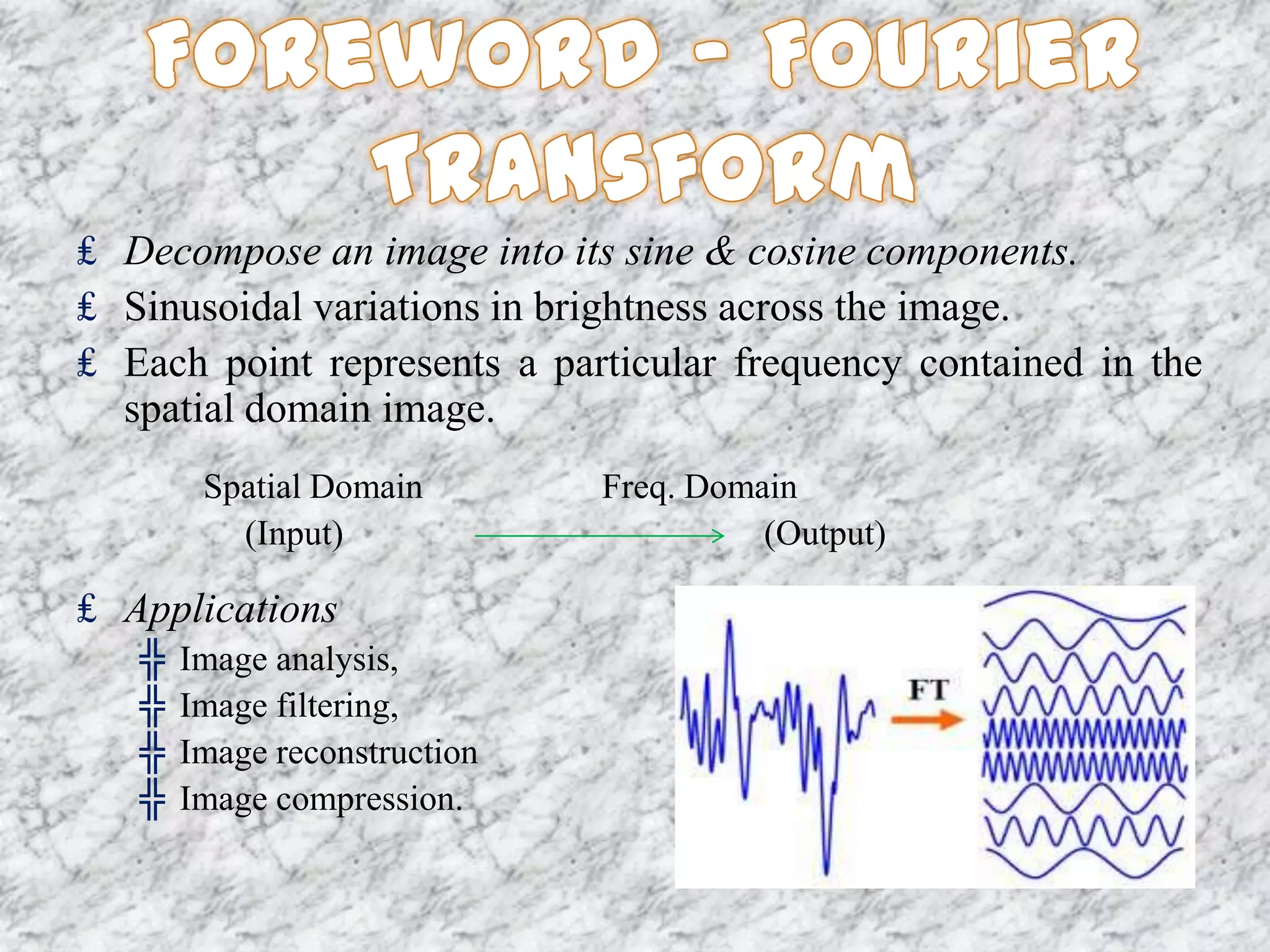
₤ Decompose an image into its sine & cosine components.
₤ Sinusoidal variations in brightness across the image.
₤ Each point represents a particular frequency contained in the
  spatial domain image.
        Spatial Domain        Freq. Domain
          (Input)                       (Output)

₤ Applications
   ╬   Image analysis,
   ╬   Image filtering,
   ╬   Image reconstruction
   ╬   Image compression.
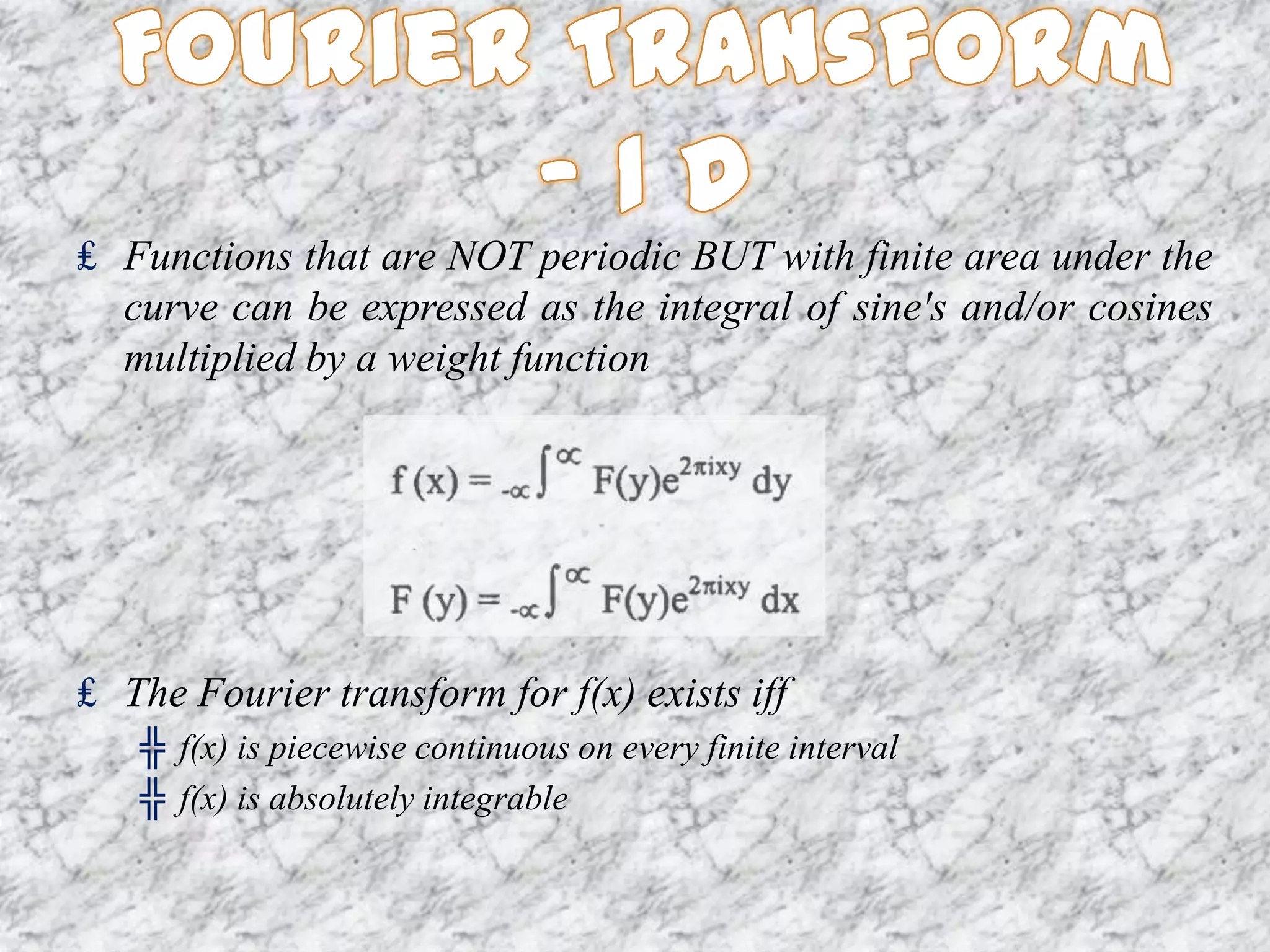
₤ Functions that are NOT periodic BUT with finite area under the
  curve can be expressed as the integral of sine's and/or cosines
  multiplied by a weight function


₤ The Fourier transform for f(x) exists iff
   ╬ f(x) is piecewise continuous on every finite interval
   ╬ f(x) is absolutely integrable
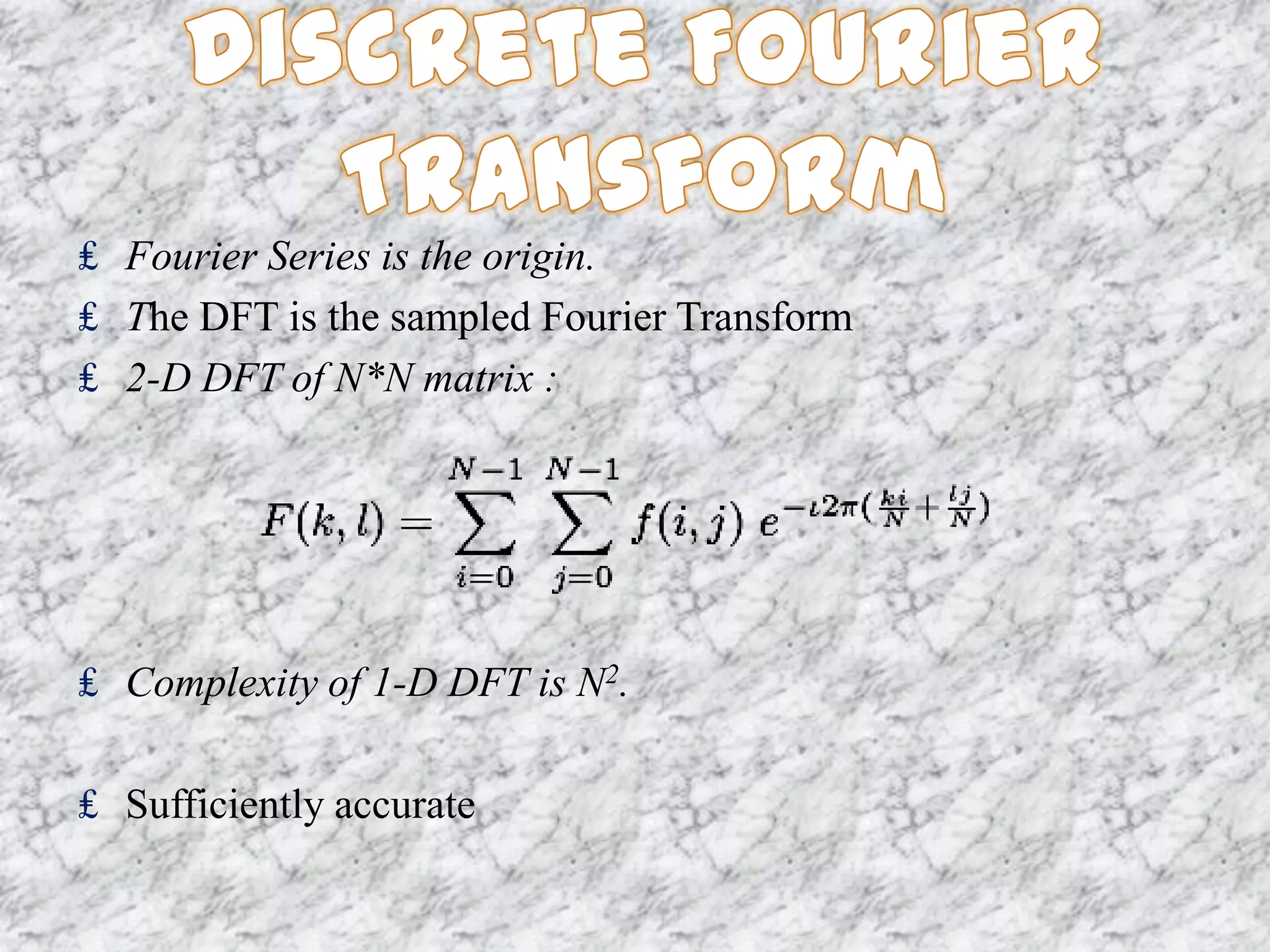
₤ Fourier Series is the origin.
₤ The DFT is the sampled Fourier Transform
₤ 2-D DFT of N*N matrix :


₤ Complexity of 1-D DFT is N2.

₤ Sufficiently accurate
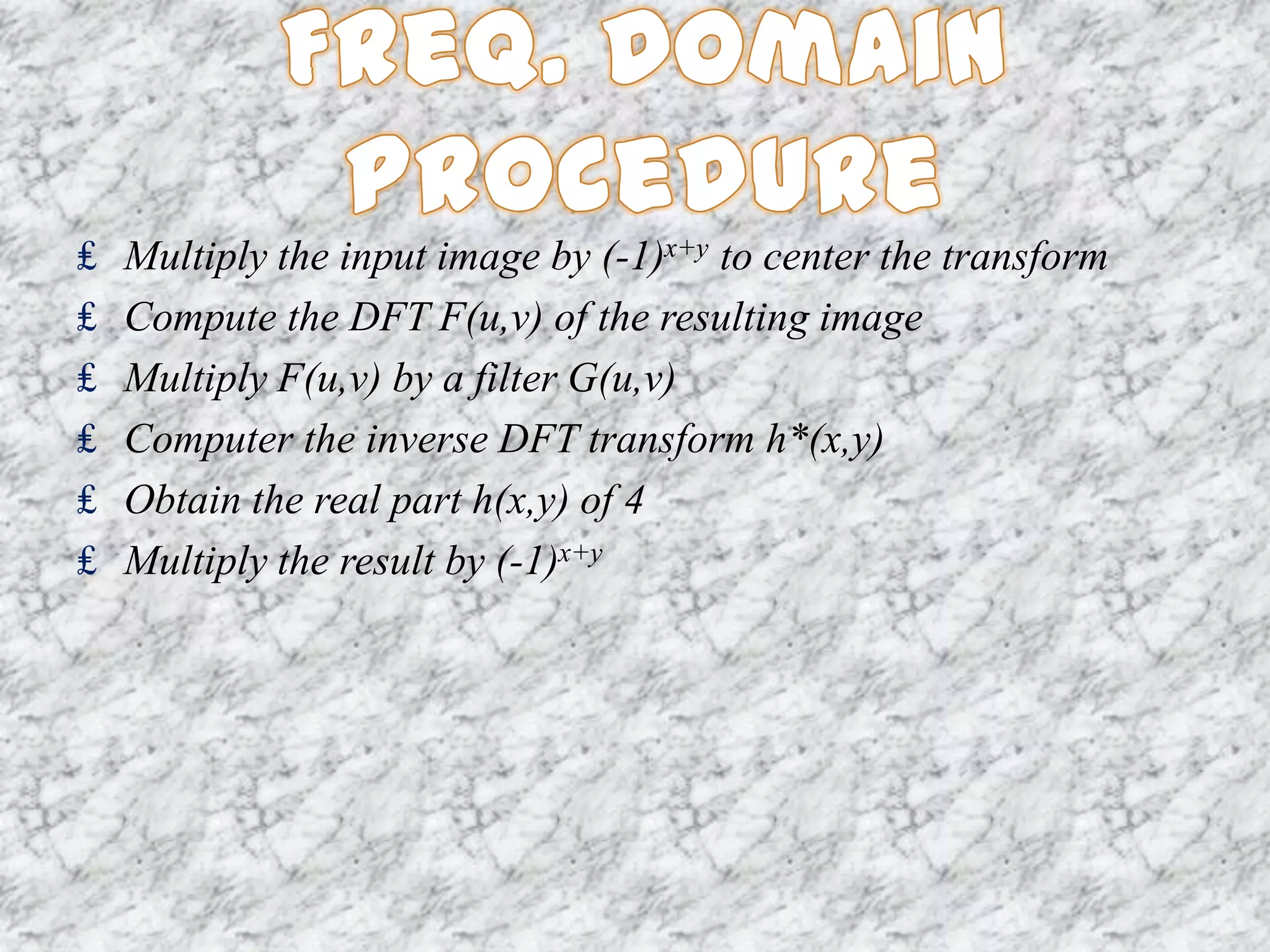
₤   Multiply the input image by (-1)x+y to center the transform
₤   Compute the DFT F(u,v) of the resulting image
₤   Multiply F(u,v) by a filter G(u,v)
₤   Computer the inverse DFT transform h*(x,y)
₤   Obtain the real part h(x,y) of 4
₤   Multiply the result by (-1)x+y
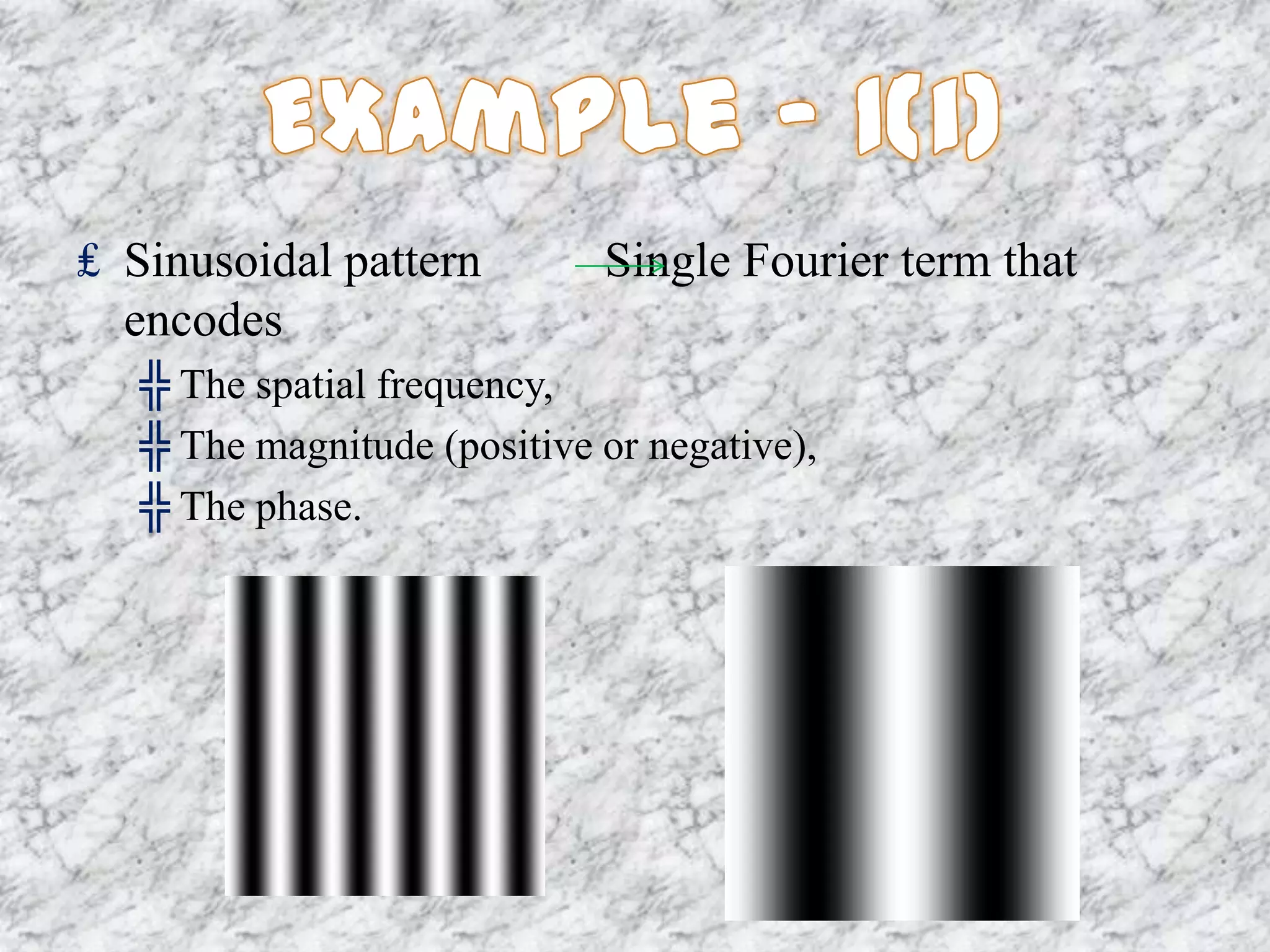
₤ Sinusoidal pattern         Single Fourier term that
  encodes
   ╬ The spatial frequency,
   ╬ The magnitude (positive or negative),
   ╬ The phase.
₤ The spatial frequency,
   ╬ Frequency across space


₤ The magnitude (positive or negative),
   ╬ Corresponds to its contrast
   ╬ A negative magnitude represents a contrast-reversal, i.e.
     the bright become dark, and vice-versa


₤ The phase.
   ╬ How the wave is shifted relative to the origin
Plausibility


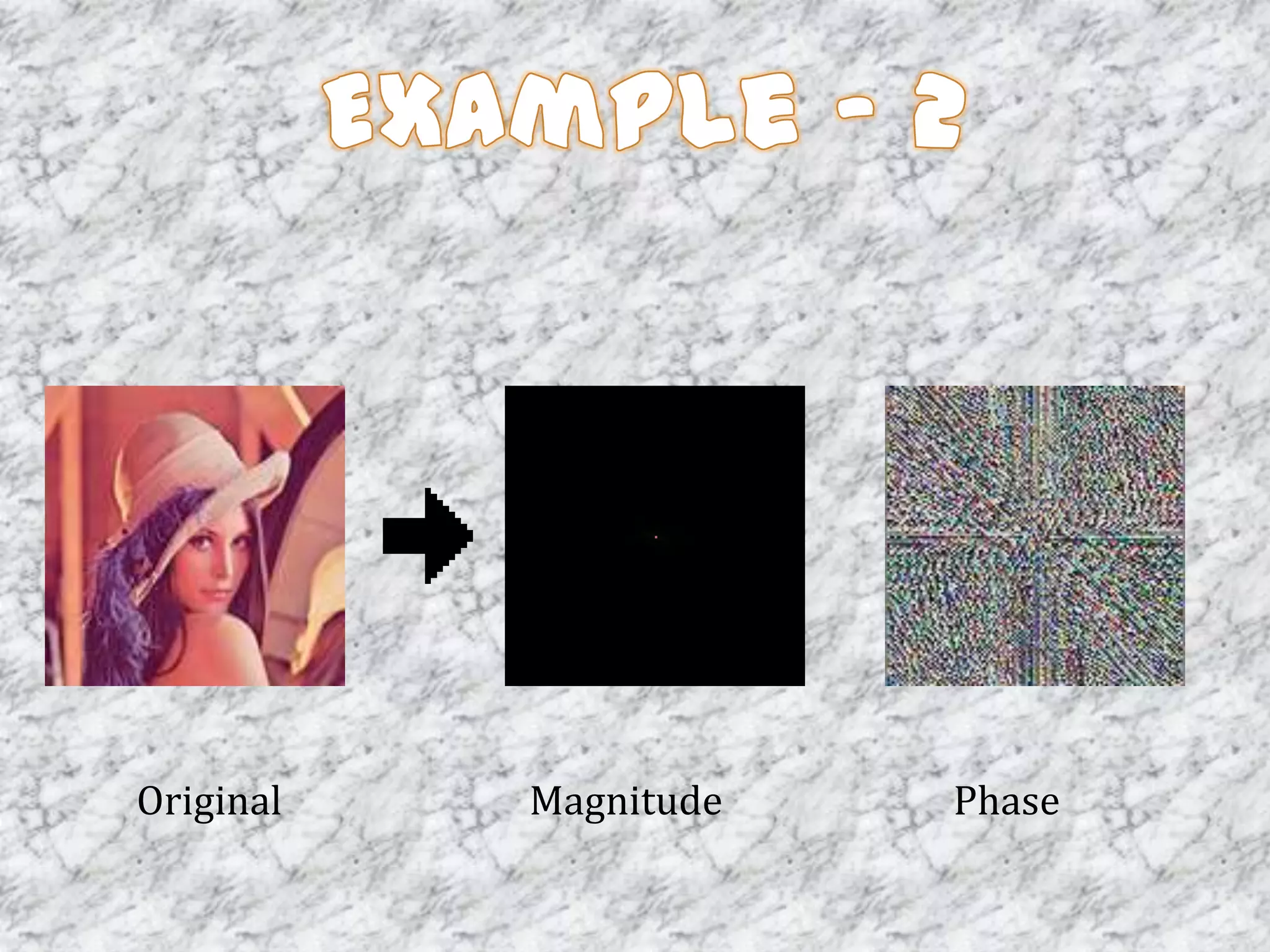
Original   Magnitude       Phase
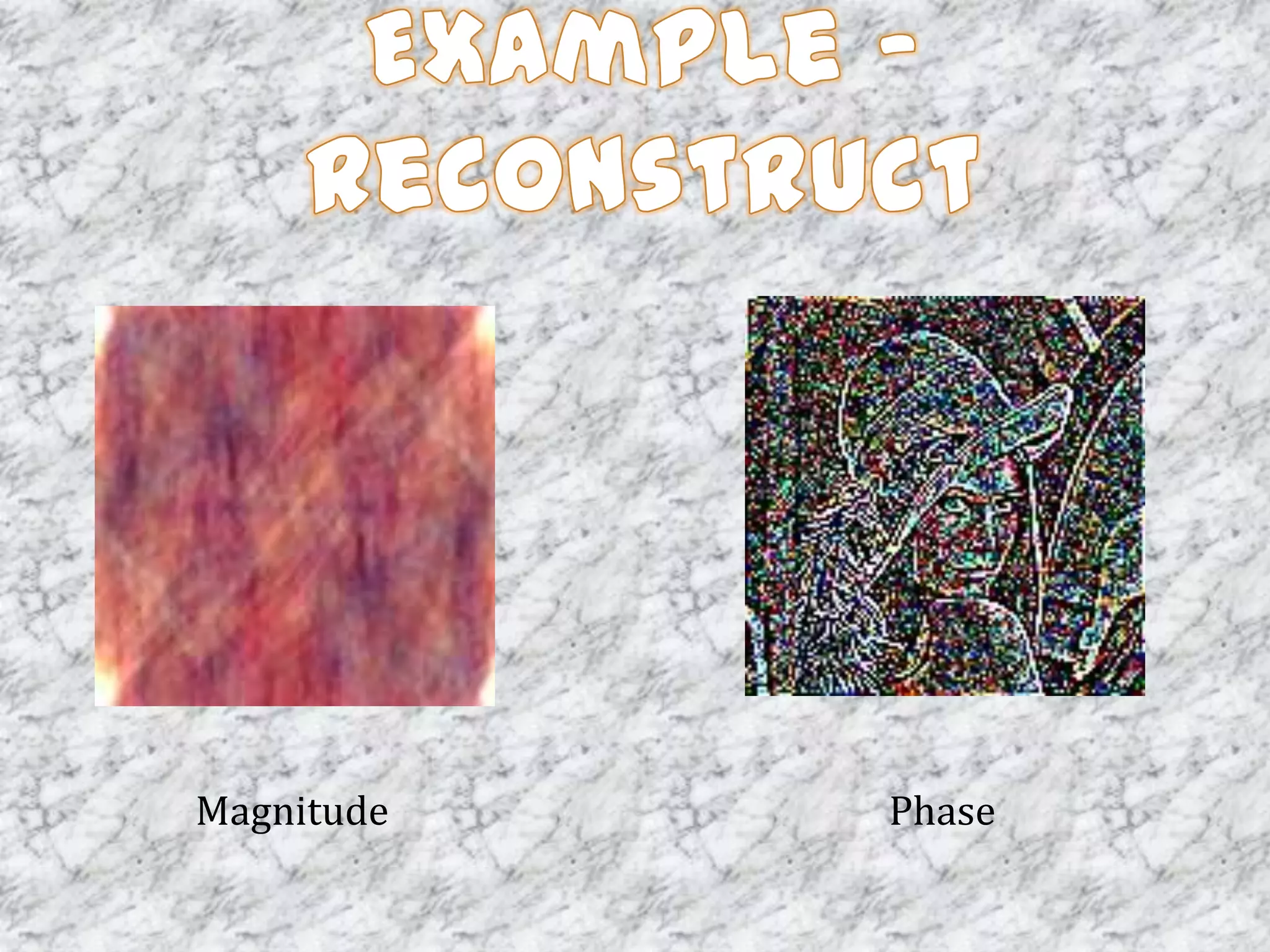
Magnitude   Phase
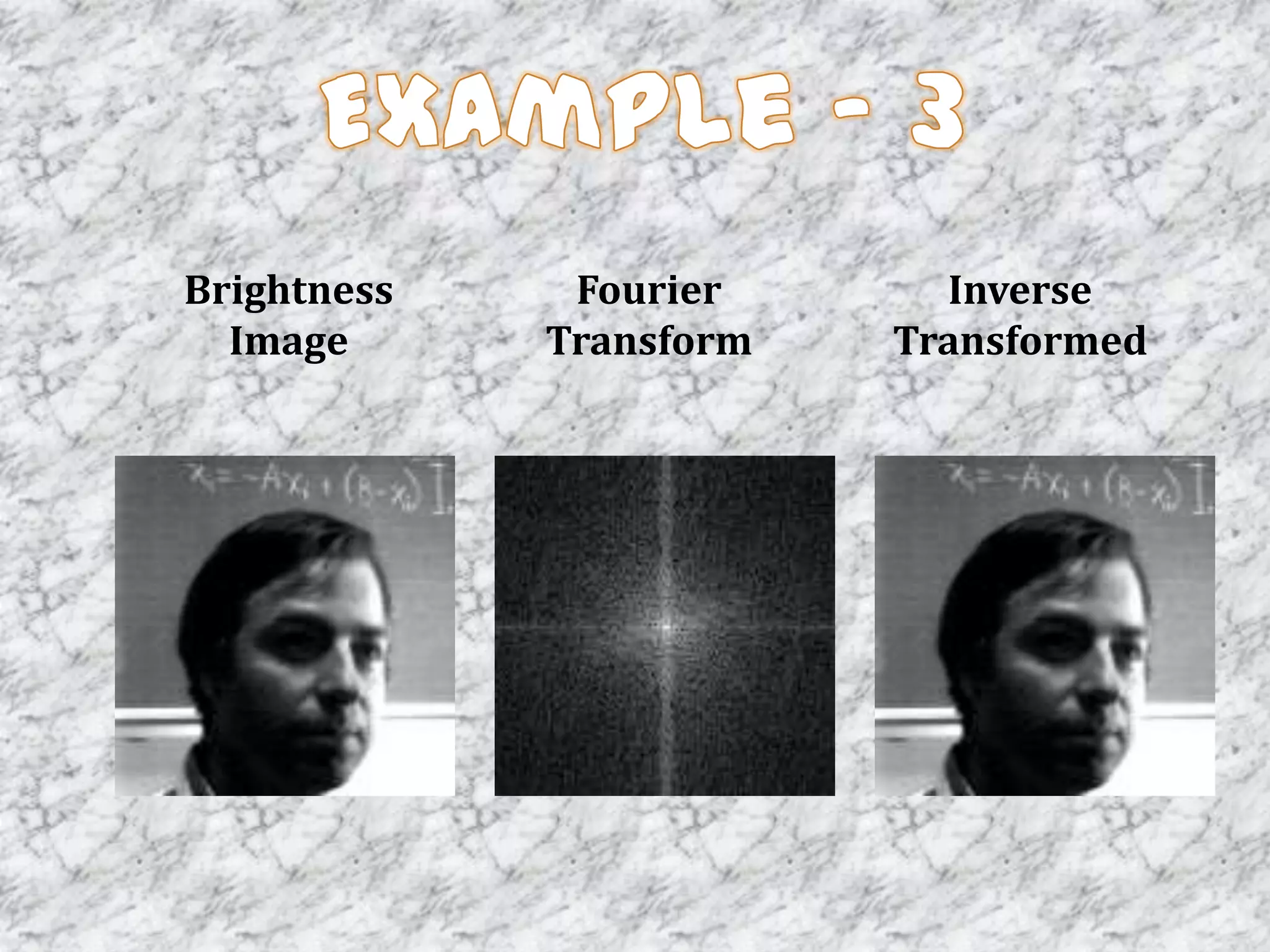
Brightness    Fourier      Inverse
  Image      Transform   Transformed
Fourier transform

Fourier transform

  • 2.
    ₤ Image ╬ A representation of the external form of a person or thing in sculpture, painting, etc. ₤ Image Processing ╬ The analysis and manipulation of a digitized image, esp. in order to improve its quality. ╬ Study of any algorithm Image Input Output
  • 3.
    ₤ The rateat which image intensity values are changing in the image ₤ Its domain over which values of F(u) range. u Freq. of component of Transform ₤ Steps: ╬ Transform the image to its frequency representation ╬ Perform image processing ╬ Compute inverse transform.
  • 4.
    ₤ Decompose animage into its sine & cosine components. ₤ Sinusoidal variations in brightness across the image. ₤ Each point represents a particular frequency contained in the spatial domain image. Spatial Domain Freq. Domain (Input) (Output) ₤ Applications ╬ Image analysis, ╬ Image filtering, ╬ Image reconstruction ╬ Image compression.
  • 5.
    ₤ Functions thatare NOT periodic BUT with finite area under the curve can be expressed as the integral of sine's and/or cosines multiplied by a weight function ₤ The Fourier transform for f(x) exists iff ╬ f(x) is piecewise continuous on every finite interval ╬ f(x) is absolutely integrable
  • 6.
    ₤ Fourier Seriesis the origin. ₤ The DFT is the sampled Fourier Transform ₤ 2-D DFT of N*N matrix : ₤ Complexity of 1-D DFT is N2. ₤ Sufficiently accurate
  • 7.
    Multiply the input image by (-1)x+y to center the transform ₤ Compute the DFT F(u,v) of the resulting image ₤ Multiply F(u,v) by a filter G(u,v) ₤ Computer the inverse DFT transform h*(x,y) ₤ Obtain the real part h(x,y) of 4 ₤ Multiply the result by (-1)x+y
  • 8.
    ₤ Sinusoidal pattern Single Fourier term that encodes ╬ The spatial frequency, ╬ The magnitude (positive or negative), ╬ The phase.
  • 9.
    ₤ The spatialfrequency, ╬ Frequency across space ₤ The magnitude (positive or negative), ╬ Corresponds to its contrast ╬ A negative magnitude represents a contrast-reversal, i.e. the bright become dark, and vice-versa ₤ The phase. ╬ How the wave is shifted relative to the origin
  • 10.
    Plausibility Original Magnitude Phase
  • 11.
  • 12.
    Brightness Fourier Inverse Image Transform Transformed

Editor's Notes

  • #7 F(i,j) – Spatial Domain ImageExponential Function – Basis Functioncorresponding to each point F(k,l) in the Fourier space.basis functions are sine and cosine waves