











Identifying Native Language Difficulties among Foreign Language Learners in College:  A “foreign” language learning disability? Leonard Ganschow, Richard L. Sparks,  James Javorsky, Jane Pohlman, &  Andrea Bishop-Marbury  Presenter: Cindy
Outline Introduction I Literature Review II Method III Instruments and Procedures IV Results and Discussion V Summary and Future Directions VI
Introduction The authors described studies that at-risk foreign language learners exhibit  linguistic coding problems —subtle phonological, syntactic, and/or semantic difficulties—in their  native language .  This  “linguistic coding deficit” hypothesis  forms the basis for the purpose of this study:  to compare successful and unsuccessful foreign language learners on variable thought to be related to learning a foreign language.
Evidence  for  Foreign Language  Learning Disabilities
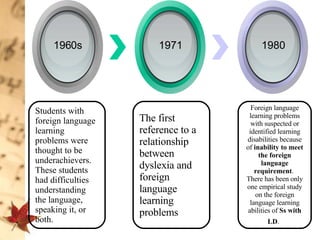
The first reference to a relationship between dyslexia and foreign language learning problems  Students with foreign language learning problems were thought to be underachievers.  These students had difficulties understanding the language, speaking it, or both.  Foreign language learning problems with suspected or identified learning disabilities because of  inability to meet the foreign language requirement .  There has been only one empirical study on the foreign language learning abilities of  Ss with LD .   1960s 1971 1980
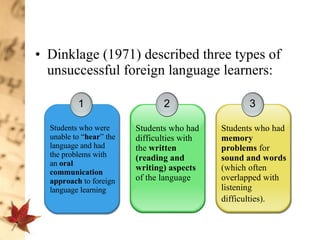
Dinklage (1971) described three types of unsuccessful foreign language learners: 1 Students who were unable to “ hear ” the language and had the problems with an  oral communication   approach  to foreign language learning  3 Students who had  memory problems  for  sound and words  (which often overlapped with listening difficulties).   2 Students who had difficulties with the  written (reading and writing) aspects  of the language
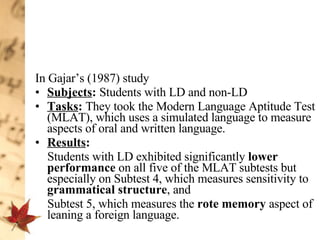
In Gajar’s (1987) study Subjects :  Students with LD and non-LD  Tasks :  They took the Modern Language Aptitude Test (MLAT), which uses a simulated language to measure aspects of oral and written language.  Results : Students with LD exhibited significantly  lower   performance  on all five of the MLAT subtests but especially on Subtest 4, which measures sensitivity to  grammatical structure , and  Subtest 5, which measures the  rote memory  aspect of leaning a foreign language.
 
The Language-Based Nature of  Foreign Language  Learning Difficulties   In examining the nature of foreign language aptitude through factor analysis, John Carroll, the author of MLAT, identified four aspects area, which he called  (a)  phonetic coding , or the ability to code auditory phonetic material in such a way that this material can be recognized, identified, and remembered over time;  (b)  grammatical sensitivity , or the ability to handle grammar;  (c)  inductive language learning ability , or the ability to infer linguistic forms, rules, or patterns from new linguistic content;  (d)  rote memory  for foreign language learning materials, or the capacity to learn a large number of phonetic and grammatical associations.
Like Carroll, Pimsleur (1966) developed a test of  foreign language aptitude ,  the Language Aptitude Battery .  Pimsleur stated that “ auditory ability ” was measured by sound discrimination and sound-symbol association tests.  Auditory ability  was perhaps the chief factor that distinguished underachievers from successful language learners (Pimsleur, 1968; Pimsleur et al., 1964).
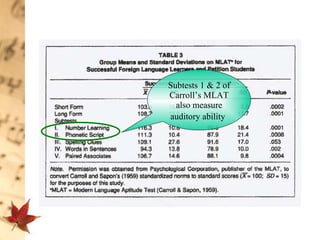
Subtests 1 & 2 of Carroll’s MLAT also measure auditory ability
Besides Carroll’s and Pimsleur’s theories, other attempts have been made to  predict success   in foreign language learning  using  (1)   general cognitive ability,  (2) language aptitude  (Gardner & Lambert, 1972;  Jakobovits, 1970; Pimsleur et al., 1964; Wesche  et al., 1982),   and  (3)   attitude/motivation measures,  such as high  anxiety, low motivation, or negative attitude,  are the result of language learning problems  (Sparks and Ganschow, 1991).
The Language-Based Nature of  Native Language  Learning Difficulties   The presence of  oral language and communication deficits  associated with  LD  has been well established in the literature (Myklebust, 1964; Johnson, & Myklebust, 1967; Wiig & Semel, 1976, 1980).  The relationship of  oral language proficiency  to  later academic achievement  is also well documented, e.g., preschool language impairments may result in later reading, writing, and spelling difficulties (Forrell & Hood, 1985; Lee & Shapero-Fine, 1984; Stark et al., 1984).
Besides, the characteristics of children with LD….  the deficits in reading comprehension could result from a generalized  lack of linguistic awareness  (Menyuk & Flood, 1981).  difficulties in dealing with the  complex syntactic structures of spoken language  (Glass & Perna, 1986; Magee & Newcomer, 1978; Newcomer & Magee, 1977; Vogel, 1975; Wiig, Semel, & Crouse, 1973). deficits in written language  that appear to persist into  adulthood .
Poor readers often have  deficient listening comprehension skills  (Buerger, 1978; Chall, 1983; Curtis, 1980; Smiley, Oakley, Worthen, Campione, & Brown, 1977; Stanovich, Cunningham, & feeman, 1984.)  Oftentimes, these language deficits  persist  and create learning problems in college for students with LD.
All of these findings strongly suggest that  oral language disorders  play a causal role in  later reading and writing difficulties  associated with LD (Butler, 1988; Liberman, 1982; Liberman & Shankweiler, 1979; Perfetti, 1985; Vellutino, 1979).
Linkages between Native and Foreign Language Vellutino and Scanlon (1986) coined the term “ linguistic coding ” to refer to  the use of language to code information  and, specifically, to the functional use of the  phonological, syntactic, and semantic attributes of the language.
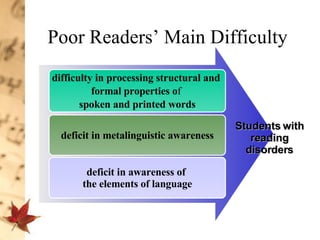
Poor Readers’ Main Difficulty difficulty in processing structural and  formal properties o f  spoken and printed words deficit in   metalinguistic awareness deficit in awareness of  the elements of language Students with reading disorders
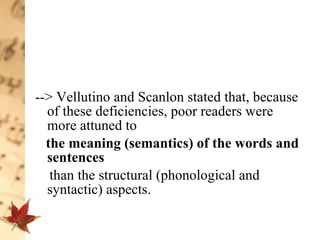
--> Vellutino and Scanlon stated that, because of these deficiencies, poor readers were more attuned to  the meaning (semantics) of the words   and sentences   than the structural (phonological and syntactic) aspects.
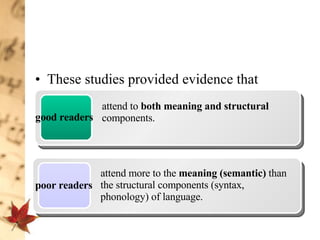
These studies provided evidence that  good readers   attend to  both   meaning and structural  components. poor readers attend more to the  meaning (semantic)  than the structural components (syntax, phonology) of language.
A pilot study (Sparks et al., 1989)  Subjects :  College students who have been identified as having  extreme difficulties learning foreign languages .
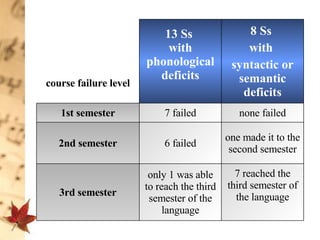
7 reached the third semester of the language only 1 was able to reach the third semester of the language 3rd semester one made it to the second semester 6 failed 2nd semester none failed 7 failed 1st semester 8 Ss  with  syntactic or semantic deficits 13 Ss  with phonological deficits course failure level
--> Specific linguistic coding problems in the students’ native language  were especially apparent in the  phonological  domain.  Results : Phonological problems  of their native language had the most immediate and severe impact on foreign language learning.
Phonological Coding &  Reading/Listening Problems with word decoding  are significant contributors to variance in  reading abilities  (Perfetti, 1985; Stanovich, 1986).  Phonological processing abilities  are strongly linked to  later reading achievement  (Catts, 1989; Catts & Kamhi, 1986; Gough & Hillinger, 1980; Liberman, 1971, 1982; Liberman & Shankweiler, 1979).
Children with  reading disabilities  are said to have  less awareness of and sensitivity to the speech-sound structure of the language  (Catts & Kamhi, 1986, 1987; Liberman, 1982). Listening problems  are also found in college students with learning disabilities (Morris & Leuenberger, 1990).
Research Purpose The purpose of the present study was to determine whether there would be significant differences between successful and unsuccessful (petition) college foreign language learners on test of  intelligence ,  foreign language aptitude ,  oral and written language , and  mathematics .
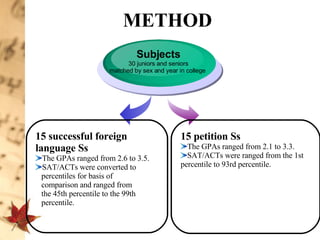
METHOD Subjects 30 juniors and seniors matched by sex and year in college  15 successful foreign language Ss  The GPAs ranged from 2.6 to 3.5. SAT/ACTs were converted to  percentiles for basis of  comparison and ranged from  the 45th percentile to the 99th  percentile.  15 petition Ss   The GPAs ranged from 2.1 to 3.3.  SAT/ACTs were ranged from the 1st percentile to 93rd percentile.
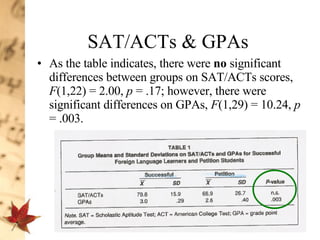
SAT/ACTs & GPAs As the table indicates, there were  no  significant differences between groups on SAT/ACTs scores,  F (1,22) = 2.00,  p  = .17; however, there were significant differences on GPAs,  F (1,29) = 10.24,  p  = .003.
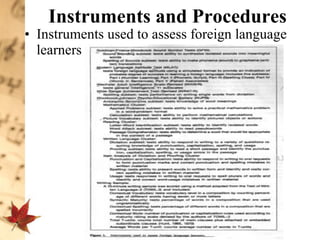
Instruments and Procedures Instruments used to assess foreign language learners
(1)  intelligence : WAIS-R;  (2)  foreign language aptitude : MLAT Long Form,  Parts I-V and Short Form, Parts III-V;  (3)  phonology :  Goldman-Fristoe-Woodcock (GFW),  Sound Blending and Spelling of Sounds subtests;  MLAT, Parts I (Number Learning), II (Phonetic Script),  and V (Paired Associates); Wide Range Achievement  Test-Revised (WRAT-R) Spelling; Woodcock-Johnson  Psycho-Educational Battery, Part II (WJPB) Letter-Word  Identification and Word Attack subtests;  (4)   grammar and syntax : MLAT Part IV, Words in  sentences; WJPB, Written Language;  (5)  semantics : that is, vocabulary and reading  comprehension: MLAT-Part III, Spelling Clues; WJPB,  antonym-Synonyms and Picture Vocabulary subtests.  Passage Comprehension subtests; (6)  mathematics : WJPB, Mathematics cluster.
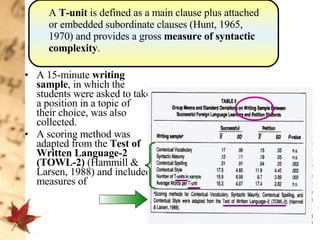
TOWL-2 A 15-minute  writing sample , in which the students were asked to take a position in a topic of their choice, was also collected.  A scoring method was adapted from the  Test of Written Language-2 (TOWL-2)  (Hammill & Larsen, 1988) and included measures of A  T-unit  is defined as a main clause plus attached or embedded subordinate clauses (Hunt, 1965, 1970) and provides a gross  measure of syntactic complexity .
In this study, the 30 writing samples with names removed and errors included were typed onto sheets, which were shuffled and graded independently by the authors.  They cross-checked scores for accuracy.  This scoring method differs from the TOWL-2, wherein total number of words or errors in a given sample are counted.
Procedure: Students were tested individually over several time periods totaling approximately 5 hours.  Achievement tests were administered by the authors; intelligence tests were administered  by a licensed psychologist.
Analysis of Data An  ANOVA procedure  was used to determine the level of significance of the difference of the difference between successful and unsuccessful foreign language learners on each test and test cluster in the diagnostic battery.  Standard scores  were used in the analysis of data.  A level of  .05  was used as the criterion for significance.  Bonferroni (Dunn) and Tukey  T -tests  were performed on variables with  unequal numbers of scores  (due to the omission of a given test in an individual’s test profile) to confirm the ANOVA results.
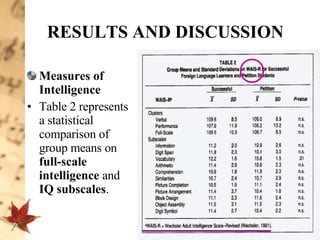
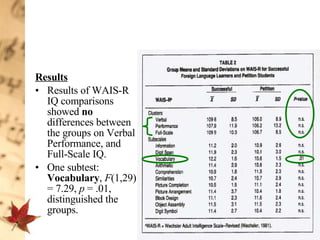
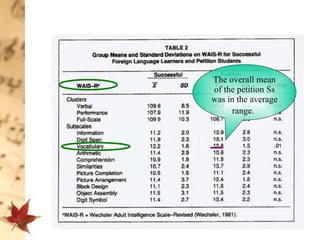
RESULTS AND DISCUSSION   Measures of Intelligence Table 2 represents a statistical comparison of group means on  full-scale intelligence  and  IQ subscales .
Results Results of WAIS-R IQ comparisons showed  no  differences between the groups on Verbal Performance, and Full-Scale IQ.  One subtest:  Vocabulary ,  F (1,29) = 7.29,  p  = .01, distinguished the groups.
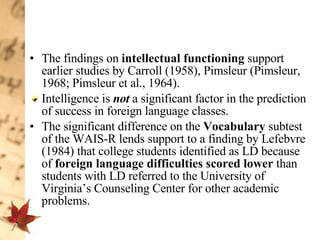
The findings on  intellectual functioning  support earlier studies by Carroll (1958), Pimsleur (Pimsleur, 1968; Pimsleur et al., 1964).  Intelligence is  not  a significant factor in the prediction of success in foreign language classes.  The significant difference on the  Vocabulary  subtest of the WAIS-R lends support to a finding by Lefebvre (1984) that college students identified as LD because of  foreign language difficulties scored lower  than students with LD referred to the University of Virginia’s Counseling Center for other academic problems.
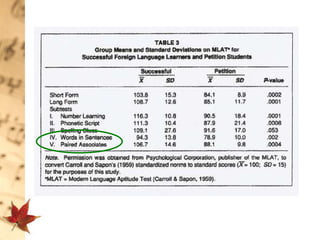
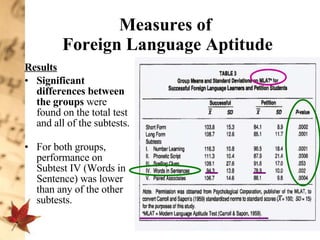
Measures of  Foreign Language Aptitude Results   Significant differences between the groups  were found on the total test and all of the subtests.  For both groups, performance on Subtest IV (Words in Sentence) was lower than any of the other subtests.
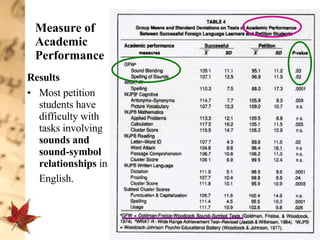
Measure of  Academic  Performance Results Most petition students have difficulty with tasks involving  sounds and sound-symbol relationships  in English.
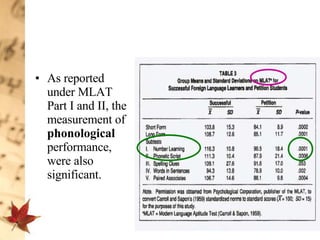
As reported under MLAT Part I and II, the measurement of  phonological  performance, were also significant.
Measures of Phonology This finding is consistent with Dinklage’s (1971, 1985) observations of Harvard students, some of whom had  difficulty remembering sounds  and  problems hearing the language .  Findings also support factor analyses by Carroll (1962), who identified  phonetic coding factors  related to success in foreign language, and research by Pimsleur and colleagues (Pimsleur, 1968; Pimsleur et al., 1964), who reported  an auditory ability factor .  These results are also consistent with the LD literature, which has shown difficulties with  phonology  to be the basis for variance in reading ability of students with LD (Bradley & Bryant, 1985; Kamhi & Catts, 1989; Wagner & Torgesen, 1987).
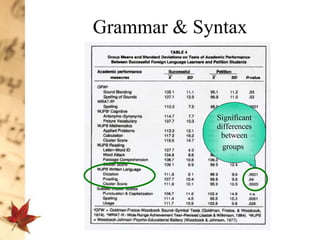
Grammar & Syntax Significant differences between groups
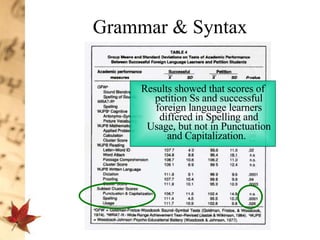
Grammar & Syntax Results showed that scores of petition Ss and successful foreign language learners differed in Spelling and Usage, but not in Punctuation and Capitalization.
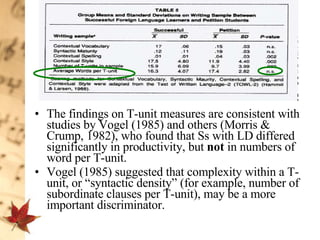
The findings on T-unit measures are consistent with studies by Vogel (1985) and others (Morris & Crump, 1982), who found that Ss with LD differed significantly in productivity, but  not  in numbers of word per T-unit.  Vogel (1985) suggested that complexity within a T-unit, or “syntactic density” (for example, number of subordinate clauses per T-unit), may be a more important discriminator.
Grammar & Syntax Overall findings on measures of grammar and syntax are consistent with…. Carroll (1968) identified a “ grammatical sensitivity ” factor related to success in learning a foreign language.  Syntactic deficits in written language  observed in college students with LD (Blalock, 1981; Gregg, 1983; Vogel, 1985; Vogel & Moran, 1982).
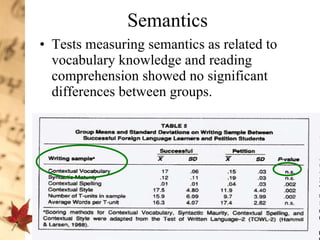
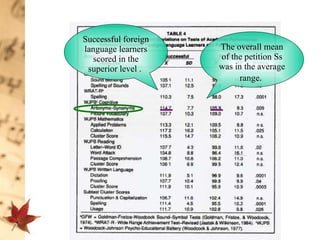
Semantics Tests measuring semantics as related to vocabulary knowledge and reading comprehension showed no significant differences between groups.
These findings support the author’s speculation that the  foreign language differences are not at the level of overall semantic understanding , as measured by these instruments.
The overall mean of the petition Ss was in the average range.
Successful foreign language learners scored in the superior level .  The overall mean of the petition Ss was in the average range.
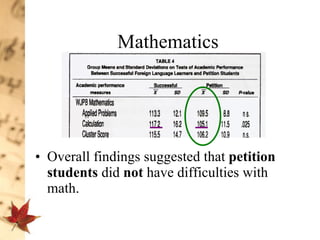
Mathematics Overall findings suggested that  petition students  did  not  have difficulties with math.
Discussion Findings on petition students in this study showed that they differed most from successful foreign language learners at the  phonological  and  syntactic (grammatical) levels  in their native language.  Petition students performed significantly poorer than successful foreign language learners on tests measuring ability to  identify single words in reading ,  synthesize isolated sounds into meaningful words ,  and spell words .  They also performed more poorly on  written language tasks , in terms of grammar and productivity.
The findings of the study suggest that, overall, the  MLAT , measures the spelling performance, and  a   writing sample  are the best indicators, in that petition Ss’ overall means differed by at least  one standard deviation  from their cognitive performance on the standardized measures.
Limitation of the study : Small sample size because of the difficulties in locating a population of petition students.
SUMMARY AND  FUTURE DIRECTIONS Based on the finding of this study, the authors suggest that the presence of difficulties with  phonological  and  syntactic skills in one’s native language  may be in indicators of potential foreign language difficulties.
There are two issues that need further exploration:  Further studies should examine specifically the role of  verbal memory  (Carroll, 1958; Dinklage, 1971),  listening comprehension  (Ganschow & Sparks, 1986; Morris & Leuenberger, 1990), and  oral expression  (Pimsleur, Hancock, & Furey, 1977) in foreign language learning.
2. The second issue is the question of ‘how to qualify for a foreign language waiver/course substitution.’ (Ganschow et al., 1989)
The authors suggest that questions such as the following be considered:  (1) Will phonological and/or syntactic  training  help foreign language learners as it has children and adults with learning disabilities (Ball & Blachman, 1988; Liberman, 1987; Lundberg, Olofsson, & Wall, 1980)?  (2) Should languages that rely less on ability to converse (e.g., Latin) or represent logographic rather than orthographic systems (e.g., Chinese) be considered for students with phonological deficits (Fisher, 1986; Ganschow & Sparks, 1987)?  (3) Will further research in second language learning provide a casual link between native and foreign language leaning problem (Sparks & Ganschow, 1991)?  (4) What kind of appropriate instruction catered to specific learning needs could fulfill the foreign language requirement?
Thank You !

Identifying Native Language Difficulties Among Foreign Language Learners in College: A "foreign" language learning disabilities?

  • 1.
    Identifying Native LanguageDifficulties among Foreign Language Learners in College: A “foreign” language learning disability? Leonard Ganschow, Richard L. Sparks, James Javorsky, Jane Pohlman, & Andrea Bishop-Marbury Presenter: Cindy
  • 2.
    Outline Introduction ILiterature Review II Method III Instruments and Procedures IV Results and Discussion V Summary and Future Directions VI
  • 3.
    Introduction The authorsdescribed studies that at-risk foreign language learners exhibit linguistic coding problems —subtle phonological, syntactic, and/or semantic difficulties—in their native language . This “linguistic coding deficit” hypothesis forms the basis for the purpose of this study: to compare successful and unsuccessful foreign language learners on variable thought to be related to learning a foreign language.
  • 4.
    Evidence for Foreign Language Learning Disabilities
  • 5.
    The first referenceto a relationship between dyslexia and foreign language learning problems Students with foreign language learning problems were thought to be underachievers. These students had difficulties understanding the language, speaking it, or both. Foreign language learning problems with suspected or identified learning disabilities because of inability to meet the foreign language requirement . There has been only one empirical study on the foreign language learning abilities of Ss with LD . 1960s 1971 1980
  • 6.
    Dinklage (1971) describedthree types of unsuccessful foreign language learners: 1 Students who were unable to “ hear ” the language and had the problems with an oral communication approach to foreign language learning 3 Students who had memory problems for sound and words (which often overlapped with listening difficulties). 2 Students who had difficulties with the written (reading and writing) aspects of the language
  • 7.
    In Gajar’s (1987)study Subjects : Students with LD and non-LD Tasks : They took the Modern Language Aptitude Test (MLAT), which uses a simulated language to measure aspects of oral and written language. Results : Students with LD exhibited significantly lower performance on all five of the MLAT subtests but especially on Subtest 4, which measures sensitivity to grammatical structure , and Subtest 5, which measures the rote memory aspect of leaning a foreign language.
  • 8.
  • 9.
    The Language-Based Natureof Foreign Language Learning Difficulties In examining the nature of foreign language aptitude through factor analysis, John Carroll, the author of MLAT, identified four aspects area, which he called (a) phonetic coding , or the ability to code auditory phonetic material in such a way that this material can be recognized, identified, and remembered over time; (b) grammatical sensitivity , or the ability to handle grammar; (c) inductive language learning ability , or the ability to infer linguistic forms, rules, or patterns from new linguistic content; (d) rote memory for foreign language learning materials, or the capacity to learn a large number of phonetic and grammatical associations.
  • 10.
    Like Carroll, Pimsleur(1966) developed a test of foreign language aptitude , the Language Aptitude Battery . Pimsleur stated that “ auditory ability ” was measured by sound discrimination and sound-symbol association tests. Auditory ability was perhaps the chief factor that distinguished underachievers from successful language learners (Pimsleur, 1968; Pimsleur et al., 1964).
  • 11.
    Subtests 1 &2 of Carroll’s MLAT also measure auditory ability
  • 12.
    Besides Carroll’s andPimsleur’s theories, other attempts have been made to predict success in foreign language learning using (1) general cognitive ability, (2) language aptitude (Gardner & Lambert, 1972; Jakobovits, 1970; Pimsleur et al., 1964; Wesche et al., 1982), and (3) attitude/motivation measures, such as high anxiety, low motivation, or negative attitude, are the result of language learning problems (Sparks and Ganschow, 1991).
  • 13.
    The Language-Based Natureof Native Language Learning Difficulties The presence of oral language and communication deficits associated with LD has been well established in the literature (Myklebust, 1964; Johnson, & Myklebust, 1967; Wiig & Semel, 1976, 1980). The relationship of oral language proficiency to later academic achievement is also well documented, e.g., preschool language impairments may result in later reading, writing, and spelling difficulties (Forrell & Hood, 1985; Lee & Shapero-Fine, 1984; Stark et al., 1984).
  • 14.
    Besides, the characteristicsof children with LD…. the deficits in reading comprehension could result from a generalized lack of linguistic awareness (Menyuk & Flood, 1981). difficulties in dealing with the complex syntactic structures of spoken language (Glass & Perna, 1986; Magee & Newcomer, 1978; Newcomer & Magee, 1977; Vogel, 1975; Wiig, Semel, & Crouse, 1973). deficits in written language that appear to persist into adulthood .
  • 15.
    Poor readers oftenhave deficient listening comprehension skills (Buerger, 1978; Chall, 1983; Curtis, 1980; Smiley, Oakley, Worthen, Campione, & Brown, 1977; Stanovich, Cunningham, & feeman, 1984.) Oftentimes, these language deficits persist and create learning problems in college for students with LD.
  • 16.
    All of thesefindings strongly suggest that oral language disorders play a causal role in later reading and writing difficulties associated with LD (Butler, 1988; Liberman, 1982; Liberman & Shankweiler, 1979; Perfetti, 1985; Vellutino, 1979).
  • 17.
    Linkages between Nativeand Foreign Language Vellutino and Scanlon (1986) coined the term “ linguistic coding ” to refer to the use of language to code information and, specifically, to the functional use of the phonological, syntactic, and semantic attributes of the language.
  • 18.
    Poor Readers’ MainDifficulty difficulty in processing structural and formal properties o f spoken and printed words deficit in metalinguistic awareness deficit in awareness of the elements of language Students with reading disorders
  • 19.
    --> Vellutino andScanlon stated that, because of these deficiencies, poor readers were more attuned to the meaning (semantics) of the words and sentences than the structural (phonological and syntactic) aspects.
  • 20.
    These studies providedevidence that good readers attend to both meaning and structural components. poor readers attend more to the meaning (semantic) than the structural components (syntax, phonology) of language.
  • 21.
    A pilot study(Sparks et al., 1989) Subjects : College students who have been identified as having extreme difficulties learning foreign languages .
  • 22.
    7 reached thethird semester of the language only 1 was able to reach the third semester of the language 3rd semester one made it to the second semester 6 failed 2nd semester none failed 7 failed 1st semester 8 Ss with syntactic or semantic deficits 13 Ss with phonological deficits course failure level
  • 23.
    --> Specific linguisticcoding problems in the students’ native language were especially apparent in the phonological domain. Results : Phonological problems of their native language had the most immediate and severe impact on foreign language learning.
  • 24.
    Phonological Coding & Reading/Listening Problems with word decoding are significant contributors to variance in reading abilities (Perfetti, 1985; Stanovich, 1986). Phonological processing abilities are strongly linked to later reading achievement (Catts, 1989; Catts & Kamhi, 1986; Gough & Hillinger, 1980; Liberman, 1971, 1982; Liberman & Shankweiler, 1979).
  • 25.
    Children with reading disabilities are said to have less awareness of and sensitivity to the speech-sound structure of the language (Catts & Kamhi, 1986, 1987; Liberman, 1982). Listening problems are also found in college students with learning disabilities (Morris & Leuenberger, 1990).
  • 26.
    Research Purpose Thepurpose of the present study was to determine whether there would be significant differences between successful and unsuccessful (petition) college foreign language learners on test of intelligence , foreign language aptitude , oral and written language , and mathematics .
  • 27.
    METHOD Subjects 30juniors and seniors matched by sex and year in college 15 successful foreign language Ss The GPAs ranged from 2.6 to 3.5. SAT/ACTs were converted to percentiles for basis of comparison and ranged from the 45th percentile to the 99th percentile. 15 petition Ss The GPAs ranged from 2.1 to 3.3. SAT/ACTs were ranged from the 1st percentile to 93rd percentile.
  • 28.
    SAT/ACTs & GPAsAs the table indicates, there were no significant differences between groups on SAT/ACTs scores, F (1,22) = 2.00, p = .17; however, there were significant differences on GPAs, F (1,29) = 10.24, p = .003.
  • 29.
    Instruments and ProceduresInstruments used to assess foreign language learners
  • 30.
    (1) intelligence: WAIS-R; (2) foreign language aptitude : MLAT Long Form, Parts I-V and Short Form, Parts III-V; (3) phonology : Goldman-Fristoe-Woodcock (GFW), Sound Blending and Spelling of Sounds subtests; MLAT, Parts I (Number Learning), II (Phonetic Script), and V (Paired Associates); Wide Range Achievement Test-Revised (WRAT-R) Spelling; Woodcock-Johnson Psycho-Educational Battery, Part II (WJPB) Letter-Word Identification and Word Attack subtests; (4) grammar and syntax : MLAT Part IV, Words in sentences; WJPB, Written Language; (5) semantics : that is, vocabulary and reading comprehension: MLAT-Part III, Spelling Clues; WJPB, antonym-Synonyms and Picture Vocabulary subtests. Passage Comprehension subtests; (6) mathematics : WJPB, Mathematics cluster.
  • 31.
    TOWL-2 A 15-minute writing sample , in which the students were asked to take a position in a topic of their choice, was also collected. A scoring method was adapted from the Test of Written Language-2 (TOWL-2) (Hammill & Larsen, 1988) and included measures of A T-unit is defined as a main clause plus attached or embedded subordinate clauses (Hunt, 1965, 1970) and provides a gross measure of syntactic complexity .
  • 32.
    In this study,the 30 writing samples with names removed and errors included were typed onto sheets, which were shuffled and graded independently by the authors. They cross-checked scores for accuracy. This scoring method differs from the TOWL-2, wherein total number of words or errors in a given sample are counted.
  • 33.
    Procedure: Students weretested individually over several time periods totaling approximately 5 hours. Achievement tests were administered by the authors; intelligence tests were administered by a licensed psychologist.
  • 34.
    Analysis of DataAn ANOVA procedure was used to determine the level of significance of the difference of the difference between successful and unsuccessful foreign language learners on each test and test cluster in the diagnostic battery. Standard scores were used in the analysis of data. A level of .05 was used as the criterion for significance. Bonferroni (Dunn) and Tukey T -tests were performed on variables with unequal numbers of scores (due to the omission of a given test in an individual’s test profile) to confirm the ANOVA results.
  • 35.
    RESULTS AND DISCUSSION Measures of Intelligence Table 2 represents a statistical comparison of group means on full-scale intelligence and IQ subscales .
  • 36.
    Results Results ofWAIS-R IQ comparisons showed no differences between the groups on Verbal Performance, and Full-Scale IQ. One subtest: Vocabulary , F (1,29) = 7.29, p = .01, distinguished the groups.
  • 37.
    The findings on intellectual functioning support earlier studies by Carroll (1958), Pimsleur (Pimsleur, 1968; Pimsleur et al., 1964). Intelligence is not a significant factor in the prediction of success in foreign language classes. The significant difference on the Vocabulary subtest of the WAIS-R lends support to a finding by Lefebvre (1984) that college students identified as LD because of foreign language difficulties scored lower than students with LD referred to the University of Virginia’s Counseling Center for other academic problems.
  • 38.
    Measures of Foreign Language Aptitude Results Significant differences between the groups were found on the total test and all of the subtests. For both groups, performance on Subtest IV (Words in Sentence) was lower than any of the other subtests.
  • 39.
    Measure of Academic Performance Results Most petition students have difficulty with tasks involving sounds and sound-symbol relationships in English.
  • 40.
    As reported underMLAT Part I and II, the measurement of phonological performance, were also significant.
  • 41.
    Measures of PhonologyThis finding is consistent with Dinklage’s (1971, 1985) observations of Harvard students, some of whom had difficulty remembering sounds and problems hearing the language . Findings also support factor analyses by Carroll (1962), who identified phonetic coding factors related to success in foreign language, and research by Pimsleur and colleagues (Pimsleur, 1968; Pimsleur et al., 1964), who reported an auditory ability factor . These results are also consistent with the LD literature, which has shown difficulties with phonology to be the basis for variance in reading ability of students with LD (Bradley & Bryant, 1985; Kamhi & Catts, 1989; Wagner & Torgesen, 1987).
  • 42.
    Grammar & SyntaxSignificant differences between groups
  • 43.
    Grammar & SyntaxResults showed that scores of petition Ss and successful foreign language learners differed in Spelling and Usage, but not in Punctuation and Capitalization.
  • 44.
    The findings onT-unit measures are consistent with studies by Vogel (1985) and others (Morris & Crump, 1982), who found that Ss with LD differed significantly in productivity, but not in numbers of word per T-unit. Vogel (1985) suggested that complexity within a T-unit, or “syntactic density” (for example, number of subordinate clauses per T-unit), may be a more important discriminator.
  • 45.
    Grammar & SyntaxOverall findings on measures of grammar and syntax are consistent with…. Carroll (1968) identified a “ grammatical sensitivity ” factor related to success in learning a foreign language. Syntactic deficits in written language observed in college students with LD (Blalock, 1981; Gregg, 1983; Vogel, 1985; Vogel & Moran, 1982).
  • 46.
    Semantics Tests measuringsemantics as related to vocabulary knowledge and reading comprehension showed no significant differences between groups.
  • 47.
    These findings supportthe author’s speculation that the foreign language differences are not at the level of overall semantic understanding , as measured by these instruments.
  • 48.
    The overall meanof the petition Ss was in the average range.
  • 49.
    Successful foreign languagelearners scored in the superior level . The overall mean of the petition Ss was in the average range.
  • 50.
    Mathematics Overall findingssuggested that petition students did not have difficulties with math.
  • 51.
    Discussion Findings onpetition students in this study showed that they differed most from successful foreign language learners at the phonological and syntactic (grammatical) levels in their native language. Petition students performed significantly poorer than successful foreign language learners on tests measuring ability to identify single words in reading , synthesize isolated sounds into meaningful words , and spell words . They also performed more poorly on written language tasks , in terms of grammar and productivity.
  • 52.
    The findings ofthe study suggest that, overall, the MLAT , measures the spelling performance, and a writing sample are the best indicators, in that petition Ss’ overall means differed by at least one standard deviation from their cognitive performance on the standardized measures.
  • 53.
    Limitation of thestudy : Small sample size because of the difficulties in locating a population of petition students.
  • 54.
    SUMMARY AND FUTURE DIRECTIONS Based on the finding of this study, the authors suggest that the presence of difficulties with phonological and syntactic skills in one’s native language may be in indicators of potential foreign language difficulties.
  • 55.
    There are twoissues that need further exploration: Further studies should examine specifically the role of verbal memory (Carroll, 1958; Dinklage, 1971), listening comprehension (Ganschow & Sparks, 1986; Morris & Leuenberger, 1990), and oral expression (Pimsleur, Hancock, & Furey, 1977) in foreign language learning.
  • 56.
    2. The secondissue is the question of ‘how to qualify for a foreign language waiver/course substitution.’ (Ganschow et al., 1989)
  • 57.
    The authors suggestthat questions such as the following be considered: (1) Will phonological and/or syntactic training help foreign language learners as it has children and adults with learning disabilities (Ball & Blachman, 1988; Liberman, 1987; Lundberg, Olofsson, & Wall, 1980)? (2) Should languages that rely less on ability to converse (e.g., Latin) or represent logographic rather than orthographic systems (e.g., Chinese) be considered for students with phonological deficits (Fisher, 1986; Ganschow & Sparks, 1987)? (3) Will further research in second language learning provide a casual link between native and foreign language leaning problem (Sparks & Ganschow, 1991)? (4) What kind of appropriate instruction catered to specific learning needs could fulfill the foreign language requirement?
  • 58.