
Second Language Acquisition in MALDIVES
         By: Sujjey, Suja, Fai, Hucen, Saadhu & Shimu
How many languages do you know/speak?

                 50
                                                               50%
                 45
                                                44%
                 40
                 35
    Percentage


                 30
                  25
                  20
                  15
                  10                6%
                      5
                      0


                              One
                                            Two
                                                           Three +
Total: 54 Participants                   No of Languages
Is English in the Maldives a foreign /
               second Language?

•   Second Language
•   Serves a communicative purpose
•   Not just taught and spoken in schools
•   Used for business purposes
•   Officially regarded as the
    second language
Do Maldivians acquire English naturally? To
              what extent?
• Majority of children LEARN English through
  instruction.
• Some children acquire naturally. Especially in
  the capital.
• Parents play a vital role.
• Maldivian couple staying
  abroad.
• Early exposure.
How do Maldivians normally acquire English and what
  are the consequences of ‘acquiring’ as opposed to
                     ‘learning’?

• Normally learned at school through formal instruction.

• Guided
  learning.

• Learning
  takes place
  consciously.
Consequences of ‘learning’ English

• Knowledge is explicit.
• Formal teaching helps (Krashen, 2006).
• Less likely to achieve perfect L2 mastery
• More concerned with fluency than accuracy
• Fossilisation (Ellis, 2004).
• Focuses on a particular aspect of the target
  language system.
• Allows teachers to control the learning process
  (Lightbown & Spada, 2006).
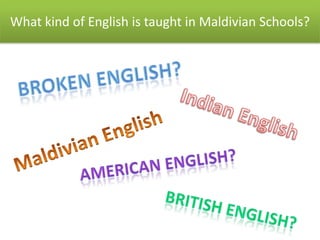
What kind of English is taught in Maldivian Schools?
References

• Ellis, R. (1994). The study of second language
       acquisition. Oxford: Oxford University Press.

• Lightbown, P.M. & Spada, N. (2006). How languages
      are learned (3rd ed.). Oxford: Oxford University
      Press.

• Krashen, S. (2005). Theory of second language
      acquisition. Retrieved on 1 February 2012 from
      http://www.sk.com.br/sk-krash.html

Second language acquisition

  • 1.
    Second Language Acquisitionin MALDIVES By: Sujjey, Suja, Fai, Hucen, Saadhu & Shimu
  • 2.
    How many languagesdo you know/speak? 50 50% 45 44% 40 35 Percentage 30 25 20 15 10 6% 5 0 One Two Three + Total: 54 Participants No of Languages
  • 3.
    Is English inthe Maldives a foreign / second Language? • Second Language • Serves a communicative purpose • Not just taught and spoken in schools • Used for business purposes • Officially regarded as the second language
  • 4.
    Do Maldivians acquireEnglish naturally? To what extent? • Majority of children LEARN English through instruction. • Some children acquire naturally. Especially in the capital. • Parents play a vital role. • Maldivian couple staying abroad. • Early exposure.
  • 5.
    How do Maldiviansnormally acquire English and what are the consequences of ‘acquiring’ as opposed to ‘learning’? • Normally learned at school through formal instruction. • Guided learning. • Learning takes place consciously.
  • 6.
    Consequences of ‘learning’English • Knowledge is explicit. • Formal teaching helps (Krashen, 2006). • Less likely to achieve perfect L2 mastery • More concerned with fluency than accuracy • Fossilisation (Ellis, 2004). • Focuses on a particular aspect of the target language system. • Allows teachers to control the learning process (Lightbown & Spada, 2006).
  • 7.
    What kind ofEnglish is taught in Maldivian Schools?
  • 8.
    References • Ellis, R.(1994). The study of second language acquisition. Oxford: Oxford University Press. • Lightbown, P.M. & Spada, N. (2006). How languages are learned (3rd ed.). Oxford: Oxford University Press. • Krashen, S. (2005). Theory of second language acquisition. Retrieved on 1 February 2012 from http://www.sk.com.br/sk-krash.html