Language Comparison Poster

A Comparison of the Spanish and English Language


• Paul Mark Bradigan
• Wilkes University
Language Comparison Poster
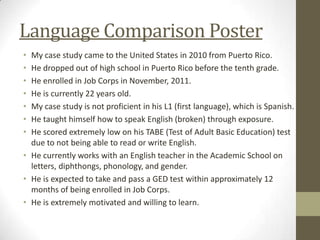
• My case study came to the United States in 2010 from Puerto Rico.
• He dropped out of high school in Puerto Rico before the tenth grade.
• He enrolled in Job Corps in November, 2011.
• He is currently 22 years old.
• My case study is not proficient in his L1 (first language), which is Spanish.
• He taught himself how to speak English (broken) through exposure.
• He scored extremely low on his TABE (Test of Adult Basic Education) test
  due to not being able to read or write English.
• He currently works with an English teacher in the Academic School on
  letters, diphthongs, phonology, and gender.
• He is expected to take and pass a GED test within approximately 12
  months of being enrolled in Job Corps.
• He is extremely motivated and willing to learn.
Language Comparison Poster
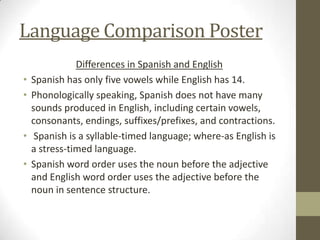
               Differences in Spanish and English
•   Spanish has only five vowels while English has 14.
•   Phonologically speaking, Spanish does not have many
    sounds produced in English, including certain vowels,
    consonants, endings, suffixes/prefixes, and contractions.
•    Spanish is a syllable-timed language; where-as English is
    a stress-timed language.
•   Spanish word order uses the noun before the adjective
    and English word order uses the adjective before the
    noun in sentence structure.
Language Comparison Poster
                Similarities in Spanish and English
•   Several words in the Spanish vocabulary look and sound
    similar to English words; called Cognates.
•   Both languages are derived from the Roman alphabet.
•   Learning to read and write in both languages use the
    same basic processes (phonemic awareness, decoding,
    fluency, comprehension, writing mechanics).
•   Sentence structure is very similar besides the noun-
    adjective placement discussed in the previous slide.
Language Comparison Poster
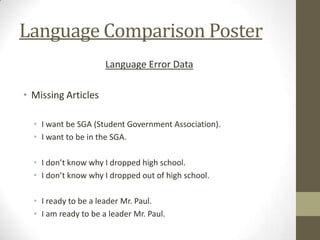
                      Language Error Data

• Missing Articles

  • I want be SGA (Student Government Association).
  • I want to be in the SGA.

  • I don’t know why I dropped high school.
  • I don’t know why I dropped out of high school.

  • I ready to be a leader Mr. Paul.
  • I am ready to be a leader Mr. Paul.
Language Comparison Poster
                     Language Error Data

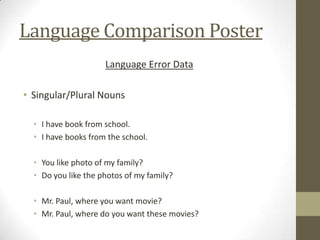
• Singular/Plural Nouns

  • I have book from school.
  • I have books from the school.

  • You like photo of my family?
  • Do you like the photos of my family?

  • Mr. Paul, where you want movie?
  • Mr. Paul, where do you want these movies?
Language Comparison Poster
                      Language Error Data

• Irregular Verbs/Verb Tense

  • I go to store yesterday.
  • I went to the store yesterday.

  • I bring application with me.
  • I brought my application with me.

  • I take my swim test with Mr. Keith.
  • I took my swim test with Mr. Keith.
Language Comparison Poster
                      Language Error Data

• Repeated Subject

  • Like Mr. L’s class, his class hard because I know hardly any English.
  • Mr. L’s class is hard because I hardly know any English.

  • Puerto Rico it is not the same as here.
  • Puerto Rico is not the same as here.

  • Mr. Keith, he said the gym is open.
  • Mr. Keith said the gym is open.
Language Comparison Poster
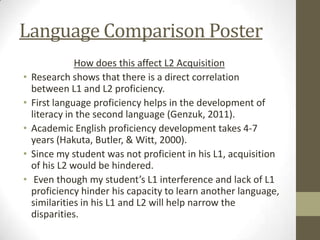
               How does this affect L2 Acquisition
•   Research shows that there is a direct correlation
    between L1 and L2 proficiency.
•   First language proficiency helps in the development of
    literacy in the second language (Genzuk, 2011).
•   Academic English proficiency development takes 4-7
    years (Hakuta, Butler, & Witt, 2000).
•   Since my student was not proficient in his L1, acquisition
    of his L2 would be hindered.
•    Even though my student’s L1 interference and lack of L1
    proficiency hinder his capacity to learn another language,
    similarities in his L1 and L2 will help narrow the
    disparities.
Language Comparison Poster
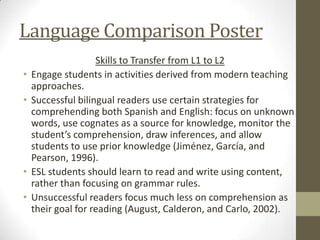
                    Skills to Transfer from L1 to L2
•   Engage students in activities derived from modern teaching
    approaches.
•   Successful bilingual readers use certain strategies for
    comprehending both Spanish and English: focus on unknown
    words, use cognates as a source for knowledge, monitor the
    student’s comprehension, draw inferences, and allow
    students to use prior knowledge (Jiménez, García, and
    Pearson, 1996).
•   ESL students should learn to read and write using content,
    rather than focusing on grammar rules.
•   Unsuccessful readers focus much less on comprehension as
    their goal for reading (August, Calderon, and Carlo, 2002).
Language Comparison Poster
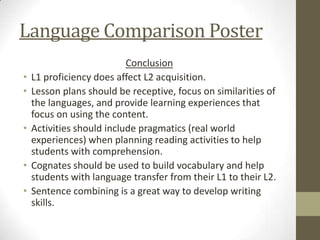
                           Conclusion
•   L1 proficiency does affect L2 acquisition.
•   Lesson plans should be receptive, focus on similarities of
    the languages, and provide learning experiences that
    focus on using the content.
•   Activities should include pragmatics (real world
    experiences) when planning reading activities to help
    students with comprehension.
•   Cognates should be used to build vocabulary and help
    students with language transfer from their L1 to their L2.
•   Sentence combining is a great way to develop writing
    skills.
Language Comparison Poster
                                       References

August, D., Calderon, M., & Carlo, M. (2002). The transfer of skills from Spanish to
         English: A study of young learners. Washington DC: Center for Applied
         Linguistics.
Colorado, C. (2007). Capitalizing on similarities and differences between Spanish and
         English. www.colorincolorado.org/educators/background/capitalizing/
         Retrieved July 10, 2012, from http://www.colorincolorado.org
Genzuk, M. (2011). Specially designed academic instruction in English (SDAIE) for
         language minority students. Center for Multilingual, Multicultural Research
         Digital Papers Series. Center for Multilingual, Multicultural Research,
         University of Southern California. Retrieved from
         http://www.usc.edu/dept/education/CMMR/DigitalPapers/SDAIE_Genzuk.pdf
Hakuta, H., Butler, Y. G., & Witt, D., (2000). How long does it take English learners to
         attain proficiency. The University of California Linguistic Minority Research
         Institute Policy Report.
Jiménez, R. T., G. E. García, and P. D. Pearson. 1996. The reading strategies of bilingual
         Latina/o students who are successful English readers: Opportunities and
         obstacles. Reading Research Quarterly, 31, 90–112.

Language Comparison Poster

  • 1.
    Language Comparison Poster AComparison of the Spanish and English Language • Paul Mark Bradigan • Wilkes University
  • 2.
    Language Comparison Poster •My case study came to the United States in 2010 from Puerto Rico. • He dropped out of high school in Puerto Rico before the tenth grade. • He enrolled in Job Corps in November, 2011. • He is currently 22 years old. • My case study is not proficient in his L1 (first language), which is Spanish. • He taught himself how to speak English (broken) through exposure. • He scored extremely low on his TABE (Test of Adult Basic Education) test due to not being able to read or write English. • He currently works with an English teacher in the Academic School on letters, diphthongs, phonology, and gender. • He is expected to take and pass a GED test within approximately 12 months of being enrolled in Job Corps. • He is extremely motivated and willing to learn.
  • 3.
    Language Comparison Poster Differences in Spanish and English • Spanish has only five vowels while English has 14. • Phonologically speaking, Spanish does not have many sounds produced in English, including certain vowels, consonants, endings, suffixes/prefixes, and contractions. • Spanish is a syllable-timed language; where-as English is a stress-timed language. • Spanish word order uses the noun before the adjective and English word order uses the adjective before the noun in sentence structure.
  • 4.
    Language Comparison Poster Similarities in Spanish and English • Several words in the Spanish vocabulary look and sound similar to English words; called Cognates. • Both languages are derived from the Roman alphabet. • Learning to read and write in both languages use the same basic processes (phonemic awareness, decoding, fluency, comprehension, writing mechanics). • Sentence structure is very similar besides the noun- adjective placement discussed in the previous slide.
  • 5.
    Language Comparison Poster Language Error Data • Missing Articles • I want be SGA (Student Government Association). • I want to be in the SGA. • I don’t know why I dropped high school. • I don’t know why I dropped out of high school. • I ready to be a leader Mr. Paul. • I am ready to be a leader Mr. Paul.
  • 6.
    Language Comparison Poster Language Error Data • Singular/Plural Nouns • I have book from school. • I have books from the school. • You like photo of my family? • Do you like the photos of my family? • Mr. Paul, where you want movie? • Mr. Paul, where do you want these movies?
  • 7.
    Language Comparison Poster Language Error Data • Irregular Verbs/Verb Tense • I go to store yesterday. • I went to the store yesterday. • I bring application with me. • I brought my application with me. • I take my swim test with Mr. Keith. • I took my swim test with Mr. Keith.
  • 8.
    Language Comparison Poster Language Error Data • Repeated Subject • Like Mr. L’s class, his class hard because I know hardly any English. • Mr. L’s class is hard because I hardly know any English. • Puerto Rico it is not the same as here. • Puerto Rico is not the same as here. • Mr. Keith, he said the gym is open. • Mr. Keith said the gym is open.
  • 9.
    Language Comparison Poster How does this affect L2 Acquisition • Research shows that there is a direct correlation between L1 and L2 proficiency. • First language proficiency helps in the development of literacy in the second language (Genzuk, 2011). • Academic English proficiency development takes 4-7 years (Hakuta, Butler, & Witt, 2000). • Since my student was not proficient in his L1, acquisition of his L2 would be hindered. • Even though my student’s L1 interference and lack of L1 proficiency hinder his capacity to learn another language, similarities in his L1 and L2 will help narrow the disparities.
  • 10.
    Language Comparison Poster Skills to Transfer from L1 to L2 • Engage students in activities derived from modern teaching approaches. • Successful bilingual readers use certain strategies for comprehending both Spanish and English: focus on unknown words, use cognates as a source for knowledge, monitor the student’s comprehension, draw inferences, and allow students to use prior knowledge (Jiménez, García, and Pearson, 1996). • ESL students should learn to read and write using content, rather than focusing on grammar rules. • Unsuccessful readers focus much less on comprehension as their goal for reading (August, Calderon, and Carlo, 2002).
  • 11.
    Language Comparison Poster Conclusion • L1 proficiency does affect L2 acquisition. • Lesson plans should be receptive, focus on similarities of the languages, and provide learning experiences that focus on using the content. • Activities should include pragmatics (real world experiences) when planning reading activities to help students with comprehension. • Cognates should be used to build vocabulary and help students with language transfer from their L1 to their L2. • Sentence combining is a great way to develop writing skills.
  • 12.
    Language Comparison Poster References August, D., Calderon, M., & Carlo, M. (2002). The transfer of skills from Spanish to English: A study of young learners. Washington DC: Center for Applied Linguistics. Colorado, C. (2007). Capitalizing on similarities and differences between Spanish and English. www.colorincolorado.org/educators/background/capitalizing/ Retrieved July 10, 2012, from http://www.colorincolorado.org Genzuk, M. (2011). Specially designed academic instruction in English (SDAIE) for language minority students. Center for Multilingual, Multicultural Research Digital Papers Series. Center for Multilingual, Multicultural Research, University of Southern California. Retrieved from http://www.usc.edu/dept/education/CMMR/DigitalPapers/SDAIE_Genzuk.pdf Hakuta, H., Butler, Y. G., & Witt, D., (2000). How long does it take English learners to attain proficiency. The University of California Linguistic Minority Research Institute Policy Report. Jiménez, R. T., G. E. García, and P. D. Pearson. 1996. The reading strategies of bilingual Latina/o students who are successful English readers: Opportunities and obstacles. Reading Research Quarterly, 31, 90–112.