Embed presentation
Download as ODP, PPTX







This document discusses how to set SMART goals, which are goals that are Specific, Measurable, Attainable, Realistic, and Timed. It explains each component of a SMART goal, such as making specific goals answer what, why, and how questions, making measurable goals have concrete criteria, making attainable goals use your strengths, making realistic goals achievable but challenging, and setting timely goals with target dates. The document encourages setting short, medium, and long term SMART goals.


Introduction to advanced learning strategies focused on goal setting by Elona Hartjes, emphasizing the importance of structured goal-setting.
Introduction to the SMART goal-setting method, introduced by Elona Hartjes, highlighting its structured approach.
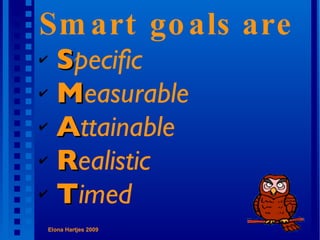
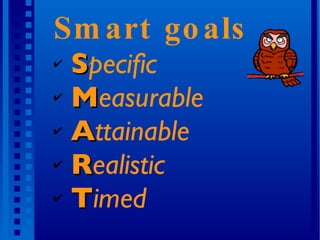
Definition of SMART goals: Specific, Measurable, Attainable, Realistic, Timed, as explained by Elona Hartjes.
Specific goals focus on clarity with questions: What, Why, and How. Elona Hartjes emphasizes action-oriented language.
Measurable goals require concrete criteria for tracking progress in terms of time, amount, and date.
Attainable goals leverage personal strengths for success, according to Elona Hartjes, promoting self-awareness.
Realistic goals should be achievable with effort; persistence is encouraged to reach these goals.
Timely goals establish a target date for outcomes, spanning short, medium, and long-term categories.
Recap of the SMART framework: Specific, Measurable, Attainable, Realistic, Timed.
Encouragement from Elona Hartjes to apply the SMART framework effectively for goal-setting success.