




Identifying a research question
Tong SF
MBBS (UM) MMed (Fam Med) (UKM) PhD (Sydney)
Department of Family Medicine
FPUKM
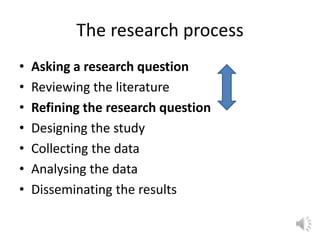
The research process
• Asking a research question
• Reviewing the literature
• Refining the research question
• Designing the study
• Collecting the data
• Analysing the data
• Disseminating the results
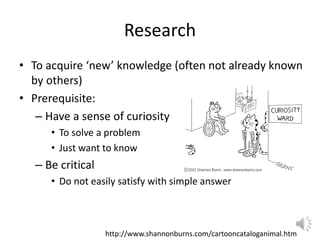
Research
• To acquire ‘new’ knowledge (often not already known
by others)
• Prerequisite:
– Have a sense of curiosity
• To solve a problem
• Just want to know
– Be critical
• Do not easily satisfy with simple answer
http://www.shannonburns.com/cartooncataloganimal.htm
What is “research question”?
• A focus of what the research is about to
answer
“What is to be studied”
• It gives you the start of the journey of
research
• Often, it provides the direction of the project
Issues in generating research
questions
• Where does the idea come from?
• What is “right” research question?
Where does idea come from?
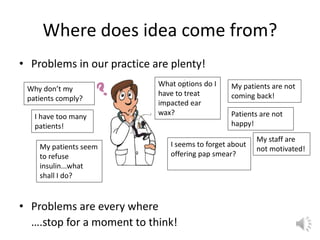
• Problems in our practice are plenty!
• Problems are every where
….stop for a moment to think!
My patients are not
coming back!
Patients are not
happy!
Why don’t my
patients comply?
My patients seem
to refuse
insulin...what
shall I do?
What options do I
have to treat
impacted ear
wax?
I seems to forget about
offering pap smear?
I have too many
patients!
My staff are
not motivated!
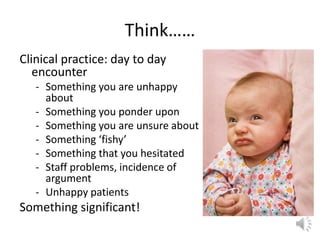
Think……
Clinical practice: day to day
encounter
- Something you are unhappy
about
- Something you ponder upon
- Something you are unsure about
- Something ‘fishy’
- Something that you hesitated
- Staff problems, incidence of
argument
- Unhappy patients
Something significant!
Another way of getting an idea
• Read…and something that you want to know
more about.
JMH 2012; 9(1): 25–35
Yet another way of getting an idea!
• Speak to people, experts
• Participate in discussion
• Attending conferences, seminars
Madam Yip has been following up with me for
diabetes. Recently she refuses to see other
doctors during my absence in the clinic.
• Why does she refuse to see other doctors?
• How do patients choose their GP?
• Has she had bad encounters in the clinic?
• What is an appropriate doctor-patient relationship?
• Is this relationship healthy?
• How can I empower my patients about help seeking behaviour?
• What is ‘right’ help seeking behaviour?
• What is the impact of having different doctors following up the
same patients?
• How should doctors react in this situation?
• Is rescheduling patients better than having other doctor to
attend to her? …endless list of questions!
Now that I have an idea (which could be
vague), how do I go about next?
You will need to refine you questions:
1. Start with a framework
2. Review your topic - AFIA
3. Ask specific question - PICO
4. Literature review
5. Revisit your question
One of the many frameworks
(problem solving approach)
• Characteristic of a phenomenon:
Frequency, incidence, patterns, extensiveness
e.g. Defaulters: prevalence, characteristics of defaulters
• The relationship: association, aetiology, roots of the
problem:
e.g. Causes of defaulters
• Effect (outcome): survival, improve QoL, satisfaction
e.g DM control of defaulters, QoL of defaulters
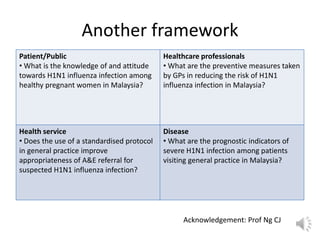
Patient/Public
• What is the knowledge of and attitude
towards H1N1 influenza infection among
healthy pregnant women in Malaysia?
Healthcare professionals
• What are the preventive measures taken
by GPs in reducing the risk of H1N1
influenza infection in Malaysia?
Health service
• Does the use of a standardised protocol
in general practice improve
appropriateness of A&E referral for
suspected H1N1 influenza infection?
Disease
• What are the prognostic indicators of
severe H1N1 infection among patients
visiting general practice in Malaysia?
Another framework
Acknowledgement: Prof Ng CJ
Refining your idea
• But how to transform the idea to a good research
question?
What, when, who, why, how, outcome
• Must write down your research question
“why do diabetic patients present late with their foot
problem?”
Reflect on it
Ask yourself these questions…
Example: diabetic foot is problematic
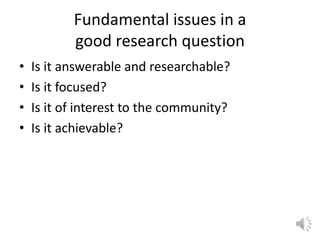
Fundamental issues in a
good research question
• Is it answerable and researchable?
• Is it focused?
• Is it of interest to the community?
• Is it achievable?
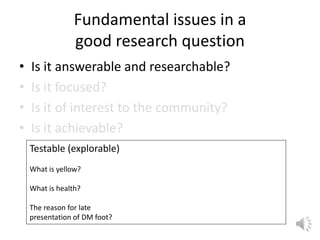
Fundamental issues in a
good research question
• Is it answerable and researchable?
• Is it focused?
• Is it of interest to the community?
• Is it achievable?
Testable (explorable)
What is yellow?
What is health?
The reason for late
presentation of DM foot?
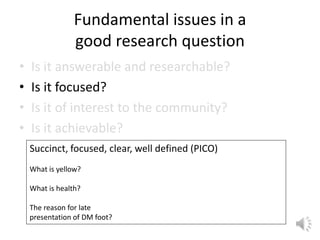
Fundamental issues in a
good research question
• Is it answerable and researchable?
• Is it focused?
• Is it of interest to the community?
• Is it achievable?
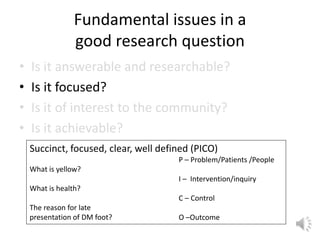
Succinct, focused, clear, well defined (PICO)
What is yellow?
What is health?
The reason for late
presentation of DM foot?
Fundamental issues in a
good research question
• Is it answerable and researchable?
• Is it focused?
• Is it of interest to the community?
• Is it achievable?
Succinct, focused, clear, well defined (PICO)
What is yellow?
What is health?
The reason for late
presentation of DM foot?
P – Problem/Patients /People
I – Intervention/inquiry
C – Control
O –Outcome
Fundamental issues in a
good research question
• Is it answerable and researchable?
• Is it focused?
• Is it of interest to the community?
• Is it achievable?
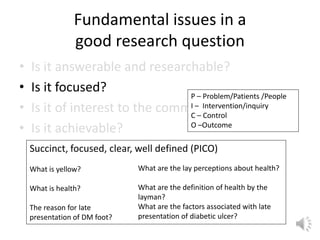
Succinct, focused, clear, well defined (PICO)
What is yellow?
What is health?
The reason for late
presentation of DM foot?
What are the lay perceptions about health?
What are the definition of health by the
layman?
What are the factors associated with late
presentation of diabetic ulcer?
P – Problem/Patients /People
I – Intervention/inquiry
C – Control
O –Outcome
Fundamental issues in a
good research question
• Is it answerable and researchable?
• Is it focused?
• Is it of interest to the community?
• Is it achievable?
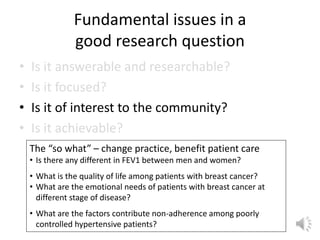
The “so what” – change practice, benefit patient care
• Is there any different in FEV1 between men and women?
• What is the quality of life among patients with breast cancer?
• What are the emotional needs of patients with breast cancer at
different stage of disease?
• What are the factors contribute non-adherence among poorly
controlled hypertensive patients?
Fundamental issues in a
good research question
• Is it answerable and researchable?
• Is it focused?
• Is it of interest to the community?
• Is it achievable?
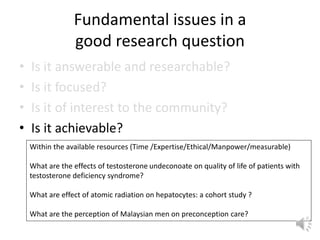
Within the available resources (Time /Expertise/Ethical/Manpower/measurable)
What are the effects of testosterone undeconoate on quality of life of patients with
testosterone deficiency syndrome?
What are effect of atomic radiation on hepatocytes: a cohort study ?
What are the perception of Malaysian men on preconception care?
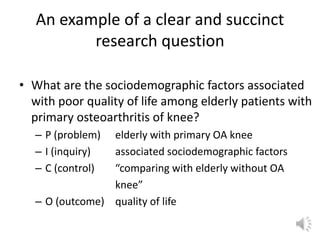
An example of a clear and succinct
research question
• What are the sociodemographic factors associated
with poor quality of life among elderly patients with
primary osteoarthritis of knee?
– P (problem) elderly with primary OA knee
– I (inquiry) associated sociodemographic factors
– C (control) “comparing with elderly without OA
knee”
– O (outcome) quality of life
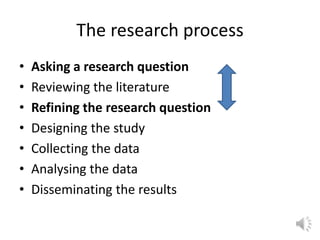
The research process
• Asking a research question
• Reviewing the literature
• Refining the research question
• Designing the study
• Collecting the data
• Analysing the data
• Disseminating the results
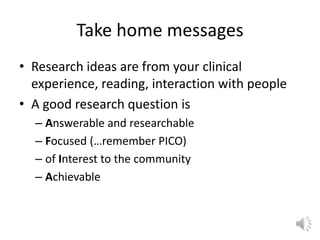
Take home messages
• Research ideas are from your clinical
experience, reading, interaction with people
• A good research question is
– Answerable and researchable
– Focused (…remember PICO)
– of Interest to the community
– Achievable

Identifying a research question

  • 1.
    Identifying a researchquestion Tong SF MBBS (UM) MMed (Fam Med) (UKM) PhD (Sydney) Department of Family Medicine FPUKM
  • 2.
    The research process •Asking a research question • Reviewing the literature • Refining the research question • Designing the study • Collecting the data • Analysing the data • Disseminating the results
  • 3.
    Research • To acquire‘new’ knowledge (often not already known by others) • Prerequisite: – Have a sense of curiosity • To solve a problem • Just want to know – Be critical • Do not easily satisfy with simple answer http://www.shannonburns.com/cartooncataloganimal.htm
  • 4.
    What is “researchquestion”? • A focus of what the research is about to answer “What is to be studied” • It gives you the start of the journey of research • Often, it provides the direction of the project
  • 5.
    Issues in generatingresearch questions • Where does the idea come from? • What is “right” research question?
  • 6.
    Where does ideacome from? • Problems in our practice are plenty! • Problems are every where ….stop for a moment to think! My patients are not coming back! Patients are not happy! Why don’t my patients comply? My patients seem to refuse insulin...what shall I do? What options do I have to treat impacted ear wax? I seems to forget about offering pap smear? I have too many patients! My staff are not motivated!
  • 7.
    Think…… Clinical practice: dayto day encounter - Something you are unhappy about - Something you ponder upon - Something you are unsure about - Something ‘fishy’ - Something that you hesitated - Staff problems, incidence of argument - Unhappy patients Something significant!
  • 8.
    Another way ofgetting an idea • Read…and something that you want to know more about. JMH 2012; 9(1): 25–35
  • 9.
    Yet another wayof getting an idea! • Speak to people, experts • Participate in discussion • Attending conferences, seminars
  • 10.
    Madam Yip hasbeen following up with me for diabetes. Recently she refuses to see other doctors during my absence in the clinic. • Why does she refuse to see other doctors? • How do patients choose their GP? • Has she had bad encounters in the clinic? • What is an appropriate doctor-patient relationship? • Is this relationship healthy? • How can I empower my patients about help seeking behaviour? • What is ‘right’ help seeking behaviour? • What is the impact of having different doctors following up the same patients? • How should doctors react in this situation? • Is rescheduling patients better than having other doctor to attend to her? …endless list of questions!
  • 11.
    Now that Ihave an idea (which could be vague), how do I go about next? You will need to refine you questions: 1. Start with a framework 2. Review your topic - AFIA 3. Ask specific question - PICO 4. Literature review 5. Revisit your question
  • 12.
    One of themany frameworks (problem solving approach) • Characteristic of a phenomenon: Frequency, incidence, patterns, extensiveness e.g. Defaulters: prevalence, characteristics of defaulters • The relationship: association, aetiology, roots of the problem: e.g. Causes of defaulters • Effect (outcome): survival, improve QoL, satisfaction e.g DM control of defaulters, QoL of defaulters
  • 13.
    Patient/Public • What isthe knowledge of and attitude towards H1N1 influenza infection among healthy pregnant women in Malaysia? Healthcare professionals • What are the preventive measures taken by GPs in reducing the risk of H1N1 influenza infection in Malaysia? Health service • Does the use of a standardised protocol in general practice improve appropriateness of A&E referral for suspected H1N1 influenza infection? Disease • What are the prognostic indicators of severe H1N1 infection among patients visiting general practice in Malaysia? Another framework Acknowledgement: Prof Ng CJ
  • 14.
    Refining your idea •But how to transform the idea to a good research question? What, when, who, why, how, outcome • Must write down your research question “why do diabetic patients present late with their foot problem?” Reflect on it Ask yourself these questions… Example: diabetic foot is problematic
  • 15.
    Fundamental issues ina good research question • Is it answerable and researchable? • Is it focused? • Is it of interest to the community? • Is it achievable?
  • 16.
    Fundamental issues ina good research question • Is it answerable and researchable? • Is it focused? • Is it of interest to the community? • Is it achievable? Testable (explorable) What is yellow? What is health? The reason for late presentation of DM foot?
  • 17.
    Fundamental issues ina good research question • Is it answerable and researchable? • Is it focused? • Is it of interest to the community? • Is it achievable? Succinct, focused, clear, well defined (PICO) What is yellow? What is health? The reason for late presentation of DM foot?
  • 18.
    Fundamental issues ina good research question • Is it answerable and researchable? • Is it focused? • Is it of interest to the community? • Is it achievable? Succinct, focused, clear, well defined (PICO) What is yellow? What is health? The reason for late presentation of DM foot? P – Problem/Patients /People I – Intervention/inquiry C – Control O –Outcome
  • 19.
    Fundamental issues ina good research question • Is it answerable and researchable? • Is it focused? • Is it of interest to the community? • Is it achievable? Succinct, focused, clear, well defined (PICO) What is yellow? What is health? The reason for late presentation of DM foot? What are the lay perceptions about health? What are the definition of health by the layman? What are the factors associated with late presentation of diabetic ulcer? P – Problem/Patients /People I – Intervention/inquiry C – Control O –Outcome
  • 20.
    Fundamental issues ina good research question • Is it answerable and researchable? • Is it focused? • Is it of interest to the community? • Is it achievable? The “so what” – change practice, benefit patient care • Is there any different in FEV1 between men and women? • What is the quality of life among patients with breast cancer? • What are the emotional needs of patients with breast cancer at different stage of disease? • What are the factors contribute non-adherence among poorly controlled hypertensive patients?
  • 21.
    Fundamental issues ina good research question • Is it answerable and researchable? • Is it focused? • Is it of interest to the community? • Is it achievable? Within the available resources (Time /Expertise/Ethical/Manpower/measurable) What are the effects of testosterone undeconoate on quality of life of patients with testosterone deficiency syndrome? What are effect of atomic radiation on hepatocytes: a cohort study ? What are the perception of Malaysian men on preconception care?
  • 22.
    An example ofa clear and succinct research question • What are the sociodemographic factors associated with poor quality of life among elderly patients with primary osteoarthritis of knee? – P (problem) elderly with primary OA knee – I (inquiry) associated sociodemographic factors – C (control) “comparing with elderly without OA knee” – O (outcome) quality of life
  • 23.
    The research process •Asking a research question • Reviewing the literature • Refining the research question • Designing the study • Collecting the data • Analysing the data • Disseminating the results
  • 24.
    Take home messages •Research ideas are from your clinical experience, reading, interaction with people • A good research question is – Answerable and researchable – Focused (…remember PICO) – of Interest to the community – Achievable

Editor's Notes

  • #4 Be critical: people default because they forget about their appointment. But, could there multiple reason. Why people forget? People don’t like insulin because it is cumbersome. Could there be other reason? What cumbersome means? Often we can’t solve a problem because we are not getting to the root of the problem.
  • #7 The potentials are everyway, some are specific problems, some are vague