CONTENT ANALYSIS
DR. SHAIKH TAHEMINA NAAZ
ASSISTANT PROFESSOR
MARATHWADA COLLEGE OF
EDUCATION,
DR. RAFIQ ZAKARIA CAMPUS,
AURANGABAD.
MEANING:
Content analysis is a research technique
used to make replicable and valid
inferences by interpreting and coding
textual material. By systematically
evaluating texts (e.g., documents, oral
communication, and graphics),
qualitative data can be converted into
quantitative data.
Types of
CONTENT
ANALYSIS
1. CONCEPTUAL
ANALYSIS
2. RELATIONAL
ANALYSIS
Types of Content Analysis.
There are two general categories
of content analysis:
conceptual analysis and
relational analysis.
Conceptual analysis can be
thought of as establishing the
existence and frequency of
concepts in a text.
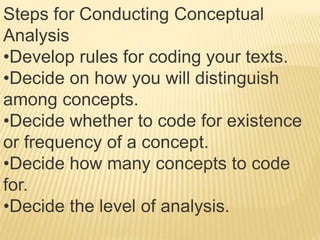
Steps for Conducting Conceptual
Analysis
•Develop rules for coding your texts.
•Decide on how you will distinguish
among concepts.
•Decide whether to code for existence
or frequency of a concept.
•Decide how many concepts to code
for.
•Decide the level of analysis.
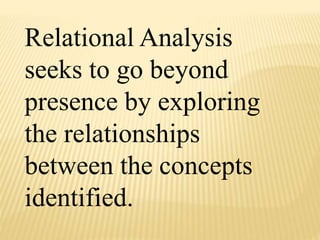
Relational Analysis
seeks to go beyond
presence by exploring
the relationships
between the concepts
identified.
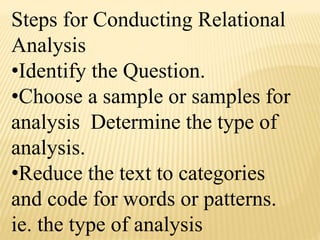
Steps for Conducting Relational
Analysis
•Identify the Question.
•Choose a sample or samples for
analysis Determine the type of
analysis.
•Reduce the text to categories
and code for words or patterns.
ie. the type of analysis

Content analysis

  • 1.
    CONTENT ANALYSIS DR. SHAIKHTAHEMINA NAAZ ASSISTANT PROFESSOR MARATHWADA COLLEGE OF EDUCATION, DR. RAFIQ ZAKARIA CAMPUS, AURANGABAD.
  • 2.
    MEANING: Content analysis isa research technique used to make replicable and valid inferences by interpreting and coding textual material. By systematically evaluating texts (e.g., documents, oral communication, and graphics), qualitative data can be converted into quantitative data.
  • 3.
  • 4.
  • 5.
    Types of ContentAnalysis. There are two general categories of content analysis: conceptual analysis and relational analysis. Conceptual analysis can be thought of as establishing the existence and frequency of concepts in a text.
  • 6.
    Steps for ConductingConceptual Analysis •Develop rules for coding your texts. •Decide on how you will distinguish among concepts. •Decide whether to code for existence or frequency of a concept. •Decide how many concepts to code for. •Decide the level of analysis.
  • 7.
    Relational Analysis seeks togo beyond presence by exploring the relationships between the concepts identified.
  • 8.
    Steps for ConductingRelational Analysis •Identify the Question. •Choose a sample or samples for analysis Determine the type of analysis. •Reduce the text to categories and code for words or patterns. ie. the type of analysis