Identification of novel potential
anti-cancer agents using
network pharmacology based
computational modelling
Name: Ben Allen
Organisation: E-Therapeutics PLC
e-Therapeutics
plc
 What is Network Pharmacology
 Network Science
 Application to Biological Networks
 Drug Discovery using Networks
 Bioinformatics
 Network Construction
 Proprietary Chemoinformatics
 Anti-cancer Compounds
 Dexanabinol
 Validation in Cytotoxicity Assays
e-Therapeutics
plc
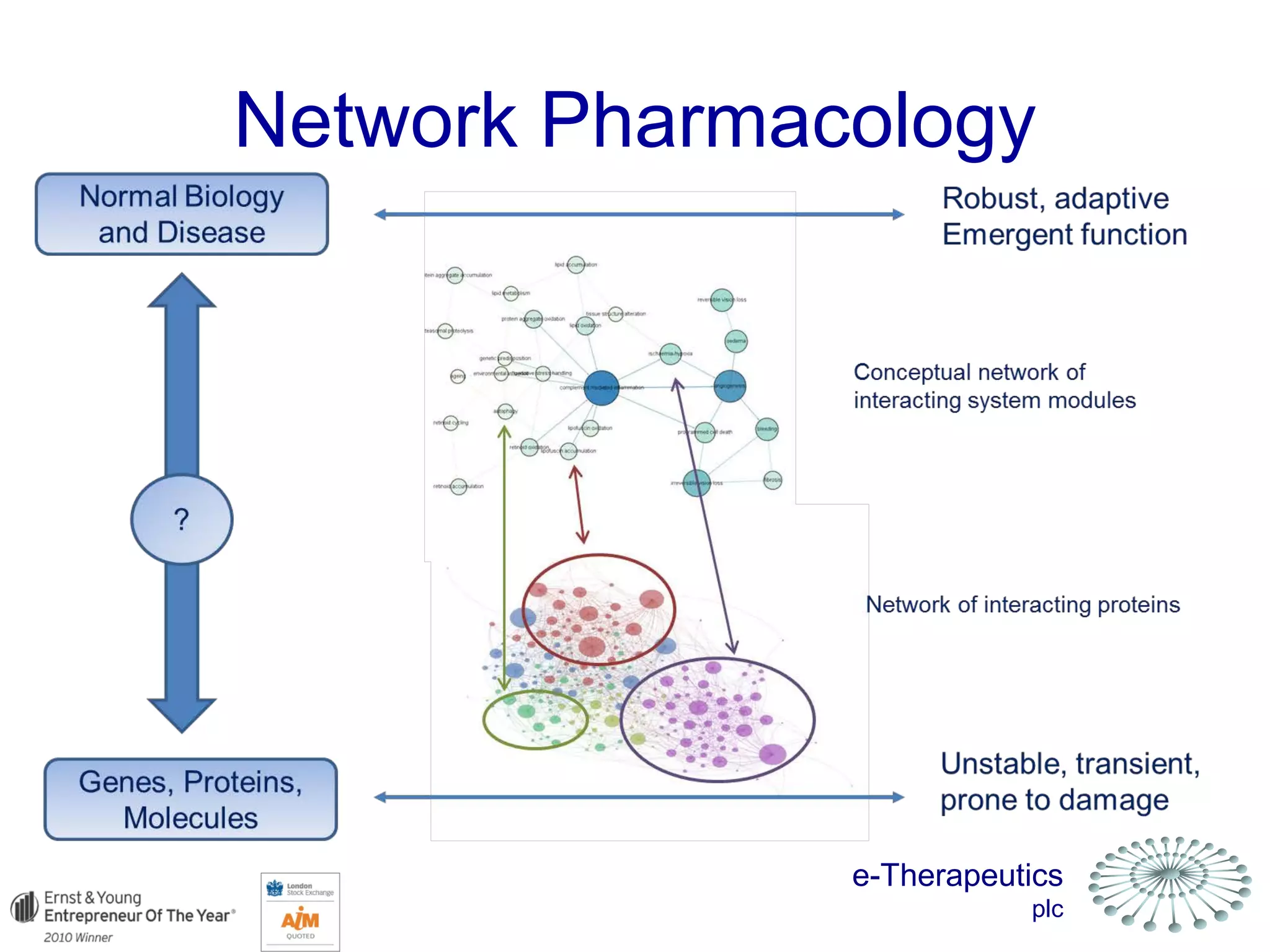
Network Pharmacology
e-Therapeutics
plc
Network Science
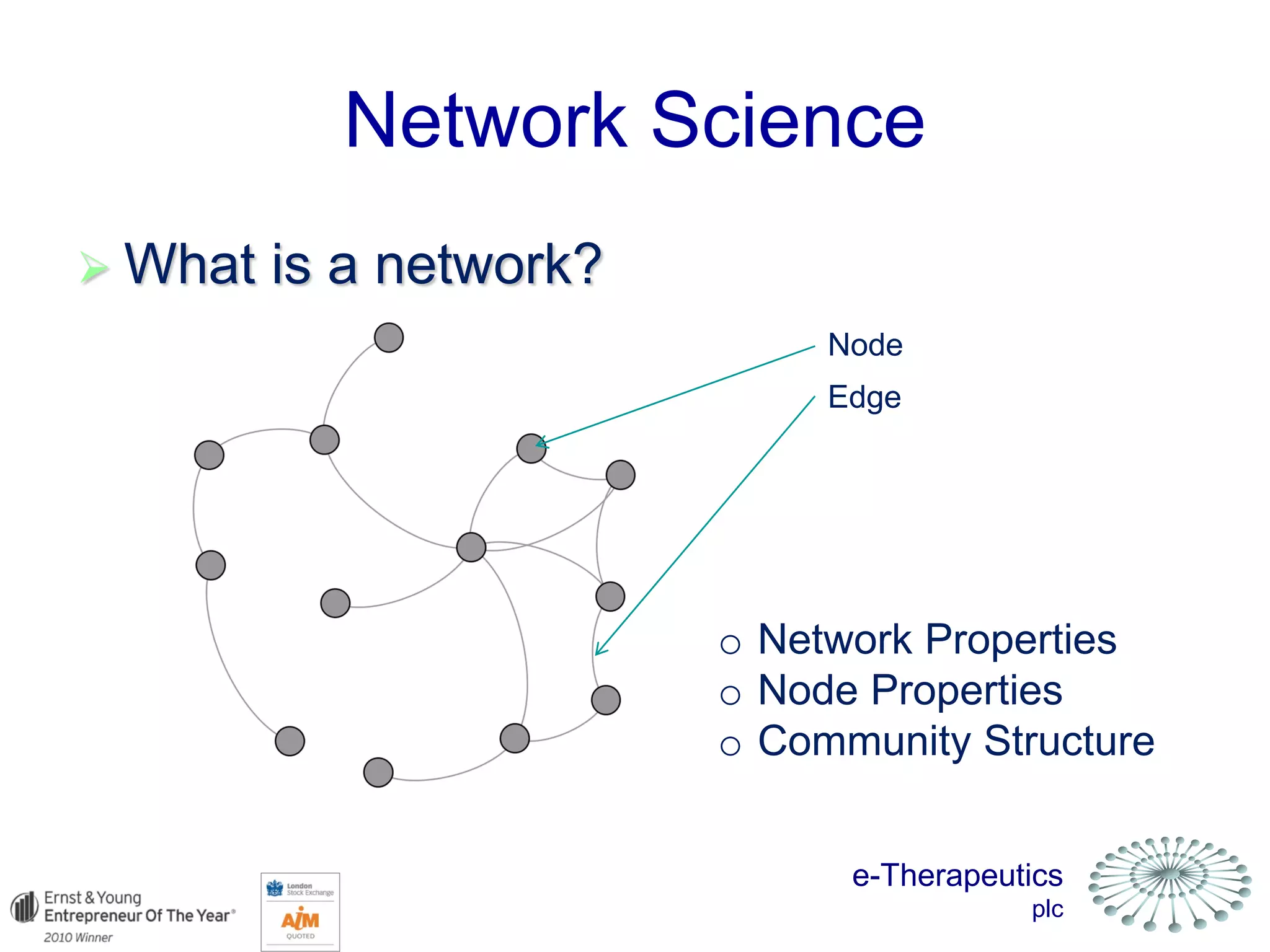
 What is a network?
Node
Edge
o Network Properties
o Node Properties
o Community Structure
e-Therapeutics
plc
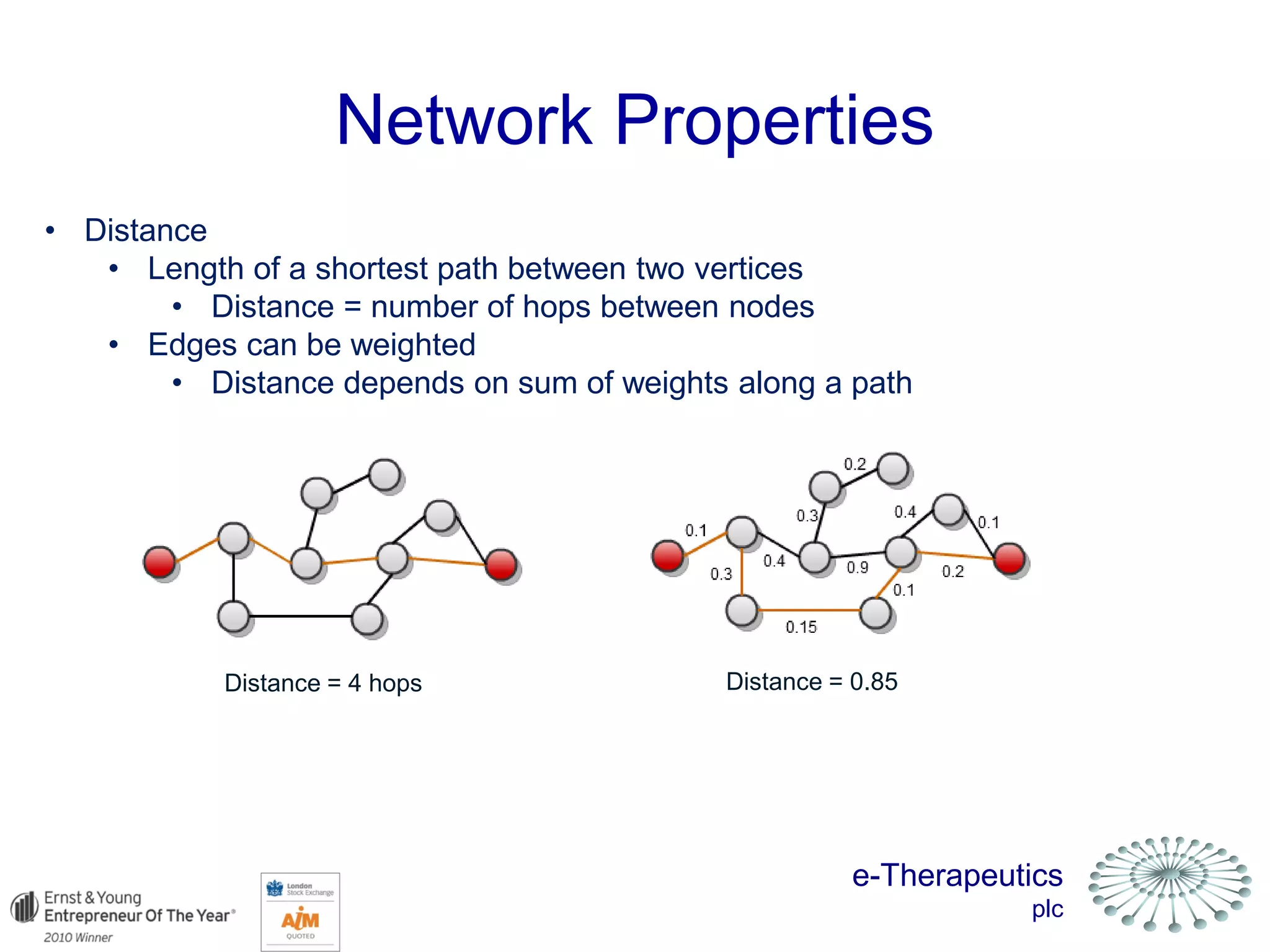
Network Properties
• Distance
• Length of a shortest path between two vertices
• Distance = number of hops between nodes
• Edges can be weighted
• Distance depends on sum of weights along a path
Distance = 4 hops Distance = 0.85
e-Therapeutics
plc
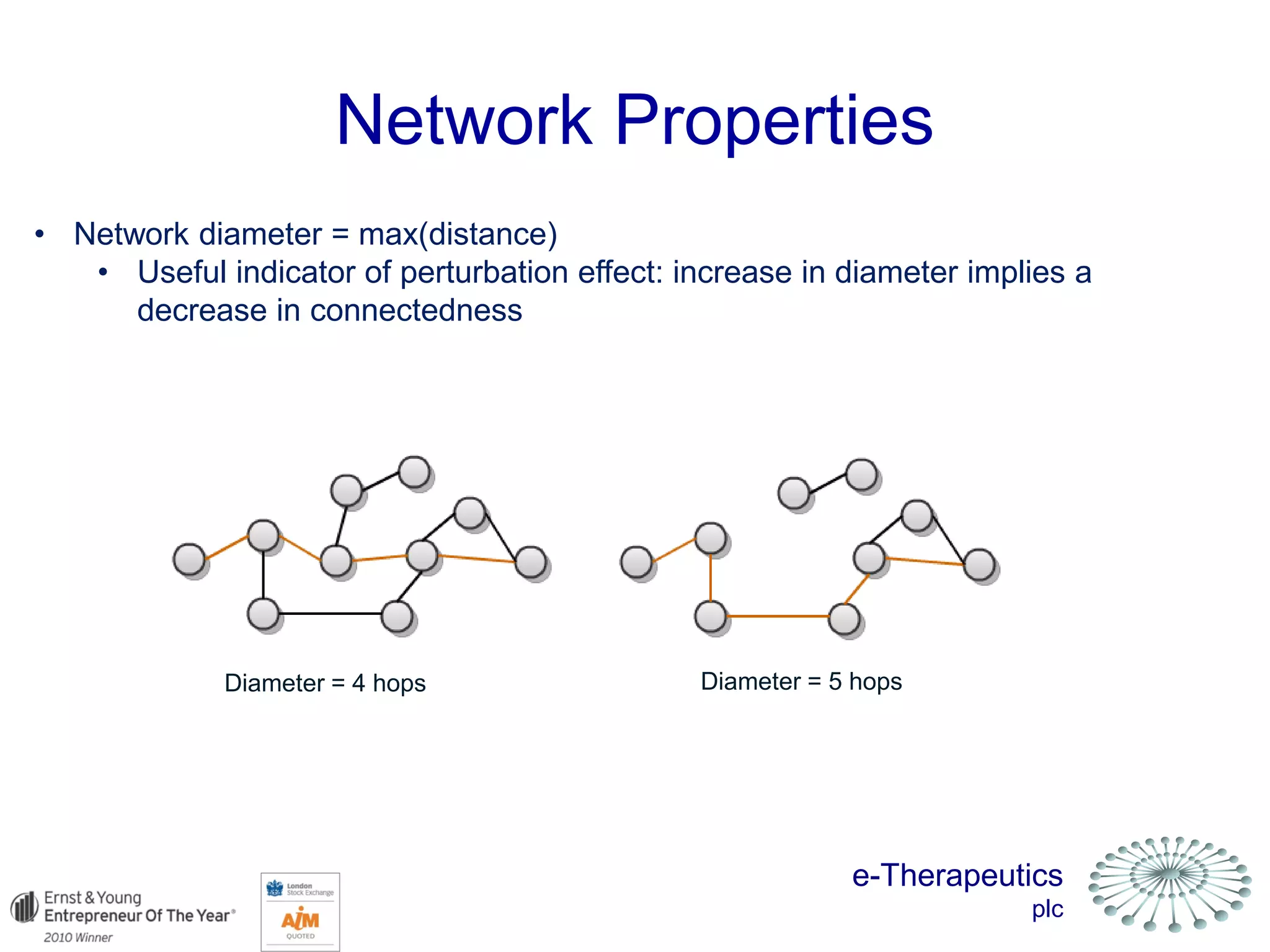
Network Properties
• Network diameter = max(distance)
• Useful indicator of perturbation effect: increase in diameter implies a
decrease in connectedness
Diameter = 4 hops Diameter = 5 hops
e-Therapeutics
plc
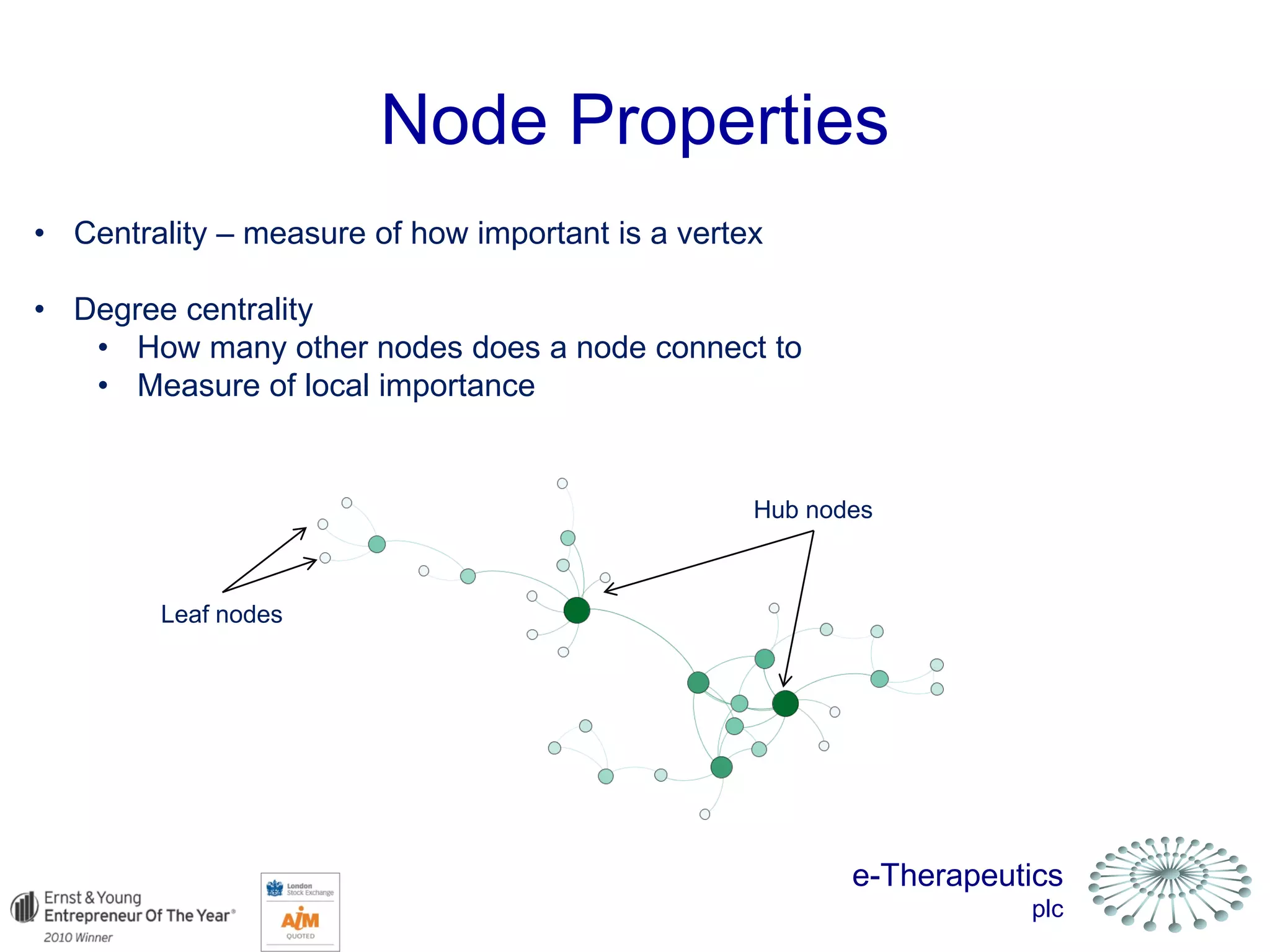
Node Properties
• Centrality – measure of how important is a vertex
• Degree centrality
• How many other nodes does a node connect to
• Measure of local importance
Leaf nodes
Hub nodes
e-Therapeutics
plc
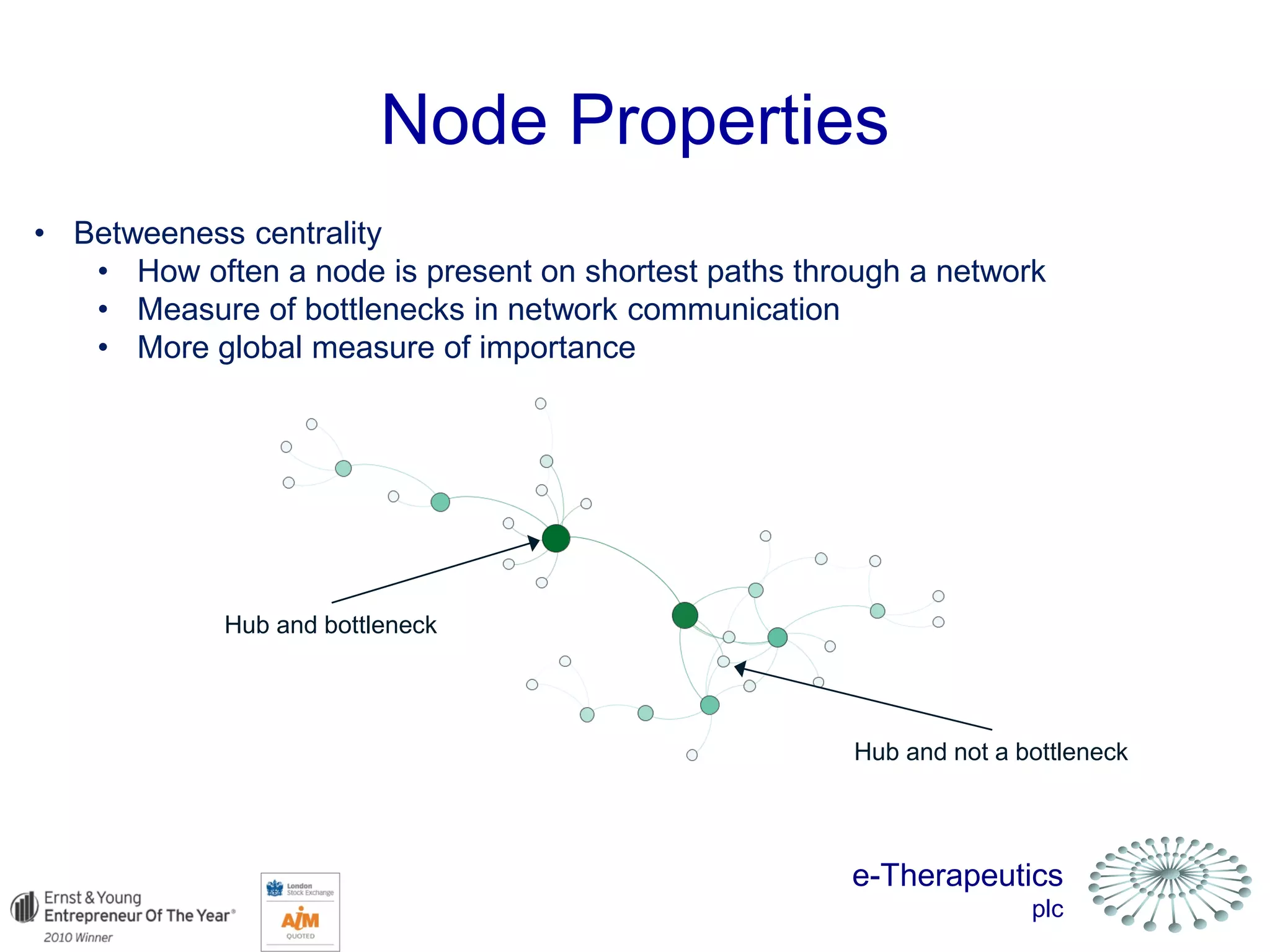
Node Properties
• Betweeness centrality
• How often a node is present on shortest paths through a network
• Measure of bottlenecks in network communication
• More global measure of importance
Hub and bottleneck
Hub and not a bottleneck
e-Therapeutics
plc
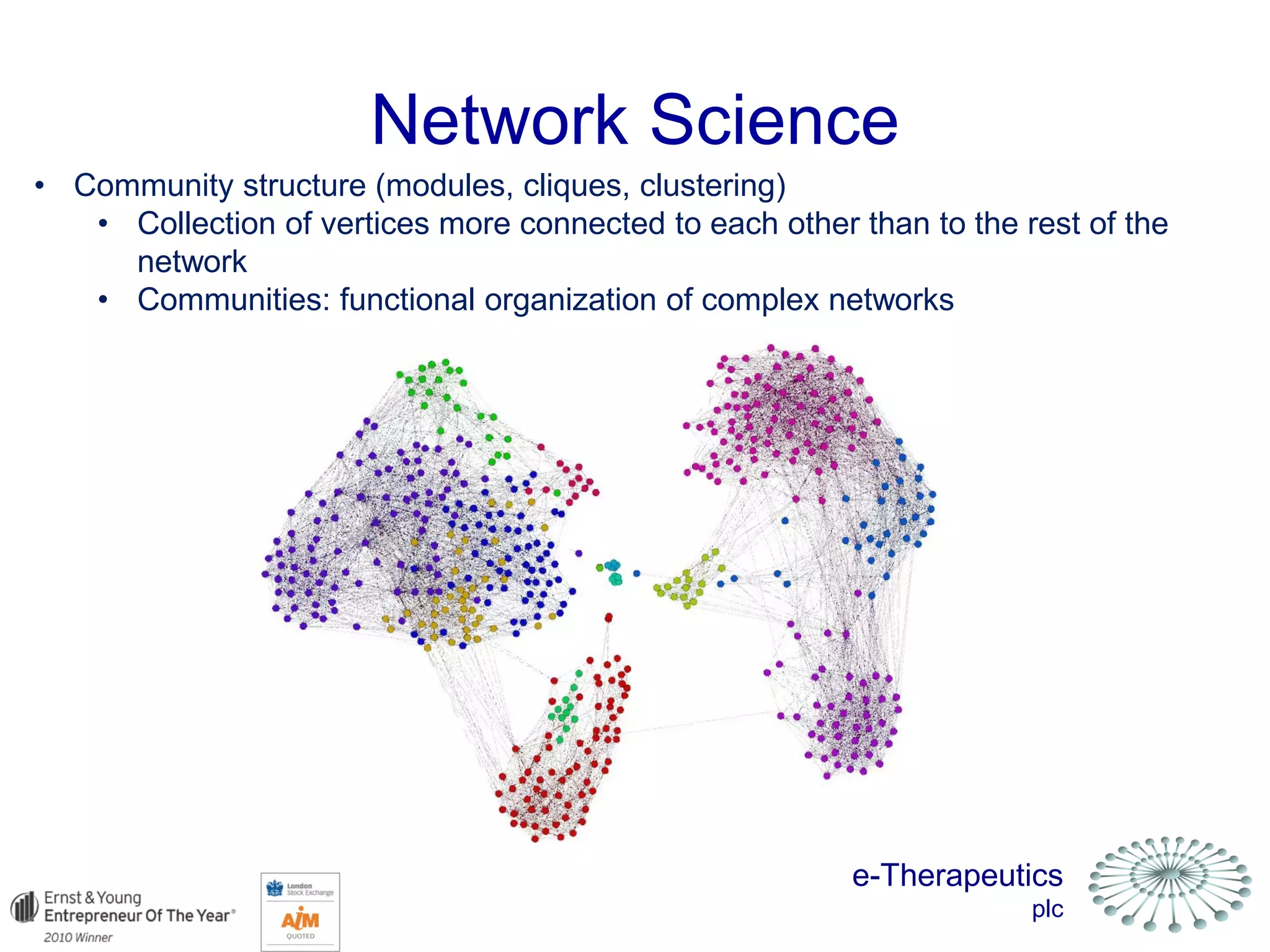
Network Science
• Community structure (modules, cliques, clustering)
• Collection of vertices more connected to each other than to the rest of the
network
• Communities: functional organization of complex networks
e-Therapeutics
plc
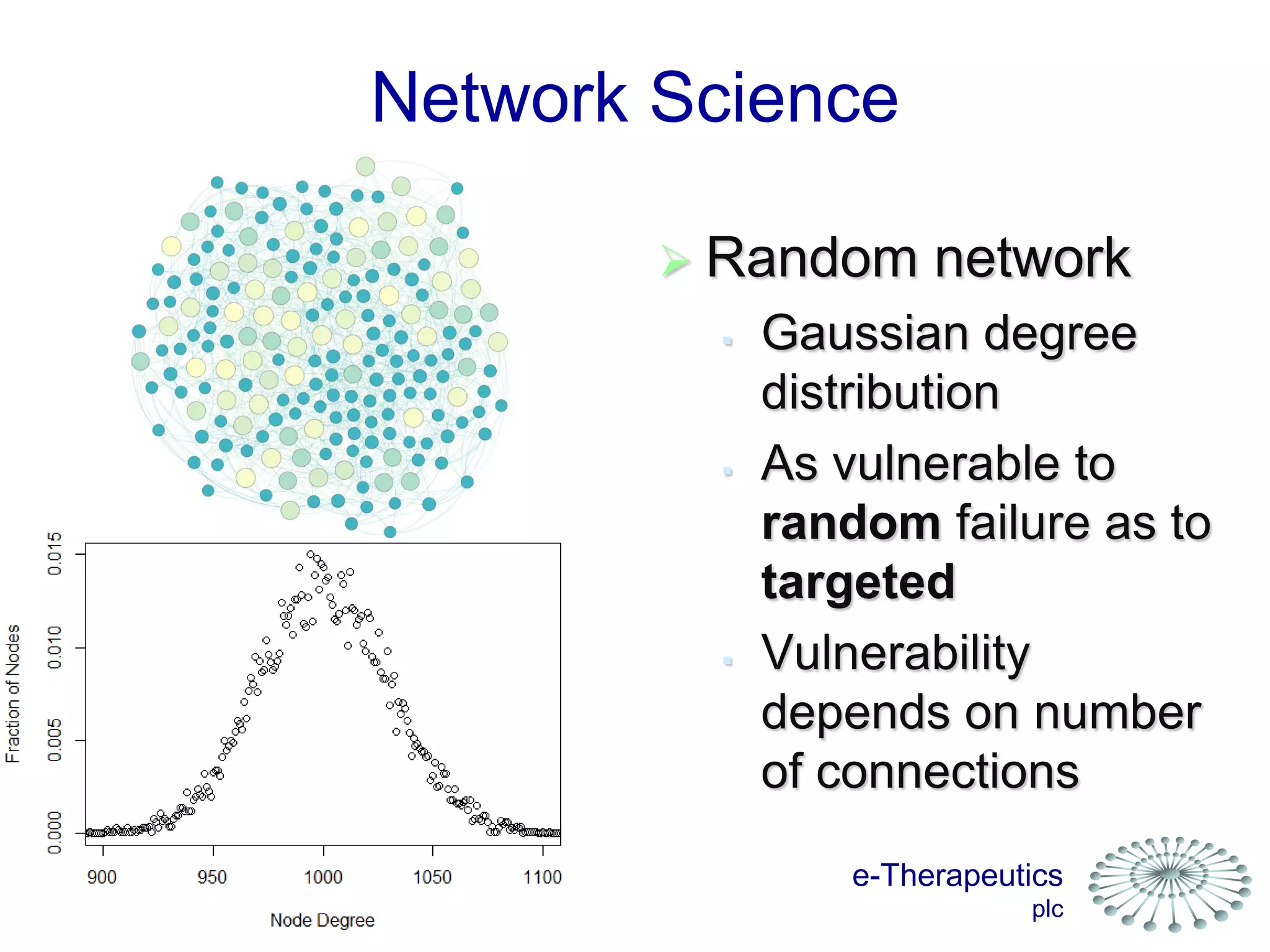
 Random network
 Gaussian degree
distribution
 As vulnerable to
random failure as to
targeted
 Vulnerability
depends on number
of connections
Network Science
e-Therapeutics
plc
Network Science
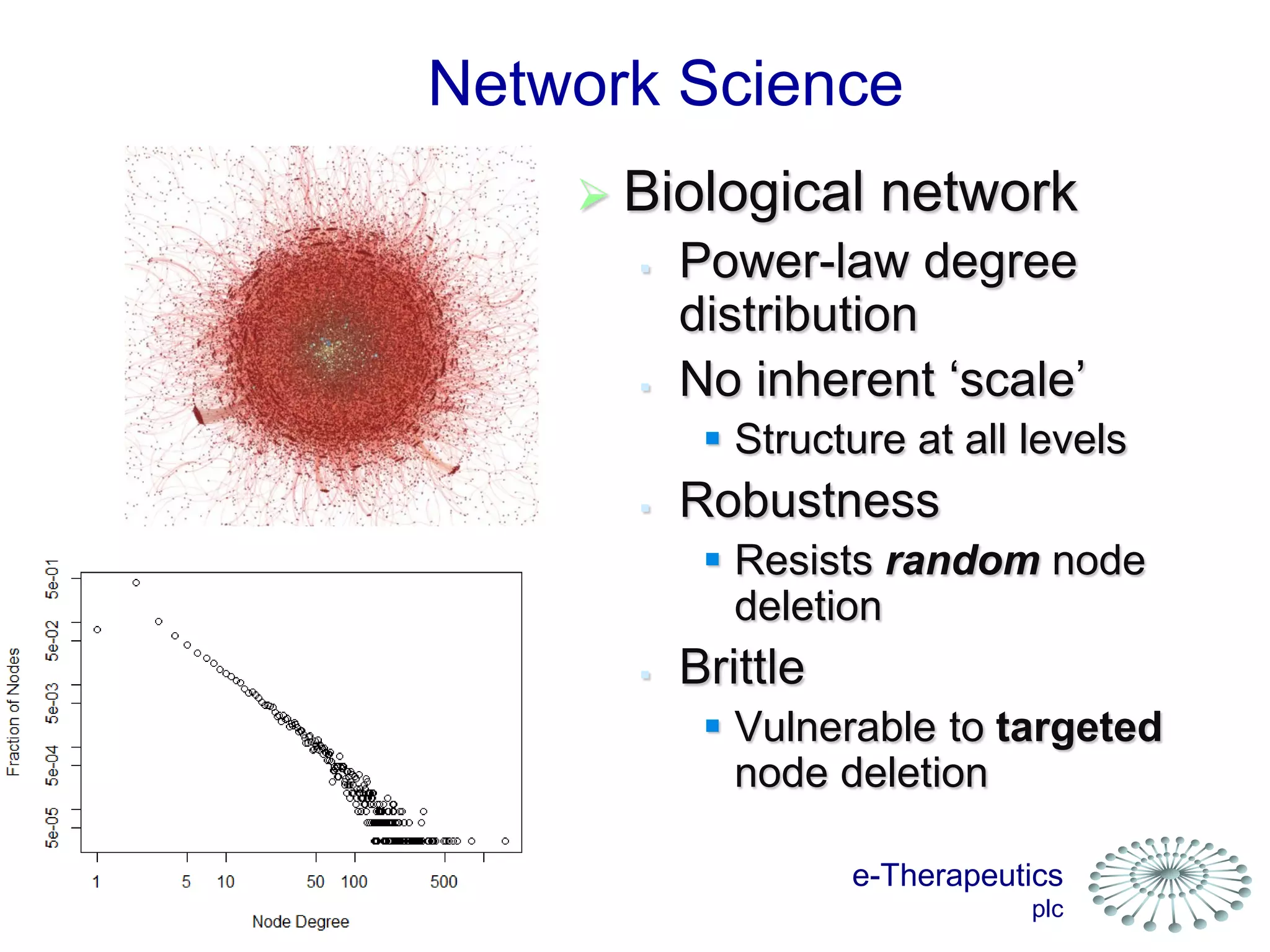
 Biological network
 Power-law degree
distribution
 No inherent ‘scale’
 Structure at all levels
 Robustness
 Resists random node
deletion
 Brittle
 Vulnerable to targeted
node deletion
e-Therapeutics
plc
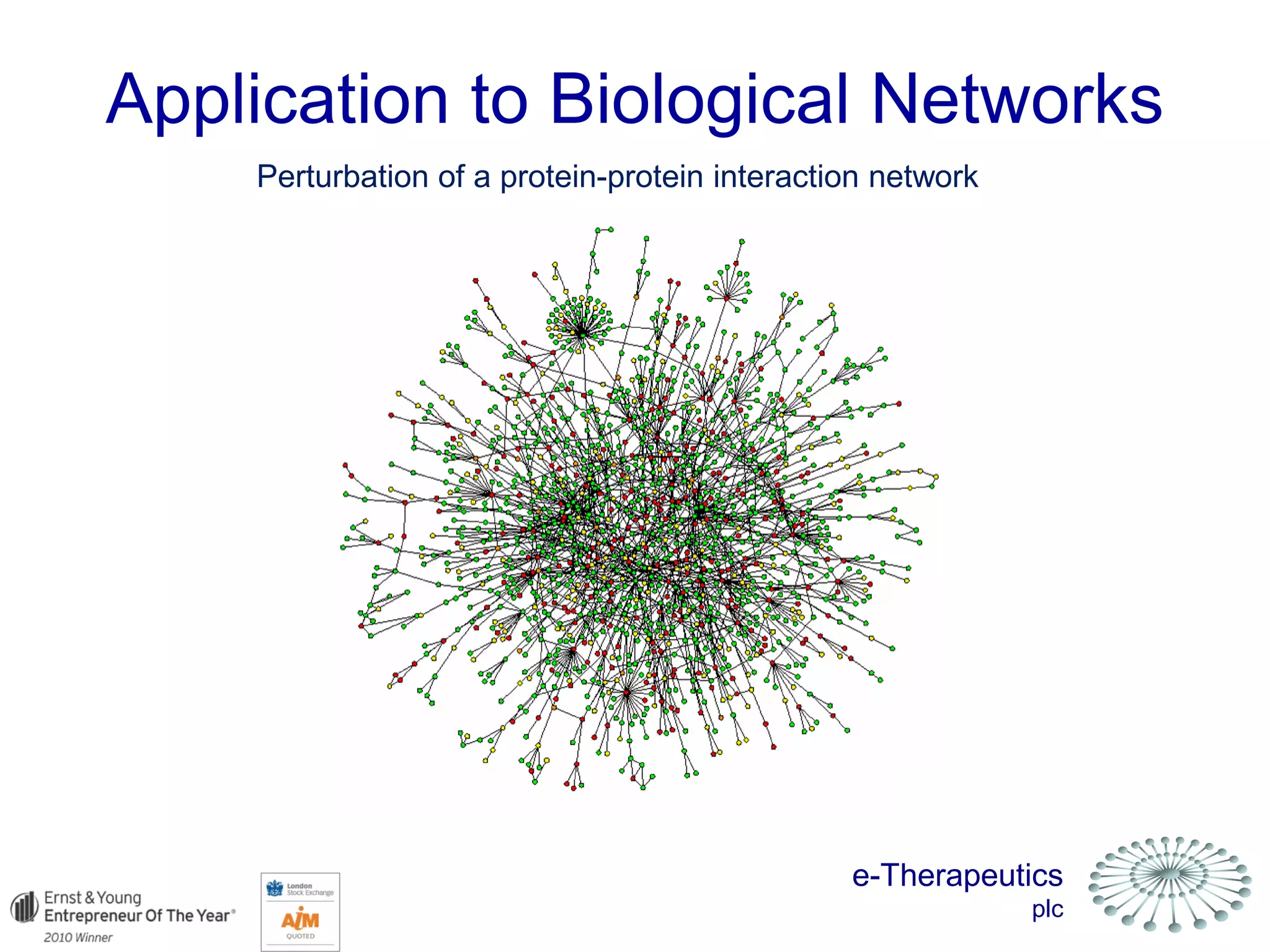
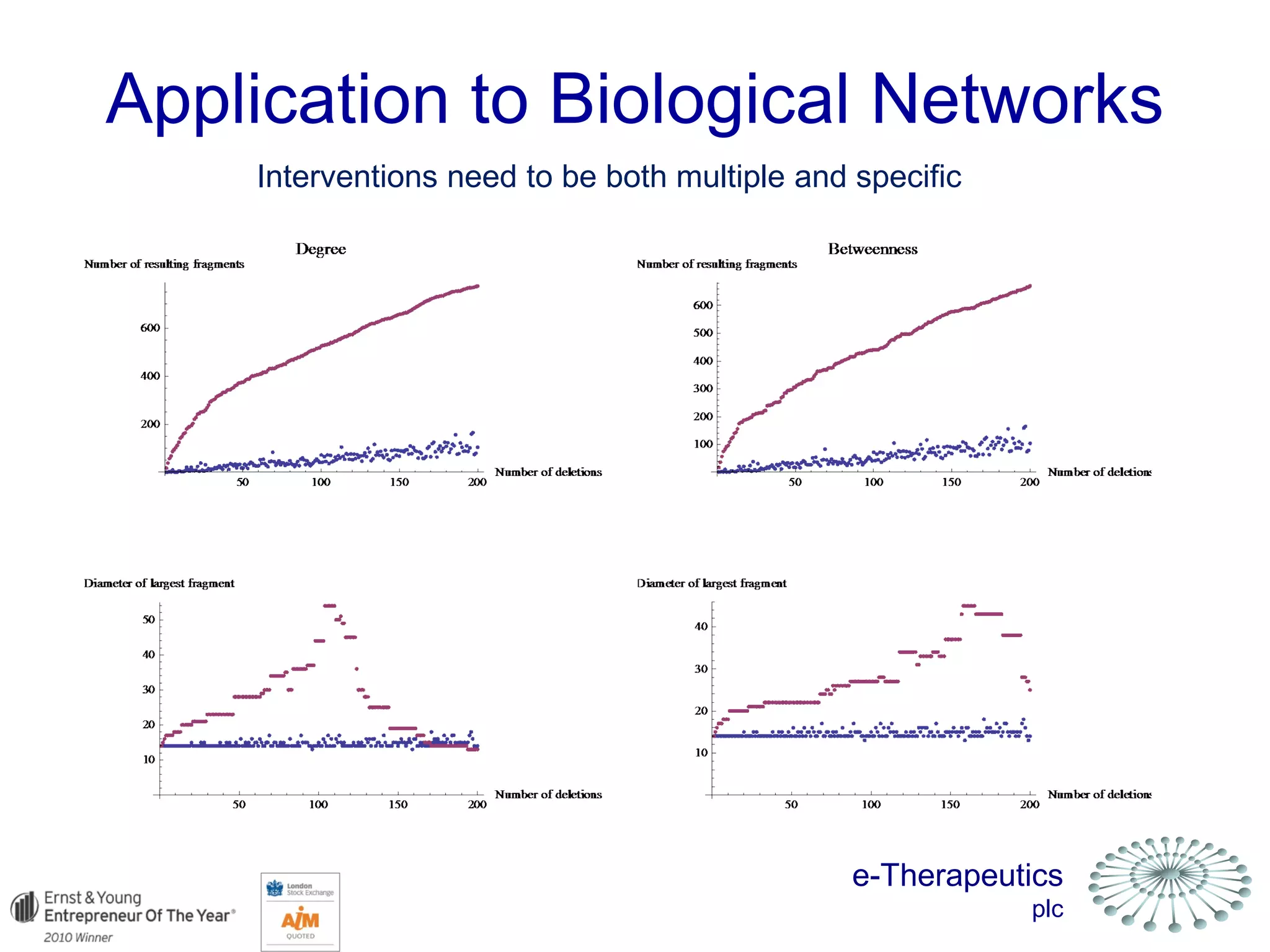
Application to Biological Networks
Perturbation of a protein-protein interaction network
e-Therapeutics
plc
Application to Biological Networks
Interventions need to be both multiple and specific
e-Therapeutics
plc
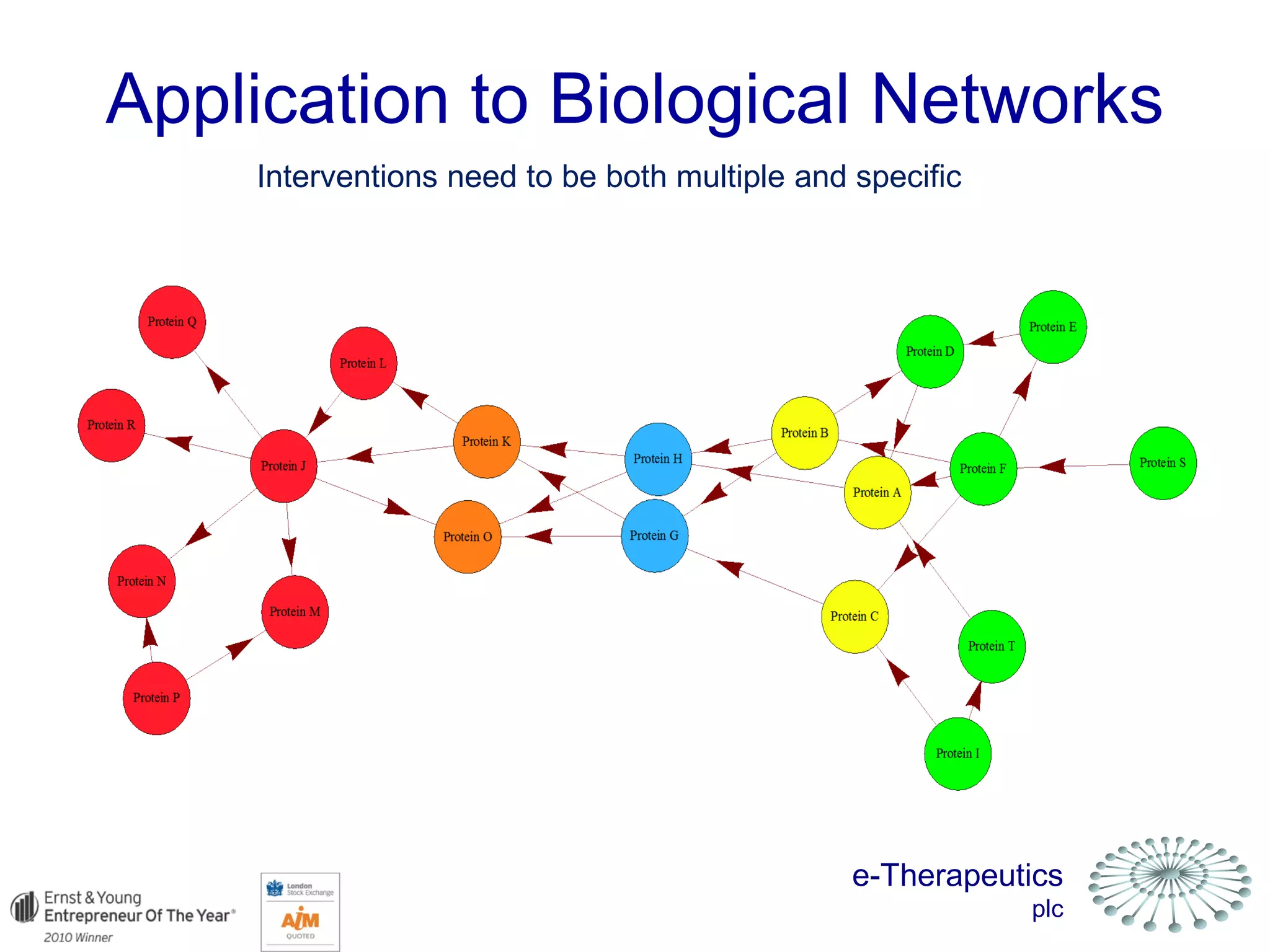
Application to Biological Networks
Interventions need to be both multiple and specific
e-Therapeutics
plc
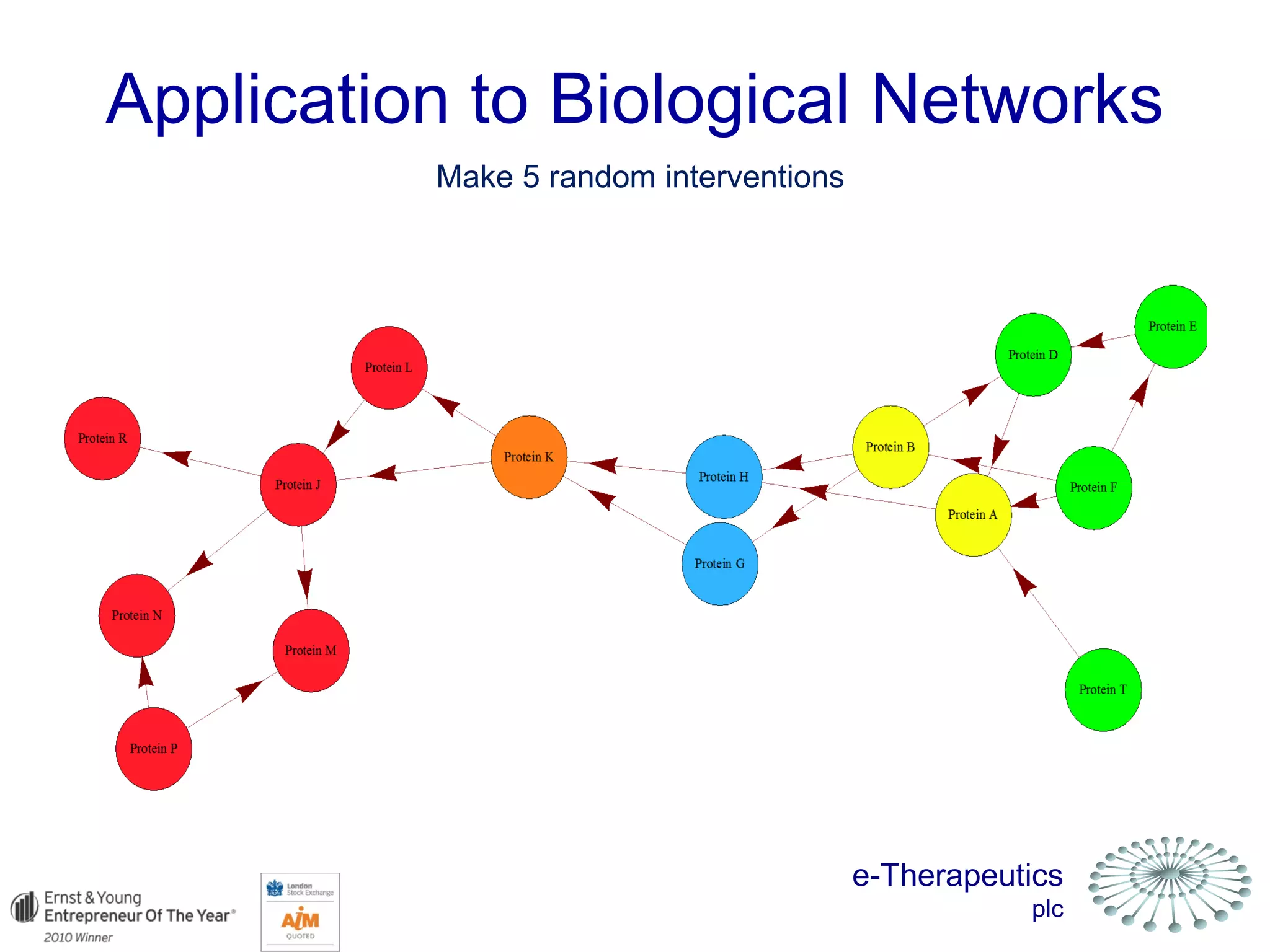
And nothing much happens….
Application to Biological Networks
Make 5 random interventions
e-Therapeutics
plc
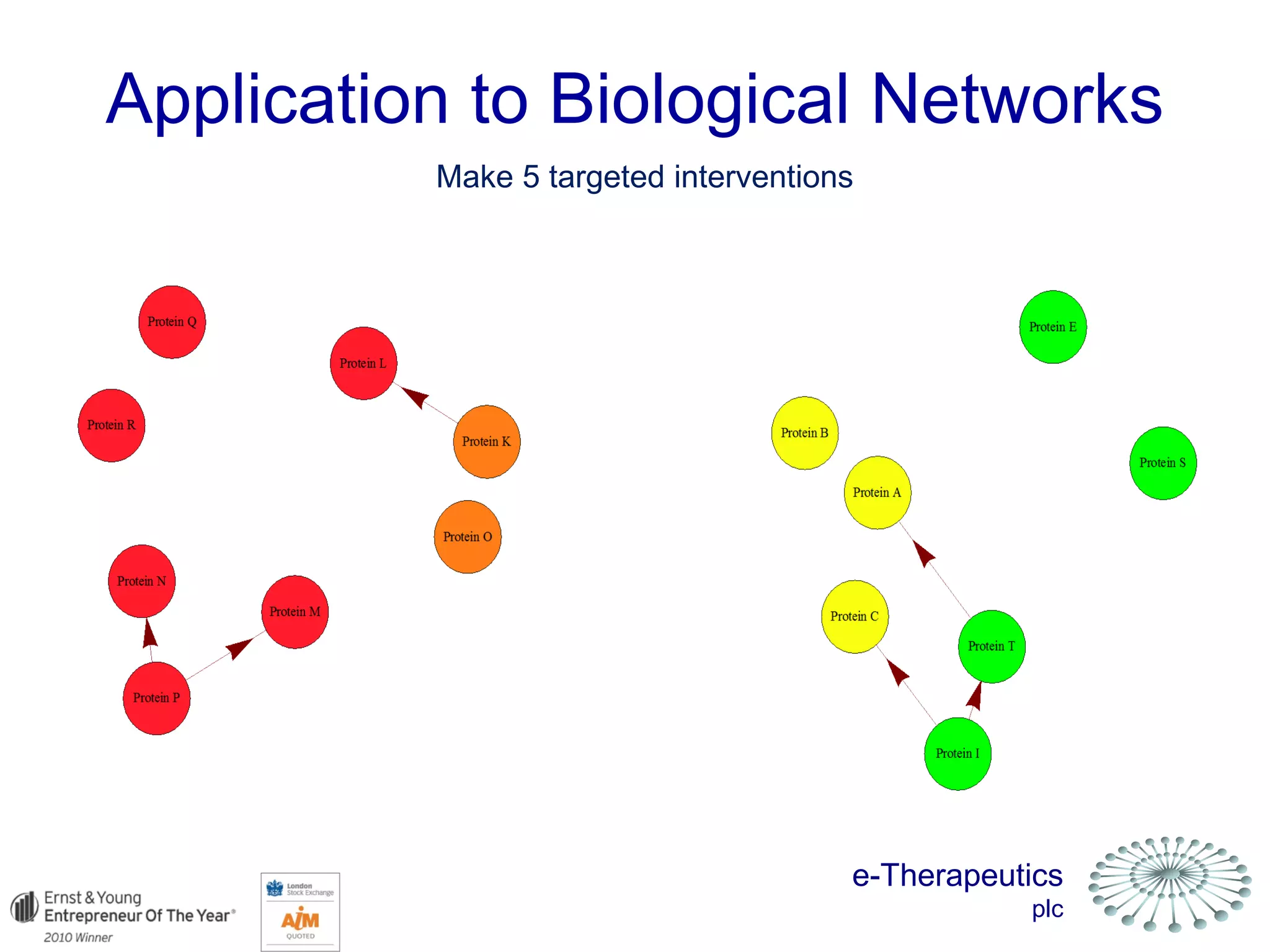
And big things can happen…And nothing much happens….
Application to Biological Networks
Make 5 targeted interventions
e-Therapeutics
plc
Drug Discovery using Networks
 Bioinformatics
 Cellular networks
• Protein–protein interaction networks
• Signal transduction and gene regulation networks
• Metabolic networks
 Distinction reflects experimental techniques
 Real cellular network is integration of all three
 Compound-Protein Interaction Database
e-Therapeutics
plc
Network Construction
 Requires detailed biological insight
 Literature searching
 Pathway analysis
 Single network v’s multiple
 Disease network compared to normal
 Network validation
 Node score for key proteins
e-Therapeutics
plc
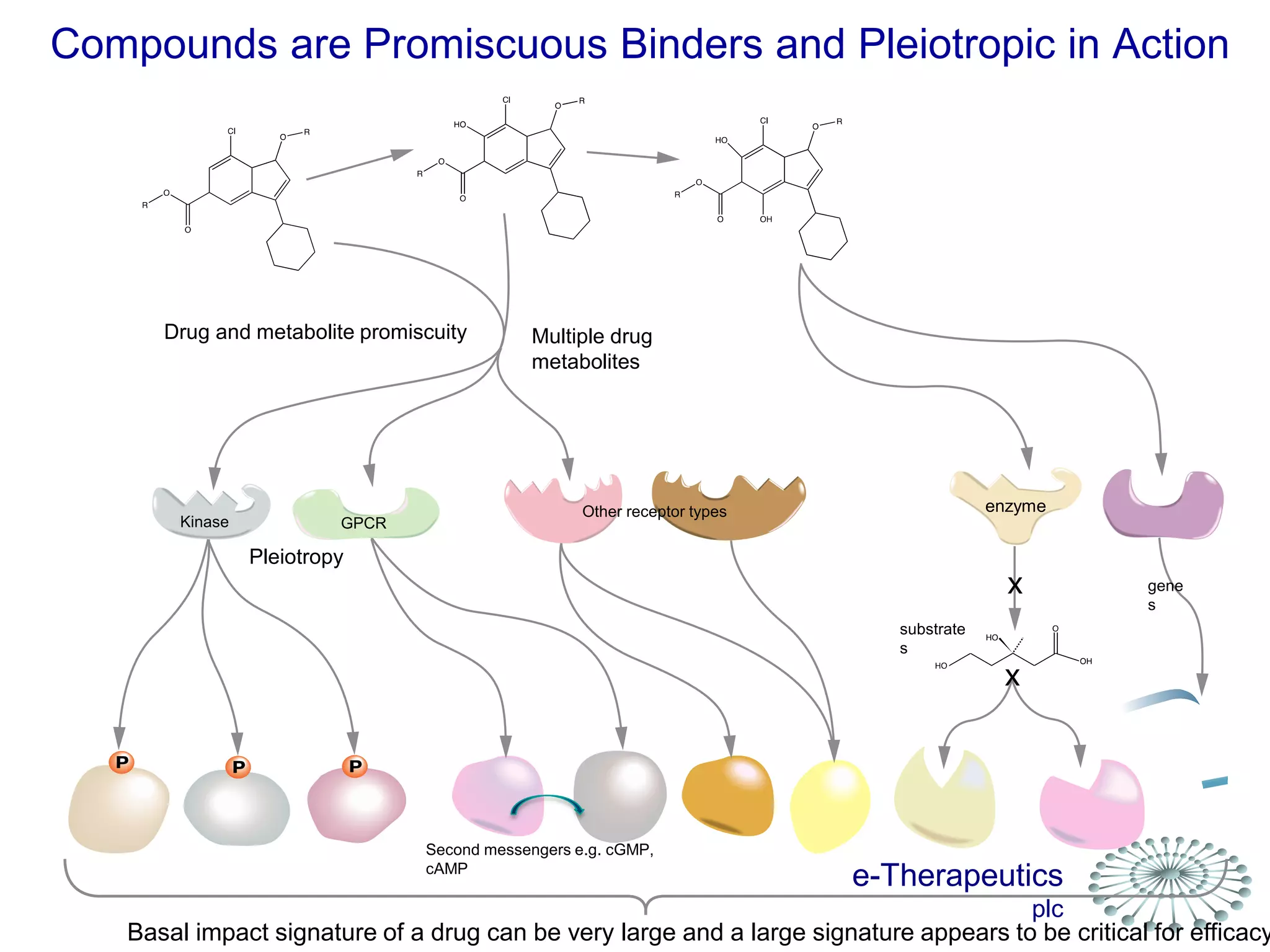
Kinase GPCR
Second messengers e.g. cGMP,
cAMP
Other receptor types enzyme
Basal impact signature of a drug can be very large and a large signature appears to be critical for efficacy
Drug and metabolite promiscuity Multiple drug
metabolites
Pleiotropy
substrate
s
gene
s
Compounds are Promiscuous Binders and Pleiotropic in Action
e-Therapeutics
plc
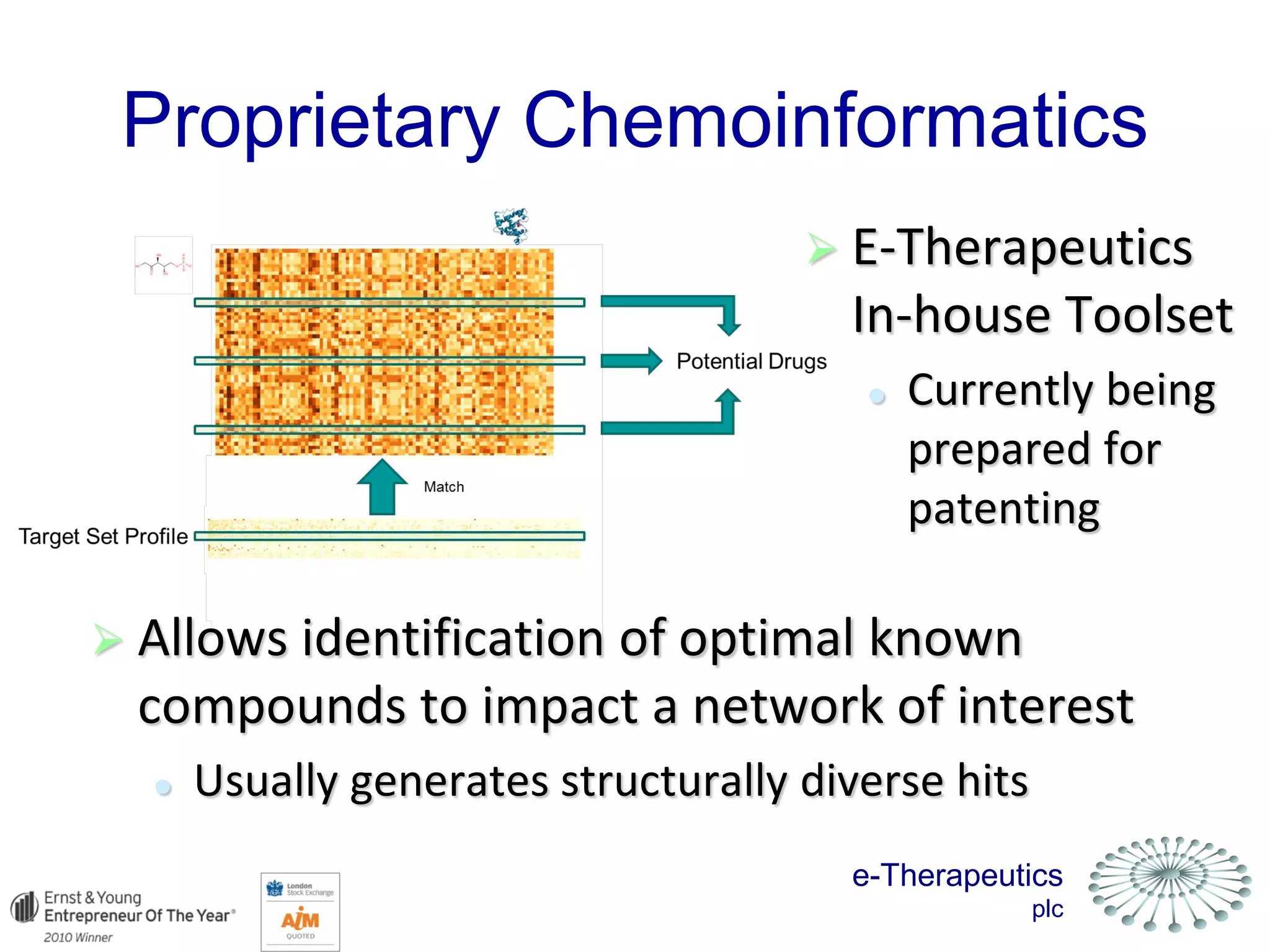
 E-Therapeutics
In-house Toolset
 Currently being
prepared for
patenting
 Allows identification of optimal known
compounds to impact a network of interest
 Usually generates structurally diverse hits
Proprietary Chemoinformatics
e-Therapeutics
plc
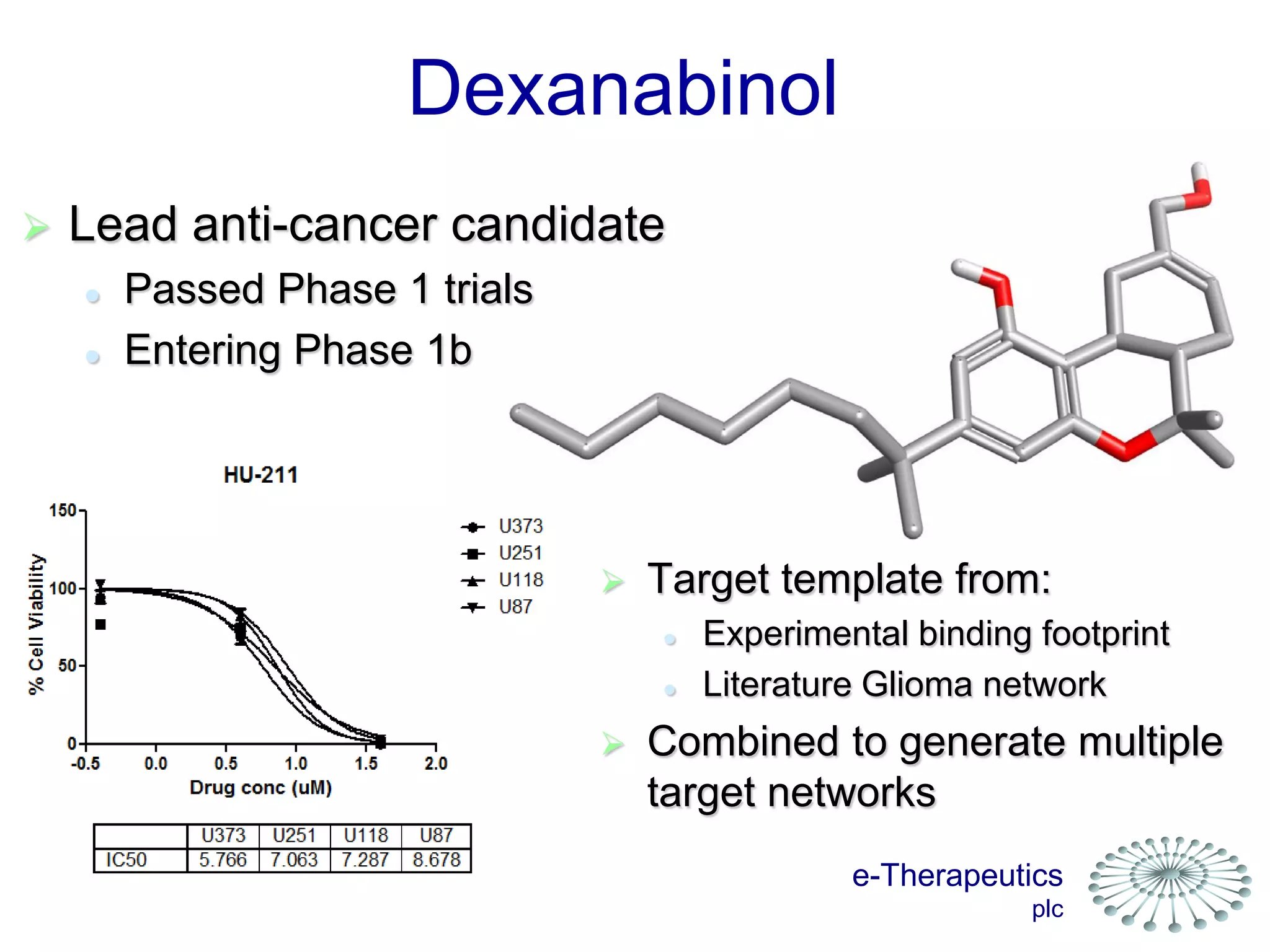
 Lead anti-cancer candidate
 Passed Phase 1 trials
 Entering Phase 1b
 Target template from:
 Experimental binding footprint
 Literature Glioma network
 Combined to generate multiple
target networks
Dexanabinol
e-Therapeutics
plc
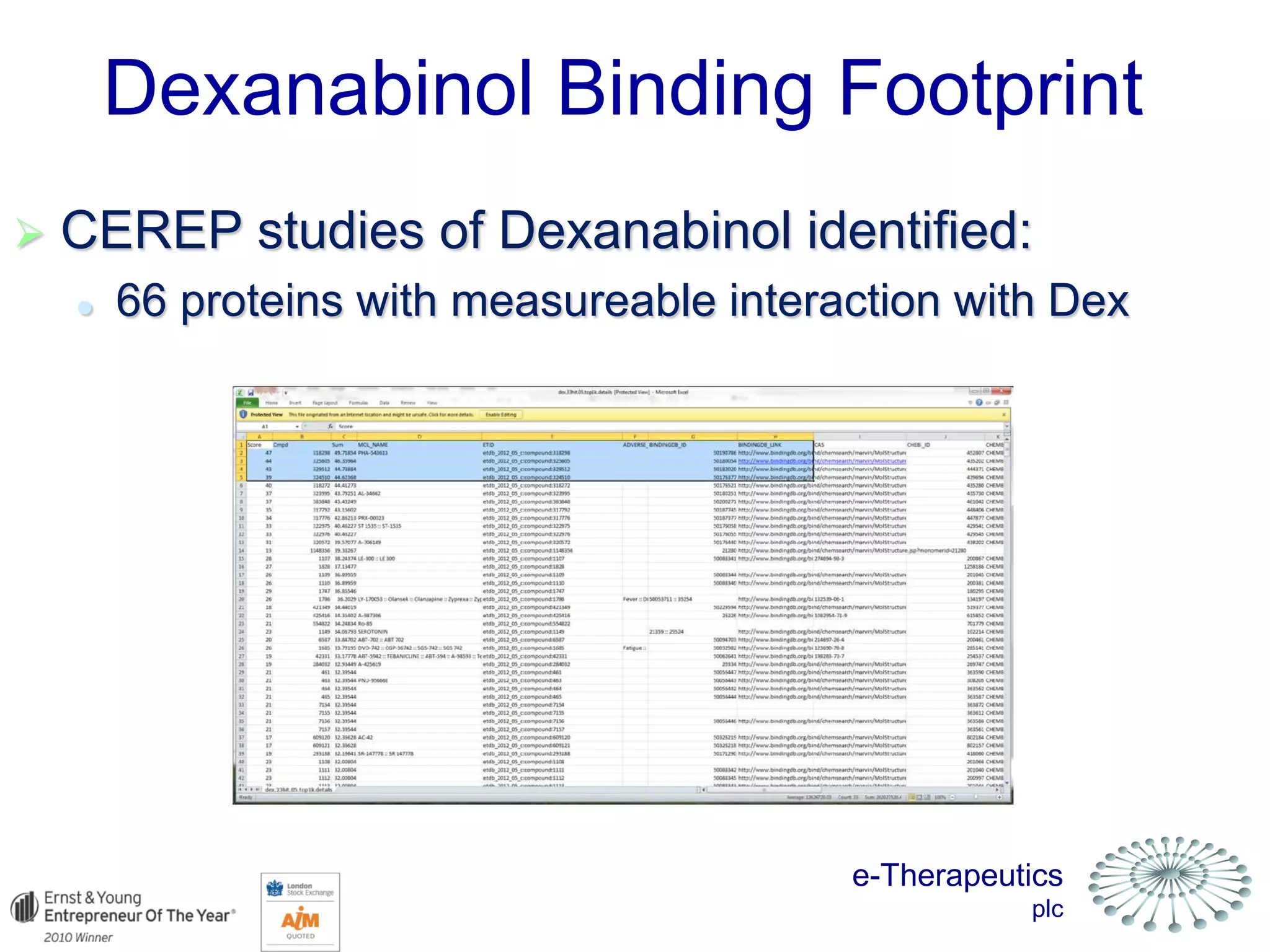
Dexanabinol Binding Footprint
 CEREP studies of Dexanabinol identified:
 66 proteins with measureable interaction with Dex
e-Therapeutics
plc
 Application of proprietary chemoinformatics to target
networks generates a ranked list of candidate
compounds
 Additional filtering based on IP and ADME/Tox
 Final list of 100 selected for testing
 Cytotoxicity assay against three cancer cell lines
 U-87 MG, Hs578.T and OE21.
 85 compounds sourced
 Screening performed by Biofocus
Experimental Methods
e-Therapeutics
plc
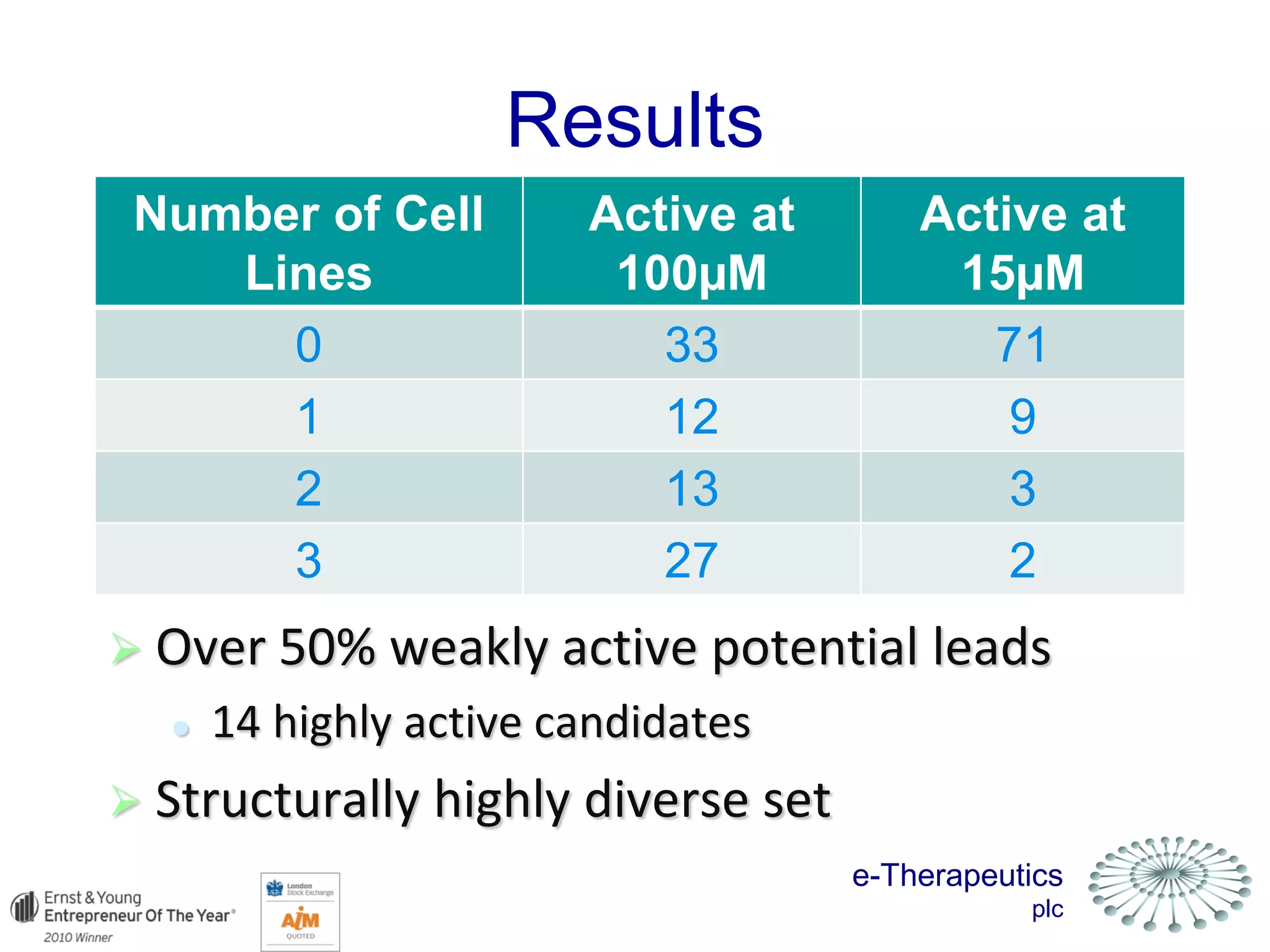
Results
Number of Cell
Lines
Active at
100µM
Active at
15µM
0 33 71
1 12 9
2 13 3
3 27 2
 Over 50% weakly active potential leads
 14 highly active candidates
 Structurally highly diverse set
e-Therapeutics
plc
Conclusions
 Network Pharmacology be used to
describe and model disease systems.
 E-Therapeutics can identify compounds
that impact the model system.
e-Therapeutics
plc
Further Work
 Larger scale test of 200 additional
compounds
 Non-cancer cell line to assess therapeutic
index
 Comparison test of 200 compounds
generated using structural similarity
 Using Cresset Blaze screening software
e-Therapeutics
plc
Thanks
 The E-Therapeutics Discovery Team
 Jonny Wray
 Brendan Jackson
 Victoria Flores
 Marie Weston
 Andreas Gessner
 Everyone at Cresset!

Identification of novel potential anti cancer agents using network pharmacology based computational modelling