




Network Biology
A paradigm for modeling biological complex systems
Ganesh Bagler
Center for Computational Biology, IIIT-Delhi, New Delhi.
Center for Computational Biology
Modeling Living Systems
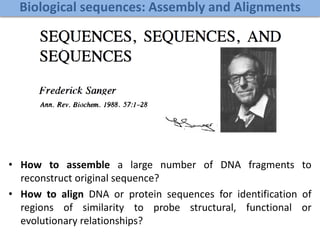
Biological sequences: Assembly and Alignments
• How to assemble a large number of DNA fragments to
reconstruct original sequence?
• How to align DNA or protein sequences for identification of
regions of similarity to probe structural, functional or
evolutionary relationships?
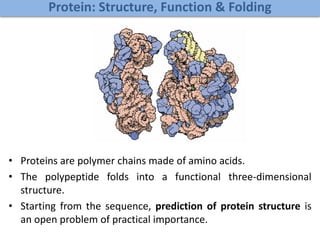
Protein: Structure, Function & Folding
• Proteins are polymer chains made of amino acids.
• The polypeptide folds into a functional three-dimensional
structure.
• Starting from the sequence, prediction of protein structure is
an open problem of practical importance.
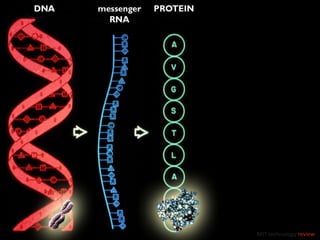
MIT technology review
Can a biologist fix a radio?
Need for integrative models of biological systems
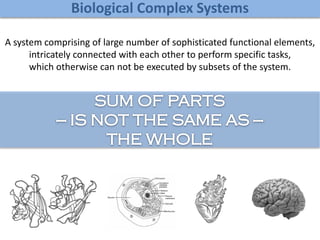
Biological Complex Systems
Modeling biological systems as networked entities
Networks in Biology
Intro to graph theory, key concepts, applications
Biological Complex Systems
A system comprising of large number of sophisticated functional elements,
intricately connected with each other to perform specific tasks,
which otherwise can not be executed by subsets of the system.
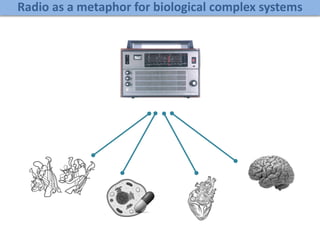
Radio as a metaphor for biological complex systems
Biologist finds a radio on an island
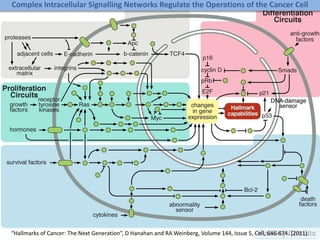
“Hallmarks of Cancer: The Next Generation”, D Hanahan and RA Weinberg, Volume 144, Issue 5, Cell, 646-674. (2011).
Complex Intracellular Signalling Networks Regulate the Operations of the Cancer Cell
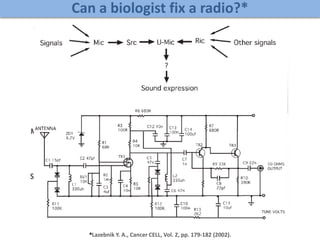
*Lazebnik Y. A., Cancer CELL, Vol. 2, pp. 179-182 (2002).
Can a biologist fix a radio?*
Can a biologist fix a radio?
Need for integrative models of biological systems
Biological Complex Systems
Modeling biological systems as networked entities
Networks in Biology
Intro to graph theory, key concepts, applications
MIT technology review
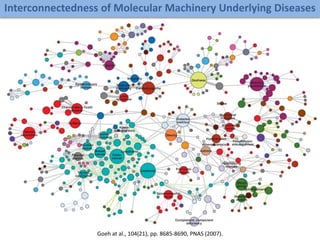
Goeh at al., 104(21), pp. 8685-8690, PNAS (2007).
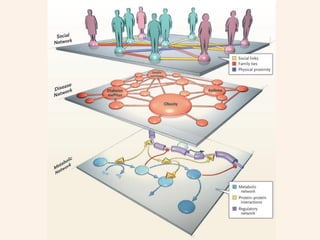
Interconnectedness of Molecular Machinery Underlying Diseases
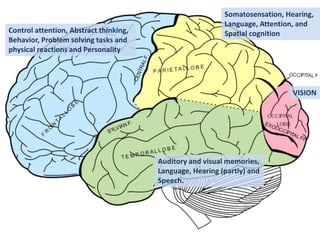
VISION
Somatosensation, Hearing,
Language, Attention, and
Spatial cognitionControl attention, Abstract thinking,
Behavior, Problem solving tasks and
physical reactions and Personality
Auditory and visual memories,
Language, Hearing (partly) and
Speech.
THE ASTONOSHING
HYPOTHESIS
'You, ' your joys and your
sorrows, your memories
and your ambitions, your
sense of personal identity
and free will, are in fact no
more than the behavior of
a vast assembly of nerve
cells and their associated
molecules.
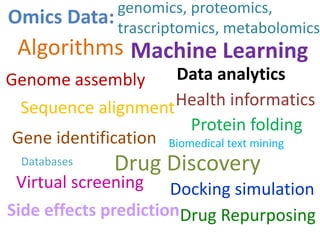
Algorithms
Sequence alignment
Genome assembly
Gene identification
Machine Learning
Data analytics
Health informatics
Protein folding
Drug Discovery
Docking simulationVirtual screening
Side effects predictionDrug Repurposing
Omics Data:genomics, proteomics,
trascriptomics, metabolomics
Databases
Biomedical text mining
• Transdisciplinary Research •
Application of Computation for Biology and Medicine
Biological Complex Systems
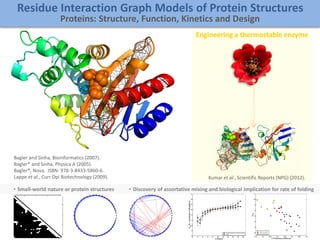
Residue Interaction Graph Models of Protein Structures
Proteins: Structure, Function, Kinetics and Design
Bagler and Sinha, Bioinformatics (2007).
Bagler* and Sinha, Physica A (2005).
Bagler*, Nova, ISBN: 978-3-8433-5860-6.
Lappe et al., Curr Opi Biotechnology (2009). Kumar et al., Scientific Reports (NPG) (2012).
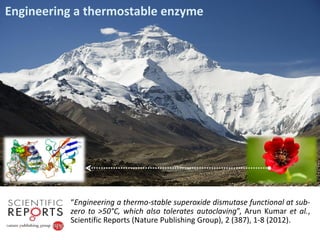
Engineering a thermostable enzyme
• Small-world nature or protein structures • Discovery of assortative mixing and biological implication for rate of folding
“Engineering a thermo-stable superoxide dismutase functional at sub-
zero to >50°C, which also tolerates autoclaving”, Arun Kumar et al.,
Scientific Reports (Nature Publishing Group), 2 (387), 1-8 (2012).
Engineering a thermostable enzyme
Shikha Vashisht and Ganesh Bagler*, 7(11): e49401, PLoS ONE (2012). arXiv:1112.1510v2 [q-bio.MN]
Vinay Randhawa and Ganesh Bagler*, OMICS: A Journal of Integrative Biology, 16 (10) , 2012.
V Randhawa, P Sharma, S Bhushan and G Bagler*, OMICS: A Journal of Integrative Biology, 17(6), 302-317 (2013).
A rational approach towards ‘complex diseases’.
Data: KEGG, OMIM, PubMed, protein interactomes, gene regulations, expression data.
Network Models of Complex Diseases
Molecular interactomes of diseases phenotypes: Modeling and control
Why
What
How
model
Interactomes,
Expression data
control
targets, drugs
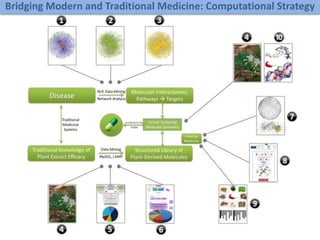
Bridging Modern and Traditional Medicine: Computational Strategy
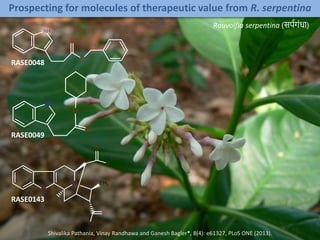
Prospecting for molecules of therapeutic value from R. serpentina
RASE0048
RASE0049
RASE0143
Rauvolfia serpentina (सर्पगंधा)
Shivalika Pathania, Vinay Randhawa and Ganesh Bagler*, 8(4): e61327, PLoS ONE (2013).
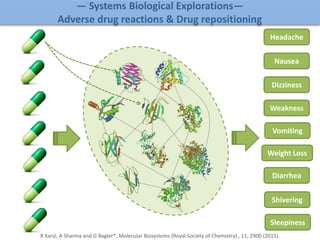
Headache
Nausea
Dizziness
Weakness
Vomiting
Weight Loss
Diarrhea
Shivering
Sleepiness
R Kanji, A Sharma and G Bagler*, Molecular Biosystems (Royal Society of Chemistry) , 11, 2900 (2015).
— Systems Biological Explorations—
Adverse drug reactions & Drug repositioning
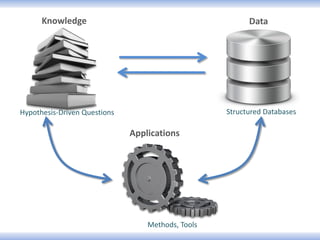
Knowledge Data
Applications
Methods, Tools
Hypothesis-Driven Questions Structured Databases
Can a biologist fix a radio?
Need for integrative models of biological systems
Biological Complex Systems
Modeling biological systems as networked entities
Networks in Biology
Intro to graph theory, key concepts, applications
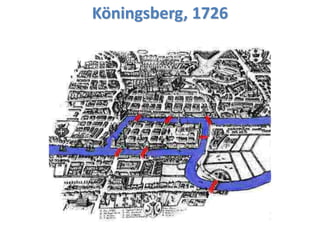
Köningsberg, 1726
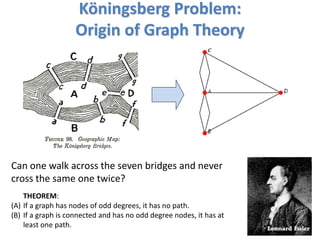
Köningsberg Problem:
Origin of Graph Theory
Can one walk across the seven bridges and never
cross the same one twice?
THEOREM:
(A) If a graph has nodes of odd degrees, it has no path.
(B) If a graph is connected and has no odd degree nodes, it has at
least one path.
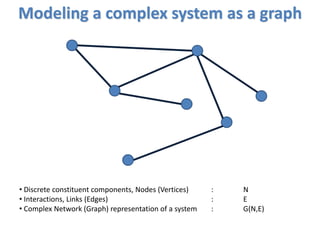
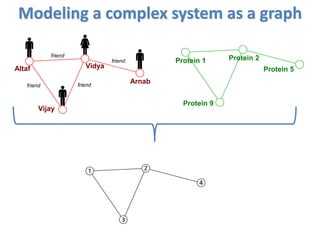
Modeling a complex system as a graph
• Discrete constituent components, Nodes (Vertices) : N
• Interactions, Links (Edges) : E
• Complex Network (Graph) representation of a system : G(N,E)
Altaf Vidya
Vijay
Arnab
friend
friendfriend
friend
Modeling a complex system as a graph
Protein 1 Protein 2
Protein 5
Protein 9
Modeling a complex system as a graph
Undirected Network Directed Network
[DEFN] Degree: Number of nodes connected to a given node.
A
B
C
D
E
F G
A
B
C
D
E
F G
k_A=2; k_B=3 k_A_in=1; k_A_out=1;
k_B_in=3; k_B_in=1;
 Weighted and Un-weighted Networks
• Social Systems: Actors’ network, Collaboration network, Friends’ network
• Technological Systems: Internet, WWW, Transportation
• Biological Systems: Protein interaction network, Gene regulatory network,
Food webs
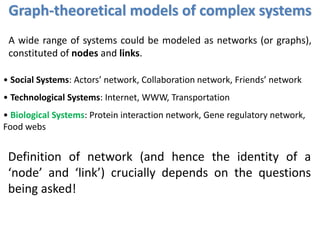
A wide range of systems could be modeled as networks (or graphs),
constituted of nodes and links.
Definition of network (and hence the identity of a
‘node’ and ‘link’) crucially depends on the questions
being asked!
Graph-theoretical models of complex systems
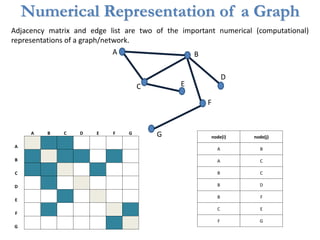
Adjacency matrix and edge list are two of the important numerical (computational)
representations of a graph/network.
Numerical Representation of a Graph
A B
C
D
E
F
GA B C D E F G
A
B
C
D
E
F
G
node(i) node(j)
A B
A C
B C
B D
B F
C E
F G
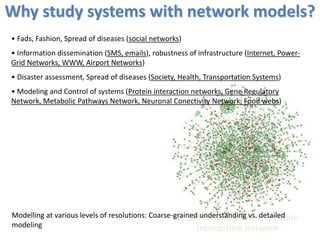
S. cerevisiae protein–protein
interaction network
• Fads, Fashion, Spread of diseases (social networks)
• Information dissemination (SMS, emails), robustness of infrastructure (Internet, Power-
Grid Networks, WWW, Airport Networks)
• Disaster assessment, Spread of diseases (Society, Health, Transportation Systems)
• Modeling and Control of systems (Protein interaction networks, Gene Regulatory
Network, Metabolic Pathways Network, Neuronal Conectivity Network, Food webs)
Modelling at various levels of resolutions: Coarse-grained understanding vs. detailed
modeling
Why study systems with network models?
• How many elements? How many interactions? (n,e)
• Directed/ undirected, weighted/ unweighted?
• What kind of connectivity? What kind of connectivity
distribution?
• Is there any special importance to a node or a group of nodes
or a link?
• Is it important for the network to be together? Good
(information dissemination) and bad (disease spread).
• How are the degree-degree correlations?
• Are there special motifs for performing specific functions?
• How to identify structural and functional modules?
What questions to ask?
Small World Networks
Small-World Networks
• Many self-organizing systems could be viewed as networks of
coupled dynamical systems.
• In such systems, ordinarily, the connection topology is assumed to
be either completely regular or completely random.
• But many biological, technological and social networks lie
somewhere between these two extremes.
• Simple models of networks that can be tuned through this middle
ground: regular networks ‘rewired’ to introduce increasing
amounts of disorder.
• These systems can be highly clustered, like regular lattices, yet
have small characteristic path lengths, like random graphs.
‘small-world’ networks
“Collective dynamics of small-world networks”, Watts and Strogatz, Nature, 393, 440-442 (1998).
Small -World Networks
“Collective dynamics of small-world networks”, Watts and Strogatz, Nature, 393, 440-442 (1998).
Procedure used by Watts and Strogatz (Nature, 1998)
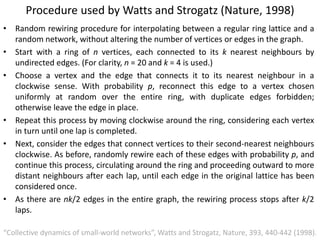
• Random rewiring procedure for interpolating between a regular ring lattice and a
random network, without altering the number of vertices or edges in the graph.
• Start with a ring of n vertices, each connected to its k nearest neighbours by
undirected edges. (For clarity, n = 20 and k = 4 is used.)
• Choose a vertex and the edge that connects it to its nearest neighbour in a
clockwise sense. With probability p, reconnect this edge to a vertex chosen
uniformly at random over the entire ring, with duplicate edges forbidden;
otherwise leave the edge in place.
• Repeat this process by moving clockwise around the ring, considering each vertex
in turn until one lap is completed.
• Next, consider the edges that connect vertices to their second-nearest neighbours
clockwise. As before, randomly rewire each of these edges with probability p, and
continue this process, circulating around the ring and proceeding outward to more
distant neighbours after each lap, until each edge in the original lattice has been
considered once.
• As there are nk/2 edges in the entire graph, the rewiring process stops after k/2
laps.
“Collective dynamics of small-world networks”, Watts and Strogatz, Nature, 393, 440-442 (1998).
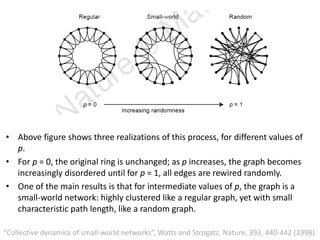
• Above figure shows three realizations of this process, for different values of
p.
• For p = 0, the original ring is unchanged; as p increases, the graph becomes
increasingly disordered until for p = 1, all edges are rewired randomly.
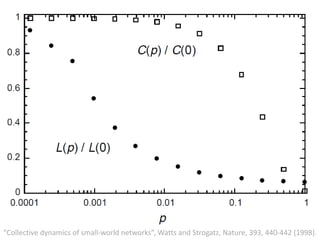
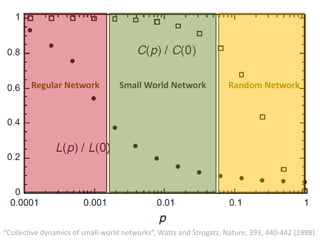
• One of the main results is that for intermediate values of p, the graph is a
small-world network: highly clustered like a regular graph, yet with small
characteristic path length, like a random graph.
“Collective dynamics of small-world networks”, Watts and Strogatz, Nature, 393, 440-442 (1998).
Regular Network Small World Network Random Network
“Collective dynamics of small-world networks”, Watts and Strogatz, Nature, 393, 440-442 (1998).
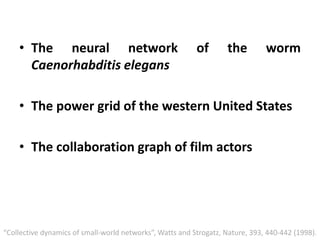
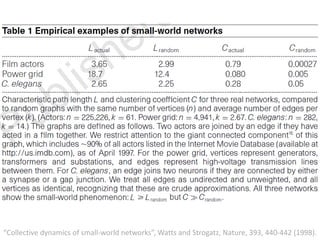
• The neural network of the worm
Caenorhabditis elegans
• The power grid of the western United States
• The collaboration graph of film actors
“Collective dynamics of small-world networks”, Watts and Strogatz, Nature, 393, 440-442 (1998).
Scale-Free Networks
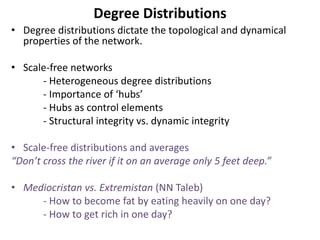
Degree Distributions
• Degree distributions dictate the topological and dynamical
properties of the network.
• Scale-free networks
- Heterogeneous degree distributions
- Importance of ‘hubs’
- Hubs as control elements
- Structural integrity vs. dynamic integrity
• Scale-free distributions and averages
“Don’t cross the river if it on an average only 5 feet deep.”
• Mediocristan vs. Extremistan (NN Taleb)
- How to become fat by eating heavily on one day?
- How to get rich in one day?
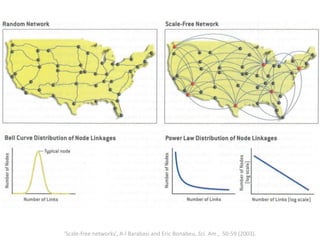
‘Scale-free networks’, A-l Barabasi and Eric Bonabeu, Sci. Am., 50-59 (2003).
Barabasi Albert (BA) Model
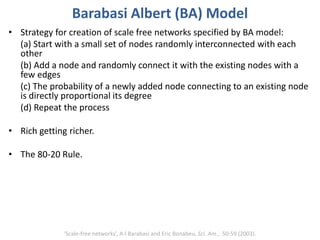
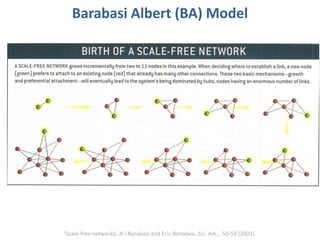
• Strategy for creation of scale free networks specified by BA model:
(a) Start with a small set of nodes randomly interconnected with each
other
(b) Add a node and randomly connect it with the existing nodes with a
few edges
(c) The probability of a newly added node connecting to an existing node
is directly proportional its degree
(d) Repeat the process
• Rich getting richer.
• The 80-20 Rule.
‘Scale-free networks’, A-l Barabasi and Eric Bonabeu, Sci. Am., 50-59 (2003).
Barabasi Albert (BA) Model
‘Scale-free networks’, A-l Barabasi and Eric Bonabeu, Sci. Am., 50-59 (2003).
Network Topology has functional basis.
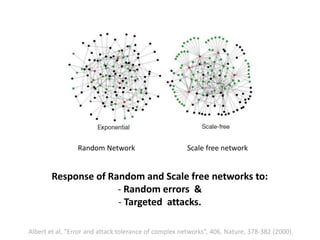
Random Network Scale free network
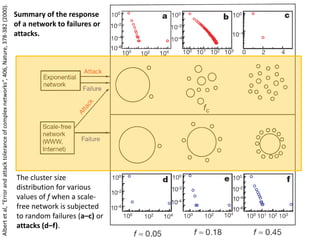
Response of Random and Scale free networks to:
- Random errors &
- Targeted attacks.
Albert et al, “Error and attack tolerance of complex networks”, 406, Nature, 378-382 (2000).
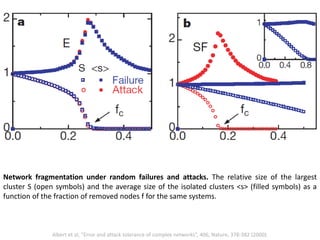
Network fragmentation under random failures and attacks. The relative size of the largest
cluster S (open symbols) and the average size of the isolated clusters <s> (filled symbols) as a
function of the fraction of removed nodes f for the same systems.
Albert et al, “Error and attack tolerance of complex networks”, 406, Nature, 378-382 (2000).
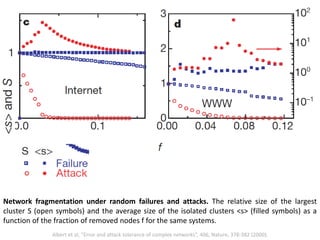
Network fragmentation under random failures and attacks. The relative size of the largest
cluster S (open symbols) and the average size of the isolated clusters <s> (filled symbols) as a
function of the fraction of removed nodes f for the same systems.
The cluster size
distribution for various
values of f when a scale-
free network is subjected
to random failures (a–c) or
attacks (d–f).
Summary of the response
of a network to failures or
attacks.
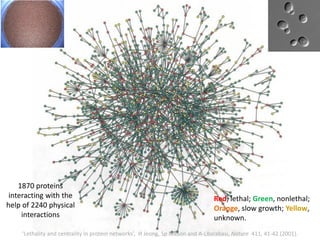
‘Lethality and centrality in protein networks’, H Jeong, Sp Meson and A-LBarabasi, Nature 411, 41-42 (2001).
1870 proteins
interacting with the
help of 2240 physical
interactions
Red, lethal; Green, nonlethal;
Orange, slow growth; Yellow,
unknown.
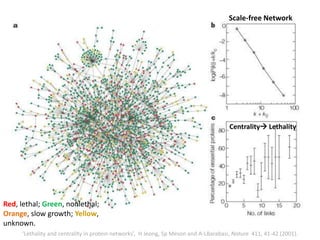
‘Lethality and centrality in protein networks’, H Jeong, Sp Meson and A-LBarabasi, Nature 411, 41-42 (2001).
Scale-free Network
Centrality Lethality
Red, lethal; Green, nonlethal;
Orange, slow growth; Yellow,
unknown.
• Scale-free networks are robust to random
errors, but are vulnerable to targeted attacks.
• The response of exponential (random)
networks for random errors and targeted
attacks is indistinguishable.
• The hub proteins in the yeast protein
interaction network tend to be most critical.
Network Motifs
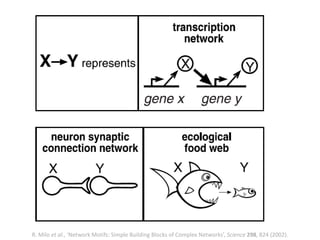
R. Milo et al., ‘Network Motifs: Simple Building Blocks of Complex Networks’, Science 298, 824 (2002).
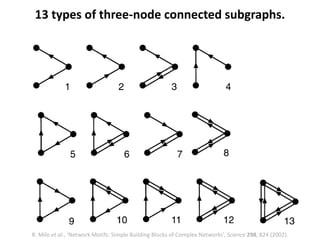
13 types of three-node connected subgraphs.
R. Milo et al., ‘Network Motifs: Simple Building Blocks of Complex Networks’, Science 298, 824 (2002).
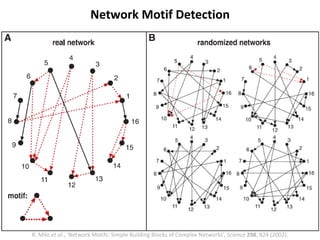
Network Motif Detection
R. Milo et al., ‘Network Motifs: Simple Building Blocks of Complex Networks’, Science 298, 824 (2002).
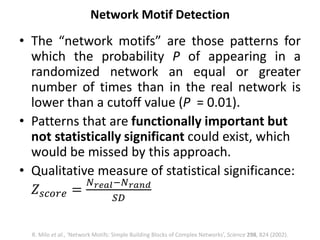
• The “network motifs” are those patterns for
which the probability P of appearing in a
randomized network an equal or greater
number of times than in the real network is
lower than a cutoff value (P = 0.01).
• Patterns that are functionally important but
not statistically significant could exist, which
would be missed by this approach.
• Qualitative measure of statistical significance:
𝑍𝑠𝑐𝑜𝑟𝑒 =
𝑁 𝑟𝑒𝑎𝑙−𝑁 𝑟𝑎𝑛𝑑
𝑆𝐷
Network Motif Detection
R. Milo et al., ‘Network Motifs: Simple Building Blocks of Complex Networks’, Science 298, 824 (2002).
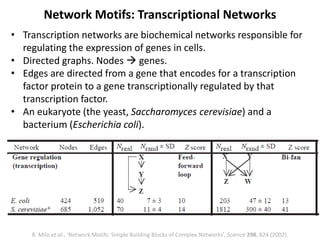
• Transcription networks are biochemical networks responsible for
regulating the expression of genes in cells.
• Directed graphs. Nodes  genes.
• Edges are directed from a gene that encodes for a transcription
factor protein to a gene transcriptionally regulated by that
transcription factor.
• An eukaryote (the yeast, Saccharomyces cerevisiae) and a
bacterium (Escherichia coli).
Network Motifs: Transcriptional Networks
R. Milo et al., ‘Network Motifs: Simple Building Blocks of Complex Networks’, Science 298, 824 (2002).
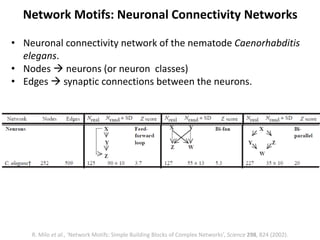
• Neuronal connectivity network of the nematode Caenorhabditis
elegans.
• Nodes  neurons (or neuron classes)
• Edges  synaptic connections between the neurons.
Network Motifs: Neuronal Connectivity Networks
R. Milo et al., ‘Network Motifs: Simple Building Blocks of Complex Networks’, Science 298, 824 (2002).
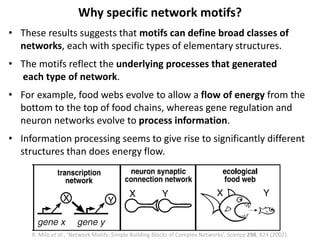
• These results suggests that motifs can define broad classes of
networks, each with specific types of elementary structures.
• The motifs reflect the underlying processes that generated
each type of network.
• For example, food webs evolve to allow a flow of energy from the
bottom to the top of food chains, whereas gene regulation and
neuron networks evolve to process information.
• Information processing seems to give rise to significantly different
structures than does energy flow.
Why specific network motifs?
R. Milo et al., ‘Network Motifs: Simple Building Blocks of Complex Networks’, Science 298, 824 (2002).
Applications of network modeling in biomedicine
Ganesh Bagler
Center for Computational Biology, IIIT-Delhi, New Delhi.
Identification of Generic Cancer Genes: Cancer Genes Network (CGN)
Shikha Vashisht and Ganesh Bagler*, 7(11): e49401, PLoS ONE (2012). arXiv:1112.1510v2 [q-bio.MN]
• A protein interactome of interactions among cancer genes: Cancer Genes Network (CGN).
• Databases: CancerGenes Database, Human Protein Reference Database, KEGG-PIC.
• Central genes were identified using ‘degree’, ‘betweenness’ and ‘stress’ metrics.
11602 interactions
among 2665
cancer proteins
Cancer Genes Network : Generic and Specific Cancer Genes
Shikha Vashisht and Ganesh Bagler*, 7(11): e49401, PLoS ONE (2012). arXiv:1112.1510v2 [q-bio.MN]
11602 interactions
among 2665
cancer proteins
● % Overlap of Central Genes in
‘Cancer Genes Network’ with
‘KEGG Pathways-in-Cancer’
 Random Samplings
 Negative Controls
The hubs and bottlenecks of ‘Cancer Genes Network’ represent
genes that are involved in generic cancer mechanisms.
Genes Central to ‘Cancer Genes Network’ match with KEGG-PIC
Shikha Vashisht and Ganesh Bagler*, 7(11): e49401, PLoS ONE (2012). arXiv:1112.1510v2 [q-bio.MN]
Hub Genes Random Samplings
1,2,3: Degree, Betweenness, Stress
4,5: Neighborhood connectivity,
Topological coefficient
6,7 (data not shown): Clustering coeff.,
Average shortest path length
Around 50% of a total 2665 cancer
genes of CGN, were ‘essential (1315)’.
Mouse Genome Informatics (MGI)
Phenotype Data.
Hubs of Cancer Genes Network (CGN) are ‘Biologically Essential’
Shikha Vashisht and Ganesh Bagler*, 7(11): e49401, PLoS ONE (2012). arXiv:1112.1510v2 [q-bio.MN]
Strategy for Identification of Targets Specific to Secondary Bone Cancer
Shikha Vashisht and Ganesh Bagler*, 7(11): e49401, PLoS ONE (2012). arXiv:1112.1510v2 [q-bio.MN]
(A) (B)
(C)
Subsets comprising
targets specific to
‘Secondary Bone
Cancer’
Identification of Targets Specific to Secondary Bone Cancer
Shikha Vashisht and Ganesh Bagler*, 7(11): e49401, PLoS ONE (2012). arXiv:1112.1510v2 [q-bio.MN]
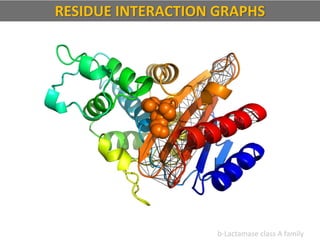
b-Lactamase class A family
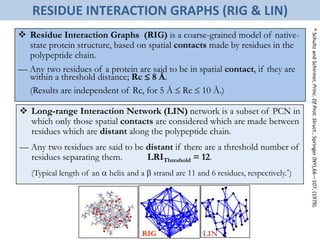
RESIDUE INTERACTION GRAPHS
 Long-range Interaction Network (LIN) network is a subset of PCN in
which only those spatial contacts are considered which are made between
residues which are distant along the polypeptide chain.
— Any two residues are said to be distant if there are a threshold number of
residues separating them. LRIThreshold = 12.
(Typical length of an  helix and a  strand are 11 and 6 residues, respectively.*)
*SchultzandSchirmer,Princ.OfProt.Struct.,Springer(NY),66—107,(1979).
 Residue Interaction Graphs (RIG) is a coarse-grained model of native-
state protein structure, based on spatial contacts made by residues in the
polypeptide chain.
— Any two residues of a protein are said to be in spatial contact, if they are
within a threshold distance; Rc  8 Å.
(Results are independent of Rc, for 5 Å  Rc  10 Å.)
RESIDUE INTERACTION GRAPHS (RIG & LIN)
RIG LIN
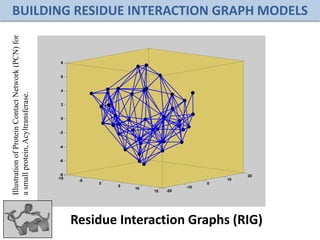
BUILDING RESIDUE INTERACTION GRAPH MODELS
Residue Interaction Graphs (RIG)
-10
-5
0
5
10
15 -20
-10
0
10
20-8
-6
-4
-2
0
2
4
6
8
-10
-5
0
5
10
15 -20
-10
0
10
20-8
-6
-4
-2
0
2
4
6
8
N
C
-10
-5
0
5
10
15 -20
-10
0
10
20-8
-6
-4
-2
0
2
4
6
8
-10
-5
0
5
10
15 -20
-10
0
10
20-8
-6
-4
-2
0
2
4
6
8
-10
-5
0
5
10
15 -20
-10
0
10
20-8
-6
-4
-2
0
2
4
6
8
-10
-5
0
5
10
15 -20
-10
0
10
20-8
-6
-4
-2
0
2
4
6
8
-10
-5
0
5
10
15 -20
-10
0
10
20-8
-6
-4
-2
0
2
4
6
8
IllustrationofProteinContactNetwork(PCN)for
asmallprotein,Acyltransferase.
-10
-5
0
5
10
15 -20
-10
0
10
20-8
-6
-4
-2
0
2
4
6
8
-10
-5
0
5
10
15 -20
-10
0
10
20-8
-6
-4
-2
0
2
4
6
8
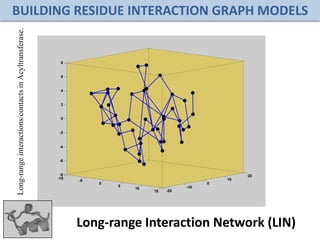
Long-range Interaction Network (LIN)
Long-rangeinteractions/contactsinAcyltransferase.
BUILDING RESIDUE INTERACTION GRAPH MODELS
-10
-5
0
5
10
15 -20
-10
0
10
20-8
-6
-4
-2
0
2
4
6
8
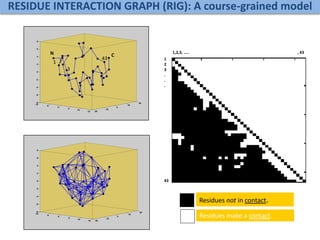
1 2
3
43
N C
1,2,3, ….. , 43
1
2
3
.
.
.
43
-10
-5
0
5
10
15 -20
-10
0
10
20-8
-6
-4
-2
0
2
4
6
8
Residues not in contact.
Residues make a contact.
RESIDUE INTERACTION GRAPH (RIG): A course-grained model
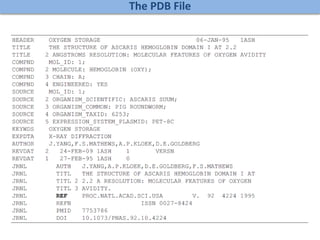
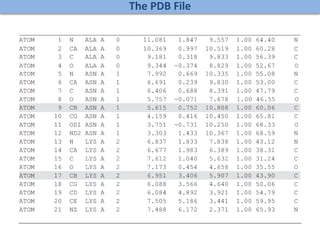
The PDB File
The PDB File
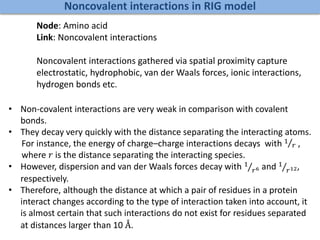
Noncovalent interactions in RIG model
Node: Amino acid
Link: Noncovalent interactions
Noncovalent interactions gathered via spatial proximity capture
electrostatic, hydrophobic, van der Waals forces, ionic interactions,
hydrogen bonds etc.
• Non-covalent interactions are very weak in comparison with covalent
bonds.
• They decay very quickly with the distance separating the interacting atoms.
For instance, the energy of charge–charge interactions decays with 1
𝑟 ,
where 𝑟 is the distance separating the interacting species.
• However, dispersion and van der Waals forces decay with 1
𝑟6 and 1
𝑟12,
respectively.
• Therefore, although the distance at which a pair of residues in a protein
interact changes according to the type of interaction taken into account, it
is almost certain that such interactions do not exist for residues separated
at distances larger than 10 Å.
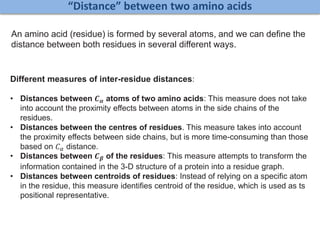
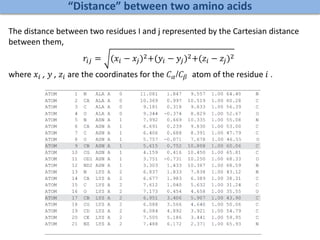
“Distance” between two amino acids
An amino acid (residue) is formed by several atoms, and we can define the
distance between both residues in several different ways.
Different measures of inter-residue distances:
• Distances between 𝑪 𝜶 atoms of two amino acids: This measure does not take
into account the proximity effects between atoms in the side chains of the
residues.
• Distances between the centres of residues. This measure takes into account
the proximity effects between side chains, but is more time-consuming than those
based on 𝐶 𝛼 distance.
• Distances between 𝑪 𝜷 of the residues: This measure attempts to transform the
information contained in the 3-D structure of a protein into a residue graph.
• Distances between centroids of residues: Instead of relying on a specific atom
in the residue, this measure identifies centroid of the residue, which is used as ts
positional representative.
“Distance” between two amino acids
The distance between two residues I and j represented by the Cartesian distance
between them,
𝑟𝑖𝑗 = (𝑥𝑖 − 𝑥𝑗)2+(𝑦𝑖 − 𝑦𝑗)2+(𝑧𝑖 − 𝑧𝑗)2
where 𝑥𝑖 , 𝑦 , 𝑧𝑖 are the coordinates for the 𝐶 𝛼/𝐶𝛽 atom of the residue 𝑖 .
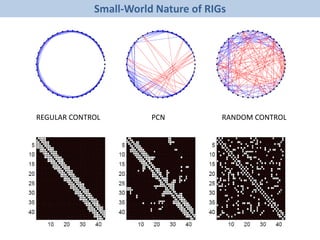
Small-World Nature of RIGs
REGULAR CONTROL PCN RANDOM CONTROL
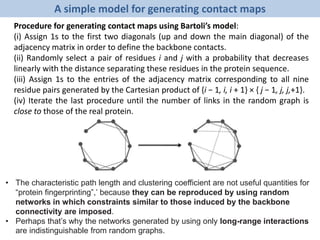
A simple model for generating contact maps
Procedure for generating contact maps using Bartoli’s model:
(i) Assign 1s to the first two diagonals (up and down the main diagonal) of the
adjacency matrix in order to define the backbone contacts.
(ii) Randomly select a pair of residues i and j with a probability that decreases
linearly with the distance separating these residues in the protein sequence.
(iii) Assign 1s to the entries of the adjacency matrix corresponding to all nine
residue pairs generated by the Cartesian product of {i − 1, i, i + 1} × { j − 1, j, j,+1}.
(iv) Iterate the last procedure until the number of links in the random graph is
close to those of the real protein.
• The characteristic path length and clustering coefficient are not useful quantities for
“protein fingerprinting”,’ because they can be reproduced by using random
networks in which constraints similar to those induced by the backbone
connectivity are imposed.
• Perhaps that’s why the networks generated by using only long-range interactions
are indistinguishable from random graphs.
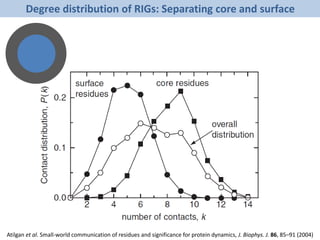
Degree distribution of RIGs: Separating core and surface
Atilgan et al. Small-world communication of residues and significance for protein dynamics, J. Biophys. J. 86, 85–91 (2004)
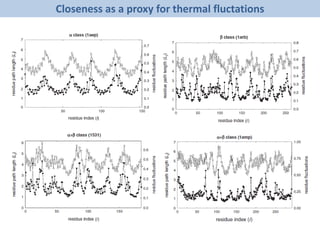
Closeness as a proxy for thermal fluctations
Folding
Time
kF [sec-1]ln (kF)
7.389 s0.1353-2
1 s1.000
0.1353 s7.392
18.32 ms54.604
2.479 ms403.436
33.55 ms2,981.008
0.4540 s22,026.0010
6.144 s16275.4712
RATE OF FOLDING—FOLDING TIME
Bagler and Sinha, Bioinformatics (2007)
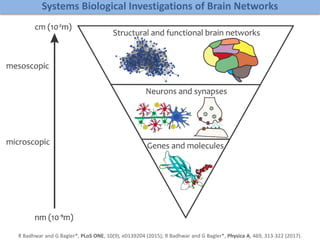
Systems Biological Investigations of Brain Networks
R Badhwar and G Bagler*, PLoS ONE, 10(9), e0139204 (2015); R Badhwar and G Bagler*, Physica A, 469, 313-322 (2017).
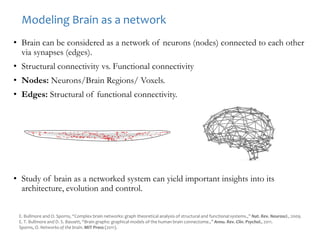
Modeling Brain as a network
• Brain can be considered as a network of neurons (nodes) connected to each other
via synapses (edges).
• Structural connectivity vs. Functional connectivity
• Nodes: Neurons/Brain Regions/ Voxels.
• Edges: Structural of functional connectivity.
• Study of brain as a networked system can yield important insights into its
architecture, evolution and control.
E. Bullmore and O. Sporns, “Complex brain networks: graph theoretical analysis of structural and functional systems.,” Nat. Rev. Neurosci., 2009.
E. T. Bullmore and D. S. Bassett, “Brain graphs: graphical models of the human brain connectome.,” Annu. Rev. Clin. Psychol., 2011.
Sporns, O. Networks of the brain. MIT Press (2011).
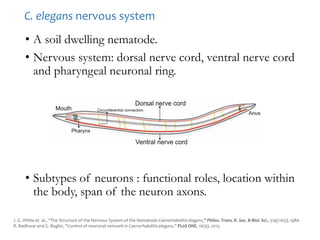
• A soil dwelling nematode.
• Nervous system: dorsal nerve cord, ventral nerve cord
and pharyngeal neuronal ring.
• Subtypes of neurons : functional roles, location within
the body, span of the neuron axons.
J. G. White et. al., “The Structure of the Nervous System of the Nematode Caenorhabditis elegans,” Philos. Trans. R. Soc. B Biol. Sci., 314(1165), 1986.
R. Badhwar and G. Bagler, “Control of neuronal network in Caenorhabditis elegans,” PLoS ONE, 10(9), 2015.
C. elegans nervous system
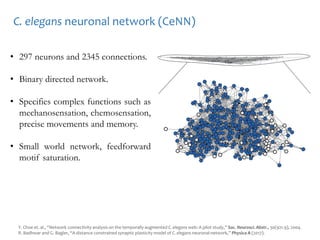
• 297 neurons and 2345 connections.
• Binary directed network.
• Specifies complex functions such as
mechanosensation, chemosensation,
precise movements and memory.
• Small world network, feedforward
motif saturation.
Y. Choe et. al., “Network connectivity analysis on the temporally augmented C. elegans web: A pilot study,” Soc. Neurosci. Abstr., 30(921.9), 2004.
R. Badhwar and G. Bagler, “A distance constrained synaptic plasticity model of C. elegans neuronal network,” Physica A (2017).
C. elegans neuronal network (CeNN)
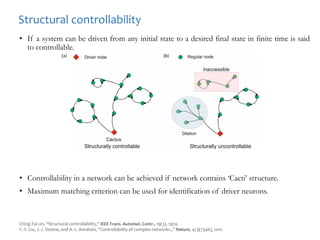
• If a system can be driven from any initial state to a desired final state in finite time is said
to controllable.
• Controllability in a network can be achieved if network contains ‘Cacti’ structure.
• Maximum matching criterion can be used for identification of driver neurons.
Ching-Tai Lin, “Structural controllability,” IEEE Trans. Automat. Contr., 19(3), 1974.
Y.-Y. Liu, J.-J. Slotine, and A.-L. Barabási, “Controllability of complex networks.,” Nature, 473(7346), 2011.
Structural controllability
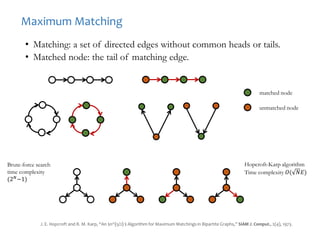
• Matching: a set of directed edges without common heads or tails.
• Matched node: the tail of matching edge.
J. E. Hopcroft and R. M. Karp, “An $n^{5/2} $ Algorithm for Maximum Matchings in Bipartite Graphs,” SIAM J. Comput., 2(4), 1973.
Maximum Matching
matched node
unmatched node
Hopcroft-Karp algorithm
Time complexity 𝑂( 𝑁𝐸)
Brute-force search
time complexity
(2 𝑁
−1)
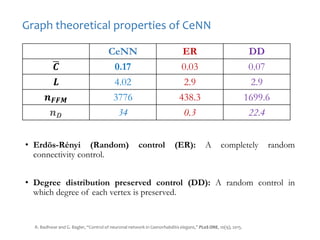
• Erdös-Rényi (Random) control (ER): A completely random
connectivity control.
• Degree distribution preserved control (DD): A random control in
which degree of each vertex is preserved.
Graph theoretical properties of CeNN
CeNN ER DD
𝑪 0.17 0.03 0.07
𝑳 4.02 2.9 2.9
𝒏 𝑭𝑭𝑴 3776 438.3 1699.6
𝒏 𝑫 34 0.3 22.4
R. Badhwar and G. Bagler, “Control of neuronal network in Caenorhabditis elegans,” PLoS ONE, 10(9), 2015.
R. Badhwar and G. Bagler, “A distance constrained synaptic plasticity model of C. elegans neuronal network,” Physica A 2017; arXiv:1603.03867
R. Milo, S. Shen-Orr, S. Itzkovitz, and N. Kashtan, “Network Motif: Simple Building Blocks of Complex Networks,” Science, 298(5594), 2002.
S. Mangan and U. Alon, “Structure and function of the feed-forward loop network motif.,” PNAS, 100(21), 2003.
CeNN has saturation of Feed Forward Motifs (FFMs)
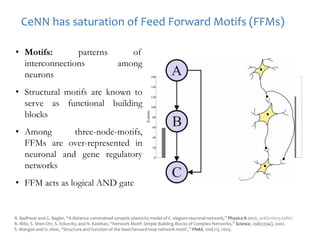
• Motifs: patterns of
interconnections among
neurons
• Structural motifs are known to
serve as functional building
blocks
• Among three-node-motifs,
FFMs are over-represented in
neuronal and gene regulatory
networks
• FFM acts as logical AND gate
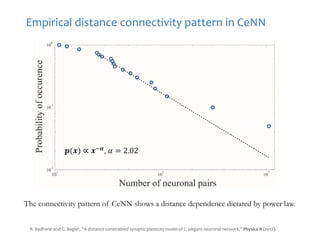
Empirical distance connectivity pattern in CeNN
The connectivity pattern of CeNN shows a distance dependence dictated by power law.
R. Badhwar and G. Bagler, “A distance constrained synaptic plasticity model of C. elegans neuronal network,” Physica A (2017).
𝒑(𝒙) ∝ 𝒙−𝜶, 𝛼 = 2.02
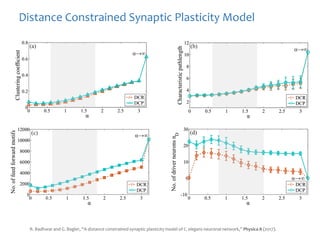
Distance Constrained Synaptic Plasticity Model
R. Badhwar and G. Bagler, “A distance constrained synaptic plasticity model of C. elegans neuronal network,” Physica A (2017).
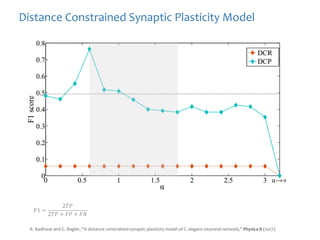
𝐹1 =
2𝑇𝑃
2𝑇𝑃 + 𝐹𝑃 + 𝐹𝑁
R. Badhwar and G. Bagler, “A distance constrained synaptic plasticity model of C. elegans neuronal network,” Physica A (2017).
Distance Constrained Synaptic Plasticity Model
‘Catching Fire—How cooking made us human’ by Richard Wrangham
Why do we eat what we eat?
Why do we combine ingredients
in our recipes the way we do?
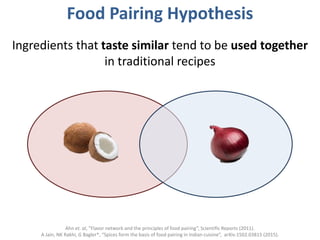
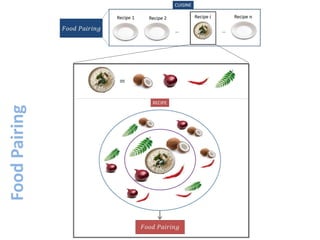
Food Pairing Hypothesis
Ingredients that taste similar tend to be used together
in traditional recipes
Ahn et. al, “Flavor network and the principles of food pairing”, Scientific Reports (2011).
A Jain, NK Rakhi, G Bagler*, “Spices form the basis of food pairing in Indian cuisine”, arXiv:1502.03815 (2015).
Recipes & Ingredients
2543 Traditional Indian Recipes (TarlaDalal)
Regional cuisines: Bengali, Gujarati, Jain, Maharashtrian,
Mughlai, Punjabi, Rajasthani, South Indian.
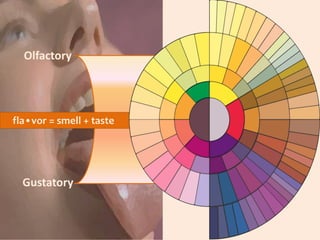
fla•vor = smell + taste
Olfactory
Gustatory
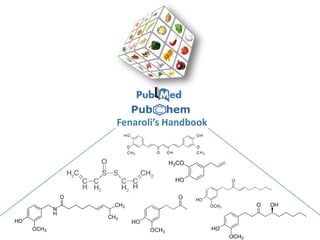
Fenaroli’s Handbook
Complex Systems Laboratory, G Bagler*
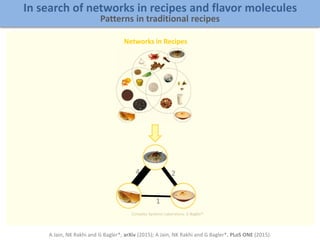
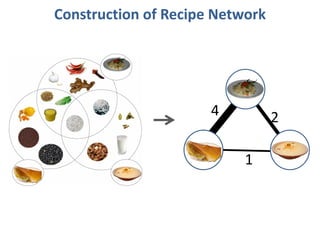
Networks in Recipes
4
1
2
In search of networks in recipes and flavor molecules
Patterns in traditional recipes
A Jain, NK Rakhi and G Bagler*, arXiv (2015); A Jain, NK Rakhi and G Bagler*, PLoS ONE (2015).
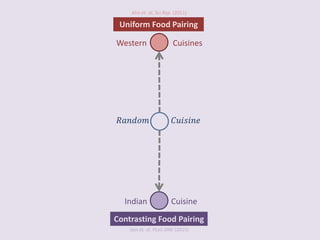
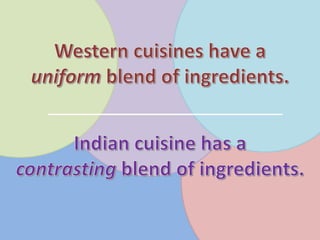
𝑅𝑎𝑛𝑑𝑜𝑚 𝐶𝑢𝑖𝑠𝑖𝑛𝑒
Western Cuisines
Ahn et. al, Sci.Rep. (2011)
Uniform Food Pairing
Indian Cuisine
Jain et. al, PLoS ONE (2015)
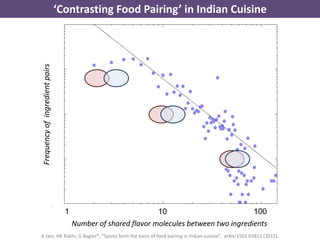
Contrasting Food Pairing
‘Contrasting Food Pairing’ in Indian Cuisine
A Jain, NK Rakhi, G Bagler*, “Spices form the basis of food pairing in Indian cuisine”, arXiv:1502.03815 (2015).
4
6
8
10
12
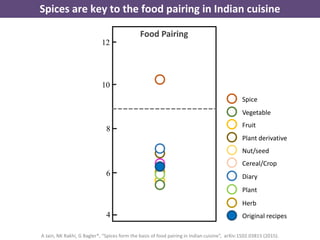
Food Pairing
Original recipes
Herb
Plant
Diary
Cereal/Crop
Nut/seed
Plant derivative
Fruit
Vegetable
Spice
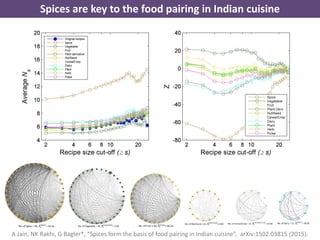
Spices are key to the food pairing in Indian cuisine
A Jain, NK Rakhi, G Bagler*, “Spices form the basis of food pairing in Indian cuisine”, arXiv:1502.03815 (2015).
Spice
The Taste of India
A Jain, NK Rakhi and G Bagler*, arXiv (2015); A Jain, NK Rakhi and G Bagler*, PLoS ONE (2015).
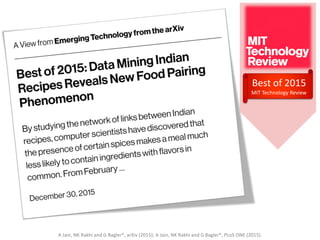
Best of 2015
MIT Technology Review
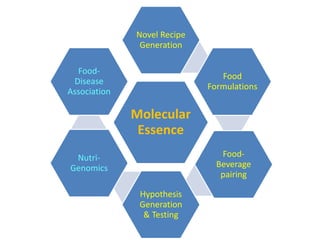
Molecular
Essence
Novel Recipe
Generation
Food
Formulations
Food-
Beverage
pairing
Hypothesis
Generation
& Testing
Nutri-
Genomics
Food-
Disease
Association
Navjot Singh and G Bagler*, unpublished (2017).
http://cosylab.iiitd.edu.in/flavordb
*
* under development
𝑓 × = 𝑧
R Tuwani, Rakhi NK and G Bagler*, Under preparation (2017); Rakhi NK, R Tuwani, J Mukherjee and G Bagler*, Under review, PNAS (2017).
Data-driven analytics of food-disease associations
Image Credits: Wikipedia, Google Images (wherever applicable)
bagler@iiitd.ac.in
http://cosylab.iiitd.ac.in
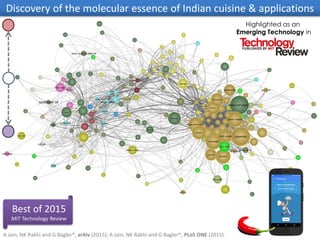
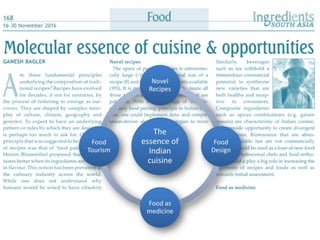
Discovery of the molecular essence of Indian cuisine & applications
Highlighted as an
Emerging Technology in
A Jain, NK Rakhi and G Bagler*, arXiv (2015); A Jain, NK Rakhi and G Bagler*, PLoS ONE (2015).
Best of 2015
MIT Technology Review
1 0 1 0 1 0 1 0 1 0 1 0 1 0 1 0 1 0 1 0 1 0 1 0 1 0 1 0 1 0 1 0
1 0 1 0 1 0 1 0 1 0 1 0 1 0 1 0 1 0 1 0 1 0 1 0 1 0 1 0 1 0 1 0
1 0 1 0 1 0 1 0 1 0 1 0 1 0 1 0 1 0 1 0 1 0 1 0 1 0 1 0 1 0 1 0
1 0 1 0 1 0 1 0 1 0 1 0 1 0 1 0 1 0 1 0 1 0 1 0 1 0 1 0 1 0 1 0
1 0 1 0 1 0 1 0 1 0 1 0 1 0 1 0 1 0 1 0 1 0 1 0 1 0 1 0 1 0 1 0
1 0 1 0 1 0 1 0 1 0 1 0 1 0 1 0 1 0 1 0 1 0 1 0 1 0 1 0 1 0 1 0
1 0 1 0 1 0 1 0 1 0 1 0 1 0 1 0 1 0 1 0 1 0 1 0 1 0 1 0 1 0 1 0
1 0 1 0 1 0 1 0 1 0 1 0 1 0 1 0 1 0 1 0 1 0 1 0 1 0 1 0 1 0 1 0
1 0 1 0 1 0 1 0 1 0 1 0 1 0 1 0 1 0 1 0 1 0 1 0 1 0 1 0 1 0 1 0
1 0 1 0 1 0 1 0 1 0 1 0 1 0 1 0 1 0 1 0 1 0 1 0 1 0 1 0 1 0 1 0
1 0 1 0 1 0 1 0 1 0 1 0 1 0 1 0 1 0 1 0 1 0 1 0 1 0 1 0 1 0 1 0
1 0 1 0 1 0 1 0 1 0 1 0 1 0 1 0 1 0 1 0 1 0 1 0 1 0 1 0 1 0 1 0
1 0 1 0 1 0 1 0 1 0 1 0 1 0 1 0 1 0 1 0 1 0 1 0 1 0 1 0 1 0 1 0
1 0 1 0 1 0 1 0 1 0 1 0 1 0 1 0 1 0 1 0 1 0 1 0 1 0 1 0 1 0 1 0
1 0 1 0 1 0 1 0 1 0 1 0 1 0 1 0 1 0 1 0 1 0 1 0 1 0 1 0 1 0 1 0
1 0 1 0 1 0 1 0 1 0 1 0 1 0 1 0 1 0 1 0 1 0 1 0 1 0 1 0 1 0 1 0
1 0 1 0 1 0 1 0 1 0 1 0 1 0 1 0 1 0 1 0 1 0 1 0 1 0 1 0 1 0 1 0
1 0 1 0 1 0 1 0 1 0 1 0 1 0 1 0 1 0 1 0 1 0 1 0 1 0 1 0 1 0 1 0
1 0 1 0 1 0 1 0 1 0 1 0 1 0 1 0 1 0 1 0 1 0 1 0 1 0 1 0 1 0 1 0
1 0 1 0 1 0 1 0 1 0 1 0 1 0 1 0 1 0 1 0 1 0 1 0 1 0 1 0 1 0 1 0
1 0 1 0 1 0 1 0 1 0 1 0 1 0 1 0 1 0 1 0 1 0 1 0 1 0 1 0 1 0 1 0
1 0 1 0 1 0 1 0 1 0 1 0 1 0 1 0 1 0 1 0 1 0 1 0 1 0 1 0 1 0 1 0
1 0 1 0 1 0 1 0 1 0 1 0 1 0 1 0 1 0 1 0 1 0 1 0 1 0 1 0 1 0 1 0
1 0 1 0 1 0 1 0 1 0 1 0 1 0 1 0 1 0 1 0 1 0 1 0 1 0 1 0 1 0 1 0
1 0 1 0 1 0 1 0 1 0 1 0 1 0 1 0 1 0 1 0 1 0 1 0 1 0 1 0 1 0 1 0
1 0 1 0 1 0 1 0 1 0 1 0 1 0 1 0 1 0 1 0 1 0 1 0 1 0 1 0 1 0 1 0
1 0 1 0 1 0 1 0 1 0 1 0 1 0 1 0 1 0 1 0 1 0 1 0 1 0 1 0 1 0 1 0
1 0 1 0 1 0 1 0 1 0 1 0 1 0 1 0 1 0 1 0 1 0 1 0 1 0 1 0 1 0 1 0
1 0 1 0 1 0 1 0 1 0 1 0 1 0 1 0 1 0 1 0 1 0 1 0 1 0 1 0 1 0 1 0
1 0 1 0 1 0 1 0 1 0 1 0 1 0 1 0 1 0 1 0 1 0 1 0 1 0 1 0 1 0 1 0
1 0 1 0 1 0 1 0 1 0 1 0 1 0 1 0 1 0 1 0 1 0 1 0 1 0 1 0 1 0 1 0
1 0 1 0 1 0 1 0 1 0 1 0 1 0 1 0 1 0 1 0 1 0 1 0 1 0 1 0 1 0 1 0
1 0 1 0 1 0 1 0 1 0 1 0 1 0 1 0 1 0 1 0 1 0 1 0 1 0 1 0 1 0 1 0
1 0 1 0 1 0 1 0 1 0 1 0 1 0 1 0 1 0 1 0 1 0
• India has a culinary history of health-centric dietary practices
aimed at disease prevention and promotion of health.
• Food as a medicine: Traditionally, food has been treated as a
medicinal agent in the Indian subcontinent.
Charaka Samhitā (चरक संहिता)
Susruta Samhitā (सुशृत संहिता)
Bhāvaprakāśa Nighaņțu (भावप्रकाश हिघण्टु)
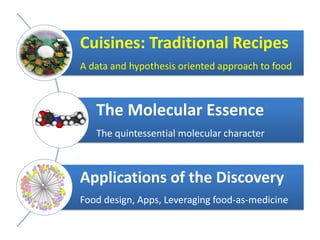
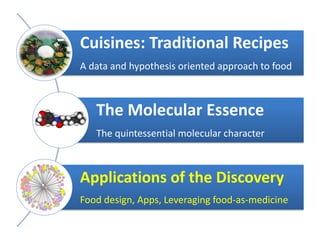
Cuisines: Traditional Recipes
A data and hypothesis oriented approach to food
The Molecular Essence
The quintessential molecular character
Applications of the Discovery
Food design, Apps, Leveraging food-as-medicine
1,000,000,000+
experiments per day
&
well tasted
:: Data ::
well tested
2543 Traditional Indian Recipes (TarlaDalal)
Regional cuisines: Bengali, Gujarati, Jain, Maharashtrian,
Mughlai, Punjabi, Rajasthani, South Indian.
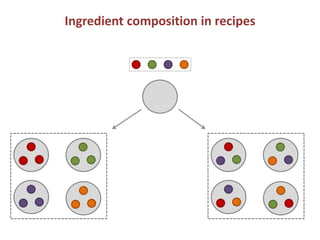
Ingredient composition in recipes
Cuisines: Traditional Recipes
A data and hypothesis oriented approach to food
The Molecular Essence
The quintessential molecular character
Applications of the Discovery
Food design, Apps, Leveraging food-as-medicine
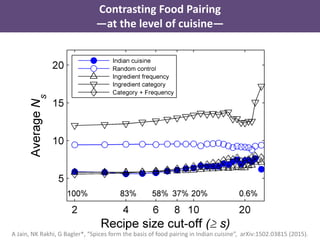
A Jain, NK Rakhi, G Bagler*, “Spices form the basis of food pairing in Indian cuisine”, arXiv:1502.03815 (2015).
Contrasting Food Pairing
—at the level of cuisine—
A Jain, NK Rakhi, G Bagler*, “Spices form the basis of food pairing in Indian cuisine”, arXiv:1502.03815 (2015).
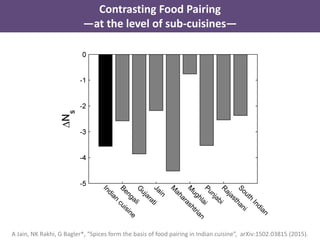
Contrasting Food Pairing
—at the level of sub-cuisines—
Jain et. al, PLoS ONE (2015).
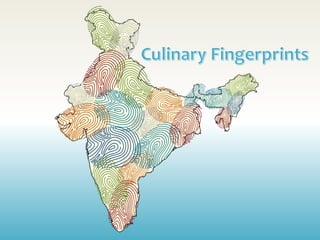
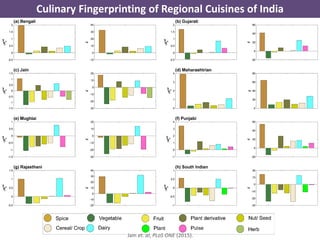
Culinary Fingerprinting of Regional Cuisines of India
A Jain, NK Rakhi, G Bagler*, “Spices form the basis of food pairing in Indian cuisine”, arXiv:1502.03815 (2015).
Spices are key to the food pairing in Indian cuisine
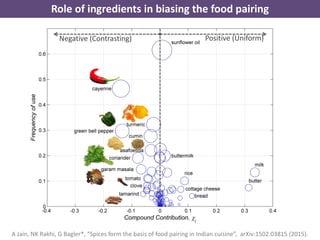
Positive (Uniform)Negative (Contrasting)
A Jain, NK Rakhi, G Bagler*, “Spices form the basis of food pairing in Indian cuisine”, arXiv:1502.03815 (2015).
Role of ingredients in biasing the food pairing
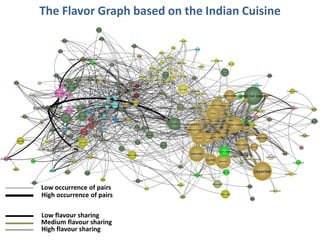
Low flavour sharing
Low occurrence of pairs
High occurrence of pairs
High flavour sharing
Medium flavour sharing
The Flavor Graph based on the Indian Cuisine
4
1
2
Construction of Recipe Network
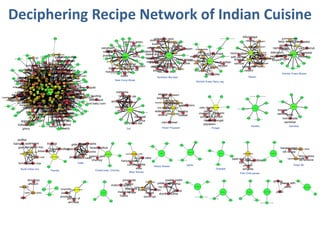
Deciphering Recipe Network of Indian Cuisine
Cuisines: Traditional Recipes
A data and hypothesis oriented approach to food
The Molecular Essence
The quintessential molecular character
Applications of the Discovery
Food design, Apps, Leveraging food-as-medicine
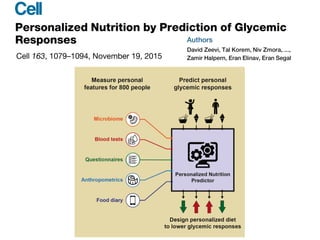
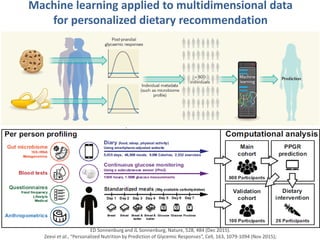
Levels of glucose in the blood are measured in terms of
“Postprandial Glycemic Response (PPGR)”.
Image Credits: HealthClinic
Machine learning applied to multidimensional data
for personalized dietary recommendation
ED Sonnenburg and JL Sonnenburg, Nature, 528, 484 (Dec 2015).
Zeevi et al., “Personalized Nutrition by Prediction of Glycemic Responses”, Cell, 163, 1079-1094 (Nov 2015);
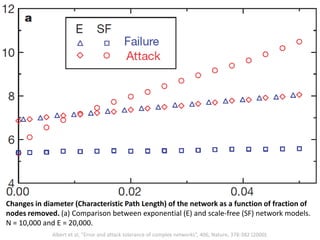
Changes in diameter (Characteristic Path Length) of the network as a function of fraction of
nodes removed. (a) Comparison between exponential (E) and scale-free (SF) network models.
N = 10,000 and E = 20,000.
Albert et al, “Error and attack tolerance of complex networks”, 406, Nature, 378-382 (2000).
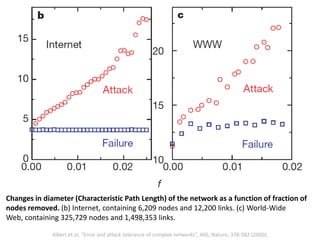
Changes in diameter (Characteristic Path Length) of the network as a function of fraction of
nodes removed. (b) Internet, containing 6,209 nodes and 12,200 links. (c) World-Wide
Web, containing 325,729 nodes and 1,498,353 links.
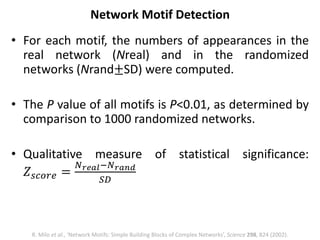
• For each motif, the numbers of appearances in the
real network (Nreal) and in the randomized
networks (Nrand±SD) were computed.
• The P value of all motifs is P<0.01, as determined by
comparison to 1000 randomized networks.
• Qualitative measure of statistical significance:
𝑍𝑠𝑐𝑜𝑟𝑒 =
𝑁 𝑟𝑒𝑎𝑙−𝑁 𝑟𝑎𝑛𝑑
𝑆𝐷
Network Motif Detection
R. Milo et al., ‘Network Motifs: Simple Building Blocks of Complex Networks’, Science 298, 824 (2002).
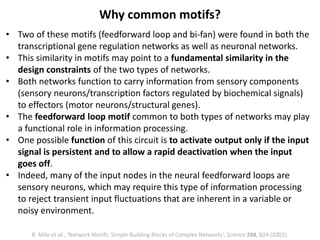
• Two of these motifs (feedforward loop and bi-fan) were found in both the
transcriptional gene regulation networks as well as neuronal networks.
• This similarity in motifs may point to a fundamental similarity in the
design constraints of the two types of networks.
• Both networks function to carry information from sensory components
(sensory neurons/transcription factors regulated by biochemical signals)
to effectors (motor neurons/structural genes).
• The feedforward loop motif common to both types of networks may play
a functional role in information processing.
• One possible function of this circuit is to activate output only if the input
signal is persistent and to allow a rapid deactivation when the input
goes off.
• Indeed, many of the input nodes in the neural feedforward loops are
sensory neurons, which may require this type of information processing
to reject transient input fluctuations that are inherent in a variable or
noisy environment.
Why common motifs?
R. Milo et al., ‘Network Motifs: Simple Building Blocks of Complex Networks’, Science 298, 824 (2002).
Barabasietal,“NetworkMedicine:Anetworkbasedapproachtohumandisease”,NatureReviews(2002)
Barabasi et al, “Network Medicine: A network based approach to human disease”, Nature Reviews (2002)
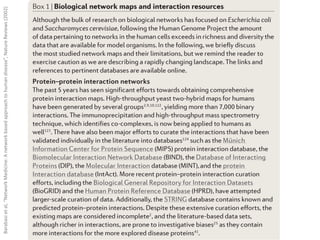
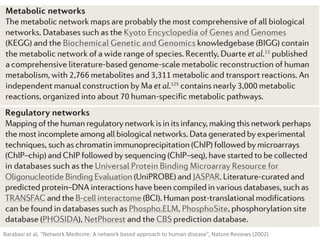
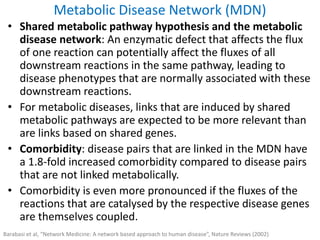
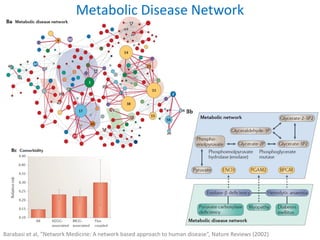
• Shared metabolic pathway hypothesis and the metabolic
disease network: An enzymatic defect that affects the flux
of one reaction can potentially affect the fluxes of all
downstream reactions in the same pathway, leading to
disease phenotypes that are normally associated with these
downstream reactions.
• For metabolic diseases, links that are induced by shared
metabolic pathways are expected to be more relevant than
are links based on shared genes.
• Comorbidity: disease pairs that are linked in the MDN have
a 1.8-fold increased comorbidity compared to disease pairs
that are not linked metabolically.
• Comorbidity is even more pronounced if the fluxes of the
reactions that are catalysed by the respective disease genes
are themselves coupled.
Metabolic Disease Network (MDN)
Barabasi et al, “Network Medicine: A network based approach to human disease”, Nature Reviews (2002)
Metabolic Disease Network
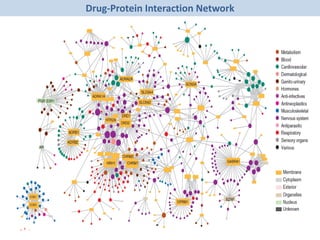
Drug-Protein Interaction Network
• The highly interconnected nature of the interactome implies that
it is difficult to consider diseases as being consistently
independent of one another at the molecular level.
• Diseasome: The systematic mapping of such network-based
dependencies between pathophenotypes and their disease
modules.
• Diseasome are disease maps whose nodes are diseases and
whose links represent various molecular relationships between
the disease-associated cellular components.
• Study of diseasome can help is better understanding of how
different phenotypes are linked at the molecular level and their
comorbidity insights
• This may yield new approaches to disease prevention, diagnosis
and treatment.
• Diseasome-based approaches could also aid drug discovery,
specifically for repurposing of drugs (use of approved drugs to
treat molecularly linked diseases).
Human Diseasome
Barabasi et al, “Network Medicine: A network based approach to human disease”, Nature Reviews (2002)
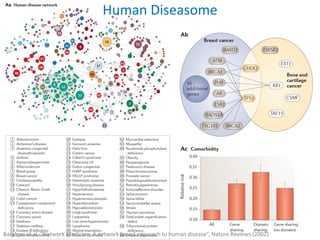
• Shared gene hypothesis and the human disease
network: In the obtained human disease network
(HDN) of Goh et al., 867 of 1,284 diseases with an
associated gene are connected to at least one
other disease, and 516 of them belong to a single
disease cluster.
• Comorbidity: a patient is twice as likely to develop
a particular disease if that disease shares a gene
with the patient’s primary disease.
• But, many disease pairs that share genes do not
show significant comorbidity.
Human Diseasome
Barabasi et al, “Network Medicine: A network based approach to human disease”, Nature Reviews (2002)
Human Diseasome
Barabasi et al, “Network Medicine: A network based approach to human disease”, Nature Reviews (2002)
Network Medicine
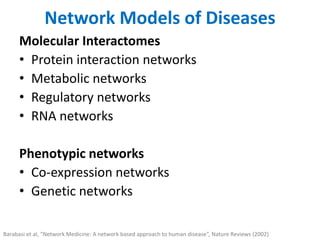
Network Models of Diseases
Molecular Interactomes
• Protein interaction networks
• Metabolic networks
• Regulatory networks
• RNA networks
Phenotypic networks
• Co-expression networks
• Genetic networks
Barabasi et al, “Network Medicine: A network based approach to human disease”, Nature Reviews (2002)
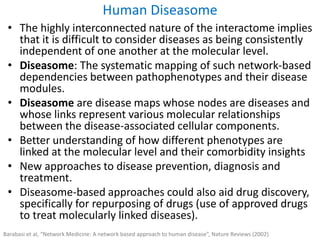
• The highly interconnected nature of the interactome implies
that it is difficult to consider diseases as being consistently
independent of one another at the molecular level.
• Diseasome: The systematic mapping of such network-based
dependencies between pathophenotypes and their disease
modules.
• Diseasome are disease maps whose nodes are diseases and
whose links represent various molecular relationships
between the disease-associated cellular components.
• Better understanding of how different phenotypes are
linked at the molecular level and their comorbidity insights
• New approaches to disease prevention, diagnosis and
treatment.
• Diseasome-based approaches could also aid drug discovery,
specifically for repurposing of drugs (use of approved drugs
to treat molecularly linked diseases).
Human Diseasome
Barabasi et al, “Network Medicine: A network based approach to human disease”, Nature Reviews (2002)
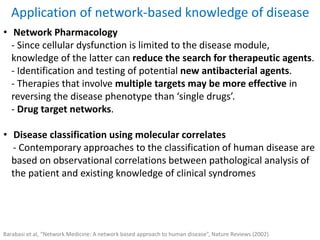
Application of network-based knowledge of disease
• Network Pharmacology
- Since cellular dysfunction is limited to the disease module,
knowledge of the latter can reduce the search for therapeutic agents.
- Identification and testing of potential new antibacterial agents.
- Therapies that involve multiple targets may be more effective in
reversing the disease phenotype than ‘single drugs’.
- Drug target networks.
• Disease classification using molecular correlates
- Contemporary approaches to the classification of human disease are
based on observational correlations between pathological analysis of
the patient and existing knowledge of clinical syndromes
Barabasi et al, “Network Medicine: A network based approach to human disease”, Nature Reviews (2002)
Summary
• Modeling biological entities as networked entities can provide
valuable insights into their mechanisms.
• Biological Networks: Protein Interactomes, Gene Regulatory
Networks, Metabolic Networks, Brain Networks, Residue Interaction
Graphs, Diseasomes…
• Small-world networks
• Scale-free networks
• Robustness and vulnerability of scale-free networks
• Centrality and lethality of hub proteins
• Network Medicine: Medical applications of network modeling
A simple model for co-expression networks
Genetic Networks
Gene Co-expression Networks
• Association by virtue of co-expression
• False positives
Gene Regulatory Networks
• Nodes: Transcription factors  Genes
• Genes: Regulatory Genes and Target Genes
Architecture of Molecular Networks
• Is the scale-free, small-world architecture direct product of
selection and thus functionally meaningful, merely a by-
product of the requirements of function and of selection at
other levels, or even a natural consequence of mechanisms
such as gene duplication.
Previous models suggested to explain the architecture:
• Selection on global properties such as robustness
• Fast spread of perturbations
• Phenomenological models (Duplication growth or hierarchical
architecture)
“The yeast coexpression network has a small-world, scale-free architecture and can be explained by a simple model”,
Noort et al., EMBO Reports, 5(3), 2004.
Yeast Coexpression Network
• Although gene coexpression is a continuous observable, the
underlying principle is discrete: the sharing of regulatory
elements.
• Compared to protein interaction networks or metabolic
networks, coexpression covers a more inclusive array of
functional relations between gene products.
• Yeast Coexpression Network
- 4077 genes and 65,430 coexpression relationships
- Average Degree: 32
- Degree Exponent 𝛾 ≈ 1
- Average Clustering Coefficient = 0.6
- Characteristic Path Length = 4
“The yeast coexpression network has a small-world, scale-free architecture and can be explained by a simple model”,
Noort et al., EMBO Reports, 5(3), 2004.
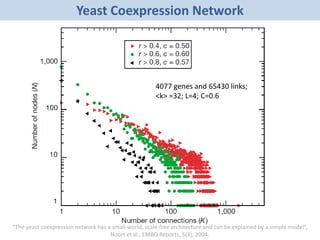
4077 genes and 65430 links;
<k> =32; L=4; C=0.6
Yeast Coexpression Network
“The yeast coexpression network has a small-world, scale-free architecture and can be explained by a simple model”,
Noort et al., EMBO Reports, 5(3), 2004.
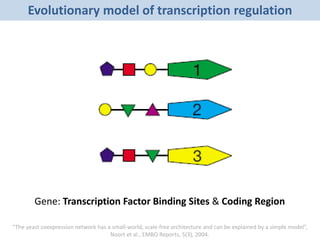
Evolutionary model of transcription regulation
Gene: Transcription Factor Binding Sites & Coding Region
“The yeast coexpression network has a small-world, scale-free architecture and can be explained by a simple model”,
Noort et al., EMBO Reports, 5(3), 2004.
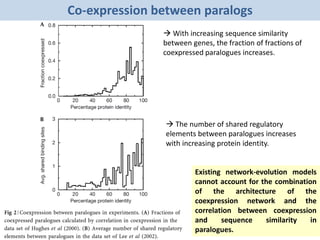
Co-expression between paralogs
 With increasing sequence similarity
between genes, the fraction of fractions of
coexpressed paralogues increases.
 The number of shared regulatory
elements between paralogues increases
with increasing protein identity.
Existing network-evolution models
cannot account for the combination
of the architecture of the
coexpression network and the
correlation between coexpression
and sequence similarity in
paralogues.
Evolutionary model of transcription regulation
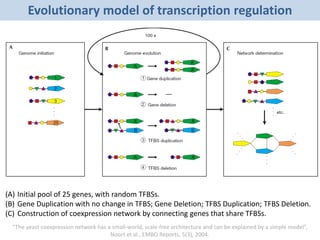
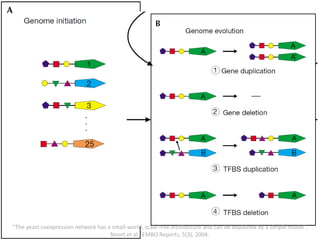
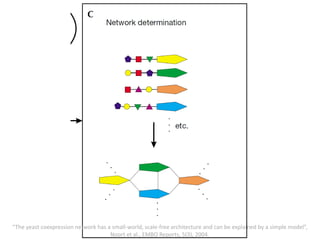
(A) Initial pool of 25 genes, with random TFBSs.
(B) Gene Duplication with no change in TFBS; Gene Deletion; TFBS Duplication; TFBS Deletion.
(C) Construction of coexpression network by connecting genes that share TFBSs.
“The yeast coexpression network has a small-world, scale-free architecture and can be explained by a simple model”,
Noort et al., EMBO Reports, 5(3), 2004.
Evolutionary model of transcription regulation
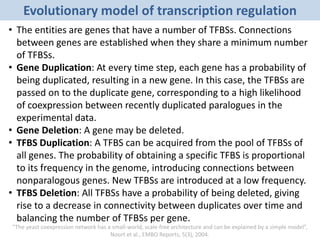
• The entities are genes that have a number of TFBSs. Connections
between genes are established when they share a minimum number
of TFBSs.
• Gene Duplication: At every time step, each gene has a probability of
being duplicated, resulting in a new gene. In this case, the TFBSs are
passed on to the duplicate gene, corresponding to a high likelihood
of coexpression between recently duplicated paralogues in the
experimental data.
• Gene Deletion: A gene may be deleted.
• TFBS Duplication: A TFBS can be acquired from the pool of TFBSs of
all genes. The probability of obtaining a specific TFBS is proportional
to its frequency in the genome, introducing connections between
nonparalogous genes. New TFBSs are introduced at a low frequency.
• TFBS Deletion: All TFBSs have a probability of being deleted, giving
rise to a decrease in connectivity between duplicates over time and
balancing the number of TFBSs per gene.
“The yeast coexpression network has a small-world, scale-free architecture and can be explained by a simple model”,
Noort et al., EMBO Reports, 5(3), 2004.
“The yeast coexpression network has a small-world, scale-free architecture and can be explained by a simple model”,
Noort et al., EMBO Reports, 5(3), 2004.
“The yeast coexpression network has a small-world, scale-free architecture and can be explained by a simple model”,
Noort et al., EMBO Reports, 5(3), 2004.
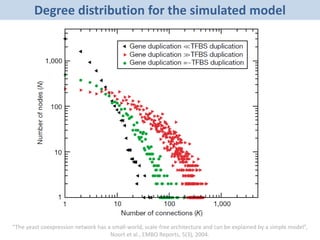
Degree distribution for the simulated model
“The yeast coexpression network has a small-world, scale-free architecture and can be explained by a simple model”,
Noort et al., EMBO Reports, 5(3), 2004.
Comparison of degree distributions for the empirical
data and simulated model
“The yeast coexpression network has a small-world, scale-free architecture and can be explained by a simple model”,
Noort et al., EMBO Reports, 5(3), 2004.
Network Biology: A paradigm for modeling biological complex systems

Network Biology: A paradigm for modeling biological complex systems

  • 1.
    Network Biology A paradigmfor modeling biological complex systems Ganesh Bagler Center for Computational Biology, IIIT-Delhi, New Delhi.
  • 2.
  • 3.
  • 4.
    Biological sequences: Assemblyand Alignments • How to assemble a large number of DNA fragments to reconstruct original sequence? • How to align DNA or protein sequences for identification of regions of similarity to probe structural, functional or evolutionary relationships?
  • 5.
    Protein: Structure, Function& Folding • Proteins are polymer chains made of amino acids. • The polypeptide folds into a functional three-dimensional structure. • Starting from the sequence, prediction of protein structure is an open problem of practical importance.
  • 6.
  • 7.
    Can a biologistfix a radio? Need for integrative models of biological systems Biological Complex Systems Modeling biological systems as networked entities Networks in Biology Intro to graph theory, key concepts, applications
  • 8.
    Biological Complex Systems Asystem comprising of large number of sophisticated functional elements, intricately connected with each other to perform specific tasks, which otherwise can not be executed by subsets of the system.
  • 9.
    Radio as ametaphor for biological complex systems
  • 10.
    Biologist finds aradio on an island
  • 12.
    “Hallmarks of Cancer:The Next Generation”, D Hanahan and RA Weinberg, Volume 144, Issue 5, Cell, 646-674. (2011). Complex Intracellular Signalling Networks Regulate the Operations of the Cancer Cell
  • 13.
    *Lazebnik Y. A.,Cancer CELL, Vol. 2, pp. 179-182 (2002). Can a biologist fix a radio?*
  • 14.
    Can a biologistfix a radio? Need for integrative models of biological systems Biological Complex Systems Modeling biological systems as networked entities Networks in Biology Intro to graph theory, key concepts, applications
  • 15.
  • 17.
    Goeh at al.,104(21), pp. 8685-8690, PNAS (2007). Interconnectedness of Molecular Machinery Underlying Diseases
  • 20.
    VISION Somatosensation, Hearing, Language, Attention,and Spatial cognitionControl attention, Abstract thinking, Behavior, Problem solving tasks and physical reactions and Personality Auditory and visual memories, Language, Hearing (partly) and Speech.
  • 21.
    THE ASTONOSHING HYPOTHESIS 'You, 'your joys and your sorrows, your memories and your ambitions, your sense of personal identity and free will, are in fact no more than the behavior of a vast assembly of nerve cells and their associated molecules.
  • 23.
    Algorithms Sequence alignment Genome assembly Geneidentification Machine Learning Data analytics Health informatics Protein folding Drug Discovery Docking simulationVirtual screening Side effects predictionDrug Repurposing Omics Data:genomics, proteomics, trascriptomics, metabolomics Databases Biomedical text mining
  • 24.
    • Transdisciplinary Research• Application of Computation for Biology and Medicine Biological Complex Systems
  • 25.
    Residue Interaction GraphModels of Protein Structures Proteins: Structure, Function, Kinetics and Design Bagler and Sinha, Bioinformatics (2007). Bagler* and Sinha, Physica A (2005). Bagler*, Nova, ISBN: 978-3-8433-5860-6. Lappe et al., Curr Opi Biotechnology (2009). Kumar et al., Scientific Reports (NPG) (2012). Engineering a thermostable enzyme • Small-world nature or protein structures • Discovery of assortative mixing and biological implication for rate of folding
  • 26.
    “Engineering a thermo-stablesuperoxide dismutase functional at sub- zero to >50°C, which also tolerates autoclaving”, Arun Kumar et al., Scientific Reports (Nature Publishing Group), 2 (387), 1-8 (2012). Engineering a thermostable enzyme
  • 27.
    Shikha Vashisht andGanesh Bagler*, 7(11): e49401, PLoS ONE (2012). arXiv:1112.1510v2 [q-bio.MN] Vinay Randhawa and Ganesh Bagler*, OMICS: A Journal of Integrative Biology, 16 (10) , 2012. V Randhawa, P Sharma, S Bhushan and G Bagler*, OMICS: A Journal of Integrative Biology, 17(6), 302-317 (2013). A rational approach towards ‘complex diseases’. Data: KEGG, OMIM, PubMed, protein interactomes, gene regulations, expression data. Network Models of Complex Diseases Molecular interactomes of diseases phenotypes: Modeling and control Why What How model Interactomes, Expression data control targets, drugs
  • 28.
    Bridging Modern andTraditional Medicine: Computational Strategy
  • 29.
    Prospecting for moleculesof therapeutic value from R. serpentina RASE0048 RASE0049 RASE0143 Rauvolfia serpentina (सर्पगंधा) Shivalika Pathania, Vinay Randhawa and Ganesh Bagler*, 8(4): e61327, PLoS ONE (2013).
  • 30.
    Headache Nausea Dizziness Weakness Vomiting Weight Loss Diarrhea Shivering Sleepiness R Kanji,A Sharma and G Bagler*, Molecular Biosystems (Royal Society of Chemistry) , 11, 2900 (2015). — Systems Biological Explorations— Adverse drug reactions & Drug repositioning
  • 31.
  • 32.
    Can a biologistfix a radio? Need for integrative models of biological systems Biological Complex Systems Modeling biological systems as networked entities Networks in Biology Intro to graph theory, key concepts, applications
  • 33.
  • 34.
    Köningsberg Problem: Origin ofGraph Theory Can one walk across the seven bridges and never cross the same one twice? THEOREM: (A) If a graph has nodes of odd degrees, it has no path. (B) If a graph is connected and has no odd degree nodes, it has at least one path.
  • 35.
    Modeling a complexsystem as a graph • Discrete constituent components, Nodes (Vertices) : N • Interactions, Links (Edges) : E • Complex Network (Graph) representation of a system : G(N,E)
  • 36.
    Altaf Vidya Vijay Arnab friend friendfriend friend Modeling acomplex system as a graph Protein 1 Protein 2 Protein 5 Protein 9
  • 37.
    Modeling a complexsystem as a graph Undirected Network Directed Network [DEFN] Degree: Number of nodes connected to a given node. A B C D E F G A B C D E F G k_A=2; k_B=3 k_A_in=1; k_A_out=1; k_B_in=3; k_B_in=1;  Weighted and Un-weighted Networks
  • 38.
    • Social Systems:Actors’ network, Collaboration network, Friends’ network • Technological Systems: Internet, WWW, Transportation • Biological Systems: Protein interaction network, Gene regulatory network, Food webs A wide range of systems could be modeled as networks (or graphs), constituted of nodes and links. Definition of network (and hence the identity of a ‘node’ and ‘link’) crucially depends on the questions being asked! Graph-theoretical models of complex systems
  • 39.
    Adjacency matrix andedge list are two of the important numerical (computational) representations of a graph/network. Numerical Representation of a Graph A B C D E F GA B C D E F G A B C D E F G node(i) node(j) A B A C B C B D B F C E F G
  • 40.
    S. cerevisiae protein–protein interactionnetwork • Fads, Fashion, Spread of diseases (social networks) • Information dissemination (SMS, emails), robustness of infrastructure (Internet, Power- Grid Networks, WWW, Airport Networks) • Disaster assessment, Spread of diseases (Society, Health, Transportation Systems) • Modeling and Control of systems (Protein interaction networks, Gene Regulatory Network, Metabolic Pathways Network, Neuronal Conectivity Network, Food webs) Modelling at various levels of resolutions: Coarse-grained understanding vs. detailed modeling Why study systems with network models?
  • 41.
    • How manyelements? How many interactions? (n,e) • Directed/ undirected, weighted/ unweighted? • What kind of connectivity? What kind of connectivity distribution? • Is there any special importance to a node or a group of nodes or a link? • Is it important for the network to be together? Good (information dissemination) and bad (disease spread). • How are the degree-degree correlations? • Are there special motifs for performing specific functions? • How to identify structural and functional modules? What questions to ask?
  • 43.
  • 45.
    Small-World Networks • Manyself-organizing systems could be viewed as networks of coupled dynamical systems. • In such systems, ordinarily, the connection topology is assumed to be either completely regular or completely random. • But many biological, technological and social networks lie somewhere between these two extremes. • Simple models of networks that can be tuned through this middle ground: regular networks ‘rewired’ to introduce increasing amounts of disorder. • These systems can be highly clustered, like regular lattices, yet have small characteristic path lengths, like random graphs. ‘small-world’ networks “Collective dynamics of small-world networks”, Watts and Strogatz, Nature, 393, 440-442 (1998).
  • 46.
    Small -World Networks “Collectivedynamics of small-world networks”, Watts and Strogatz, Nature, 393, 440-442 (1998).
  • 47.
    Procedure used byWatts and Strogatz (Nature, 1998) • Random rewiring procedure for interpolating between a regular ring lattice and a random network, without altering the number of vertices or edges in the graph. • Start with a ring of n vertices, each connected to its k nearest neighbours by undirected edges. (For clarity, n = 20 and k = 4 is used.) • Choose a vertex and the edge that connects it to its nearest neighbour in a clockwise sense. With probability p, reconnect this edge to a vertex chosen uniformly at random over the entire ring, with duplicate edges forbidden; otherwise leave the edge in place. • Repeat this process by moving clockwise around the ring, considering each vertex in turn until one lap is completed. • Next, consider the edges that connect vertices to their second-nearest neighbours clockwise. As before, randomly rewire each of these edges with probability p, and continue this process, circulating around the ring and proceeding outward to more distant neighbours after each lap, until each edge in the original lattice has been considered once. • As there are nk/2 edges in the entire graph, the rewiring process stops after k/2 laps. “Collective dynamics of small-world networks”, Watts and Strogatz, Nature, 393, 440-442 (1998).
  • 48.
    • Above figureshows three realizations of this process, for different values of p. • For p = 0, the original ring is unchanged; as p increases, the graph becomes increasingly disordered until for p = 1, all edges are rewired randomly. • One of the main results is that for intermediate values of p, the graph is a small-world network: highly clustered like a regular graph, yet with small characteristic path length, like a random graph. “Collective dynamics of small-world networks”, Watts and Strogatz, Nature, 393, 440-442 (1998).
  • 49.
    “Collective dynamics ofsmall-world networks”, Watts and Strogatz, Nature, 393, 440-442 (1998).
  • 50.
    Regular Network SmallWorld Network Random Network “Collective dynamics of small-world networks”, Watts and Strogatz, Nature, 393, 440-442 (1998).
  • 51.
    • The neuralnetwork of the worm Caenorhabditis elegans • The power grid of the western United States • The collaboration graph of film actors “Collective dynamics of small-world networks”, Watts and Strogatz, Nature, 393, 440-442 (1998).
  • 52.
    “Collective dynamics ofsmall-world networks”, Watts and Strogatz, Nature, 393, 440-442 (1998).
  • 53.
  • 54.
    Degree Distributions • Degreedistributions dictate the topological and dynamical properties of the network. • Scale-free networks - Heterogeneous degree distributions - Importance of ‘hubs’ - Hubs as control elements - Structural integrity vs. dynamic integrity • Scale-free distributions and averages “Don’t cross the river if it on an average only 5 feet deep.” • Mediocristan vs. Extremistan (NN Taleb) - How to become fat by eating heavily on one day? - How to get rich in one day?
  • 55.
    ‘Scale-free networks’, A-lBarabasi and Eric Bonabeu, Sci. Am., 50-59 (2003).
  • 56.
    ‘Scale-free networks’, A-lBarabasi and Eric Bonabeu, Sci. Am., 50-59 (2003).
  • 57.
    Barabasi Albert (BA)Model • Strategy for creation of scale free networks specified by BA model: (a) Start with a small set of nodes randomly interconnected with each other (b) Add a node and randomly connect it with the existing nodes with a few edges (c) The probability of a newly added node connecting to an existing node is directly proportional its degree (d) Repeat the process • Rich getting richer. • The 80-20 Rule. ‘Scale-free networks’, A-l Barabasi and Eric Bonabeu, Sci. Am., 50-59 (2003).
  • 58.
    Barabasi Albert (BA)Model ‘Scale-free networks’, A-l Barabasi and Eric Bonabeu, Sci. Am., 50-59 (2003).
  • 59.
    Network Topology hasfunctional basis.
  • 61.
    Random Network Scalefree network Response of Random and Scale free networks to: - Random errors & - Targeted attacks. Albert et al, “Error and attack tolerance of complex networks”, 406, Nature, 378-382 (2000).
  • 62.
    Albert et al,“Error and attack tolerance of complex networks”, 406, Nature, 378-382 (2000). Network fragmentation under random failures and attacks. The relative size of the largest cluster S (open symbols) and the average size of the isolated clusters <s> (filled symbols) as a function of the fraction of removed nodes f for the same systems.
  • 63.
    Albert et al,“Error and attack tolerance of complex networks”, 406, Nature, 378-382 (2000). Network fragmentation under random failures and attacks. The relative size of the largest cluster S (open symbols) and the average size of the isolated clusters <s> (filled symbols) as a function of the fraction of removed nodes f for the same systems.
  • 64.
    The cluster size distributionfor various values of f when a scale- free network is subjected to random failures (a–c) or attacks (d–f). Summary of the response of a network to failures or attacks.
  • 65.
    ‘Lethality and centralityin protein networks’, H Jeong, Sp Meson and A-LBarabasi, Nature 411, 41-42 (2001). 1870 proteins interacting with the help of 2240 physical interactions Red, lethal; Green, nonlethal; Orange, slow growth; Yellow, unknown.
  • 66.
    ‘Lethality and centralityin protein networks’, H Jeong, Sp Meson and A-LBarabasi, Nature 411, 41-42 (2001). Scale-free Network Centrality Lethality Red, lethal; Green, nonlethal; Orange, slow growth; Yellow, unknown.
  • 67.
    • Scale-free networksare robust to random errors, but are vulnerable to targeted attacks. • The response of exponential (random) networks for random errors and targeted attacks is indistinguishable. • The hub proteins in the yeast protein interaction network tend to be most critical.
  • 68.
  • 69.
    R. Milo etal., ‘Network Motifs: Simple Building Blocks of Complex Networks’, Science 298, 824 (2002).
  • 70.
    13 types ofthree-node connected subgraphs. R. Milo et al., ‘Network Motifs: Simple Building Blocks of Complex Networks’, Science 298, 824 (2002).
  • 71.
    Network Motif Detection R.Milo et al., ‘Network Motifs: Simple Building Blocks of Complex Networks’, Science 298, 824 (2002).
  • 72.
    • The “networkmotifs” are those patterns for which the probability P of appearing in a randomized network an equal or greater number of times than in the real network is lower than a cutoff value (P = 0.01). • Patterns that are functionally important but not statistically significant could exist, which would be missed by this approach. • Qualitative measure of statistical significance: 𝑍𝑠𝑐𝑜𝑟𝑒 = 𝑁 𝑟𝑒𝑎𝑙−𝑁 𝑟𝑎𝑛𝑑 𝑆𝐷 Network Motif Detection R. Milo et al., ‘Network Motifs: Simple Building Blocks of Complex Networks’, Science 298, 824 (2002).
  • 73.
    • Transcription networksare biochemical networks responsible for regulating the expression of genes in cells. • Directed graphs. Nodes  genes. • Edges are directed from a gene that encodes for a transcription factor protein to a gene transcriptionally regulated by that transcription factor. • An eukaryote (the yeast, Saccharomyces cerevisiae) and a bacterium (Escherichia coli). Network Motifs: Transcriptional Networks R. Milo et al., ‘Network Motifs: Simple Building Blocks of Complex Networks’, Science 298, 824 (2002).
  • 74.
    • Neuronal connectivitynetwork of the nematode Caenorhabditis elegans. • Nodes  neurons (or neuron classes) • Edges  synaptic connections between the neurons. Network Motifs: Neuronal Connectivity Networks R. Milo et al., ‘Network Motifs: Simple Building Blocks of Complex Networks’, Science 298, 824 (2002).
  • 75.
    • These resultssuggests that motifs can define broad classes of networks, each with specific types of elementary structures. • The motifs reflect the underlying processes that generated each type of network. • For example, food webs evolve to allow a flow of energy from the bottom to the top of food chains, whereas gene regulation and neuron networks evolve to process information. • Information processing seems to give rise to significantly different structures than does energy flow. Why specific network motifs? R. Milo et al., ‘Network Motifs: Simple Building Blocks of Complex Networks’, Science 298, 824 (2002).
  • 77.
    Applications of networkmodeling in biomedicine Ganesh Bagler Center for Computational Biology, IIIT-Delhi, New Delhi.
  • 78.
    Identification of GenericCancer Genes: Cancer Genes Network (CGN) Shikha Vashisht and Ganesh Bagler*, 7(11): e49401, PLoS ONE (2012). arXiv:1112.1510v2 [q-bio.MN] • A protein interactome of interactions among cancer genes: Cancer Genes Network (CGN). • Databases: CancerGenes Database, Human Protein Reference Database, KEGG-PIC. • Central genes were identified using ‘degree’, ‘betweenness’ and ‘stress’ metrics. 11602 interactions among 2665 cancer proteins
  • 79.
    Cancer Genes Network: Generic and Specific Cancer Genes Shikha Vashisht and Ganesh Bagler*, 7(11): e49401, PLoS ONE (2012). arXiv:1112.1510v2 [q-bio.MN] 11602 interactions among 2665 cancer proteins
  • 80.
    ● % Overlapof Central Genes in ‘Cancer Genes Network’ with ‘KEGG Pathways-in-Cancer’  Random Samplings  Negative Controls The hubs and bottlenecks of ‘Cancer Genes Network’ represent genes that are involved in generic cancer mechanisms. Genes Central to ‘Cancer Genes Network’ match with KEGG-PIC Shikha Vashisht and Ganesh Bagler*, 7(11): e49401, PLoS ONE (2012). arXiv:1112.1510v2 [q-bio.MN]
  • 81.
    Hub Genes RandomSamplings 1,2,3: Degree, Betweenness, Stress 4,5: Neighborhood connectivity, Topological coefficient 6,7 (data not shown): Clustering coeff., Average shortest path length Around 50% of a total 2665 cancer genes of CGN, were ‘essential (1315)’. Mouse Genome Informatics (MGI) Phenotype Data. Hubs of Cancer Genes Network (CGN) are ‘Biologically Essential’ Shikha Vashisht and Ganesh Bagler*, 7(11): e49401, PLoS ONE (2012). arXiv:1112.1510v2 [q-bio.MN]
  • 82.
    Strategy for Identificationof Targets Specific to Secondary Bone Cancer Shikha Vashisht and Ganesh Bagler*, 7(11): e49401, PLoS ONE (2012). arXiv:1112.1510v2 [q-bio.MN]
  • 83.
    (A) (B) (C) Subsets comprising targetsspecific to ‘Secondary Bone Cancer’ Identification of Targets Specific to Secondary Bone Cancer Shikha Vashisht and Ganesh Bagler*, 7(11): e49401, PLoS ONE (2012). arXiv:1112.1510v2 [q-bio.MN]
  • 84.
    b-Lactamase class Afamily RESIDUE INTERACTION GRAPHS
  • 85.
     Long-range InteractionNetwork (LIN) network is a subset of PCN in which only those spatial contacts are considered which are made between residues which are distant along the polypeptide chain. — Any two residues are said to be distant if there are a threshold number of residues separating them. LRIThreshold = 12. (Typical length of an  helix and a  strand are 11 and 6 residues, respectively.*) *SchultzandSchirmer,Princ.OfProt.Struct.,Springer(NY),66—107,(1979).  Residue Interaction Graphs (RIG) is a coarse-grained model of native- state protein structure, based on spatial contacts made by residues in the polypeptide chain. — Any two residues of a protein are said to be in spatial contact, if they are within a threshold distance; Rc  8 Å. (Results are independent of Rc, for 5 Å  Rc  10 Å.) RESIDUE INTERACTION GRAPHS (RIG & LIN) RIG LIN
  • 86.
    BUILDING RESIDUE INTERACTIONGRAPH MODELS Residue Interaction Graphs (RIG) -10 -5 0 5 10 15 -20 -10 0 10 20-8 -6 -4 -2 0 2 4 6 8 -10 -5 0 5 10 15 -20 -10 0 10 20-8 -6 -4 -2 0 2 4 6 8 N C -10 -5 0 5 10 15 -20 -10 0 10 20-8 -6 -4 -2 0 2 4 6 8 -10 -5 0 5 10 15 -20 -10 0 10 20-8 -6 -4 -2 0 2 4 6 8 -10 -5 0 5 10 15 -20 -10 0 10 20-8 -6 -4 -2 0 2 4 6 8 -10 -5 0 5 10 15 -20 -10 0 10 20-8 -6 -4 -2 0 2 4 6 8 -10 -5 0 5 10 15 -20 -10 0 10 20-8 -6 -4 -2 0 2 4 6 8 IllustrationofProteinContactNetwork(PCN)for asmallprotein,Acyltransferase.
  • 87.
    -10 -5 0 5 10 15 -20 -10 0 10 20-8 -6 -4 -2 0 2 4 6 8 -10 -5 0 5 10 15 -20 -10 0 10 20-8 -6 -4 -2 0 2 4 6 8 Long-rangeInteraction Network (LIN) Long-rangeinteractions/contactsinAcyltransferase. BUILDING RESIDUE INTERACTION GRAPH MODELS
  • 88.
    -10 -5 0 5 10 15 -20 -10 0 10 20-8 -6 -4 -2 0 2 4 6 8 1 2 3 43 NC 1,2,3, ….. , 43 1 2 3 . . . 43 -10 -5 0 5 10 15 -20 -10 0 10 20-8 -6 -4 -2 0 2 4 6 8 Residues not in contact. Residues make a contact. RESIDUE INTERACTION GRAPH (RIG): A course-grained model
  • 89.
  • 90.
  • 91.
    Noncovalent interactions inRIG model Node: Amino acid Link: Noncovalent interactions Noncovalent interactions gathered via spatial proximity capture electrostatic, hydrophobic, van der Waals forces, ionic interactions, hydrogen bonds etc. • Non-covalent interactions are very weak in comparison with covalent bonds. • They decay very quickly with the distance separating the interacting atoms. For instance, the energy of charge–charge interactions decays with 1 𝑟 , where 𝑟 is the distance separating the interacting species. • However, dispersion and van der Waals forces decay with 1 𝑟6 and 1 𝑟12, respectively. • Therefore, although the distance at which a pair of residues in a protein interact changes according to the type of interaction taken into account, it is almost certain that such interactions do not exist for residues separated at distances larger than 10 Å.
  • 92.
    “Distance” between twoamino acids An amino acid (residue) is formed by several atoms, and we can define the distance between both residues in several different ways. Different measures of inter-residue distances: • Distances between 𝑪 𝜶 atoms of two amino acids: This measure does not take into account the proximity effects between atoms in the side chains of the residues. • Distances between the centres of residues. This measure takes into account the proximity effects between side chains, but is more time-consuming than those based on 𝐶 𝛼 distance. • Distances between 𝑪 𝜷 of the residues: This measure attempts to transform the information contained in the 3-D structure of a protein into a residue graph. • Distances between centroids of residues: Instead of relying on a specific atom in the residue, this measure identifies centroid of the residue, which is used as ts positional representative.
  • 93.
    “Distance” between twoamino acids The distance between two residues I and j represented by the Cartesian distance between them, 𝑟𝑖𝑗 = (𝑥𝑖 − 𝑥𝑗)2+(𝑦𝑖 − 𝑦𝑗)2+(𝑧𝑖 − 𝑧𝑗)2 where 𝑥𝑖 , 𝑦 , 𝑧𝑖 are the coordinates for the 𝐶 𝛼/𝐶𝛽 atom of the residue 𝑖 .
  • 94.
    Small-World Nature ofRIGs REGULAR CONTROL PCN RANDOM CONTROL
  • 95.
    A simple modelfor generating contact maps Procedure for generating contact maps using Bartoli’s model: (i) Assign 1s to the first two diagonals (up and down the main diagonal) of the adjacency matrix in order to define the backbone contacts. (ii) Randomly select a pair of residues i and j with a probability that decreases linearly with the distance separating these residues in the protein sequence. (iii) Assign 1s to the entries of the adjacency matrix corresponding to all nine residue pairs generated by the Cartesian product of {i − 1, i, i + 1} × { j − 1, j, j,+1}. (iv) Iterate the last procedure until the number of links in the random graph is close to those of the real protein. • The characteristic path length and clustering coefficient are not useful quantities for “protein fingerprinting”,’ because they can be reproduced by using random networks in which constraints similar to those induced by the backbone connectivity are imposed. • Perhaps that’s why the networks generated by using only long-range interactions are indistinguishable from random graphs.
  • 96.
    Degree distribution ofRIGs: Separating core and surface Atilgan et al. Small-world communication of residues and significance for protein dynamics, J. Biophys. J. 86, 85–91 (2004)
  • 97.
    Closeness as aproxy for thermal fluctations
  • 98.
    Folding Time kF [sec-1]ln (kF) 7.389s0.1353-2 1 s1.000 0.1353 s7.392 18.32 ms54.604 2.479 ms403.436 33.55 ms2,981.008 0.4540 s22,026.0010 6.144 s16275.4712 RATE OF FOLDING—FOLDING TIME Bagler and Sinha, Bioinformatics (2007)
  • 99.
    Systems Biological Investigationsof Brain Networks R Badhwar and G Bagler*, PLoS ONE, 10(9), e0139204 (2015); R Badhwar and G Bagler*, Physica A, 469, 313-322 (2017).
  • 100.
    Modeling Brain asa network • Brain can be considered as a network of neurons (nodes) connected to each other via synapses (edges). • Structural connectivity vs. Functional connectivity • Nodes: Neurons/Brain Regions/ Voxels. • Edges: Structural of functional connectivity. • Study of brain as a networked system can yield important insights into its architecture, evolution and control. E. Bullmore and O. Sporns, “Complex brain networks: graph theoretical analysis of structural and functional systems.,” Nat. Rev. Neurosci., 2009. E. T. Bullmore and D. S. Bassett, “Brain graphs: graphical models of the human brain connectome.,” Annu. Rev. Clin. Psychol., 2011. Sporns, O. Networks of the brain. MIT Press (2011).
  • 101.
    • A soildwelling nematode. • Nervous system: dorsal nerve cord, ventral nerve cord and pharyngeal neuronal ring. • Subtypes of neurons : functional roles, location within the body, span of the neuron axons. J. G. White et. al., “The Structure of the Nervous System of the Nematode Caenorhabditis elegans,” Philos. Trans. R. Soc. B Biol. Sci., 314(1165), 1986. R. Badhwar and G. Bagler, “Control of neuronal network in Caenorhabditis elegans,” PLoS ONE, 10(9), 2015. C. elegans nervous system
  • 102.
    • 297 neuronsand 2345 connections. • Binary directed network. • Specifies complex functions such as mechanosensation, chemosensation, precise movements and memory. • Small world network, feedforward motif saturation. Y. Choe et. al., “Network connectivity analysis on the temporally augmented C. elegans web: A pilot study,” Soc. Neurosci. Abstr., 30(921.9), 2004. R. Badhwar and G. Bagler, “A distance constrained synaptic plasticity model of C. elegans neuronal network,” Physica A (2017). C. elegans neuronal network (CeNN)
  • 103.
    • If asystem can be driven from any initial state to a desired final state in finite time is said to controllable. • Controllability in a network can be achieved if network contains ‘Cacti’ structure. • Maximum matching criterion can be used for identification of driver neurons. Ching-Tai Lin, “Structural controllability,” IEEE Trans. Automat. Contr., 19(3), 1974. Y.-Y. Liu, J.-J. Slotine, and A.-L. Barabási, “Controllability of complex networks.,” Nature, 473(7346), 2011. Structural controllability
  • 104.
    • Matching: aset of directed edges without common heads or tails. • Matched node: the tail of matching edge. J. E. Hopcroft and R. M. Karp, “An $n^{5/2} $ Algorithm for Maximum Matchings in Bipartite Graphs,” SIAM J. Comput., 2(4), 1973. Maximum Matching matched node unmatched node Hopcroft-Karp algorithm Time complexity 𝑂( 𝑁𝐸) Brute-force search time complexity (2 𝑁 −1)
  • 105.
    • Erdös-Rényi (Random)control (ER): A completely random connectivity control. • Degree distribution preserved control (DD): A random control in which degree of each vertex is preserved. Graph theoretical properties of CeNN CeNN ER DD 𝑪 0.17 0.03 0.07 𝑳 4.02 2.9 2.9 𝒏 𝑭𝑭𝑴 3776 438.3 1699.6 𝒏 𝑫 34 0.3 22.4 R. Badhwar and G. Bagler, “Control of neuronal network in Caenorhabditis elegans,” PLoS ONE, 10(9), 2015.
  • 106.
    R. Badhwar andG. Bagler, “A distance constrained synaptic plasticity model of C. elegans neuronal network,” Physica A 2017; arXiv:1603.03867 R. Milo, S. Shen-Orr, S. Itzkovitz, and N. Kashtan, “Network Motif: Simple Building Blocks of Complex Networks,” Science, 298(5594), 2002. S. Mangan and U. Alon, “Structure and function of the feed-forward loop network motif.,” PNAS, 100(21), 2003. CeNN has saturation of Feed Forward Motifs (FFMs) • Motifs: patterns of interconnections among neurons • Structural motifs are known to serve as functional building blocks • Among three-node-motifs, FFMs are over-represented in neuronal and gene regulatory networks • FFM acts as logical AND gate
  • 107.
    Empirical distance connectivitypattern in CeNN The connectivity pattern of CeNN shows a distance dependence dictated by power law. R. Badhwar and G. Bagler, “A distance constrained synaptic plasticity model of C. elegans neuronal network,” Physica A (2017). 𝒑(𝒙) ∝ 𝒙−𝜶, 𝛼 = 2.02
  • 108.
    Distance Constrained SynapticPlasticity Model R. Badhwar and G. Bagler, “A distance constrained synaptic plasticity model of C. elegans neuronal network,” Physica A (2017).
  • 109.
    𝐹1 = 2𝑇𝑃 2𝑇𝑃 +𝐹𝑃 + 𝐹𝑁 R. Badhwar and G. Bagler, “A distance constrained synaptic plasticity model of C. elegans neuronal network,” Physica A (2017). Distance Constrained Synaptic Plasticity Model
  • 113.
    ‘Catching Fire—How cookingmade us human’ by Richard Wrangham
  • 114.
    Why do weeat what we eat?
  • 115.
    Why do wecombine ingredients in our recipes the way we do?
  • 116.
    Food Pairing Hypothesis Ingredientsthat taste similar tend to be used together in traditional recipes Ahn et. al, “Flavor network and the principles of food pairing”, Scientific Reports (2011). A Jain, NK Rakhi, G Bagler*, “Spices form the basis of food pairing in Indian cuisine”, arXiv:1502.03815 (2015).
  • 117.
    Recipes & Ingredients 2543Traditional Indian Recipes (TarlaDalal) Regional cuisines: Bengali, Gujarati, Jain, Maharashtrian, Mughlai, Punjabi, Rajasthani, South Indian.
  • 118.
    fla•vor = smell+ taste Olfactory Gustatory
  • 119.
  • 121.
    Complex Systems Laboratory,G Bagler* Networks in Recipes 4 1 2 In search of networks in recipes and flavor molecules Patterns in traditional recipes A Jain, NK Rakhi and G Bagler*, arXiv (2015); A Jain, NK Rakhi and G Bagler*, PLoS ONE (2015).
  • 122.
    𝑅𝑎𝑛𝑑𝑜𝑚 𝐶𝑢𝑖𝑠𝑖𝑛𝑒 Western Cuisines Ahnet. al, Sci.Rep. (2011) Uniform Food Pairing Indian Cuisine Jain et. al, PLoS ONE (2015) Contrasting Food Pairing
  • 124.
    ‘Contrasting Food Pairing’in Indian Cuisine A Jain, NK Rakhi, G Bagler*, “Spices form the basis of food pairing in Indian cuisine”, arXiv:1502.03815 (2015).
  • 126.
    4 6 8 10 12 Food Pairing Original recipes Herb Plant Diary Cereal/Crop Nut/seed Plantderivative Fruit Vegetable Spice Spices are key to the food pairing in Indian cuisine A Jain, NK Rakhi, G Bagler*, “Spices form the basis of food pairing in Indian cuisine”, arXiv:1502.03815 (2015).
  • 128.
  • 129.
    A Jain, NKRakhi and G Bagler*, arXiv (2015); A Jain, NK Rakhi and G Bagler*, PLoS ONE (2015). Best of 2015 MIT Technology Review
  • 132.
  • 133.
    Navjot Singh andG Bagler*, unpublished (2017).
  • 134.
  • 135.
  • 136.
    𝑓 × =𝑧 R Tuwani, Rakhi NK and G Bagler*, Under preparation (2017); Rakhi NK, R Tuwani, J Mukherjee and G Bagler*, Under review, PNAS (2017). Data-driven analytics of food-disease associations
  • 137.
    Image Credits: Wikipedia,Google Images (wherever applicable)
  • 139.
  • 140.
    Discovery of themolecular essence of Indian cuisine & applications Highlighted as an Emerging Technology in A Jain, NK Rakhi and G Bagler*, arXiv (2015); A Jain, NK Rakhi and G Bagler*, PLoS ONE (2015). Best of 2015 MIT Technology Review
  • 141.
    1 0 10 1 0 1 0 1 0 1 0 1 0 1 0 1 0 1 0 1 0 1 0 1 0 1 0 1 0 1 0 1 0 1 0 1 0 1 0 1 0 1 0 1 0 1 0 1 0 1 0 1 0 1 0 1 0 1 0 1 0 1 0 1 0 1 0 1 0 1 0 1 0 1 0 1 0 1 0 1 0 1 0 1 0 1 0 1 0 1 0 1 0 1 0 1 0 1 0 1 0 1 0 1 0 1 0 1 0 1 0 1 0 1 0 1 0 1 0 1 0 1 0 1 0 1 0 1 0 1 0 1 0 1 0 1 0 1 0 1 0 1 0 1 0 1 0 1 0 1 0 1 0 1 0 1 0 1 0 1 0 1 0 1 0 1 0 1 0 1 0 1 0 1 0 1 0 1 0 1 0 1 0 1 0 1 0 1 0 1 0 1 0 1 0 1 0 1 0 1 0 1 0 1 0 1 0 1 0 1 0 1 0 1 0 1 0 1 0 1 0 1 0 1 0 1 0 1 0 1 0 1 0 1 0 1 0 1 0 1 0 1 0 1 0 1 0 1 0 1 0 1 0 1 0 1 0 1 0 1 0 1 0 1 0 1 0 1 0 1 0 1 0 1 0 1 0 1 0 1 0 1 0 1 0 1 0 1 0 1 0 1 0 1 0 1 0 1 0 1 0 1 0 1 0 1 0 1 0 1 0 1 0 1 0 1 0 1 0 1 0 1 0 1 0 1 0 1 0 1 0 1 0 1 0 1 0 1 0 1 0 1 0 1 0 1 0 1 0 1 0 1 0 1 0 1 0 1 0 1 0 1 0 1 0 1 0 1 0 1 0 1 0 1 0 1 0 1 0 1 0 1 0 1 0 1 0 1 0 1 0 1 0 1 0 1 0 1 0 1 0 1 0 1 0 1 0 1 0 1 0 1 0 1 0 1 0 1 0 1 0 1 0 1 0 1 0 1 0 1 0 1 0 1 0 1 0 1 0 1 0 1 0 1 0 1 0 1 0 1 0 1 0 1 0 1 0 1 0 1 0 1 0 1 0 1 0 1 0 1 0 1 0 1 0 1 0 1 0 1 0 1 0 1 0 1 0 1 0 1 0 1 0 1 0 1 0 1 0 1 0 1 0 1 0 1 0 1 0 1 0 1 0 1 0 1 0 1 0 1 0 1 0 1 0 1 0 1 0 1 0 1 0 1 0 1 0 1 0 1 0 1 0 1 0 1 0 1 0 1 0 1 0 1 0 1 0 1 0 1 0 1 0 1 0 1 0 1 0 1 0 1 0 1 0 1 0 1 0 1 0 1 0 1 0 1 0 1 0 1 0 1 0 1 0 1 0 1 0 1 0 1 0 1 0 1 0 1 0 1 0 1 0 1 0 1 0 1 0 1 0 1 0 1 0 1 0 1 0 1 0 1 0 1 0 1 0 1 0 1 0 1 0 1 0 1 0 1 0 1 0 1 0 1 0 1 0 1 0 1 0 1 0 1 0 1 0 1 0 1 0 1 0 1 0 1 0 1 0 1 0 1 0 1 0 1 0 1 0 1 0 1 0 1 0 1 0 1 0 1 0 1 0 1 0 1 0 1 0 1 0 1 0 1 0 1 0 1 0 1 0 1 0 1 0 1 0 1 0 1 0 1 0 1 0 1 0 1 0 1 0 1 0 1 0 1 0 1 0 1 0 1 0 1 0 1 0 1 0 1 0 1 0 1 0 1 0 1 0 1 0 1 0 1 0 1 0 1 0 1 0 1 0 1 0 1 0 1 0 1 0 1 0 1 0 1 0 1 0 1 0 1 0 1 0 1 0 1 0 1 0 1 0 1 0 1 0 1 0 1 0 1 0 1 0 1 0 1 0 1 0 1 0 1 0 1 0 1 0 1 0 1 0 1 0 1 0 1 0 1 0 1 0 1 0 1 0 1 0 1 0 1 0 1 0 1 0 1 0 1 0 1 0 1 0 1 0 1 0 1 0 1 0 1 0 1 0 1 0 1 0 1 0 1 0 1 0 1 0 1 0 1 0 1 0 1 0 1 0 1 0 1 0 1 0 1 0 1 0 1 0 1 0 1 0 1 0 1 0 1 0 1 0 1 0 1 0 1 0 1 0 1 0 1 0 1 0 1 0 1 0 1 0 1 0 1 0 1 0 1 0 1 0 1 0 1 0 1 0 1 0 1 0 1 0 1 0 1 0 1 0 1 0 1 0 1 0 1 0 1 0 1 0 1 0 1 0 1 0 1 0 1 0 1 0 1 0 1 0 1 0 1 0 1 0 1 0 1 0 1 0 1 0 1 0 1 0 1 0 1 0 1 0 1 0 1 0 1 0 1 0 1 0 1 0 1 0 1 0 1 0 1 0 1 0 1 0 1 0 1 0 1 0 1 0 1 0 1 0 1 0 1 0 1 0 1 0
  • 143.
    • India hasa culinary history of health-centric dietary practices aimed at disease prevention and promotion of health. • Food as a medicine: Traditionally, food has been treated as a medicinal agent in the Indian subcontinent. Charaka Samhitā (चरक संहिता) Susruta Samhitā (सुशृत संहिता) Bhāvaprakāśa Nighaņțu (भावप्रकाश हिघण्टु)
  • 144.
    Cuisines: Traditional Recipes Adata and hypothesis oriented approach to food The Molecular Essence The quintessential molecular character Applications of the Discovery Food design, Apps, Leveraging food-as-medicine
  • 145.
  • 146.
    & well tasted :: Data:: well tested
  • 147.
    2543 Traditional IndianRecipes (TarlaDalal) Regional cuisines: Bengali, Gujarati, Jain, Maharashtrian, Mughlai, Punjabi, Rajasthani, South Indian.
  • 148.
  • 149.
    Cuisines: Traditional Recipes Adata and hypothesis oriented approach to food The Molecular Essence The quintessential molecular character Applications of the Discovery Food design, Apps, Leveraging food-as-medicine
  • 150.
    A Jain, NKRakhi, G Bagler*, “Spices form the basis of food pairing in Indian cuisine”, arXiv:1502.03815 (2015). Contrasting Food Pairing —at the level of cuisine—
  • 151.
    A Jain, NKRakhi, G Bagler*, “Spices form the basis of food pairing in Indian cuisine”, arXiv:1502.03815 (2015). Contrasting Food Pairing —at the level of sub-cuisines—
  • 152.
    Jain et. al,PLoS ONE (2015). Culinary Fingerprinting of Regional Cuisines of India
  • 153.
    A Jain, NKRakhi, G Bagler*, “Spices form the basis of food pairing in Indian cuisine”, arXiv:1502.03815 (2015). Spices are key to the food pairing in Indian cuisine
  • 154.
    Positive (Uniform)Negative (Contrasting) AJain, NK Rakhi, G Bagler*, “Spices form the basis of food pairing in Indian cuisine”, arXiv:1502.03815 (2015). Role of ingredients in biasing the food pairing
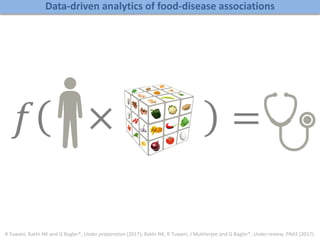
  • 155.
    Low flavour sharing Lowoccurrence of pairs High occurrence of pairs High flavour sharing Medium flavour sharing The Flavor Graph based on the Indian Cuisine
  • 156.
  • 157.
    Deciphering Recipe Networkof Indian Cuisine
  • 158.
    Cuisines: Traditional Recipes Adata and hypothesis oriented approach to food The Molecular Essence The quintessential molecular character Applications of the Discovery Food design, Apps, Leveraging food-as-medicine
  • 162.
    Levels of glucosein the blood are measured in terms of “Postprandial Glycemic Response (PPGR)”. Image Credits: HealthClinic
  • 164.
    Machine learning appliedto multidimensional data for personalized dietary recommendation ED Sonnenburg and JL Sonnenburg, Nature, 528, 484 (Dec 2015). Zeevi et al., “Personalized Nutrition by Prediction of Glycemic Responses”, Cell, 163, 1079-1094 (Nov 2015);
  • 166.
    Changes in diameter(Characteristic Path Length) of the network as a function of fraction of nodes removed. (a) Comparison between exponential (E) and scale-free (SF) network models. N = 10,000 and E = 20,000. Albert et al, “Error and attack tolerance of complex networks”, 406, Nature, 378-382 (2000).
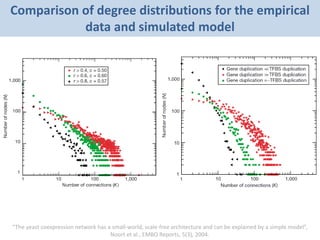
  • 167.
    Albert et al,“Error and attack tolerance of complex networks”, 406, Nature, 378-382 (2000). Changes in diameter (Characteristic Path Length) of the network as a function of fraction of nodes removed. (b) Internet, containing 6,209 nodes and 12,200 links. (c) World-Wide Web, containing 325,729 nodes and 1,498,353 links.
  • 168.
    • For eachmotif, the numbers of appearances in the real network (Nreal) and in the randomized networks (Nrand±SD) were computed. • The P value of all motifs is P<0.01, as determined by comparison to 1000 randomized networks. • Qualitative measure of statistical significance: 𝑍𝑠𝑐𝑜𝑟𝑒 = 𝑁 𝑟𝑒𝑎𝑙−𝑁 𝑟𝑎𝑛𝑑 𝑆𝐷 Network Motif Detection R. Milo et al., ‘Network Motifs: Simple Building Blocks of Complex Networks’, Science 298, 824 (2002).
  • 169.
    • Two ofthese motifs (feedforward loop and bi-fan) were found in both the transcriptional gene regulation networks as well as neuronal networks. • This similarity in motifs may point to a fundamental similarity in the design constraints of the two types of networks. • Both networks function to carry information from sensory components (sensory neurons/transcription factors regulated by biochemical signals) to effectors (motor neurons/structural genes). • The feedforward loop motif common to both types of networks may play a functional role in information processing. • One possible function of this circuit is to activate output only if the input signal is persistent and to allow a rapid deactivation when the input goes off. • Indeed, many of the input nodes in the neural feedforward loops are sensory neurons, which may require this type of information processing to reject transient input fluctuations that are inherent in a variable or noisy environment. Why common motifs? R. Milo et al., ‘Network Motifs: Simple Building Blocks of Complex Networks’, Science 298, 824 (2002).
  • 170.
  • 171.
    Barabasi et al,“Network Medicine: A network based approach to human disease”, Nature Reviews (2002)
  • 172.
    • Shared metabolicpathway hypothesis and the metabolic disease network: An enzymatic defect that affects the flux of one reaction can potentially affect the fluxes of all downstream reactions in the same pathway, leading to disease phenotypes that are normally associated with these downstream reactions. • For metabolic diseases, links that are induced by shared metabolic pathways are expected to be more relevant than are links based on shared genes. • Comorbidity: disease pairs that are linked in the MDN have a 1.8-fold increased comorbidity compared to disease pairs that are not linked metabolically. • Comorbidity is even more pronounced if the fluxes of the reactions that are catalysed by the respective disease genes are themselves coupled. Metabolic Disease Network (MDN) Barabasi et al, “Network Medicine: A network based approach to human disease”, Nature Reviews (2002)
  • 173.
    Barabasi et al,“Network Medicine: A network based approach to human disease”, Nature Reviews (2002) Metabolic Disease Network
  • 174.
  • 175.
    • The highlyinterconnected nature of the interactome implies that it is difficult to consider diseases as being consistently independent of one another at the molecular level. • Diseasome: The systematic mapping of such network-based dependencies between pathophenotypes and their disease modules. • Diseasome are disease maps whose nodes are diseases and whose links represent various molecular relationships between the disease-associated cellular components. • Study of diseasome can help is better understanding of how different phenotypes are linked at the molecular level and their comorbidity insights • This may yield new approaches to disease prevention, diagnosis and treatment. • Diseasome-based approaches could also aid drug discovery, specifically for repurposing of drugs (use of approved drugs to treat molecularly linked diseases). Human Diseasome Barabasi et al, “Network Medicine: A network based approach to human disease”, Nature Reviews (2002)
  • 176.
    • Shared genehypothesis and the human disease network: In the obtained human disease network (HDN) of Goh et al., 867 of 1,284 diseases with an associated gene are connected to at least one other disease, and 516 of them belong to a single disease cluster. • Comorbidity: a patient is twice as likely to develop a particular disease if that disease shares a gene with the patient’s primary disease. • But, many disease pairs that share genes do not show significant comorbidity. Human Diseasome Barabasi et al, “Network Medicine: A network based approach to human disease”, Nature Reviews (2002)
  • 177.
    Human Diseasome Barabasi etal, “Network Medicine: A network based approach to human disease”, Nature Reviews (2002)
  • 178.
  • 180.
    Network Models ofDiseases Molecular Interactomes • Protein interaction networks • Metabolic networks • Regulatory networks • RNA networks Phenotypic networks • Co-expression networks • Genetic networks Barabasi et al, “Network Medicine: A network based approach to human disease”, Nature Reviews (2002)
  • 181.
    • The highlyinterconnected nature of the interactome implies that it is difficult to consider diseases as being consistently independent of one another at the molecular level. • Diseasome: The systematic mapping of such network-based dependencies between pathophenotypes and their disease modules. • Diseasome are disease maps whose nodes are diseases and whose links represent various molecular relationships between the disease-associated cellular components. • Better understanding of how different phenotypes are linked at the molecular level and their comorbidity insights • New approaches to disease prevention, diagnosis and treatment. • Diseasome-based approaches could also aid drug discovery, specifically for repurposing of drugs (use of approved drugs to treat molecularly linked diseases). Human Diseasome Barabasi et al, “Network Medicine: A network based approach to human disease”, Nature Reviews (2002)
  • 182.
    Application of network-basedknowledge of disease • Network Pharmacology - Since cellular dysfunction is limited to the disease module, knowledge of the latter can reduce the search for therapeutic agents. - Identification and testing of potential new antibacterial agents. - Therapies that involve multiple targets may be more effective in reversing the disease phenotype than ‘single drugs’. - Drug target networks. • Disease classification using molecular correlates - Contemporary approaches to the classification of human disease are based on observational correlations between pathological analysis of the patient and existing knowledge of clinical syndromes Barabasi et al, “Network Medicine: A network based approach to human disease”, Nature Reviews (2002)
  • 183.
    Summary • Modeling biologicalentities as networked entities can provide valuable insights into their mechanisms. • Biological Networks: Protein Interactomes, Gene Regulatory Networks, Metabolic Networks, Brain Networks, Residue Interaction Graphs, Diseasomes… • Small-world networks • Scale-free networks • Robustness and vulnerability of scale-free networks • Centrality and lethality of hub proteins • Network Medicine: Medical applications of network modeling
  • 185.
    A simple modelfor co-expression networks
  • 186.
    Genetic Networks Gene Co-expressionNetworks • Association by virtue of co-expression • False positives Gene Regulatory Networks • Nodes: Transcription factors  Genes • Genes: Regulatory Genes and Target Genes
  • 187.
    Architecture of MolecularNetworks • Is the scale-free, small-world architecture direct product of selection and thus functionally meaningful, merely a by- product of the requirements of function and of selection at other levels, or even a natural consequence of mechanisms such as gene duplication. Previous models suggested to explain the architecture: • Selection on global properties such as robustness • Fast spread of perturbations • Phenomenological models (Duplication growth or hierarchical architecture) “The yeast coexpression network has a small-world, scale-free architecture and can be explained by a simple model”, Noort et al., EMBO Reports, 5(3), 2004.
  • 188.
    Yeast Coexpression Network •Although gene coexpression is a continuous observable, the underlying principle is discrete: the sharing of regulatory elements. • Compared to protein interaction networks or metabolic networks, coexpression covers a more inclusive array of functional relations between gene products. • Yeast Coexpression Network - 4077 genes and 65,430 coexpression relationships - Average Degree: 32 - Degree Exponent 𝛾 ≈ 1 - Average Clustering Coefficient = 0.6 - Characteristic Path Length = 4 “The yeast coexpression network has a small-world, scale-free architecture and can be explained by a simple model”, Noort et al., EMBO Reports, 5(3), 2004.
  • 189.
    4077 genes and65430 links; <k> =32; L=4; C=0.6 Yeast Coexpression Network “The yeast coexpression network has a small-world, scale-free architecture and can be explained by a simple model”, Noort et al., EMBO Reports, 5(3), 2004.
  • 190.
    Evolutionary model oftranscription regulation Gene: Transcription Factor Binding Sites & Coding Region “The yeast coexpression network has a small-world, scale-free architecture and can be explained by a simple model”, Noort et al., EMBO Reports, 5(3), 2004.
  • 191.
    Co-expression between paralogs With increasing sequence similarity between genes, the fraction of fractions of coexpressed paralogues increases.  The number of shared regulatory elements between paralogues increases with increasing protein identity. Existing network-evolution models cannot account for the combination of the architecture of the coexpression network and the correlation between coexpression and sequence similarity in paralogues.
  • 192.
    Evolutionary model oftranscription regulation (A) Initial pool of 25 genes, with random TFBSs. (B) Gene Duplication with no change in TFBS; Gene Deletion; TFBS Duplication; TFBS Deletion. (C) Construction of coexpression network by connecting genes that share TFBSs. “The yeast coexpression network has a small-world, scale-free architecture and can be explained by a simple model”, Noort et al., EMBO Reports, 5(3), 2004.
  • 193.
    Evolutionary model oftranscription regulation • The entities are genes that have a number of TFBSs. Connections between genes are established when they share a minimum number of TFBSs. • Gene Duplication: At every time step, each gene has a probability of being duplicated, resulting in a new gene. In this case, the TFBSs are passed on to the duplicate gene, corresponding to a high likelihood of coexpression between recently duplicated paralogues in the experimental data. • Gene Deletion: A gene may be deleted. • TFBS Duplication: A TFBS can be acquired from the pool of TFBSs of all genes. The probability of obtaining a specific TFBS is proportional to its frequency in the genome, introducing connections between nonparalogous genes. New TFBSs are introduced at a low frequency. • TFBS Deletion: All TFBSs have a probability of being deleted, giving rise to a decrease in connectivity between duplicates over time and balancing the number of TFBSs per gene. “The yeast coexpression network has a small-world, scale-free architecture and can be explained by a simple model”, Noort et al., EMBO Reports, 5(3), 2004.
  • 194.
    “The yeast coexpressionnetwork has a small-world, scale-free architecture and can be explained by a simple model”, Noort et al., EMBO Reports, 5(3), 2004.
  • 195.
    “The yeast coexpressionnetwork has a small-world, scale-free architecture and can be explained by a simple model”, Noort et al., EMBO Reports, 5(3), 2004.
  • 196.
    Degree distribution forthe simulated model “The yeast coexpression network has a small-world, scale-free architecture and can be explained by a simple model”, Noort et al., EMBO Reports, 5(3), 2004.
  • 197.
    Comparison of degreedistributions for the empirical data and simulated model “The yeast coexpression network has a small-world, scale-free architecture and can be explained by a simple model”, Noort et al., EMBO Reports, 5(3), 2004.