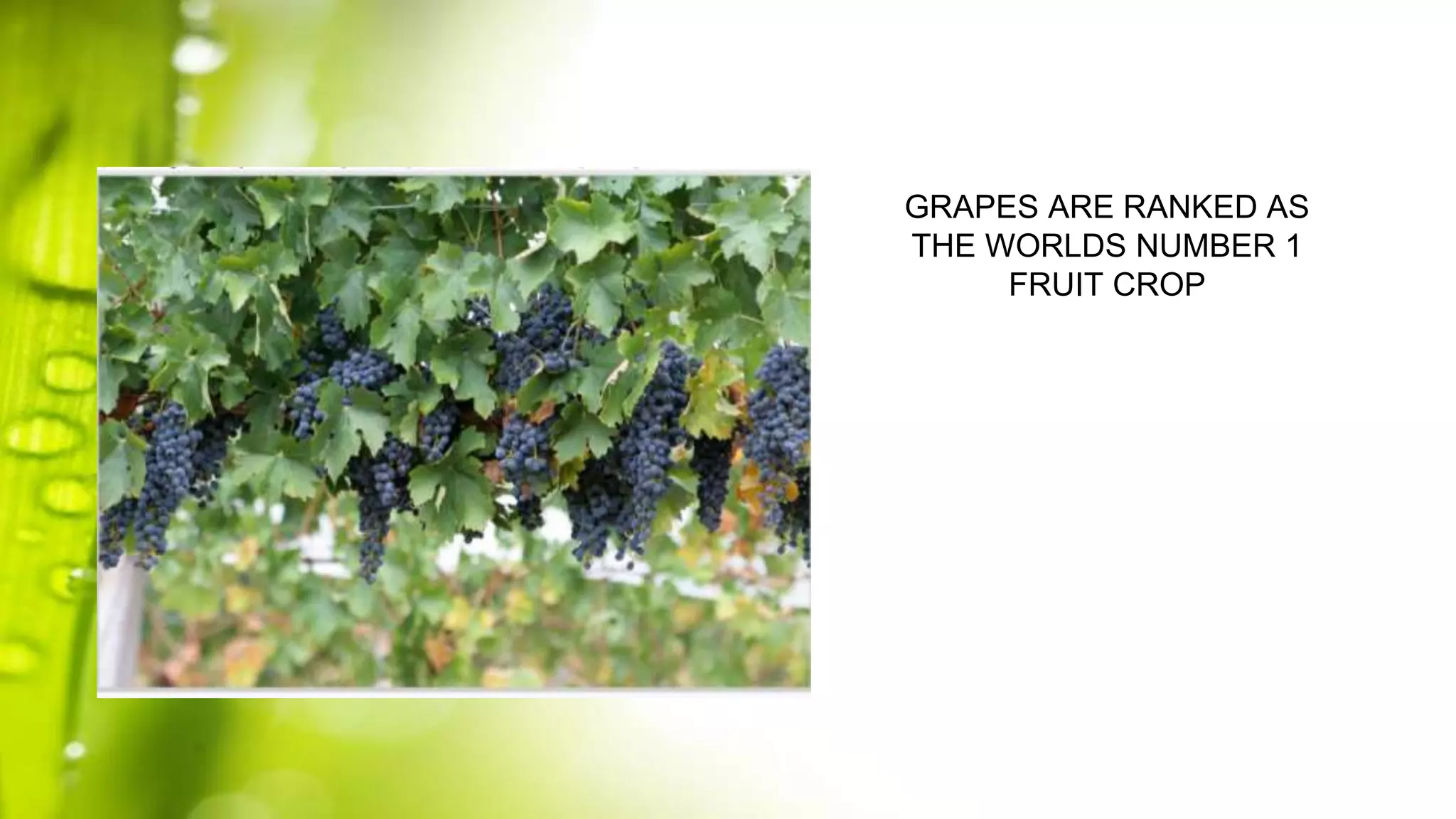

GRAPES ARE RANKED AS
THE WORLDS NUMBER 1
FRUIT CROP
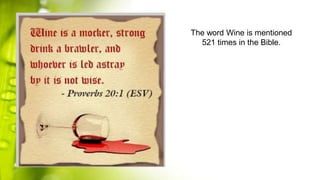
The word Wine is mentioned
521 times in the Bible.
Tom Cruise served 300
bottles of wine at his
wedding
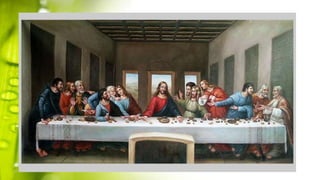
 The man who most profoundly affected the history of wine was
the prophet Mohammed. Within ten years of his death in A.D. 632,
wine was largely banned from Arabia and from every country that
heeded him.
WINE TECHNOLOGIES
Krishnaraj
2011-09-107
WINE
Wine is an alcoholic beverage obtained from the fermentation of
juice of freshly gathered grapes or other fruits.
Production of wine, starting with
selection of the grapes or other produce
and ending with bottling the finished wine
is called Winemaking or Vinification
 Although most wine is made from grapes, it may also be made
from other fruits or plants
 Mead is a wine that is made with honey being the primary
ingredient after water.
 Different varieties of grapes are present :
a) Vitis vinifera
b) Vitis labruska
c) Vitis rotundifolia
 The grapes are at their best when the soil is sandy, rocky and has lime in it.
 When the grapes are ripe, their natural acid decreases and their sugar
content increases.
 A black grape turns from green to dark red and white grapes turn from
green to yellow.
 Winemaking can be divided into two general categories: still wine
production (without carbonation) and sparkling wine production (with
carbonation — natural or injected).
 The science of wine and winemaking is known as oenology.
 A person who makes wine is traditionally called a winemaker or vintner
HISTORY
 Earliest wine production came from the sites of Georgia and Iran
in early 6000 to 5000 BC.
 Wine consumption became popularized from the 15th century
onwards, surpassing the devastating phylloxera louse of the 1870s.
PROCESS
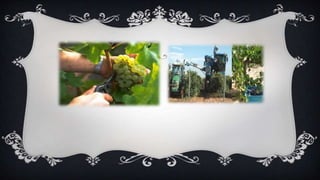
 MANUALLY- All the grapes are picked by the
hand. This is very time consuming and costly
method. But it is a traditional method. All the good
wines , the grapes are plucked by this method.
HARVESTING
 BY machine- it is very time saving & work is done very fast. big
Machine is used for this all the grapes are collected in big bucket
downward.
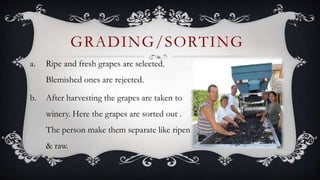
a. Ripe and fresh grapes are selected.
Blemished ones are rejected.
b. After harvesting the grapes are taken to
winery. Here the grapes are sorted out .
The person make them separate like ripen
& raw.
GRADING/SORTING
 Branches, leaves &unripe grapes. Then they give the grade to the
grapes like A grade means very good ,B grade means medium quality
grapes.
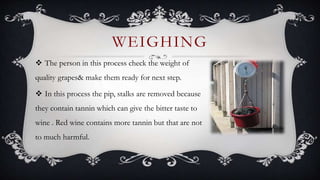
 The person in this process check the weight of
quality grapes& make them ready for next step.
 In this process the pip, stalks are removed because
they contain tannin which can give the bitter taste to
wine . Red wine contains more tannin but that are not
to much harmful.
WEIGHING
 The grapes are pressed or extracted the juice from the grapes. Crushed
material is called MUST. There are various methods of crushing the grapes.
They are:
1. Troddening
2. Balloon press
3. Plunger system
4. Electrically
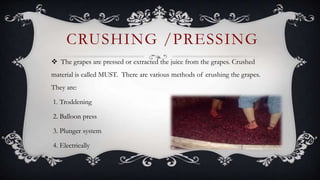
CRUSHING /PRESSING
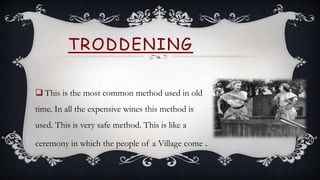
 This is the most common method used in old
time. In all the expensive wines this method is
used. This is very safe method. This is like a
ceremony in which the people of a Village come .
TRODDENING
BALOON PRESS
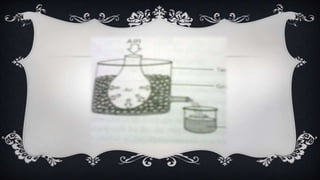
 In this method there is a big tank made of plastic or metal. We put
grapes in this tank & on upper side there is a balloon & we pump the
air by pressure.
 The balloon starts to increase in size but on the other hand this
pressure crush the grapes & juice is collected in bucket.
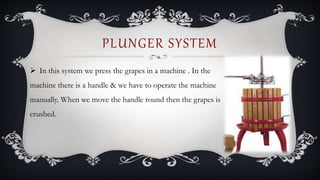
 In this system we press the grapes in a machine . In the
machine there is a handle & we have to operate the machine
manually. When we move the handle round then the grapes is
crushed.
PLUNGER SYSTEM
ELECTRICAL METHOD
 This is a process like roller with a plate fitted in a machine . The
grapes are crushed b/w the plate and roller . Seeds also crushed so
there are chances of tannins and bitter flavour.
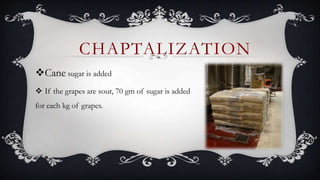
Cane sugar is added
 If the grapes are sour, 70 gm of sugar is added
for each kg of grapes.
CHAPTALIZATION
Adjustment Of pH
• If necessary then pH of juice is adjusted.
• If it is too low then juice is diluted with water
• If high then tartaric acid is added to lower it.(usually 0.6 to 0.8 % of
acid is added.
 Potassium metabisulphite (KMS) is added at the rate of 1.5 g for every 10
kg of grapes, mixed and allow to stand for 2-4 hrs.
 KMS inhibits growth of wild yeasts and spoilage organisms.
ADDITION OF PRESERVATIVE
Addition Of Wine Yeast
• Wine yeast eg. Saccharomyces ellipsoideus inoculum is added at the rate of 20 ml for
5 kg of grapes.
• If yeast is not used then KMS is not added.
• Yeast present in the skin of grapes can also ferment but the wine produced is
not of good quality.
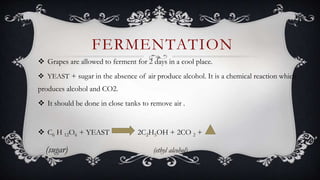
 Grapes are allowed to ferment for 2 days in a cool place.
 YEAST + sugar in the absence of air produce alcohol. It is a chemical reaction which
produces alcohol and CO2.
 It should be done in close tanks to remove air .
 C6 H 12O6 + YEAST 2C2H5OH + 2CO 2 +
(sugar) (ethyl alcohol)
FERMENTATION
 Sulfur dioxide (SO2) is added in the juice to remove the CO2 .
This process is called sulphurlization.
 The fermentation should be slow .
 It gives flavor to wine. We remove the CO2 after the
fermentation.
SULPHURLIZATION
 The contents are filtered through a muslin cloth or a filter aid on the
third day.
 Filterate is again allowed to ferment in a cool place for another 10
days.
FILTRATION
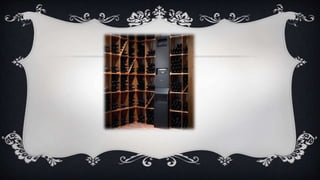
RACKING
 After the fermentation there are dead yeast in the wine it is called
LEES. It is yeast + skin. We remove the wine & transfer the wine in
oak barrels. Oak wood have a tendency to soak the acidity, lees settle
in the base.
 Then it is also transferred to other barrels
 It is done in order to remove all suspended particles in the wines. This can be
done by following methods:
 Betonite is added. All the colloidal material settles along with it.
 Blue icing glass.It is used only after the permission of govt. They attract the
particles in the wine which is settled at the bottom.
 Filtered if necessary.
FINING
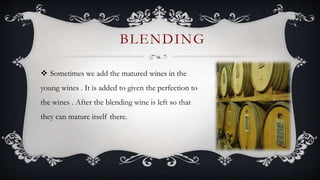
 Sometimes we add the matured wines in the
young wines . It is added to given the perfection to
the wines . After the blending wine is left so that
they can mature itself there.
BLENDING
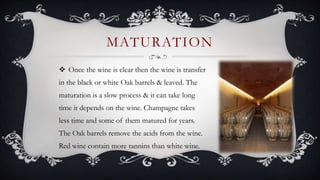
 Once the wine is clear then the wine is transfer
in the black or white Oak barrels & leaved. The
maturation is a slow process & it can take long
time it depends on the wine. Champagne takes
less time and some of them matured for years.
The Oak barrels remove the acids from the wine.
Red wine contain more tannins than white wine.
MATURATION
 In this process we kill the bacteria in the wine which are harmful for the body.
First the bottle is passed through boiling water, so due to heat all the harmful
bacteria is removed and suddenly the bottle is pass through from chilled water so all
the bacteria are killed.
 82-88 degree celsius for 1-2 min.
 Bottles are pasteurized at 65 degree celcius for about 20 min, then cooled and
stored.
PASTEURIZATION
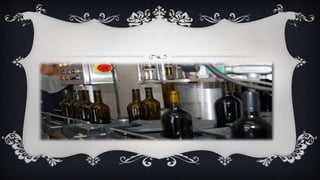
 After the maturation the wine is ready to consume then it is bottled . The
wines are matured in the bottles also. Then it is covered with cork. It is made by
OAK WOOD BARK . It is soft in nature. The size of bottle depends on the
countries. Then it is stored in coo,l place.
BOTTLING AND STORAGE
TYPES OF WINES
.
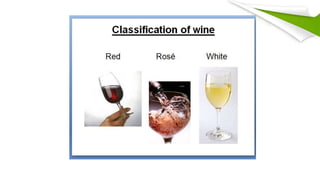
Red Wine:
•Consumed more than white wines.
•Unlike white wines , reds do not have varied degrees of sweetness. They are
almost exclusive dry.
•To produce red wine, grapes are crushed.
•Skin is left with the juice during fermentation
•Contain 9-14% alcohol, and the taste ranges from very dry to very sweet.
•The service temperature of red wine is 16-18 degrees centigrade
Rose wines
-These are produced exactly as red wines except that wine is
drawn off from the fermenting red grapes after 2-3 days
when enough red colour has been absorbed by the wine to
give it a pink tinge.
-They contain 9-14 % alcohol, and the taste ranges from
very dry to very sweet.
-The service temperature of rose wine is 13 – 16 degrees
centigrade.
White Wine
• Light and delicate in flavour.
•The grapes are pressed and the juice is drawn off immediately without
the skin.
•Sweet white wines: The sugar content is very high, hence are preferred at
the end of a meal.
•They contain 9-14 % alcohol, and the taste ranges from very dry to very
sweet.
•The service temperature of white wine is 11 – 13 degrees centigrade.
Sparkling wine
The most famous one is Champagne.
Sparkling wines are made in France, Spain, Italy, America, Australia
and many other countries.
It contains carbon dioxide.
They are made effervescent by secondary fermentation in closed
containers.
Still wine
 Do not contain carbon dioxide.
THANK YOU
 “We are all mortal until the first kiss and the second glass of wine.”
- Eduardo Galeano

Wine technologies

  • 1.
    GRAPES ARE RANKEDAS THE WORLDS NUMBER 1 FRUIT CROP
  • 3.
    The word Wineis mentioned 521 times in the Bible.
  • 4.
    Tom Cruise served300 bottles of wine at his wedding
  • 5.
     The manwho most profoundly affected the history of wine was the prophet Mohammed. Within ten years of his death in A.D. 632, wine was largely banned from Arabia and from every country that heeded him.
  • 6.
  • 7.
    WINE Wine is analcoholic beverage obtained from the fermentation of juice of freshly gathered grapes or other fruits.
  • 8.
    Production of wine,starting with selection of the grapes or other produce and ending with bottling the finished wine is called Winemaking or Vinification
  • 9.
     Although mostwine is made from grapes, it may also be made from other fruits or plants  Mead is a wine that is made with honey being the primary ingredient after water.
  • 10.
     Different varietiesof grapes are present : a) Vitis vinifera b) Vitis labruska c) Vitis rotundifolia
  • 11.
     The grapesare at their best when the soil is sandy, rocky and has lime in it.  When the grapes are ripe, their natural acid decreases and their sugar content increases.  A black grape turns from green to dark red and white grapes turn from green to yellow.
  • 12.
     Winemaking canbe divided into two general categories: still wine production (without carbonation) and sparkling wine production (with carbonation — natural or injected).  The science of wine and winemaking is known as oenology.  A person who makes wine is traditionally called a winemaker or vintner
  • 13.
    HISTORY  Earliest wineproduction came from the sites of Georgia and Iran in early 6000 to 5000 BC.  Wine consumption became popularized from the 15th century onwards, surpassing the devastating phylloxera louse of the 1870s.
  • 14.
  • 15.
     MANUALLY- Allthe grapes are picked by the hand. This is very time consuming and costly method. But it is a traditional method. All the good wines , the grapes are plucked by this method. HARVESTING
  • 16.
     BY machine-it is very time saving & work is done very fast. big Machine is used for this all the grapes are collected in big bucket downward.
  • 18.
    a. Ripe andfresh grapes are selected. Blemished ones are rejected. b. After harvesting the grapes are taken to winery. Here the grapes are sorted out . The person make them separate like ripen & raw. GRADING/SORTING
  • 19.
     Branches, leaves&unripe grapes. Then they give the grade to the grapes like A grade means very good ,B grade means medium quality grapes.
  • 20.
     The personin this process check the weight of quality grapes& make them ready for next step.  In this process the pip, stalks are removed because they contain tannin which can give the bitter taste to wine . Red wine contains more tannin but that are not to much harmful. WEIGHING
  • 21.
     The grapesare pressed or extracted the juice from the grapes. Crushed material is called MUST. There are various methods of crushing the grapes. They are: 1. Troddening 2. Balloon press 3. Plunger system 4. Electrically CRUSHING /PRESSING
  • 22.
     This isthe most common method used in old time. In all the expensive wines this method is used. This is very safe method. This is like a ceremony in which the people of a Village come . TRODDENING
  • 23.
    BALOON PRESS  Inthis method there is a big tank made of plastic or metal. We put grapes in this tank & on upper side there is a balloon & we pump the air by pressure.  The balloon starts to increase in size but on the other hand this pressure crush the grapes & juice is collected in bucket.
  • 25.
     In thissystem we press the grapes in a machine . In the machine there is a handle & we have to operate the machine manually. When we move the handle round then the grapes is crushed. PLUNGER SYSTEM
  • 26.
    ELECTRICAL METHOD  Thisis a process like roller with a plate fitted in a machine . The grapes are crushed b/w the plate and roller . Seeds also crushed so there are chances of tannins and bitter flavour.
  • 27.
    Cane sugar isadded  If the grapes are sour, 70 gm of sugar is added for each kg of grapes. CHAPTALIZATION
  • 28.
    Adjustment Of pH •If necessary then pH of juice is adjusted. • If it is too low then juice is diluted with water • If high then tartaric acid is added to lower it.(usually 0.6 to 0.8 % of acid is added.
  • 29.
     Potassium metabisulphite(KMS) is added at the rate of 1.5 g for every 10 kg of grapes, mixed and allow to stand for 2-4 hrs.  KMS inhibits growth of wild yeasts and spoilage organisms. ADDITION OF PRESERVATIVE
  • 30.
    Addition Of WineYeast • Wine yeast eg. Saccharomyces ellipsoideus inoculum is added at the rate of 20 ml for 5 kg of grapes. • If yeast is not used then KMS is not added. • Yeast present in the skin of grapes can also ferment but the wine produced is not of good quality.
  • 31.
     Grapes areallowed to ferment for 2 days in a cool place.  YEAST + sugar in the absence of air produce alcohol. It is a chemical reaction which produces alcohol and CO2.  It should be done in close tanks to remove air .  C6 H 12O6 + YEAST 2C2H5OH + 2CO 2 + (sugar) (ethyl alcohol) FERMENTATION
  • 32.
     Sulfur dioxide(SO2) is added in the juice to remove the CO2 . This process is called sulphurlization.  The fermentation should be slow .  It gives flavor to wine. We remove the CO2 after the fermentation. SULPHURLIZATION
  • 33.
     The contentsare filtered through a muslin cloth or a filter aid on the third day.  Filterate is again allowed to ferment in a cool place for another 10 days. FILTRATION
  • 34.
    RACKING  After thefermentation there are dead yeast in the wine it is called LEES. It is yeast + skin. We remove the wine & transfer the wine in oak barrels. Oak wood have a tendency to soak the acidity, lees settle in the base.  Then it is also transferred to other barrels
  • 36.
     It isdone in order to remove all suspended particles in the wines. This can be done by following methods:  Betonite is added. All the colloidal material settles along with it.  Blue icing glass.It is used only after the permission of govt. They attract the particles in the wine which is settled at the bottom.  Filtered if necessary. FINING
  • 37.
     Sometimes weadd the matured wines in the young wines . It is added to given the perfection to the wines . After the blending wine is left so that they can mature itself there. BLENDING
  • 38.
     Once thewine is clear then the wine is transfer in the black or white Oak barrels & leaved. The maturation is a slow process & it can take long time it depends on the wine. Champagne takes less time and some of them matured for years. The Oak barrels remove the acids from the wine. Red wine contain more tannins than white wine. MATURATION
  • 39.
     In thisprocess we kill the bacteria in the wine which are harmful for the body. First the bottle is passed through boiling water, so due to heat all the harmful bacteria is removed and suddenly the bottle is pass through from chilled water so all the bacteria are killed.  82-88 degree celsius for 1-2 min.  Bottles are pasteurized at 65 degree celcius for about 20 min, then cooled and stored. PASTEURIZATION
  • 40.
     After thematuration the wine is ready to consume then it is bottled . The wines are matured in the bottles also. Then it is covered with cork. It is made by OAK WOOD BARK . It is soft in nature. The size of bottle depends on the countries. Then it is stored in coo,l place. BOTTLING AND STORAGE
  • 42.
  • 43.
    . Red Wine: •Consumed morethan white wines. •Unlike white wines , reds do not have varied degrees of sweetness. They are almost exclusive dry. •To produce red wine, grapes are crushed. •Skin is left with the juice during fermentation •Contain 9-14% alcohol, and the taste ranges from very dry to very sweet. •The service temperature of red wine is 16-18 degrees centigrade
  • 44.
    Rose wines -These areproduced exactly as red wines except that wine is drawn off from the fermenting red grapes after 2-3 days when enough red colour has been absorbed by the wine to give it a pink tinge. -They contain 9-14 % alcohol, and the taste ranges from very dry to very sweet. -The service temperature of rose wine is 13 – 16 degrees centigrade.
  • 45.
    White Wine • Lightand delicate in flavour. •The grapes are pressed and the juice is drawn off immediately without the skin. •Sweet white wines: The sugar content is very high, hence are preferred at the end of a meal. •They contain 9-14 % alcohol, and the taste ranges from very dry to very sweet. •The service temperature of white wine is 11 – 13 degrees centigrade.
  • 47.
    Sparkling wine The mostfamous one is Champagne. Sparkling wines are made in France, Spain, Italy, America, Australia and many other countries. It contains carbon dioxide. They are made effervescent by secondary fermentation in closed containers.
  • 48.
    Still wine  Donot contain carbon dioxide.
  • 50.
    THANK YOU  “Weare all mortal until the first kiss and the second glass of wine.” - Eduardo Galeano