The HALO Network
IntroductionThe markets of broadband, wireless, and multimedia network services are growing rapidly. The challenges areQuality infrastructure that can be deployed quickly and economically. IntroductionThe markets of broadband, wireless, and multimedia network services are growing rapidly. The challenges areQuality infrastructure that can be deployed quickly and economically.
Services must be delivered to businesses and consumers, the end users of the network, at affordable prices.IntroductionThe markets of broadband, wireless, and multimedia network services are growing rapidly. The challenges areQuality infrastructure that can be deployed quickly and economically.
Services must be delivered to businesses and consumers, the end users of the network, at affordable prices.
The information bandwidth must be capable to respond dynamically to the needs of the end user.The HALO NetworkIt stands for High Altitude Long Operation NetworkTM.The HALO NetworkIt stands for High Altitude Long Operation NetworkTM.
It is a broadband wireless  metropolitan area network with a star  topology.The HALO NetworkIt stands for High Altitude Long Operation NetworkTM.
It is a broadband wireless  metropolitan area network with a star  topology.
The solitary hub is located in a HALO aircraft  also known as the High Altitude Aeronautical Platform Station(HAAPS) operating at an altitude higher than commercial airline traffic and adverse weather.The HALO NetworkIt stands for High Altitude Long Operation NetworkTM.
It is a broadband wireless  metropolitan area network with a star  topology.
The solitary hub is located in a HALO aircraft  also known as the High Altitude Aeronautical Platform Station(HAAPS) operating at an altitude higher than commercial airline traffic and adverse weather.
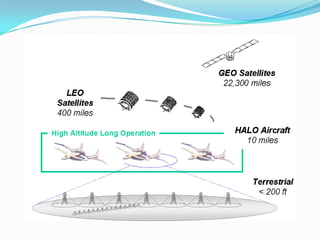
It is located at an altitude miles above terrestrial wireless, but hundreds to thousands of miles below satellite networks.
Architecture
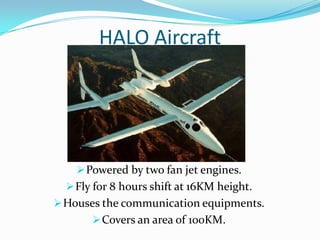
HALO AircraftPowered by two fan jet engines.
Fly for 8 hours shift at 16KM height.
Houses the communication equipments.
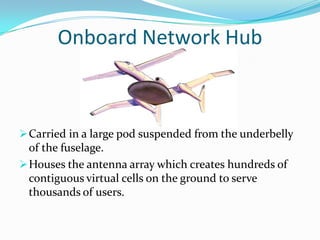
Covers an area of 100KM.Onboard Network HubCarried in a large pod suspended from the underbelly of the fuselage.
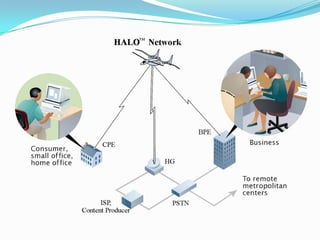
Houses the antenna array which creates hundreds of contiguous virtual cells on the ground to serve thousands of users.Subscriber TerminalsBroadband facilities are provided through Customer Premise Equipment(CPE) to home and small offices.Business Premise Equipment(BPE) for  business purposes.It can also be connected with non-HALO networks like ATM networks, ISPs, etc.
Advantages
Rapid BuildoutA HALO Network can be put into operation within weeks. Upon network activation, it provides service to the full super metropolitan area.
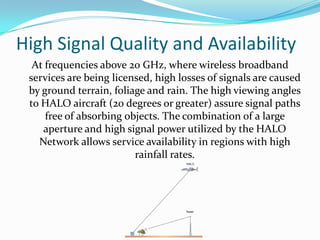
High Signal Quality and AvailabilityAt frequencies above 20 GHz, where wireless broadband services are being licensed, high losses of signals are caused by ground terrain, foliage and rain. The high viewing angles to HALO aircraft (20 degrees or greater) assure signal paths free of absorbing objects. The combination of a large aperture and high signal power utilized by the HALO Network allows service availability in regions with high rainfall rates.
High BandwidthThe initial capacity of the network will be on the scale of 10 Gb/s, with growth beyond 100 Gb/s. This enables services including but not limited to T1 access, ISDN access, Web browsing, high-resolution videoconferencing, large file transfers, offsite training and Ethernet LAN bridging.
Low CostNegligible ground infrastructure, coupled with a large footprint and multi-megabit-per-second data rates make it extremely competitive on a $/bit/square mile basis.
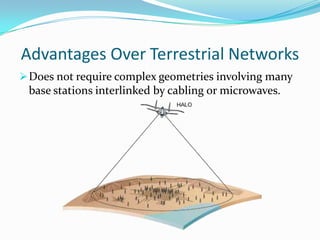
Advantages Over Terrestrial NetworksDoes not require complex geometries involving many base stations interlinked by cabling or microwaves.Unlike terrestrial networks, reengineering of the entire satellite network may not be required to increase the system capacity.Unlike terrestrial networks, reengineering of the entire satellite network may not be required to increase the system capacity.
High look angle preventing signal fading.Advantages Over Satellite NetworksSatellite networks require more expensive terminals with high power to achieve the same data rates possible through the HALO Network.Advantages Over Satellite NetworksSatellite networks require more expensive terminals with high power to achieve the same data rates possible through the HALO Network.
The capacity of a satellite network can be increased only by adding more satellites, which is very expensive.Advantages Over Satellite NetworksSatellite networks require more expensive terminals with high power to achieve the same data rates possible through the HALO Network.
The capacity of a satellite network can be increased only by adding more satellites, which is very expensive.
Unlike satellite systems, which are  multi-billion dollar investments, the HALO Network can be financed one market at a time, which makes it more suitable  for developing countries.The HALO aircraft is 10 to 1,000 times closer to the user than a satellite, with 10 times the available electrical power. Consequently, the HALO Network can allocate significant capacity directly to densely populated regions.The HALO aircraft is 10 to 1,000 times closer to the user than a satellite, with 10 times the available electrical power. Consequently, the HALO Network can allocate significant capacity directly to densely populated regions.
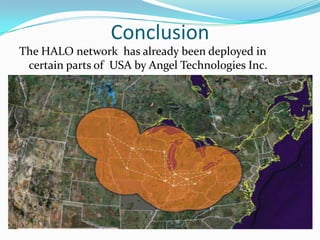
The central node, can be routinely serviced for optimal performance, and be steadily enhanced with emerging technologies.ConclusionThe HALO network  has already been deployed in certain parts of  USA by Angel Technologies Inc.

The Halo Network

  • 1.
  • 2.
    IntroductionThe markets ofbroadband, wireless, and multimedia network services are growing rapidly. The challenges areQuality infrastructure that can be deployed quickly and economically. IntroductionThe markets of broadband, wireless, and multimedia network services are growing rapidly. The challenges areQuality infrastructure that can be deployed quickly and economically.
  • 3.
    Services must bedelivered to businesses and consumers, the end users of the network, at affordable prices.IntroductionThe markets of broadband, wireless, and multimedia network services are growing rapidly. The challenges areQuality infrastructure that can be deployed quickly and economically.
  • 4.
    Services must bedelivered to businesses and consumers, the end users of the network, at affordable prices.
  • 5.
    The information bandwidthmust be capable to respond dynamically to the needs of the end user.The HALO NetworkIt stands for High Altitude Long Operation NetworkTM.The HALO NetworkIt stands for High Altitude Long Operation NetworkTM.
  • 6.
    It is abroadband wireless metropolitan area network with a star topology.The HALO NetworkIt stands for High Altitude Long Operation NetworkTM.
  • 7.
    It is abroadband wireless metropolitan area network with a star topology.
  • 8.
    The solitary hubis located in a HALO aircraft also known as the High Altitude Aeronautical Platform Station(HAAPS) operating at an altitude higher than commercial airline traffic and adverse weather.The HALO NetworkIt stands for High Altitude Long Operation NetworkTM.
  • 9.
    It is abroadband wireless metropolitan area network with a star topology.
  • 10.
    The solitary hubis located in a HALO aircraft also known as the High Altitude Aeronautical Platform Station(HAAPS) operating at an altitude higher than commercial airline traffic and adverse weather.
  • 11.
    It is locatedat an altitude miles above terrestrial wireless, but hundreds to thousands of miles below satellite networks.
  • 12.
  • 13.
    HALO AircraftPowered bytwo fan jet engines.
  • 14.
    Fly for 8hours shift at 16KM height.
  • 15.
  • 16.
    Covers an areaof 100KM.Onboard Network HubCarried in a large pod suspended from the underbelly of the fuselage.
  • 17.
    Houses the antennaarray which creates hundreds of contiguous virtual cells on the ground to serve thousands of users.Subscriber TerminalsBroadband facilities are provided through Customer Premise Equipment(CPE) to home and small offices.Business Premise Equipment(BPE) for business purposes.It can also be connected with non-HALO networks like ATM networks, ISPs, etc.
  • 18.
  • 19.
    Rapid BuildoutA HALONetwork can be put into operation within weeks. Upon network activation, it provides service to the full super metropolitan area.
  • 20.
    High Signal Qualityand AvailabilityAt frequencies above 20 GHz, where wireless broadband services are being licensed, high losses of signals are caused by ground terrain, foliage and rain. The high viewing angles to HALO aircraft (20 degrees or greater) assure signal paths free of absorbing objects. The combination of a large aperture and high signal power utilized by the HALO Network allows service availability in regions with high rainfall rates.
  • 21.
    High BandwidthThe initialcapacity of the network will be on the scale of 10 Gb/s, with growth beyond 100 Gb/s. This enables services including but not limited to T1 access, ISDN access, Web browsing, high-resolution videoconferencing, large file transfers, offsite training and Ethernet LAN bridging.
  • 22.
    Low CostNegligible groundinfrastructure, coupled with a large footprint and multi-megabit-per-second data rates make it extremely competitive on a $/bit/square mile basis.
  • 23.
    Advantages Over TerrestrialNetworksDoes not require complex geometries involving many base stations interlinked by cabling or microwaves.Unlike terrestrial networks, reengineering of the entire satellite network may not be required to increase the system capacity.Unlike terrestrial networks, reengineering of the entire satellite network may not be required to increase the system capacity.
  • 24.
    High look anglepreventing signal fading.Advantages Over Satellite NetworksSatellite networks require more expensive terminals with high power to achieve the same data rates possible through the HALO Network.Advantages Over Satellite NetworksSatellite networks require more expensive terminals with high power to achieve the same data rates possible through the HALO Network.
  • 25.
    The capacity ofa satellite network can be increased only by adding more satellites, which is very expensive.Advantages Over Satellite NetworksSatellite networks require more expensive terminals with high power to achieve the same data rates possible through the HALO Network.
  • 26.
    The capacity ofa satellite network can be increased only by adding more satellites, which is very expensive.
  • 27.
    Unlike satellite systems,which are multi-billion dollar investments, the HALO Network can be financed one market at a time, which makes it more suitable for developing countries.The HALO aircraft is 10 to 1,000 times closer to the user than a satellite, with 10 times the available electrical power. Consequently, the HALO Network can allocate significant capacity directly to densely populated regions.The HALO aircraft is 10 to 1,000 times closer to the user than a satellite, with 10 times the available electrical power. Consequently, the HALO Network can allocate significant capacity directly to densely populated regions.
  • 28.
    The central node,can be routinely serviced for optimal performance, and be steadily enhanced with emerging technologies.ConclusionThe HALO network has already been deployed in certain parts of USA by Angel Technologies Inc.