International Journal of Trend in Scientific Research and Development (IJTSRD)
Volume 3 Issue 5, August 2019 Available Online: www.ijtsrd.com e-ISSN: 2456 – 6470
@ IJTSRD | Unique Paper ID – IJTSRD26570 | Volume – 3 | Issue – 5 | July - August 2019 Page 1013
Study on Infrastructure Developments of Mobile Generations
Aye Myat Myat Myo1, Zar Chi Soe2
1Lecturer, Department of Electronic Engineering, Pyay Technological University, Pyay, Myanmar
2Lecturer, Department of Electronic Engineering, Technological University, Hinthata, Myanmar
How to cite this paper: Aye Myat Myat
Myo | Zar Chi Soe "Study onInfrastructure
Developments of Mobile Generations"
Published in
International
Journal of Trend in
Scientific Research
and Development
(ijtsrd), ISSN: 2456-
6470, Volume-3 |
Issue-5, August
2019, pp.1013-1018,
https://doi.org/10.31142/ijtsrd26570
Copyright © 2019 by author(s) and
International Journalof Trendin Scientific
Research and Development Journal. This
is an Open Access article distributed
under the terms of
the Creative
CommonsAttribution
License (CC BY 4.0)
(http://creativecommons.org/licenses/by
/4.0)
ABSTRACT
Nowadays, as Mobile communicationsystems havebeendevelopinginvarious
ways, people can get better communications and mobility. A long way in a
remarkably short time has been achieved in the history of wireless. The first
generation (1G) has fulfilled the basic mobile voice while the second
generation (2G) has introduced capacity and coverage. This is followed by the
third generation (3G), which has requested data at higher speeds to open the
gates for truly “mobile broadband” experience. Furthermore, the fourth
generation will be realized as the nextgeneration. 4Gprovidesaccesstoawide
range of telecommunication services, including advanced mobile services,
supported by mobile and fixed networks, which areincreasinglypacket-based.
This paper explains about therequiredcomponentsof infrastructureinmobile
generations (from 1G to 4G) and also describes the performance of each
portion in evolutions of 1G to 4G infrastructure.And then, peoplecan studythe
introduction of the infrastructure requirements of 5G network technology.
KEYWORDS: 1G, 2G, 3G, 4G, infrastructure, evolution
I. INTRODUCTION
The first generation (1G) mobile wireless communication network was analog
used for voice calls only. The second-generation (2G) isadigitaltechnology and
supports text messaging. The generation (3G) mobile technology provided
higher data transmission rate, increased capacity and provide multimedia
support.
The fourth-generation (4G) integrates 3G withfixedinternet
to support wireless mobile internet.Inthispaper,peoplecan
look at the infrastructure and components that underpin
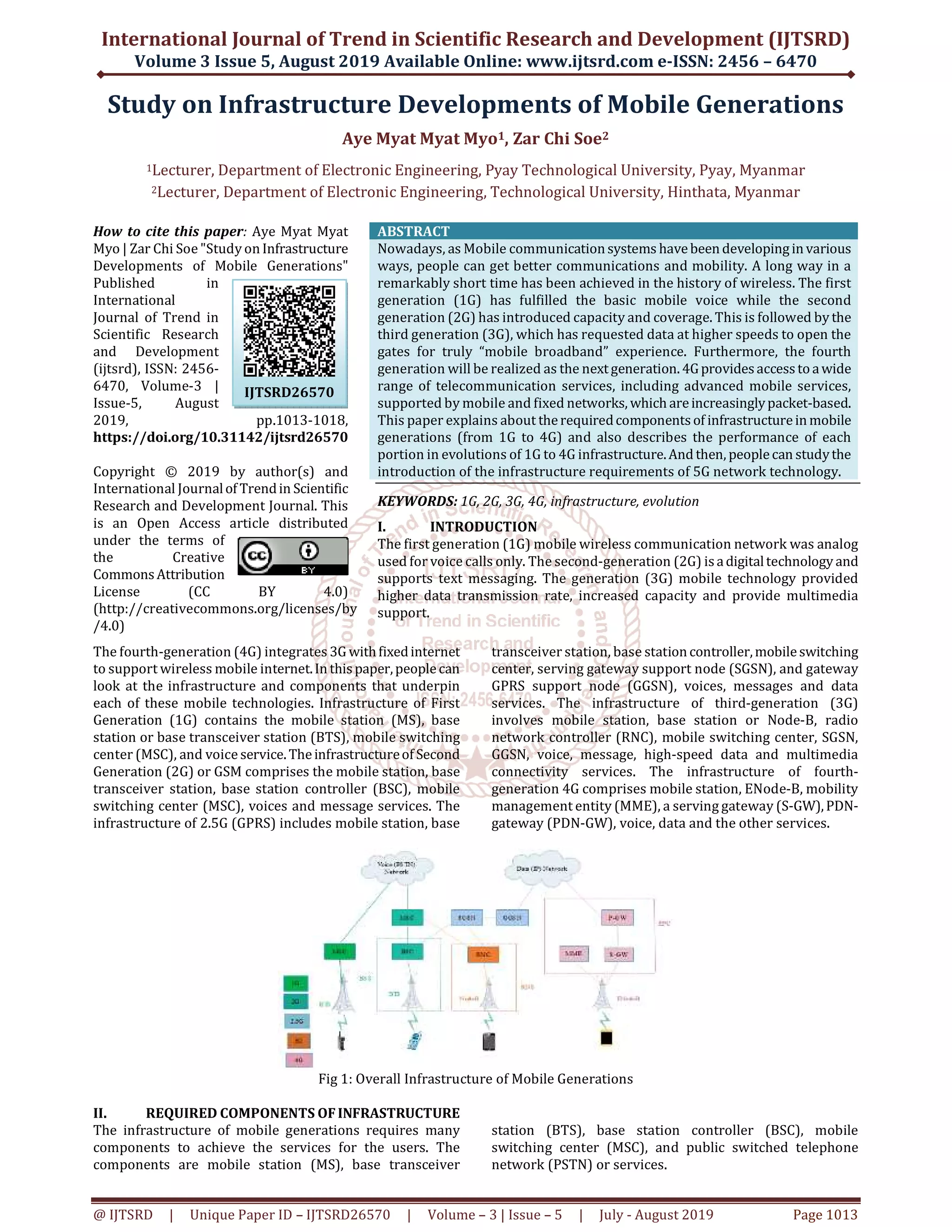
each of these mobile technologies. Infrastructure of First
Generation (1G) contains the mobile station (MS), base
station or base transceiver station (BTS), mobile switching
center (MSC), and voice service. Theinfrastructureof Second
Generation (2G) or GSM comprises the mobile station, base
transceiver station, base station controller (BSC), mobile
switching center (MSC), voices and message services. The
infrastructure of 2.5G (GPRS) includes mobile station, base
transceiver station, base stationcontroller,mobileswitching
center, serving gateway support node (SGSN), and gateway
GPRS support node (GGSN), voices, messages and data
services. The infrastructure of third-generation (3G)
involves mobile station, base station or Node-B, radio
network controller (RNC), mobile switching center, SGSN,
GGSN, voice, message, high-speed data and multimedia
connectivity services. The infrastructure of fourth-
generation 4G comprises mobile station, ENode-B, mobility
management entity (MME), a serving gateway (S-GW),PDN-
gateway (PDN-GW), voice, data and the other services.
Fig 1: Overall Infrastructure of Mobile Generations
II. REQUIRED COMPONENTS OFINFRASTRUCTURE
The infrastructure of mobile generations requires many
components to achieve the services for the users. The
components are mobile station (MS), base transceiver
station (BTS), base station controller (BSC), mobile
switching center (MSC), and public switched telephone
network (PSTN) or services.
IJTSRD26570
International Journal of Trend in Scientific Research and Development (IJTSRD) @ www.ijtsrd.com eISSN: 2456-6470
@ IJTSRD | Unique Paper ID – IJTSRD26570 | Volume – 3 | Issue – 5 | July - August 2019 Page 1014
A. Mobile Station (MS)
A mobile station (MS) comprises all user equipment and
software needed for communication with a mobile network.
This means that a mobile phone or mobile computer
connected using a mobile broadband adapter. A mobile
station includes mobile equipment (ME) and a subscriber
identity module (SIM). Mobile Equipment is identified by an
IMEI (international mobile equipment identity). The ME
forms part of the mobile termination (MT) which depending
on the application and services, may also include various
types of terminal equipment (TE) and associated terminal
adapter (TA). SIM is used to support roaming. SIM contains
the International Mobile Subscriber Identity (IMSI). The
functions of the mobile station are a voice and data
transmission, frequency and time synchronization,
monitoring of power and signal quality of the surrounding
cells, and provision of location updates even during inactive
state [1].
B. Base Transceiver Station (BTS)
A base transceiver station (BTS) is equipmentthat facilitates
wirelesscommunicationbetweenuser equipment(UE) and a
network. BTS can be applicable to any of the wireless
communication standards; it is generally associated with
mobile communication technologies like GSM, and CDMA.
Antennas may also be considered as components of BTS in
general sense as they facilitate the functioning of BTS.
C. Base Station Controller (BSC)
A base station controller (BSC) is a critical mobile network
component that controls one or more base transceiver
stations (BTS), also known as a base station or cell sites. Key
functions of BSC include radio network management (such
as radiofrequency control), BTS handover management and
call setup [2].
D. Mobile Switching Center (MSC)
A mobile switching center (MSC) is the centerpiece of a
network switching subsystem (NSS). The MSC is mostly
associated with communications switchingfunctions,suchas
call set-up, release, and routing. However, it also performs a
host of other duties, including routing SMS messages,
conference calls, fax, and service billing, as well as
interfacing with other networks,such asthepublic,switched
the public switched telephone network (PSTN).
The MSC works with a large database known as the home
location register (HLR), which stores relevant location and
other information for each mobile phone. Because accessing
the HLR uses many network resources, most operators
employ visitor location registers(VLRs).These arerelatively
smaller databases, which are integrated with the MSC [2].
The parts of services contain the PSTN (public switched
telephone network) and PDN (public data network) or IP
(internet protocol).
III. DEVELOPMENTS OF MOBILE NETWORK
INFRASTRUCTURE
With the rapid development of wireless communication
networks, mobile operators need to build entirely new
networks and license entirely new frequencies. Mobile
operators use many technologies to deliver higher-speed
data services.
A. First Generation Technology (1G)
Those circuit-switched systems were based on analog
transmission techniques and were designed to carry low-
quality voice traffic. First-generation of wireless
telecommunication technology consistsofvariousstandards
among which most popular were Advance Mobile Phone
Service (AMPS), Nordic Mobile Telephone (NMT), and Total
Access Communication System (TACS). All of the standards
in 1G use frequency modulation techniques for voice signals
and all the handover decisions were taken at the Base
Stations [3][4].
Mobile first-generation infrastructure is described in Fig 2.
In that infrastructure includes many components such as
mobile station (MS), base transceiver station (BTS), mobile
switching center (MSC), and the public switched telephone
network (PSTN).PSTN also is known as the plain old
telephone system (POTS) is basically the inter-connected
telephone system over which telephone calls are made via
copper wires. The PSTN is based on the principle of circuit
switching. Therefore, when a call is made a particular
dedicated circuit activates which eventually deactivates
when the call ends. Telephone calls transmit as analog
signals across copper wires [1].
Fig 2: First Generation (1G) Infrastructure
B. Second Generation Technology (2G) or GSM
Second Generation technology was introduced in the early
1990s. The second generation of mobile communication
system introduced a new digital technology for wireless
transmission also known as Global System Mobile
communication (GSM). GSM technological backbone of
choice is TDMA (similar to FDMA).Theradiofrequencyband
utilized by GSM is the 900MHz spectrum and later
introduced on the 1800MHz band. GSM technology was
capable of supporting up to 14.4 to 64kbps (maximum) data
rates which are sufficient for short message services (SMS)
and multimedia message services (MMS) [4].
Fig 3: GSM (2G) Infrastructure
A network mobile system has two major components: the
fixed infrastructure (network) and mobile subscribers, who
BSS
Base Station
Subsystem
NSS Network
Station
Subsystem
Services
International Journal of Trend in Scientific Research and Development (IJTSRD) @ www.ijtsrd.com eISSN: 2456-6470
@ IJTSRD | Unique Paper ID – IJTSRD26570 | Volume – 3 | Issue – 5 | July - August 2019 Page 1015
use the services of the network. The fixed installed network
can again be subdivided into three sub-networks: radio
networks, mobile switching network and management
network.
According to Fig 3, the 2G system can be divided into four
parts. They are
Mobile Station (MS)
Base Station Subsystem (BSS)
Network Station Subsystem (NSS)
Part of Services [4].
A mobile transmits and receives messages to and from the
GSM system over the air interface to establish and continue
connections through the system. It provides the voice,
message, and data services for the users [2].BSS contains all
nodes and functionalities that are necessary to wirelessly
connect mobile subscribers over the radio interface to the
network. The radio interface is usuallyalsoreferredto asthe
‘air interface’. BSS comprises the Base Station Controller
(BSC) and the Base Transceiver Station (BTS) [4].
Home Location Register (HLR) is the central databasewhich
provides information about the mobile phone subscribers
who are authorized to use GSM network. Other data which
are stored in the HLR database are GSM services, that the
subscriber has requested or been given, current location
information and call divert services [4].
VLR is the database which provides information about the
mobile phone subscribers who are using roaming services.
The data which are stored in the VLR is either received from
the HLR or collected from the mobile station. In general,
there is one central HLR per public land mobile network
(PLMN) and one VLR for each MSC [4].
In order to support data rate, General Packet Radio Service
(GPRS) was designed as a packet-switched addition to the
circuit-switched GSM network in 2001. It should be noted
that IP packets can be sent over a circuit-switched GSM data
connection as well. The outcome was 2.5G networks which
differentiated from their predecessorsastheycouldsupport
packet data services in addition to the circuit-switched data
services that 2G used to support [5].
EDGE (Enhanced Data Rate for GSM Evolution) is the
technology for the enhanced GPRS or EGPRS and could
increase GSM and GPRS data rates up to 3 times. This could
be done by using different modulation techniqueswhich can
provide data rates up to 384kbps [5].
C. Third Generation Technology System (3G)
The ever-growing needs of subscribers and the several
technological advances that existed in the early 2000s made
Second Generation Systems obsolete. The development of
the third generation technology which focused on the
improvement of voice services with some data capabilities.
The International Telecommunication Union(alsoknownas
ITU) has defined 3G systems as being capable of supporting
high-speed data ranges of 144 kbps to greater than 2 Mbps.
A few technologies are able to fulfill the InternationalMobile
Telecommunications standards (IMTS), such as universal
mobile telecommunication system (UMTS), code division
multiple access (CDMA) and some variation of GSM such as
EDGE. UMTS network consists of four parts: the ME (mobile
equipment), UTRAN (the UMTS Terrestrial Radio Access
Network), CN (Core Network) and the part of Services [4].
D. Mobile Equipment of UMTS Network in 3G
TheUE (User Equipment) or ME (Mobile Equipment)
contains the mobile phone and the SIM (Subscriber Identity
Module) card called USIM (Universal SIM) which contains
member specific data and enables the authenticatedentryof
the subscriber into the network. This UMTS UE is capable of
working in three modes: CS (circuit-switched) mode, PS
(packet-switched) mode and CS/PS mode. In the CS mode,
the UE is connected only to the core network. In the PS
mode, the UE is connected only to the PS domain (though CS
services like VoIP (Voice over Internet Protocol) can still be
offered), while in the CS/PS mode, the mobile is capable of
working simultaneously to offer both CS and PS services [4].
E. Radio Access Network of UMTS
The components of the UMTS Terrestrial Radio Access
Network (UTRAN) are Node Band RadioNetwork Controller
(RNC).
F. Base Transceiver Station or Node-B of UMTS
Network in 3G
The base station is called Node-B in the 3GPP (third
generation partnership project) standards, which is
responsible for all functions required for sending and
receiving data over the air interface. Node-B is also
responsible for the power control of all connections. The
other functions of the base station or Node-B are physical
channel coding, modulation, demodulation, and error
handling [4].
Fig 4: UMTS Infrastructure
Even Third Generation Systems failed to meet user’s
expectations as there were limitations mainly on access
speed. That led the industry to find ways to update the
already existing air interface standards and replace them
with improved and higherdata versions.HSPAorHigh-Speed
Packet Access which is the evolved version of W- CDMA is
the actual technology for 3.5 Network Generation [4].
G. Fourth Generation Technology System (4G)
In the 2010s, Fourth Generation (4G) is also known as Long
Term Evolution (LTE).4G is IP-based and packet-switching
evolution of 3G systems. A 4G system in addition to voice,
data and the other services Third Generation Systems
support, provides mobile broadband internet access.
UMTS Terrestrial
Radio Access Network
(UTRAN)
Core Network
(CN)
Service
International Journal of Trend in Scientific Research and Development (IJTSRD) @ www.ijtsrd.com eISSN: 2456-6470
@ IJTSRD | Unique Paper ID – IJTSRD26570 | Volume – 3 | Issue – 5 | July - August 2019 Page 1016
Fig 5: 4G Network Infrastructures
The LTE Network Infrastructure consists of three parts: the
E-UTRAN which stands for the evolved UMTS Terrestrial
Radio Access Network, the EPC or Evolved Packet Core and
the part of Services [4].
LTE network infrastructure contains three parts; evolved
UMTS terrestrial radio access network (E-UTRAN), evolved
packet core (EPC) and part of services.
E-UTRAN or Evolved UMTS Terrestrial Radio Access
Network is the air interface of the Fourth Generation
Network System and it is the replacement of UMTS and
HSPA technologies that were specified in 3GPP networks. It
consists of UEs or User Equipment which is the devices
through which the user is connected to the network and the
ENode-B which are the Evolved versions of Node-B [4].
IV. EVOLUTIONS OF MOBILE GENERATIONS
The evolution and comparison of infrastructures for mobile
generations are described in thisarticlebytheauthor’s view.
A. Evolution of 1G to 2G
In the author’s view, the radio signals used by 1G networks
are analog while 2G networks are digital. 1G gives onlyvoice
services but 2G can give not only voice services but also
message services. Evolved 2G can alsosupportdataservices.
In 1G, MSC (mobile switching center) is the part of the
cellular network and used to call routing, registration,
authentication. In 2G, MSC used to controlit'sunder BSC and
to update the information of the mobiles.2G has also GMSC
(gateway MSC) which serves as a gateway. GMSC can
communicate to different networks.2G has been adapted to
the GPRS connectionless packet mode of operation. A new
functional node called thepacket controlunit(PCU) hasbeen
introduced to control and manage the allocation of GPRS
radio resources to mobile users.
Fig 6:1G and 2G Infrastructure
B. Evolution of 2G to 3G
Base transceiver station (BTS) of 2G is responsible for
transmitting and receiving radio signals while this BTS is
advanced to Node-B in 3G. When the BSC (base station
controller) handles the allocation of radio channels and
controls handovers from BTS to BTS, this BSC is upgraded to
the radio network controller (RNC) in 3G. Security of RNC in
3G is better than 2G. While MSC of 2G is responsible for
routing all the voice or message services, GMSC (gateway
MSC) of 3G is used to route calls outside the mobilenetwork.
When the SGSN (serving gateway support node) of GPRS in
evolved 2G is responsible for establishing and managing the
data connections between the mobile user and the
destination network, SGSN in 3G is responsible for
establishing the packet data protocol (PDP) contextwiththe
GGSN (gateway GPRS support node) upon activation.
Although GGSN in evolved 2G provides the point of
attachment between the GPRS domain and external data
networks, such astheinternetand corporateintranets,GGSN
in UMTS (3G) networkisresponsiblefortheinternetworking
between theGPRSnetwork and theexternalpacket-switched
networks, for the billing, and allocates IP address to mobile
users as well as provides other many functions. 3G
technology offers a high level of security as compared to 2G
technologybecause3Gnetworkspermitvalidation measures
when communicating with other services.
Fig 7: 2G and 3G Infrastructure
C. Evolution of 3G to 4G
ENode-B of 4G is the evolution of 3G Node-B with 3G radio
network controller functionality. ENode-Bprovidessecurity
and better efficiencyofoperationbycompressingtheselarge
IP headers compared to Node-B of 3G.
Fig 7: 3G and 4G Infrastructure
E-UTRAN
Evolved UMTS
Terrestrial Radio
Access Network
EPC
Evolved Packet
Core
Services
International Journal of Trend in Scientific Research and Development (IJTSRD) @ www.ijtsrd.com eISSN: 2456-6470
@ IJTSRD | Unique Paper ID – IJTSRD26570 | Volume – 3 | Issue – 5 | July - August 2019 Page 1017
As shown in Fig 7,4G infrastructure contains different
components as compared to 3G infrastructures. 3G uses the
packet switching for data transmission but 4G uses both
packet and message switching. In 4G, Hybrid network
architecture is used while 3G uses a wide-area cell-based
network. In 3G, CDMA (code division multiple access) is
employed but 4G utilizes OFDMA (orthogonal frequency
division multipleaccess).Whilehandoff managementisdone
vertically in 3G, 4G is done vertically as well as horizontally.
Full IP Network is supported in 4G. However, in the case of
3G, it is circuit and packet-based. Essentially 4G promises to
deliver even faster speeds than 3G but at an added cost of
even less coverage (1km range) than 3G.
The author tabulates the comparison of Mobile generation
infrastructure as shown in Table 1.
Table 1: Comparisons of 1G to 4G Infrastructures
D. Fifth Generation Telephone Network (5G)
Fifth Generation (5G) is a generation currently under
popular development. It denotes the major phase of mobile
telecommunications standards beyond the current 4G
standards. Facilities that might be seen with 5G technology
includes far better levels of connectivity and coverage. The
main focus of 5G will be on World-WirelessWorldWideWeb
(www). It is a complete wireless communication with no
limitations. In the service-oriented 5G network architecture,
logical control functions can be abstracted as independent
functional components, which can be flexibly combined
according to service requirements.Logicallydecoupled from
other components, network function components support
neutral interfaced and implement an identical network
interface message to provide services for other network
function subscribers. A network function management
framework providesnetwork registration,identification, and
management. Independent features ensurethattheaddition
of network functions and potential upgrades do not affect
existing network services.Creatingandverifying5Gnetwork
based on 3GPP 5G New Radio standards poses development
challenges for operators, vendors, and test equipment
makers that that fall into seven broad categories:
throughput, mobility, capacity, massive connectivity, latency
and reliability, energy-saving and security [12].
E. Components of 5G Infrastructure
5G Infrastructure contains aradioaccessnetwork(RAN), the
core network (CN). RAN is referred toasCloud RANorcRAN,
also known as the centralized RAN, is cheaper for operators
in terms of capital expenditures and operatingexpenditures.
However, it’s still early in the cRAN development. A cRAN
architecture has three primary components- a centralized
baseband unit (BBU) pool, remote radio unit (RRU)
networks, and transport network or front haul.
The BBU pool located at a centralized site functions as a
cloud or a data center. Its multiple BBU nodes dynamically
allocate resources to RRUs based on current network
needs.RRU network: The wireless RRU network connects
wireless devices similarly to access points or towers in
traditional cellular networks. Front haul or transport
network: Using optical fiber communication, cellular
communication, or millimeter wave (mmWave)
communication, the front haul is the connection layer
between a BBU and a set of RRUs, providinghigh-bandwidth
links to handle the requirements of multiple RRUs [8]. 5G
core network will be able to utilize far greater levels of
flexibility to enable it to serve the increased and diverse
requirements placed upon itbytheradioaccessnetwork and
the increased number of connections and traffic [7].
V. CONCLUSION
Mobile Communications are clearly going to show major
enhancements in terms of capabilities of the mobile
networks. The ever-growing demands for higher data rates,
greater capacity and better quality of services triggered
operators to come up with new network technologies. After
studying, the author got knowledge of infrastructure
developments in mobile generations. In the first generation
(1G), the analogue system was introduced as the basic
mobile voice services. 1G infrastructure contains
components such as MS, BTS, MSC, and PSTN. The second-
generation (2G) has fulfilled capacity and coverage
enhancements. 2G infrastructure includes MS, BTS, base
station controller (BSC), MSC, gateway MSC (GMSC), and
International Journal of Trend in Scientific Research and Development (IJTSRD) @ www.ijtsrd.com eISSN: 2456-6470
@ IJTSRD | Unique Paper ID – IJTSRD26570 | Volume – 3 | Issue – 5 | July - August 2019 Page 1018
PSTN. 3G infrastructure composed of the user equipment
(UE), Node-B, the radio network controller (RNC), MSC,
serving gateway support node (SGSN), gateway GPRS
support node (GGSN), PSTN, and PDN or internet protocol
(IP). 4G infrastructure is upgraded in these portions, the UE,
ENode-B, mobility management entity (MME), a serving
gateway (S-GW), PDN gateway (P-GW) and PDN or IP. The
last few years have experienced a remarkable growth in the
wireless industry 5G technology going to be a new mobile
revolution in the mobile market. The advent of 5G will
revolutionize the field of communication domain, bringing
wireless experience to a completely new level. The author
hopes to become completely wireless, demanding
uninterrupted access to information anywhere with better
quality, high speed, increased bandwidth and reduction in
cost.
ACKNOWLEDGMENT
I would wish to acknowledge the many colleagues at Pyay
Technological University who have contributed to the
passing this research paper.
REFERENCES
[1] https://en.m.wikipedia.org
[2] www.techopedia.com
[3] www.ijcsit.com, Mohammad Merajud in Mir et
al,/(IJCSIT) International Journal of Computer Science
and Information Technologies, Vol.6 (3), 2015, 2545-
2551
[4] P. Giotopoulou, the evolution of mobile generations:
Moving from 1G to 5G, and from human-to-human to
machine-to-machine communications
[5] MARTIN SAUTER, From GSM toLTE,An Introduction to
Mobile Networks and Mobile Broadband
[6] Sustainability2017,9,1848;doi:doi:10.3390/su9101848
,www.mdpi.com/journal/sustainability
[7] www.electronics-notes.com
[8] www.sdxcentral.com
[9] www.iosrjournals.org
[10] www.makeuseof.com
[11] www.engineersgarage.com
[12] www.google.com.mm

Study on Infrastructure Developments of Mobile Generations

  • 1.
    International Journal ofTrend in Scientific Research and Development (IJTSRD) Volume 3 Issue 5, August 2019 Available Online: www.ijtsrd.com e-ISSN: 2456 – 6470 @ IJTSRD | Unique Paper ID – IJTSRD26570 | Volume – 3 | Issue – 5 | July - August 2019 Page 1013 Study on Infrastructure Developments of Mobile Generations Aye Myat Myat Myo1, Zar Chi Soe2 1Lecturer, Department of Electronic Engineering, Pyay Technological University, Pyay, Myanmar 2Lecturer, Department of Electronic Engineering, Technological University, Hinthata, Myanmar How to cite this paper: Aye Myat Myat Myo | Zar Chi Soe "Study onInfrastructure Developments of Mobile Generations" Published in International Journal of Trend in Scientific Research and Development (ijtsrd), ISSN: 2456- 6470, Volume-3 | Issue-5, August 2019, pp.1013-1018, https://doi.org/10.31142/ijtsrd26570 Copyright © 2019 by author(s) and International Journalof Trendin Scientific Research and Development Journal. This is an Open Access article distributed under the terms of the Creative CommonsAttribution License (CC BY 4.0) (http://creativecommons.org/licenses/by /4.0) ABSTRACT Nowadays, as Mobile communicationsystems havebeendevelopinginvarious ways, people can get better communications and mobility. A long way in a remarkably short time has been achieved in the history of wireless. The first generation (1G) has fulfilled the basic mobile voice while the second generation (2G) has introduced capacity and coverage. This is followed by the third generation (3G), which has requested data at higher speeds to open the gates for truly “mobile broadband” experience. Furthermore, the fourth generation will be realized as the nextgeneration. 4Gprovidesaccesstoawide range of telecommunication services, including advanced mobile services, supported by mobile and fixed networks, which areincreasinglypacket-based. This paper explains about therequiredcomponentsof infrastructureinmobile generations (from 1G to 4G) and also describes the performance of each portion in evolutions of 1G to 4G infrastructure.And then, peoplecan studythe introduction of the infrastructure requirements of 5G network technology. KEYWORDS: 1G, 2G, 3G, 4G, infrastructure, evolution I. INTRODUCTION The first generation (1G) mobile wireless communication network was analog used for voice calls only. The second-generation (2G) isadigitaltechnology and supports text messaging. The generation (3G) mobile technology provided higher data transmission rate, increased capacity and provide multimedia support. The fourth-generation (4G) integrates 3G withfixedinternet to support wireless mobile internet.Inthispaper,peoplecan look at the infrastructure and components that underpin each of these mobile technologies. Infrastructure of First Generation (1G) contains the mobile station (MS), base station or base transceiver station (BTS), mobile switching center (MSC), and voice service. Theinfrastructureof Second Generation (2G) or GSM comprises the mobile station, base transceiver station, base station controller (BSC), mobile switching center (MSC), voices and message services. The infrastructure of 2.5G (GPRS) includes mobile station, base transceiver station, base stationcontroller,mobileswitching center, serving gateway support node (SGSN), and gateway GPRS support node (GGSN), voices, messages and data services. The infrastructure of third-generation (3G) involves mobile station, base station or Node-B, radio network controller (RNC), mobile switching center, SGSN, GGSN, voice, message, high-speed data and multimedia connectivity services. The infrastructure of fourth- generation 4G comprises mobile station, ENode-B, mobility management entity (MME), a serving gateway (S-GW),PDN- gateway (PDN-GW), voice, data and the other services. Fig 1: Overall Infrastructure of Mobile Generations II. REQUIRED COMPONENTS OFINFRASTRUCTURE The infrastructure of mobile generations requires many components to achieve the services for the users. The components are mobile station (MS), base transceiver station (BTS), base station controller (BSC), mobile switching center (MSC), and public switched telephone network (PSTN) or services. IJTSRD26570
  • 2.
    International Journal ofTrend in Scientific Research and Development (IJTSRD) @ www.ijtsrd.com eISSN: 2456-6470 @ IJTSRD | Unique Paper ID – IJTSRD26570 | Volume – 3 | Issue – 5 | July - August 2019 Page 1014 A. Mobile Station (MS) A mobile station (MS) comprises all user equipment and software needed for communication with a mobile network. This means that a mobile phone or mobile computer connected using a mobile broadband adapter. A mobile station includes mobile equipment (ME) and a subscriber identity module (SIM). Mobile Equipment is identified by an IMEI (international mobile equipment identity). The ME forms part of the mobile termination (MT) which depending on the application and services, may also include various types of terminal equipment (TE) and associated terminal adapter (TA). SIM is used to support roaming. SIM contains the International Mobile Subscriber Identity (IMSI). The functions of the mobile station are a voice and data transmission, frequency and time synchronization, monitoring of power and signal quality of the surrounding cells, and provision of location updates even during inactive state [1]. B. Base Transceiver Station (BTS) A base transceiver station (BTS) is equipmentthat facilitates wirelesscommunicationbetweenuser equipment(UE) and a network. BTS can be applicable to any of the wireless communication standards; it is generally associated with mobile communication technologies like GSM, and CDMA. Antennas may also be considered as components of BTS in general sense as they facilitate the functioning of BTS. C. Base Station Controller (BSC) A base station controller (BSC) is a critical mobile network component that controls one or more base transceiver stations (BTS), also known as a base station or cell sites. Key functions of BSC include radio network management (such as radiofrequency control), BTS handover management and call setup [2]. D. Mobile Switching Center (MSC) A mobile switching center (MSC) is the centerpiece of a network switching subsystem (NSS). The MSC is mostly associated with communications switchingfunctions,suchas call set-up, release, and routing. However, it also performs a host of other duties, including routing SMS messages, conference calls, fax, and service billing, as well as interfacing with other networks,such asthepublic,switched the public switched telephone network (PSTN). The MSC works with a large database known as the home location register (HLR), which stores relevant location and other information for each mobile phone. Because accessing the HLR uses many network resources, most operators employ visitor location registers(VLRs).These arerelatively smaller databases, which are integrated with the MSC [2]. The parts of services contain the PSTN (public switched telephone network) and PDN (public data network) or IP (internet protocol). III. DEVELOPMENTS OF MOBILE NETWORK INFRASTRUCTURE With the rapid development of wireless communication networks, mobile operators need to build entirely new networks and license entirely new frequencies. Mobile operators use many technologies to deliver higher-speed data services. A. First Generation Technology (1G) Those circuit-switched systems were based on analog transmission techniques and were designed to carry low- quality voice traffic. First-generation of wireless telecommunication technology consistsofvariousstandards among which most popular were Advance Mobile Phone Service (AMPS), Nordic Mobile Telephone (NMT), and Total Access Communication System (TACS). All of the standards in 1G use frequency modulation techniques for voice signals and all the handover decisions were taken at the Base Stations [3][4]. Mobile first-generation infrastructure is described in Fig 2. In that infrastructure includes many components such as mobile station (MS), base transceiver station (BTS), mobile switching center (MSC), and the public switched telephone network (PSTN).PSTN also is known as the plain old telephone system (POTS) is basically the inter-connected telephone system over which telephone calls are made via copper wires. The PSTN is based on the principle of circuit switching. Therefore, when a call is made a particular dedicated circuit activates which eventually deactivates when the call ends. Telephone calls transmit as analog signals across copper wires [1]. Fig 2: First Generation (1G) Infrastructure B. Second Generation Technology (2G) or GSM Second Generation technology was introduced in the early 1990s. The second generation of mobile communication system introduced a new digital technology for wireless transmission also known as Global System Mobile communication (GSM). GSM technological backbone of choice is TDMA (similar to FDMA).Theradiofrequencyband utilized by GSM is the 900MHz spectrum and later introduced on the 1800MHz band. GSM technology was capable of supporting up to 14.4 to 64kbps (maximum) data rates which are sufficient for short message services (SMS) and multimedia message services (MMS) [4]. Fig 3: GSM (2G) Infrastructure A network mobile system has two major components: the fixed infrastructure (network) and mobile subscribers, who BSS Base Station Subsystem NSS Network Station Subsystem Services
  • 3.
    International Journal ofTrend in Scientific Research and Development (IJTSRD) @ www.ijtsrd.com eISSN: 2456-6470 @ IJTSRD | Unique Paper ID – IJTSRD26570 | Volume – 3 | Issue – 5 | July - August 2019 Page 1015 use the services of the network. The fixed installed network can again be subdivided into three sub-networks: radio networks, mobile switching network and management network. According to Fig 3, the 2G system can be divided into four parts. They are Mobile Station (MS) Base Station Subsystem (BSS) Network Station Subsystem (NSS) Part of Services [4]. A mobile transmits and receives messages to and from the GSM system over the air interface to establish and continue connections through the system. It provides the voice, message, and data services for the users [2].BSS contains all nodes and functionalities that are necessary to wirelessly connect mobile subscribers over the radio interface to the network. The radio interface is usuallyalsoreferredto asthe ‘air interface’. BSS comprises the Base Station Controller (BSC) and the Base Transceiver Station (BTS) [4]. Home Location Register (HLR) is the central databasewhich provides information about the mobile phone subscribers who are authorized to use GSM network. Other data which are stored in the HLR database are GSM services, that the subscriber has requested or been given, current location information and call divert services [4]. VLR is the database which provides information about the mobile phone subscribers who are using roaming services. The data which are stored in the VLR is either received from the HLR or collected from the mobile station. In general, there is one central HLR per public land mobile network (PLMN) and one VLR for each MSC [4]. In order to support data rate, General Packet Radio Service (GPRS) was designed as a packet-switched addition to the circuit-switched GSM network in 2001. It should be noted that IP packets can be sent over a circuit-switched GSM data connection as well. The outcome was 2.5G networks which differentiated from their predecessorsastheycouldsupport packet data services in addition to the circuit-switched data services that 2G used to support [5]. EDGE (Enhanced Data Rate for GSM Evolution) is the technology for the enhanced GPRS or EGPRS and could increase GSM and GPRS data rates up to 3 times. This could be done by using different modulation techniqueswhich can provide data rates up to 384kbps [5]. C. Third Generation Technology System (3G) The ever-growing needs of subscribers and the several technological advances that existed in the early 2000s made Second Generation Systems obsolete. The development of the third generation technology which focused on the improvement of voice services with some data capabilities. The International Telecommunication Union(alsoknownas ITU) has defined 3G systems as being capable of supporting high-speed data ranges of 144 kbps to greater than 2 Mbps. A few technologies are able to fulfill the InternationalMobile Telecommunications standards (IMTS), such as universal mobile telecommunication system (UMTS), code division multiple access (CDMA) and some variation of GSM such as EDGE. UMTS network consists of four parts: the ME (mobile equipment), UTRAN (the UMTS Terrestrial Radio Access Network), CN (Core Network) and the part of Services [4]. D. Mobile Equipment of UMTS Network in 3G TheUE (User Equipment) or ME (Mobile Equipment) contains the mobile phone and the SIM (Subscriber Identity Module) card called USIM (Universal SIM) which contains member specific data and enables the authenticatedentryof the subscriber into the network. This UMTS UE is capable of working in three modes: CS (circuit-switched) mode, PS (packet-switched) mode and CS/PS mode. In the CS mode, the UE is connected only to the core network. In the PS mode, the UE is connected only to the PS domain (though CS services like VoIP (Voice over Internet Protocol) can still be offered), while in the CS/PS mode, the mobile is capable of working simultaneously to offer both CS and PS services [4]. E. Radio Access Network of UMTS The components of the UMTS Terrestrial Radio Access Network (UTRAN) are Node Band RadioNetwork Controller (RNC). F. Base Transceiver Station or Node-B of UMTS Network in 3G The base station is called Node-B in the 3GPP (third generation partnership project) standards, which is responsible for all functions required for sending and receiving data over the air interface. Node-B is also responsible for the power control of all connections. The other functions of the base station or Node-B are physical channel coding, modulation, demodulation, and error handling [4]. Fig 4: UMTS Infrastructure Even Third Generation Systems failed to meet user’s expectations as there were limitations mainly on access speed. That led the industry to find ways to update the already existing air interface standards and replace them with improved and higherdata versions.HSPAorHigh-Speed Packet Access which is the evolved version of W- CDMA is the actual technology for 3.5 Network Generation [4]. G. Fourth Generation Technology System (4G) In the 2010s, Fourth Generation (4G) is also known as Long Term Evolution (LTE).4G is IP-based and packet-switching evolution of 3G systems. A 4G system in addition to voice, data and the other services Third Generation Systems support, provides mobile broadband internet access. UMTS Terrestrial Radio Access Network (UTRAN) Core Network (CN) Service
  • 4.
    International Journal ofTrend in Scientific Research and Development (IJTSRD) @ www.ijtsrd.com eISSN: 2456-6470 @ IJTSRD | Unique Paper ID – IJTSRD26570 | Volume – 3 | Issue – 5 | July - August 2019 Page 1016 Fig 5: 4G Network Infrastructures The LTE Network Infrastructure consists of three parts: the E-UTRAN which stands for the evolved UMTS Terrestrial Radio Access Network, the EPC or Evolved Packet Core and the part of Services [4]. LTE network infrastructure contains three parts; evolved UMTS terrestrial radio access network (E-UTRAN), evolved packet core (EPC) and part of services. E-UTRAN or Evolved UMTS Terrestrial Radio Access Network is the air interface of the Fourth Generation Network System and it is the replacement of UMTS and HSPA technologies that were specified in 3GPP networks. It consists of UEs or User Equipment which is the devices through which the user is connected to the network and the ENode-B which are the Evolved versions of Node-B [4]. IV. EVOLUTIONS OF MOBILE GENERATIONS The evolution and comparison of infrastructures for mobile generations are described in thisarticlebytheauthor’s view. A. Evolution of 1G to 2G In the author’s view, the radio signals used by 1G networks are analog while 2G networks are digital. 1G gives onlyvoice services but 2G can give not only voice services but also message services. Evolved 2G can alsosupportdataservices. In 1G, MSC (mobile switching center) is the part of the cellular network and used to call routing, registration, authentication. In 2G, MSC used to controlit'sunder BSC and to update the information of the mobiles.2G has also GMSC (gateway MSC) which serves as a gateway. GMSC can communicate to different networks.2G has been adapted to the GPRS connectionless packet mode of operation. A new functional node called thepacket controlunit(PCU) hasbeen introduced to control and manage the allocation of GPRS radio resources to mobile users. Fig 6:1G and 2G Infrastructure B. Evolution of 2G to 3G Base transceiver station (BTS) of 2G is responsible for transmitting and receiving radio signals while this BTS is advanced to Node-B in 3G. When the BSC (base station controller) handles the allocation of radio channels and controls handovers from BTS to BTS, this BSC is upgraded to the radio network controller (RNC) in 3G. Security of RNC in 3G is better than 2G. While MSC of 2G is responsible for routing all the voice or message services, GMSC (gateway MSC) of 3G is used to route calls outside the mobilenetwork. When the SGSN (serving gateway support node) of GPRS in evolved 2G is responsible for establishing and managing the data connections between the mobile user and the destination network, SGSN in 3G is responsible for establishing the packet data protocol (PDP) contextwiththe GGSN (gateway GPRS support node) upon activation. Although GGSN in evolved 2G provides the point of attachment between the GPRS domain and external data networks, such astheinternetand corporateintranets,GGSN in UMTS (3G) networkisresponsiblefortheinternetworking between theGPRSnetwork and theexternalpacket-switched networks, for the billing, and allocates IP address to mobile users as well as provides other many functions. 3G technology offers a high level of security as compared to 2G technologybecause3Gnetworkspermitvalidation measures when communicating with other services. Fig 7: 2G and 3G Infrastructure C. Evolution of 3G to 4G ENode-B of 4G is the evolution of 3G Node-B with 3G radio network controller functionality. ENode-Bprovidessecurity and better efficiencyofoperationbycompressingtheselarge IP headers compared to Node-B of 3G. Fig 7: 3G and 4G Infrastructure E-UTRAN Evolved UMTS Terrestrial Radio Access Network EPC Evolved Packet Core Services
  • 5.
    International Journal ofTrend in Scientific Research and Development (IJTSRD) @ www.ijtsrd.com eISSN: 2456-6470 @ IJTSRD | Unique Paper ID – IJTSRD26570 | Volume – 3 | Issue – 5 | July - August 2019 Page 1017 As shown in Fig 7,4G infrastructure contains different components as compared to 3G infrastructures. 3G uses the packet switching for data transmission but 4G uses both packet and message switching. In 4G, Hybrid network architecture is used while 3G uses a wide-area cell-based network. In 3G, CDMA (code division multiple access) is employed but 4G utilizes OFDMA (orthogonal frequency division multipleaccess).Whilehandoff managementisdone vertically in 3G, 4G is done vertically as well as horizontally. Full IP Network is supported in 4G. However, in the case of 3G, it is circuit and packet-based. Essentially 4G promises to deliver even faster speeds than 3G but at an added cost of even less coverage (1km range) than 3G. The author tabulates the comparison of Mobile generation infrastructure as shown in Table 1. Table 1: Comparisons of 1G to 4G Infrastructures D. Fifth Generation Telephone Network (5G) Fifth Generation (5G) is a generation currently under popular development. It denotes the major phase of mobile telecommunications standards beyond the current 4G standards. Facilities that might be seen with 5G technology includes far better levels of connectivity and coverage. The main focus of 5G will be on World-WirelessWorldWideWeb (www). It is a complete wireless communication with no limitations. In the service-oriented 5G network architecture, logical control functions can be abstracted as independent functional components, which can be flexibly combined according to service requirements.Logicallydecoupled from other components, network function components support neutral interfaced and implement an identical network interface message to provide services for other network function subscribers. A network function management framework providesnetwork registration,identification, and management. Independent features ensurethattheaddition of network functions and potential upgrades do not affect existing network services.Creatingandverifying5Gnetwork based on 3GPP 5G New Radio standards poses development challenges for operators, vendors, and test equipment makers that that fall into seven broad categories: throughput, mobility, capacity, massive connectivity, latency and reliability, energy-saving and security [12]. E. Components of 5G Infrastructure 5G Infrastructure contains aradioaccessnetwork(RAN), the core network (CN). RAN is referred toasCloud RANorcRAN, also known as the centralized RAN, is cheaper for operators in terms of capital expenditures and operatingexpenditures. However, it’s still early in the cRAN development. A cRAN architecture has three primary components- a centralized baseband unit (BBU) pool, remote radio unit (RRU) networks, and transport network or front haul. The BBU pool located at a centralized site functions as a cloud or a data center. Its multiple BBU nodes dynamically allocate resources to RRUs based on current network needs.RRU network: The wireless RRU network connects wireless devices similarly to access points or towers in traditional cellular networks. Front haul or transport network: Using optical fiber communication, cellular communication, or millimeter wave (mmWave) communication, the front haul is the connection layer between a BBU and a set of RRUs, providinghigh-bandwidth links to handle the requirements of multiple RRUs [8]. 5G core network will be able to utilize far greater levels of flexibility to enable it to serve the increased and diverse requirements placed upon itbytheradioaccessnetwork and the increased number of connections and traffic [7]. V. CONCLUSION Mobile Communications are clearly going to show major enhancements in terms of capabilities of the mobile networks. The ever-growing demands for higher data rates, greater capacity and better quality of services triggered operators to come up with new network technologies. After studying, the author got knowledge of infrastructure developments in mobile generations. In the first generation (1G), the analogue system was introduced as the basic mobile voice services. 1G infrastructure contains components such as MS, BTS, MSC, and PSTN. The second- generation (2G) has fulfilled capacity and coverage enhancements. 2G infrastructure includes MS, BTS, base station controller (BSC), MSC, gateway MSC (GMSC), and
  • 6.
    International Journal ofTrend in Scientific Research and Development (IJTSRD) @ www.ijtsrd.com eISSN: 2456-6470 @ IJTSRD | Unique Paper ID – IJTSRD26570 | Volume – 3 | Issue – 5 | July - August 2019 Page 1018 PSTN. 3G infrastructure composed of the user equipment (UE), Node-B, the radio network controller (RNC), MSC, serving gateway support node (SGSN), gateway GPRS support node (GGSN), PSTN, and PDN or internet protocol (IP). 4G infrastructure is upgraded in these portions, the UE, ENode-B, mobility management entity (MME), a serving gateway (S-GW), PDN gateway (P-GW) and PDN or IP. The last few years have experienced a remarkable growth in the wireless industry 5G technology going to be a new mobile revolution in the mobile market. The advent of 5G will revolutionize the field of communication domain, bringing wireless experience to a completely new level. The author hopes to become completely wireless, demanding uninterrupted access to information anywhere with better quality, high speed, increased bandwidth and reduction in cost. ACKNOWLEDGMENT I would wish to acknowledge the many colleagues at Pyay Technological University who have contributed to the passing this research paper. REFERENCES [1] https://en.m.wikipedia.org [2] www.techopedia.com [3] www.ijcsit.com, Mohammad Merajud in Mir et al,/(IJCSIT) International Journal of Computer Science and Information Technologies, Vol.6 (3), 2015, 2545- 2551 [4] P. Giotopoulou, the evolution of mobile generations: Moving from 1G to 5G, and from human-to-human to machine-to-machine communications [5] MARTIN SAUTER, From GSM toLTE,An Introduction to Mobile Networks and Mobile Broadband [6] Sustainability2017,9,1848;doi:doi:10.3390/su9101848 ,www.mdpi.com/journal/sustainability [7] www.electronics-notes.com [8] www.sdxcentral.com [9] www.iosrjournals.org [10] www.makeuseof.com [11] www.engineersgarage.com [12] www.google.com.mm