

Welcome
TECHNOLOGY
Submitted by:
Aswathy Ramachandran
S5 CT
Reg. No. 16130076
NSS PTC, Pandalam
CONTENTS
• Introduction
• Goal of Technology
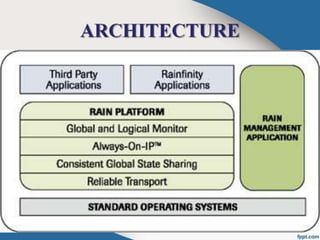
• Architecture
• Features
• Advantages
• Disadvantages
• Applications
• Future Scope
• Conclusion
INTRODUCTION
RAIN stand’s for Reliable Array of Independent
Nodes.
I.A communications component that creates a
redundant network between multiple processors.
II.A computing component that automatically recovers
and restarts applications if a processor fails.
III.A component that stores data across distributed
processors and retrieves it even if some of the
processors fail.
EVOLUTION
The RAIN technology originated in a research project
at the California Institute of Technology (Caltech),in
collaboration with NASA’s Jet Propulsion Laboratory
and the Defense Advanced Research Projects Agency
(DARPA).
The RAIN research team in 1998 formed a company
called Rainfinity. Rainfinity is a company that
primarily deals with creating clustered solutions for
enhancing the performance and availability.
RAINIFINITY
• Start-up based on RAIN technology
Company:
• Founded Sept. 1998
• Released first product April 1999
• Received $15 million funding in Dec.
1999
• Now over 50 employees
RAINFINITY
• Business Plan:
Clustered solutions for Internet data
centers, focusing on:
• Availability
• Scalability
• Performance
RAIN Project: Goals
Efficient, reliable distributed computing
and storage systems:
key building blocks
Goals of Rain Technology
• RAIN Technology is able to offer the solution by
minimizing number of nodes in the chain connecting
the client and server.
• RAIN Technology making the exiting nodes more
robust and independent of each other.
• RAIN Technology provides the feature of replacing a
faulty node by a healthy one.
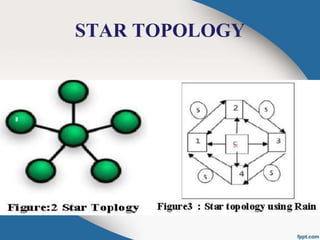
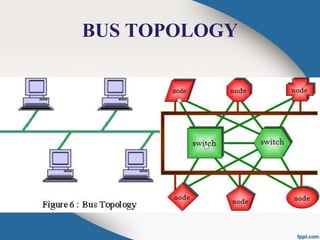
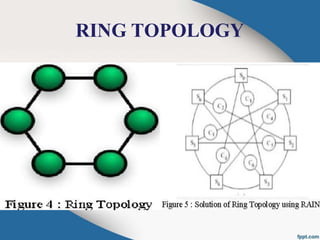
TOPOLOGIES IN RAIN
TECHNOLOGY
STAR TOPOLOGY
BUS TOPOLOGY
RING TOPOLOGY
FEATURES
• Communication
• Group Membership
• Data Storage
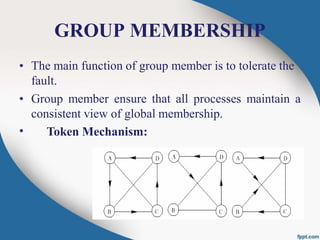
GROUP MEMBERSHIP
• The main function of group member is to tolerate the
fault.
• Group member ensure that all processes maintain a
consistent view of global membership.
• Token Mechanism:
DATA STORAGE
Fault tolerance in data storage across many
disks is obtained using redundant storage
schemes. Novel error-correcting codes have
been developed for this purpose. These are
array codes that encode and decode using
simple XOR operations.
ADVANTAGES
• There is no limit on the size of a RAIN cluster.
• There is no concept of master-slave relation.
•
•
A RAIN cluster can tolerate multiple node failure.
This is highly efficiency in traffic management.
• New node can be added into the cluster to participate
in load sharing.
DIS-ADVANTAGES
Rain technology suffers with some drawback as specified below:
1. As the rain technology requires placement of switches in
between of structure, so it becomes little expensive.
2. Secondly, Installation and configuration is time consuming
and requires maintenance also.
3. Although if the node of the topology fails, it will not disturb
the topology completely as mentioned above but if the switch
fails, it affects the network partially and switch has to be
repaired as early as possible.
• High Availability Video Server
• High Availability Web Server
• Distributed Check pointing Mechanism
FUTURE SCOPE
• Development of API’s for using the various building
blocks.
• The implementation of a real distributed file system
using the partitioning scheme developed here.
• The group communication protocols are being
extended to address more challenging scenarios.
CONCLUSION
• The goal of the RAIN project has been to build a test-
bed for various building blocks that address fault
management
• Communication and storage in a distributed
environment
• The creation of such building blocks is important for
the development of a fully distributed computing
system
REFERENCES
[1]. www.wikipedia.com
[2]. www.searchdatacenter.techtarget.com
[3]. www.campusfever.com
[4]. www.seminartime.com
THANK YOU!!

Rain technology ppt

  • 1.
  • 2.
    TECHNOLOGY Submitted by: Aswathy Ramachandran S5CT Reg. No. 16130076 NSS PTC, Pandalam
  • 3.
    CONTENTS • Introduction • Goalof Technology • Architecture • Features • Advantages • Disadvantages • Applications • Future Scope • Conclusion
  • 4.
    INTRODUCTION RAIN stand’s forReliable Array of Independent Nodes. I.A communications component that creates a redundant network between multiple processors. II.A computing component that automatically recovers and restarts applications if a processor fails. III.A component that stores data across distributed processors and retrieves it even if some of the processors fail.
  • 5.
    EVOLUTION The RAIN technologyoriginated in a research project at the California Institute of Technology (Caltech),in collaboration with NASA’s Jet Propulsion Laboratory and the Defense Advanced Research Projects Agency (DARPA). The RAIN research team in 1998 formed a company called Rainfinity. Rainfinity is a company that primarily deals with creating clustered solutions for enhancing the performance and availability.
  • 6.
    RAINIFINITY • Start-up basedon RAIN technology Company: • Founded Sept. 1998 • Released first product April 1999 • Received $15 million funding in Dec. 1999 • Now over 50 employees
  • 7.
    RAINFINITY • Business Plan: Clusteredsolutions for Internet data centers, focusing on: • Availability • Scalability • Performance
  • 8.
    RAIN Project: Goals Efficient,reliable distributed computing and storage systems: key building blocks
  • 9.
    Goals of RainTechnology • RAIN Technology is able to offer the solution by minimizing number of nodes in the chain connecting the client and server. • RAIN Technology making the exiting nodes more robust and independent of each other. • RAIN Technology provides the feature of replacing a faulty node by a healthy one.
  • 11.
  • 12.
  • 13.
  • 14.
  • 15.
    FEATURES • Communication • GroupMembership • Data Storage
  • 16.
    GROUP MEMBERSHIP • Themain function of group member is to tolerate the fault. • Group member ensure that all processes maintain a consistent view of global membership. • Token Mechanism:
  • 17.
    DATA STORAGE Fault tolerancein data storage across many disks is obtained using redundant storage schemes. Novel error-correcting codes have been developed for this purpose. These are array codes that encode and decode using simple XOR operations.
  • 18.
    ADVANTAGES • There isno limit on the size of a RAIN cluster. • There is no concept of master-slave relation. • • A RAIN cluster can tolerate multiple node failure. This is highly efficiency in traffic management. • New node can be added into the cluster to participate in load sharing.
  • 19.
    DIS-ADVANTAGES Rain technology sufferswith some drawback as specified below: 1. As the rain technology requires placement of switches in between of structure, so it becomes little expensive. 2. Secondly, Installation and configuration is time consuming and requires maintenance also. 3. Although if the node of the topology fails, it will not disturb the topology completely as mentioned above but if the switch fails, it affects the network partially and switch has to be repaired as early as possible.
  • 20.
    • High AvailabilityVideo Server • High Availability Web Server • Distributed Check pointing Mechanism
  • 21.
    FUTURE SCOPE • Developmentof API’s for using the various building blocks. • The implementation of a real distributed file system using the partitioning scheme developed here. • The group communication protocols are being extended to address more challenging scenarios.
  • 22.
    CONCLUSION • The goalof the RAIN project has been to build a test- bed for various building blocks that address fault management • Communication and storage in a distributed environment • The creation of such building blocks is important for the development of a fully distributed computing system
  • 23.
  • 24.