
I've got an idea. And now?

                              IED
                            Lesson 3

Frieda Brioschi
frieda.brioschi@gmail.com
Course program
1. Italian Startups
2. Set up a startup in Italy
3. I've got an idea. And now?
4. Value analysis
5. Business model
6. Communicate, communicate, communicate
7. Being net
8. Find your market
9. Funding: venture capital, business angel and other
ways of financing
10. Pitch
Today's table of content


1. Design and life cycle

2. From concept to company

3. Useful tools
Innovative startups: quick recap

During last lesson we investigated some laws,
 regarding 3 areas:

1. startup regulation
2. labour agreements
3. intellectual property
Innovative startups: quick recap

We went through the definitions of:
• startup
• innovative startup
• startup with a social goal
• limited company (particularly ssrl, srlcr)
• liquidation & bankruptcy
Innovative startups: quick recap

Two examples of startup with a social goal

• Movie Reading

• HelpTalk
Design a project
• no ToDo list available

• every project is different, according to its story, your
team, the chosen field, etc.

• we can just identify some good practices and useful
tools
Design a project
Starting a project implies

• to have clear goals (both quantitative and qualitative)

• these goals must be reached in a fixed time

• using available resources (human and monetary)
Concept
Discuss your hunch as much as possible, and
evaluate every single feedback you receive.


If you want to patent your product don’t offer too many
details.
Life cycle
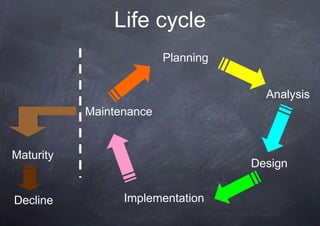
                         Planning


                                      Analysis
           Maintenance


Maturity
                                    Design


Decline          Implementation
Strategic planning
Prior questions:

• may I make money from my hunch?

• is it scalable?

• does it answer to a market need or am I trying to
create a demand for my product?

• Have I any competitors?

• Which is my target?
Product Vs Market
According to Steve Blank:

• new product new market
• new product existing market
• "existing" product segmenting an existing market,
acting on cost
• new product segmenting an existing market, creating
a niche

They differ for consumers, needs, perfomance,
competitors and risks.

                       http://blog.nicolamattina.it/2011/03/i-quattro-tipi-di-startup-sencondo-steve-blank/
Analysis
• Feasibility study

• Requirements

• Outline analysis

• Financial assessment

• Technology outlook

• Use cases
Feasibility study
A feasibility study is an evaluation and analysis of
the potential of the proposed project which is based
on extensive investigation and research to give full
comfort to the decisions makers.

Feasibility studies aim to objectively and rationally
uncover the strengths and weaknesses of an
existing business or proposed venture, opportunities
and threats as presented by the environment, the
resources required to carry through, and ultimately the
prospects for success.
                                      http://en.wikipedia.org/wiki/Feasibility_study
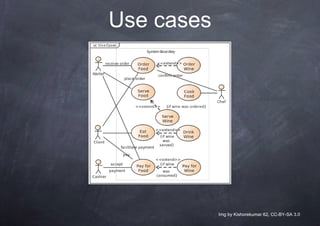
Use cases


            Img by Kishorekumar 62, CC-BY-SA 3.0
Design
• Physical design

• Performance

• Usability

• Security

• Cross platform

• Certification
Outputs
• Placement

• Promotion

• Price
Implementation
• Prioritization of features (must have/nice to have)

• Testing
Maintenance
• Evolutionary maintenance

• other possible outcomes: maturity and decline of the
product
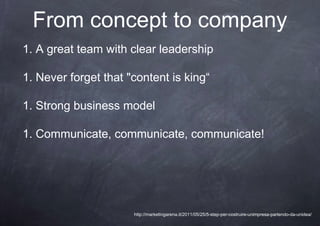
From concept to company
1. A great team with clear leadership

1. Never forget that "content is king“

1. Strong business model

1. Communicate, communicate, communicate!


                      http://marketingarena.it/2011/05/25/5-step-per-costruire-unimpresa-partendo-da-unidea/
http://bit.ly/912l9G
Formalization
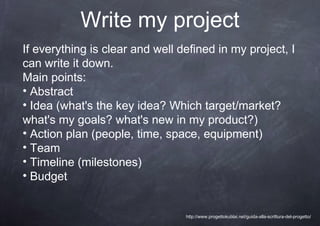
Write my project
If everything is clear and well defined in my project, I
can write it down.
Main points:
• Abstract
• Idea (what's the key idea? Which target/market?
what's my goals? what's new in my product?)
• Action plan (people, time, space, equipment)
• Team
• Timeline (milestones)
• Budget


                                 http://www.progettokublai.net/guida-alla-scrittura-del-progetto/
Help needed!
What is Kublai?


It’s an incubator for territorial project.


Implemented by:
Inside Kublai


A community where designers and experts meet together.
Which kind of projects?

• At any development stage (from hunch to project needing to be
redesigned from scratch)

• Economically sustainable

• Linked to the territory

• Offering (job!) opportunities
Activities


• Sharing project

• Collaborating to fulfill projects

• Looking for & finding partners

• Writing project documentation
What Kublai offers
• Tutoring & coaching

• A multi-skilled community

• Periodic information on grants, announcements, etc.

• A guide to useful tool

• Lifelong learning (learning by doing)

• Web conferencing meeting

• Real life meeting

• Common sense
Target
Everyone. Mainly interested in:

- 4 regions “obiettivo convergenza” (Calabria,
Campania, Sicilia, Puglia)

- Women

- Young people looking for their first job

- Second youth (40-50s + silver economy)
What Kublai does not offer


- Money

- Ghostwriter

- (designers!)
Project coaching


Project coaching is a professional consulting activity, providing
developmental support for individuals, project teams, enterprises and
communities, with the goal of supplementing and improving project
management capability.


                                                     http://en.wikipedia.org/wiki/Project_coaching
Business incubators
Business incubators are programs designed to support the successful
development of entrepreneurial companies through an array of business
support resources and services, developed and orchestrated by incubator
management and offered both in the incubator and through its network of
contacts. Incubators vary in the way they deliver their services, in their
organizational structure, and in the types of clients they serve. Successful
completion of a business incubation program increases the likelihood that a
startup company will stay in business for the long term: older studies found
87% of incubator graduates stayed in business, in contrast to 44% of all
firms.


                                                     http://en.wikipedia.org/wiki/Business_incubator
Seed accelerators
Seed accelerators are a modern, for-profit type of startup incubator, with an
open application process, taking in classes of startups consisting of small
teams, supporting them with funding, mentoring, training and events for a
definite period (usually three months), in exchange for equity.


While traditional business incubators are often government-funded, generally
take no equity, and focus on biotech, medical technology, clean tech or
product-centric companies, accelerators are privately funded and focused on
mobile/Internet startups.


                                                      http://en.wikipedia.org/wiki/Seed_accelerator
Next week


Value analysis.


                       (with Emma Tracanella)

Ideas management

  • 1.
    I've got anidea. And now? IED Lesson 3 Frieda Brioschi frieda.brioschi@gmail.com
  • 2.
    Course program 1. ItalianStartups 2. Set up a startup in Italy 3. I've got an idea. And now? 4. Value analysis 5. Business model 6. Communicate, communicate, communicate 7. Being net 8. Find your market 9. Funding: venture capital, business angel and other ways of financing 10. Pitch
  • 3.
    Today's table ofcontent 1. Design and life cycle 2. From concept to company 3. Useful tools
  • 4.
    Innovative startups: quickrecap During last lesson we investigated some laws, regarding 3 areas: 1. startup regulation 2. labour agreements 3. intellectual property
  • 5.
    Innovative startups: quickrecap We went through the definitions of: • startup • innovative startup • startup with a social goal • limited company (particularly ssrl, srlcr) • liquidation & bankruptcy
  • 6.
    Innovative startups: quickrecap Two examples of startup with a social goal • Movie Reading • HelpTalk
  • 7.
    Design a project •no ToDo list available • every project is different, according to its story, your team, the chosen field, etc. • we can just identify some good practices and useful tools
  • 8.
    Design a project Startinga project implies • to have clear goals (both quantitative and qualitative) • these goals must be reached in a fixed time • using available resources (human and monetary)
  • 9.
    Concept Discuss your hunchas much as possible, and evaluate every single feedback you receive. If you want to patent your product don’t offer too many details.
  • 10.
    Life cycle Planning Analysis Maintenance Maturity Design Decline Implementation
  • 11.
    Strategic planning Prior questions: •may I make money from my hunch? • is it scalable? • does it answer to a market need or am I trying to create a demand for my product? • Have I any competitors? • Which is my target?
  • 12.
    Product Vs Market Accordingto Steve Blank: • new product new market • new product existing market • "existing" product segmenting an existing market, acting on cost • new product segmenting an existing market, creating a niche They differ for consumers, needs, perfomance, competitors and risks. http://blog.nicolamattina.it/2011/03/i-quattro-tipi-di-startup-sencondo-steve-blank/
  • 13.
    Analysis • Feasibility study •Requirements • Outline analysis • Financial assessment • Technology outlook • Use cases
  • 14.
    Feasibility study A feasibilitystudy is an evaluation and analysis of the potential of the proposed project which is based on extensive investigation and research to give full comfort to the decisions makers. Feasibility studies aim to objectively and rationally uncover the strengths and weaknesses of an existing business or proposed venture, opportunities and threats as presented by the environment, the resources required to carry through, and ultimately the prospects for success. http://en.wikipedia.org/wiki/Feasibility_study
  • 15.
    Use cases Img by Kishorekumar 62, CC-BY-SA 3.0
  • 16.
    Design • Physical design •Performance • Usability • Security • Cross platform • Certification
  • 17.
  • 18.
    Implementation • Prioritization offeatures (must have/nice to have) • Testing
  • 19.
    Maintenance • Evolutionary maintenance •other possible outcomes: maturity and decline of the product
  • 20.
    From concept tocompany 1. A great team with clear leadership 1. Never forget that "content is king“ 1. Strong business model 1. Communicate, communicate, communicate! http://marketingarena.it/2011/05/25/5-step-per-costruire-unimpresa-partendo-da-unidea/
  • 21.
  • 22.
  • 23.
    Write my project Ifeverything is clear and well defined in my project, I can write it down. Main points: • Abstract • Idea (what's the key idea? Which target/market? what's my goals? what's new in my product?) • Action plan (people, time, space, equipment) • Team • Timeline (milestones) • Budget http://www.progettokublai.net/guida-alla-scrittura-del-progetto/
  • 24.
  • 26.
    What is Kublai? It’san incubator for territorial project. Implemented by:
  • 27.
    Inside Kublai A communitywhere designers and experts meet together.
  • 28.
    Which kind ofprojects? • At any development stage (from hunch to project needing to be redesigned from scratch) • Economically sustainable • Linked to the territory • Offering (job!) opportunities
  • 29.
    Activities • Sharing project •Collaborating to fulfill projects • Looking for & finding partners • Writing project documentation
  • 30.
    What Kublai offers •Tutoring & coaching • A multi-skilled community • Periodic information on grants, announcements, etc. • A guide to useful tool • Lifelong learning (learning by doing) • Web conferencing meeting • Real life meeting • Common sense
  • 31.
    Target Everyone. Mainly interestedin: - 4 regions “obiettivo convergenza” (Calabria, Campania, Sicilia, Puglia) - Women - Young people looking for their first job - Second youth (40-50s + silver economy)
  • 32.
    What Kublai doesnot offer - Money - Ghostwriter - (designers!)
  • 33.
    Project coaching Project coachingis a professional consulting activity, providing developmental support for individuals, project teams, enterprises and communities, with the goal of supplementing and improving project management capability. http://en.wikipedia.org/wiki/Project_coaching
  • 34.
    Business incubators Business incubatorsare programs designed to support the successful development of entrepreneurial companies through an array of business support resources and services, developed and orchestrated by incubator management and offered both in the incubator and through its network of contacts. Incubators vary in the way they deliver their services, in their organizational structure, and in the types of clients they serve. Successful completion of a business incubation program increases the likelihood that a startup company will stay in business for the long term: older studies found 87% of incubator graduates stayed in business, in contrast to 44% of all firms. http://en.wikipedia.org/wiki/Business_incubator
  • 35.
    Seed accelerators Seed acceleratorsare a modern, for-profit type of startup incubator, with an open application process, taking in classes of startups consisting of small teams, supporting them with funding, mentoring, training and events for a definite period (usually three months), in exchange for equity. While traditional business incubators are often government-funded, generally take no equity, and focus on biotech, medical technology, clean tech or product-centric companies, accelerators are privately funded and focused on mobile/Internet startups. http://en.wikipedia.org/wiki/Seed_accelerator
  • 36.
    Next week Value analysis. (with Emma Tracanella)