Why “Innovation Ecosystems?”
CCTP673: Creating a Culture of Innovation (Nelson)
18 March 2010

Jeffrey Alexander, Ph.D.
Senior Science & Technology Policy Analyst
Center for Science, Technology & Economic Development
                         © 2010 Jeffrey Alexander
Key Topics & Concepts

    • Terms of Reference—Defining Innovation

    • Innovation Ecosystems—Modeling Innovation

    • Evaluating Innovation Capacity—Measuring Innovation

    • Social Aspects of Innovation—Enabling Innovation


18 March 2010                © 2010 Jeffrey Alexander       Page 2
First, a bit about me & where I come from…


                  © 2010 Jeffrey Alexander
Who We Are
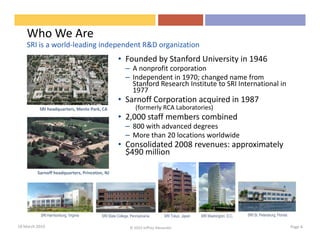
    SRI is a world-leading independent R&D organization
                                                  • Founded by Stanford University in 1946
                                                       – A nonprofit corporation
                                                       – Independent in 1970; changed name from
                                                         Stanford Research Institute to SRI International in
                                                         1977
                                                  • Sarnoff Corporation acquired in 1987
          SRI headquarters, Menlo Park, CA                   (formerly RCA Laboratories)
                                                  • 2,000 staff members combined
                                                       – 800 with advanced degrees
                                                       – More than 20 locations worldwide
                                                  • Consolidated 2008 revenues: approximately
                                                    $490 million

         Sarnoff headquarters, Princeton, NJ


           SRI Harrisonburg, Virginia   SRI State College, Pennsylvania      SRI Tokyo, Japan   SRI Washington, D.C.   SRI St. Petersburg, Florida

18 March 2010                                             © 2010 Jeffrey Alexander                                                                   Page 4
A Couple of Innovations…
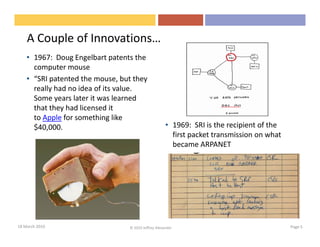
    • 1967: Doug Engelbart patents the
      computer mouse
    • “SRI patented the mouse, but they
      really had no idea of its value.
      Some years later it was learned
      that they had licensed it
      to Apple for something like
      $40,000.                                       • 1969: SRI is the recipient of the
                                                       first packet transmission on what
                                                       became ARPANET


18 March 2010                    © 2010 Jeffrey Alexander                                  Page 5
Terms of Reference

            Inventors, Innovators & Innovation


                     © 2010 Jeffrey Alexander
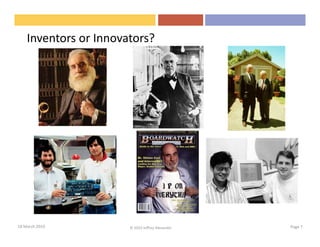
Inventors or Innovators?


18 March 2010          © 2010 Jeffrey Alexander   Page 7
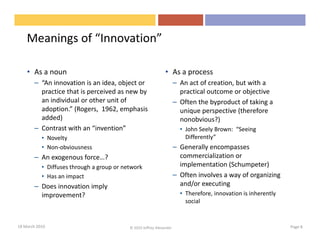
Meanings of “Innovation”

    • As a noun                                                • As a process
       – “An innovation is an idea, object or                         – An act of creation, but with a
         practice that is perceived as new by                           practical outcome or objective
         an individual or other unit of                               – Often the byproduct of taking a
         adoption.” (Rogers, 1962, emphasis                             unique perspective (therefore
         added)                                                         nonobvious?)
       – Contrast with an “invention”                                   • John Seely Brown: “Seeing
           • Novelty                                                      Differently”
           • Non-obviousness                                          – Generally encompasses
       – An exogenous force…?                                           commercialization or
           • Diffuses through a group or network                        implementation (Schumpeter)
           • Has an impact                                            – Often involves a way of organizing
       – Does innovation imply                                          and/or executing
         improvement?                                                   • Therefore, innovation is inherently
                                                                          social


18 March 2010                              © 2010 Jeffrey Alexander                                             Page 8
Why “Innovation Ecosystems?”

                 The Power & Perils of Metaphor


                 © 2010 Jeffrey Alexander
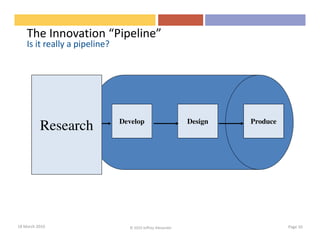
The Innovation “Pipeline”
    Is it really a pipeline?


                Research       Develop                      Design   Produce
          Research


18 March 2010                    © 2010 Jeffrey Alexander                      Page 10
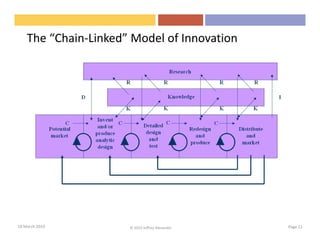
The “Chain-Linked” Model of Innovation


18 March 2010         © 2010 Jeffrey Alexander   Page 11
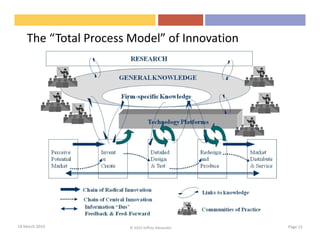
The “Total Process Model” of Innovation


18 March 2010         © 2010 Jeffrey Alexander   Page 12
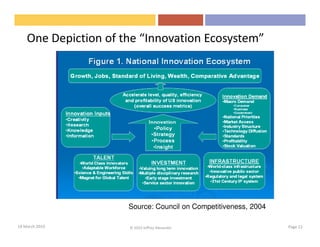
One Depiction of the “Innovation Ecosystem”


                      Source: Council on Competitiveness, 2004

18 March 2010         © 2010 Jeffrey Alexander                   Page 13
Characteristics of Ecosystems

           • Evolving
                –Organic
                –Diverse
                –Symbiotic
           • Complex
                –Self-organizing
                –Self-regulating
                –Adaptive
           • Fragile—or
             Resilient?
18 March 2010                      © 2010 Jeffrey Alexander   Page 14
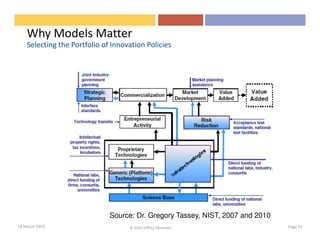
Why Models Matter
    Selecting the Portfolio of Innovation Policies


                              Source: Dr. Gregory Tassey, NIST, 2007 and 2010
18 March 2010                       © 2010 Jeffrey Alexander                    Page 15
Evaluating Innovation Capacity

                                             Measuring Innovation


                  © 2010 Jeffrey Alexander
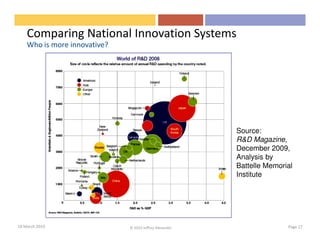
Comparing National Innovation Systems
    Who is more innovative?


                                                         Source:
                                                         R&D Magazine,
                                                         December 2009,
                                                         Analysis by
                                                         Battelle Memorial
                                                         Institute


18 March 2010                 © 2010 Jeffrey Alexander                  Page 17
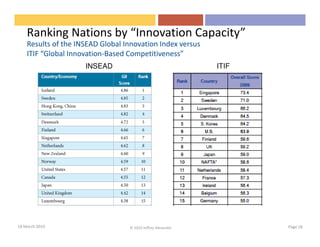
Ranking Nations by “Innovation Capacity”
    Results of the INSEAD Global Innovation Index versus
    ITIF “Global Innovation-Based Competitiveness”
                     INSEAD                                  ITIF


18 March 2010                     © 2010 Jeffrey Alexander          Page 18
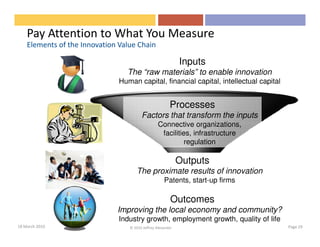
Pay Attention to What You Measure
    Elements of the Innovation Value Chain

                                                             Inputs
                                 The “raw materials” to enable innovation
                               Human capital, financial capital, intellectual capital


                                                        Processes
                                        Factors that transform the inputs
                                                  Connective organizations,
                                                   facilities, infrastructure
                                                            regulation

                                                             Outputs
                                      The proximate results of innovation
                                                     Patents, start-up firms

                                                         Outcomes
                              Improving the local economy and community?
                               Industry growth, employment growth, quality of life
18 March 2010                     © 2010 Jeffrey Alexander                              Page 19
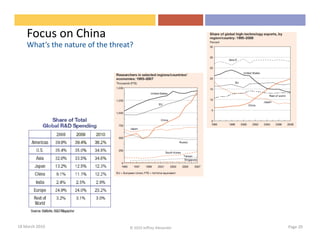
Focus on China
    What’s the nature of the threat?


18 March 2010                     © 2010 Jeffrey Alexander   Page 20
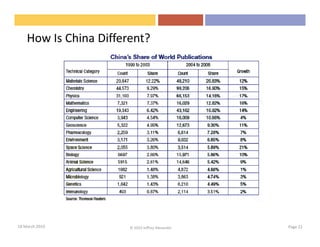
How Is China Different?


18 March 2010          © 2010 Jeffrey Alexander   Page 21
The Social Aspects of Innovation

                                  Enabling Innovation


                   © 2010 Jeffrey Alexander
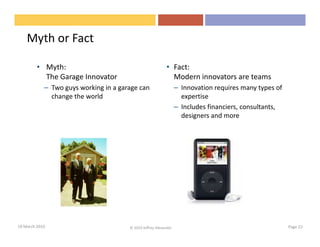
Myth or Fact

         • Myth:                                            • Fact:
           The Garage Innovator                               Modern innovators are teams
            – Two guys working in a garage can                    – Innovation requires many types of
              change the world                                      expertise
                                                                  – Includes financiers, consultants,
                                                                    designers and more


18 March 2010                          © 2010 Jeffrey Alexander                                         Page 23
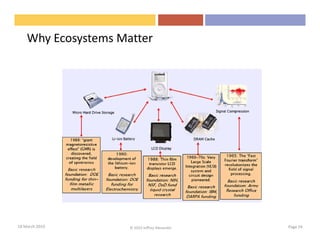
Why Ecosystems Matter


18 March 2010        © 2010 Jeffrey Alexander   Page 24
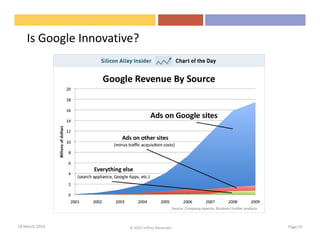
Is Google Innovative?


18 March 2010          © 2010 Jeffrey Alexander   Page 25
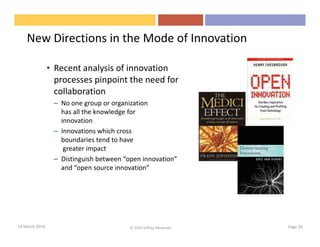
New Directions in the Mode of Innovation

                • Recent analysis of innovation
                  processes pinpoint the need for
                  collaboration
                 – No one group or organization
                   has all the knowledge for
                   innovation
                 – Innovations which cross
                   boundaries tend to have
                    greater impact
                 – Distinguish between “open innovation”
                   and “open source innovation”


18 March 2010                            © 2010 Jeffrey Alexander   Page 26
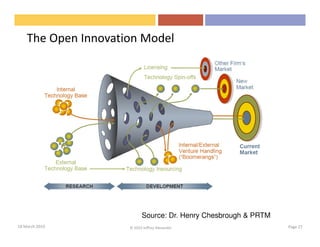
The Open Innovation Model


                           Source: Dr. Henry Chesbrough & PRTM
18 March 2010        © 2010 Jeffrey Alexander                    Page 27
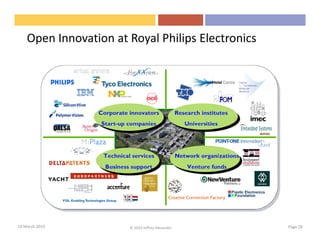
Open Innovation at Royal Philips Electronics


18 March 2010          © 2010 Jeffrey Alexander    Page 28
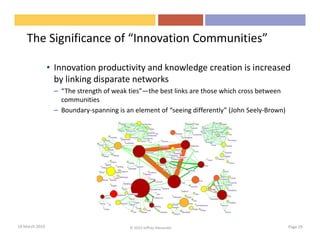
The Significance of “Innovation Communities”

                • Innovation productivity and knowledge creation is increased
                  by linking disparate networks
                 – “The strength of weak ties”—the best links are those which cross between
                   communities
                 – Boundary-spanning is an element of “seeing differently” (John Seely-Brown)


18 March 2010                            © 2010 Jeffrey Alexander                               Page 29
Building a Community of Innovation

    • Strong leadership to build trust among participants

    • Existence of significant incentives to motivate collaboration

    • Governance process for managing conflicts

    • Institutions which reinforce and bridge across phases of the
      innovation value chain

    • Processes for socializing community participants to create their
      own subculture
18 March 2010                  © 2010 Jeffrey Alexander                  Page 30
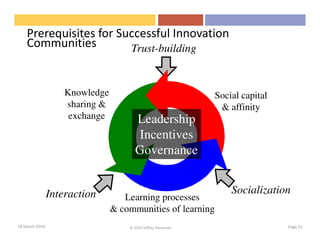
Prerequisites for Successful Innovation
    Communities         Trust-building


                    Knowledge                                  Social capital
                    sharing &                                   & affinity
                     exchange          Leadership
                                        Incentives
                                       Governance


                Interaction                                        Socialization
                                   Learning processes
                                & communities of learning
18 March 2010                       © 2010 Jeffrey Alexander                    Page 31
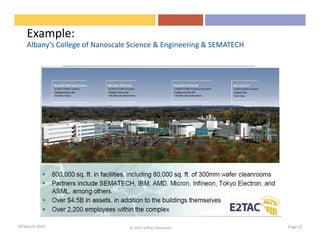
Example:
    Albany’s College of Nanoscale Science & Engineering & SEMATECH


18 March 2010                    © 2010 Jeffrey Alexander            Page 32
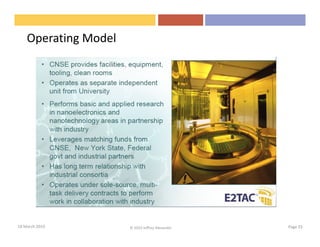
Operating Model


18 March 2010         © 2010 Jeffrey Alexander   Page 33
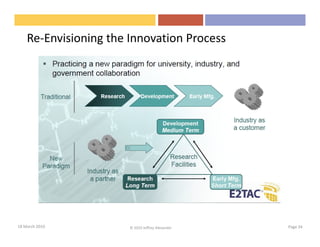
Re-Envisioning the Innovation Process


18 March 2010          © 2010 Jeffrey Alexander   Page 34
The CNSE Community of Innovation
    • Leadership
       – Entrepreneurial visionary (Prof. Alain Kaloyeros)
       – Credibility (backing of SEMATECH, Governor Pataki, NIST)
    • Incentives
       – Massive capital costs for moving to next generation of semiconductor
         manufacturing
       – Opportunities to share pre-competitive knowledge
    • Governance
       – Dynamic networks of research teams
       – Partners select where they will put their investments
    • Socialization
       – Shared research and office space
       – Faculty and students are the “glue” linking partners
18 March 2010                       © 2010 Jeffrey Alexander                    Page 35
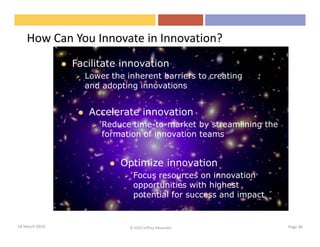
How Can You Innovate in Innovation?
                Facilitate innovation
                  Lower the inherent barriers to creating
                  and adopting innovations


                   Accelerate innovation
                      Reduce time-to-market by streamlining the
                      formation of innovation teams


                          Optimize innovation
                              Focus resources on innovation
                              opportunities with highest
                              potential for success and impact


18 March 2010                © 2010 Jeffrey Alexander             Page 36
Thank You!                                   Menlo Park Headquarters
                                             SRI International
                                             333 Ravenswood Avenue
                                             Menlo Park, CA 94025-3493
                                             650.859.2000

jeffalex@stanfordalumni.org                  Washington, D.C.
                                             SRI International
                                             1100 Wilson Blvd., Suite 2800
jeffrey.alexander@sri.com                    Arlington, VA 22209-3915
                                             703.524.2053

                                             Additional U.S. and
                                             international locations

                                             www.sri.com


                  © 2010 Jeffrey Alexander

Why "Innovation Ecosystems?" Lecture

  • 1.
    Why “Innovation Ecosystems?” CCTP673:Creating a Culture of Innovation (Nelson) 18 March 2010 Jeffrey Alexander, Ph.D. Senior Science & Technology Policy Analyst Center for Science, Technology & Economic Development © 2010 Jeffrey Alexander
  • 2.
    Key Topics &Concepts • Terms of Reference—Defining Innovation • Innovation Ecosystems—Modeling Innovation • Evaluating Innovation Capacity—Measuring Innovation • Social Aspects of Innovation—Enabling Innovation 18 March 2010 © 2010 Jeffrey Alexander Page 2
  • 3.
    First, a bitabout me & where I come from… © 2010 Jeffrey Alexander
  • 4.
    Who We Are SRI is a world-leading independent R&D organization • Founded by Stanford University in 1946 – A nonprofit corporation – Independent in 1970; changed name from Stanford Research Institute to SRI International in 1977 • Sarnoff Corporation acquired in 1987 SRI headquarters, Menlo Park, CA (formerly RCA Laboratories) • 2,000 staff members combined – 800 with advanced degrees – More than 20 locations worldwide • Consolidated 2008 revenues: approximately $490 million Sarnoff headquarters, Princeton, NJ SRI Harrisonburg, Virginia SRI State College, Pennsylvania SRI Tokyo, Japan SRI Washington, D.C. SRI St. Petersburg, Florida 18 March 2010 © 2010 Jeffrey Alexander Page 4
  • 5.
    A Couple ofInnovations… • 1967: Doug Engelbart patents the computer mouse • “SRI patented the mouse, but they really had no idea of its value. Some years later it was learned that they had licensed it to Apple for something like $40,000. • 1969: SRI is the recipient of the first packet transmission on what became ARPANET 18 March 2010 © 2010 Jeffrey Alexander Page 5
  • 6.
    Terms of Reference Inventors, Innovators & Innovation © 2010 Jeffrey Alexander
  • 7.
    Inventors or Innovators? 18March 2010 © 2010 Jeffrey Alexander Page 7
  • 8.
    Meanings of “Innovation” • As a noun • As a process – “An innovation is an idea, object or – An act of creation, but with a practice that is perceived as new by practical outcome or objective an individual or other unit of – Often the byproduct of taking a adoption.” (Rogers, 1962, emphasis unique perspective (therefore added) nonobvious?) – Contrast with an “invention” • John Seely Brown: “Seeing • Novelty Differently” • Non-obviousness – Generally encompasses – An exogenous force…? commercialization or • Diffuses through a group or network implementation (Schumpeter) • Has an impact – Often involves a way of organizing – Does innovation imply and/or executing improvement? • Therefore, innovation is inherently social 18 March 2010 © 2010 Jeffrey Alexander Page 8
  • 9.
    Why “Innovation Ecosystems?” The Power & Perils of Metaphor © 2010 Jeffrey Alexander
  • 10.
    The Innovation “Pipeline” Is it really a pipeline? Research Develop Design Produce Research 18 March 2010 © 2010 Jeffrey Alexander Page 10
  • 11.
    The “Chain-Linked” Modelof Innovation 18 March 2010 © 2010 Jeffrey Alexander Page 11
  • 12.
    The “Total ProcessModel” of Innovation 18 March 2010 © 2010 Jeffrey Alexander Page 12
  • 13.
    One Depiction ofthe “Innovation Ecosystem” Source: Council on Competitiveness, 2004 18 March 2010 © 2010 Jeffrey Alexander Page 13
  • 14.
    Characteristics of Ecosystems • Evolving –Organic –Diverse –Symbiotic • Complex –Self-organizing –Self-regulating –Adaptive • Fragile—or Resilient? 18 March 2010 © 2010 Jeffrey Alexander Page 14
  • 15.
    Why Models Matter Selecting the Portfolio of Innovation Policies Source: Dr. Gregory Tassey, NIST, 2007 and 2010 18 March 2010 © 2010 Jeffrey Alexander Page 15
  • 16.
    Evaluating Innovation Capacity Measuring Innovation © 2010 Jeffrey Alexander
  • 17.
    Comparing National InnovationSystems Who is more innovative? Source: R&D Magazine, December 2009, Analysis by Battelle Memorial Institute 18 March 2010 © 2010 Jeffrey Alexander Page 17
  • 18.
    Ranking Nations by“Innovation Capacity” Results of the INSEAD Global Innovation Index versus ITIF “Global Innovation-Based Competitiveness” INSEAD ITIF 18 March 2010 © 2010 Jeffrey Alexander Page 18
  • 19.
    Pay Attention toWhat You Measure Elements of the Innovation Value Chain Inputs The “raw materials” to enable innovation Human capital, financial capital, intellectual capital Processes Factors that transform the inputs Connective organizations, facilities, infrastructure regulation Outputs The proximate results of innovation Patents, start-up firms Outcomes Improving the local economy and community? Industry growth, employment growth, quality of life 18 March 2010 © 2010 Jeffrey Alexander Page 19
  • 20.
    Focus on China What’s the nature of the threat? 18 March 2010 © 2010 Jeffrey Alexander Page 20
  • 21.
    How Is ChinaDifferent? 18 March 2010 © 2010 Jeffrey Alexander Page 21
  • 22.
    The Social Aspectsof Innovation Enabling Innovation © 2010 Jeffrey Alexander
  • 23.
    Myth or Fact • Myth: • Fact: The Garage Innovator Modern innovators are teams – Two guys working in a garage can – Innovation requires many types of change the world expertise – Includes financiers, consultants, designers and more 18 March 2010 © 2010 Jeffrey Alexander Page 23
  • 24.
    Why Ecosystems Matter 18March 2010 © 2010 Jeffrey Alexander Page 24
  • 25.
    Is Google Innovative? 18March 2010 © 2010 Jeffrey Alexander Page 25
  • 26.
    New Directions inthe Mode of Innovation • Recent analysis of innovation processes pinpoint the need for collaboration – No one group or organization has all the knowledge for innovation – Innovations which cross boundaries tend to have greater impact – Distinguish between “open innovation” and “open source innovation” 18 March 2010 © 2010 Jeffrey Alexander Page 26
  • 27.
    The Open InnovationModel Source: Dr. Henry Chesbrough & PRTM 18 March 2010 © 2010 Jeffrey Alexander Page 27
  • 28.
    Open Innovation atRoyal Philips Electronics 18 March 2010 © 2010 Jeffrey Alexander Page 28
  • 29.
    The Significance of“Innovation Communities” • Innovation productivity and knowledge creation is increased by linking disparate networks – “The strength of weak ties”—the best links are those which cross between communities – Boundary-spanning is an element of “seeing differently” (John Seely-Brown) 18 March 2010 © 2010 Jeffrey Alexander Page 29
  • 30.
    Building a Communityof Innovation • Strong leadership to build trust among participants • Existence of significant incentives to motivate collaboration • Governance process for managing conflicts • Institutions which reinforce and bridge across phases of the innovation value chain • Processes for socializing community participants to create their own subculture 18 March 2010 © 2010 Jeffrey Alexander Page 30
  • 31.
    Prerequisites for SuccessfulInnovation Communities Trust-building Knowledge Social capital sharing & & affinity exchange Leadership Incentives Governance Interaction Socialization Learning processes & communities of learning 18 March 2010 © 2010 Jeffrey Alexander Page 31
  • 32.
    Example: Albany’s College of Nanoscale Science & Engineering & SEMATECH 18 March 2010 © 2010 Jeffrey Alexander Page 32
  • 33.
    Operating Model 18 March2010 © 2010 Jeffrey Alexander Page 33
  • 34.
    Re-Envisioning the InnovationProcess 18 March 2010 © 2010 Jeffrey Alexander Page 34
  • 35.
    The CNSE Communityof Innovation • Leadership – Entrepreneurial visionary (Prof. Alain Kaloyeros) – Credibility (backing of SEMATECH, Governor Pataki, NIST) • Incentives – Massive capital costs for moving to next generation of semiconductor manufacturing – Opportunities to share pre-competitive knowledge • Governance – Dynamic networks of research teams – Partners select where they will put their investments • Socialization – Shared research and office space – Faculty and students are the “glue” linking partners 18 March 2010 © 2010 Jeffrey Alexander Page 35
  • 36.
    How Can YouInnovate in Innovation? Facilitate innovation Lower the inherent barriers to creating and adopting innovations Accelerate innovation Reduce time-to-market by streamlining the formation of innovation teams Optimize innovation Focus resources on innovation opportunities with highest potential for success and impact 18 March 2010 © 2010 Jeffrey Alexander Page 36
  • 37.
    Thank You! Menlo Park Headquarters SRI International 333 Ravenswood Avenue Menlo Park, CA 94025-3493 650.859.2000 jeffalex@stanfordalumni.org Washington, D.C. SRI International 1100 Wilson Blvd., Suite 2800 jeffrey.alexander@sri.com Arlington, VA 22209-3915 703.524.2053 Additional U.S. and international locations www.sri.com © 2010 Jeffrey Alexander