An approach to the use of ICT
in South African FET Colleges:
   Lessons from Experience
   Greig Krull and Maryla Bialobrzeska
                  Saide
        North-South VET ICT Conference
           25 – 27 September 2012
Agenda
 • Context – Motivators and Constraints
 • ICT Integration in the FET Areas
    – Teaching, Administration, Communication
 • Challenges and Opportunities
    – Environment, Institution, People, Technology, Learning
 • Case Study: Approach to ICT Integration
 • Discussion
Overarching Context in FET

          Improve quality of teaching and
          learning to promote student success
          rates and employability


          Significantly increased participation
Context

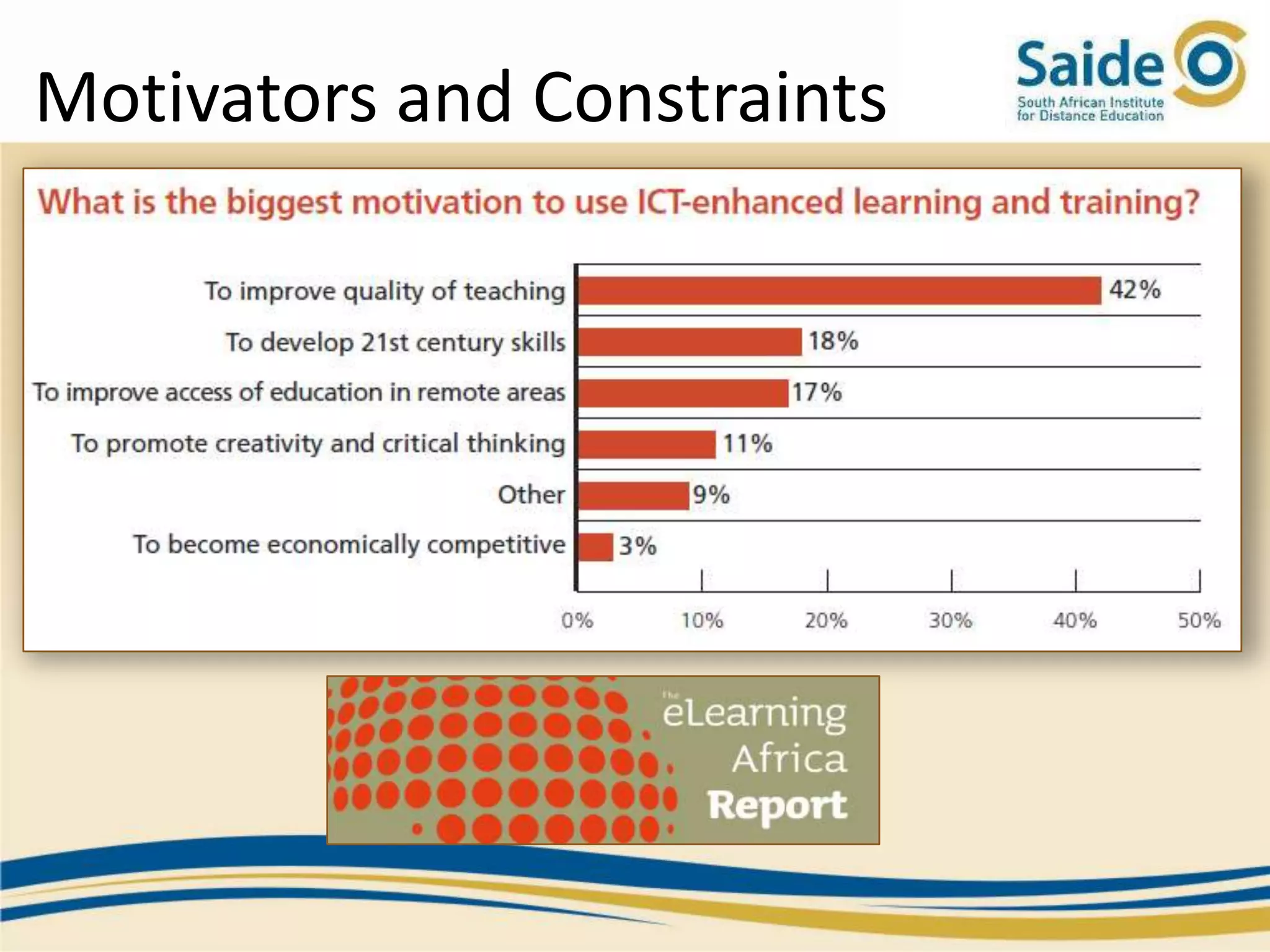
1. What is your biggest motivator to integrate ICT into
   your teaching and learning?

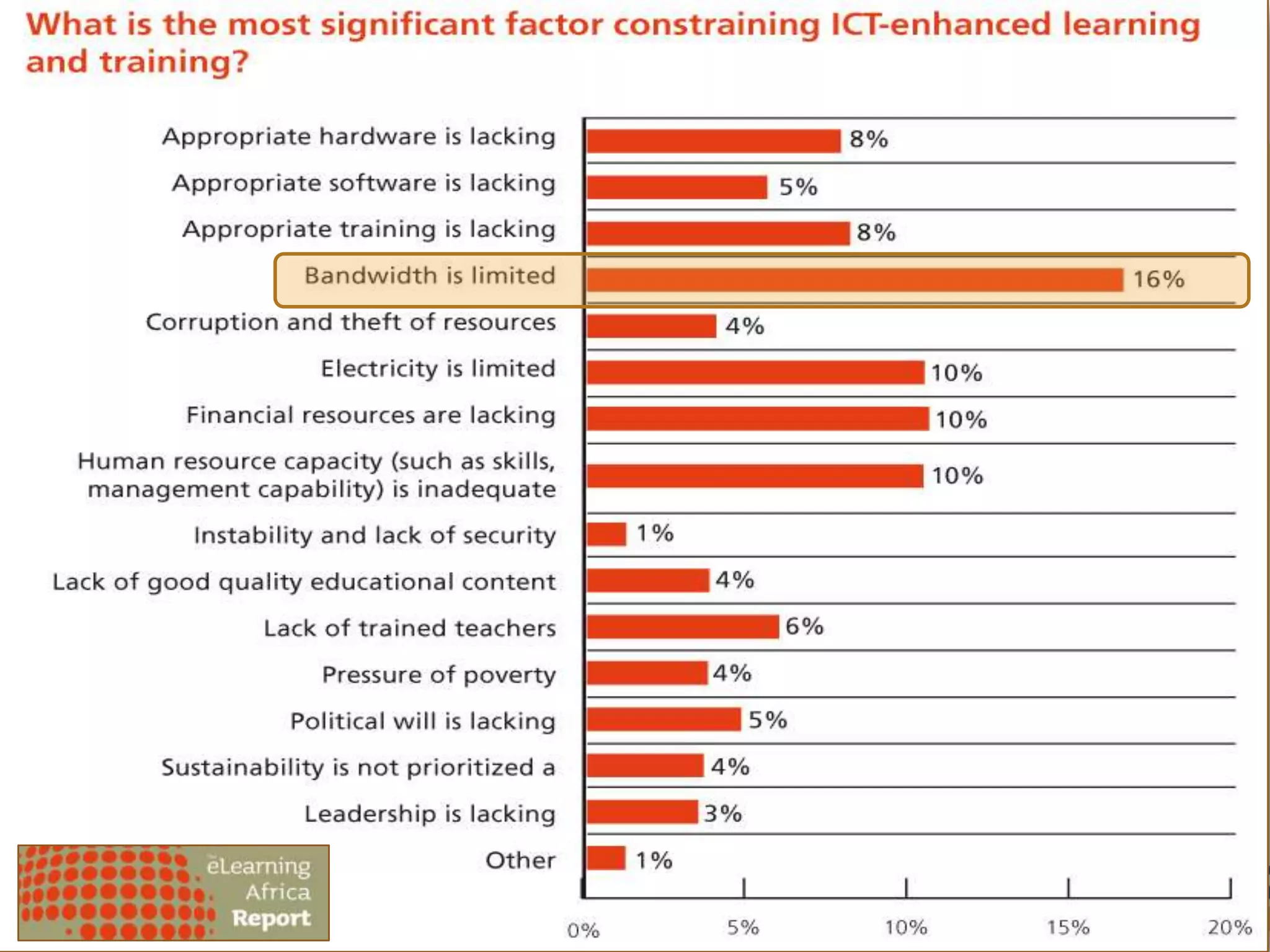
2. What is your biggest constraint to integrate ICT into
   your teaching and learning?
Motivators and Constraints
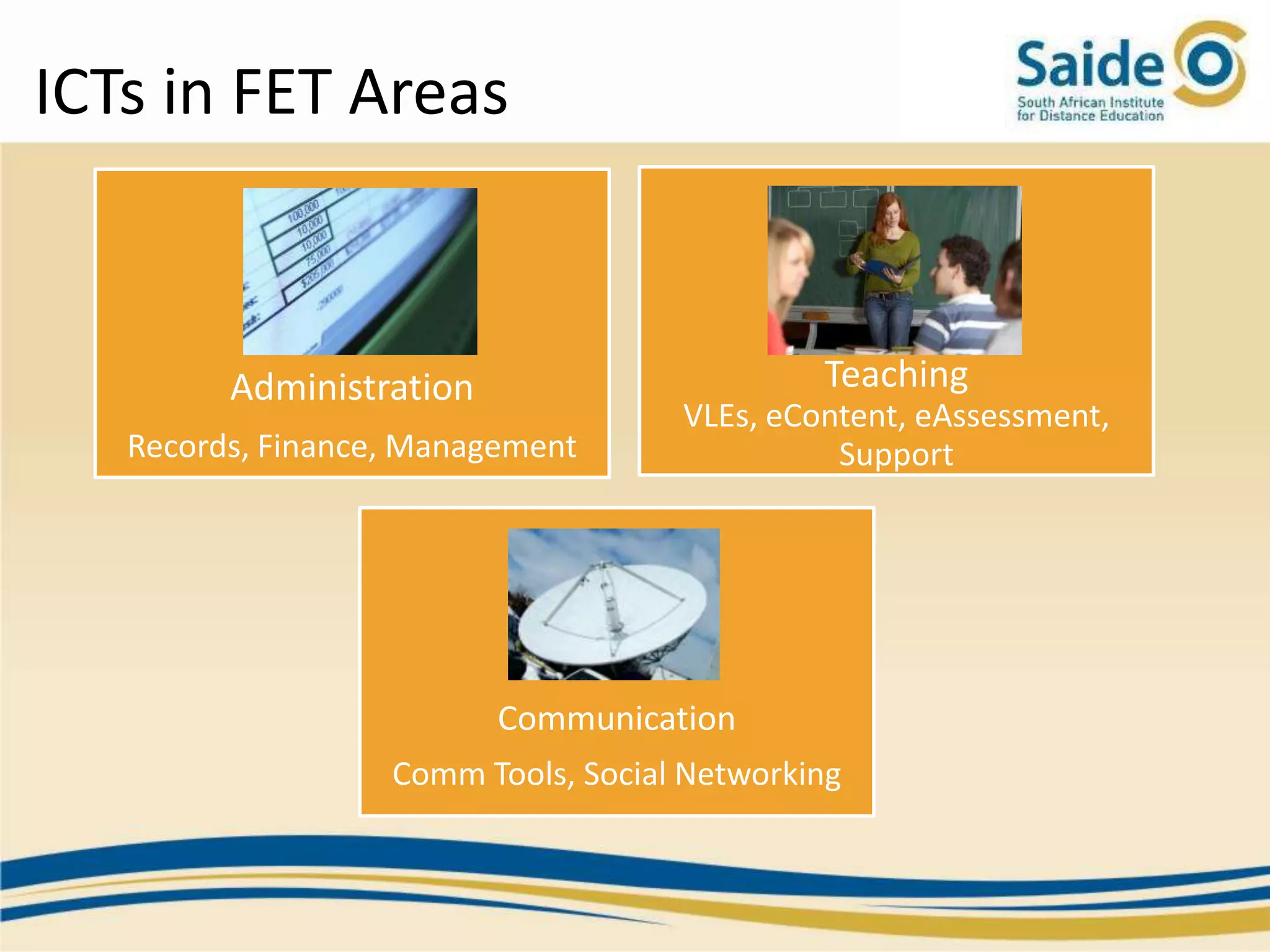
ICTs in FET Areas


         Administration                       Teaching
                                     VLEs, eContent, eAssessment,
   Records, Finance, Management                Support


                        Communication
                   Comm Tools, Social Networking
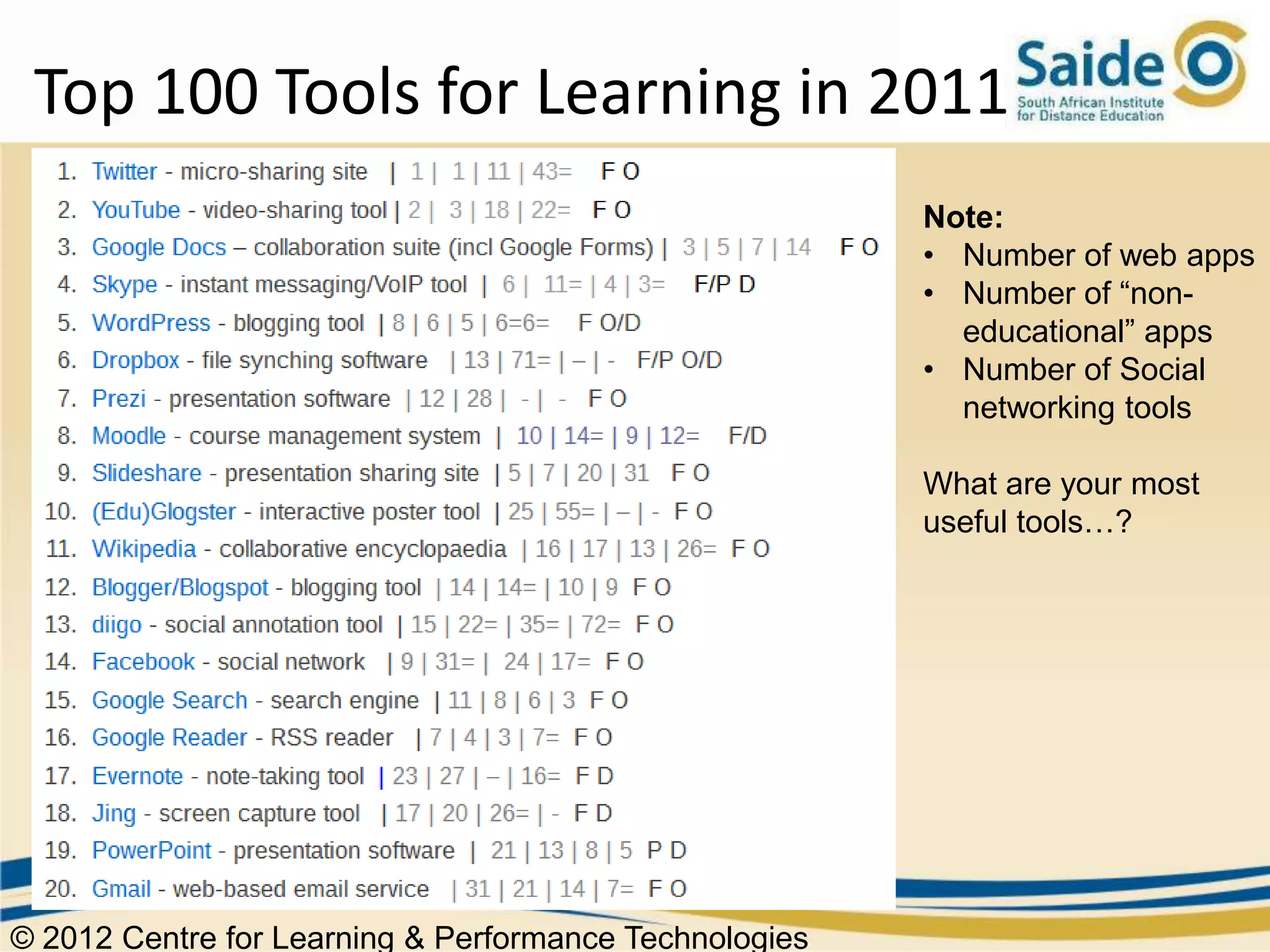
Top 100 Tools for Learning in 2011
                                                        Note:
                                                        • Number of web apps
                                                        • Number of “non-
                                                          educational” apps
                                                        • Number of Social
                                                          networking tools

                                                        What are your most
                                                        useful tools…?


© 2012 Centre for Learning & Performance Technologies
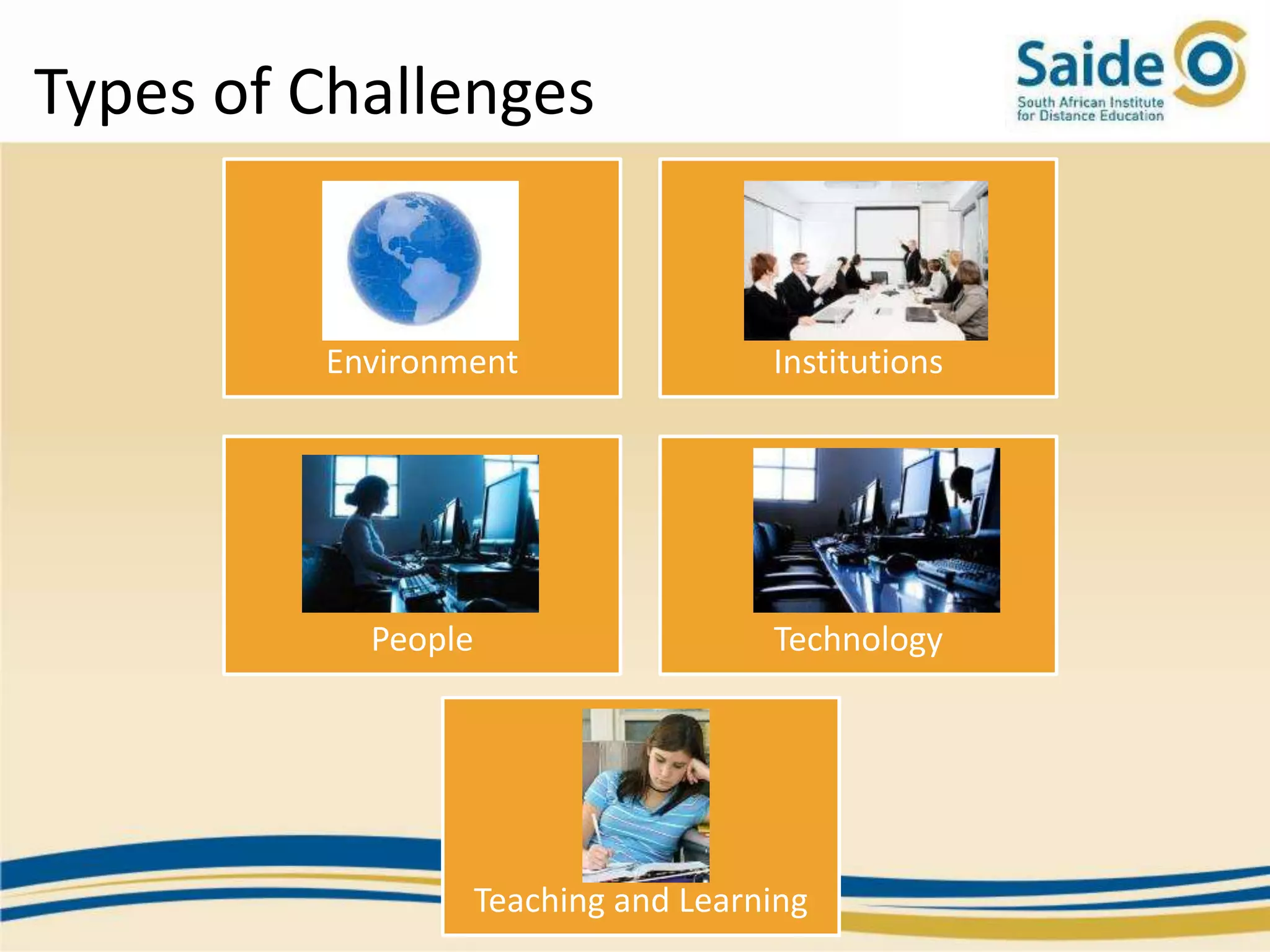
Types of Challenges


         Environment                  Institutions


           People                     Technology


                    Teaching and Learning
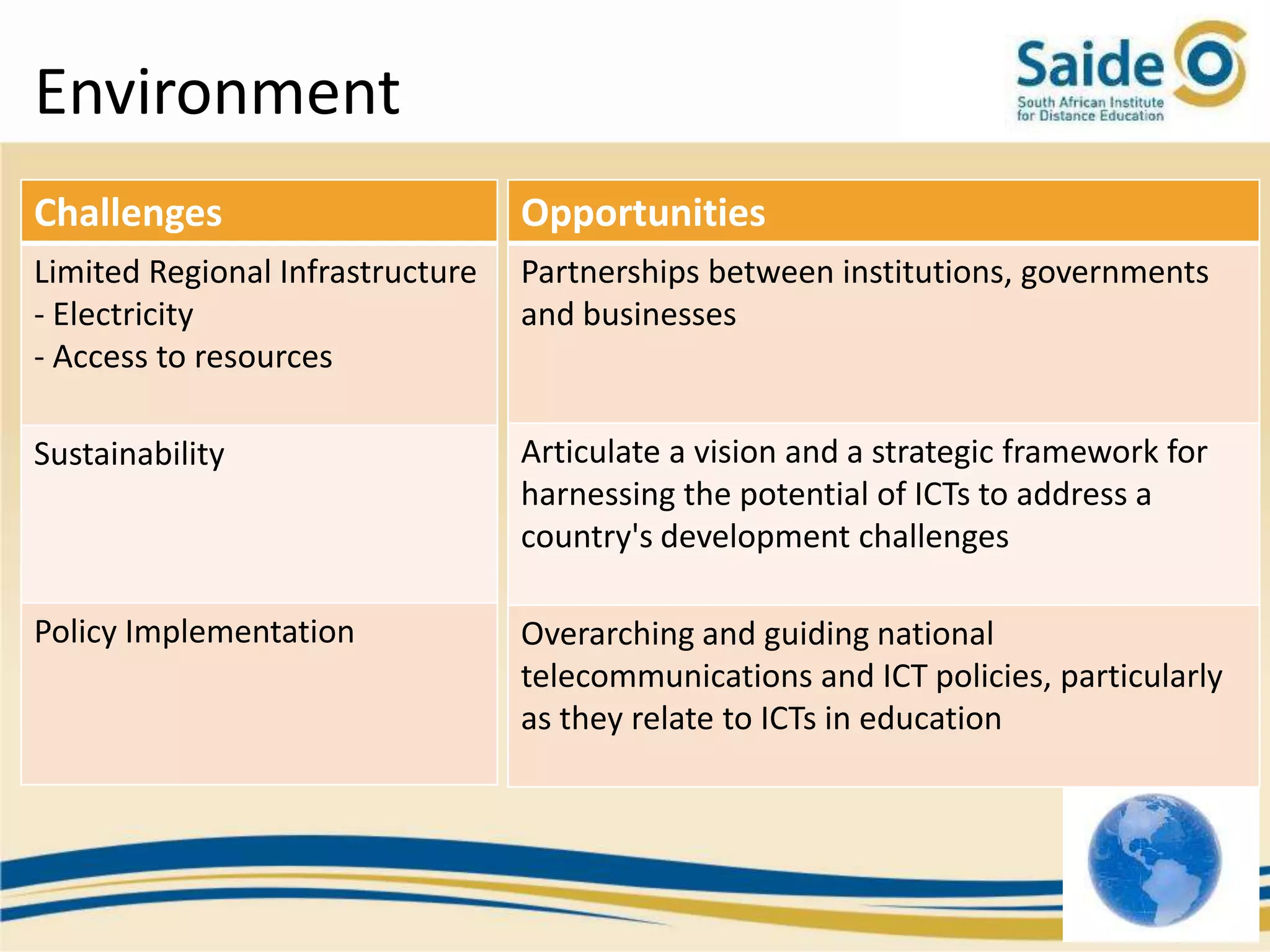
Environment
Challenges                        Opportunities
Limited Regional Infrastructure   Partnerships between institutions, governments
- Electricity                     and businesses
- Access to resources

Sustainability                    Articulate a vision and a strategic framework for
                                  harnessing the potential of ICTs to address a
                                  country's development challenges

Policy Implementation             Overarching and guiding national
                                  telecommunications and ICT policies, particularly
                                  as they relate to ICTs in education
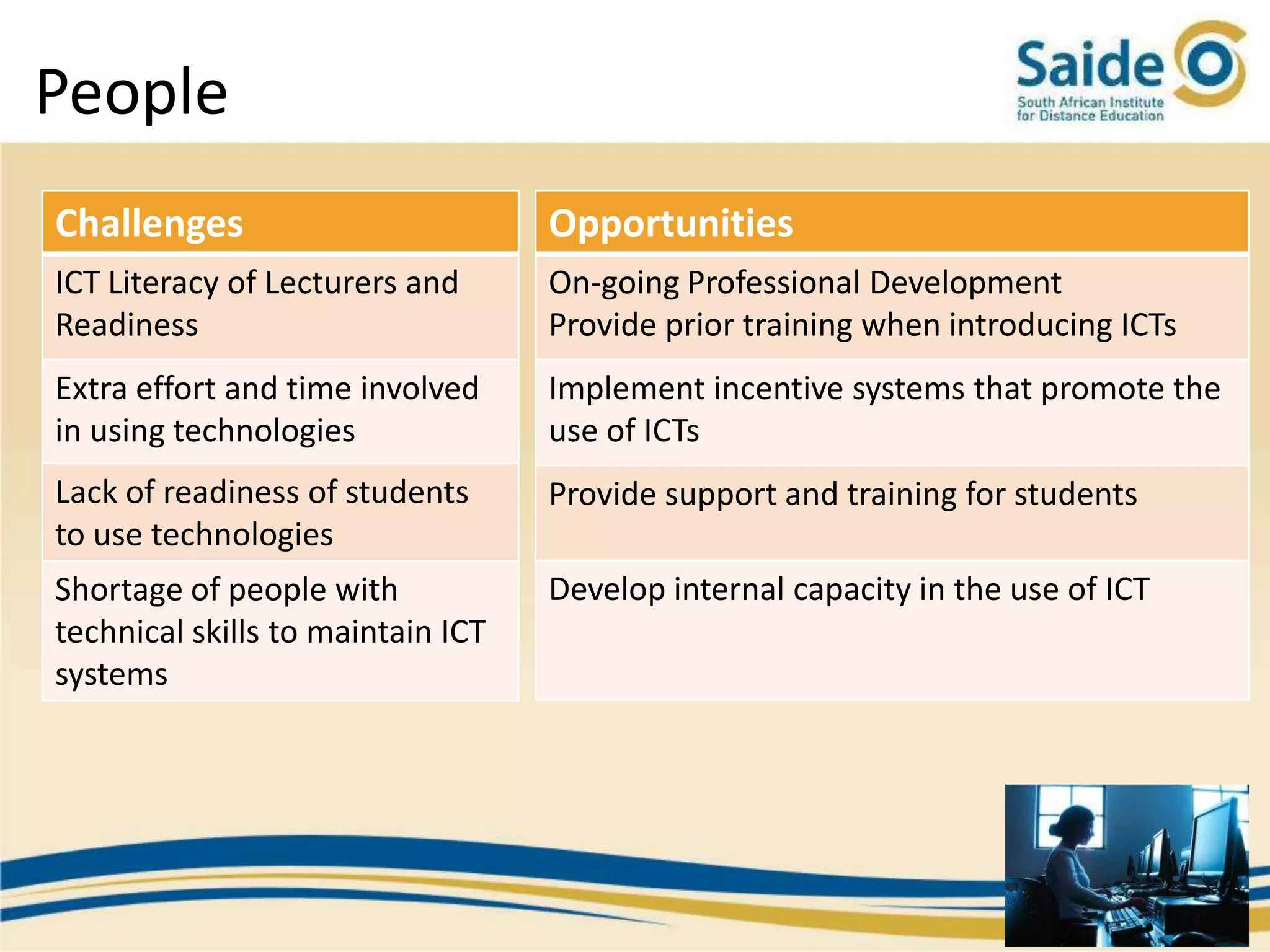
People
Challenges                         Opportunities
ICT Literacy of Lecturers and      On-going Professional Development
Readiness                          Provide prior training when introducing ICTs
Extra effort and time involved     Implement incentive systems that promote the
in using technologies              use of ICTs
Lack of readiness of students      Provide support and training for students
to use technologies
Shortage of people with            Develop internal capacity in the use of ICT
technical skills to maintain ICT
systems
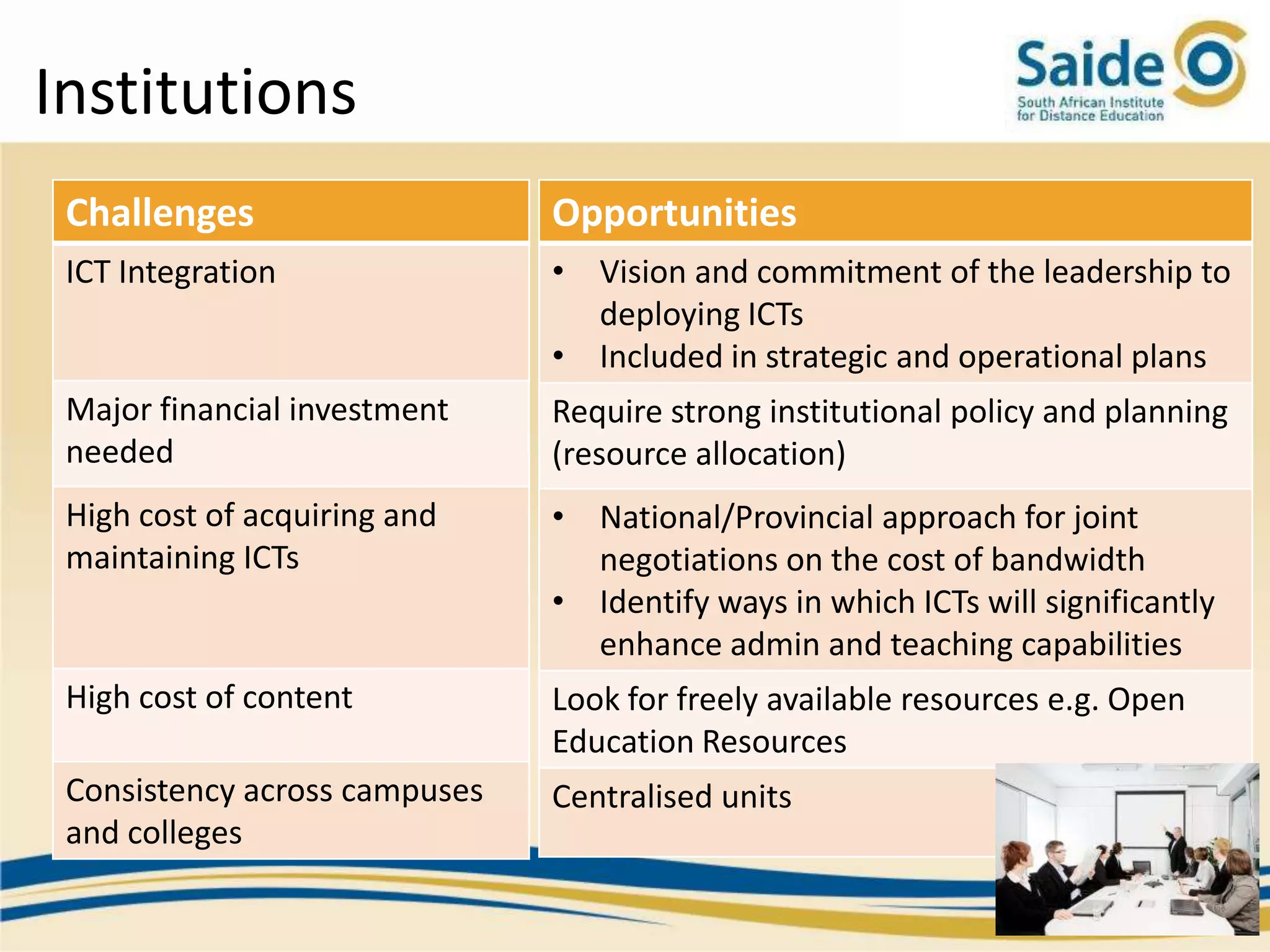
Institutions
 Challenges                    Opportunities
 ICT Integration               • Vision and commitment of the leadership to
                                 deploying ICTs
                               • Included in strategic and operational plans
 Major financial investment    Require strong institutional policy and planning
 needed                        (resource allocation)
 High cost of acquiring and    • National/Provincial approach for joint
 maintaining ICTs                negotiations on the cost of bandwidth
                               • Identify ways in which ICTs will significantly
                                 enhance admin and teaching capabilities
 High cost of content          Look for freely available resources e.g. Open
                               Education Resources
 Consistency across campuses   Centralised units
 and colleges
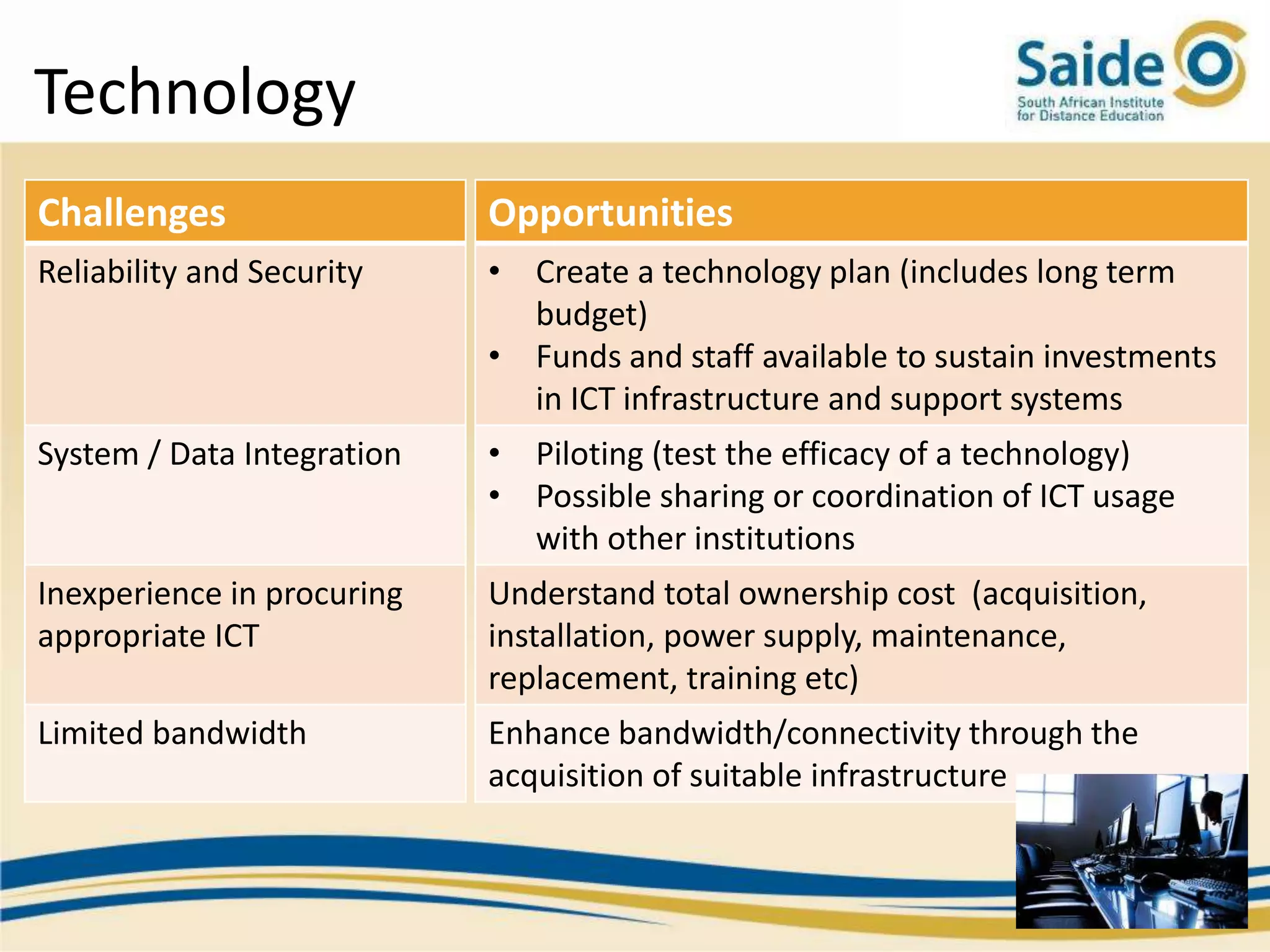
Technology
Challenges                  Opportunities
Reliability and Security    • Create a technology plan (includes long term
                              budget)
                            • Funds and staff available to sustain investments
                              in ICT infrastructure and support systems
System / Data Integration   • Piloting (test the efficacy of a technology)
                            • Possible sharing or coordination of ICT usage
                              with other institutions
Inexperience in procuring   Understand total ownership cost (acquisition,
appropriate ICT             installation, power supply, maintenance,
                            replacement, training etc)
Limited bandwidth           Enhance bandwidth/connectivity through the
                            acquisition of suitable infrastructure
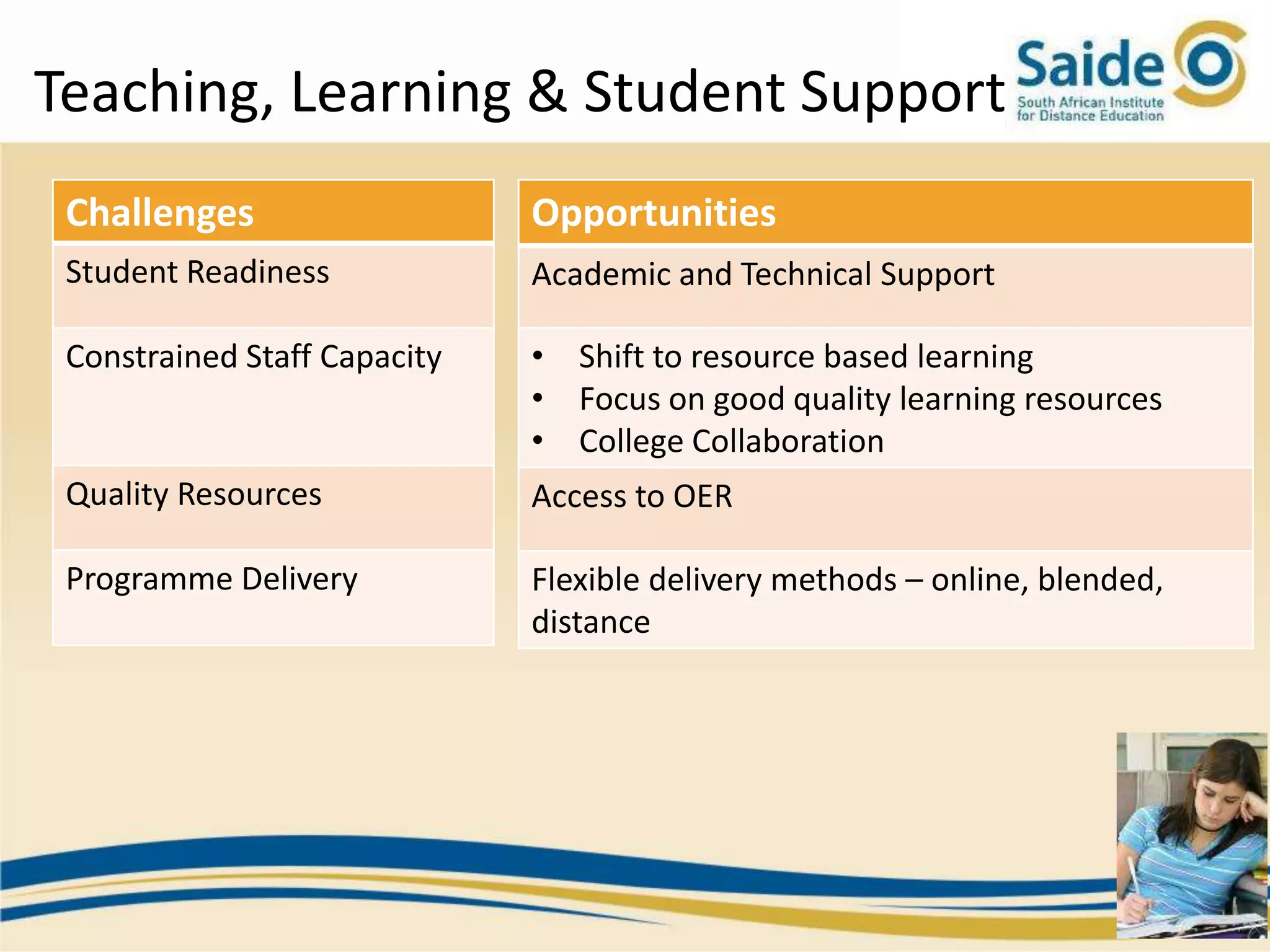
Teaching, Learning & Student Support
 Challenges                   Opportunities
 Student Readiness            Academic and Technical Support

 Constrained Staff Capacity   • Shift to resource based learning
                              • Focus on good quality learning resources
                              • College Collaboration
 Quality Resources            Access to OER

 Programme Delivery           Flexible delivery methods – online, blended,
                              distance
Case Study: Approach to Integration


   Partnership for Higher Education in Africa (PHEA)
         Educational Technology Initiative (ETI)
Project Objective
     “To support interventions in universities to make increasingly
    effective use of educational technology to address some of the
    underlying educational challenges facing the higher educational
                            sector in Africa”

Strategic objectives :
•    Support initiatives that integrate educational technology
•    Promote collaborative knowledge creation and dissemination
•    Refine institutional systems to more directly support teaching
•    Research and report on educational technology activity
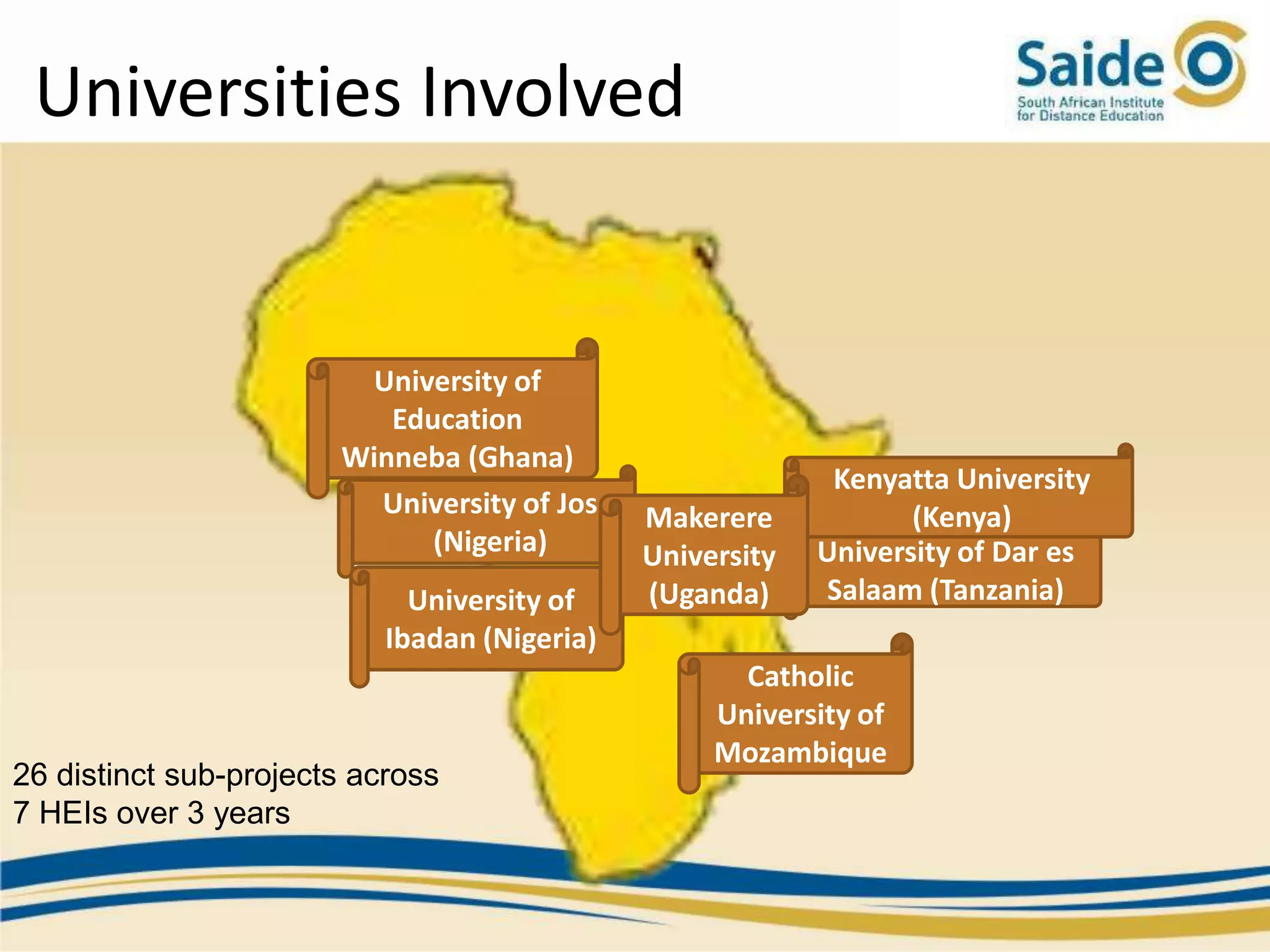
Universities Involved


                        University of
                          Education
                       Winneba (Ghana)
                                                            Kenyatta University
                         University of Jos    Makerere            (Kenya)
                             (Nigeria)        University   University of Dar es
                             University of    (Uganda)     Salaam (Tanzania)
                           Ibadan (Nigeria)
                                                     Catholic
                                                   University of
                                                   Mozambique
26 distinct sub-projects across
7 HEIs over 3 years
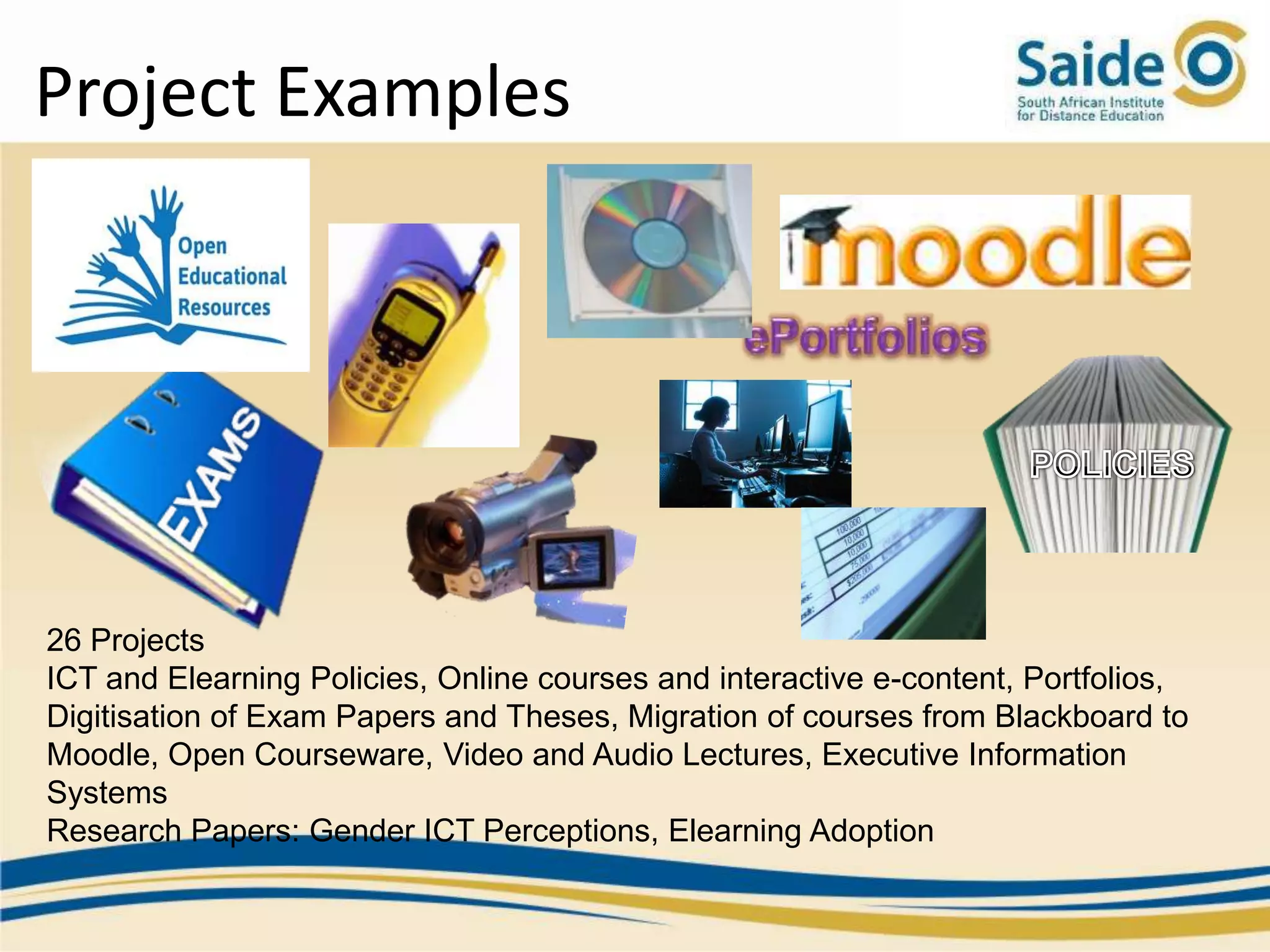
Project Examples


26 Projects
ICT and Elearning Policies, Online courses and interactive e-content, Portfolios,
Digitisation of Exam Papers and Theses, Migration of courses from Blackboard to
Moodle, Open Courseware, Video and Audio Lectures, Executive Information
Systems
Research Papers: Gender ICT Perceptions, Elearning Adoption
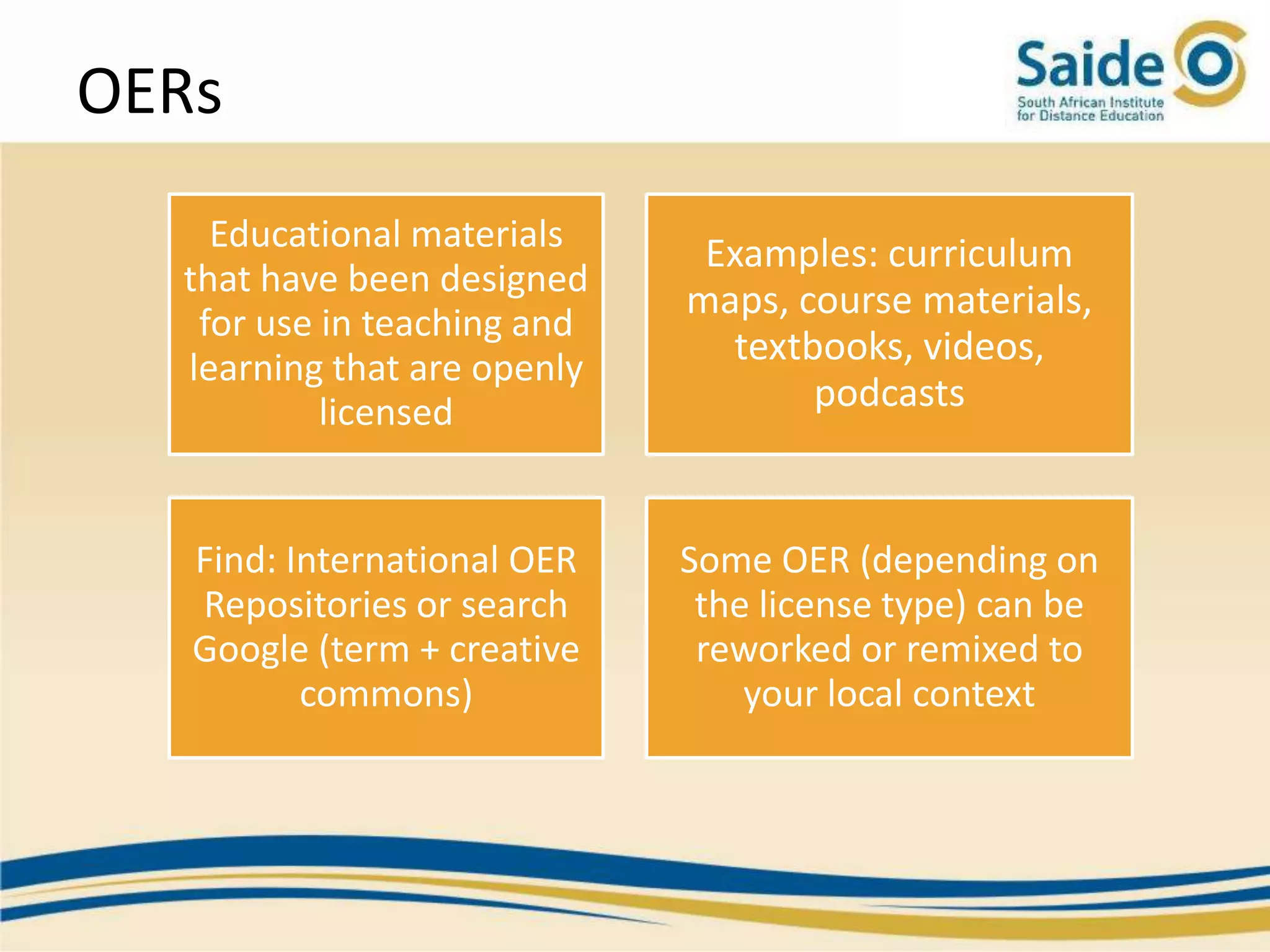
OERs
    Educational materials     Examples: curriculum
  that have been designed
                             maps, course materials,
   for use in teaching and
  learning that are openly
                               textbooks, videos,
           licensed                 podcasts


   Find: International OER   Some OER (depending on
   Repositories or search     the license type) can be
   Google (term + creative    reworked or remixed to
          commons)               your local context
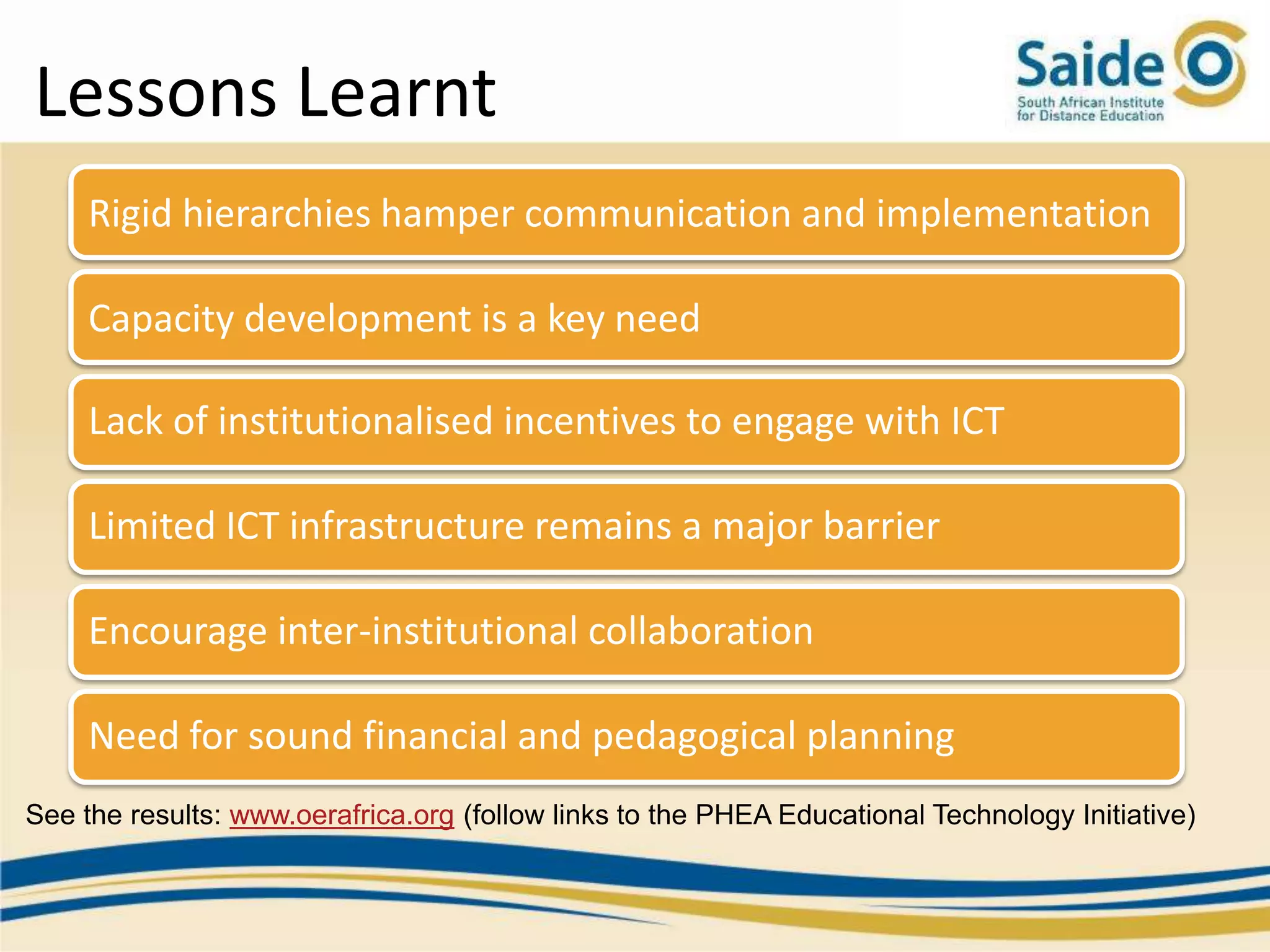
Lessons Learnt
     Rigid hierarchies hamper communication and implementation

     Capacity development is a key need

     Lack of institutionalised incentives to engage with ICT

     Limited ICT infrastructure remains a major barrier

     Encourage inter-institutional collaboration

     Need for sound financial and pedagogical planning
See the results: www.oerafrica.org (follow links to the PHEA Educational Technology Initiative)
Conclusions
 Basic problems such as limited bandwidth and intermittent
 electricity place significant limitations on the potential for
 growth
 However…
 • Telecommunications capacity is growing rapidly
 • Expanding range of devices at reducing costs
 • Explosion of available quality content online that educators
    and students can link to
 • Need governments and institutions to continue investment
    and focus on ICT use in FET
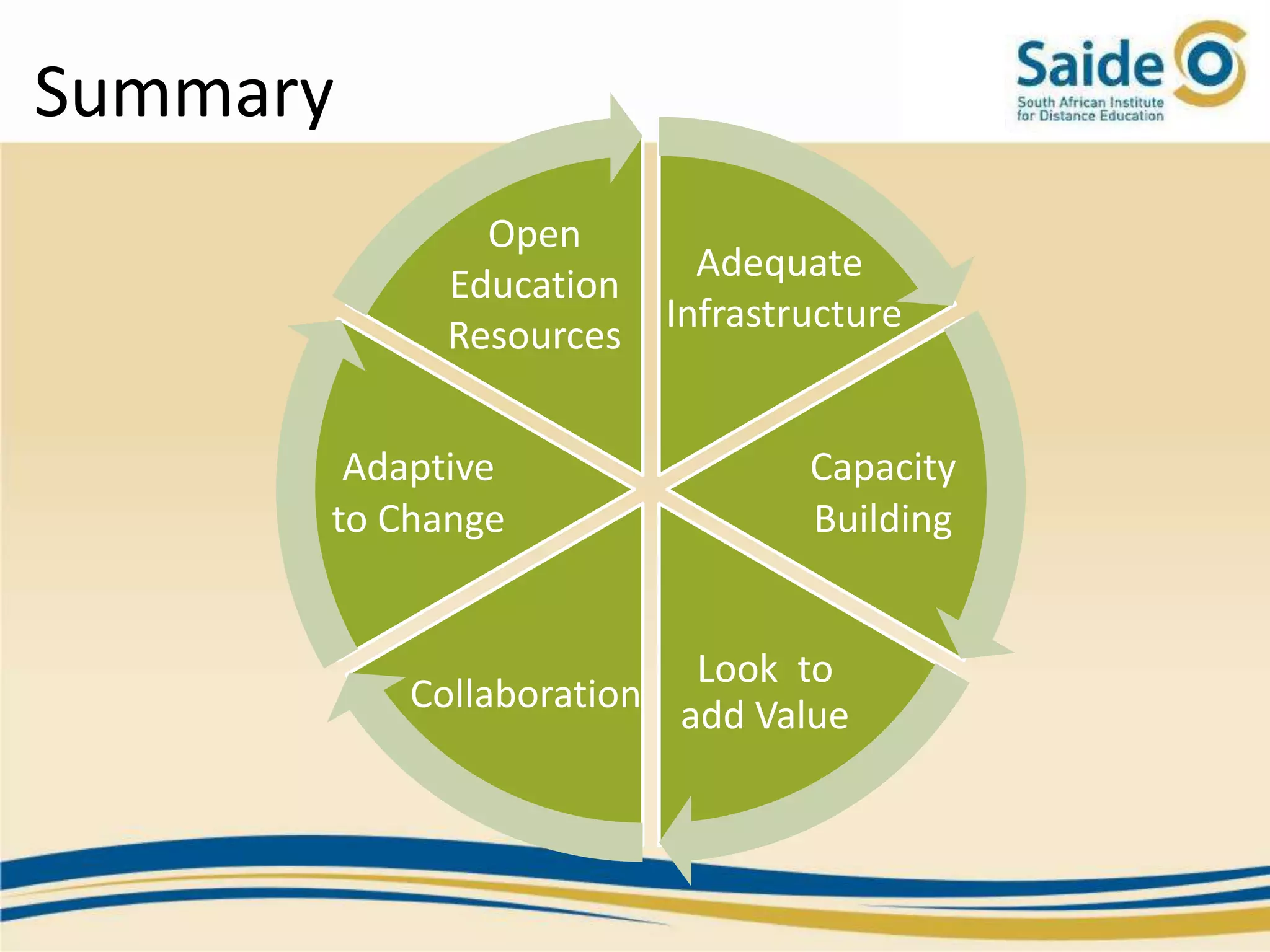
Summary
              Open
                          Adequate
            Education
                        Infrastructure
            Resources


       Adaptive                 Capacity
      to Change                 Building


                         Look to
          Collaboration
                        add Value
Discussion

                       Thank you
      greigk@saide.org.za             marylab@saide.org.za
      greigk_za                       Maryla Bialobrzeska
      Greig Krull


                       www.saide.org.za
                       www.oerafrica.org

             This work is licensed under a
             Creative Commons Attribution 3.0 Unported License.
References
 • Johnson, L, Adams, S, and Cummins, M (2012). The NMC Horizon Report:
   2012 Higher Education Edition. Austin, Texas: The New Media Consortium.
 • Isaacs, S and Hollow, D, (eds) 2012. The eLearning Africa 2012 Report,
   ICWE: Germany.
 • Commonwealth of Learning. 2009. ICTs for higher education: background
   paper from the Commonwealth of Learning. World Conference on Higher
   Education, Paris.
 • OER Africa: http://www.oerafrica.org/
 • PHEA ETI:
   http://www.oerafrica.org/phea/PHEAETIProjectHome/tabid/170/Default.
   aspx
 • http://c4lpt.co.uk/top-100-tools-for-learning-2011/
 • Tony Mays, Saide, 2012, Recapping OER Presentation

ICT Integration in South African FET Colleges

  • 1.
    An approach tothe use of ICT in South African FET Colleges: Lessons from Experience Greig Krull and Maryla Bialobrzeska Saide North-South VET ICT Conference 25 – 27 September 2012
  • 2.
    Agenda • Context– Motivators and Constraints • ICT Integration in the FET Areas – Teaching, Administration, Communication • Challenges and Opportunities – Environment, Institution, People, Technology, Learning • Case Study: Approach to ICT Integration • Discussion
  • 3.
    Overarching Context inFET Improve quality of teaching and learning to promote student success rates and employability Significantly increased participation
  • 4.
    Context 1. What isyour biggest motivator to integrate ICT into your teaching and learning? 2. What is your biggest constraint to integrate ICT into your teaching and learning?
  • 5.
  • 7.
    ICTs in FETAreas Administration Teaching VLEs, eContent, eAssessment, Records, Finance, Management Support Communication Comm Tools, Social Networking
  • 8.
    Top 100 Toolsfor Learning in 2011 Note: • Number of web apps • Number of “non- educational” apps • Number of Social networking tools What are your most useful tools…? © 2012 Centre for Learning & Performance Technologies
  • 9.
    Types of Challenges Environment Institutions People Technology Teaching and Learning
  • 10.
    Environment Challenges Opportunities Limited Regional Infrastructure Partnerships between institutions, governments - Electricity and businesses - Access to resources Sustainability Articulate a vision and a strategic framework for harnessing the potential of ICTs to address a country's development challenges Policy Implementation Overarching and guiding national telecommunications and ICT policies, particularly as they relate to ICTs in education
  • 11.
    People Challenges Opportunities ICT Literacy of Lecturers and On-going Professional Development Readiness Provide prior training when introducing ICTs Extra effort and time involved Implement incentive systems that promote the in using technologies use of ICTs Lack of readiness of students Provide support and training for students to use technologies Shortage of people with Develop internal capacity in the use of ICT technical skills to maintain ICT systems
  • 12.
    Institutions Challenges Opportunities ICT Integration • Vision and commitment of the leadership to deploying ICTs • Included in strategic and operational plans Major financial investment Require strong institutional policy and planning needed (resource allocation) High cost of acquiring and • National/Provincial approach for joint maintaining ICTs negotiations on the cost of bandwidth • Identify ways in which ICTs will significantly enhance admin and teaching capabilities High cost of content Look for freely available resources e.g. Open Education Resources Consistency across campuses Centralised units and colleges
  • 13.
    Technology Challenges Opportunities Reliability and Security • Create a technology plan (includes long term budget) • Funds and staff available to sustain investments in ICT infrastructure and support systems System / Data Integration • Piloting (test the efficacy of a technology) • Possible sharing or coordination of ICT usage with other institutions Inexperience in procuring Understand total ownership cost (acquisition, appropriate ICT installation, power supply, maintenance, replacement, training etc) Limited bandwidth Enhance bandwidth/connectivity through the acquisition of suitable infrastructure
  • 14.
    Teaching, Learning &Student Support Challenges Opportunities Student Readiness Academic and Technical Support Constrained Staff Capacity • Shift to resource based learning • Focus on good quality learning resources • College Collaboration Quality Resources Access to OER Programme Delivery Flexible delivery methods – online, blended, distance
  • 15.
    Case Study: Approachto Integration Partnership for Higher Education in Africa (PHEA) Educational Technology Initiative (ETI)
  • 16.
    Project Objective “To support interventions in universities to make increasingly effective use of educational technology to address some of the underlying educational challenges facing the higher educational sector in Africa” Strategic objectives : • Support initiatives that integrate educational technology • Promote collaborative knowledge creation and dissemination • Refine institutional systems to more directly support teaching • Research and report on educational technology activity
  • 17.
    Universities Involved University of Education Winneba (Ghana) Kenyatta University University of Jos Makerere (Kenya) (Nigeria) University University of Dar es University of (Uganda) Salaam (Tanzania) Ibadan (Nigeria) Catholic University of Mozambique 26 distinct sub-projects across 7 HEIs over 3 years
  • 18.
    Project Examples 26 Projects ICTand Elearning Policies, Online courses and interactive e-content, Portfolios, Digitisation of Exam Papers and Theses, Migration of courses from Blackboard to Moodle, Open Courseware, Video and Audio Lectures, Executive Information Systems Research Papers: Gender ICT Perceptions, Elearning Adoption
  • 19.
    OERs Educational materials Examples: curriculum that have been designed maps, course materials, for use in teaching and learning that are openly textbooks, videos, licensed podcasts Find: International OER Some OER (depending on Repositories or search the license type) can be Google (term + creative reworked or remixed to commons) your local context
  • 20.
    Lessons Learnt Rigid hierarchies hamper communication and implementation Capacity development is a key need Lack of institutionalised incentives to engage with ICT Limited ICT infrastructure remains a major barrier Encourage inter-institutional collaboration Need for sound financial and pedagogical planning See the results: www.oerafrica.org (follow links to the PHEA Educational Technology Initiative)
  • 21.
    Conclusions Basic problemssuch as limited bandwidth and intermittent electricity place significant limitations on the potential for growth However… • Telecommunications capacity is growing rapidly • Expanding range of devices at reducing costs • Explosion of available quality content online that educators and students can link to • Need governments and institutions to continue investment and focus on ICT use in FET
  • 22.
    Summary Open Adequate Education Infrastructure Resources Adaptive Capacity to Change Building Look to Collaboration add Value
  • 23.
    Discussion Thank you greigk@saide.org.za marylab@saide.org.za greigk_za Maryla Bialobrzeska Greig Krull www.saide.org.za www.oerafrica.org This work is licensed under a Creative Commons Attribution 3.0 Unported License.
  • 24.
    References • Johnson,L, Adams, S, and Cummins, M (2012). The NMC Horizon Report: 2012 Higher Education Edition. Austin, Texas: The New Media Consortium. • Isaacs, S and Hollow, D, (eds) 2012. The eLearning Africa 2012 Report, ICWE: Germany. • Commonwealth of Learning. 2009. ICTs for higher education: background paper from the Commonwealth of Learning. World Conference on Higher Education, Paris. • OER Africa: http://www.oerafrica.org/ • PHEA ETI: http://www.oerafrica.org/phea/PHEAETIProjectHome/tabid/170/Default. aspx • http://c4lpt.co.uk/top-100-tools-for-learning-2011/ • Tony Mays, Saide, 2012, Recapping OER Presentation

Editor's Notes

  • #6 21st century skills -Critical thinking and problem solving, Communication, Collaboration, and Creativity and innovation, Technology and Life skills
  • #7 Major constraints:Bandwidth, Limited electricity, Financial resources, Human resources, Hardware, Training
  • #8 Teaching - Virtual Learning Environments (VLEs) - Content dissemination and student support, Online AssessmentComms - Growing interest in the social networking in education working sites, wikis, communication tools and folksonomiesAdmin - systems for: admission and records, examination and transcripts, finance and management information
  • #9 5th Annual Survey of Learning Tools,compiled from the Top 10 Tools lists of 531 learning professionals worldwide Implications – number of web applications, few education applications
  • #11 Provide a sense of focus and direction Spell out clearly how improving the ICT capacity of the education sector can help to address issues of access, equity and quality at all levels. Enable institutions to generate their own internal ICT policies, strategies and plans, they also foster an appropriate allocation of resources.
  • #12 Since students are often more familiar with these technologies than they areProvide a sense of focus and direction and spell out clearly how improving the ICT capacity of the education sector can help to address issues of access, equity and quality at all levels. Enable institutions to generate their own internal ICT policies, strategies and plans, they also foster an appropriate allocation of resources.
  • #13 foster appropriate allocation of resources determine sustainable staffing issues and faculty roles Enable institutions to generate their own internal ICT policies, strategies and plansFunding, talentInstitutional policies and procedures for adopting and adapting technology
  • #14 Build staff capacity in the areas of ICT procurement and contracting Use of unlicensed software an issue
  • #15 Technology is of little use if the pedagogical skills needed to effectively and optimally use it are lackingDo not underestimate the effective interaction of students with content, fellow students and teachers/tutors during the learning processRequires a paradigm shift to a process that promotes interaction, communication, collaboration and construction
  • #18 26 distinct sub-projects across 7 HEIs over 3 years
  • #19 27 ProjectsICT and Elearning Policies, Online courses and interactive e-content, Portfolios, Digitisation of Exam Papers and ThesesMigration of courses from Blackboard to Moodle, Open Courseware,Video and Audio Lectures, Executive Information SystemsResearch Papers: Gender ICT Perceptions, Elearning AdoptionInstitutional commitments to ICT growing Strong focus on deployment of ICT to tackle challenges: using Moodle, other technologies (mobile, radio, e-portfolios)Extensive growth in number of online courses produced, Growing use of online courses on campuses
  • #21 Projects : have specific and realistic deliverables and link to already identified institutional prioritiesInstitutional commitment to ICT needed through presence of supportive ICT policies and ICT Funding
  • #23 The integration of ICTs in higher education is inevitableICT is moving beyond personal computers to mobile technology, Virtual World, Cloud Computing Role of ICTs in improving quality, widening access and cutting costs in the teaching functionTechnology must be seen as a supportive toolThe use of technology needs to add valueLook to integrate emerging technologies into policies and programmes Identify the specific roles of ICT in enhancing research and learning capabilities Provide for adequate infrastructure - backed by capacity buildingEnhance ICT though inter-institutional collaboration Wide adoption of ICTs calls for mindsets and skill sets that are adaptive to change