

2020:
Leveraging IT to achieve
USHE’s goals
IT Opportunity in HE
 The current model for HE may
become financially unsustainable,
making college increasingly
inaccessible to students.
 Technology is a disruptive force to HE.
 Technology (when strategically and
practically applied) provides increased
accessibility and quality to HE.
 Current progress at USHE institutions.
 Possible Regents’ recommendations.
IT Opportunity in HE
 The current model for HE may
become financially unsustainable,
making college increasingly
inaccessible to students.
 Technology is a disruptive force to HE.
 Technology (when strategically and
practically applied) provides increased
accessibility and quality to HE.
 Current progress at USHE institutions.
 Regents’ recommendations for future.
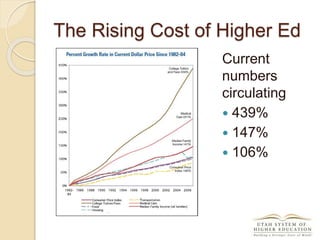
The Rising Cost of Higher Ed
Current
numbers
circulating
 439%
 147%
 106%
Impact of the Recession
 ↓ Budgets
 ↑ Tuition, ↑ student debt
 ↑ Tuition dependency
 ↓ State resources allocated
 ↑ Reliance on private and federal funding
 ↓ Access (low income, first generation
students)
 ↓ Reduction in student completion rates
 New normal is cost management and greater
productivity
 Financing problems are structural, not short-
term
Thriving in the Paradox of HE
 To survive the university and colleges
must break with tradition,
◦ but to thrive they must build on what they
have always done best.
 Technology investment in teaching,
administration, research and public
service can bring down the cost and
improve quality.
Clayton Christensen Manuscript: University DNA
Speaking of Harvard University
IT Opportunity in HE
 The current model for HE may
become financially unsustainable,
making college increasingly
inaccessible to students.
 Technology is a disruptive force to HE.
 Technology (when strategically and
practically applied) provides increased
accessibility and quality to HE.
 Current progress at USHE institutions.
 Regents’ recommendations for future.
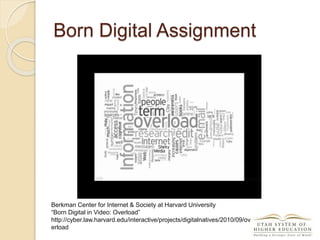
Berkman Center for Internet & Society at Harvard University
“Born Digital in Video: Overload”
http://cyber.law.harvard.edu/interactive/projects/digitalnatives/2010/09/ov
erload
Born Digital Assignment
Disruptive technology
“Disruption is a positive force. It is the
process by which an innovation
(technology) transforms a market
whose services or products are
complicated and expensive into one
where simplicity, convenience,
accessibility and affordability
characterize the industry.”
Clayton Christensen: Disrupting Class
Top 10 New Disruptive
Technologies Impacting Higher
Education
 Cloud computing
 Mobile phones and tablet devices
 Social communication and collaboration
 Social analytics
 Video, interactive, streamed and on demand
 Context aware computing
 Flash memory
 Ubiquitous computing
 Electronic Textbooks
 Improved Learning Management Systems
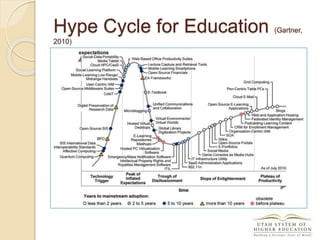
Hype Cycle for Education (Gartner,
2010)
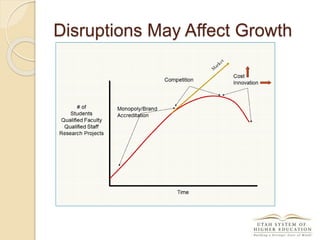
Disruptions May Affect Growth
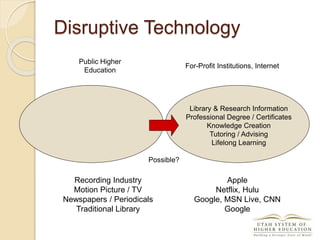
Disruptive Technology
Public Higher
Education
For-Profit Institutions, Internet
Library & Research Information
Professional Degree / Certificates
Tutoring / Advising
Knowledge Creation
Lifelong Learning
Library & Research Information
Professional Degree / Certificates
Knowledge Creation
Tutoring / Advising
Lifelong Learning
Possible?
Recording Industry
Motion Picture / TV
Newspapers / Periodicals
Traditional Library
Apple
Netflix, Hulu
Google, MSN Live, CNN
Google
Bill Gates’ View on HE Future
 Five years from now, on the web for
free, you’ll be able to find the best
lectures in the world
 College needs to be less “place-
based”
 University education is just too
expensive
 Technology is the only way to bring
education cost back under control and
expand access.
Bill Gates
Most HE Services are Online
 Courses
 Libraries
 Labs
 Text books
 Classrooms
 Administrative processes and services
in HR, finance, students, etc.
Competition
 Online and commercial courses,
modules, objects
 For-profit colleges offering a blended,
flexible experience
 Google digitizing all scholarly books,
periodicals, AV materials
 Search engines, answer engines
 Offerings that satisfy student as
consumer
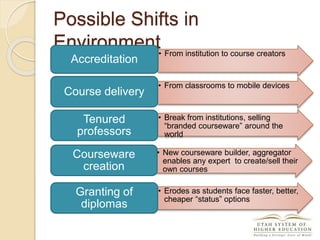
Possible Shifts in
Environment• From institution to course creators
Accreditation
• From classrooms to mobile devices
Course delivery
• Break from institutions, selling
“branded courseware” around the
world
Tenured
professors
• New courseware builder, aggregator
enables any expert to create/sell their
own courses
Courseware
creation
• Erodes as students face faster, better,
cheaper “status” options
Granting of
diplomas
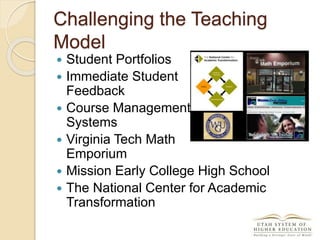
Challenging the Teaching
Model
 Student Portfolios
 Immediate Student
Feedback
 Course Management
Systems
 Virginia Tech Math
Emporium
 Mission Early College High School
 The National Center for Academic
Transformation
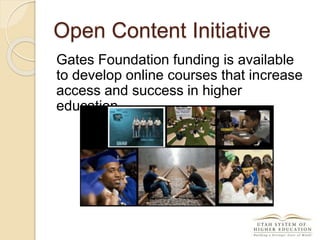
Open Content Initiative
Gates Foundation funding is available
to develop online courses that increase
access and success in higher
education.
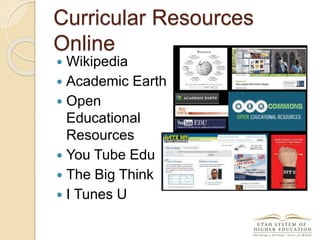
Curricular Resources
Online
 Wikipedia
 Academic Earth
 Open
Educational
Resources
 You Tube Edu
 The Big Think
 I Tunes U
Engaging the Classroom
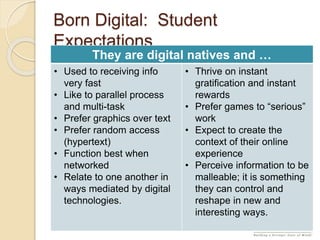
Born Digital: Student
Expectations
They are digital natives and …
• Used to receiving info
very fast
• Like to parallel process
and multi-task
• Prefer graphics over text
• Prefer random access
(hypertext)
• Function best when
networked
• Relate to one another in
ways mediated by digital
technologies.
• Thrive on instant
gratification and instant
rewards
• Prefer games to “serious”
work
• Expect to create the
context of their online
experience
• Perceive information to be
malleable; it is something
they can control and
reshape in new and
interesting ways.
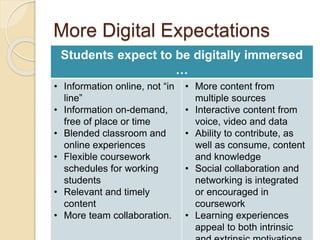
More Digital Expectations
Students expect to be digitally immersed
…
• Information online, not “in
line”
• Information on-demand,
free of place or time
• Blended classroom and
online experiences
• Flexible coursework
schedules for working
students
• Relevant and timely
content
• More team collaboration.
• More content from
multiple sources
• Interactive content from
voice, video and data
• Ability to contribute, as
well as consume, content
and knowledge
• Social collaboration and
networking is integrated
or encouraged in
coursework
• Learning experiences
appeal to both intrinsic
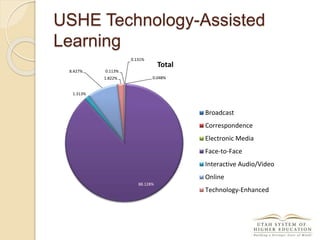
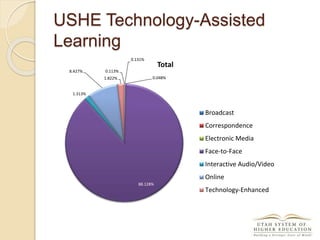
USHE Technology-Assisted
Learning
0.113%
0.131%
0.048%
88.128%
1.313%
8.427%
1.822%
Total
Broadcast
Correspondence
Electronic Media
Face-to-Face
Interactive Audio/Video
Online
Technology-Enhanced
IT Opportunity in HE
 The current model for HE may
become financially unsustainable,
making college increasingly
inaccessible to students.
 Technology is a disruptive force to HE.
 Technology (when strategically and
practically applied) provides increased
accessibility and quality to HE.
 Current progress at USHE institutions.
 Regents’ recommendations for future.
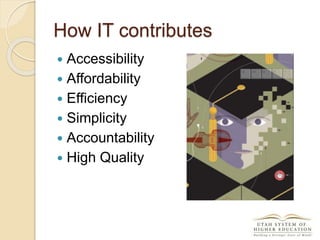
How IT contributes
 Accessibility
 Affordability
 Efficiency
 Simplicity
 Accountability
 High Quality
How IT Contributes
Move
Online
• Move most processes, applications and services online.
• Move selected courses online.
• Once online they are accessible any time and any place.
Savings
• Save time, travel and other expenses.
• Fewer buildings, parking , roads
• Shorter process times, fewer people needed to administer.
• Provide data/key indicators of success delivered in timely
reports and dashboards.
Outcomes
• Accessibility Affordability
• Efficiency Simplicity
• Accountability High Quality
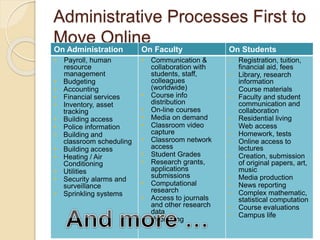
Administrative Processes First to
Move Online
On Administration On Faculty On Students
• Payroll, human
resource
management
• Budgeting
• Accounting
• Financial services
• Inventory, asset
tracking
• Building access
• Police information
• Building and
classroom scheduling
• Building access
• Heating / Air
Conditioning
• Utilities
• Security alarms and
surveillance
• Sprinkling systems
• Communication &
collaboration with
students, staff,
colleagues
(worldwide)
• Course info
distribution
• On-line courses
• Media on demand
• Classroom video
capture
• Classroom network
access
• Student Grades
• Research grants,
applications
submissions
• Computational
research
• Access to journals
and other research
data
• Publishing
• Registration, tuition,
financial aid, fees
• Library, research
information
• Course materials
• Faculty and student
communication and
collaboration
• Residential living
• Web access
• Homework, tests
• Online access to
lectures
• Creation, submission
of original papers, art,
music
• Media production
• News reporting
• Complex mathematic,
statistical computation
• Course evaluations
• Campus life
Teaching and Learning is Now
Moving Online
 Reduce costs of teaching to $1000/ credit
hr.
 Learning outcomes comparable to
traditional classroom outcomes.
 Reduce cost of delivering a full four-degree
to less than $13,000.
◦ compared to price of $ 28,000 to $106,000 at the
typical public or private institutions, respectively.
 Obtain savings on, buildings, parking lots
etc. and the student’s convenience.
Clayton Christensen Manuscript: University DNA
New Teaching Technologies
Address:Recruiting
• Online summer offerings
• Student CRM
• Active-duty Military, students
• Apply Yourself
• College Web Sites with Department Pre-
requisites
Academic Costs
• Mandatory Blended Course Conversions
• Tiered Instructional Support
• Outsourced Instructional Support
• Course Consortia (state, peer institution,
discipline specific)
• Peer Institution & Discipline-specific
Online Course Consortia
Access and Student Success
• Online and Hybrid Core Requirements
• Fully Online Undergrad degrees
• Online Dual Credit Courses
• Student-centered Course Design
• Pre-Matriculation Developmental Courses
• Online Degree Completion Programs
Student Learning
• Web-mediated Learning Resources
• Multi-site Study Abroad Courses
• Global Guest Faculty
• Online-only Faculty Hires
• Semester-Online Teaching Option
IT Goals to Support USHE
2020
 ↑ student participation
 ↑ student completion
 ↑ the level of economic innovation
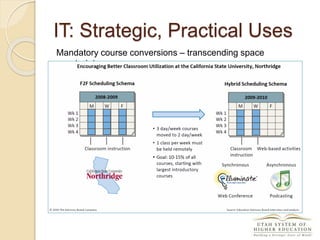
Mandatory course conversions – transcending space
constraints
IT: Strategic, Practical Uses
IT: Strategic, Practical
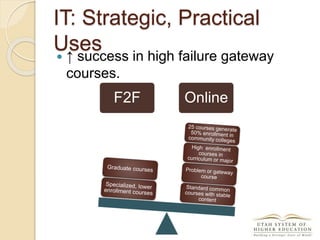
Uses ↑ success in high failure gateway
courses.
F2F Online
Strategic, Practical
Objectives to Achieve 2020
Goals Employ online faculty
 Help students overcome educational
interruptions (Degree Audit Programs)
 Provide expanded transcripts
 Join Open Content Initiative
 Provide a portal for easy access to
courses at little/no cost. (UEN)
 Negotiate state contracts for electronic
text books (UEN).
IT Opportunity in HE
 The current model for HE may
become financially unsustainable,
making college increasingly
inaccessible to students.
 Technology is a disruptive force to HE.
 Technology (when strategically and
practically applied) provides increased
accessibility and quality to HE.
 Current progress at USHE institutions.
 Regents’ recommendations for future.
USHE Technology-Assisted
Learning
0.113%
0.131%
0.048%
88.128%
1.313%
8.427%
1.822%
Total
Broadcast
Correspondence
Electronic Media
Face-to-Face
Interactive Audio/Video
Online
Technology-Enhanced
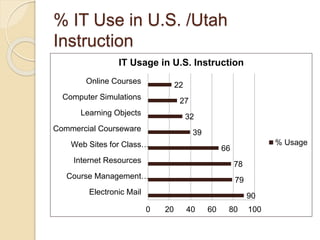
% IT Use in U.S. /Utah
Instruction
90
79
78
66
39
32
27
22
0 20 40 60 80 100
Electronic Mail
Course Management…
Internet Resources
Web Sites for Class…
Commercial Courseware
Learning Objects
Computer Simulations
Online Courses
IT Usage in U.S. Instruction
% Usage
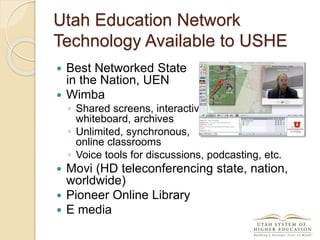
Utah Education Network
Technology Available to USHE
 Best Networked State
in the Nation, UEN
 Wimba
◦ Shared screens, interactive
whiteboard, archives
◦ Unlimited, synchronous,
online classrooms
◦ Voice tools for discussions, podcasting, etc.
 Movi (HD teleconferencing state, nation,
worldwide)
 Pioneer Online Library
 E media
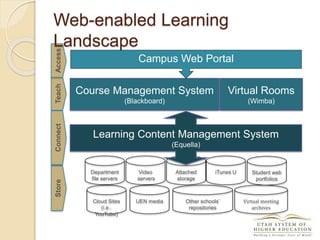
Attached
storage
Other schools’
repositories
UEN media
Video
servers
iTunes U
Virtual meeting
archives
Department
file servers
Cloud Sites
(i.e..
YouTube)
Learning Content Management System
(Equella)
Course Management System
(Blackboard)
TeachStoreConnectAccess Campus Web Portal
Virtual Rooms
(Wimba)
Student web
portfolios
Web-enabled Learning
Landscape
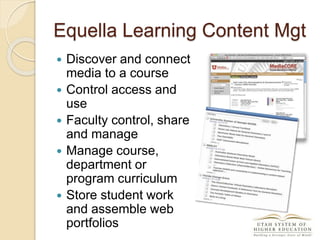
Equella Learning Content Mgt
 Discover and connect
media to a course
 Control access and
use
 Faculty control, share
and manage
 Manage course,
department or
program curriculum
 Store student work
and assemble web
portfolios
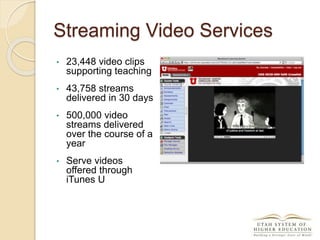
Streaming Video Services
• 23,448 video clips
supporting teaching
• 43,758 streams
delivered in 30 days
• 500,000 video
streams delivered
over the course of a
year
• Serve videos
offered through
iTunes U
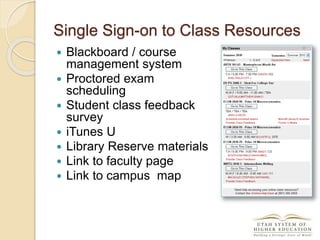
Single Sign-on to Class Resources
 Blackboard / course
management system
 Proctored exam
scheduling
 Student class feedback
survey
 iTunes U
 Library Reserve materials
 Link to faculty page
 Link to campus map
IT Opportunity in HE
 The current model for HE may
become financially unsustainable,
making college increasingly
inaccessible to students.
 Technology (when strategically and
practically applied) provides increased
accessibility and quality to HE.
 Current progress at USHE institutions.
 Technology is a disruptive force to HE.
 Regents’ recommendations for future.
Recommendations
 Invest in strategic technology and its practical
application.
 Hire people who are digital natives or
successful immigrants.
 Include technology and student achievement
in campus master plans.
 Collaborate on the development and use of
strategic online courses.
 Provide financial & RPT incentives for
providing higher-quality, technologically
delivered courses and services.
 Take advantage of the national open content,
cloud and software initiatives.
A Next Step:
Universities and colleges
will present their specific technology
accomplishments in December
2010.
Technology layered on top of old paper, people
centered processes will not always reduce costs.
QUESTIONS?
COMMENTS?
stephen.hess@utah.edu

Leveraging IT to Achieve USHE's Goals

  • 1.
    2020: Leveraging IT toachieve USHE’s goals
  • 2.
    IT Opportunity inHE  The current model for HE may become financially unsustainable, making college increasingly inaccessible to students.  Technology is a disruptive force to HE.  Technology (when strategically and practically applied) provides increased accessibility and quality to HE.  Current progress at USHE institutions.  Possible Regents’ recommendations.
  • 3.
    IT Opportunity inHE  The current model for HE may become financially unsustainable, making college increasingly inaccessible to students.  Technology is a disruptive force to HE.  Technology (when strategically and practically applied) provides increased accessibility and quality to HE.  Current progress at USHE institutions.  Regents’ recommendations for future.
  • 4.
    The Rising Costof Higher Ed Current numbers circulating  439%  147%  106%
  • 5.
    Impact of theRecession  ↓ Budgets  ↑ Tuition, ↑ student debt  ↑ Tuition dependency  ↓ State resources allocated  ↑ Reliance on private and federal funding  ↓ Access (low income, first generation students)  ↓ Reduction in student completion rates  New normal is cost management and greater productivity  Financing problems are structural, not short- term
  • 6.
    Thriving in theParadox of HE  To survive the university and colleges must break with tradition, ◦ but to thrive they must build on what they have always done best.  Technology investment in teaching, administration, research and public service can bring down the cost and improve quality. Clayton Christensen Manuscript: University DNA Speaking of Harvard University
  • 7.
    IT Opportunity inHE  The current model for HE may become financially unsustainable, making college increasingly inaccessible to students.  Technology is a disruptive force to HE.  Technology (when strategically and practically applied) provides increased accessibility and quality to HE.  Current progress at USHE institutions.  Regents’ recommendations for future.
  • 8.
    Berkman Center forInternet & Society at Harvard University “Born Digital in Video: Overload” http://cyber.law.harvard.edu/interactive/projects/digitalnatives/2010/09/ov erload Born Digital Assignment
  • 9.
    Disruptive technology “Disruption isa positive force. It is the process by which an innovation (technology) transforms a market whose services or products are complicated and expensive into one where simplicity, convenience, accessibility and affordability characterize the industry.” Clayton Christensen: Disrupting Class
  • 10.
    Top 10 NewDisruptive Technologies Impacting Higher Education  Cloud computing  Mobile phones and tablet devices  Social communication and collaboration  Social analytics  Video, interactive, streamed and on demand  Context aware computing  Flash memory  Ubiquitous computing  Electronic Textbooks  Improved Learning Management Systems
  • 11.
    Hype Cycle forEducation (Gartner, 2010)
  • 12.
  • 13.
    Disruptive Technology Public Higher Education For-ProfitInstitutions, Internet Library & Research Information Professional Degree / Certificates Tutoring / Advising Knowledge Creation Lifelong Learning Library & Research Information Professional Degree / Certificates Knowledge Creation Tutoring / Advising Lifelong Learning Possible? Recording Industry Motion Picture / TV Newspapers / Periodicals Traditional Library Apple Netflix, Hulu Google, MSN Live, CNN Google
  • 14.
    Bill Gates’ Viewon HE Future  Five years from now, on the web for free, you’ll be able to find the best lectures in the world  College needs to be less “place- based”  University education is just too expensive  Technology is the only way to bring education cost back under control and expand access. Bill Gates
  • 15.
    Most HE Servicesare Online  Courses  Libraries  Labs  Text books  Classrooms  Administrative processes and services in HR, finance, students, etc.
  • 16.
    Competition  Online andcommercial courses, modules, objects  For-profit colleges offering a blended, flexible experience  Google digitizing all scholarly books, periodicals, AV materials  Search engines, answer engines  Offerings that satisfy student as consumer
  • 17.
    Possible Shifts in Environment•From institution to course creators Accreditation • From classrooms to mobile devices Course delivery • Break from institutions, selling “branded courseware” around the world Tenured professors • New courseware builder, aggregator enables any expert to create/sell their own courses Courseware creation • Erodes as students face faster, better, cheaper “status” options Granting of diplomas
  • 18.
    Challenging the Teaching Model Student Portfolios  Immediate Student Feedback  Course Management Systems  Virginia Tech Math Emporium  Mission Early College High School  The National Center for Academic Transformation
  • 19.
    Open Content Initiative GatesFoundation funding is available to develop online courses that increase access and success in higher education.
  • 20.
    Curricular Resources Online  Wikipedia Academic Earth  Open Educational Resources  You Tube Edu  The Big Think  I Tunes U
  • 21.
  • 22.
    Born Digital: Student Expectations Theyare digital natives and … • Used to receiving info very fast • Like to parallel process and multi-task • Prefer graphics over text • Prefer random access (hypertext) • Function best when networked • Relate to one another in ways mediated by digital technologies. • Thrive on instant gratification and instant rewards • Prefer games to “serious” work • Expect to create the context of their online experience • Perceive information to be malleable; it is something they can control and reshape in new and interesting ways.
  • 23.
    More Digital Expectations Studentsexpect to be digitally immersed … • Information online, not “in line” • Information on-demand, free of place or time • Blended classroom and online experiences • Flexible coursework schedules for working students • Relevant and timely content • More team collaboration. • More content from multiple sources • Interactive content from voice, video and data • Ability to contribute, as well as consume, content and knowledge • Social collaboration and networking is integrated or encouraged in coursework • Learning experiences appeal to both intrinsic
  • 24.
  • 25.
    IT Opportunity inHE  The current model for HE may become financially unsustainable, making college increasingly inaccessible to students.  Technology is a disruptive force to HE.  Technology (when strategically and practically applied) provides increased accessibility and quality to HE.  Current progress at USHE institutions.  Regents’ recommendations for future.
  • 26.
    How IT contributes Accessibility  Affordability  Efficiency  Simplicity  Accountability  High Quality
  • 27.
    How IT Contributes Move Online •Move most processes, applications and services online. • Move selected courses online. • Once online they are accessible any time and any place. Savings • Save time, travel and other expenses. • Fewer buildings, parking , roads • Shorter process times, fewer people needed to administer. • Provide data/key indicators of success delivered in timely reports and dashboards. Outcomes • Accessibility Affordability • Efficiency Simplicity • Accountability High Quality
  • 28.
    Administrative Processes Firstto Move Online On Administration On Faculty On Students • Payroll, human resource management • Budgeting • Accounting • Financial services • Inventory, asset tracking • Building access • Police information • Building and classroom scheduling • Building access • Heating / Air Conditioning • Utilities • Security alarms and surveillance • Sprinkling systems • Communication & collaboration with students, staff, colleagues (worldwide) • Course info distribution • On-line courses • Media on demand • Classroom video capture • Classroom network access • Student Grades • Research grants, applications submissions • Computational research • Access to journals and other research data • Publishing • Registration, tuition, financial aid, fees • Library, research information • Course materials • Faculty and student communication and collaboration • Residential living • Web access • Homework, tests • Online access to lectures • Creation, submission of original papers, art, music • Media production • News reporting • Complex mathematic, statistical computation • Course evaluations • Campus life
  • 29.
    Teaching and Learningis Now Moving Online  Reduce costs of teaching to $1000/ credit hr.  Learning outcomes comparable to traditional classroom outcomes.  Reduce cost of delivering a full four-degree to less than $13,000. ◦ compared to price of $ 28,000 to $106,000 at the typical public or private institutions, respectively.  Obtain savings on, buildings, parking lots etc. and the student’s convenience. Clayton Christensen Manuscript: University DNA
  • 30.
    New Teaching Technologies Address:Recruiting •Online summer offerings • Student CRM • Active-duty Military, students • Apply Yourself • College Web Sites with Department Pre- requisites Academic Costs • Mandatory Blended Course Conversions • Tiered Instructional Support • Outsourced Instructional Support • Course Consortia (state, peer institution, discipline specific) • Peer Institution & Discipline-specific Online Course Consortia Access and Student Success • Online and Hybrid Core Requirements • Fully Online Undergrad degrees • Online Dual Credit Courses • Student-centered Course Design • Pre-Matriculation Developmental Courses • Online Degree Completion Programs Student Learning • Web-mediated Learning Resources • Multi-site Study Abroad Courses • Global Guest Faculty • Online-only Faculty Hires • Semester-Online Teaching Option
  • 31.
    IT Goals toSupport USHE 2020  ↑ student participation  ↑ student completion  ↑ the level of economic innovation
  • 32.
    Mandatory course conversions– transcending space constraints IT: Strategic, Practical Uses
  • 33.
    IT: Strategic, Practical Uses↑ success in high failure gateway courses. F2F Online
  • 34.
    Strategic, Practical Objectives toAchieve 2020 Goals Employ online faculty  Help students overcome educational interruptions (Degree Audit Programs)  Provide expanded transcripts  Join Open Content Initiative  Provide a portal for easy access to courses at little/no cost. (UEN)  Negotiate state contracts for electronic text books (UEN).
  • 35.
    IT Opportunity inHE  The current model for HE may become financially unsustainable, making college increasingly inaccessible to students.  Technology is a disruptive force to HE.  Technology (when strategically and practically applied) provides increased accessibility and quality to HE.  Current progress at USHE institutions.  Regents’ recommendations for future.
  • 36.
  • 37.
    % IT Usein U.S. /Utah Instruction 90 79 78 66 39 32 27 22 0 20 40 60 80 100 Electronic Mail Course Management… Internet Resources Web Sites for Class… Commercial Courseware Learning Objects Computer Simulations Online Courses IT Usage in U.S. Instruction % Usage
  • 38.
    Utah Education Network TechnologyAvailable to USHE  Best Networked State in the Nation, UEN  Wimba ◦ Shared screens, interactive whiteboard, archives ◦ Unlimited, synchronous, online classrooms ◦ Voice tools for discussions, podcasting, etc.  Movi (HD teleconferencing state, nation, worldwide)  Pioneer Online Library  E media
  • 39.
    Attached storage Other schools’ repositories UEN media Video servers iTunesU Virtual meeting archives Department file servers Cloud Sites (i.e.. YouTube) Learning Content Management System (Equella) Course Management System (Blackboard) TeachStoreConnectAccess Campus Web Portal Virtual Rooms (Wimba) Student web portfolios Web-enabled Learning Landscape
  • 40.
    Equella Learning ContentMgt  Discover and connect media to a course  Control access and use  Faculty control, share and manage  Manage course, department or program curriculum  Store student work and assemble web portfolios
  • 41.
    Streaming Video Services •23,448 video clips supporting teaching • 43,758 streams delivered in 30 days • 500,000 video streams delivered over the course of a year • Serve videos offered through iTunes U
  • 42.
    Single Sign-on toClass Resources  Blackboard / course management system  Proctored exam scheduling  Student class feedback survey  iTunes U  Library Reserve materials  Link to faculty page  Link to campus map
  • 43.
    IT Opportunity inHE  The current model for HE may become financially unsustainable, making college increasingly inaccessible to students.  Technology (when strategically and practically applied) provides increased accessibility and quality to HE.  Current progress at USHE institutions.  Technology is a disruptive force to HE.  Regents’ recommendations for future.
  • 44.
    Recommendations  Invest instrategic technology and its practical application.  Hire people who are digital natives or successful immigrants.  Include technology and student achievement in campus master plans.  Collaborate on the development and use of strategic online courses.  Provide financial & RPT incentives for providing higher-quality, technologically delivered courses and services.  Take advantage of the national open content, cloud and software initiatives.
  • 45.
    A Next Step: Universitiesand colleges will present their specific technology accomplishments in December 2010.
  • 46.
    Technology layered ontop of old paper, people centered processes will not always reduce costs.
  • 47.

Editor's Notes

  • #7 Higher Education is simultaneously world-class and domestically derided, research driven and student dependent, technologically outdated and socially indispensable.
  • #16 Most higher education services including courses, libraries, science labs, text books are online and many are free.Applications providers like Oracle and SunGard Banner provide comprehensive higher education computer programs to automate services and processes and provide them on line.Most college and universities in the USHE have made great progress in these areas but some have not.
  • #17 Online courses from other institutionsFor-profit colleges with a blended online classroom and flexible experienceModularity and learning objectsCommercial coursesGoogle (Mission is to provide all scholarly books, periodicals, AV materials online and searchable. )Offerings by competitors that focus on satisfying students as consumers
  • #18 Accreditation shifts from institutions to course creators and coursesOpen courseware becomes a path to earning creditCourse delivery shifts to mobile devicesTenured professors break from institutions, selling “branded courseware” around the worldNew courseware builder and aggregator enables any expert “to create their own courses and money from the sale”Granting of diplomas erodes as students face “a vast array of faster, better, cheaper ‘status’ options
  • #23 Workplace prep – 85% did not know what BCC meant.
  • #30 Adjuncts will teach online courses for less than $1000 per credit hour.Learning outcomes comparable to those of traditional classroom based courses.Cost of delivering a full four-degree is less than $13,000.compared to price of $ 28,000 to $106,000 at the typical public or private institutions, respectively.Will include the savings on, buildings, parking lots etc. and the student’s convenience by living at home.
  • #32 Increase student participationAdd 109,000 students by 2020Increase student completionMove from 39% to 55% of population with degreesIncrease the level of economic innovationThe Utah Education Network will provide a portal to allow students and faculty members to easily access quality on-line courses at little or no cost.  The Utah Education Network will negotiate state contracts for electronic text books to reduce the cost of textbooks for students.
  • #33 Under “Academic Costs”Seeking efficiencies in Instructional deliveryTranscending space constraints
  • #39 Best Networked State in the Nation, UENWimba unlimited online classroomsMovi high definition teleconferencing state, nation, worldwidePioneer Online LibraryE mediaFuture: portal to allow students and faculty members to easily access quality on-line courses at little or no cost.  Future: negotiate state contracts for electronic text books to reduce the cost of textbooks for students. 
  • #41 Easily discover and connect media from across the web into a course Control access and use Find, share and reuse curriculum media items Let faculty control, share and manage the media files they use Manage curriculum across an entire department or program Store student work and assemble web portfolios
  • #43 Blackboard course system or other class websitesProctored exam scheduling for fully-online classesEnd of semester student class feedback web surveyiTunes U delivered class mediaLibrary Reserve materialsLink to instructor’s faculty.utah.edu profile pageLink to class location on the campus map