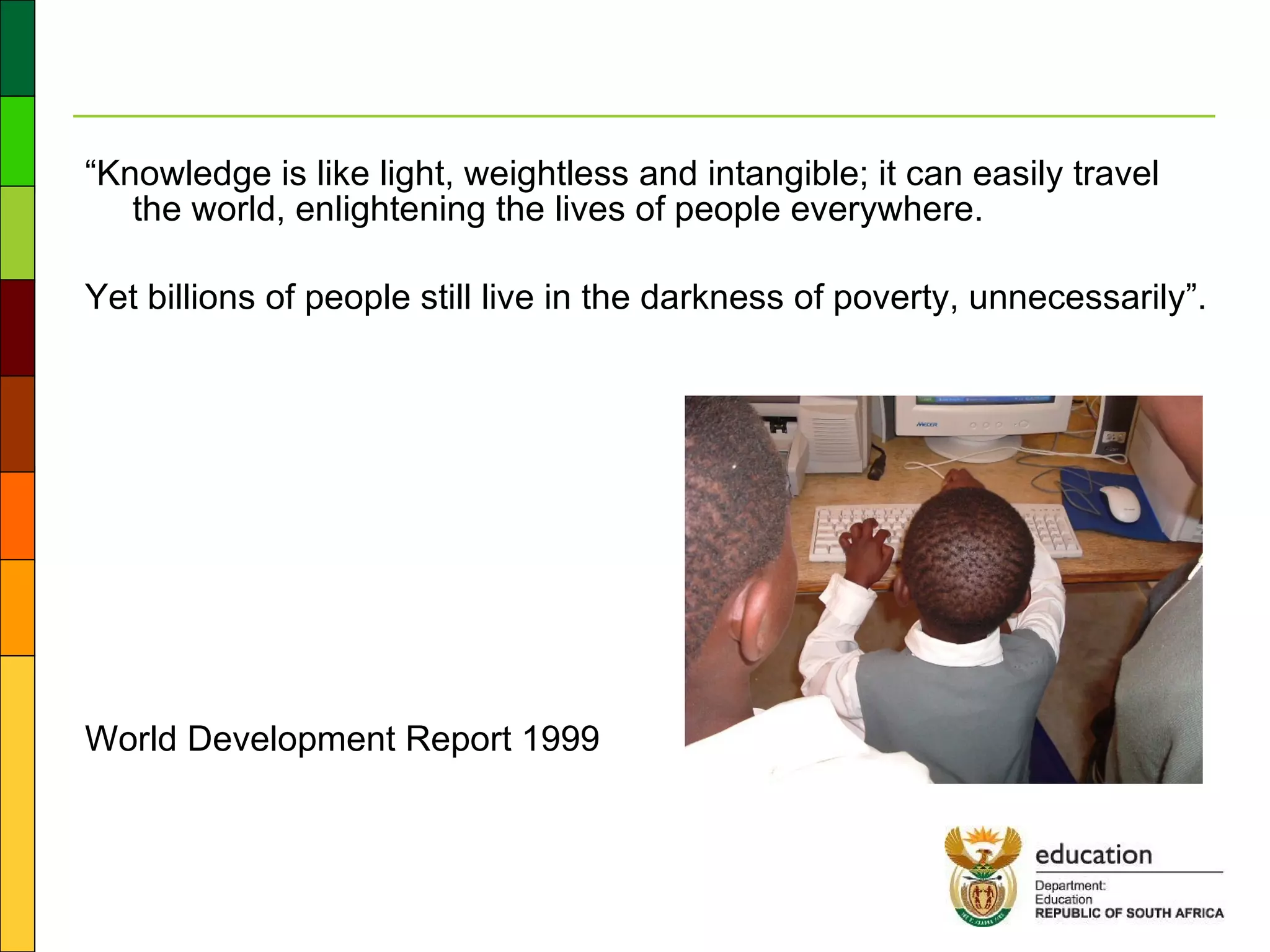
“ Knowledge is like light, weightless and intangible; it can easily travel the world, enlightening the lives of people everywhere.  Yet billions of people still live in the darkness of poverty, unnecessarily”.  World Development Report 1999
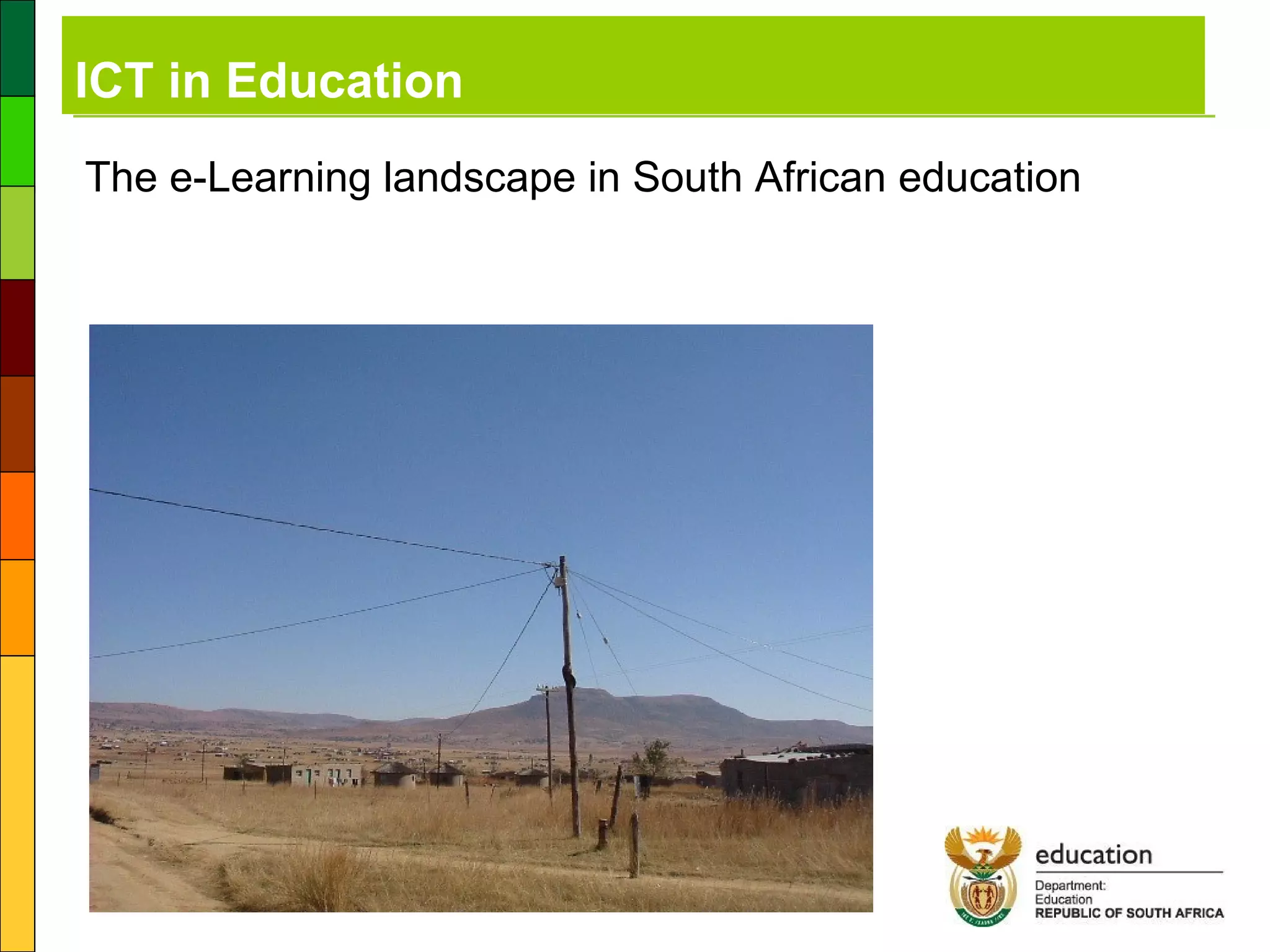
ICT in Education The e-Learning landscape in South African education
ICT in Education: overview Skills for the 21st century ICT in Education: principles Principles of the National Curriculum White Paper on e-Education Feasibility Study Proof of Concept Thutong Education Portal
21st Century Skills: (enGauge) Digital-Age Literacy Basic, scientific, economic, ICT  and technological literacy's  Visual and information literacy's  Multicultural literacy and global awareness Effective Communication Teaming, collaboration, and interpersonal skills  Personal, social, and civic responsibility  Interactive communication High Productivity Prioritising, planning, and managing for results  Effective use of real-world tools  Ability to produce relevant, high-quality products Inventive Thinking Adaptability and managing complexity  Self-direction  Curiosity, creativity, and  Risk taking  Higher-order thinking and sound reasoning
ICT in Education: Principles Systemic  impact - planning, management and administration  Reduce  expenses  or  change the ways  in which things are being done Improved  communication , flow of  information  and access to information Widening access to high  quality , relevant and diverse  resources  and  learning opportunities  to all teachers and learners Exposing  all learners , in advantaged and disadvantaged areas, to enriched educational experiences Provide to all learners and teachers the means of  communication  and  collaboration  to  enhance teaching and learning ; and give all learners the opportunities to excel in a 21 st   Century environment.
Principles of the National Curriculum Social transformation High knowledge and high skills Integration and applied competence Progression Articulation and portability Human rights, inclusivity, environmental and social justice Valuing indigenous knowledge systems Credibility, quality and efficiency
Critical Outcomes in the National Curriculum Problem solving, decision making, critical and creative thinking Work effectively in a team Organise and manage themselves and their activities Collect, analyse, organise and critically evaluate information Communicate effectively Use science and technology effectively Understanding that the world is a set of related systems Variety of learning strategies
Broad Principles of the White Paper improve systemic  efficiency  redress  inequalities widen  access  to high quality, relevant and diverse resources and learning opportunities to all teachers and learners expose all learners, in advantaged and disadvantaged areas, to  enriched  educational experiences provide to all learners and teachers the means of  communication  and collaboration to enhance teaching and learning give all learners the opportunities to excel in a  21st century  environment
Six Pillars of the White Paper infrastructure  in all schools and for all support personnel including maintenance, sustainability, security, technical support and initial training connectivity  to all schools, FET Colleges and district offices to a closed network linked to the Internet ongoing  professional development   (teacher training and teacher development programmes) for teachers, principals and support personnel maintenance and further development of the Educational Portal and  content development research, monitoring and evaluation community  involvement
Feasibility Study The Department of Education has conducted a feasibility study in ICT in Education - in terms of Treasury Regulation 16 to the Public Finance Management Act, 1999 (PFMA). The Feasibility Study will: Outline strategic and operational benefits of the e-Education Initiative  Describe the specific terms of the e-Education Initiative Set out the legislative and regulatory framework applicable to the initiative Demonstrate the affordability of the e-Education Initiative Outline proposed allocation of financial, technical and operational risks Give the anticipated value for money Comment on the capacity of the Institution to  procure, implement, manage, monitor and report
Secure infrastructure for ICT equipment ICT hardware and software Access to broadband technologies  Curriculum support and innovation Ongoing professional development  Electronic and on-line learning support material Support services Feasibility Study : background The Department of Education has initiated structured processes to develop a feasible model/s to supply schools and FET Colleges with:
Feasibility Study Focus on schools and the management  Includes:  School administration (links to EMIS, LURITS, IQMS and district/provincial administration) District infrastructure for subject advisors Appointments to manage ICT in teaching and learning Excludes: ECD Centres/pre-primary schools/care centres and ABET Other IT/EMIS related appointments and equipment
Feasibility Study: Output Targets  Infrastructure  in all schools (6 786 high schools and 12 085 primary schools) and for all support personnel (1 538) including maintenance, sustainability, security, technical support and initial training Broadband Connectivity  to all schools (25 772), FET Colleges (50) and district offices (139) to a closed network linked to the Internet Ongoing  professional development   (teacher training and teacher development programmes) for teachers (373 140), principals (18 657) and support personnel (769) Maintenance and further development of the Educational Portal and  content development Research, monitoring and evaluation Appointment of Human Resources  (National, Provincial and Districts) to drive, manage and support ICT in Education
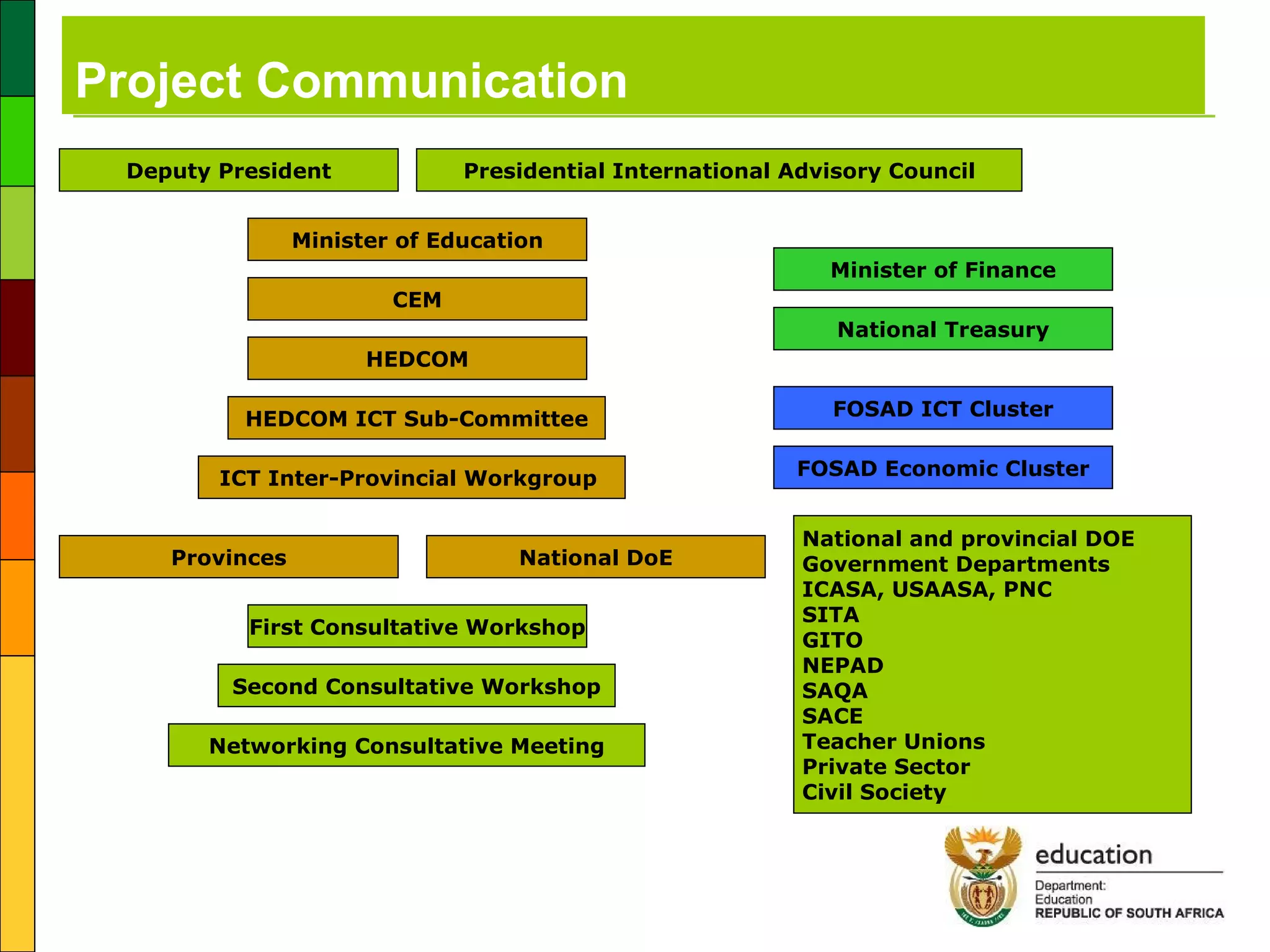
Project Communication  Deputy President Minister of Education Minister of Finance CEM HEDCOM HEDCOM ICT Sub-Committee ICT Inter-Provincial Workgroup  Presidential International Advisory Council National Treasury FOSAD ICT Cluster FOSAD Economic Cluster Provinces National DoE First Consultative Workshop Second Consultative Workshop National and provincial DOE Government Departments ICASA, USAASA, PNC SITA GITO NEPAD SAQA SACE Teacher Unions Private Sector Civil Society Networking Consultative Meeting
Needs Analysis Mission and vision of the Department of Education The core function of Public Schools and FET Colleges The current situation Policy and legislative environment Teaching and learning Logistics and operations Summarise the need Provide learners access to quality education Building teachers’ capacity to teach effectively Enhancing logistics and Operations International experience ICT use in other sectors ICT access, equity and human rights Defining the outputs Primary outputs Secondary outputs
Opportunities Integrate ICT in all operational elements of the schooling system (e.g. EMIS, finance, physical planning, exams, HR and IQMS) Leverage expanded ICT infrastructure to create greater efficiencies and productivity in running SA Education System Capacity to ensure that learners are equipped with the skills and competences needed to thrive in global knowledge economy Cross over potential to leverage ICT network to support a broad range of government development priorities (e.g. health, safety and security)
Challenges Scale of investment demands comprehensive  change Changes demands that the process is led and driven by all senior  managers Potential for active and passive  resistance  from managers, principals and teachers Re-structuring of  budgets  across all units of national and provincial departments is required Requires  “leap of faith”  of decision-makers Sustainability  – keep on the priorities of the Department of Education If DoE is successful in securing funds there may be pressure to  spend  money faster than the system can absorb it Inter-governmental  buy-in
Service delivery approach Four-phased approach to implementation at the site level: 1) Basic readiness:  sites are prepared for rollout of ICT to enhance logistics and operations. 2) Logistics and operations:  ICT hardware and applications, connectivity, and associated professional development, maintenance, and support are provided to schools predominantly to enhance management and administration processes at site level. 3) e-Readiness:  sites are prepared for rollout of ICT to support teaching and learning. 4) Teaching and learning:  ICT hardware and applications, connectivity, content, and associated professional development, maintenance, and support are provided to schools predominantly to support teaching and learning at site level.
Proof of Concept Implementing a “Proof of Concept” in 1200 schools in 9 districts/circuits over a 2-year period with a one year planning period, including: ICT infrastructure  Connectivity (Collaboration with Department of Communications) Teacher development Content development  Monitoring, evaluation and research Appropriate governance structure and back office support
Preparing Districts/Planning Stage (2009 – 2010) Provincial Liaison and Change Management Selection of districts/circuits  (135 – 200 schools) Audit and Verification of data Establishment of management structure Provinces  make districts implementation ready Approval of District Development ICT plan Detailed implementation plans with budgets Development of guidelines for supporting documents to support ICT Development of help desk facility
 
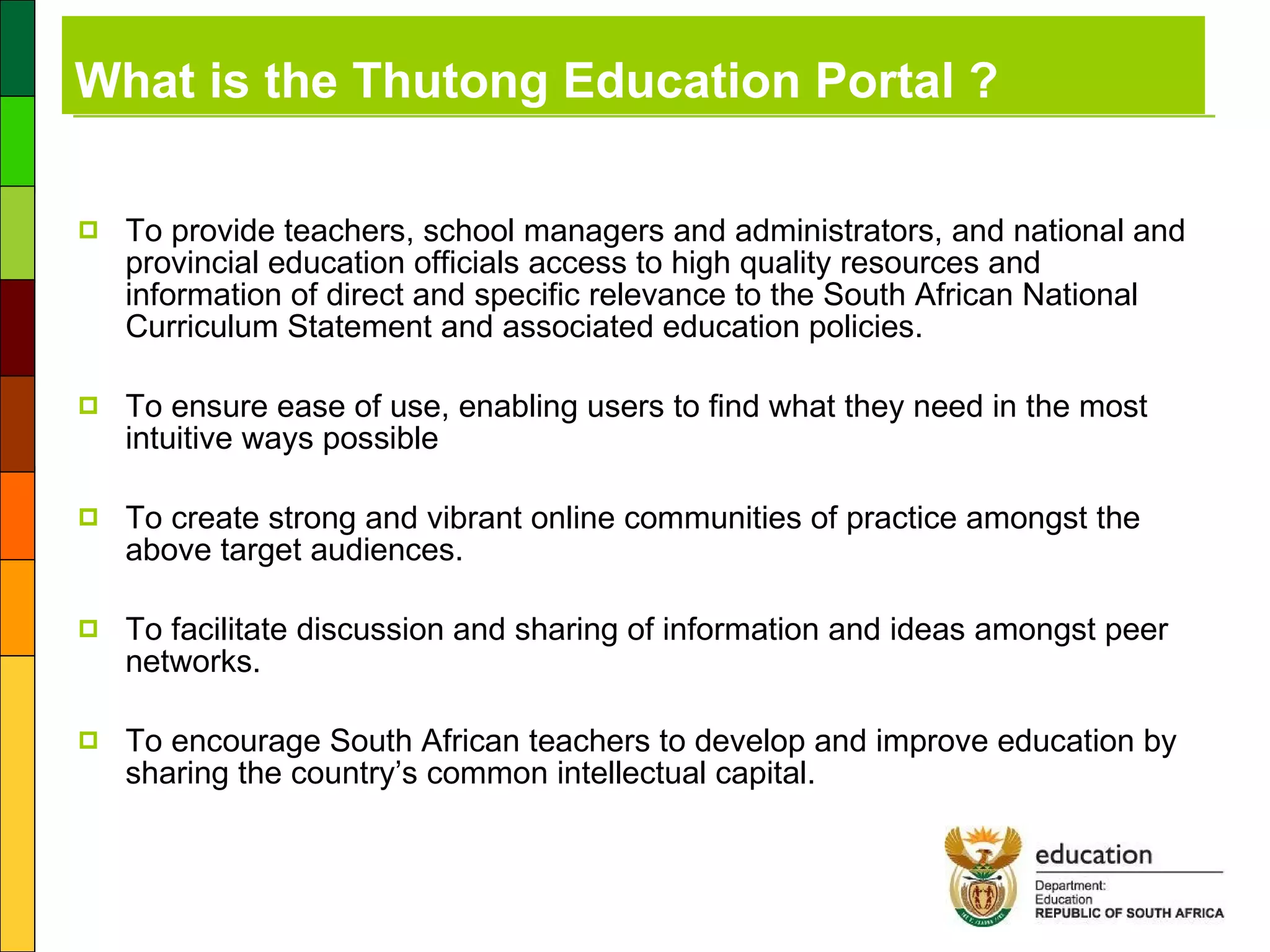
What is the Thutong Education Portal ? To provide teachers, school managers and administrators, and national and provincial education officials access to high quality resources and information of direct and specific relevance to the South African National Curriculum Statement and associated education policies. To ensure ease of use, enabling users to find what they need in the most intuitive ways possible To create strong and vibrant online communities of practice amongst the above target audiences. To facilitate discussion and sharing of information and ideas amongst peer networks. To encourage South African teachers to develop and improve education by sharing the country’s common intellectual capital.
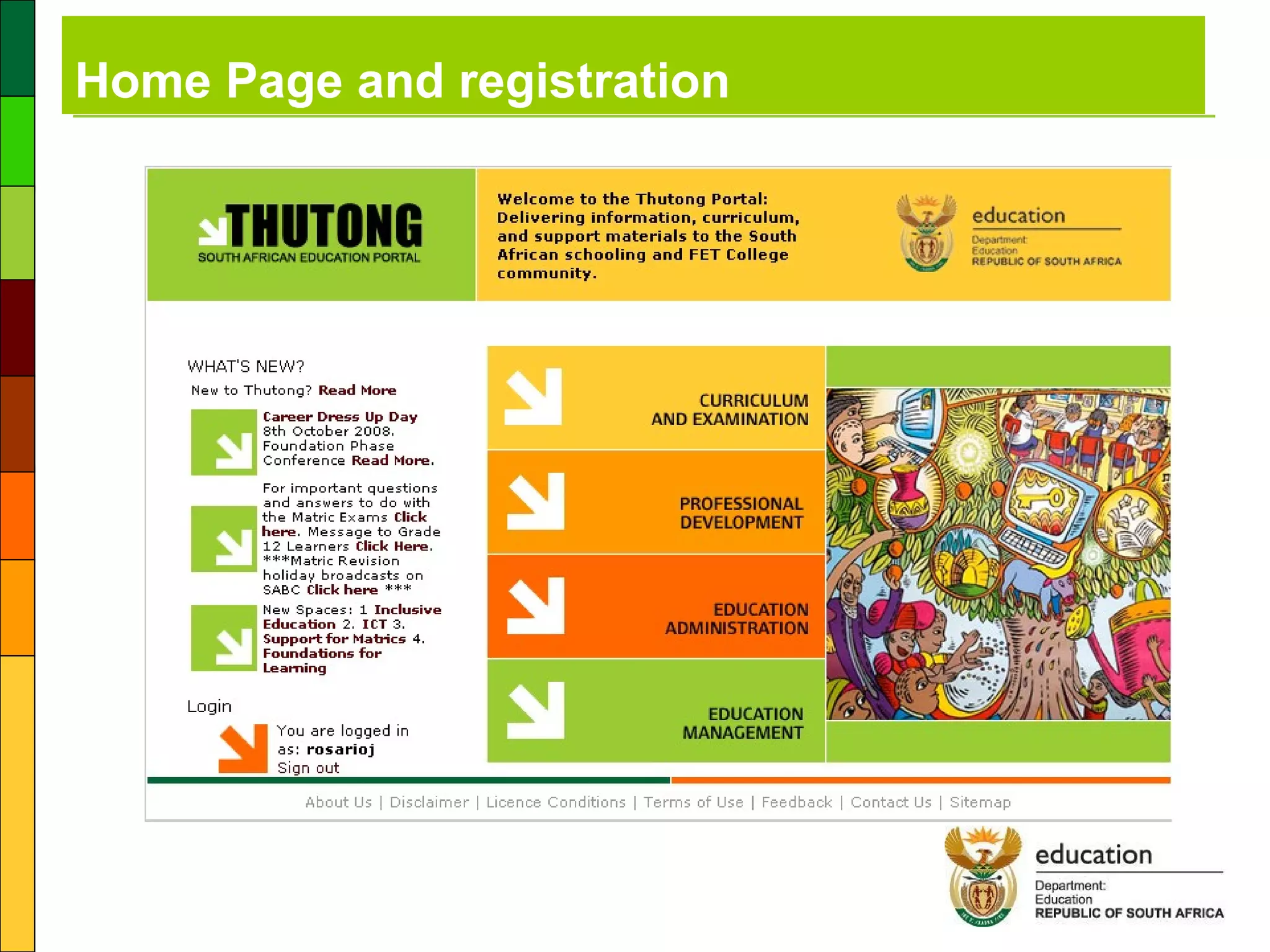
Home Page and registration
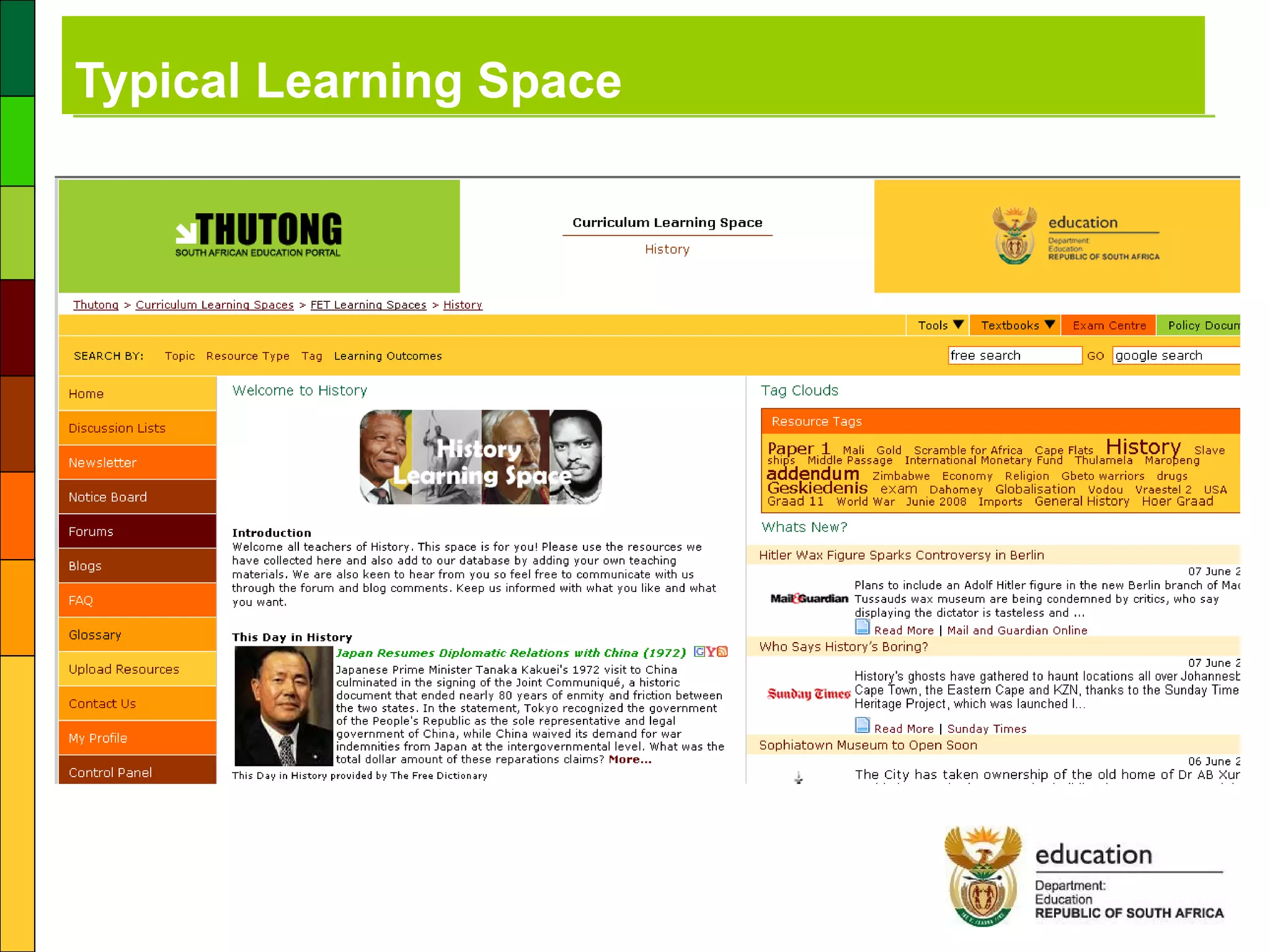
Typical Learning Space
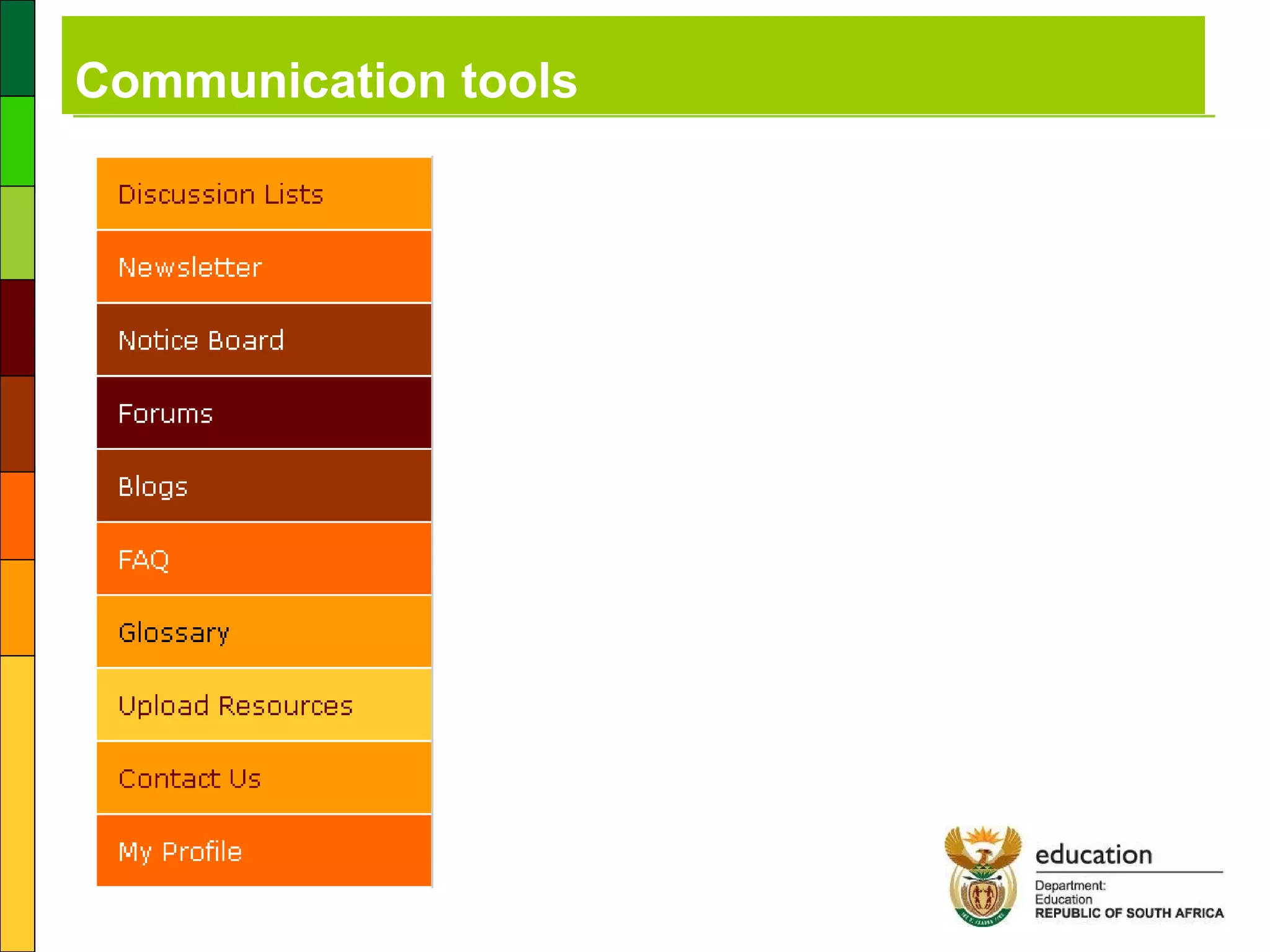
Communication tools
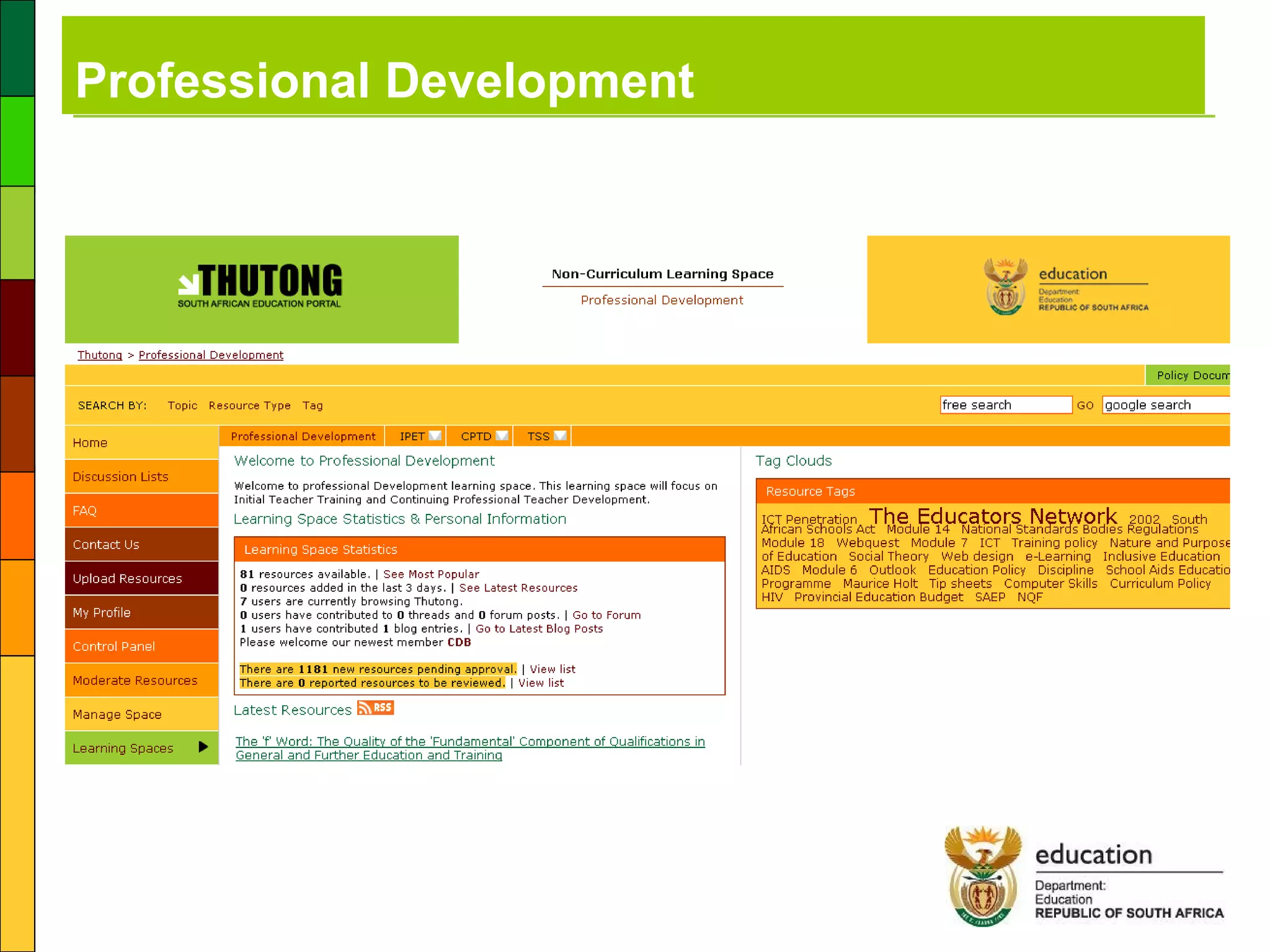
Professional Development
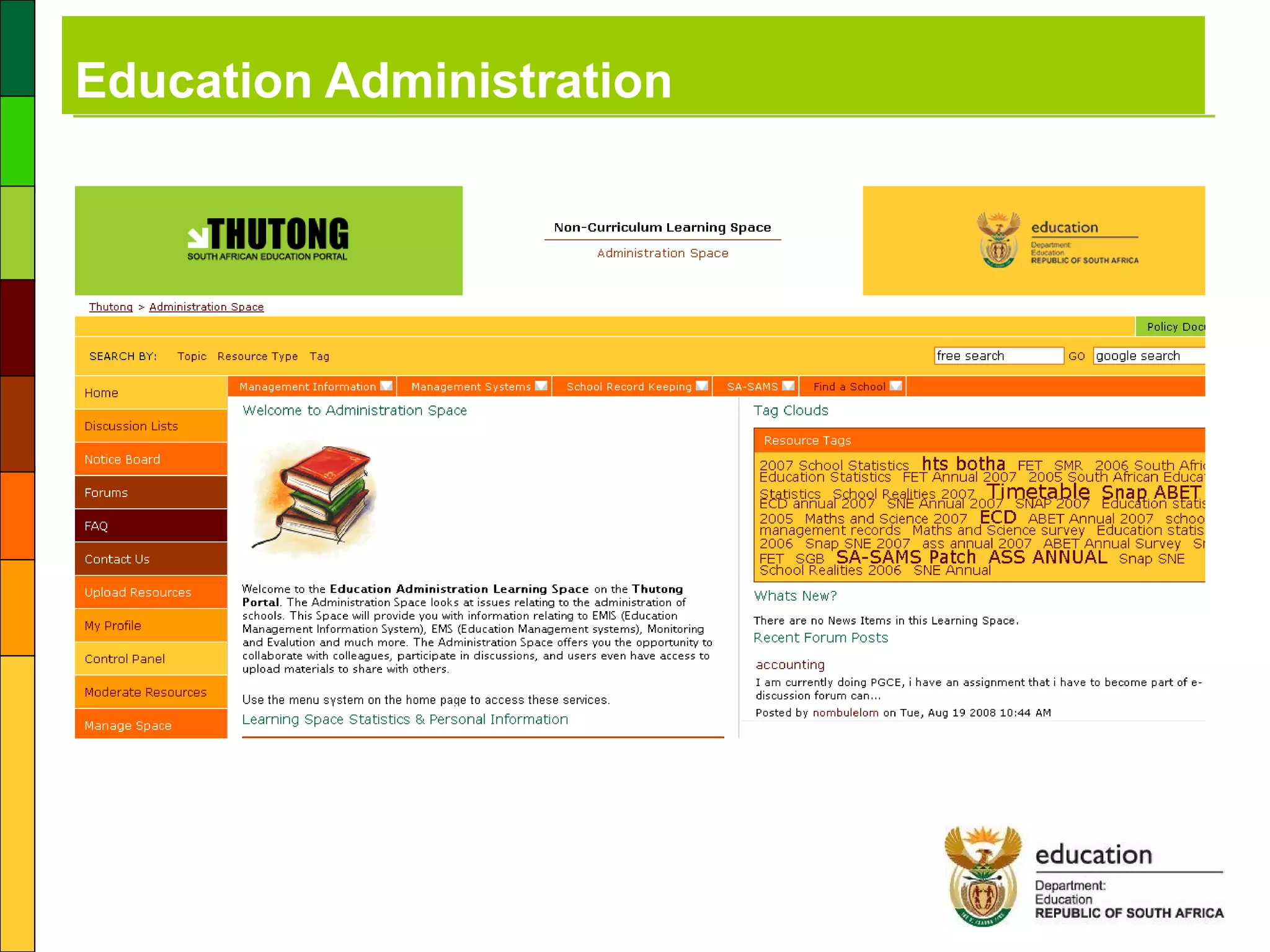
Education Administration
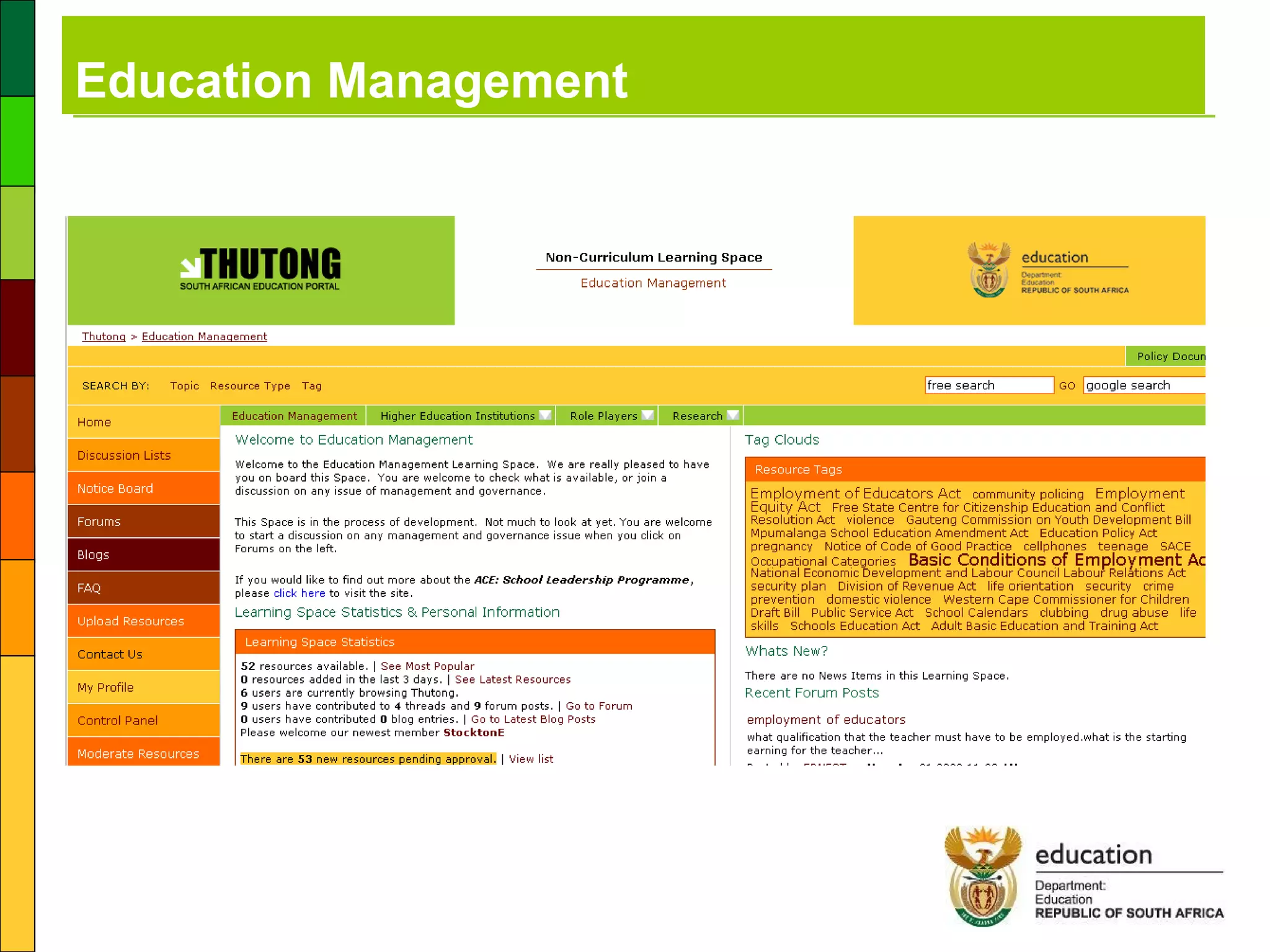
Education Management
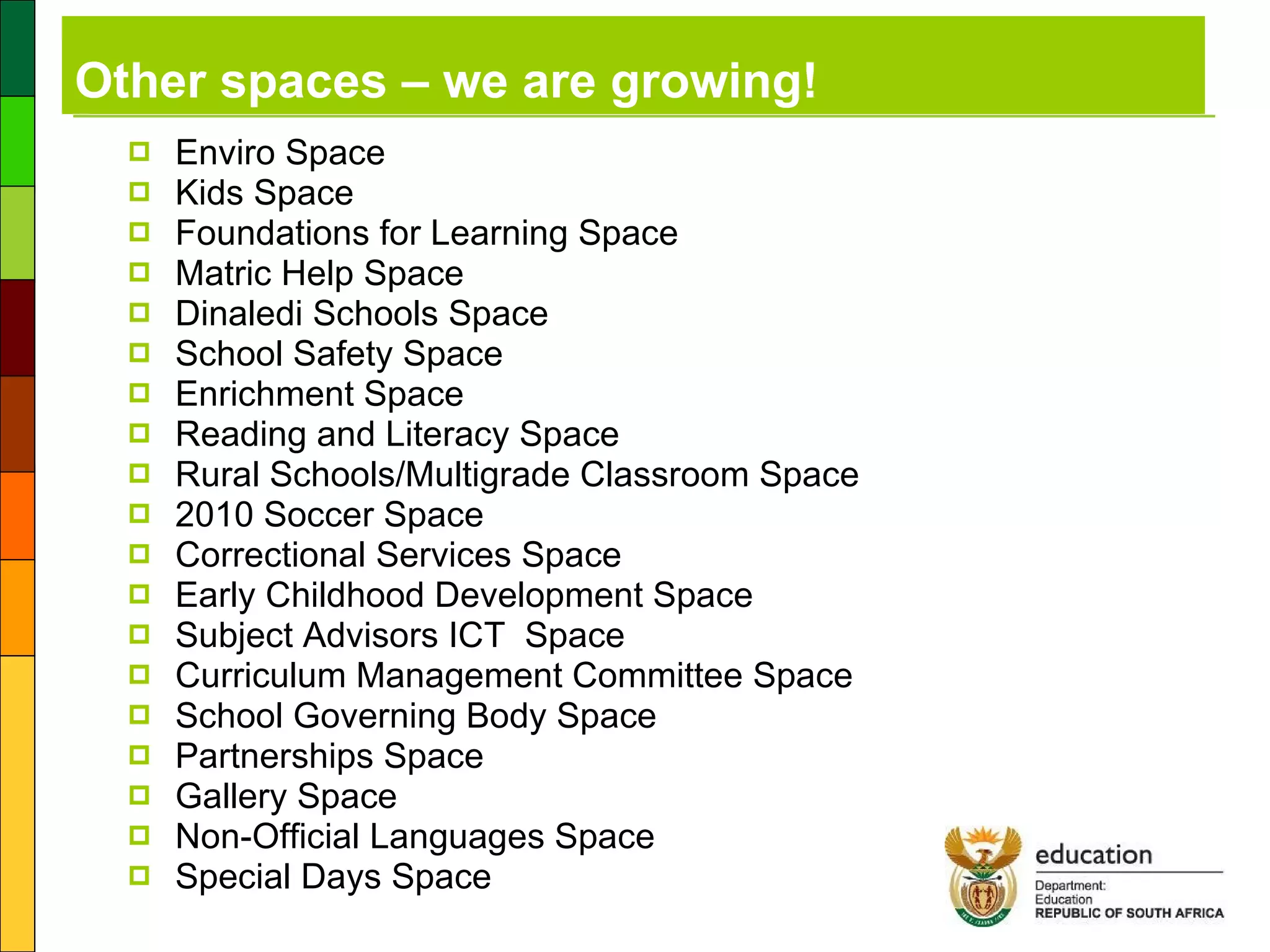
Other spaces – we are growing! Enviro Space Kids Space Foundations for Learning Space  Matric Help Space  Dinaledi Schools Space School Safety Space Enrichment Space Reading and Literacy Space Rural Schools/Multigrade Classroom Space 2010 Soccer Space Correctional Services Space Early Childhood Development Space Subject Advisors ICT  Space Curriculum Management Committee Space School Governing Body Space Partnerships Space  Gallery Space Non-Official Languages Space Special Days Space
Thank you… Joy Rosario Department of Education [email_address] http://www.thutong.doe.gov.za

Library Conference DoE talk

  • 1.
    “ Knowledge islike light, weightless and intangible; it can easily travel the world, enlightening the lives of people everywhere. Yet billions of people still live in the darkness of poverty, unnecessarily”. World Development Report 1999
  • 2.
    ICT in EducationThe e-Learning landscape in South African education
  • 3.
    ICT in Education:overview Skills for the 21st century ICT in Education: principles Principles of the National Curriculum White Paper on e-Education Feasibility Study Proof of Concept Thutong Education Portal
  • 4.
    21st Century Skills:(enGauge) Digital-Age Literacy Basic, scientific, economic, ICT and technological literacy's Visual and information literacy's Multicultural literacy and global awareness Effective Communication Teaming, collaboration, and interpersonal skills Personal, social, and civic responsibility Interactive communication High Productivity Prioritising, planning, and managing for results Effective use of real-world tools Ability to produce relevant, high-quality products Inventive Thinking Adaptability and managing complexity Self-direction Curiosity, creativity, and Risk taking Higher-order thinking and sound reasoning
  • 5.
    ICT in Education:Principles Systemic impact - planning, management and administration Reduce expenses or change the ways in which things are being done Improved communication , flow of information and access to information Widening access to high quality , relevant and diverse resources and learning opportunities to all teachers and learners Exposing all learners , in advantaged and disadvantaged areas, to enriched educational experiences Provide to all learners and teachers the means of communication and collaboration to enhance teaching and learning ; and give all learners the opportunities to excel in a 21 st Century environment.
  • 6.
    Principles of theNational Curriculum Social transformation High knowledge and high skills Integration and applied competence Progression Articulation and portability Human rights, inclusivity, environmental and social justice Valuing indigenous knowledge systems Credibility, quality and efficiency
  • 7.
    Critical Outcomes inthe National Curriculum Problem solving, decision making, critical and creative thinking Work effectively in a team Organise and manage themselves and their activities Collect, analyse, organise and critically evaluate information Communicate effectively Use science and technology effectively Understanding that the world is a set of related systems Variety of learning strategies
  • 8.
    Broad Principles ofthe White Paper improve systemic efficiency redress inequalities widen access to high quality, relevant and diverse resources and learning opportunities to all teachers and learners expose all learners, in advantaged and disadvantaged areas, to enriched educational experiences provide to all learners and teachers the means of communication and collaboration to enhance teaching and learning give all learners the opportunities to excel in a 21st century environment
  • 9.
    Six Pillars ofthe White Paper infrastructure in all schools and for all support personnel including maintenance, sustainability, security, technical support and initial training connectivity to all schools, FET Colleges and district offices to a closed network linked to the Internet ongoing professional development (teacher training and teacher development programmes) for teachers, principals and support personnel maintenance and further development of the Educational Portal and content development research, monitoring and evaluation community involvement
  • 10.
    Feasibility Study TheDepartment of Education has conducted a feasibility study in ICT in Education - in terms of Treasury Regulation 16 to the Public Finance Management Act, 1999 (PFMA). The Feasibility Study will: Outline strategic and operational benefits of the e-Education Initiative Describe the specific terms of the e-Education Initiative Set out the legislative and regulatory framework applicable to the initiative Demonstrate the affordability of the e-Education Initiative Outline proposed allocation of financial, technical and operational risks Give the anticipated value for money Comment on the capacity of the Institution to procure, implement, manage, monitor and report
  • 11.
    Secure infrastructure forICT equipment ICT hardware and software Access to broadband technologies Curriculum support and innovation Ongoing professional development Electronic and on-line learning support material Support services Feasibility Study : background The Department of Education has initiated structured processes to develop a feasible model/s to supply schools and FET Colleges with:
  • 12.
    Feasibility Study Focuson schools and the management Includes: School administration (links to EMIS, LURITS, IQMS and district/provincial administration) District infrastructure for subject advisors Appointments to manage ICT in teaching and learning Excludes: ECD Centres/pre-primary schools/care centres and ABET Other IT/EMIS related appointments and equipment
  • 13.
    Feasibility Study: OutputTargets Infrastructure in all schools (6 786 high schools and 12 085 primary schools) and for all support personnel (1 538) including maintenance, sustainability, security, technical support and initial training Broadband Connectivity to all schools (25 772), FET Colleges (50) and district offices (139) to a closed network linked to the Internet Ongoing professional development (teacher training and teacher development programmes) for teachers (373 140), principals (18 657) and support personnel (769) Maintenance and further development of the Educational Portal and content development Research, monitoring and evaluation Appointment of Human Resources (National, Provincial and Districts) to drive, manage and support ICT in Education
  • 14.
    Project Communication Deputy President Minister of Education Minister of Finance CEM HEDCOM HEDCOM ICT Sub-Committee ICT Inter-Provincial Workgroup Presidential International Advisory Council National Treasury FOSAD ICT Cluster FOSAD Economic Cluster Provinces National DoE First Consultative Workshop Second Consultative Workshop National and provincial DOE Government Departments ICASA, USAASA, PNC SITA GITO NEPAD SAQA SACE Teacher Unions Private Sector Civil Society Networking Consultative Meeting
  • 15.
    Needs Analysis Missionand vision of the Department of Education The core function of Public Schools and FET Colleges The current situation Policy and legislative environment Teaching and learning Logistics and operations Summarise the need Provide learners access to quality education Building teachers’ capacity to teach effectively Enhancing logistics and Operations International experience ICT use in other sectors ICT access, equity and human rights Defining the outputs Primary outputs Secondary outputs
  • 16.
    Opportunities Integrate ICTin all operational elements of the schooling system (e.g. EMIS, finance, physical planning, exams, HR and IQMS) Leverage expanded ICT infrastructure to create greater efficiencies and productivity in running SA Education System Capacity to ensure that learners are equipped with the skills and competences needed to thrive in global knowledge economy Cross over potential to leverage ICT network to support a broad range of government development priorities (e.g. health, safety and security)
  • 17.
    Challenges Scale ofinvestment demands comprehensive change Changes demands that the process is led and driven by all senior managers Potential for active and passive resistance from managers, principals and teachers Re-structuring of budgets across all units of national and provincial departments is required Requires “leap of faith” of decision-makers Sustainability – keep on the priorities of the Department of Education If DoE is successful in securing funds there may be pressure to spend money faster than the system can absorb it Inter-governmental buy-in
  • 18.
    Service delivery approachFour-phased approach to implementation at the site level: 1) Basic readiness: sites are prepared for rollout of ICT to enhance logistics and operations. 2) Logistics and operations: ICT hardware and applications, connectivity, and associated professional development, maintenance, and support are provided to schools predominantly to enhance management and administration processes at site level. 3) e-Readiness: sites are prepared for rollout of ICT to support teaching and learning. 4) Teaching and learning: ICT hardware and applications, connectivity, content, and associated professional development, maintenance, and support are provided to schools predominantly to support teaching and learning at site level.
  • 19.
    Proof of ConceptImplementing a “Proof of Concept” in 1200 schools in 9 districts/circuits over a 2-year period with a one year planning period, including: ICT infrastructure Connectivity (Collaboration with Department of Communications) Teacher development Content development Monitoring, evaluation and research Appropriate governance structure and back office support
  • 20.
    Preparing Districts/Planning Stage(2009 – 2010) Provincial Liaison and Change Management Selection of districts/circuits (135 – 200 schools) Audit and Verification of data Establishment of management structure Provinces make districts implementation ready Approval of District Development ICT plan Detailed implementation plans with budgets Development of guidelines for supporting documents to support ICT Development of help desk facility
  • 21.
  • 22.
    What is theThutong Education Portal ? To provide teachers, school managers and administrators, and national and provincial education officials access to high quality resources and information of direct and specific relevance to the South African National Curriculum Statement and associated education policies. To ensure ease of use, enabling users to find what they need in the most intuitive ways possible To create strong and vibrant online communities of practice amongst the above target audiences. To facilitate discussion and sharing of information and ideas amongst peer networks. To encourage South African teachers to develop and improve education by sharing the country’s common intellectual capital.
  • 23.
    Home Page andregistration
  • 24.
  • 25.
  • 26.
  • 27.
  • 28.
  • 29.
    Other spaces –we are growing! Enviro Space Kids Space Foundations for Learning Space Matric Help Space Dinaledi Schools Space School Safety Space Enrichment Space Reading and Literacy Space Rural Schools/Multigrade Classroom Space 2010 Soccer Space Correctional Services Space Early Childhood Development Space Subject Advisors ICT Space Curriculum Management Committee Space School Governing Body Space Partnerships Space Gallery Space Non-Official Languages Space Special Days Space
  • 30.
    Thank you… JoyRosario Department of Education [email_address] http://www.thutong.doe.gov.za