

QUALITY MANAGEMENT SYSTEM (MQA-102T)
UNIT IV
ICH - Stability Guidelines for New Drug Substances and Drug Product
(Q1A R2 - Q1F)
Presented By
V. Manikandan,
Roll No. 2061050002,
M. Pharm (Pharmaceutical Quality Assurance) – I Year,
Batch : 2020-2022,
Department of Pharmacy,
Annamalai University.
Submitted to
Dr. K. Devi, M. Pharm., Ph. D,
Assistant Professor,
Department of Pharmacy,
Annamalai University.
ICH – Stability Guidelines for New Drug Substances and Drug
Product (Q1A R2 – Q1F)
Q1A(R2) : Stability Testing of New Drug Substances and Products
Q1B : Stability Testing Photostability Testing of New Drug Substances and Products
Q1C : Stability Testing for New Dosage Forms
Q1D : Bracketing and Matrixing Designs for Stability Testing of New Drug Substances and Products
Q1E : Evaluation of Stability Data
Q1F : Stability Data Package for Registration Applications in Climatic Zones III and IV
Q1A(R2): Stability Testing of New Drug Substances and Products
1. Introduction
1.1. Objectives of the Guideline
The following guideline is a revised version of the ICH Q1A guideline and defines the stability data
package for a new drug substance or drug product that is sufficient for a registration application within the three
regions of the EC, Japan, and the United States.
1.2. Scope of the Guideline
• The guideline addresses the information to be submitted in registration applications for new molecular entities
and associated drug products.
• Specific details of the sampling and testing for particular dosage forms in their proposed container closures are
not covered in this guideline.
• Further guidance on new dosage forms and on biotechnological/biological products can be found in ICH
guidelines Q1C and Q5C, respectively.
• The purpose of stability testing is to provide evidence on how the quality of a drug substance or drug product
varies with time under the influence of a variety of environmental factors such as temperature, humidity, and
light, and to establish a re-test period for the drug substance or a shelf life for the drug product and
recommended storage conditions.
• The choice of test conditions defined in this guideline is based on an analysis of the effects of climatic
conditions in the three regions of the EC, Japan and the United States.
• The mean kinetic temperature in any part of the world can be derived from climatic data, and the world can be
divided into four climatic zones, I-IV.
• This guideline addresses climatic zones I and II. The principle has been established that stability information
generated in any one of the three regions of the EC, Japan and the United States would be mutually acceptable to
the other two regions, provided the information is consistent with this guideline and the labeling is in accord
with national/regional requirements.
1.3. General Principle
2. Guidelines
2.1. Drug Substance
2.1.1. General
• Information on the stability of the drug substance is an integral part of the systematic approach to stability
evaluation.
2.1.2. Stress Testing
• Stress testing of the drug substance can help identify the likely degradation products, which can in turn help
establish the degradation pathways and the intrinsic stability of the molecule and validate the stability indicating
power of the analytical procedures used.
• Stress testing is likely to be carried out on a single batch of the drug substance. It should include
• the effect of temperatures (in 10°C increments (e.g., 50°C, 60°C, etc.) above that for accelerated testing),
• humidity (e.g., 75% RH or greater)
• hydrolysis across a wide range of pH values
• Photostability testing.
• Results from these studies will form an integral part of the information provided to regulatory authorities.
2.1.3. Selection of Batches
• Data from formal stability studies should be provided on at least three primary batches of the drug substance.
• The batches should be manufactured to a minimum of pilot scale by the same synthetic route as, and using a
method of manufacture and procedure that simulates the final process to be used for, production batches.
• The overall quality of the batches of drug substance placed on formal stability studies should be representative
of the quality of the material to be made on a production scale.
• Other supporting data can be provided.
2.1.4. Container Closure System
• The stability studies should be conducted on the drug substance packaged in a container closure system that is
the same as or simulates the packaging proposed for storage and distribution.
2.1.5. Specification
• Specification, which is a list of tests, reference to analytical procedures, and proposed acceptance criteria, is
addressed in ICH Q6A and Q6B. In addition, specification for degradation products in a drug substance is
discussed in Q3A.
• The testing should cover, as appropriate, the physical, chemical, biological, and microbiological attributes.
2.1.6. Testing Frequency
• For drug substances with a proposed re-test period of at least 12 months, the frequency of testing at the long
term storage condition should normally be every 3 months over the first year, every 6 months over the second
year, and annually thereafter through the proposed re-test period.
• At the accelerated storage condition, a minimum of three time points, including the initial and final time points
(e.g., 0, 3, and 6 months), from a 6-month study is recommended.
• When testing at the intermediate storage condition a minimum of four time points, including the initial and final
time points (e.g., 0, 6, 9, 12 months), from a 12-month study is recommended.
2.1.7. Storage Conditions
• In general, a drug substance should be evaluated for thermal stability, sensitivity to moisture and cover
conditions sufficient to cover storage, shipment, and subsequent use.
2.1.7.1. General Case
• It is up to the applicant to decide whether long term stability studies are performed at 25 ± 2°C/60% RH ± 5%
RH or 30°C ± 2°C/65% RH ± 5% RH.
• If 30°C ± 2°C/65% RH ± 5% RH is the long-term condition, there is no intermediate condition.
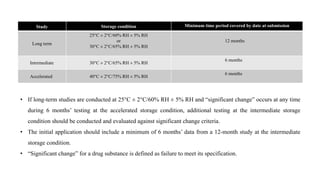
Study Storage condition Minimum time period covered by date at submission
Long term
25°C ± 2°C/60% RH ± 5% RH
or
30°C ± 2°C/65% RH ± 5% RH
12 months
Intermediate 30°C ± 2°C/65% RH ± 5% RH
6 months
Accelerated 40°C ± 2°C/75% RH ± 5% RH
6 months
• If long-term studies are conducted at 25°C ± 2°C/60% RH ± 5% RH and “significant change” occurs at any time
during 6 months’ testing at the accelerated storage condition, additional testing at the intermediate storage
condition should be conducted and evaluated against significant change criteria.
• The initial application should include a minimum of 6 months’ data from a 12-month study at the intermediate
storage condition.
• “Significant change” for a drug substance is defined as failure to meet its specification.
2.1.7.2. Drug substances intended for storage in a refrigerator
Study Storage condition Minimum time period covered by data at submission
Long term 5°C ± 3°C 12 months
Accelerated 25°C ± 2°C/60% RH ± 5% RH 6 months
• If significant change occurs between 3 and 6 months’ testing at the accelerated storage condition, the proposed
re-test period should be based on the real time data available at the long term storage condition.
• If significant change occurs within the first 3 months’ testing at the accelerated storage condition, a discussion
should be provided to address the effect of short term excursions outside the label storage condition,
• This discussion can be supported, if appropriate, by further testing on a single batch of the drug substance for a
period shorter than 3 months but with more frequent testing than usual.
2.1.7.3. Drug substances intended for storage in a freezer
• For drug substances intended for storage in a freezer, the re-test period should be based on the real time data
obtained at the long term storage condition.
• In the absence of an accelerated storage condition for drug substances intended to be stored in a freezer, testing
on a single batch at an elevated temperature (e.g., 5°C ± 3°C or 25°C ± 2°C) for an appropriate time period
should be conducted to address the effect of short term excursions outside the proposed label storage condition,
e.g., during shipping or handling.
• Drug substances intended for storage below -20°C: Drug substances intended for storage below -20°C should be
treated on a case-by-case basis.
Study Storage condition Minimum time period covered by data at submission
Long term - 20°C ± 5°C 12 months
2.1.8. Stability Commitment
• When available long term stability data on primary batches do not cover the proposed re-test period granted at
the time of approval, a commitment should be made to continue the stability studies post approval in order to
firmly establish the re-test period.
• Where the submission includes long term stability data on three production batches covering the proposed re-test
period, a post approval commitment is considered unnecessary. Otherwise, one of the following commitments
should be made:
i. If the submission includes data from stability studies on at least three production batches, a commitment
should be made to continue these studies through the proposed re-test period.
ii. If the submission includes data from stability studies on fewer than three production batches, a
commitment should be made to continue these studies through the proposed re-test period and to place
additional production batches, to a total of at least three, on long term stability studies through the
proposed re-test period.
iii. If the submission does not include stability data on production batches, a commitment should be made to
place the first three production batches on long term stability studies through the proposed re-test period.
2.1.9. Evaluation
• The degree of variability of individual batches affects the confidence that a future production batch will remain
within specification throughout the assigned re-test period.
• The data may show so little degradation and so little variability that it is apparent from looking at the data that
the requested re-test period will be granted.
• Under these circumstances, it is normally unnecessary to go through the formal statistical analysis; providing a
justification for the omission should be sufficient.
• If analysis shows that the batch-to-batch variability is small, it is advantageous to combine the data into one
overall estimate.
• Limited extrapolation of the real time data from the long term storage condition beyond the observed range to
extend the re-test period can be undertaken at approval time, if justified.
• Any evaluation should cover not only the assay, but also the levels of degradation products and other
appropriate attributes.
2.1.10. Statements/Labeling
• A storage statement should be established for the labeling in accordance with relevant national/regional
requirements.
• The statement should be based on the stability evaluation of the drug substance.
• Where applicable, specific instructions should be provided, particularly for drug substances that cannot tolerate
freezing.
• Terms such as “ambient conditions” or “room temperature” should be avoided.
• A re-test period should be derived from the stability information, and a retest date should be displayed on the
container label if appropriate.
2.2.1. General
• The design of the formal stability studies for the drug product should be based on knowledge of the behavior
and properties of the drug substance and from stability studies on the drug substance and on experience gained
from clinical formulation studies.
2.2.2. Photostability Testing
• Photostability testing should be conducted on at least one primary batch of the drug product if appropriate. The
standard conditions for photostability testing are described in ICH Q1B.
2.2. Drug Product
2.2.3. Selection of Batches
• Data from stability studies should be provided on at least three primary batches of the drug product.
• The primary batches should be of the same formulation and packaged in the same container closure system as
proposed for marketing.
• The manufacturing process used for primary batches should simulate that to be applied to production batches
and should provide product of the same quality and meeting the same specification as that intended for
marketing.
• Two of the three batches should be at least pilot scale batches and the third one can be smaller, if justified.
• Where possible, batches of the drug product should be manufactured by using different batches of the drug
substance.
• Stability studies should be performed on each individual strength and container size of the drug product unless
bracketing or matrixing is applied.
2.2.4. Container Closure System
• Stability testing should be conducted on the dosage form packaged in the container closure system proposed for
marketing (including, as appropriate, any secondary packaging and container label).
• Any available studies carried out on the drug product outside its immediate container or in other packaging
materials can form a useful part of the stress testing of the dosage form or can be considered as supporting
information, respectively.
2.2.5. Specification
• Specifications are addressed in ICH Q6A and Q6B. In addition, specification for degradation products in a drug
product is addressed in Q3B.
• Stability studies should include testing of those attributes of the drug product that are susceptible to change
during storage and are likely to influence quality, safety, and/or efficacy.
• The testing should cover, as appropriate, the physical, chemical, biological, and microbiological attributes,
preservative content (e.g., antioxidant, antimicrobial preservative), and functionality tests.
• Analytical procedures should be fully validated and stability indicating.
2.2.6. Testing Frequency
• For products with a proposed shelf life of at least 12 months, the frequency of testing at the long term storage
condition should normally be every 3 months over the first year, every 6 months over the second year, and
annually thereafter through the proposed shelf life.
• At the accelerated storage condition, a minimum of three time points, including the initial and final time points
(e.g., 0, 3, and 6 months), from a 6-month study is recommended.
• Where results from accelerated testing are likely to approach significant change criteria, increased testing
should be conducted either by adding samples at the final time point or by including a fourth time point in the
study design.
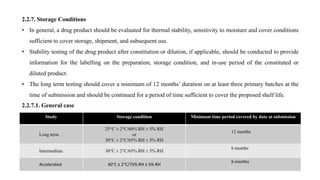
2.2.7. Storage Conditions
• In general, a drug product should be evaluated for thermal stability, sensitivity to moisture and cover conditions
sufficient to cover storage, shipment, and subsequent use.
• Stability testing of the drug product after constitution or dilution, if applicable, should be conducted to provide
information for the labelling on the preparation, storage condition, and in-use period of the constituted or
diluted product.
• The long term testing should cover a minimum of 12 months’ duration on at least three primary batches at the
time of submission and should be continued for a period of time sufficient to cover the proposed shelf life.
2.2.7.1. General case
Study Storage condition Minimum time period covered by date at submission
Long term
25°C ± 2°C/60% RH ± 5% RH
or
30°C ± 2°C/65% RH ± 5% RH
12 months
Intermediate 30°C ± 2°C/65% RH ± 5% RH
6 months
Accelerated 40°C ± 2°C/75% RH ± 5% RH
6 months
• It is up to the applicant to decide whether long term stability studies are performed at 25 ± 2°C/60% RH ± 5%
RH or 30°C ± 2°C/65% RH ± 5% RH.
• If 30°C ± 2°C/65% RH ± 5% RH is the long-term condition, there is no intermediate condition.
• If long-term studies are conducted at 25°C ± 2°C/60% RH ± 5% RH and “significant change” occurs at any time
during 6 months’ testing at the accelerated storage condition, additional testing at the intermediate storage
condition should be conducted and evaluated against significant change criteria.
• The initial application should include a minimum of 6 months’ data from a 12-month study at the intermediate
storage condition.
• “Significant change” for a drug substance is defined as failure to meet its specification.
2.2.7.2. Drug products packaged in impermeable containers
• Sensitivity to moisture or potential for solvent loss is not a concern for drug products packaged in impermeable
containers that provide a permanent barrier to passage of moisture or solvent.
• Thus, stability studies for products stored in impermeable containers can be conducted under any controlled or
ambient humidity condition.
2.2.7.3. Drug products packaged in semi-permeable containers
• Aqueous-based products packaged in semi-permeable containers should be evaluated for potential water loss in
addition to physical, chemical, biological, and microbiological stability. This evaluation can be carried out under
conditions of low relative humidity, as discussed below.
Study Storage condition Minimum time period covered by date at submission
Long term
25°C ± 2°C/40% RH ± 5% RH
or
30°C ± 2°C/35% RH ± 5% RH
12 months
Intermediate 30°C ± 2°C/65% RH ± 5% RH
6 months
Accelerated 40°C ± NMT 25% RH
6 months
• It is up to the applicant to decide whether long term stability studies are performed at 25 ± 2°C/40% RH ± 5%
RH or 30°C ± 2°C/35% RH ± 5% RH.
• If 30°C ± 2°C/35% RH ± 5% RH is the long-term condition, there is no intermediate condition.
• For long-term studies conducted at 25°C ± 2°C/40% RH ± 5% RH, additional testing at the intermediate storage
condition should be performed as described under the general case to evaluate the temperature effect at 30°C if
significant change other than water loss occurs during the 6 months’ testing at the accelerated storage condition.
• A significant change in water loss alone at the accelerated storage condition does not necessitate testing at the
intermediate storage condition.
• A 5% loss in water from its initial value is considered a significant change for a product packaged in a semi-
permeable container after an equivalent of 3 months’ storage at 40°C/NMT 25% RH.
• However, for small containers (1 mL or less) or unit-dose products, a water loss of 5% or more after an
equivalent of 3 months’ storage at 40°C/NMT 25% RH may be appropriate, if justified.
2.1.7.4. Drug products intended for storage in a refrigerator
Study Storage condition Minimum time period covered by data at submission
Long term 5°C ± 3°C 12 months
Accelerated 25°C ± 2°C/60% RH ± 5% RH 6 months
2.1.7.5. Drug substances intended for storage in a freezer
Study Storage condition Minimum time period covered by data at submission
Long term - 20°C ± 5°C 12 months
2.1.7.6. Drug products intended for storage below -20ºC
• Drug products intended for storage below -20ºC should be treated on a case-by-case basis
2.2.8. Stability Commitment
• When available long term stability data on primary batches do not cover the proposed shelf life granted at the
time of approval, a commitment should be made to continue the stability studies post approval in order to firmly
establish the shelf life.
• Where the submission includes long term stability data from three production batches covering the proposed
shelf life, a post approval commitment is considered unnecessary. Otherwise, one of the following commitments
should be made:
i. If the submission includes data from stability studies on at least three production batches, a commitment
should be made to continue the long term studies through the proposed shelf life and the accelerated
studies for 6 months.
ii. If the submission includes data from stability studies on fewer than three production batches, a
commitment should be made to continue the long term studies through the proposed shelf life and the
accelerated studies for 6 months, and to place additional production batches, to a total of at least three, on
long term stability studies through the proposed shelf life and on accelerated studies for 6 months.
iii. If the submission does not include stability data on production batches, a commitment should be made to
place the first three production batches on long term stability studies through the proposed shelf life and
on accelerated studies for 6 months.
2.2.9. Evaluation
• A systematic approach should be adopted in the presentation and evaluation of the stability information, which
should include, as appropriate, results from the physical, chemical, biological, and microbiological tests,
including particular attributes of the dosage form (for example, dissolution rate for solid oral dosage forms).
• The purpose of the stability study is to establish, based on testing a minimum of three batches of the drug
product, a shelf life and label storage instructions applicable to all future batches of the drug product
manufactured and packaged under similar circumstances. The degree of variability of individual batches affects
the confidence that a future production batch will remain within specification throughout its shelf life.
2.2.10. Statements/Labeling
• A storage statement should be established for the labeling in accordance with relevant national/regional
requirements. The statement should be based on the stability evaluation of the drug product. Where applicable,
specific instruction should be provided, particularly for drug products that cannot tolerate freezing. Terms such
as “ambient conditions” or “room temperature” should be avoided.
• There should be a direct link between the label storage statement and the demonstrated stability of the drug
product. An expiration date should be displayed on the container label.
Q1B: Photostability Testing of New Drug Substances and Products
1. General
• This document is an annex to the Parent Guideline and addresses the recommendations for photostability testing.
A. Preamble
• The intrinsic photostability characteristics of new drug substances and products should be evaluated to
demonstrate that, as appropriate, light exposure does not result in unacceptable change.
• Normally, photostability testing is carried out on a single batch of material selected as described under Selection
of Batches in the Parent Guideline.
• The guideline primarily addresses the generation of photostability information for submission in Registration
Applications for new molecular entities and associated drug products.
• A systematic approach to photostability testing is recommended covering, as appropriate, studies such as:
i. Tests on the drug substance;
ii. Tests on the exposed drug product outside of the immediate pack; and if necessary ;
iii. Tests on the drug product in the immediate pack; and if necessary ;
iv. Tests on the drug product in the marketing pack.
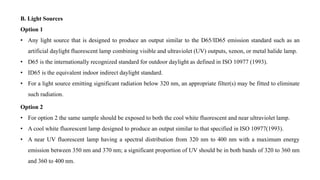
B. Light Sources
Option 1
• Any light source that is designed to produce an output similar to the D65/ID65 emission standard such as an
artificial daylight fluorescent lamp combining visible and ultraviolet (UV) outputs, xenon, or metal halide lamp.
• D65 is the internationally recognized standard for outdoor daylight as defined in ISO 10977 (1993).
• ID65 is the equivalent indoor indirect daylight standard.
• For a light source emitting significant radiation below 320 nm, an appropriate filter(s) may be fitted to eliminate
such radiation.
Option 2
• For option 2 the same sample should be exposed to both the cool white fluorescent and near ultraviolet lamp.
• A cool white fluorescent lamp designed to produce an output similar to that specified in ISO 10977(1993).
• A near UV fluorescent lamp having a spectral distribution from 320 nm to 400 nm with a maximum energy
emission between 350 nm and 370 nm; a significant proportion of UV should be in both bands of 320 to 360 nm
and 360 to 400 nm.
C. Procedure
• For confirmatory studies, samples should be exposed to light providing an overall illumination of not less than
1.2 million lux hours and an integrated near ultraviolet energy of not less than 200 watt hours/square meter to
allow direct comparisons to be made between the drug substance and drug product.
• Samples may be exposed side-by-side with a validated chemical actinometric system to ensure the specified light
exposure is obtained,
• If protected samples (e.g., wrapped in aluminum foil) are used as dark controls to evaluate the contribution of
thermally induced change to the total observed change, these should be placed alongside the authentic sample.
Decision flow chart for photostability testing of drug products
2. Drug Substance
For drug substances, photostability testing should consist of two parts:
 Forced degradation testing
 Confirmatory testing
2.1. Forced degradation testing
• The purpose of forced degradation testing studies is to evaluate the overall photosensitivity of the material for
method development purposes and/or degradation pathway elucidation.
• This testing may involve the drug substance alone and/or in simple solutions/suspensions to validate the
analytical procedures.
• In these studies, the samples should be in chemically inert and transparent containers.
• For development and validation purposes it is appropriate to limit exposure and end the studies if extensive
decomposition occurs.
• For photostable materials, studies may be terminated after an appropriate exposure level has been used.
• Under forcing conditions, decomposition products may be observed that are unlikely to be formed under the
conditions used for confirmatory studies.
• This information may be useful in developing and validating suitable analytical methods.
• If in practice it has been demonstrated they are not formed in the confirmatory studies, these degradation
products need not be further examined.
2.2. Confirmatory testing
• Confirmatory studies should then be undertaken to provide the information necessary for handling, packaging,
and labeling.
• Normally, only one batch of drug substance is tested during the development phase, and then the photostability
characteristics should be confirmed on a single batch selected as described in the Parent Guideline if the drug is
clearly photostable or photolabile.
• If the results of the confirmatory study are equivocal, testing of up to two additional batches should be
conducted. Samples should be selected as described in the Parent Guideline.
Presentation of Samples:
• Care should be taken to ensure that the physical characteristics of the samples under test are taken into account
and efforts should be made, such as cooling and/or placing the samples in sealed containers, to ensure that the
effects of the changes in physical states such as sublimation, evaporation or melting are minimized.
• Possible interactions between the samples and any material used for containers or for general protection of the
sample, should also be considered and eliminated wherever not relevant to the test being carried out.
• As a direct challenge for samples of solid drug substances, an appropriate amount of sample should be taken and
placed in a suitable glass or plastic dish and protected with a suitable transparent cover if considered necessary.
• Solid drug substances should be spread across the container to give a thickness of typically not more than 3
millimeters.
• Drug substances that are liquids should be exposed in chemically inert and transparent containers.
Analysis of Samples
• At the end of the exposure period, the samples should be examined for any changes in physical properties (e.g.,
appearance, clarity, or color of solution) and for assay and degradants by a method suitably validated for
products likely to arise from photochemical degradation processes.
• Where solid drug substance samples are involved, sampling should ensure that a representative portion is used in
individual tests.
• Similar sampling considerations, such as homogenization of the entire sample, apply to other materials that may
not be homogeneous after exposure.
Judgement of Results
• The forced degradation studies should be designed to provide suitable information to develop and validate test
methods for the confirmatory studies.
• These test methods should be capable of resolving and detecting photolytic degradants that appear during the
confirmatory studies.
• When evaluating the results of these studies, it is important to recognize that they form part of the stress testing
and are not therefore designed to establish qualitative or quantitative limits for change.
• The confirmatory studies should identify precautionary measures needed in manufacturing or in formulation of
the drug product, and if light resistant packaging is needed.
• When evaluating the results of confirmatory studies to determine whether change due to exposure to light is
acceptable, it is important to consider the results from other formal stability studies in order to assure that the
drug will be within justified limits at time of use.
3. Drug Product
• Normally, the studies on drug products should be carried out in a sequential manner starting with testing the
fully exposed product then progressing as necessary to the product in the immediate pack and then in the
marketing pack.
• Testing should progress until the results demonstrate that the drug product is adequately protected from exposure
to light.
• The drug product should be exposed to the light conditions described under the procedure in section I.C.
• Normally, only one batch of drug product is tested during the development phase, and then the photostability
characteristics should be confirmed on a single batch selected as described in the Parent Guideline if the product
is clearly photostable or photolabile.
• If the results of the confirmatory study are equivocal, testing of up to two additional batches should be
conducted.
• For some products where it has been demonstrated that the immediate pack is completely impenetrable to light,
such as aluminium tubes or cans, testing should normally only be conducted on directly exposed drug product.
• It may be appropriate to test certain products such as infusion liquids, dermal creams, etc., to support their
photostability in-use.
• The extent of this testing should depend on and relate to the directions for use, and is left to the applicant’s
discretion.
• The analytical procedures used should be suitably validated.
Presentation of Samples:
• Care should be taken to ensure that the physical characteristics of the samples under test are taken into account
and efforts, such as cooling and/or placing the samples in sealed containers, should be made to ensure that the
effects of the changes in physical states are minimized, such as sublimation, evaporation, or melting.
• Possible interactions between the samples and any material used for containers or for general protection of the
sample should also be considered and eliminated wherever not relevant to the test being carried out.
• Where practicable when testing samples of the drug product outside of the primary pack, these should be
presented in a way similar to the conditions mentioned for the drug substance.
• The samples should be positioned to provide maximum area of exposure to the light source. For example,
tablets, capsules, etc., should be spread in a single layer.
• If direct exposure is not practical (e.g., due to oxidation of a product), the sample should be placed in a suitable
protective inert transparent container (e.g., quartz).
• If testing of the drug product in the immediate container or as marketed is needed, the samples should be placed
horizontally or transversely with respect to the light source, whichever provides for the most uniform exposure
of the samples. Some adjustment of testing conditions may have to be made when testing large volume
containers (e.g., dispensing packs).
Analysis of Samples
• At the end of the exposure period, the samples should be examined for any changes in physical properties (e.g.,
appearance, clarity or color of solution, dissolution/disintegration for dosage forms such as capsules, etc.) and
for assay and degradants by a method suitably validated for products likely to arise from photochemical
degradation processes.
• Similar sampling considerations, such as homogenization or solubilization of the entire sample, apply to other
materials that may not be homogeneous after exposure (e.g., creams, ointments, suspensions, etc.).
• The analysis of the exposed sample should be performed concomitantly with that of any protected samples used
as dark controls if these are used in the test.
• When powder samples are involved, sampling should ensure that a representative portion is used in individual
tests.
• For solid oral dosage form products, testing should be conducted on an appropriately sized composite of, for
example, 20 tablets or capsules.
Judgement of Results
• Depending on the extent of change special labeling or packaging may be needed to mitigate exposure to light.
• When evaluating the results of photostability studies to determine whether change due to exposure to light is
acceptable, it is important to consider the results obtained from other formal stability studies in order to assure
that the product will be within proposed specifications during the shelf life.
Q1C: Stability Testing for New Dosage Forms
General
• The ICH harmonized Tripartite Guideline on Stability Testing of New Drug Substances and Products was issued
on October 27, 1993.
• This document is an annex to the ICH parent stability guideline and addresses the recommendations on what
should be submitted regarding stability of new dosage forms by the owner of the original application, after the
original submission for new drug substances and products.
New Dosage Forms
• A new dosage form is defined as a drug product which is a different pharmaceutical product type, but contains
the same active substance as included in the existing drug product approved by the pertinent regulatory authority.
• Such pharmaceutical product types include
i. Products of different administration route (e.g., oral to parenteral)
ii. New specific functionality/delivery systems (e.g., immediate release tablet to modified release tablet)
iii. Different dosage forms of the same administration route (e.g., capsule to tablet, solution to suspension).
• Stability protocols for new dosage forms should follow the guidance in the parent stability guideline in
principle.
• However, a reduced stability database at submission time (e.g., 6 months accelerated and 6 months long term
data from ongoing studies) may be acceptable in certain justified cases.
Q1D: Bracketing and Matrixing Designs for Stability Testing of New Drug Substances and
Products
1. Introduction
1.1. Objectives of the Guideline
• This guideline is intended to address recommendations on the application of bracketing and matrixing to
stability studies conducted in accordance with principles outlined in the ICH Q1A(R) Harmonised Tripartite
guideline on Stability Testing of New Drug Substances and Products (hereafter referred to as the parent
guideline).
1.2. Background
• The parent guideline notes that the use of matrixing and bracketing can be applied, if justified, to the testing of
new drug substances and products, but provides no further guidance on the subject.
1.3. Scope of the Guideline
• This document provides guidance on bracketing and matrixing study designs. Specific principles are defined in
this guideline for situations in which bracketing or matrixing can be applied.
• Sample designs are provided for illustrative purposes, and should not be considered the only, or the most
appropriate, designs in all cases.
• The design of a stability schedule such that only samples on the extremes of certain design factors, e.g.,
strength, package size, are tested at all time points as in a full design.
Bracketing
• The design assumes that the stability of any intermediate levels is represented by the stability of the extremes
tested. Where a range of strengths is to be tested, bracketing is applicable if the strengths are identical or very
closely related in composition (e.g., for a tablet range made with different compression weights of a similar
basic granulation, or a capsule range made by filling different plug fill weights of the same basic composition
into different size capsule shells).
• Bracketing can be applied to different container sizes or different fills in the same container closure system.
Matrixing
• The design of a stability schedule such that a selected subset of the total number of possible samples for all
factor combinations is tested at a specified time point.
• At a subsequent time point, another subset of samples for all factor combinations is tested.
• The design assumes that the stability of each subset of samples tested represents the stability of all samples at a
given time point.
• The differences in the samples for the same drug product should be identified as, for example, covering different
batches, different strengths, different sizes of the same container closure system, and, possibly in some cases,
different container closure systems.
2. Guidelines
2.1. General
• A full study design is one in which samples for every combination of all design factors are tested at all time
points.
• A reduced design is one in which samples for every factor combination are not all tested at all time points.
• A reduced design can be a suitable alternative to a full design when multiple design factors are involved.
• Any reduced design should have the ability to adequately predict the retest period or shelf life.
• Before a reduced design is considered, certain assumptions should be assessed and justified.
• The potential risk should be considered of establishing a shorter retest period or shelf life than could be derived
from a full design due to the reduced amount of data collected.
• During the course of a reduced design study, a change to full testing or to a less reduced design can be
considered if a justification is provided and the principles of full designs and reduced designs are followed.
• However, proper adjustments should be made to the statistical analysis, where applicable, to account for the
increase in sample size as a result of the change.
2.2. Applicability of Reduced Designs
• Reduced designs can be applied to the formal stability study of most types of drug products, although additional
justification should be provided for certain complex drug delivery systems where there are a large number of
potential drug-device interactions.
• For the study of drug substances, matrixing is of limited utility and bracketing is generally not applicable.
• The use of any reduced design should be justified. In certain cases, the condition described in this guideline is
sufficient justification for use, while in other cases, additional justification should be provided.
• The type and level of justification in each of these cases will depend on the available supporting data.
• Data variability and product stability, as shown by supporting data, should be considered when a matrixing
design is applied.
• Bracketing and matrixing are reduced designs based on different principles. Therefore, careful consideration and
scientific justification should precede the use of bracketing and matrixing together in one design.
2.3. Bracketing
• As defined in the glossary to the parent guideline, bracketing is the design of a stability schedule such that
only samples on the extremes of certain design factors (e.g., strength, container size and/or fill) are tested at
all time points as in a full design. The design assumes that the stability of any intermediate levels is
represented by the stability of the extremes tested.
• The use of a bracketing design would not be considered appropriate if it cannot be demonstrated that the
strengths or container sizes and/or fills selected for testing are indeed the extremes.
2.3.1. Design Factors
• Design factors are variables (e.g., strength, container size and/or fill) to be evaluated in a study design for
their effect on product stability.
2.3.1.1. Strength
• Bracketing can be applied to studies with multiple strengths of identical or closely related formulations.
• Examples include but are not limited to,
i. Capsules of different strengths made with different fill plug sizes from the same powder blend,
ii. Tablets of different strengths manufactured by compressing varying amounts of the same granulation, and
iii. Oral solutions of different strengths with formulations that differ only in minor excipients (e.g., colorants,
flavorings).
• With justification, bracketing can be applied to studies with multiple strengths where the relative amounts of
drug substance and excipients change in a formulation.
• Such justification can include a demonstration of comparable stability profiles among the different strengths of
clinical or development batches.
• In cases where different excipients are used among strengths, bracketing generally should not be applied.
2.3.1.2. Container Closure Sizes and/or Fills
• Bracketing can be applied to studies of the same container closure system where either container size or fill
varies while the other remains constant.
• However, if a bracketing design is considered where both container size and fill vary, it should not be assumed
that the largest and smallest containers represent the extremes of all packaging configurations.
• Care should be taken to select the extremes by comparing the various characteristics of the container closure
system that may affect product stability.
2.3.2. Design Considerations and Potential Risks
• If, after starting the studies, one of the extremes is no longer expected to be marketed, the study design can be
maintained to support the bracketed intermediates.
• A commitment should be provided to carry out stability studies on the marketed extremes post-approval.
• Before a bracketing design is applied, its effect on the retest period or shelf life estimation should be assessed.
• If the stability of the extremes is shown to be different, the intermediates should be considered no more stable
than the least stable extreme (i.e., the shelf life for the intermediates should not exceed that for the least stable
extreme).
2.4. Matrixing
• As defined in the glossary of the parent guideline, matrixing is the design of a stability schedule such that a
selected subset of the total number of possible samples for all factor combinations would be tested at a specified
time point.
• At a subsequent time point, another subset of samples for all factor combinations would be tested.
• The design assumes that the stability of each subset of samples tested represents the stability of all samples at a
given time point.
• The differences in the samples for the same drug product should be identified as, for example, covering different
batches, different strengths, different sizes of the same container closure system, and possibly, in some cases,
different container closure systems.
• When a secondary packaging system contributes to the stability of the drug product, matrixing can be performed
across the packaging systems.
2.4.1. Design Factors
• Matrixing designs can be applied to strengths with identical or closely related formulations.
• Examples include but are not limited to,
i. Capsules of different strengths made with different fill plug sizes from the same powder blend,
ii. Tablets of different strengths manufactured by compressing varying amounts of the same granulation, and
iii. Oral solutions of different strengths with formulations that differ only in minor excipients (e.g., colourants
or flavourings).
• Other examples of design factors that can be matrixed include batches made by using the same process and
equipment, and container sizes and/or fills in the same container closure system.
2.4.2. Design Considerations
• A matrixing design should be balanced as far as possible so that each combination of factors is tested to the same
extent over the intended duration of the study and through the last time point prior to submission. However, due
to the recommended full testing at certain time points, as discussed below, it may be difficult to achieve a
complete balance in a design where time points are matrixed.
• In a design where time points are matrixed, all selected factor combinations should be tested at the initial and
final time points, while only certain fractions of the designated combinations should be tested at each
intermediate time point.
• If full long-term data for the proposed shelf life will not be available for review before approval, all selected
combinations of batch, strength, container size, and fill, among other things, should also be tested at 12 months
or at the last time point prior to submission.
2.4.3. Applicability and Degree of Reduction
• The following, although not an exhaustive list, should be considered when a matrixing design is contemplated,
i. Knowledge of data variability
ii. Expected stability of the product
iii. Availability of supporting data
iv. Stability differences in the product within a factor or among factors and/or
v. Number of factor combinations in the study
• In general, a matrixing design is applicable if the supporting data indicate predictable product stability.
2.4.4. Potential Risk
• Due to the reduced amount of data collected, a matrixing design on factors other than time points generally has
less precision in shelf life estimation and yields a shorter shelf life than the corresponding full design.
• In addition, such a matrixing design may have insufficient power to detect certain main or interaction effects,
thus leading to incorrect pooling of data from different design factors during shelf life estimation.
• If there is an excessive reduction in the number of factor combinations tested and data from the tested factor
combinations cannot be pooled to establish a single shelf life, it may be impossible to estimate the shelf lives for
the missing factor combinations.
• A study design that matrixes on time points only would often have similar ability to that of a full design to detect
differences in rates of change among factors and to establish a reliable shelf life.
• This feature exists because linearity is assumed and because full testing of all factor combinations would still be
performed at both the initial time point and the last time point prior to submission.
2.5. Data Evaluation
• Stability data from studies in a reduced design should be treated in the same manner as data from full design
studies.
Q1E: ICH Harmonised Tripartite Guideline Evaluation for Stability Data
1. Introduction
1.1. Objectives of the Guideline
• This guideline is intended to provide recommendations on how to use stability data generated in accordance with
the principles detailed in the ICH guideline “Q1A(R) Stability Testing of New Drug Substances and Products” to
propose a retest period or shelf life in a registration application.
• This guideline describes when and how extrapolation can be considered when proposing a retest period for a
drug substance or a shelf life for a drug product that extends beyond the period covered by “available data from
the stability study under the long-term storage condition” (hereafter referred to as long-term data).
1.2. Background
• The parent guideline includes few details and does not cover situations where multiple factors are involved in a
full- or reduced-design study.
• This guideline is an expansion of the guidance presented in the Evaluation sections of the parent guideline.
1.3. Scope of the Guideline
• This guideline addresses the evaluation of stability data that should be submitted in registration applications for
new molecular entities and associated drug products. The guideline provides recommendations on establishing
retest periods and shelf lives for drug substances and drug products intended for storage at or below “room
temperature”.
2. Guidelines
2.1. General Principles
• The design and execution of formal stability studies should follow the principles outlined in the parent guideline.
• The purpose of a stability study is to establish, based on testing a minimum of three batches of the drug
substance or product, a retest period or shelf life and label storage instructions applicable to all future batches
manufactured and packaged under similar circumstances.
• The degree of variability of individual batches affects the confidence that a future production batch will remain
within acceptance criteria throughout its retest period or shelf life.
• If the assay values of the batches used to support the registration application are higher than 100 percent of label
claim at the time of batch release, after taking into account manufacturing and analytical variations, the shelf life
proposed in the application can be overestimated.
• On the other hand, if the assay value of a batch is lower than 100 percent of label claim at the time of batch
release, it might fall below the lower acceptance criterion before the end of the proposed shelf life.
2.2. Data presentation
• Data for all attributes should be presented in an appropriate format (e.g., tabular, graphical, narrative) and an
evaluation of such data should be included in the application.
• The values of quantitative attributes at all time points should be reported as measured (e.g., assay as percent of
label claim).
• If a statistical analysis is performed, the procedure used and the assumptions underlying the model should be
stated and justified.
• A tabulated summary of the outcome of statistical analysis and/or graphical presentation of the long-term data
should be included.
2.3. Extrapolation
• Extrapolation is the practice of using a known data set to infer information about future data.
• Extrapolation to extend the retest period or shelf life beyond the period covered by long-term data can be
proposed in the application, particularly if no significant change is observed at the accelerated condition.
• Whether extrapolation of stability data is appropriate depends on the extent of knowledge about the change
pattern, the goodness of fit of any mathematical model, and the existence of relevant supporting data.
• Any extrapolation should be performed such that the extended retest period or shelf life will be valid for a future
batch released with test results close to the release acceptance criteria.
2.4. Data Evaluation for Retest Period or Shelf Life Estimation for Drug Substances or Products Intended for
Room Temperature Storage
• A systematic evaluation of the data from formal stability studies should be performed as illustrated in this
section.
• For drug substances or products intended for storage at room temperature, the assessment should begin with any
significant change at the accelerated condition and, if appropriate, at the intermediate condition, and progress
through the trends and variability of the long-term data.
• The circumstances are delineated under which extrapolation of retest period or shelf life beyond the period
covered by long-term data can be appropriate.
• A decision tree is provided in Appendix A as an aid.
• Stability data for each attribute should be assessed sequentially.
2.4.1. No significant change at accelerated condition
• Where no significant change occurs at the accelerated condition, the retest period or shelf life would depend on
the nature of the long-term and accelerated data.
2.4.1.1. Long-term and accelerated data showing little or no change over time and little or no variability
• Where the long-term data and accelerated data for an attribute show little or no change over time and little or no
variability, it might be apparent that the drug substance or product will remain well within the acceptance
criteria for that attribute during the proposed retest period or shelf life.
• In these circumstances, a statistical analysis is normally considered unnecessary but justification for the
omission should be provided.
• Justification can include a discussion of the change pattern or lack of change, relevance of the accelerated data,
mass balance, and/or other supporting data as described in the parent guideline.
• Extrapolation of the retest period or shelf life beyond the period covered by long-term data can be proposed. The
proposed retest period or shelf life can be up to twice, but should not be more than 12 months beyond, the period
covered by long-term data.
2.4.1.2. Long-term or accelerated data showing change over time and/or variability
• If the long-term or accelerated data for an attribute show change over time and/or variability within a factor or
among factors, statistical analysis of the long-term data can be useful in establishing a retest period or shelf life.
• Where there are differences in stability observed among batches or among other factors (e.g., strength, container
size and/or fill) or factor combinations (e.g., strength-by-container size and/or fill) that preclude the combining
of data, the proposed retest period or shelf life should not exceed the shortest period supported by any batch,
other factor, or factor combination.
• Alternatively, where the differences are readily attributed to a particular factor (e.g., strength), different shelf
lives can be assigned to different levels within the factor (e.g., different strengths).
• A discussion should be provided to address the cause for the differences and the overall significance of such
differences on the product.
• Extrapolation beyond the period covered by long-term data can be proposed; however, the extent of extrapolation
would depend on whether long-term data for the attribute are amenable to statistical analysis.
2.4.2. Significant change at accelerated condition
• Where significant change* occurs at the accelerated condition, the retest period or shelf life would depend on the
outcome of stability testing at the intermediate condition, as well as at the long-term condition.
Note: The following physical changes can be expected to occur at the accelerated condition and would not be
considered significant change that calls for intermediate testing if there is no other significant change.
2.4.2.1. No significant change at intermediate condition
• If there is no significant change at the intermediate condition, extrapolation beyond the period covered by long-
term data can be proposed; however, the extent of extrapolation would depend on whether long-term data for the
attribute are amenable to statistical analysis.
2.4.2.2. Significant change at intermediate condition
• Where significant change occurs at the intermediate condition, the proposed retest period or shelf life should not
exceed the period covered by long-term data. In addition, a retest period or shelf life shorter than the period
covered by long-term data could be called for.
2.5. Data Evaluation for Retest Period or Shelf Life Estimation for Drug Substances or Products Intended
for Storage Below Room Temperature
2.5.1. Drug substances or products intended for storage in a refrigerator
• Data from drug substances or products intended to be stored in a refrigerator should be assessed according to the
same principles as described in Section 2.4 for drug substances or products intended for room temperature
storage, except where explicitly noted in the section below. The decision tree in Appendix A can be used as an
aid.
2.5.1.1. No significant change at accelerated condition
• Where no significant change occurs at the accelerated condition, extrapolation of retest period or shelf life
beyond the period covered by long-term data can be proposed based on the principles outlined in Section 2.4.1,
except that the extent of extrapolation should be more limited.
• If the long-term and accelerated data show little change over time and little variability, the proposed retest period
or shelf life can be up to one-and-a-half times, but should not be more than 6 months beyond, the period covered
by long-term data normally without the support of statistical analysis.
2.5.1.2. Significant change at accelerated condition
• If significant change occurs between 3 and 6 months’ testing at the accelerated storage condition, the proposed
retest period or shelf life should be based on the long-term data. Extrapolation is not considered appropriate. In
addition, a retest period or shelf life shorter than the period covered by long-term data could be called for. If the
long-term data show variability, verification of the proposed retest period or shelf life by statistical analysis can
be appropriate.
2.5.2. Drug substances or products intended for storage in a freezer
• For drug substances or products intended for storage in a freezer, the retest period or shelf life should be based on
long-term data. In the absence of an accelerated storage condition for drug substances or products intended to be
stored in a freezer, testing on a single batch at an elevated temperature (e.g., 5°C ± 3°C or 25°C ± 2°C) for an
appropriate time period should be conducted to address the effect of short-term excursions outside the proposed
label storage condition (e.g., during shipping or handling).
2.5.3. Drug substances or products intended for storage below -20°C
• For drug substances or products intended for storage below -20°C, the retest period or shelf life should be based
on long-term data and should be assessed on a case-by-case basis.
2.6. General Statistical Approaches
• Where applicable, an appropriate statistical method should be employed to analyze the long-term primary
stability data in an original application. The purpose of this analysis is to establish, with a high degree of
confidence, a retest period or shelf life during which a quantitative attribute will remain within acceptance
criteria for all future batches manufactured, packaged, and stored under similar circumstances.
• In cases where a statistical analysis was employed to evaluate long-term data due to a change over time and/or
variability, the same statistical method should also be used to analyse data from commitment batches to verify or
extend the originally approved retest period or shelf life.
• An appropriate approach to retest period or shelf life estimation is to analyze a quantitative attribute (e.g., assay,
degradation products) by determining the earliest time at which the 95 percent confidence limit for the mean
intersects the proposed acceptance criterion.
Q1F: Stability Data Package for Registration application in climatic zones III and IV
• ICH Q1 F Stability Data Package for Registration Applications in Climatic Zones III and IV defined storage
conditions for stability testing in countries located in Climatic Zones III (hot and dry) and IV (hot and humid),
i.e. countries not located in the ICH regions and not covered by ICH Q1 A (R2) Stability Testing for New Drug
Substances and Drug Products.
• ICH Q1 F described harmonised global stability testing requirements in order to facilitate access to medicines by
reducing the number of different storage conditions. In the course of the discussions which led to the
development of the guideline, WHO conducted a survey amongst their member states to find consensus on
30°C/65% RH as the long-term storage conditions for hot and humid regions.
• As no significant objections were raised in this survey, 30°C/65% RH was defined as the long-term storage
condition for Climatic Zone III/IV countries in ICH Q1F.
• The document was adopted by the ICH Steering Committee in February 2003 and subsequently implemented in
the ICH regions.
• However, based on new calculations and discussions, some countries in Climatic Zone IV have expressed their
wish to include a larger safety margin for medicinal products to be marketed in their region than foreseen in ICH
Q1F.
• As a consequence, several countries and regions have revised their own stability testing guidelines, defining up
to 30°C/75 % RH as the long-term storage conditions for hot and humid regions. Due to this divergence in
global stability testing requirements, the ICH Steering Committee has decided to withdraw ICH Q1F and to
leave definition of storage conditions in Climatic Zones III and IV to the respective regions and WHO.
• In assessing the impact of the withdrawal of ICH Q1F on intermediate testing conditions defined in ICH Q1A
(R2), the decision was reached to retain 30°C/65%RH. However, regulatory authorities in the ICH regions have
agreed that the use of more stringent humidity conditions such as 30°C/75% RH will be acceptable should the
applicant decide to use them.
REFERENCES
 https://www.ich.org (ICH Quality Guidelines)
• Q1A (R2) – Q1F for Stability testing for new drug substances and product
THANK YOU

ICH Stability Guidelines

  • 1.
    QUALITY MANAGEMENT SYSTEM(MQA-102T) UNIT IV ICH - Stability Guidelines for New Drug Substances and Drug Product (Q1A R2 - Q1F) Presented By V. Manikandan, Roll No. 2061050002, M. Pharm (Pharmaceutical Quality Assurance) – I Year, Batch : 2020-2022, Department of Pharmacy, Annamalai University. Submitted to Dr. K. Devi, M. Pharm., Ph. D, Assistant Professor, Department of Pharmacy, Annamalai University.
  • 2.
    ICH – StabilityGuidelines for New Drug Substances and Drug Product (Q1A R2 – Q1F) Q1A(R2) : Stability Testing of New Drug Substances and Products Q1B : Stability Testing Photostability Testing of New Drug Substances and Products Q1C : Stability Testing for New Dosage Forms Q1D : Bracketing and Matrixing Designs for Stability Testing of New Drug Substances and Products Q1E : Evaluation of Stability Data Q1F : Stability Data Package for Registration Applications in Climatic Zones III and IV
  • 3.
    Q1A(R2): Stability Testingof New Drug Substances and Products 1. Introduction 1.1. Objectives of the Guideline The following guideline is a revised version of the ICH Q1A guideline and defines the stability data package for a new drug substance or drug product that is sufficient for a registration application within the three regions of the EC, Japan, and the United States. 1.2. Scope of the Guideline • The guideline addresses the information to be submitted in registration applications for new molecular entities and associated drug products. • Specific details of the sampling and testing for particular dosage forms in their proposed container closures are not covered in this guideline. • Further guidance on new dosage forms and on biotechnological/biological products can be found in ICH guidelines Q1C and Q5C, respectively.
  • 4.
    • The purposeof stability testing is to provide evidence on how the quality of a drug substance or drug product varies with time under the influence of a variety of environmental factors such as temperature, humidity, and light, and to establish a re-test period for the drug substance or a shelf life for the drug product and recommended storage conditions. • The choice of test conditions defined in this guideline is based on an analysis of the effects of climatic conditions in the three regions of the EC, Japan and the United States. • The mean kinetic temperature in any part of the world can be derived from climatic data, and the world can be divided into four climatic zones, I-IV. • This guideline addresses climatic zones I and II. The principle has been established that stability information generated in any one of the three regions of the EC, Japan and the United States would be mutually acceptable to the other two regions, provided the information is consistent with this guideline and the labeling is in accord with national/regional requirements. 1.3. General Principle
  • 5.
    2. Guidelines 2.1. DrugSubstance 2.1.1. General • Information on the stability of the drug substance is an integral part of the systematic approach to stability evaluation. 2.1.2. Stress Testing • Stress testing of the drug substance can help identify the likely degradation products, which can in turn help establish the degradation pathways and the intrinsic stability of the molecule and validate the stability indicating power of the analytical procedures used. • Stress testing is likely to be carried out on a single batch of the drug substance. It should include • the effect of temperatures (in 10°C increments (e.g., 50°C, 60°C, etc.) above that for accelerated testing), • humidity (e.g., 75% RH or greater) • hydrolysis across a wide range of pH values • Photostability testing. • Results from these studies will form an integral part of the information provided to regulatory authorities.
  • 6.
    2.1.3. Selection ofBatches • Data from formal stability studies should be provided on at least three primary batches of the drug substance. • The batches should be manufactured to a minimum of pilot scale by the same synthetic route as, and using a method of manufacture and procedure that simulates the final process to be used for, production batches. • The overall quality of the batches of drug substance placed on formal stability studies should be representative of the quality of the material to be made on a production scale. • Other supporting data can be provided. 2.1.4. Container Closure System • The stability studies should be conducted on the drug substance packaged in a container closure system that is the same as or simulates the packaging proposed for storage and distribution. 2.1.5. Specification • Specification, which is a list of tests, reference to analytical procedures, and proposed acceptance criteria, is addressed in ICH Q6A and Q6B. In addition, specification for degradation products in a drug substance is discussed in Q3A. • The testing should cover, as appropriate, the physical, chemical, biological, and microbiological attributes.
  • 7.
    2.1.6. Testing Frequency •For drug substances with a proposed re-test period of at least 12 months, the frequency of testing at the long term storage condition should normally be every 3 months over the first year, every 6 months over the second year, and annually thereafter through the proposed re-test period. • At the accelerated storage condition, a minimum of three time points, including the initial and final time points (e.g., 0, 3, and 6 months), from a 6-month study is recommended. • When testing at the intermediate storage condition a minimum of four time points, including the initial and final time points (e.g., 0, 6, 9, 12 months), from a 12-month study is recommended. 2.1.7. Storage Conditions • In general, a drug substance should be evaluated for thermal stability, sensitivity to moisture and cover conditions sufficient to cover storage, shipment, and subsequent use. 2.1.7.1. General Case • It is up to the applicant to decide whether long term stability studies are performed at 25 ± 2°C/60% RH ± 5% RH or 30°C ± 2°C/65% RH ± 5% RH. • If 30°C ± 2°C/65% RH ± 5% RH is the long-term condition, there is no intermediate condition.
  • 8.
    Study Storage conditionMinimum time period covered by date at submission Long term 25°C ± 2°C/60% RH ± 5% RH or 30°C ± 2°C/65% RH ± 5% RH 12 months Intermediate 30°C ± 2°C/65% RH ± 5% RH 6 months Accelerated 40°C ± 2°C/75% RH ± 5% RH 6 months • If long-term studies are conducted at 25°C ± 2°C/60% RH ± 5% RH and “significant change” occurs at any time during 6 months’ testing at the accelerated storage condition, additional testing at the intermediate storage condition should be conducted and evaluated against significant change criteria. • The initial application should include a minimum of 6 months’ data from a 12-month study at the intermediate storage condition. • “Significant change” for a drug substance is defined as failure to meet its specification.
  • 9.
    2.1.7.2. Drug substancesintended for storage in a refrigerator Study Storage condition Minimum time period covered by data at submission Long term 5°C ± 3°C 12 months Accelerated 25°C ± 2°C/60% RH ± 5% RH 6 months • If significant change occurs between 3 and 6 months’ testing at the accelerated storage condition, the proposed re-test period should be based on the real time data available at the long term storage condition. • If significant change occurs within the first 3 months’ testing at the accelerated storage condition, a discussion should be provided to address the effect of short term excursions outside the label storage condition, • This discussion can be supported, if appropriate, by further testing on a single batch of the drug substance for a period shorter than 3 months but with more frequent testing than usual. 2.1.7.3. Drug substances intended for storage in a freezer • For drug substances intended for storage in a freezer, the re-test period should be based on the real time data obtained at the long term storage condition.
  • 10.
    • In theabsence of an accelerated storage condition for drug substances intended to be stored in a freezer, testing on a single batch at an elevated temperature (e.g., 5°C ± 3°C or 25°C ± 2°C) for an appropriate time period should be conducted to address the effect of short term excursions outside the proposed label storage condition, e.g., during shipping or handling. • Drug substances intended for storage below -20°C: Drug substances intended for storage below -20°C should be treated on a case-by-case basis. Study Storage condition Minimum time period covered by data at submission Long term - 20°C ± 5°C 12 months 2.1.8. Stability Commitment • When available long term stability data on primary batches do not cover the proposed re-test period granted at the time of approval, a commitment should be made to continue the stability studies post approval in order to firmly establish the re-test period. • Where the submission includes long term stability data on three production batches covering the proposed re-test period, a post approval commitment is considered unnecessary. Otherwise, one of the following commitments should be made:
  • 11.
    i. If thesubmission includes data from stability studies on at least three production batches, a commitment should be made to continue these studies through the proposed re-test period. ii. If the submission includes data from stability studies on fewer than three production batches, a commitment should be made to continue these studies through the proposed re-test period and to place additional production batches, to a total of at least three, on long term stability studies through the proposed re-test period. iii. If the submission does not include stability data on production batches, a commitment should be made to place the first three production batches on long term stability studies through the proposed re-test period. 2.1.9. Evaluation • The degree of variability of individual batches affects the confidence that a future production batch will remain within specification throughout the assigned re-test period. • The data may show so little degradation and so little variability that it is apparent from looking at the data that the requested re-test period will be granted. • Under these circumstances, it is normally unnecessary to go through the formal statistical analysis; providing a justification for the omission should be sufficient.
  • 12.
    • If analysisshows that the batch-to-batch variability is small, it is advantageous to combine the data into one overall estimate. • Limited extrapolation of the real time data from the long term storage condition beyond the observed range to extend the re-test period can be undertaken at approval time, if justified. • Any evaluation should cover not only the assay, but also the levels of degradation products and other appropriate attributes. 2.1.10. Statements/Labeling • A storage statement should be established for the labeling in accordance with relevant national/regional requirements. • The statement should be based on the stability evaluation of the drug substance. • Where applicable, specific instructions should be provided, particularly for drug substances that cannot tolerate freezing. • Terms such as “ambient conditions” or “room temperature” should be avoided. • A re-test period should be derived from the stability information, and a retest date should be displayed on the container label if appropriate.
  • 13.
    2.2.1. General • Thedesign of the formal stability studies for the drug product should be based on knowledge of the behavior and properties of the drug substance and from stability studies on the drug substance and on experience gained from clinical formulation studies. 2.2.2. Photostability Testing • Photostability testing should be conducted on at least one primary batch of the drug product if appropriate. The standard conditions for photostability testing are described in ICH Q1B. 2.2. Drug Product 2.2.3. Selection of Batches • Data from stability studies should be provided on at least three primary batches of the drug product. • The primary batches should be of the same formulation and packaged in the same container closure system as proposed for marketing. • The manufacturing process used for primary batches should simulate that to be applied to production batches and should provide product of the same quality and meeting the same specification as that intended for marketing.
  • 14.
    • Two ofthe three batches should be at least pilot scale batches and the third one can be smaller, if justified. • Where possible, batches of the drug product should be manufactured by using different batches of the drug substance. • Stability studies should be performed on each individual strength and container size of the drug product unless bracketing or matrixing is applied. 2.2.4. Container Closure System • Stability testing should be conducted on the dosage form packaged in the container closure system proposed for marketing (including, as appropriate, any secondary packaging and container label). • Any available studies carried out on the drug product outside its immediate container or in other packaging materials can form a useful part of the stress testing of the dosage form or can be considered as supporting information, respectively. 2.2.5. Specification • Specifications are addressed in ICH Q6A and Q6B. In addition, specification for degradation products in a drug product is addressed in Q3B.
  • 15.
    • Stability studiesshould include testing of those attributes of the drug product that are susceptible to change during storage and are likely to influence quality, safety, and/or efficacy. • The testing should cover, as appropriate, the physical, chemical, biological, and microbiological attributes, preservative content (e.g., antioxidant, antimicrobial preservative), and functionality tests. • Analytical procedures should be fully validated and stability indicating. 2.2.6. Testing Frequency • For products with a proposed shelf life of at least 12 months, the frequency of testing at the long term storage condition should normally be every 3 months over the first year, every 6 months over the second year, and annually thereafter through the proposed shelf life. • At the accelerated storage condition, a minimum of three time points, including the initial and final time points (e.g., 0, 3, and 6 months), from a 6-month study is recommended. • Where results from accelerated testing are likely to approach significant change criteria, increased testing should be conducted either by adding samples at the final time point or by including a fourth time point in the study design.
  • 16.
    2.2.7. Storage Conditions •In general, a drug product should be evaluated for thermal stability, sensitivity to moisture and cover conditions sufficient to cover storage, shipment, and subsequent use. • Stability testing of the drug product after constitution or dilution, if applicable, should be conducted to provide information for the labelling on the preparation, storage condition, and in-use period of the constituted or diluted product. • The long term testing should cover a minimum of 12 months’ duration on at least three primary batches at the time of submission and should be continued for a period of time sufficient to cover the proposed shelf life. 2.2.7.1. General case Study Storage condition Minimum time period covered by date at submission Long term 25°C ± 2°C/60% RH ± 5% RH or 30°C ± 2°C/65% RH ± 5% RH 12 months Intermediate 30°C ± 2°C/65% RH ± 5% RH 6 months Accelerated 40°C ± 2°C/75% RH ± 5% RH 6 months
  • 17.
    • It isup to the applicant to decide whether long term stability studies are performed at 25 ± 2°C/60% RH ± 5% RH or 30°C ± 2°C/65% RH ± 5% RH. • If 30°C ± 2°C/65% RH ± 5% RH is the long-term condition, there is no intermediate condition. • If long-term studies are conducted at 25°C ± 2°C/60% RH ± 5% RH and “significant change” occurs at any time during 6 months’ testing at the accelerated storage condition, additional testing at the intermediate storage condition should be conducted and evaluated against significant change criteria. • The initial application should include a minimum of 6 months’ data from a 12-month study at the intermediate storage condition. • “Significant change” for a drug substance is defined as failure to meet its specification. 2.2.7.2. Drug products packaged in impermeable containers • Sensitivity to moisture or potential for solvent loss is not a concern for drug products packaged in impermeable containers that provide a permanent barrier to passage of moisture or solvent. • Thus, stability studies for products stored in impermeable containers can be conducted under any controlled or ambient humidity condition.
  • 18.
    2.2.7.3. Drug productspackaged in semi-permeable containers • Aqueous-based products packaged in semi-permeable containers should be evaluated for potential water loss in addition to physical, chemical, biological, and microbiological stability. This evaluation can be carried out under conditions of low relative humidity, as discussed below. Study Storage condition Minimum time period covered by date at submission Long term 25°C ± 2°C/40% RH ± 5% RH or 30°C ± 2°C/35% RH ± 5% RH 12 months Intermediate 30°C ± 2°C/65% RH ± 5% RH 6 months Accelerated 40°C ± NMT 25% RH 6 months • It is up to the applicant to decide whether long term stability studies are performed at 25 ± 2°C/40% RH ± 5% RH or 30°C ± 2°C/35% RH ± 5% RH. • If 30°C ± 2°C/35% RH ± 5% RH is the long-term condition, there is no intermediate condition.
  • 19.
    • For long-termstudies conducted at 25°C ± 2°C/40% RH ± 5% RH, additional testing at the intermediate storage condition should be performed as described under the general case to evaluate the temperature effect at 30°C if significant change other than water loss occurs during the 6 months’ testing at the accelerated storage condition. • A significant change in water loss alone at the accelerated storage condition does not necessitate testing at the intermediate storage condition. • A 5% loss in water from its initial value is considered a significant change for a product packaged in a semi- permeable container after an equivalent of 3 months’ storage at 40°C/NMT 25% RH. • However, for small containers (1 mL or less) or unit-dose products, a water loss of 5% or more after an equivalent of 3 months’ storage at 40°C/NMT 25% RH may be appropriate, if justified. 2.1.7.4. Drug products intended for storage in a refrigerator Study Storage condition Minimum time period covered by data at submission Long term 5°C ± 3°C 12 months Accelerated 25°C ± 2°C/60% RH ± 5% RH 6 months
  • 20.
    2.1.7.5. Drug substancesintended for storage in a freezer Study Storage condition Minimum time period covered by data at submission Long term - 20°C ± 5°C 12 months 2.1.7.6. Drug products intended for storage below -20ºC • Drug products intended for storage below -20ºC should be treated on a case-by-case basis 2.2.8. Stability Commitment • When available long term stability data on primary batches do not cover the proposed shelf life granted at the time of approval, a commitment should be made to continue the stability studies post approval in order to firmly establish the shelf life. • Where the submission includes long term stability data from three production batches covering the proposed shelf life, a post approval commitment is considered unnecessary. Otherwise, one of the following commitments should be made: i. If the submission includes data from stability studies on at least three production batches, a commitment should be made to continue the long term studies through the proposed shelf life and the accelerated studies for 6 months.
  • 21.
    ii. If thesubmission includes data from stability studies on fewer than three production batches, a commitment should be made to continue the long term studies through the proposed shelf life and the accelerated studies for 6 months, and to place additional production batches, to a total of at least three, on long term stability studies through the proposed shelf life and on accelerated studies for 6 months. iii. If the submission does not include stability data on production batches, a commitment should be made to place the first three production batches on long term stability studies through the proposed shelf life and on accelerated studies for 6 months. 2.2.9. Evaluation • A systematic approach should be adopted in the presentation and evaluation of the stability information, which should include, as appropriate, results from the physical, chemical, biological, and microbiological tests, including particular attributes of the dosage form (for example, dissolution rate for solid oral dosage forms). • The purpose of the stability study is to establish, based on testing a minimum of three batches of the drug product, a shelf life and label storage instructions applicable to all future batches of the drug product manufactured and packaged under similar circumstances. The degree of variability of individual batches affects the confidence that a future production batch will remain within specification throughout its shelf life.
  • 22.
    2.2.10. Statements/Labeling • Astorage statement should be established for the labeling in accordance with relevant national/regional requirements. The statement should be based on the stability evaluation of the drug product. Where applicable, specific instruction should be provided, particularly for drug products that cannot tolerate freezing. Terms such as “ambient conditions” or “room temperature” should be avoided. • There should be a direct link between the label storage statement and the demonstrated stability of the drug product. An expiration date should be displayed on the container label.
  • 23.
    Q1B: Photostability Testingof New Drug Substances and Products 1. General • This document is an annex to the Parent Guideline and addresses the recommendations for photostability testing. A. Preamble • The intrinsic photostability characteristics of new drug substances and products should be evaluated to demonstrate that, as appropriate, light exposure does not result in unacceptable change. • Normally, photostability testing is carried out on a single batch of material selected as described under Selection of Batches in the Parent Guideline. • The guideline primarily addresses the generation of photostability information for submission in Registration Applications for new molecular entities and associated drug products. • A systematic approach to photostability testing is recommended covering, as appropriate, studies such as: i. Tests on the drug substance; ii. Tests on the exposed drug product outside of the immediate pack; and if necessary ; iii. Tests on the drug product in the immediate pack; and if necessary ; iv. Tests on the drug product in the marketing pack.
  • 24.
    B. Light Sources Option1 • Any light source that is designed to produce an output similar to the D65/ID65 emission standard such as an artificial daylight fluorescent lamp combining visible and ultraviolet (UV) outputs, xenon, or metal halide lamp. • D65 is the internationally recognized standard for outdoor daylight as defined in ISO 10977 (1993). • ID65 is the equivalent indoor indirect daylight standard. • For a light source emitting significant radiation below 320 nm, an appropriate filter(s) may be fitted to eliminate such radiation. Option 2 • For option 2 the same sample should be exposed to both the cool white fluorescent and near ultraviolet lamp. • A cool white fluorescent lamp designed to produce an output similar to that specified in ISO 10977(1993). • A near UV fluorescent lamp having a spectral distribution from 320 nm to 400 nm with a maximum energy emission between 350 nm and 370 nm; a significant proportion of UV should be in both bands of 320 to 360 nm and 360 to 400 nm.
  • 25.
    C. Procedure • Forconfirmatory studies, samples should be exposed to light providing an overall illumination of not less than 1.2 million lux hours and an integrated near ultraviolet energy of not less than 200 watt hours/square meter to allow direct comparisons to be made between the drug substance and drug product. • Samples may be exposed side-by-side with a validated chemical actinometric system to ensure the specified light exposure is obtained, • If protected samples (e.g., wrapped in aluminum foil) are used as dark controls to evaluate the contribution of thermally induced change to the total observed change, these should be placed alongside the authentic sample. Decision flow chart for photostability testing of drug products
  • 26.
    2. Drug Substance Fordrug substances, photostability testing should consist of two parts:  Forced degradation testing  Confirmatory testing 2.1. Forced degradation testing • The purpose of forced degradation testing studies is to evaluate the overall photosensitivity of the material for method development purposes and/or degradation pathway elucidation. • This testing may involve the drug substance alone and/or in simple solutions/suspensions to validate the analytical procedures. • In these studies, the samples should be in chemically inert and transparent containers. • For development and validation purposes it is appropriate to limit exposure and end the studies if extensive decomposition occurs. • For photostable materials, studies may be terminated after an appropriate exposure level has been used. • Under forcing conditions, decomposition products may be observed that are unlikely to be formed under the conditions used for confirmatory studies.
  • 27.
    • This informationmay be useful in developing and validating suitable analytical methods. • If in practice it has been demonstrated they are not formed in the confirmatory studies, these degradation products need not be further examined. 2.2. Confirmatory testing • Confirmatory studies should then be undertaken to provide the information necessary for handling, packaging, and labeling. • Normally, only one batch of drug substance is tested during the development phase, and then the photostability characteristics should be confirmed on a single batch selected as described in the Parent Guideline if the drug is clearly photostable or photolabile. • If the results of the confirmatory study are equivocal, testing of up to two additional batches should be conducted. Samples should be selected as described in the Parent Guideline. Presentation of Samples: • Care should be taken to ensure that the physical characteristics of the samples under test are taken into account and efforts should be made, such as cooling and/or placing the samples in sealed containers, to ensure that the effects of the changes in physical states such as sublimation, evaporation or melting are minimized.
  • 28.
    • Possible interactionsbetween the samples and any material used for containers or for general protection of the sample, should also be considered and eliminated wherever not relevant to the test being carried out. • As a direct challenge for samples of solid drug substances, an appropriate amount of sample should be taken and placed in a suitable glass or plastic dish and protected with a suitable transparent cover if considered necessary. • Solid drug substances should be spread across the container to give a thickness of typically not more than 3 millimeters. • Drug substances that are liquids should be exposed in chemically inert and transparent containers. Analysis of Samples • At the end of the exposure period, the samples should be examined for any changes in physical properties (e.g., appearance, clarity, or color of solution) and for assay and degradants by a method suitably validated for products likely to arise from photochemical degradation processes. • Where solid drug substance samples are involved, sampling should ensure that a representative portion is used in individual tests. • Similar sampling considerations, such as homogenization of the entire sample, apply to other materials that may not be homogeneous after exposure.
  • 29.
    Judgement of Results •The forced degradation studies should be designed to provide suitable information to develop and validate test methods for the confirmatory studies. • These test methods should be capable of resolving and detecting photolytic degradants that appear during the confirmatory studies. • When evaluating the results of these studies, it is important to recognize that they form part of the stress testing and are not therefore designed to establish qualitative or quantitative limits for change. • The confirmatory studies should identify precautionary measures needed in manufacturing or in formulation of the drug product, and if light resistant packaging is needed. • When evaluating the results of confirmatory studies to determine whether change due to exposure to light is acceptable, it is important to consider the results from other formal stability studies in order to assure that the drug will be within justified limits at time of use.
  • 30.
    3. Drug Product •Normally, the studies on drug products should be carried out in a sequential manner starting with testing the fully exposed product then progressing as necessary to the product in the immediate pack and then in the marketing pack. • Testing should progress until the results demonstrate that the drug product is adequately protected from exposure to light. • The drug product should be exposed to the light conditions described under the procedure in section I.C. • Normally, only one batch of drug product is tested during the development phase, and then the photostability characteristics should be confirmed on a single batch selected as described in the Parent Guideline if the product is clearly photostable or photolabile. • If the results of the confirmatory study are equivocal, testing of up to two additional batches should be conducted. • For some products where it has been demonstrated that the immediate pack is completely impenetrable to light, such as aluminium tubes or cans, testing should normally only be conducted on directly exposed drug product.
  • 31.
    • It maybe appropriate to test certain products such as infusion liquids, dermal creams, etc., to support their photostability in-use. • The extent of this testing should depend on and relate to the directions for use, and is left to the applicant’s discretion. • The analytical procedures used should be suitably validated. Presentation of Samples: • Care should be taken to ensure that the physical characteristics of the samples under test are taken into account and efforts, such as cooling and/or placing the samples in sealed containers, should be made to ensure that the effects of the changes in physical states are minimized, such as sublimation, evaporation, or melting. • Possible interactions between the samples and any material used for containers or for general protection of the sample should also be considered and eliminated wherever not relevant to the test being carried out. • Where practicable when testing samples of the drug product outside of the primary pack, these should be presented in a way similar to the conditions mentioned for the drug substance.
  • 32.
    • The samplesshould be positioned to provide maximum area of exposure to the light source. For example, tablets, capsules, etc., should be spread in a single layer. • If direct exposure is not practical (e.g., due to oxidation of a product), the sample should be placed in a suitable protective inert transparent container (e.g., quartz). • If testing of the drug product in the immediate container or as marketed is needed, the samples should be placed horizontally or transversely with respect to the light source, whichever provides for the most uniform exposure of the samples. Some adjustment of testing conditions may have to be made when testing large volume containers (e.g., dispensing packs). Analysis of Samples • At the end of the exposure period, the samples should be examined for any changes in physical properties (e.g., appearance, clarity or color of solution, dissolution/disintegration for dosage forms such as capsules, etc.) and for assay and degradants by a method suitably validated for products likely to arise from photochemical degradation processes.
  • 33.
    • Similar samplingconsiderations, such as homogenization or solubilization of the entire sample, apply to other materials that may not be homogeneous after exposure (e.g., creams, ointments, suspensions, etc.). • The analysis of the exposed sample should be performed concomitantly with that of any protected samples used as dark controls if these are used in the test. • When powder samples are involved, sampling should ensure that a representative portion is used in individual tests. • For solid oral dosage form products, testing should be conducted on an appropriately sized composite of, for example, 20 tablets or capsules. Judgement of Results • Depending on the extent of change special labeling or packaging may be needed to mitigate exposure to light. • When evaluating the results of photostability studies to determine whether change due to exposure to light is acceptable, it is important to consider the results obtained from other formal stability studies in order to assure that the product will be within proposed specifications during the shelf life.
  • 34.
    Q1C: Stability Testingfor New Dosage Forms General • The ICH harmonized Tripartite Guideline on Stability Testing of New Drug Substances and Products was issued on October 27, 1993. • This document is an annex to the ICH parent stability guideline and addresses the recommendations on what should be submitted regarding stability of new dosage forms by the owner of the original application, after the original submission for new drug substances and products. New Dosage Forms • A new dosage form is defined as a drug product which is a different pharmaceutical product type, but contains the same active substance as included in the existing drug product approved by the pertinent regulatory authority. • Such pharmaceutical product types include i. Products of different administration route (e.g., oral to parenteral) ii. New specific functionality/delivery systems (e.g., immediate release tablet to modified release tablet)
  • 35.
    iii. Different dosageforms of the same administration route (e.g., capsule to tablet, solution to suspension). • Stability protocols for new dosage forms should follow the guidance in the parent stability guideline in principle. • However, a reduced stability database at submission time (e.g., 6 months accelerated and 6 months long term data from ongoing studies) may be acceptable in certain justified cases. Q1D: Bracketing and Matrixing Designs for Stability Testing of New Drug Substances and Products 1. Introduction 1.1. Objectives of the Guideline • This guideline is intended to address recommendations on the application of bracketing and matrixing to stability studies conducted in accordance with principles outlined in the ICH Q1A(R) Harmonised Tripartite guideline on Stability Testing of New Drug Substances and Products (hereafter referred to as the parent guideline).
  • 36.
    1.2. Background • Theparent guideline notes that the use of matrixing and bracketing can be applied, if justified, to the testing of new drug substances and products, but provides no further guidance on the subject. 1.3. Scope of the Guideline • This document provides guidance on bracketing and matrixing study designs. Specific principles are defined in this guideline for situations in which bracketing or matrixing can be applied. • Sample designs are provided for illustrative purposes, and should not be considered the only, or the most appropriate, designs in all cases. • The design of a stability schedule such that only samples on the extremes of certain design factors, e.g., strength, package size, are tested at all time points as in a full design. Bracketing
  • 38.
    • The designassumes that the stability of any intermediate levels is represented by the stability of the extremes tested. Where a range of strengths is to be tested, bracketing is applicable if the strengths are identical or very closely related in composition (e.g., for a tablet range made with different compression weights of a similar basic granulation, or a capsule range made by filling different plug fill weights of the same basic composition into different size capsule shells). • Bracketing can be applied to different container sizes or different fills in the same container closure system. Matrixing • The design of a stability schedule such that a selected subset of the total number of possible samples for all factor combinations is tested at a specified time point. • At a subsequent time point, another subset of samples for all factor combinations is tested. • The design assumes that the stability of each subset of samples tested represents the stability of all samples at a given time point. • The differences in the samples for the same drug product should be identified as, for example, covering different batches, different strengths, different sizes of the same container closure system, and, possibly in some cases, different container closure systems.
  • 40.
    2. Guidelines 2.1. General •A full study design is one in which samples for every combination of all design factors are tested at all time points. • A reduced design is one in which samples for every factor combination are not all tested at all time points. • A reduced design can be a suitable alternative to a full design when multiple design factors are involved. • Any reduced design should have the ability to adequately predict the retest period or shelf life. • Before a reduced design is considered, certain assumptions should be assessed and justified. • The potential risk should be considered of establishing a shorter retest period or shelf life than could be derived from a full design due to the reduced amount of data collected. • During the course of a reduced design study, a change to full testing or to a less reduced design can be considered if a justification is provided and the principles of full designs and reduced designs are followed. • However, proper adjustments should be made to the statistical analysis, where applicable, to account for the increase in sample size as a result of the change.
  • 41.
    2.2. Applicability ofReduced Designs • Reduced designs can be applied to the formal stability study of most types of drug products, although additional justification should be provided for certain complex drug delivery systems where there are a large number of potential drug-device interactions. • For the study of drug substances, matrixing is of limited utility and bracketing is generally not applicable. • The use of any reduced design should be justified. In certain cases, the condition described in this guideline is sufficient justification for use, while in other cases, additional justification should be provided. • The type and level of justification in each of these cases will depend on the available supporting data. • Data variability and product stability, as shown by supporting data, should be considered when a matrixing design is applied. • Bracketing and matrixing are reduced designs based on different principles. Therefore, careful consideration and scientific justification should precede the use of bracketing and matrixing together in one design.
  • 42.
    2.3. Bracketing • Asdefined in the glossary to the parent guideline, bracketing is the design of a stability schedule such that only samples on the extremes of certain design factors (e.g., strength, container size and/or fill) are tested at all time points as in a full design. The design assumes that the stability of any intermediate levels is represented by the stability of the extremes tested. • The use of a bracketing design would not be considered appropriate if it cannot be demonstrated that the strengths or container sizes and/or fills selected for testing are indeed the extremes. 2.3.1. Design Factors • Design factors are variables (e.g., strength, container size and/or fill) to be evaluated in a study design for their effect on product stability. 2.3.1.1. Strength • Bracketing can be applied to studies with multiple strengths of identical or closely related formulations. • Examples include but are not limited to, i. Capsules of different strengths made with different fill plug sizes from the same powder blend,
  • 43.
    ii. Tablets ofdifferent strengths manufactured by compressing varying amounts of the same granulation, and iii. Oral solutions of different strengths with formulations that differ only in minor excipients (e.g., colorants, flavorings). • With justification, bracketing can be applied to studies with multiple strengths where the relative amounts of drug substance and excipients change in a formulation. • Such justification can include a demonstration of comparable stability profiles among the different strengths of clinical or development batches. • In cases where different excipients are used among strengths, bracketing generally should not be applied. 2.3.1.2. Container Closure Sizes and/or Fills • Bracketing can be applied to studies of the same container closure system where either container size or fill varies while the other remains constant. • However, if a bracketing design is considered where both container size and fill vary, it should not be assumed that the largest and smallest containers represent the extremes of all packaging configurations. • Care should be taken to select the extremes by comparing the various characteristics of the container closure system that may affect product stability.
  • 44.
    2.3.2. Design Considerationsand Potential Risks • If, after starting the studies, one of the extremes is no longer expected to be marketed, the study design can be maintained to support the bracketed intermediates. • A commitment should be provided to carry out stability studies on the marketed extremes post-approval. • Before a bracketing design is applied, its effect on the retest period or shelf life estimation should be assessed. • If the stability of the extremes is shown to be different, the intermediates should be considered no more stable than the least stable extreme (i.e., the shelf life for the intermediates should not exceed that for the least stable extreme). 2.4. Matrixing • As defined in the glossary of the parent guideline, matrixing is the design of a stability schedule such that a selected subset of the total number of possible samples for all factor combinations would be tested at a specified time point. • At a subsequent time point, another subset of samples for all factor combinations would be tested. • The design assumes that the stability of each subset of samples tested represents the stability of all samples at a given time point.
  • 45.
    • The differencesin the samples for the same drug product should be identified as, for example, covering different batches, different strengths, different sizes of the same container closure system, and possibly, in some cases, different container closure systems. • When a secondary packaging system contributes to the stability of the drug product, matrixing can be performed across the packaging systems. 2.4.1. Design Factors • Matrixing designs can be applied to strengths with identical or closely related formulations. • Examples include but are not limited to, i. Capsules of different strengths made with different fill plug sizes from the same powder blend, ii. Tablets of different strengths manufactured by compressing varying amounts of the same granulation, and iii. Oral solutions of different strengths with formulations that differ only in minor excipients (e.g., colourants or flavourings). • Other examples of design factors that can be matrixed include batches made by using the same process and equipment, and container sizes and/or fills in the same container closure system.
  • 46.
    2.4.2. Design Considerations •A matrixing design should be balanced as far as possible so that each combination of factors is tested to the same extent over the intended duration of the study and through the last time point prior to submission. However, due to the recommended full testing at certain time points, as discussed below, it may be difficult to achieve a complete balance in a design where time points are matrixed. • In a design where time points are matrixed, all selected factor combinations should be tested at the initial and final time points, while only certain fractions of the designated combinations should be tested at each intermediate time point. • If full long-term data for the proposed shelf life will not be available for review before approval, all selected combinations of batch, strength, container size, and fill, among other things, should also be tested at 12 months or at the last time point prior to submission. 2.4.3. Applicability and Degree of Reduction • The following, although not an exhaustive list, should be considered when a matrixing design is contemplated, i. Knowledge of data variability ii. Expected stability of the product
  • 47.
    iii. Availability ofsupporting data iv. Stability differences in the product within a factor or among factors and/or v. Number of factor combinations in the study • In general, a matrixing design is applicable if the supporting data indicate predictable product stability. 2.4.4. Potential Risk • Due to the reduced amount of data collected, a matrixing design on factors other than time points generally has less precision in shelf life estimation and yields a shorter shelf life than the corresponding full design. • In addition, such a matrixing design may have insufficient power to detect certain main or interaction effects, thus leading to incorrect pooling of data from different design factors during shelf life estimation. • If there is an excessive reduction in the number of factor combinations tested and data from the tested factor combinations cannot be pooled to establish a single shelf life, it may be impossible to estimate the shelf lives for the missing factor combinations. • A study design that matrixes on time points only would often have similar ability to that of a full design to detect differences in rates of change among factors and to establish a reliable shelf life.
  • 48.
    • This featureexists because linearity is assumed and because full testing of all factor combinations would still be performed at both the initial time point and the last time point prior to submission. 2.5. Data Evaluation • Stability data from studies in a reduced design should be treated in the same manner as data from full design studies. Q1E: ICH Harmonised Tripartite Guideline Evaluation for Stability Data 1. Introduction 1.1. Objectives of the Guideline • This guideline is intended to provide recommendations on how to use stability data generated in accordance with the principles detailed in the ICH guideline “Q1A(R) Stability Testing of New Drug Substances and Products” to propose a retest period or shelf life in a registration application. • This guideline describes when and how extrapolation can be considered when proposing a retest period for a drug substance or a shelf life for a drug product that extends beyond the period covered by “available data from the stability study under the long-term storage condition” (hereafter referred to as long-term data).
  • 49.
    1.2. Background • Theparent guideline includes few details and does not cover situations where multiple factors are involved in a full- or reduced-design study. • This guideline is an expansion of the guidance presented in the Evaluation sections of the parent guideline. 1.3. Scope of the Guideline • This guideline addresses the evaluation of stability data that should be submitted in registration applications for new molecular entities and associated drug products. The guideline provides recommendations on establishing retest periods and shelf lives for drug substances and drug products intended for storage at or below “room temperature”. 2. Guidelines 2.1. General Principles • The design and execution of formal stability studies should follow the principles outlined in the parent guideline. • The purpose of a stability study is to establish, based on testing a minimum of three batches of the drug substance or product, a retest period or shelf life and label storage instructions applicable to all future batches manufactured and packaged under similar circumstances.
  • 50.
    • The degreeof variability of individual batches affects the confidence that a future production batch will remain within acceptance criteria throughout its retest period or shelf life. • If the assay values of the batches used to support the registration application are higher than 100 percent of label claim at the time of batch release, after taking into account manufacturing and analytical variations, the shelf life proposed in the application can be overestimated. • On the other hand, if the assay value of a batch is lower than 100 percent of label claim at the time of batch release, it might fall below the lower acceptance criterion before the end of the proposed shelf life. 2.2. Data presentation • Data for all attributes should be presented in an appropriate format (e.g., tabular, graphical, narrative) and an evaluation of such data should be included in the application. • The values of quantitative attributes at all time points should be reported as measured (e.g., assay as percent of label claim). • If a statistical analysis is performed, the procedure used and the assumptions underlying the model should be stated and justified.
  • 51.
    • A tabulatedsummary of the outcome of statistical analysis and/or graphical presentation of the long-term data should be included. 2.3. Extrapolation • Extrapolation is the practice of using a known data set to infer information about future data. • Extrapolation to extend the retest period or shelf life beyond the period covered by long-term data can be proposed in the application, particularly if no significant change is observed at the accelerated condition. • Whether extrapolation of stability data is appropriate depends on the extent of knowledge about the change pattern, the goodness of fit of any mathematical model, and the existence of relevant supporting data. • Any extrapolation should be performed such that the extended retest period or shelf life will be valid for a future batch released with test results close to the release acceptance criteria. 2.4. Data Evaluation for Retest Period or Shelf Life Estimation for Drug Substances or Products Intended for Room Temperature Storage • A systematic evaluation of the data from formal stability studies should be performed as illustrated in this section.
  • 52.
    • For drugsubstances or products intended for storage at room temperature, the assessment should begin with any significant change at the accelerated condition and, if appropriate, at the intermediate condition, and progress through the trends and variability of the long-term data. • The circumstances are delineated under which extrapolation of retest period or shelf life beyond the period covered by long-term data can be appropriate. • A decision tree is provided in Appendix A as an aid. • Stability data for each attribute should be assessed sequentially. 2.4.1. No significant change at accelerated condition • Where no significant change occurs at the accelerated condition, the retest period or shelf life would depend on the nature of the long-term and accelerated data. 2.4.1.1. Long-term and accelerated data showing little or no change over time and little or no variability • Where the long-term data and accelerated data for an attribute show little or no change over time and little or no variability, it might be apparent that the drug substance or product will remain well within the acceptance criteria for that attribute during the proposed retest period or shelf life.
  • 53.
    • In thesecircumstances, a statistical analysis is normally considered unnecessary but justification for the omission should be provided. • Justification can include a discussion of the change pattern or lack of change, relevance of the accelerated data, mass balance, and/or other supporting data as described in the parent guideline. • Extrapolation of the retest period or shelf life beyond the period covered by long-term data can be proposed. The proposed retest period or shelf life can be up to twice, but should not be more than 12 months beyond, the period covered by long-term data. 2.4.1.2. Long-term or accelerated data showing change over time and/or variability • If the long-term or accelerated data for an attribute show change over time and/or variability within a factor or among factors, statistical analysis of the long-term data can be useful in establishing a retest period or shelf life. • Where there are differences in stability observed among batches or among other factors (e.g., strength, container size and/or fill) or factor combinations (e.g., strength-by-container size and/or fill) that preclude the combining of data, the proposed retest period or shelf life should not exceed the shortest period supported by any batch, other factor, or factor combination.
  • 54.
    • Alternatively, wherethe differences are readily attributed to a particular factor (e.g., strength), different shelf lives can be assigned to different levels within the factor (e.g., different strengths). • A discussion should be provided to address the cause for the differences and the overall significance of such differences on the product. • Extrapolation beyond the period covered by long-term data can be proposed; however, the extent of extrapolation would depend on whether long-term data for the attribute are amenable to statistical analysis. 2.4.2. Significant change at accelerated condition • Where significant change* occurs at the accelerated condition, the retest period or shelf life would depend on the outcome of stability testing at the intermediate condition, as well as at the long-term condition. Note: The following physical changes can be expected to occur at the accelerated condition and would not be considered significant change that calls for intermediate testing if there is no other significant change. 2.4.2.1. No significant change at intermediate condition • If there is no significant change at the intermediate condition, extrapolation beyond the period covered by long- term data can be proposed; however, the extent of extrapolation would depend on whether long-term data for the attribute are amenable to statistical analysis.
  • 55.
    2.4.2.2. Significant changeat intermediate condition • Where significant change occurs at the intermediate condition, the proposed retest period or shelf life should not exceed the period covered by long-term data. In addition, a retest period or shelf life shorter than the period covered by long-term data could be called for. 2.5. Data Evaluation for Retest Period or Shelf Life Estimation for Drug Substances or Products Intended for Storage Below Room Temperature 2.5.1. Drug substances or products intended for storage in a refrigerator • Data from drug substances or products intended to be stored in a refrigerator should be assessed according to the same principles as described in Section 2.4 for drug substances or products intended for room temperature storage, except where explicitly noted in the section below. The decision tree in Appendix A can be used as an aid. 2.5.1.1. No significant change at accelerated condition • Where no significant change occurs at the accelerated condition, extrapolation of retest period or shelf life beyond the period covered by long-term data can be proposed based on the principles outlined in Section 2.4.1, except that the extent of extrapolation should be more limited.
  • 56.
    • If thelong-term and accelerated data show little change over time and little variability, the proposed retest period or shelf life can be up to one-and-a-half times, but should not be more than 6 months beyond, the period covered by long-term data normally without the support of statistical analysis. 2.5.1.2. Significant change at accelerated condition • If significant change occurs between 3 and 6 months’ testing at the accelerated storage condition, the proposed retest period or shelf life should be based on the long-term data. Extrapolation is not considered appropriate. In addition, a retest period or shelf life shorter than the period covered by long-term data could be called for. If the long-term data show variability, verification of the proposed retest period or shelf life by statistical analysis can be appropriate. 2.5.2. Drug substances or products intended for storage in a freezer • For drug substances or products intended for storage in a freezer, the retest period or shelf life should be based on long-term data. In the absence of an accelerated storage condition for drug substances or products intended to be stored in a freezer, testing on a single batch at an elevated temperature (e.g., 5°C ± 3°C or 25°C ± 2°C) for an appropriate time period should be conducted to address the effect of short-term excursions outside the proposed label storage condition (e.g., during shipping or handling).
  • 57.
    2.5.3. Drug substancesor products intended for storage below -20°C • For drug substances or products intended for storage below -20°C, the retest period or shelf life should be based on long-term data and should be assessed on a case-by-case basis. 2.6. General Statistical Approaches • Where applicable, an appropriate statistical method should be employed to analyze the long-term primary stability data in an original application. The purpose of this analysis is to establish, with a high degree of confidence, a retest period or shelf life during which a quantitative attribute will remain within acceptance criteria for all future batches manufactured, packaged, and stored under similar circumstances. • In cases where a statistical analysis was employed to evaluate long-term data due to a change over time and/or variability, the same statistical method should also be used to analyse data from commitment batches to verify or extend the originally approved retest period or shelf life. • An appropriate approach to retest period or shelf life estimation is to analyze a quantitative attribute (e.g., assay, degradation products) by determining the earliest time at which the 95 percent confidence limit for the mean intersects the proposed acceptance criterion.
  • 58.
    Q1F: Stability DataPackage for Registration application in climatic zones III and IV • ICH Q1 F Stability Data Package for Registration Applications in Climatic Zones III and IV defined storage conditions for stability testing in countries located in Climatic Zones III (hot and dry) and IV (hot and humid), i.e. countries not located in the ICH regions and not covered by ICH Q1 A (R2) Stability Testing for New Drug Substances and Drug Products. • ICH Q1 F described harmonised global stability testing requirements in order to facilitate access to medicines by reducing the number of different storage conditions. In the course of the discussions which led to the development of the guideline, WHO conducted a survey amongst their member states to find consensus on 30°C/65% RH as the long-term storage conditions for hot and humid regions. • As no significant objections were raised in this survey, 30°C/65% RH was defined as the long-term storage condition for Climatic Zone III/IV countries in ICH Q1F. • The document was adopted by the ICH Steering Committee in February 2003 and subsequently implemented in the ICH regions.
  • 59.
    • However, basedon new calculations and discussions, some countries in Climatic Zone IV have expressed their wish to include a larger safety margin for medicinal products to be marketed in their region than foreseen in ICH Q1F. • As a consequence, several countries and regions have revised their own stability testing guidelines, defining up to 30°C/75 % RH as the long-term storage conditions for hot and humid regions. Due to this divergence in global stability testing requirements, the ICH Steering Committee has decided to withdraw ICH Q1F and to leave definition of storage conditions in Climatic Zones III and IV to the respective regions and WHO. • In assessing the impact of the withdrawal of ICH Q1F on intermediate testing conditions defined in ICH Q1A (R2), the decision was reached to retain 30°C/65%RH. However, regulatory authorities in the ICH regions have agreed that the use of more stringent humidity conditions such as 30°C/75% RH will be acceptable should the applicant decide to use them.
  • 60.
    REFERENCES  https://www.ich.org (ICHQuality Guidelines) • Q1A (R2) – Q1F for Stability testing for new drug substances and product
  • 61.