Aarcha Gowri Varma
II year PSW
IMHANS
CLASSIFICATION
 Classification is a process by which complex phenomena
are organized into categories, classes or ranks so as bring
together those things that most resemble each other & to
separate those that differ from each other
Purpose of classification
 Clearly and precisely defined nomenclature
 To distinguish one psychiatric diagnosis from another
 To provide a common language among health care professionals;
 Provide a comprehensive reference system which can be used in
practice (diagnosis, prognosis, treatment)
 Bring in uniformity in practice and research.
 Ultimate purpose is to offer the most effective treatment;
INTERNATIONAL CLASSIFICATIONS
IN PSYCHIATRY
 Many authors like Hippocrates have classified
psychiatric disorders.
 But not accepted now.
Currently used classification
 1.International Classification of Disease (ICD)
 2. Diagnostic & Statistical Manual (DSM)
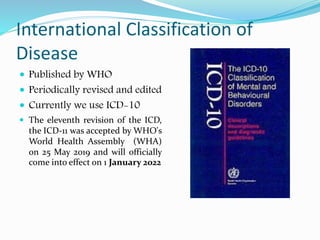
International Classification of
Disease
 Published by WHO
 Periodically revised and edited
 Currently we use ICD-10
 The eleventh revision of the ICD,
the ICD-11 was accepted by WHO's
World Health Assembly (WHA)
on 25 May 2019 and will officially
come into effect on 1 January 2022
History
 During the 1800s the importance of creating a uniform system
of health was realized
 The International Statistical Institute adopted the first
international classification of diseases in 1893.
 Came to be known as the International List of Causes of Death
(ICD).
 1948, the WHO took over the responsibility for publishing the
ICD
 Mental disorders were included in the 6th edition of ICD.
 WHO revised the ICD in the 1980s and ’90s. The
resulting three-volume work, known as ICD-10
(International Statistical Classification of Diseases and
Related Health Problems), and was published in 1992;
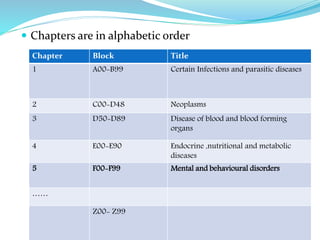
 Chapters are in alphabetic order
Chapter Block Title
1 A00-B99 Certain Infections and parasitic diseases
2 C00-D48 Neoplasms
3 D50-D89 Disease of blood and blood forming
organs
4 E00-E90 Endocrine ,nutritional and metabolic
diseases
5 F00-F99 Mental and behavioural disorders
……
Z00- Z99
F00-F99.Mental and behavioural
disorders
F0: Organic, including symptomatic, mental disorders
F1: Mental and behavioural disorders due to use of
psychoactive substances
F2: Schizophrenia, schizotypal and delusional disorders
F3: Mood [affective] disorders
F4: Neurotic, stress-related and somatoform disorders
F5: Behavioural syndromes associated with physiological
disturbances and physical factors
F6: Disorders of personality and behaviour in adult persons
F7: Mental retardation
F8: Disorders of psychological development
F9: Behavioural and emotional disorders with onset usually
occurring in childhood and adolescence
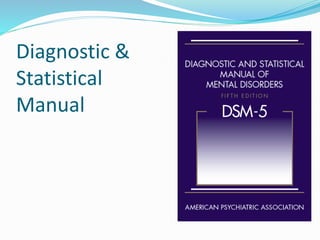
Diagnostic &
Statistical
Manual
Diagnostic & Statistical Manual
 In 1918, the American Medico-Psychological Association
(presently the American Psychological Association, or APA)
issued the Statistical Manual for Use of Institutions for the
Insane. Not widely used
 By World War II, the military had its own nomenclature
system.
 The World Health Organization (WHO) issued the
International Classification of Diseases-6 (ICD-6); it
contained a section on mental disorders
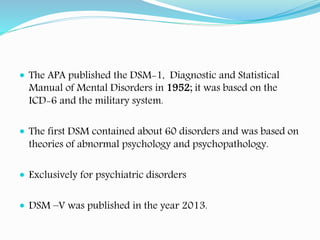
 The APA published the DSM-1, Diagnostic and Statistical
Manual of Mental Disorders in 1952; it was based on the
ICD-6 and the military system.
 The first DSM contained about 60 disorders and was based on
theories of abnormal psychology and psychopathology.
 Exclusively for psychiatric disorders
 DSM –V was published in the year 2013.
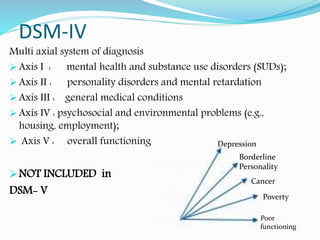
DSM-IV
Multi axial system of diagnosis
 Axis I : mental health and substance use disorders (SUDs);
 Axis II : personality disorders and mental retardation
 Axis III : general medical conditions
 Axis IV : psychosocial and environmental problems (e.g.,
housing, employment);
 Axis V : overall functioning
NOT INCLUDED in
DSM- V
Depression
Borderline
Personality
Cancer
Poverty
Poor
functioning
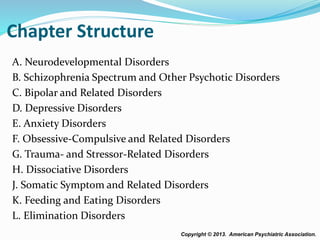
Chapter Structure
A. Neurodevelopmental Disorders
B. Schizophrenia Spectrum and Other Psychotic Disorders
C. Bipolar and Related Disorders
D. Depressive Disorders
E. Anxiety Disorders
F. Obsessive-Compulsive and Related Disorders
G. Trauma- and Stressor-Related Disorders
H. Dissociative Disorders
J. Somatic Symptom and Related Disorders
K. Feeding and Eating Disorders
L. Elimination Disorders
Copyright © 2013. American Psychiatric Association.
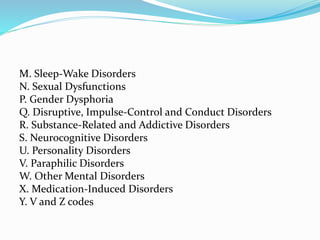
M. Sleep-Wake Disorders
N. Sexual Dysfunctions
P. Gender Dysphoria
Q. Disruptive, Impulse-Control and Conduct Disorders
R. Substance-Related and Addictive Disorders
S. Neurocognitive Disorders
U. Personality Disorders
V. Paraphilic Disorders
W. Other Mental Disorders
X. Medication-Induced Disorders
Y. V and Z codes
 THANK YOU…..

Classification of mental disorders

  • 1.
    Aarcha Gowri Varma IIyear PSW IMHANS
  • 3.
    CLASSIFICATION  Classification isa process by which complex phenomena are organized into categories, classes or ranks so as bring together those things that most resemble each other & to separate those that differ from each other
  • 4.
    Purpose of classification Clearly and precisely defined nomenclature  To distinguish one psychiatric diagnosis from another  To provide a common language among health care professionals;  Provide a comprehensive reference system which can be used in practice (diagnosis, prognosis, treatment)  Bring in uniformity in practice and research.  Ultimate purpose is to offer the most effective treatment;
  • 5.
    INTERNATIONAL CLASSIFICATIONS IN PSYCHIATRY Many authors like Hippocrates have classified psychiatric disorders.  But not accepted now. Currently used classification  1.International Classification of Disease (ICD)  2. Diagnostic & Statistical Manual (DSM)
  • 6.
    International Classification of Disease Published by WHO  Periodically revised and edited  Currently we use ICD-10  The eleventh revision of the ICD, the ICD-11 was accepted by WHO's World Health Assembly (WHA) on 25 May 2019 and will officially come into effect on 1 January 2022
  • 7.
    History  During the1800s the importance of creating a uniform system of health was realized  The International Statistical Institute adopted the first international classification of diseases in 1893.  Came to be known as the International List of Causes of Death (ICD).  1948, the WHO took over the responsibility for publishing the ICD
  • 8.
     Mental disorderswere included in the 6th edition of ICD.  WHO revised the ICD in the 1980s and ’90s. The resulting three-volume work, known as ICD-10 (International Statistical Classification of Diseases and Related Health Problems), and was published in 1992;
  • 9.
     Chapters arein alphabetic order Chapter Block Title 1 A00-B99 Certain Infections and parasitic diseases 2 C00-D48 Neoplasms 3 D50-D89 Disease of blood and blood forming organs 4 E00-E90 Endocrine ,nutritional and metabolic diseases 5 F00-F99 Mental and behavioural disorders …… Z00- Z99
  • 10.
    F00-F99.Mental and behavioural disorders F0:Organic, including symptomatic, mental disorders F1: Mental and behavioural disorders due to use of psychoactive substances F2: Schizophrenia, schizotypal and delusional disorders F3: Mood [affective] disorders F4: Neurotic, stress-related and somatoform disorders F5: Behavioural syndromes associated with physiological disturbances and physical factors F6: Disorders of personality and behaviour in adult persons F7: Mental retardation F8: Disorders of psychological development F9: Behavioural and emotional disorders with onset usually occurring in childhood and adolescence
  • 11.
  • 12.
    Diagnostic & StatisticalManual  In 1918, the American Medico-Psychological Association (presently the American Psychological Association, or APA) issued the Statistical Manual for Use of Institutions for the Insane. Not widely used  By World War II, the military had its own nomenclature system.  The World Health Organization (WHO) issued the International Classification of Diseases-6 (ICD-6); it contained a section on mental disorders
  • 13.
     The APApublished the DSM-1, Diagnostic and Statistical Manual of Mental Disorders in 1952; it was based on the ICD-6 and the military system.  The first DSM contained about 60 disorders and was based on theories of abnormal psychology and psychopathology.  Exclusively for psychiatric disorders  DSM –V was published in the year 2013.
  • 14.
    DSM-IV Multi axial systemof diagnosis  Axis I : mental health and substance use disorders (SUDs);  Axis II : personality disorders and mental retardation  Axis III : general medical conditions  Axis IV : psychosocial and environmental problems (e.g., housing, employment);  Axis V : overall functioning NOT INCLUDED in DSM- V Depression Borderline Personality Cancer Poverty Poor functioning
  • 15.
    Chapter Structure A. NeurodevelopmentalDisorders B. Schizophrenia Spectrum and Other Psychotic Disorders C. Bipolar and Related Disorders D. Depressive Disorders E. Anxiety Disorders F. Obsessive-Compulsive and Related Disorders G. Trauma- and Stressor-Related Disorders H. Dissociative Disorders J. Somatic Symptom and Related Disorders K. Feeding and Eating Disorders L. Elimination Disorders Copyright © 2013. American Psychiatric Association.
  • 16.
    M. Sleep-Wake Disorders N.Sexual Dysfunctions P. Gender Dysphoria Q. Disruptive, Impulse-Control and Conduct Disorders R. Substance-Related and Addictive Disorders S. Neurocognitive Disorders U. Personality Disorders V. Paraphilic Disorders W. Other Mental Disorders X. Medication-Induced Disorders Y. V and Z codes
  • 18.