ICD 10 vs ICD 11 changes
relavent to CAP This Photo by Unknown author is licensed under CC BY-SA.
Dr. Challa S V Krishna Vasan
Senior Resident PDCC-CAP
Moderator:Dr. Shivanand Kattimani MD,DM
Consultant, Child and Adolescent Psychiatry
JIPMER
It contains roughly 55000 unique codes, this revision
is intended to better align with current scientific and
medical knowledge.
WHO released the latest version of
International Classification of Diseases, ICD-11,On
June 18, approved by the the World Health Assembly
in May, 2019, and implemented from Jan 1, 2022.
As with previous versions, ICD-11
will enable diseases and health
conditions to be recorded using a
standardised coding system, so that
mortality and morbidity data can be
tracked, analysed, and compared.
Both the Diagnostic and Statistical
Manual of Mental Disorders (DSM)
and the ICD have always followed
a descriptive categorical approach.
Neurodevelopmental
Disorders
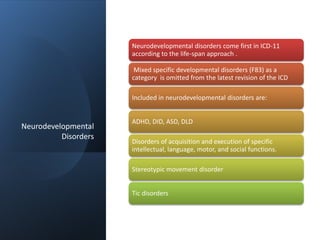
Neurodevelopmental disorders come first in ICD-11
according to the life-span approach .
Mixed specific developmental disorders (F83) as a
category is omitted from the latest revision of the ICD
Included in neurodevelopmental disorders are:
ADHD, DID, ASD, DLD
Disorders of acquisition and execution of specific
intellectual, language, motor, and social functions.
Stereotypic movement disorder
Tic disorders
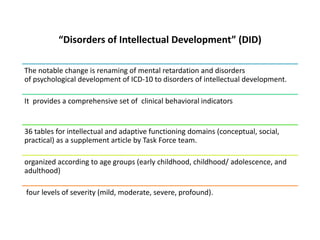
“Disorders of Intellectual Development” (DID)
The notable change is renaming of mental retardation and disorders
of psychological development of ICD-10 to disorders of intellectual development.
It provides a comprehensive set of clinical behavioral indicators
36 tables for intellectual and adaptive functioning domains (conceptual, social,
practical) as a supplement article by Task Force team.
organized according to age groups (early childhood, childhood/ adolescence, and
adulthood)
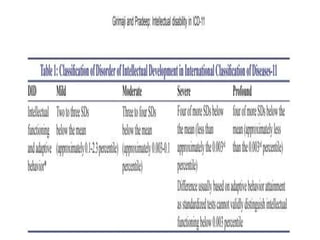
four levels of severity (mild, moderate, severe, profound).
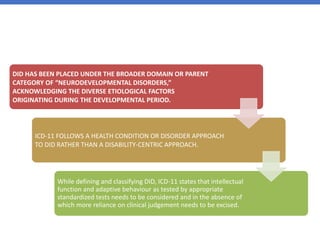
DID HAS BEEN PLACED UNDER THE BROADER DOMAIN OR PARENT
CATEGORY OF “NEURODEVELOPMENTAL DISORDERS,”
ACKNOWLEDGING THE DIVERSE ETIOLOGICAL FACTORS
ORIGINATING DURING THE DEVELOPMENTAL PERIOD.
ICD-11 FOLLOWS A HEALTH CONDITION OR DISORDER APPROACH
TO DID RATHER THAN A DISABILITY-CENTRIC APPROACH.
While defining and classifying DID, ICD-11 states that intellectual
function and adaptive behaviour as tested by appropriate
standardized tests needs to be considered and in the absence of
which more reliance on clinical judgement needs to be excised.
ICD-11 provides better definition and
description of intellectual function
and adaptive behaviors, and also
description of different severities of
ID than ICD-10.
ICD-11 allows for comorbid diagnosis
of DID and other neurodevelopmental
disorders if the core impairment in the
other disorder is significant than what
would be expected based on
intellectual and
adaptive behaviour functioning.
This was a welcome change in ICD-11
compared to ICD-10
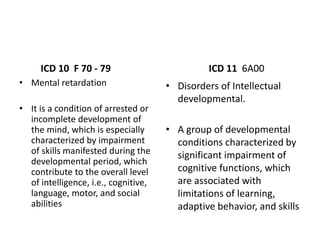
ICD 10 F 70 - 79
• Mental retardation
• It is a condition of arrested or
incomplete development of
the mind, which is especially
characterized by impairment
of skills manifested during the
developmental period, which
contribute to the overall level
of intelligence, i.e., cognitive,
language, motor, and social
abilities
ICD 11 6A00
• Disorders of Intellectual
developmental.
• A group of developmental
conditions characterized by
significant impairment of
cognitive functions, which
are associated with
limitations of learning,
adaptive behavior, and skills
Developmental learning
disorder (DLDs)
 This category is called “Specific developmental
disorders of scholastic skills” in International
Classification of Diseases 10thEdition(ICD-10)
 ICD-10 subtypes were –
a. specific reading disorder,
b. specific spelling disorder,
c. disorder of arithmetical skills,
d. and mixed types.
 It is renamed as “Developmental learning
disorder” in ICD-11 subtyped as those with
a. impairment in reading,
b. Impairment in written expression,
c. Impairement in mathematics, and with other
specified impairment of learning.
Autism spectrum disorder
Autism spectrum disorder in
the ICD-11 incorporates
both childhood autism and
Asperger’s syndrome from
the ICD-10 under a single
category
It is characterized by social
communication deficits and
restricted, repetitive and
infexible patterns of
behaviour, interests or
activities.
Qualifiers are provided for
the extent of impairment
in Intellectual functioning
and functional language
abilities.
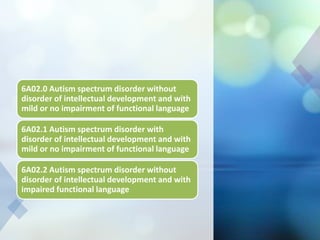
6A02.0 Autism spectrum disorder without
disorder of intellectual development and with
mild or no impairment of functional language
6A02.1 Autism spectrum disorder with
disorder of intellectual development and with
mild or no impairment of functional language
6A02.2 Autism spectrum disorder without
disorder of intellectual development and with
impaired functional language
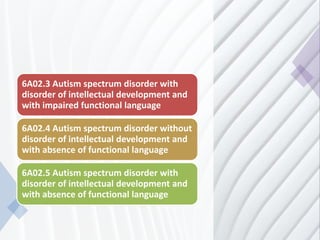
6A02.3 Autism spectrum disorder with
disorder of intellectual development and
with impaired functional language
6A02.4 Autism spectrum disorder without
disorder of intellectual development and
with absence of functional language
6A02.5 Autism spectrum disorder with
disorder of intellectual development and
with absence of functional language
Attention
deficit
hyper
active
disorder
ICD-10 does not formally recognise ADHD and instead
includes diagnostic criteria for hyperkinetic disorder
(HKD).
ADHD has replaced ICD-10 hyperkinetic disorders and
has been moved to the grouping of
neurodevelopmental disorders because of its
developmental onset, characteristic disturbances in
intellectual, motor and social functions, and common
cooccurrence with other neurodevelopmental
disorders.
This move also addresses the conceptual weakness of
viewing ADHD as more closely related to disruptive
behaviour and dissocial disorders, given that
individuals with ADHD are typically not intentionally
disruptive.
For a diagnosis of HKD to be made an individual must display symptoms
of both impaired attention and overactivity, which includes impulsivity.
The symptoms must also be present before 6 years of age.
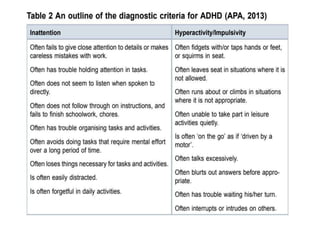
ADHD is characterized by a persistent pattern (at least 6 months) of
inattention and/or hyperactivity-impulsivity, with onset during the
developmental period, typically early to mid-childhood
Specific qualifers are used as predominantly
inattentive, predominantly hyperactive impulsive, or combined type,
and is described across the lifespan.
As with DSM-5-TR they must be found
in two settings, and other conditions
that could cause the same symptoms
must first be ruled out
ICD-11 also adopts the distinct
subtypes of ADHD found in DSM-5-TR
but adds a further two: ‘other specified
presentation’ and ‘presentation
unspecified’. At the time of writing, the
detail of what these two categories are
likely to include is unclear.
Chronic tic disorders, including Tourette syndrome,
are classifed in the ICD-11 chapter 8 on diseases of
the nervous system.
But they are cross-listed in the grouping of
neurodevelopmental disorders because of their high
co-occurrence (e.g., with ADHD) and typical onset
during the developmental period.
Disruptive
behaviour or
dissocial
disorders
(BlockL1-6C9)
ICD-11 grouping of disruptive behaviour and
dissocial disorders replaces ICD-10 conduct
disorders.
These disorders were coded under the section on
“disorders of childhood and adolescence” (F91–92).
Characterized by persistent behaviour problems
that range from markedly and persistently defiant,
disobedient, provocative or spiteful (i.e., disruptive)
behaviours to those that persistently violate the
basic rights of others or major age-appropriate
societal norms, rules, or laws (i.e., dissocial).
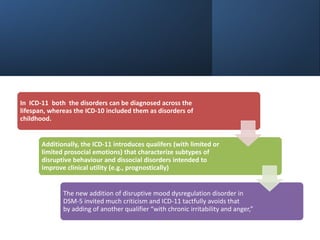
In ICD-11 both the disorders can be diagnosed across the
lifespan, whereas the ICD-10 included them as disorders of
childhood.
Additionally, the ICD-11 introduces qualifers (with limited or
limited prosocial emotions) that characterize subtypes of
disruptive behaviour and dissocial disorders intended to
improve clinical utility (e.g., prognostically)
The new addition of disruptive mood dysregulation disorder in
DSM-5 invited much criticism and ICD-11 tactfully avoids that
by adding of another qualifier “with chronic irritability and anger,”
•
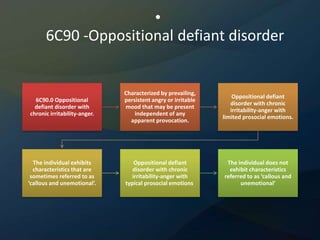
6C90 -Oppositional defiant disorder
6C90.0 Oppositional
defiant disorder with
chronic irritability-anger.
Characterized by prevailing,
persistent angry or irritable
mood that may be present
independent of any
apparent provocation.
Oppositional defiant
disorder with chronic
irritability-anger with
limited prosocial emotions.
The individual exhibits
characteristics that are
sometimes referred to as
‘callous and unemotional’.
Oppositional defiant
disorder with chronic
irritability-anger with
typical prosocial emotions
The individual does not
exhibit characteristics
referred to as ‘callous and
unemotional’
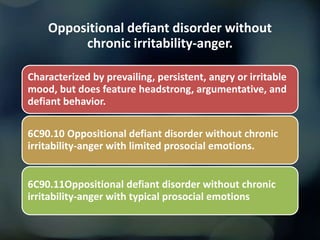
Oppositional defiant disorder without
chronic irritability-anger.
Characterized by prevailing, persistent, angry or irritable
mood, but does feature headstrong, argumentative, and
defiant behavior.
6C90.10 Oppositional defiant disorder without chronic
irritability-anger with limited prosocial emotions.
6C90.11Oppositional defiant disorder without chronic
irritability-anger with typical prosocial emotions
ICD-11 oppositional defiant disorder is conceptually similar to its ICD-10
equivalent category. ODD (F 91.3) was seen as a subtype of CD[14] in
ICD-10. The disorders are considered separate in ICD-11
However, a “with chronic irritability and anger” qualifier is provided
to those presentations of the disorder with prevailing, persistent
irritable mood or anger.
This presentation is recognized to signifcantly increase the risk for
subsequent depression and anxiety
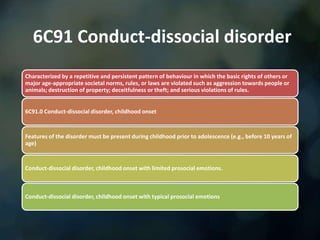
6C91 Conduct-dissocial disorder
Characterized by a repetitive and persistent pattern of behaviour in which the basic rights of others or
major age-appropriate societal norms, rules, or laws are violated such as aggression towards people or
animals; destruction of property; deceitfulness or theft; and serious violations of rules.
6C91.0 Conduct-dissocial disorder, childhood onset
Features of the disorder must be present during childhood prior to adolescence (e.g., before 10 years of
age)
Conduct-dissocial disorder, childhood onset with limited prosocial emotions.
Conduct-dissocial disorder, childhood onset with typical prosocial emotions
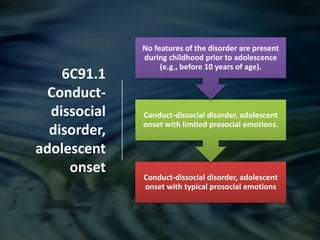
6C91.1
Conduct-
dissocial
disorder,
adolescent
onset
Conduct-dissocial disorder, adolescent
onset with typical prosocial emotions
Conduct-dissocial disorder, adolescent
onset with limited prosocial emotions.
No features of the disorder are present
during childhood prior to adolescence
(e.g., before 10 years of age).
ICD-11 conduct disorder combines the three separate conduct
disorder diagnoses classifed in ICD-10 (i.e., confined to the family
context, unsocialized, socialized).
The ICD-11 acknowledges that disruptive behaviour and dissocial
disorders are frequently associated with problematic psychosocial
environments and psychosocial risk factors, such as peer rejection,
deviant peer group influences, and parental mental disorder.
Distinction between childhood and adolescent onset of the disorder
can be indicated with a qualifer, that earlier onset is associated
with more severe pathology and a poorer course of the disorder.
A qualifier to indicate limited
prosocial emotions can be assigned
to both disruptive behaviour and
dissocial disorders.
In the context of an oppositional
defiant disorder diagnosis, this
presentation is associated with a
more stable and extreme pattern of
oppositional behaviours.
In the context of conduct dissocial
disorder, it is associated with a
tendency towards a more severe,
aggressive and stable pattern of
antisocial behaviour.
Feeding
and eating
disorders
The ICD-11 grouping of feeding and eating
disorders integrates ICD-10 eating
disorders and feeding disorders of
childhood, in recognition of the
interconnectedness of these disorders
across the lifespan, as well as reflecting the
evidence that these disorders can apply to
individuals across a broader range of ages.
Anorexia nervosa in the ICD-11 eliminates
the ICD-10 requirement for the presence of
a widespread endocrine disorder, because
evidence suggests that this does not occur
in all cases and, even when present, is a
consequence of low body weight rather
than a distinct defining feature of the
disorder.
Qualifiers are provided to characterize the severity of underweight status.
Extremely low body mass index is associated with greater risk of morbidity and
mortality.
A qualifier describing the pattern of associated behaviours is included (i.e., restricting
pattern, binge-purge pattern).
Bulimia nervosa in the ICD-11 can be diagnosed regardless of the current weight
of the individual, as long as the mass index is not so low as to
meet definitional requirements for anorexia nervosa.
Elimination disorders
The term “non-organic” is removed from the ICD-
11 elimination disorders, which include enuresis
and encopresis.
These disorders are differentiated from those that
can be better accounted for by another health
condition or the physiological effects of a
substance.
Anxiety or fear-related disorders
(BlockL1-6B0)
• ICD-11 has included a developmental lifespan approach to
the disorders classified under Anxiety and Fear-Related
Disorders section with the inclusion of separation anxiety
disorder and selective mutism.
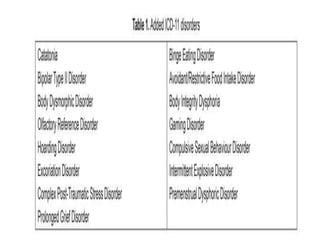
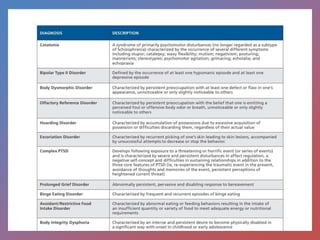
Complex posttraumatic stress disorder (complex
PTSD) is a new diagnosis in ICD 11 . This diagnosis
is a combination of PTSD and ICD-10 category of
“enduring personality change after catastrophic
experience (F62.0)”
Children are more vulnerable to this disorder than
adults and thus the previous practice of
undermining the importance of prolonged stress
in early childhood because it was difficult to
diagnose “enduring personality change after
catastrophic experience” in childhood was not
appropriate.
Disorders specifically associated
with stress (BlockL1-6B4)
• Complex PTSD is envisaged as a disorder that occurs in the
wake of an event or a series of events that are horrific,
life-threatening, and are often times repetitive and
prolonged, where the person feels escape is difficult.
• This is especially relevant given that children are often the
target of severe and significant violence and human rights
violations including sexual violence, trafficking, and other
such heinous crimes
Disorders specifically associated
with stress (BlockL1-6B4)
With respect to children, ICD-11 has discussed
the boundaries of normal bereavement and
prolonged grief disorder with developmental
presentations and expressions of grief
Prolonged grief disorder was given the status
of an independent disorder in ICD-11.
In ICD-10, attachment disorders were
classified under the section of “Disorders of
social functioning with onset specific to
childhood and adolescence” (F94).
Exposure to chronic stress in the form of
severe social neglect and grossly inadequate
caregiving specifically in the early
developmental period is necessary for
attachment disorders to occur in both
DSM-5 and ICD-11.
Disorders specifically related associated with
stress – RAD, DSED
THANK YOU

ICD 10 vs 11_064120.pptx

  • 1.
    ICD 10 vsICD 11 changes relavent to CAP This Photo by Unknown author is licensed under CC BY-SA. Dr. Challa S V Krishna Vasan Senior Resident PDCC-CAP Moderator:Dr. Shivanand Kattimani MD,DM Consultant, Child and Adolescent Psychiatry JIPMER
  • 2.
    It contains roughly55000 unique codes, this revision is intended to better align with current scientific and medical knowledge. WHO released the latest version of International Classification of Diseases, ICD-11,On June 18, approved by the the World Health Assembly in May, 2019, and implemented from Jan 1, 2022.
  • 3.
    As with previousversions, ICD-11 will enable diseases and health conditions to be recorded using a standardised coding system, so that mortality and morbidity data can be tracked, analysed, and compared. Both the Diagnostic and Statistical Manual of Mental Disorders (DSM) and the ICD have always followed a descriptive categorical approach.
  • 8.
    Neurodevelopmental Disorders Neurodevelopmental disorders comefirst in ICD-11 according to the life-span approach . Mixed specific developmental disorders (F83) as a category is omitted from the latest revision of the ICD Included in neurodevelopmental disorders are: ADHD, DID, ASD, DLD Disorders of acquisition and execution of specific intellectual, language, motor, and social functions. Stereotypic movement disorder Tic disorders
  • 9.
    “Disorders of IntellectualDevelopment” (DID) The notable change is renaming of mental retardation and disorders of psychological development of ICD-10 to disorders of intellectual development. It provides a comprehensive set of clinical behavioral indicators 36 tables for intellectual and adaptive functioning domains (conceptual, social, practical) as a supplement article by Task Force team. organized according to age groups (early childhood, childhood/ adolescence, and adulthood) four levels of severity (mild, moderate, severe, profound).
  • 11.
    DID HAS BEENPLACED UNDER THE BROADER DOMAIN OR PARENT CATEGORY OF “NEURODEVELOPMENTAL DISORDERS,” ACKNOWLEDGING THE DIVERSE ETIOLOGICAL FACTORS ORIGINATING DURING THE DEVELOPMENTAL PERIOD. ICD-11 FOLLOWS A HEALTH CONDITION OR DISORDER APPROACH TO DID RATHER THAN A DISABILITY-CENTRIC APPROACH. While defining and classifying DID, ICD-11 states that intellectual function and adaptive behaviour as tested by appropriate standardized tests needs to be considered and in the absence of which more reliance on clinical judgement needs to be excised.
  • 12.
    ICD-11 provides betterdefinition and description of intellectual function and adaptive behaviors, and also description of different severities of ID than ICD-10. ICD-11 allows for comorbid diagnosis of DID and other neurodevelopmental disorders if the core impairment in the other disorder is significant than what would be expected based on intellectual and adaptive behaviour functioning. This was a welcome change in ICD-11 compared to ICD-10
  • 13.
    ICD 10 F70 - 79 • Mental retardation • It is a condition of arrested or incomplete development of the mind, which is especially characterized by impairment of skills manifested during the developmental period, which contribute to the overall level of intelligence, i.e., cognitive, language, motor, and social abilities ICD 11 6A00 • Disorders of Intellectual developmental. • A group of developmental conditions characterized by significant impairment of cognitive functions, which are associated with limitations of learning, adaptive behavior, and skills
  • 14.
    Developmental learning disorder (DLDs) This category is called “Specific developmental disorders of scholastic skills” in International Classification of Diseases 10thEdition(ICD-10)  ICD-10 subtypes were – a. specific reading disorder, b. specific spelling disorder, c. disorder of arithmetical skills, d. and mixed types.  It is renamed as “Developmental learning disorder” in ICD-11 subtyped as those with a. impairment in reading, b. Impairment in written expression, c. Impairement in mathematics, and with other specified impairment of learning.
  • 15.
    Autism spectrum disorder Autismspectrum disorder in the ICD-11 incorporates both childhood autism and Asperger’s syndrome from the ICD-10 under a single category It is characterized by social communication deficits and restricted, repetitive and infexible patterns of behaviour, interests or activities. Qualifiers are provided for the extent of impairment in Intellectual functioning and functional language abilities.
  • 16.
    6A02.0 Autism spectrumdisorder without disorder of intellectual development and with mild or no impairment of functional language 6A02.1 Autism spectrum disorder with disorder of intellectual development and with mild or no impairment of functional language 6A02.2 Autism spectrum disorder without disorder of intellectual development and with impaired functional language
  • 17.
    6A02.3 Autism spectrumdisorder with disorder of intellectual development and with impaired functional language 6A02.4 Autism spectrum disorder without disorder of intellectual development and with absence of functional language 6A02.5 Autism spectrum disorder with disorder of intellectual development and with absence of functional language
  • 18.
    Attention deficit hyper active disorder ICD-10 does notformally recognise ADHD and instead includes diagnostic criteria for hyperkinetic disorder (HKD). ADHD has replaced ICD-10 hyperkinetic disorders and has been moved to the grouping of neurodevelopmental disorders because of its developmental onset, characteristic disturbances in intellectual, motor and social functions, and common cooccurrence with other neurodevelopmental disorders. This move also addresses the conceptual weakness of viewing ADHD as more closely related to disruptive behaviour and dissocial disorders, given that individuals with ADHD are typically not intentionally disruptive.
  • 19.
    For a diagnosisof HKD to be made an individual must display symptoms of both impaired attention and overactivity, which includes impulsivity. The symptoms must also be present before 6 years of age. ADHD is characterized by a persistent pattern (at least 6 months) of inattention and/or hyperactivity-impulsivity, with onset during the developmental period, typically early to mid-childhood Specific qualifers are used as predominantly inattentive, predominantly hyperactive impulsive, or combined type, and is described across the lifespan.
  • 20.
    As with DSM-5-TRthey must be found in two settings, and other conditions that could cause the same symptoms must first be ruled out ICD-11 also adopts the distinct subtypes of ADHD found in DSM-5-TR but adds a further two: ‘other specified presentation’ and ‘presentation unspecified’. At the time of writing, the detail of what these two categories are likely to include is unclear.
  • 22.
    Chronic tic disorders,including Tourette syndrome, are classifed in the ICD-11 chapter 8 on diseases of the nervous system. But they are cross-listed in the grouping of neurodevelopmental disorders because of their high co-occurrence (e.g., with ADHD) and typical onset during the developmental period.
  • 23.
    Disruptive behaviour or dissocial disorders (BlockL1-6C9) ICD-11 groupingof disruptive behaviour and dissocial disorders replaces ICD-10 conduct disorders. These disorders were coded under the section on “disorders of childhood and adolescence” (F91–92). Characterized by persistent behaviour problems that range from markedly and persistently defiant, disobedient, provocative or spiteful (i.e., disruptive) behaviours to those that persistently violate the basic rights of others or major age-appropriate societal norms, rules, or laws (i.e., dissocial).
  • 24.
    In ICD-11 boththe disorders can be diagnosed across the lifespan, whereas the ICD-10 included them as disorders of childhood. Additionally, the ICD-11 introduces qualifers (with limited or limited prosocial emotions) that characterize subtypes of disruptive behaviour and dissocial disorders intended to improve clinical utility (e.g., prognostically) The new addition of disruptive mood dysregulation disorder in DSM-5 invited much criticism and ICD-11 tactfully avoids that by adding of another qualifier “with chronic irritability and anger,”
  • 25.
    • 6C90 -Oppositional defiantdisorder 6C90.0 Oppositional defiant disorder with chronic irritability-anger. Characterized by prevailing, persistent angry or irritable mood that may be present independent of any apparent provocation. Oppositional defiant disorder with chronic irritability-anger with limited prosocial emotions. The individual exhibits characteristics that are sometimes referred to as ‘callous and unemotional’. Oppositional defiant disorder with chronic irritability-anger with typical prosocial emotions The individual does not exhibit characteristics referred to as ‘callous and unemotional’
  • 26.
    Oppositional defiant disorderwithout chronic irritability-anger. Characterized by prevailing, persistent, angry or irritable mood, but does feature headstrong, argumentative, and defiant behavior. 6C90.10 Oppositional defiant disorder without chronic irritability-anger with limited prosocial emotions. 6C90.11Oppositional defiant disorder without chronic irritability-anger with typical prosocial emotions
  • 27.
    ICD-11 oppositional defiantdisorder is conceptually similar to its ICD-10 equivalent category. ODD (F 91.3) was seen as a subtype of CD[14] in ICD-10. The disorders are considered separate in ICD-11 However, a “with chronic irritability and anger” qualifier is provided to those presentations of the disorder with prevailing, persistent irritable mood or anger. This presentation is recognized to signifcantly increase the risk for subsequent depression and anxiety
  • 28.
    6C91 Conduct-dissocial disorder Characterizedby a repetitive and persistent pattern of behaviour in which the basic rights of others or major age-appropriate societal norms, rules, or laws are violated such as aggression towards people or animals; destruction of property; deceitfulness or theft; and serious violations of rules. 6C91.0 Conduct-dissocial disorder, childhood onset Features of the disorder must be present during childhood prior to adolescence (e.g., before 10 years of age) Conduct-dissocial disorder, childhood onset with limited prosocial emotions. Conduct-dissocial disorder, childhood onset with typical prosocial emotions
  • 29.
    6C91.1 Conduct- dissocial disorder, adolescent onset Conduct-dissocial disorder, adolescent onsetwith typical prosocial emotions Conduct-dissocial disorder, adolescent onset with limited prosocial emotions. No features of the disorder are present during childhood prior to adolescence (e.g., before 10 years of age).
  • 30.
    ICD-11 conduct disordercombines the three separate conduct disorder diagnoses classifed in ICD-10 (i.e., confined to the family context, unsocialized, socialized). The ICD-11 acknowledges that disruptive behaviour and dissocial disorders are frequently associated with problematic psychosocial environments and psychosocial risk factors, such as peer rejection, deviant peer group influences, and parental mental disorder. Distinction between childhood and adolescent onset of the disorder can be indicated with a qualifer, that earlier onset is associated with more severe pathology and a poorer course of the disorder.
  • 31.
    A qualifier toindicate limited prosocial emotions can be assigned to both disruptive behaviour and dissocial disorders. In the context of an oppositional defiant disorder diagnosis, this presentation is associated with a more stable and extreme pattern of oppositional behaviours. In the context of conduct dissocial disorder, it is associated with a tendency towards a more severe, aggressive and stable pattern of antisocial behaviour.
  • 32.
    Feeding and eating disorders The ICD-11grouping of feeding and eating disorders integrates ICD-10 eating disorders and feeding disorders of childhood, in recognition of the interconnectedness of these disorders across the lifespan, as well as reflecting the evidence that these disorders can apply to individuals across a broader range of ages. Anorexia nervosa in the ICD-11 eliminates the ICD-10 requirement for the presence of a widespread endocrine disorder, because evidence suggests that this does not occur in all cases and, even when present, is a consequence of low body weight rather than a distinct defining feature of the disorder.
  • 33.
    Qualifiers are providedto characterize the severity of underweight status. Extremely low body mass index is associated with greater risk of morbidity and mortality. A qualifier describing the pattern of associated behaviours is included (i.e., restricting pattern, binge-purge pattern). Bulimia nervosa in the ICD-11 can be diagnosed regardless of the current weight of the individual, as long as the mass index is not so low as to meet definitional requirements for anorexia nervosa.
  • 34.
    Elimination disorders The term“non-organic” is removed from the ICD- 11 elimination disorders, which include enuresis and encopresis. These disorders are differentiated from those that can be better accounted for by another health condition or the physiological effects of a substance.
  • 35.
    Anxiety or fear-relateddisorders (BlockL1-6B0) • ICD-11 has included a developmental lifespan approach to the disorders classified under Anxiety and Fear-Related Disorders section with the inclusion of separation anxiety disorder and selective mutism.
  • 36.
    Complex posttraumatic stressdisorder (complex PTSD) is a new diagnosis in ICD 11 . This diagnosis is a combination of PTSD and ICD-10 category of “enduring personality change after catastrophic experience (F62.0)” Children are more vulnerable to this disorder than adults and thus the previous practice of undermining the importance of prolonged stress in early childhood because it was difficult to diagnose “enduring personality change after catastrophic experience” in childhood was not appropriate.
  • 37.
    Disorders specifically associated withstress (BlockL1-6B4) • Complex PTSD is envisaged as a disorder that occurs in the wake of an event or a series of events that are horrific, life-threatening, and are often times repetitive and prolonged, where the person feels escape is difficult. • This is especially relevant given that children are often the target of severe and significant violence and human rights violations including sexual violence, trafficking, and other such heinous crimes
  • 38.
    Disorders specifically associated withstress (BlockL1-6B4) With respect to children, ICD-11 has discussed the boundaries of normal bereavement and prolonged grief disorder with developmental presentations and expressions of grief Prolonged grief disorder was given the status of an independent disorder in ICD-11.
  • 39.
    In ICD-10, attachmentdisorders were classified under the section of “Disorders of social functioning with onset specific to childhood and adolescence” (F94). Exposure to chronic stress in the form of severe social neglect and grossly inadequate caregiving specifically in the early developmental period is necessary for attachment disorders to occur in both DSM-5 and ICD-11. Disorders specifically related associated with stress – RAD, DSED
  • 40.