P R E S E N T E D B Y
D R A D U L M A N N A N C H A T T H A
P O S T G R A D U A T E R E S I D E N T
D E P A R T M E N T O F P S Y C H I A T R Y A N D
B E H A V I O U R A L S C I E N C E S , F A I S A L A B A D
M E D I C A L U N I V E R S I T Y .
ICD-11 vs. ICD-10 – a review of updates and
novelties introduced in the latest version of the
WHO International Classification of Diseases
Introduction
 The new version of the ICD was released on
June 18, 2018, as a preliminary version.
 It was officially presented at the World
Health Assembly in May 2019 and will be
used as the official reporting system by
member states beginning January 1, 2022.
 The ICD-11 catalogs known human diseases, medical
conditions, and mental health disorders and is used
for insurance coding purposes, for statistical
tracking of illnesses, and as a global health
categorization tool that can be used across
countries and in different languages.
 It's important also to note that anyone can submit an
evidence-based proposal for ICD revisions and that
these are processed in an open and transparent way.
Digital-Ready and User-Friendly
 It runs on a central platform and can connect to any
software.
 In addition, it can be a machine-readable format,
expanding its potential uses in the digital age.
International Applicability
 Offers guidance for its use with different
cultures as well as translations into 43 different
languages.
 The revised system provides a common coding
language and it will aid in international comparisons
and usage.
Coding rules in ICD-11
 The codes in ICD-11 are alphanumeric and cover the
range from 1A00.00 to ZZ9Z.ZZ
 All individual codes are grouped in 26 main chapters
and two additional chapters (V and X).
 Division of mental disorders into 10 blocks created
suboptimal groupings (e.g.. F4 Neurotic, Stress-
related, and somatoform disorders).
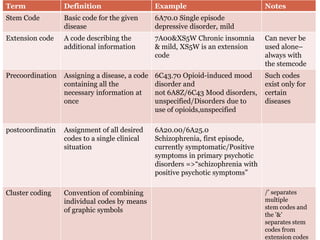
Term Definition Example Notes
Stem Code Basic code for the given
disease
6A70.0 Single episode
depressive disorder, mild
Extension code A code describing the
additional information
7A00&XS5W Chronic insomnia
& mild, XS5W is an extension
code
Can never be
used alone–
always with
the stemcode
Precoordination Assigning a disease, a code
containing all the
necessary information at
once
6C43.70 Opioid-induced mood
disorder and
not 6A8Z/6C43 Mood disorders,
unspecified/Disorders due to
use of opioids,unspecified
Such codes
exist only for
certain
diseases
postcoordinatin Assignment of all desired
codes to a single clinical
situation
6A20.00/6A25.0
Schizophrenia, first episode,
currently symptomatic/Positive
symptoms in primary psychotic
disorders =>“schizophrenia with
positive psychotic symptoms”
Cluster coding Convention of combining
individual codes by means
of graphic symbols
/’ separates
multiple
stem codes and
the ‛&’
separates stem
codes from
extension codes
Classification of mental disorders in ICD-
11 – general aspects
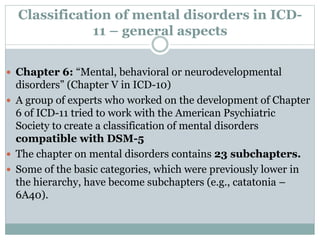
 Chapter 6: “Mental, behavioral or neurodevelopmental
disorders” (Chapter V in ICD-10)
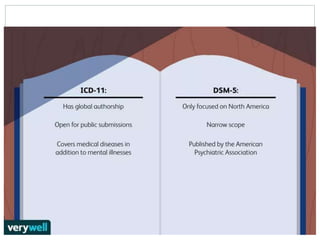
 A group of experts who worked on the development of Chapter
6 of ICD-11 tried to work with the American Psychiatric
Society to create a classification of mental disorders
compatible with DSM-5
 The chapter on mental disorders contains 23 subchapters.
 Some of the basic categories, which were previously lower in
the hierarchy, have become subchapters (e.g., catatonia –
6A40).
Changes in the different categories of
mental disorders
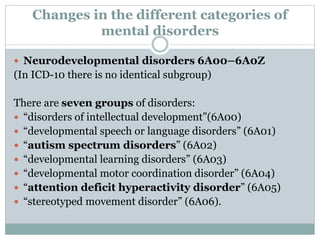
 Neurodevelopmental disorders 6A00–6A0Z
(In ICD-10 there is no identical subgroup)
There are seven groups of disorders:
 “disorders of intellectual development”(6A00)
 “developmental speech or language disorders” (6A01)
 “autism spectrum disorders” (6A02)
 “developmental learning disorders” (6A03)
 “developmental motor coordination disorder” (6A04)
 “attention deficit hyperactivity disorder” (6A05)
 “stereotyped movement disorder” (6A06).
 Among the changes, a unified approach to “pervasive
developmental disorders”(F84 in ICD-10) is
noteworthy.
 In ICD-11 they are gathered in one homogeneous
group of disorders called “autism spectrum
disorder”. Thus, it is impossible to diagnose Asperger
syndrome or Rett syndrome ad literam.
Schizophrenia or other primary psychotic disorders 6A20–6A2Z
(ICD-10 – Schizophrenia, schizotypal and delusional disorders
F20–F29)
The following diagnostic categories are included:
 “schizophrenia” (6A20)
 “schizoaffective disorder” (6A21)
 “schizotypal disorder” (6A22)
 “acute and transient psychotic disorder” (6A23)
 “delusional disorder” (6A24), which replaced
“persistent delusional disorders” originating from
ICD-10.
 Symptomatic manifestation of primary psychotic
disorder (6A25)
 The subdivision of schizophrenia into subtypes
(paranoid/hebephrenic/catatonic, etc.) has been
completely abandoned and replaced by only one
diagnostic category – “schizophrenia”.
 WHO made this decision based on the lack of significant
evidence that the subdivision affects therapeutic
management or prognosis.
 The course of the disease(first episode/multiple
episodes/solid course) and the severity of current
symptoms (currently symptomatic/partial remission/full
remission) should be determined by predefined diagnostic
categories.
 Schizoaffective disorder – the division into subtypes
(manic/depressive/mixed) has been abandoned.
 Using additional codes we can specify the type of
predominant symptoms
(positive/negative/depressive/manic/psychomotor/c
ognitive) as well as the severity of each of them
(mild/moderate/severe).
 “Induced delusional disorder” was removed from
ICD-11.
Catatonia 6A40–6A4Z
 In ICD-10, motor disorders known as catatonia are
classified either solely in the context of organic
disorders (“Organic Catatonic Disorder”– F06.1), or
in the context of schizophrenia,(“Catatonic
schizophrenia”– F20.2)
 In ICD-11, catatonia can be classified as associated
with any other mental disorder.
 Catatonia can also be described as a phenomenon
caused by a psychoactive substance.
 “secondary catatonic syndrome” (6E69)
Mood disorders 6A60–6A8Z
(ICD-10 – Mood [affective] disorders F30–F39)
 The name alternative to mood disorders, i.e.,
“affective disorders” has been omitted.
 Similarly, the name of the bipolar disorder has been
shortened – in ICD-11 it is “bipolar disorder”.
 Concepts concerning bipolar disorder type II (so far
missing in ICD) have also been shared with DSM-5.
 The two main subcategories are “bipolar or
related disorders” and “depressive disorders”.
 The category of a single manic/hypomanic episode
(F30 in ICD-10) was removed. Thus, a
manic/hypomanic episode can only be
diagnosed in the course of bipolar disorder.
 ICD-11 placed “mixed depressive and anxiety
disorder” (6A73) in the subgroup of depressive
disorders. This category is associated with a group of
“Neurotic disorders…” in ICD-10 (F40–F48)
Anxiety or fear-related disorders 6B00–6B0Z
 (ICD-10 – Neurotic, stress-related and somatoform
disorders F40–F48)
There are seven specific subgroups of disorders:
 “generalized anxiety disorder” (6B00)
 “panic disorder” (6B01)
 “agoraphobia” (6B02)
 “specific phobia” (6B03)
 “social anxiety disorder” (6B04)
 “separation anxiety disorder” (6B05)
 “Selective mutism” (6B06).
 An important modification is a separation of
agoraphobia and panic disorder
 The inclusion of two diagnostic categories so far
associated only with the psychiatryof children and
adolescents, namely “separation anxiety disorder”
and “selective mutism”, results in the possibility of
diagnosing these disorders also in adults.
Obsessive-compulsive or related disorders
6B20–6B2Z
 This is a new subchapter in ICD- 11 similar to DSM-
5.
Some of the disorders have not been present in ICD so
far (independently):
 “body dysmorphic disorder” (6B21)
 “olfactory reference disorder” (6B22)
 “hypochondriasis” (6B23)
 “hoarding disorder” (6B24),
 “body-focused repetitive behavior disorders” (6B25).
 “Olfactory reference disorder” was previously
not included in ICD-10 as a separate category and it
was associated with persistent delusional disorders.
 “Body dysmorphic disorder” or
“dysmorphophobia” (nondelusional) were classified
in ICD-10 as hypochondriacal disorder (ICD-10 –
F45.2) belonging to the group of somatoform
disorders (in opposition to delusional
dysmorphophobia, which was classified as other
persistent delusional disorder.
Disorders specifically associated with
stress 6B40–6B4Z
It includes 6 autonomous categories:
 “posttraumatic stress disorder” (6B40)
 “complex post-traumatic stress disorder” (6B41)
 “prolonged grief disorder” (6B42)
 “adjustment disorder” (6B43)
 “reactive attachment disorder” (6B44)
 “disinhibited social engagement disorder” (6B45).
The category of “acute stress reaction” (QE84) has been
removed from this subchapter.
 “complex post-traumatic stress disorder” does not
exist in ICD-10 and DSM-5.
 In ICD-10 the grief reaction belonged to the category
of adaptive disorders. In ICD11 it becomes a separate
diagnostic category. Thus, the gap between the
depressive episode and grief indicated in DSM-5, was
filled.
Dissociative disorders 6B60–6B6Z
 This subchapter was previously a part of the chapter
“Neurotic disorders...”(F40–F48) in ICD-10
 “Dissociative fugue” and “dissociative stupor” were
removed from the set.
 “dissociative motor disorders”, “dissociative
convulsions” and “dissociative anesthesia and
sensory loss” were included in a broad, new group of
disorders associated with “dissociative
neurological symptom disorder” (6B60)
 In addition, Dissociative amnesia(6B61),
Trance disorder(6B62), possession trance
disorder(6B63)“dissociative identity disorder”
(6B64), “partial dissociative identity disorder”
(6B65) and “depersonalization-derealization
disorder” (6B66) have been added to dissociative
disorders.
Feeding or eating disorders 6B80–6B8Z
ICD-11 includes several new categories. All of them
have already appeared in DSM-5.
There are 6 groups of specific disorders:
 “anorexia nervosa” (6B80).
 “bulimia nervosa” (6B81)
 “binge eating disorder” (6B82),
 “avoidant-restrictive food intake disorder”
(6B83)
 “pica”(6B84)
 “rumination-regurgitation disorder” (6B85).
 In ICD-11 the diagnostic criteria for anorexia nervosa
is slightly changed- BMI less than 18.5kg/m2 (In icd-
10 it was <17.5kg/m2
Elimination disorders 6C00–6C0Z
 This newly created subchapter were classified in
ICD-10 in the chapter “Other behavioral and
emotional disorders with onset usually occurring in
childhood and adolescence”.
 Enuresis(6C00)
 Encopresis(6C01)
Disorders of bodily distress or bodily
experience 6C20–6C2Z
 (ICD-10: no corresponding chapter)
It consists of two diagnostic categories:
 “bodily distress disorder” (6C20) and
 “body integrity dysphoria” (6C21)
 The definition of the first category is similar to the clinical
description of somatoform disorders (F45) in ICD-10
 The second category is completely new and does not appear
in ICD-10, nor in DSM-5.
 It is not classified as a ‛disorder’ but rather as
‛suffering/dysphoria’.
 This phenomenon manifests itself in a strong need to
become physically a significantly disabled person
(e.g. the desire of limb amputation or blindness).
Disorders due to substance use or
addictive behaviors 6C40–6C5Z
 There are two groups of disorders: “disorders due to
substance use” and “disorders due to addictive
behaviors”
 The inclusion of disorders associated with the use of
new psychoactive substances: synthetic
cannabinoids, methamphetamine, methcathinone,
synthetic cathinones, 3,4
methylenedioxymethamphetamine (MDMA) and
derivatives, including 3,4-methylenedioxyamphetamine
(MDA), ketamine, phencyclidine, and substances
without psychoactive properties.
The use of each of these substances is associated with the
phenomena or situations described in ICD-11, such as:
 Single episode of harmful use of the substance
 Harmful pattern of substance use,
 Dependence,
 Intoxication,
 Withdrawal,
 Delirium caused by the substance
 Psychotic disorders caused by the substance
 Other disorders caused by the substance (mood disorders
or anxiety disorders)
 Among the so-called behavioral habits,
“gambling disorder” (6C50) and
“gaming disorder” (6C51) are mentioned.
Impulse control disorders, 6C70-6C7Z
 In ICD-11 includes not only entities traditionally
associated with impulse control, i.e., “pyromania”
(6C70) and “kleptomania” (6C71), but also
“compulsive sexual behavior disorder” (6C72)
(in ICD-10 named “excessive sexual drive” F52.7)
and “intermittent explosive disorder” (6C73),
previously absent in ICD.
Disruptive behavior or dissocial disorders
6C90–6C9Z
(ICD-10: no identical chapter)
 This subchapter contains the “oppositional
defiant disorder” (6C90) and “conduct-
dissocial disorder” (6C91) known from ICD-10.
 A certain novelty is the separation of these two
categories as a distinct subchapter and thus making
the diagnosis independent from the age
criterion.
Personality disorders and related traits
6D10–6D11
 It differs significantly from the classification
provided in ICD-10 and DSM-5.
 There is now one diagnosis of "personality
disorder" as it was found that there was much
overlap in clinical practice.
 This subsection has two parts: “personality disorder”
(6D10) and “prominent personality traits or
patterns” (6D11).
 To fully describe the nature of a personality disorder,
both parts should be used.
 The codes in the first part (“personality disorder”)
refer only to the severity of the disorder
(mild/moderate/severe).
Prominent personality traits/patterns include:
 “negative affectivity”
 “detachement”,
 “dissociality”,
 “disinhibition”,
 “anankastia”
 “borderline pattern”
 It is also possible to use the aforementioned
specifiers (apart from the “borderline
pattern”) with the category of “personality
difficulty” (QE50.7), which in ICD-11 does not
belong to mental disorders, but rather to relationship
difficulties
Paraphilic disorders 6D30–6D3Z
In ICD-10-Disorders of sexual preference (F65)
The following categories are included:
 “exhibitionistic disorder” (6D30)
 “voyeuristic disorder” (6D31)
 “pedophilic disorder”(6D32)
 “coercive sexual sadism disorder” (6D33)
 “frotteuristic disorder” (6D34),
 “other paraphilic disorder involving non-consenting
individuals” (6D35)
 “paraphilic disorder involving solitary behavior or
consenting individuals” (6D36)
 ICD-11 does not contain categories such as
“fetishism”, “fetishistic transvestism” and
“sadomasochism”.
Factitious disorders 6D50–6D5Z
It contains two diagnostic categories that seem to
cover the whole issue in a general way:
 “factitious disorder imposed on self” (6D50) and
 “factitious disorder imposed on another” (6D51).
 ICD-10 takes into account only the first one (so-
called Münchhausen syndrome)
Neurocognitive disorders 6D70–6E0Z
(ICD-10: Organic, including symptomatic, mental
disorders F00–F09)
This includes “delirium” (6D70), with the possibility
of indicating any cause of the disorder, “mild
neurocognitive disorder” (6D71), “amnestic
disorder” (6D72), and a broad group of “dementias”
(6D80–6D8Z).
Mental or behavioral disorders associated with
pregnancy, childbirth and the puerperium 6E20–6E2Z
(ICD-10: no identical chapter)
 They are divided into disorders without psychotic
symptoms and disorders with psychotic
symptoms.
Sleep disorders and sexual disorders in
ICD-11
 Subsections on sleep and wakefulness disorders
(ICD-10 group “Nonorganic sleep disorders” F51)
and sexual dysfunctions (ICD-10 “Sexual
dysfunction, not caused by organic disorder or
disease” F52) have been removed from the section on
classification of mental disorders.
Summary
 Some subsections, which are very extensive
collections of diagnostic categories (e.g., “Neurotic
disorders...”) have been divided into smaller parts.
 A number of diseases not present in ICD-10 (e.g.,
“bipolar disorder type II” or “complex post-traumatic
stress disorder”) have been introduced into ICD-11.
 The nomenclature of others (e.g., schizophrenia) has
been simplified.
 Numerous diagnostic categories have gained a higher
status in the hierarchy and have given new names to
completely new chapters.
THANK YOU

ICD11.pptx

  • 1.
    P R ES E N T E D B Y D R A D U L M A N N A N C H A T T H A P O S T G R A D U A T E R E S I D E N T D E P A R T M E N T O F P S Y C H I A T R Y A N D B E H A V I O U R A L S C I E N C E S , F A I S A L A B A D M E D I C A L U N I V E R S I T Y . ICD-11 vs. ICD-10 – a review of updates and novelties introduced in the latest version of the WHO International Classification of Diseases
  • 2.
    Introduction  The newversion of the ICD was released on June 18, 2018, as a preliminary version.  It was officially presented at the World Health Assembly in May 2019 and will be used as the official reporting system by member states beginning January 1, 2022.
  • 3.
     The ICD-11catalogs known human diseases, medical conditions, and mental health disorders and is used for insurance coding purposes, for statistical tracking of illnesses, and as a global health categorization tool that can be used across countries and in different languages.  It's important also to note that anyone can submit an evidence-based proposal for ICD revisions and that these are processed in an open and transparent way.
  • 4.
    Digital-Ready and User-Friendly It runs on a central platform and can connect to any software.  In addition, it can be a machine-readable format, expanding its potential uses in the digital age.
  • 5.
    International Applicability  Offersguidance for its use with different cultures as well as translations into 43 different languages.  The revised system provides a common coding language and it will aid in international comparisons and usage.
  • 6.
    Coding rules inICD-11  The codes in ICD-11 are alphanumeric and cover the range from 1A00.00 to ZZ9Z.ZZ  All individual codes are grouped in 26 main chapters and two additional chapters (V and X).  Division of mental disorders into 10 blocks created suboptimal groupings (e.g.. F4 Neurotic, Stress- related, and somatoform disorders).
  • 7.
    Term Definition ExampleNotes Stem Code Basic code for the given disease 6A70.0 Single episode depressive disorder, mild Extension code A code describing the additional information 7A00&XS5W Chronic insomnia & mild, XS5W is an extension code Can never be used alone– always with the stemcode Precoordination Assigning a disease, a code containing all the necessary information at once 6C43.70 Opioid-induced mood disorder and not 6A8Z/6C43 Mood disorders, unspecified/Disorders due to use of opioids,unspecified Such codes exist only for certain diseases postcoordinatin Assignment of all desired codes to a single clinical situation 6A20.00/6A25.0 Schizophrenia, first episode, currently symptomatic/Positive symptoms in primary psychotic disorders =>“schizophrenia with positive psychotic symptoms” Cluster coding Convention of combining individual codes by means of graphic symbols /’ separates multiple stem codes and the ‛&’ separates stem codes from extension codes
  • 9.
    Classification of mentaldisorders in ICD- 11 – general aspects  Chapter 6: “Mental, behavioral or neurodevelopmental disorders” (Chapter V in ICD-10)  A group of experts who worked on the development of Chapter 6 of ICD-11 tried to work with the American Psychiatric Society to create a classification of mental disorders compatible with DSM-5  The chapter on mental disorders contains 23 subchapters.  Some of the basic categories, which were previously lower in the hierarchy, have become subchapters (e.g., catatonia – 6A40).
  • 10.
    Changes in thedifferent categories of mental disorders  Neurodevelopmental disorders 6A00–6A0Z (In ICD-10 there is no identical subgroup) There are seven groups of disorders:  “disorders of intellectual development”(6A00)  “developmental speech or language disorders” (6A01)  “autism spectrum disorders” (6A02)  “developmental learning disorders” (6A03)  “developmental motor coordination disorder” (6A04)  “attention deficit hyperactivity disorder” (6A05)  “stereotyped movement disorder” (6A06).
  • 11.
     Among thechanges, a unified approach to “pervasive developmental disorders”(F84 in ICD-10) is noteworthy.  In ICD-11 they are gathered in one homogeneous group of disorders called “autism spectrum disorder”. Thus, it is impossible to diagnose Asperger syndrome or Rett syndrome ad literam.
  • 12.
    Schizophrenia or otherprimary psychotic disorders 6A20–6A2Z (ICD-10 – Schizophrenia, schizotypal and delusional disorders F20–F29) The following diagnostic categories are included:  “schizophrenia” (6A20)  “schizoaffective disorder” (6A21)  “schizotypal disorder” (6A22)  “acute and transient psychotic disorder” (6A23)  “delusional disorder” (6A24), which replaced “persistent delusional disorders” originating from ICD-10.  Symptomatic manifestation of primary psychotic disorder (6A25)
  • 13.
     The subdivisionof schizophrenia into subtypes (paranoid/hebephrenic/catatonic, etc.) has been completely abandoned and replaced by only one diagnostic category – “schizophrenia”.  WHO made this decision based on the lack of significant evidence that the subdivision affects therapeutic management or prognosis.  The course of the disease(first episode/multiple episodes/solid course) and the severity of current symptoms (currently symptomatic/partial remission/full remission) should be determined by predefined diagnostic categories.
  • 14.
     Schizoaffective disorder– the division into subtypes (manic/depressive/mixed) has been abandoned.  Using additional codes we can specify the type of predominant symptoms (positive/negative/depressive/manic/psychomotor/c ognitive) as well as the severity of each of them (mild/moderate/severe).  “Induced delusional disorder” was removed from ICD-11.
  • 15.
    Catatonia 6A40–6A4Z  InICD-10, motor disorders known as catatonia are classified either solely in the context of organic disorders (“Organic Catatonic Disorder”– F06.1), or in the context of schizophrenia,(“Catatonic schizophrenia”– F20.2)  In ICD-11, catatonia can be classified as associated with any other mental disorder.  Catatonia can also be described as a phenomenon caused by a psychoactive substance.  “secondary catatonic syndrome” (6E69)
  • 16.
    Mood disorders 6A60–6A8Z (ICD-10– Mood [affective] disorders F30–F39)  The name alternative to mood disorders, i.e., “affective disorders” has been omitted.  Similarly, the name of the bipolar disorder has been shortened – in ICD-11 it is “bipolar disorder”.  Concepts concerning bipolar disorder type II (so far missing in ICD) have also been shared with DSM-5.  The two main subcategories are “bipolar or related disorders” and “depressive disorders”.  The category of a single manic/hypomanic episode (F30 in ICD-10) was removed. Thus, a manic/hypomanic episode can only be diagnosed in the course of bipolar disorder.
  • 17.
     ICD-11 placed“mixed depressive and anxiety disorder” (6A73) in the subgroup of depressive disorders. This category is associated with a group of “Neurotic disorders…” in ICD-10 (F40–F48)
  • 18.
    Anxiety or fear-relateddisorders 6B00–6B0Z  (ICD-10 – Neurotic, stress-related and somatoform disorders F40–F48) There are seven specific subgroups of disorders:  “generalized anxiety disorder” (6B00)  “panic disorder” (6B01)  “agoraphobia” (6B02)  “specific phobia” (6B03)  “social anxiety disorder” (6B04)  “separation anxiety disorder” (6B05)  “Selective mutism” (6B06).
  • 19.
     An importantmodification is a separation of agoraphobia and panic disorder  The inclusion of two diagnostic categories so far associated only with the psychiatryof children and adolescents, namely “separation anxiety disorder” and “selective mutism”, results in the possibility of diagnosing these disorders also in adults.
  • 20.
    Obsessive-compulsive or relateddisorders 6B20–6B2Z  This is a new subchapter in ICD- 11 similar to DSM- 5. Some of the disorders have not been present in ICD so far (independently):  “body dysmorphic disorder” (6B21)  “olfactory reference disorder” (6B22)  “hypochondriasis” (6B23)  “hoarding disorder” (6B24),  “body-focused repetitive behavior disorders” (6B25).
  • 21.
     “Olfactory referencedisorder” was previously not included in ICD-10 as a separate category and it was associated with persistent delusional disorders.  “Body dysmorphic disorder” or “dysmorphophobia” (nondelusional) were classified in ICD-10 as hypochondriacal disorder (ICD-10 – F45.2) belonging to the group of somatoform disorders (in opposition to delusional dysmorphophobia, which was classified as other persistent delusional disorder.
  • 22.
    Disorders specifically associatedwith stress 6B40–6B4Z It includes 6 autonomous categories:  “posttraumatic stress disorder” (6B40)  “complex post-traumatic stress disorder” (6B41)  “prolonged grief disorder” (6B42)  “adjustment disorder” (6B43)  “reactive attachment disorder” (6B44)  “disinhibited social engagement disorder” (6B45). The category of “acute stress reaction” (QE84) has been removed from this subchapter.
  • 23.
     “complex post-traumaticstress disorder” does not exist in ICD-10 and DSM-5.  In ICD-10 the grief reaction belonged to the category of adaptive disorders. In ICD11 it becomes a separate diagnostic category. Thus, the gap between the depressive episode and grief indicated in DSM-5, was filled.
  • 24.
    Dissociative disorders 6B60–6B6Z This subchapter was previously a part of the chapter “Neurotic disorders...”(F40–F48) in ICD-10  “Dissociative fugue” and “dissociative stupor” were removed from the set.  “dissociative motor disorders”, “dissociative convulsions” and “dissociative anesthesia and sensory loss” were included in a broad, new group of disorders associated with “dissociative neurological symptom disorder” (6B60)
  • 25.
     In addition,Dissociative amnesia(6B61), Trance disorder(6B62), possession trance disorder(6B63)“dissociative identity disorder” (6B64), “partial dissociative identity disorder” (6B65) and “depersonalization-derealization disorder” (6B66) have been added to dissociative disorders.
  • 26.
    Feeding or eatingdisorders 6B80–6B8Z ICD-11 includes several new categories. All of them have already appeared in DSM-5. There are 6 groups of specific disorders:  “anorexia nervosa” (6B80).  “bulimia nervosa” (6B81)  “binge eating disorder” (6B82),  “avoidant-restrictive food intake disorder” (6B83)  “pica”(6B84)  “rumination-regurgitation disorder” (6B85).
  • 27.
     In ICD-11the diagnostic criteria for anorexia nervosa is slightly changed- BMI less than 18.5kg/m2 (In icd- 10 it was <17.5kg/m2
  • 28.
    Elimination disorders 6C00–6C0Z This newly created subchapter were classified in ICD-10 in the chapter “Other behavioral and emotional disorders with onset usually occurring in childhood and adolescence”.  Enuresis(6C00)  Encopresis(6C01)
  • 29.
    Disorders of bodilydistress or bodily experience 6C20–6C2Z  (ICD-10: no corresponding chapter) It consists of two diagnostic categories:  “bodily distress disorder” (6C20) and  “body integrity dysphoria” (6C21)  The definition of the first category is similar to the clinical description of somatoform disorders (F45) in ICD-10  The second category is completely new and does not appear in ICD-10, nor in DSM-5.
  • 30.
     It isnot classified as a ‛disorder’ but rather as ‛suffering/dysphoria’.  This phenomenon manifests itself in a strong need to become physically a significantly disabled person (e.g. the desire of limb amputation or blindness).
  • 31.
    Disorders due tosubstance use or addictive behaviors 6C40–6C5Z  There are two groups of disorders: “disorders due to substance use” and “disorders due to addictive behaviors”  The inclusion of disorders associated with the use of new psychoactive substances: synthetic cannabinoids, methamphetamine, methcathinone, synthetic cathinones, 3,4 methylenedioxymethamphetamine (MDMA) and derivatives, including 3,4-methylenedioxyamphetamine (MDA), ketamine, phencyclidine, and substances without psychoactive properties.
  • 32.
    The use ofeach of these substances is associated with the phenomena or situations described in ICD-11, such as:  Single episode of harmful use of the substance  Harmful pattern of substance use,  Dependence,  Intoxication,  Withdrawal,  Delirium caused by the substance  Psychotic disorders caused by the substance  Other disorders caused by the substance (mood disorders or anxiety disorders)
  • 33.
     Among theso-called behavioral habits, “gambling disorder” (6C50) and “gaming disorder” (6C51) are mentioned.
  • 34.
    Impulse control disorders,6C70-6C7Z  In ICD-11 includes not only entities traditionally associated with impulse control, i.e., “pyromania” (6C70) and “kleptomania” (6C71), but also “compulsive sexual behavior disorder” (6C72) (in ICD-10 named “excessive sexual drive” F52.7) and “intermittent explosive disorder” (6C73), previously absent in ICD.
  • 35.
    Disruptive behavior ordissocial disorders 6C90–6C9Z (ICD-10: no identical chapter)  This subchapter contains the “oppositional defiant disorder” (6C90) and “conduct- dissocial disorder” (6C91) known from ICD-10.  A certain novelty is the separation of these two categories as a distinct subchapter and thus making the diagnosis independent from the age criterion.
  • 36.
    Personality disorders andrelated traits 6D10–6D11  It differs significantly from the classification provided in ICD-10 and DSM-5.  There is now one diagnosis of "personality disorder" as it was found that there was much overlap in clinical practice.  This subsection has two parts: “personality disorder” (6D10) and “prominent personality traits or patterns” (6D11).  To fully describe the nature of a personality disorder, both parts should be used.
  • 37.
     The codesin the first part (“personality disorder”) refer only to the severity of the disorder (mild/moderate/severe). Prominent personality traits/patterns include:  “negative affectivity”  “detachement”,  “dissociality”,  “disinhibition”,  “anankastia”  “borderline pattern”
  • 38.
     It isalso possible to use the aforementioned specifiers (apart from the “borderline pattern”) with the category of “personality difficulty” (QE50.7), which in ICD-11 does not belong to mental disorders, but rather to relationship difficulties
  • 39.
    Paraphilic disorders 6D30–6D3Z InICD-10-Disorders of sexual preference (F65) The following categories are included:  “exhibitionistic disorder” (6D30)  “voyeuristic disorder” (6D31)  “pedophilic disorder”(6D32)  “coercive sexual sadism disorder” (6D33)  “frotteuristic disorder” (6D34),  “other paraphilic disorder involving non-consenting individuals” (6D35)  “paraphilic disorder involving solitary behavior or consenting individuals” (6D36)
  • 40.
     ICD-11 doesnot contain categories such as “fetishism”, “fetishistic transvestism” and “sadomasochism”.
  • 41.
    Factitious disorders 6D50–6D5Z Itcontains two diagnostic categories that seem to cover the whole issue in a general way:  “factitious disorder imposed on self” (6D50) and  “factitious disorder imposed on another” (6D51).  ICD-10 takes into account only the first one (so- called Münchhausen syndrome)
  • 42.
    Neurocognitive disorders 6D70–6E0Z (ICD-10:Organic, including symptomatic, mental disorders F00–F09) This includes “delirium” (6D70), with the possibility of indicating any cause of the disorder, “mild neurocognitive disorder” (6D71), “amnestic disorder” (6D72), and a broad group of “dementias” (6D80–6D8Z).
  • 43.
    Mental or behavioraldisorders associated with pregnancy, childbirth and the puerperium 6E20–6E2Z (ICD-10: no identical chapter)  They are divided into disorders without psychotic symptoms and disorders with psychotic symptoms.
  • 44.
    Sleep disorders andsexual disorders in ICD-11  Subsections on sleep and wakefulness disorders (ICD-10 group “Nonorganic sleep disorders” F51) and sexual dysfunctions (ICD-10 “Sexual dysfunction, not caused by organic disorder or disease” F52) have been removed from the section on classification of mental disorders.
  • 45.
    Summary  Some subsections,which are very extensive collections of diagnostic categories (e.g., “Neurotic disorders...”) have been divided into smaller parts.  A number of diseases not present in ICD-10 (e.g., “bipolar disorder type II” or “complex post-traumatic stress disorder”) have been introduced into ICD-11.  The nomenclature of others (e.g., schizophrenia) has been simplified.  Numerous diagnostic categories have gained a higher status in the hierarchy and have given new names to completely new chapters.
  • 46.