IOSR Journal of Mechanical and Civil Engineering (IOSR-JMCE)
e-ISSN: 2278-1684,p-ISSN: 2320-334X, Volume 13, Issue 3 Ver. IV (May- Jun. 2016), PP 45-52
www.iosrjournals.org
DOI: 10.9790/1684-1303044552 www.iosrjournals.org 45 | Page
Heat Transfer Analysis of Advanced ic Engine Cylinder
M Pravalika1
T Namratha2
T Raja Santhoshkumar3
D V Srikanth4
1,2
B Tech 3
Asst Professor 4
HOD(MECH)
1,2,3,4
St Martin’s Eng college college
Abstract: The function of a cylinder is to retain the working fluid and to guide the piston. The cylinders are
usually made of cast iron or cast steel. Since the cylinder has to withstand high temperature due to the
combustion of fuel, therefore, some arrangement must be provided to cool the cylinder. The single cylinder
engines (such as scooters and motorcycles) are generally air cooled. They are provided with fins around the
cylinder. The multi-cylinder engines (such as cars) are provided with water jackets around the cylinders to cool
it.IC engine is the most important part in power generation. IC engine is the assembly of many components like
piston, connecting rod, crank shaft, cylinder block, cylinder head, etc. So the mileage of the automobile also
depends on the weight of the automobile. And the major weight is engine. As the engine is the assembly of many
components, we will take the particular component and optimization of weight is done i.e. with respective to its
function. IC engine components like cylinders are made of steel because of its good strength. Replacing the steel
components with other light weight materials will reduce the weight and heat transfer analysis of an IC Engine
cylinder. Therefore if as many as components are replaced then automatically overall weight is reduced
therefore the power required to run itself by automobile is reduced resulting in the increase in the mileage. In
this project we are taking composite materials like polyethylene, epoxy, crown glass, silicon. The components
are designed by using CATIA and analysis is done by ANSYS.
Keywords: Optimization, Design, Weight, Heat Transfer analysis, IC Engine
I. Introduction
An Internal Combustion Engine (ICE) is a heat engine where the combustion of a fuel occurs with an
oxidizer (usually air) in a combustion chamber that is an integral part of the working fluid flow circuit. In an
internal combustion engine the expansion of the high temperature and high pressure gases produced by
combustion apply direct force to some component of the engine. This force moves the component over a
distance, transforming chemical energy into useful mechanical energy. A cylinder is the central working part of
a reciprocating engine or pump, the space in which a piston travels. Multiple cylinders are commonly arranged
side by side in a bank, or engine block, which is typically cast from aluminum or cast iron before receiving
precision machine work. Cylinders may be sleeved (lined with a harder metal) or sleeveless (with a wear-
resistant coating such as Nikasil). A sleeveless engine may also be referred to as a “patent-before-engine”.
Other light weight materials are used for cylinder because of weight saving for its stiffness and strength.
Materials like aluminium, nickel, stainless steel etc are used.
II. Design Of A Cylinder
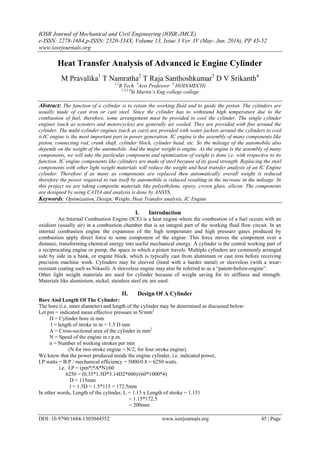
Bore And Length Of The Cylinder:
The bore (i.e. inner diameter) and length of the cylinder may be determined as discussed below:
Let pm = indicated mean effective pressure in N/mm2
D = Cylinder bore in mm
l = length of stroke in m = 1.5 D mm
A = Cross-sectional area of the cylinder in mm2
N = Speed of the engine in r.p.m.
n = Number of working strokes per min
(N for two stroke engine = N/2, for four stroke engine).
We know that the power produced inside the engine cylinder, i.e. indicated power,
I.P watts = B.P / mechanical efficiency = 5000/0.8 = 6250 watts.
i.e. I.P = (pm*|*A*N)/60
6250 = (0.35*1.5D*3.14D2*600)/(60*1000*4)
D = 115mm
l = 1.5D = 1.5*115 = 172.5mm
In other words, Length of the cylinder, L = 1.15 x Length of stroke = 1.151
= 1.15*172.5
= 200mm
Heat Transfer Analysis of Advanced ic Engine Cylinder
DOI: 10.9790/1684-1303044552 www.iosrjournals.org 46 | Page
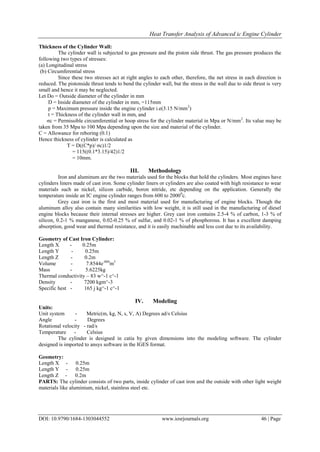
Thickness of the Cylinder Wall:
The cylinder wall is subjected to gas pressure and the piston side thrust. The gas pressure produces the
following two types of stresses:
(a) Longitudinal stress
(b) Circumferential stress
Since these two stresses act at right angles to each other, therefore, the net stress in each direction is
reduced. The pistonside thrust tends to bend the cylinder wall, but the stress in the wall due to side thrust is very
small and hence it may be neglected.
Let Do = Outside diameter of the cylinder in mm
D = Inside diameter of the cylinder in mm, =115mm
p = Maximum pressure inside the engine cylinder i.e(3.15 N/mm2
)
t = Thickness of the cylinder wall in mm, and
σc = Permissible circumferential or hoop stress for the cylinder material in Mpa or N/mm2
. Its value may be
taken from 35 Mpa to 100 Mpa depending upon the size and material of the cylinder.
C = Allowance for reboring (0.1)
Hence thickness of cylinder is calculated as
T = D((C*p)/ σc)1/2
= 115((0.1*3.15)/42)1/2
= 10mm.
III. Methodology
Iron and aluminum are the two materials used for the blocks that hold the cylinders. Most engines have
cylinders liners made of cast iron. Some cylinder liners or cylinders are also coated with high resistance to wear
materials such as nickel, silicon carbide, boron nitride, etc depending on the application. Generally the
temperature inside an IC engine cylinder ranges from 600 to 20000
c.
Grey cast iron is the first and most material used for manufacturing of engine blocks. Though the
aluminum alloy also contain many similarities with low weight, it is still used in the manufacturing of diesel
engine blocks because their internal stresses are higher. Grey cast iron contains 2.5-4 % of carbon, 1-3 % of
silicon, 0.2-1 % manganese, 0.02-0.25 % of sulfur, and 0.02-1 % of phosphorous. It has a excellent damping
absorption, good wear and thermal resistance, and it is easily machinable and less cost due to its availability.
Geometry of Cast Iron Cylinder:
Length X - 0.25m
Length Y - 0.25m
Length Z - 0.2m
Volume - 7.8544e-004
m3
Mass - 5.6225kg
Thermal conductivity – 83 w^-1 c^-1
Density - 7200 kgm^-3
Specific hest - 165 j kg^-1 c^-1
IV. Modeling
Units:
Unit system - Metric(m, kg, N, s, V, A) Degrees ad/s Celsius
Angle - Degrees
Rotational velocity - rad/s
Temperature - Celsius
The cylinder is designed in catia by given dimensions into the modeling software. The cylinder
designed is imported to ansys software in the IGES format.
Geometry:
Length X - 0.25m
Length Y - 0.25m
Length Z - 0.2m
PARTS: The cylinder consists of two parts, inside cylinder of cast iron and the outside with other light weight
materials like aluminium, nickel, stainless steel etc.
Heat Transfer Analysis of Advanced ic Engine Cylinder
DOI: 10.9790/1684-1303044552 www.iosrjournals.org 47 | Page
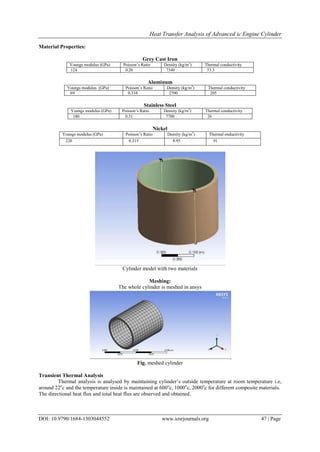
Material Properties:
Grey Cast Iron
Youngs modulus (GPa) Poisson’s Ratio Density (kg/m3
) Thermal conductivity
124 0.26 7340 53.3
Aluminum
Youngs modulus (GPa) Poisson’s Ratio Density (kg/m3
) Thermal conductivity
69 0.334 2700 205
Stainless Steel
Youngs modulus (GPa) Poisson’s Ratio Density (kg/m3
) Thermal conductivity
180 0.31 7700 26
Nickel
Youngs modulus (GPa) Poisson’s Ratio Density (kg/m3
) Thermal onductivity
220 0.315 8.95 91
Cylinder model with two materials
Meshing:
The whole cylinder is meshed in ansys
Fig. meshed cylinder
Transient Thermal Analysis
Thermal analysis is analysed by maintaining cylinder’s outside temperature at room temperature i.e,
around 22o
c and the temperature inside is maintained at 600o
c, 1000o
c, 2000o
c for different composite materials.
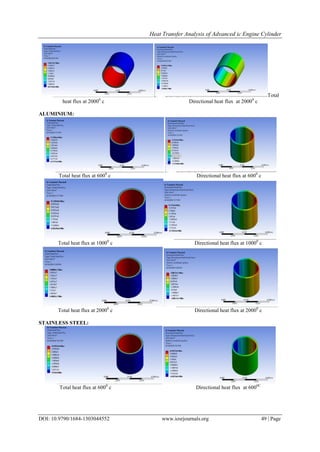
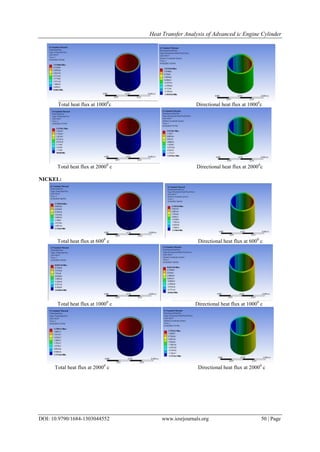
The directional heat flux and total heat flux are observed and obtained.
Heat Transfer Analysis of Advanced ic Engine Cylinder
DOI: 10.9790/1684-1303044552 www.iosrjournals.org 48 | Page
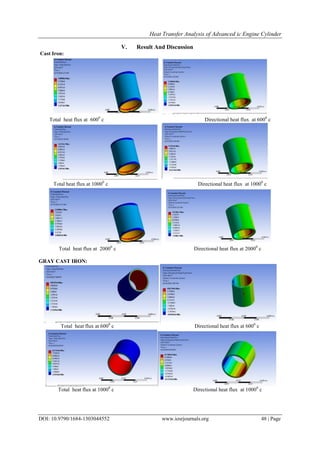
V. Result And Discussion
Cast Iron:
Total heat flux at 6000
c Directional heat flux at 6000
c
Total heat flux at 10000
c Directional heat flux at 10000
c
Total heat flux at 20000
c Directional heat flux at 20000
c
GRAY CAST IRON:
Total heat flux at 6000
c Directional heat flux at 6000
c
Total heat flux at 10000
c Directional heat flux at 10000
c
Heat Transfer Analysis of Advanced ic Engine Cylinder
DOI: 10.9790/1684-1303044552 www.iosrjournals.org 49 | Page
Total
heat flux at 20000
c Directional heat flux at 20000
c
ALUMINIUM:
Total heat flux at 6000
c Directional heat flux at 6000
c
Total heat flux at 10000
c Directional heat flux at 10000
c
Total heat flux at 20000
c Directional heat flux at 20000
c
STAINLESS STEEL:
Total heat flux at 6000
c Directional heat flux at 6000C
Heat Transfer Analysis of Advanced ic Engine Cylinder
DOI: 10.9790/1684-1303044552 www.iosrjournals.org 50 | Page
Total heat flux at 10000
c Directional heat flux at 10000
c
Total heat flux at 20000
c Directional heat flux at 20000
c
NICKEL:
Total heat flux at 6000
c Directional heat flux at 6000
c
Total heat flux at 10000
c Directional heat flux at 10000
c
Total heat flux at 20000
c Directional heat flux at 20000
c
Heat Transfer Analysis of Advanced ic Engine Cylinder
DOI: 10.9790/1684-1303044552 www.iosrjournals.org 51 | Page
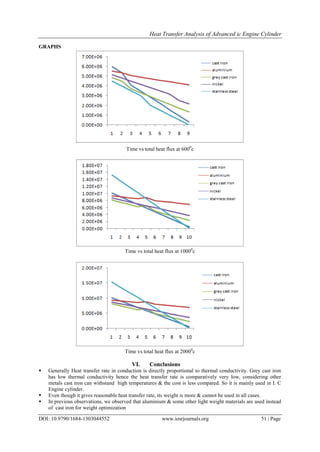
GRAPHS
Time vs total heat flux at 6000
c
Time vs total heat flux at 10000
c
Time vs total heat flux at 20000
c
VI. Conclusions
 Generally Heat transfer rate in conduction is directly proportional to thermal conductivity. Grey cast iron
has low thermal conductivity hence the heat transfer rate is comparatively very low, considering other
metals cast iron can withstand high temperatures & the cost is less compared. So it is mainly used in I. C
Engine cylinder.
 Even though it gives reasonable heat transfer rate, its weight is more & cannot be used in all cases.
 In previous observations, we observed that aluminium & some other light weight materials are used instead
of cast iron for weight optimization
Heat Transfer Analysis of Advanced ic Engine Cylinder
DOI: 10.9790/1684-1303044552 www.iosrjournals.org 52 | Page
 Due to the use of other light weight materials as an insulation around cast iron by reducing thickness of cast
iron we can effectively reduce the weight of cylinder and cylinder head with improved strength. Also due to
the use of air cooling system an efficient and faster cooling of engine can be achieved.
Cylinder made of different materials like stainless steel, aluminium, nickel are analyzed using
CATIAV5R20 package for modeling and same can be imported to ANSYS for analysis. Depending on the
thermal conductivity of the materials, heat transfer rate is analysed. With the advancement in material science,
very light weight materials with good thermal and mechanical properties can be used for safe desugn of the IC
engines.
References
[1] Dimitov L(2001), “Principle of mechanical engineering design”.
[2] Mcvey(1955), “material in engine design”.
[3] A text book on Machine Design, V.Bandari- TMH publishers.
[4] A text on machine design by SMD Jallaludin, Anuradha publications.
[5] Design of machine elements by pandya and shah.
[6] Timoshenko(1947),”strength of materials”.
[7] A text book on IC engines, Mathur and Sharma- dhanpath rai and sons publications.
[8] A text book on fundamentals of heat and mass transfer by RC Sachdeva, new age international publication.
[9] SAE paper on “weight reduced engine”(1992) volume 101 “journal of engine section-3”
[10] Release 11.0 documentation for ANSYS work bench, ANSYS Inc., Canorsburg PA(2007).
[11] Ravindra R. Navthar and Prashant A. Narwade, “ Design and Analysis of Cylinder and Cylinder head of 4- Stroke SI Engine For
Weight Reduction” Material Selection ,International Journal of Engineering Science and Technology, vol 4 No.03 march 2012.
[12] Shiang Woei Chyuan, “Finite element simulation of a twin-cam 16-valve cylinder Structure”, Finite Elements in Analysis and
Design 35, 2000
[13] ANSYS element reference, ANSYS 6.0 documentation, ANSYS, Inc.
[14] A. R. Bhagat, Y. M. Jibhakate, Thermal Analysis and Optimization of I.C. Engine Piston Using Finite Element Method,
International Journal of Modern Engineering Research (IJMER), Vol.2, Issue.4, pp.2919-2921, 2012

I1303044552

  • 1.
    IOSR Journal ofMechanical and Civil Engineering (IOSR-JMCE) e-ISSN: 2278-1684,p-ISSN: 2320-334X, Volume 13, Issue 3 Ver. IV (May- Jun. 2016), PP 45-52 www.iosrjournals.org DOI: 10.9790/1684-1303044552 www.iosrjournals.org 45 | Page Heat Transfer Analysis of Advanced ic Engine Cylinder M Pravalika1 T Namratha2 T Raja Santhoshkumar3 D V Srikanth4 1,2 B Tech 3 Asst Professor 4 HOD(MECH) 1,2,3,4 St Martin’s Eng college college Abstract: The function of a cylinder is to retain the working fluid and to guide the piston. The cylinders are usually made of cast iron or cast steel. Since the cylinder has to withstand high temperature due to the combustion of fuel, therefore, some arrangement must be provided to cool the cylinder. The single cylinder engines (such as scooters and motorcycles) are generally air cooled. They are provided with fins around the cylinder. The multi-cylinder engines (such as cars) are provided with water jackets around the cylinders to cool it.IC engine is the most important part in power generation. IC engine is the assembly of many components like piston, connecting rod, crank shaft, cylinder block, cylinder head, etc. So the mileage of the automobile also depends on the weight of the automobile. And the major weight is engine. As the engine is the assembly of many components, we will take the particular component and optimization of weight is done i.e. with respective to its function. IC engine components like cylinders are made of steel because of its good strength. Replacing the steel components with other light weight materials will reduce the weight and heat transfer analysis of an IC Engine cylinder. Therefore if as many as components are replaced then automatically overall weight is reduced therefore the power required to run itself by automobile is reduced resulting in the increase in the mileage. In this project we are taking composite materials like polyethylene, epoxy, crown glass, silicon. The components are designed by using CATIA and analysis is done by ANSYS. Keywords: Optimization, Design, Weight, Heat Transfer analysis, IC Engine I. Introduction An Internal Combustion Engine (ICE) is a heat engine where the combustion of a fuel occurs with an oxidizer (usually air) in a combustion chamber that is an integral part of the working fluid flow circuit. In an internal combustion engine the expansion of the high temperature and high pressure gases produced by combustion apply direct force to some component of the engine. This force moves the component over a distance, transforming chemical energy into useful mechanical energy. A cylinder is the central working part of a reciprocating engine or pump, the space in which a piston travels. Multiple cylinders are commonly arranged side by side in a bank, or engine block, which is typically cast from aluminum or cast iron before receiving precision machine work. Cylinders may be sleeved (lined with a harder metal) or sleeveless (with a wear- resistant coating such as Nikasil). A sleeveless engine may also be referred to as a “patent-before-engine”. Other light weight materials are used for cylinder because of weight saving for its stiffness and strength. Materials like aluminium, nickel, stainless steel etc are used. II. Design Of A Cylinder Bore And Length Of The Cylinder: The bore (i.e. inner diameter) and length of the cylinder may be determined as discussed below: Let pm = indicated mean effective pressure in N/mm2 D = Cylinder bore in mm l = length of stroke in m = 1.5 D mm A = Cross-sectional area of the cylinder in mm2 N = Speed of the engine in r.p.m. n = Number of working strokes per min (N for two stroke engine = N/2, for four stroke engine). We know that the power produced inside the engine cylinder, i.e. indicated power, I.P watts = B.P / mechanical efficiency = 5000/0.8 = 6250 watts. i.e. I.P = (pm*|*A*N)/60 6250 = (0.35*1.5D*3.14D2*600)/(60*1000*4) D = 115mm l = 1.5D = 1.5*115 = 172.5mm In other words, Length of the cylinder, L = 1.15 x Length of stroke = 1.151 = 1.15*172.5 = 200mm
  • 2.
    Heat Transfer Analysisof Advanced ic Engine Cylinder DOI: 10.9790/1684-1303044552 www.iosrjournals.org 46 | Page Thickness of the Cylinder Wall: The cylinder wall is subjected to gas pressure and the piston side thrust. The gas pressure produces the following two types of stresses: (a) Longitudinal stress (b) Circumferential stress Since these two stresses act at right angles to each other, therefore, the net stress in each direction is reduced. The pistonside thrust tends to bend the cylinder wall, but the stress in the wall due to side thrust is very small and hence it may be neglected. Let Do = Outside diameter of the cylinder in mm D = Inside diameter of the cylinder in mm, =115mm p = Maximum pressure inside the engine cylinder i.e(3.15 N/mm2 ) t = Thickness of the cylinder wall in mm, and σc = Permissible circumferential or hoop stress for the cylinder material in Mpa or N/mm2 . Its value may be taken from 35 Mpa to 100 Mpa depending upon the size and material of the cylinder. C = Allowance for reboring (0.1) Hence thickness of cylinder is calculated as T = D((C*p)/ σc)1/2 = 115((0.1*3.15)/42)1/2 = 10mm. III. Methodology Iron and aluminum are the two materials used for the blocks that hold the cylinders. Most engines have cylinders liners made of cast iron. Some cylinder liners or cylinders are also coated with high resistance to wear materials such as nickel, silicon carbide, boron nitride, etc depending on the application. Generally the temperature inside an IC engine cylinder ranges from 600 to 20000 c. Grey cast iron is the first and most material used for manufacturing of engine blocks. Though the aluminum alloy also contain many similarities with low weight, it is still used in the manufacturing of diesel engine blocks because their internal stresses are higher. Grey cast iron contains 2.5-4 % of carbon, 1-3 % of silicon, 0.2-1 % manganese, 0.02-0.25 % of sulfur, and 0.02-1 % of phosphorous. It has a excellent damping absorption, good wear and thermal resistance, and it is easily machinable and less cost due to its availability. Geometry of Cast Iron Cylinder: Length X - 0.25m Length Y - 0.25m Length Z - 0.2m Volume - 7.8544e-004 m3 Mass - 5.6225kg Thermal conductivity – 83 w^-1 c^-1 Density - 7200 kgm^-3 Specific hest - 165 j kg^-1 c^-1 IV. Modeling Units: Unit system - Metric(m, kg, N, s, V, A) Degrees ad/s Celsius Angle - Degrees Rotational velocity - rad/s Temperature - Celsius The cylinder is designed in catia by given dimensions into the modeling software. The cylinder designed is imported to ansys software in the IGES format. Geometry: Length X - 0.25m Length Y - 0.25m Length Z - 0.2m PARTS: The cylinder consists of two parts, inside cylinder of cast iron and the outside with other light weight materials like aluminium, nickel, stainless steel etc.
  • 3.
    Heat Transfer Analysisof Advanced ic Engine Cylinder DOI: 10.9790/1684-1303044552 www.iosrjournals.org 47 | Page Material Properties: Grey Cast Iron Youngs modulus (GPa) Poisson’s Ratio Density (kg/m3 ) Thermal conductivity 124 0.26 7340 53.3 Aluminum Youngs modulus (GPa) Poisson’s Ratio Density (kg/m3 ) Thermal conductivity 69 0.334 2700 205 Stainless Steel Youngs modulus (GPa) Poisson’s Ratio Density (kg/m3 ) Thermal conductivity 180 0.31 7700 26 Nickel Youngs modulus (GPa) Poisson’s Ratio Density (kg/m3 ) Thermal onductivity 220 0.315 8.95 91 Cylinder model with two materials Meshing: The whole cylinder is meshed in ansys Fig. meshed cylinder Transient Thermal Analysis Thermal analysis is analysed by maintaining cylinder’s outside temperature at room temperature i.e, around 22o c and the temperature inside is maintained at 600o c, 1000o c, 2000o c for different composite materials. The directional heat flux and total heat flux are observed and obtained.
  • 4.
    Heat Transfer Analysisof Advanced ic Engine Cylinder DOI: 10.9790/1684-1303044552 www.iosrjournals.org 48 | Page V. Result And Discussion Cast Iron: Total heat flux at 6000 c Directional heat flux at 6000 c Total heat flux at 10000 c Directional heat flux at 10000 c Total heat flux at 20000 c Directional heat flux at 20000 c GRAY CAST IRON: Total heat flux at 6000 c Directional heat flux at 6000 c Total heat flux at 10000 c Directional heat flux at 10000 c
  • 5.
    Heat Transfer Analysisof Advanced ic Engine Cylinder DOI: 10.9790/1684-1303044552 www.iosrjournals.org 49 | Page Total heat flux at 20000 c Directional heat flux at 20000 c ALUMINIUM: Total heat flux at 6000 c Directional heat flux at 6000 c Total heat flux at 10000 c Directional heat flux at 10000 c Total heat flux at 20000 c Directional heat flux at 20000 c STAINLESS STEEL: Total heat flux at 6000 c Directional heat flux at 6000C
  • 6.
    Heat Transfer Analysisof Advanced ic Engine Cylinder DOI: 10.9790/1684-1303044552 www.iosrjournals.org 50 | Page Total heat flux at 10000 c Directional heat flux at 10000 c Total heat flux at 20000 c Directional heat flux at 20000 c NICKEL: Total heat flux at 6000 c Directional heat flux at 6000 c Total heat flux at 10000 c Directional heat flux at 10000 c Total heat flux at 20000 c Directional heat flux at 20000 c
  • 7.
    Heat Transfer Analysisof Advanced ic Engine Cylinder DOI: 10.9790/1684-1303044552 www.iosrjournals.org 51 | Page GRAPHS Time vs total heat flux at 6000 c Time vs total heat flux at 10000 c Time vs total heat flux at 20000 c VI. Conclusions  Generally Heat transfer rate in conduction is directly proportional to thermal conductivity. Grey cast iron has low thermal conductivity hence the heat transfer rate is comparatively very low, considering other metals cast iron can withstand high temperatures & the cost is less compared. So it is mainly used in I. C Engine cylinder.  Even though it gives reasonable heat transfer rate, its weight is more & cannot be used in all cases.  In previous observations, we observed that aluminium & some other light weight materials are used instead of cast iron for weight optimization
  • 8.
    Heat Transfer Analysisof Advanced ic Engine Cylinder DOI: 10.9790/1684-1303044552 www.iosrjournals.org 52 | Page  Due to the use of other light weight materials as an insulation around cast iron by reducing thickness of cast iron we can effectively reduce the weight of cylinder and cylinder head with improved strength. Also due to the use of air cooling system an efficient and faster cooling of engine can be achieved. Cylinder made of different materials like stainless steel, aluminium, nickel are analyzed using CATIAV5R20 package for modeling and same can be imported to ANSYS for analysis. Depending on the thermal conductivity of the materials, heat transfer rate is analysed. With the advancement in material science, very light weight materials with good thermal and mechanical properties can be used for safe desugn of the IC engines. References [1] Dimitov L(2001), “Principle of mechanical engineering design”. [2] Mcvey(1955), “material in engine design”. [3] A text book on Machine Design, V.Bandari- TMH publishers. [4] A text on machine design by SMD Jallaludin, Anuradha publications. [5] Design of machine elements by pandya and shah. [6] Timoshenko(1947),”strength of materials”. [7] A text book on IC engines, Mathur and Sharma- dhanpath rai and sons publications. [8] A text book on fundamentals of heat and mass transfer by RC Sachdeva, new age international publication. [9] SAE paper on “weight reduced engine”(1992) volume 101 “journal of engine section-3” [10] Release 11.0 documentation for ANSYS work bench, ANSYS Inc., Canorsburg PA(2007). [11] Ravindra R. Navthar and Prashant A. Narwade, “ Design and Analysis of Cylinder and Cylinder head of 4- Stroke SI Engine For Weight Reduction” Material Selection ,International Journal of Engineering Science and Technology, vol 4 No.03 march 2012. [12] Shiang Woei Chyuan, “Finite element simulation of a twin-cam 16-valve cylinder Structure”, Finite Elements in Analysis and Design 35, 2000 [13] ANSYS element reference, ANSYS 6.0 documentation, ANSYS, Inc. [14] A. R. Bhagat, Y. M. Jibhakate, Thermal Analysis and Optimization of I.C. Engine Piston Using Finite Element Method, International Journal of Modern Engineering Research (IJMER), Vol.2, Issue.4, pp.2919-2921, 2012