INTRODUCTION
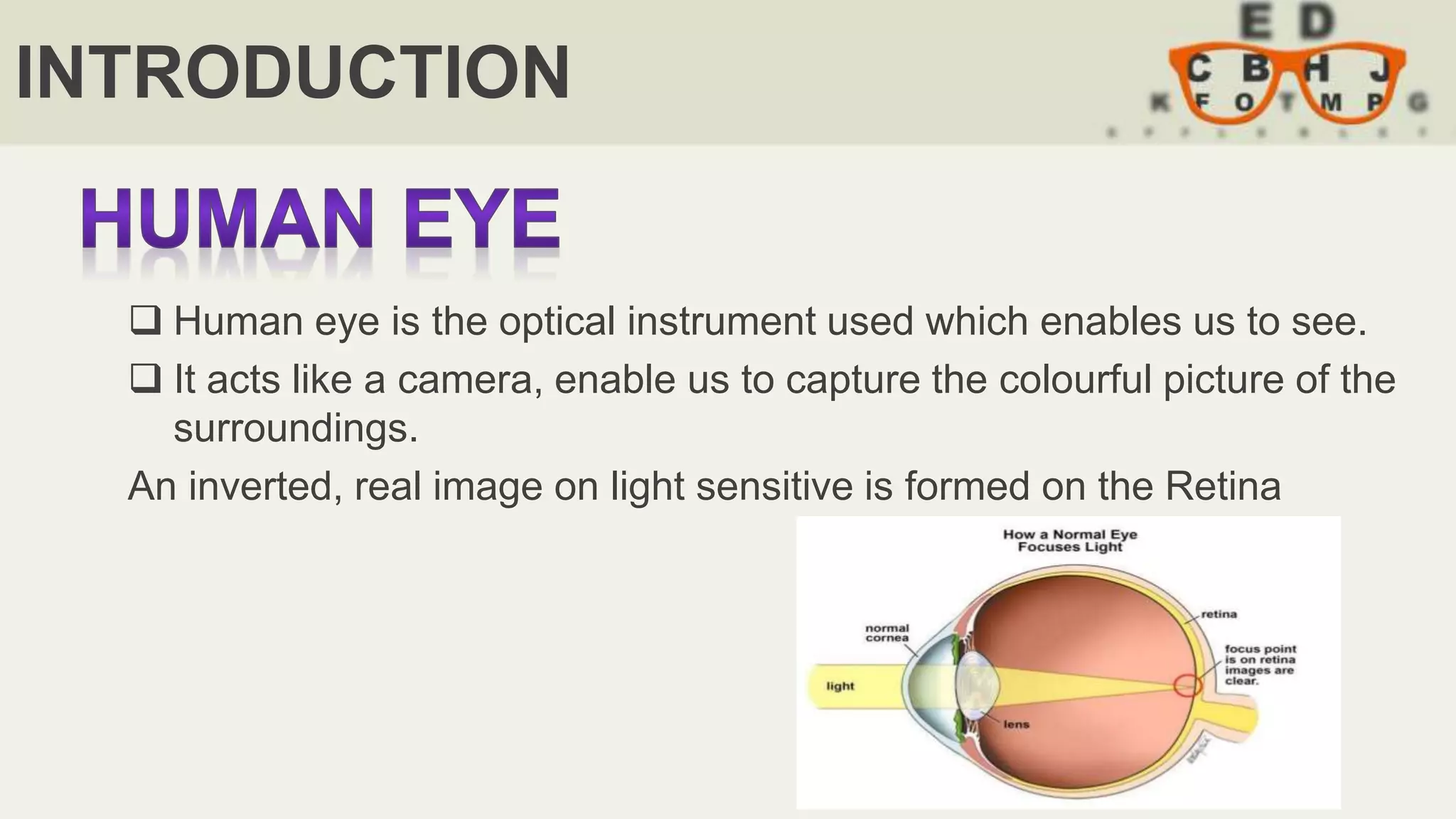
 Human eye is the optical instrument used which enables us to see.
 It acts like a camera, enable us to capture the colourful picture of the
surroundings.
An inverted, real image on light sensitive is formed on the Retina
The Various Parts of Eye and their Functions
1. Cornea
2. Eyeball
3. Iris
4. Pupil
5. Crystalline eye lens
6. Ciliary muscles
7. Retina
CORNEA
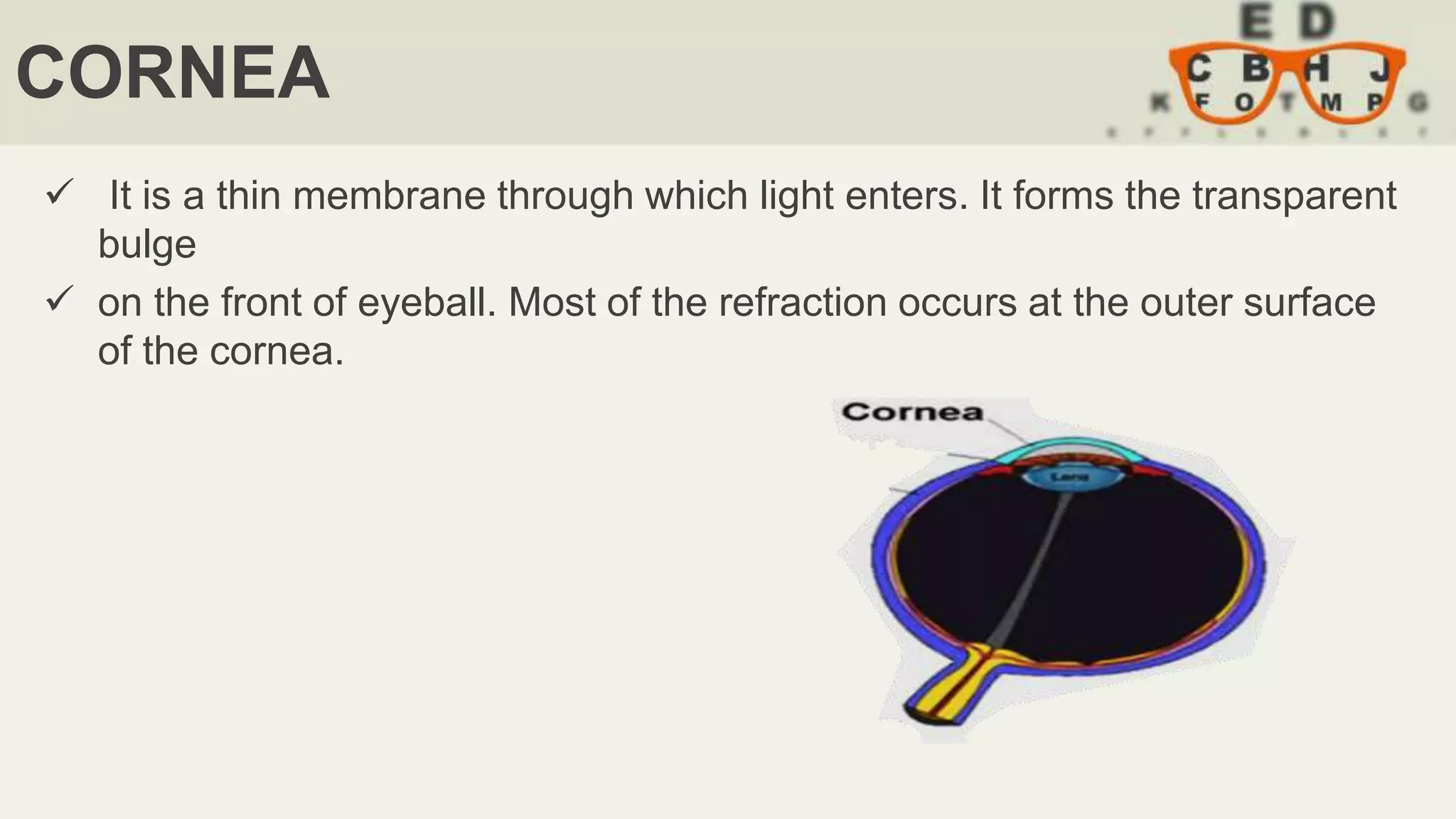
 It is a thin membrane through which light enters. It forms the transparent
bulge
 on the front of eyeball. Most of the refraction occurs at the outer surface
of the cornea.
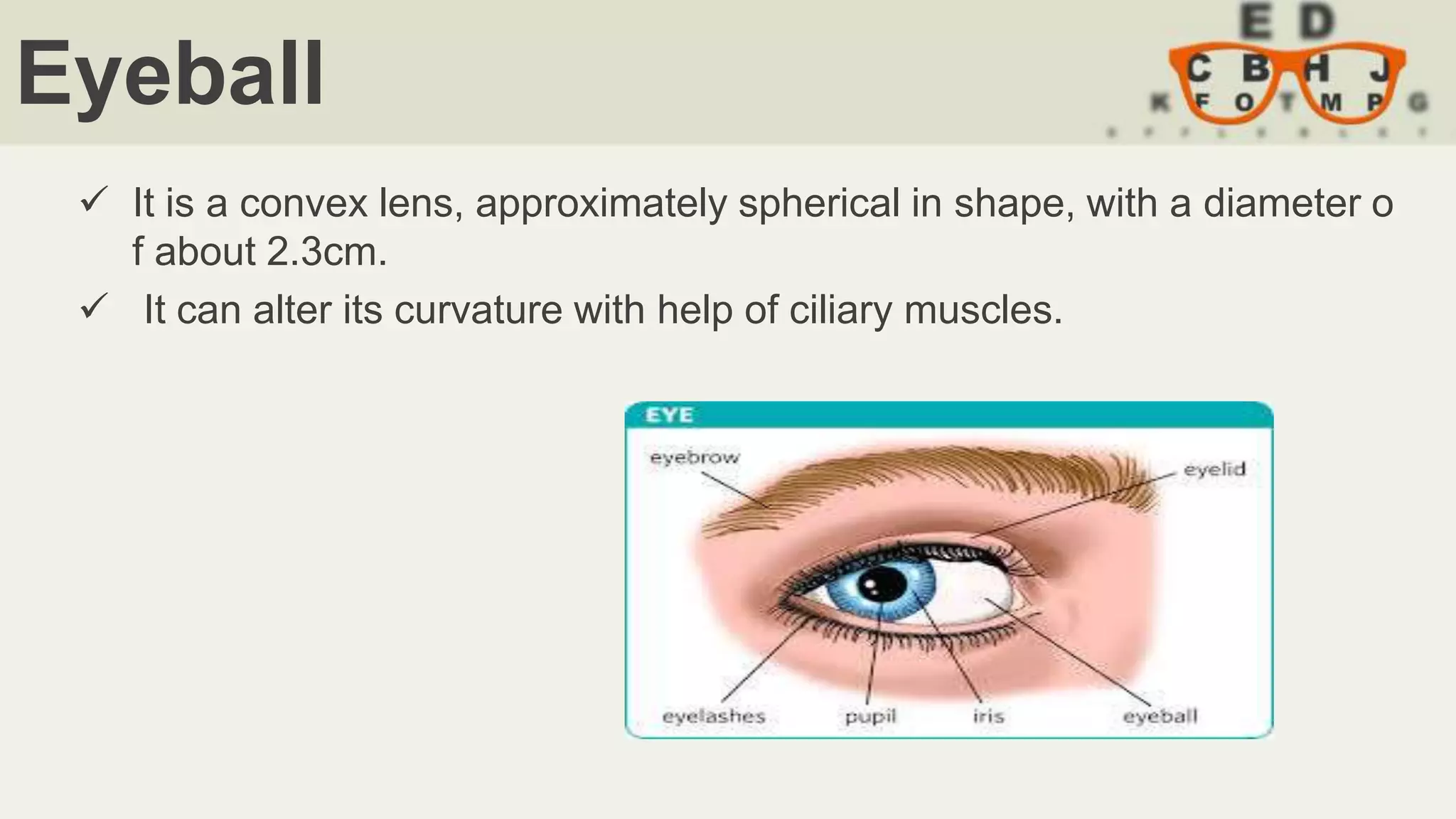
Eyeball
 It is a convex lens, approximately spherical in shape, with a diameter o
f about 2.3cm.
 It can alter its curvature with help of ciliary muscles.
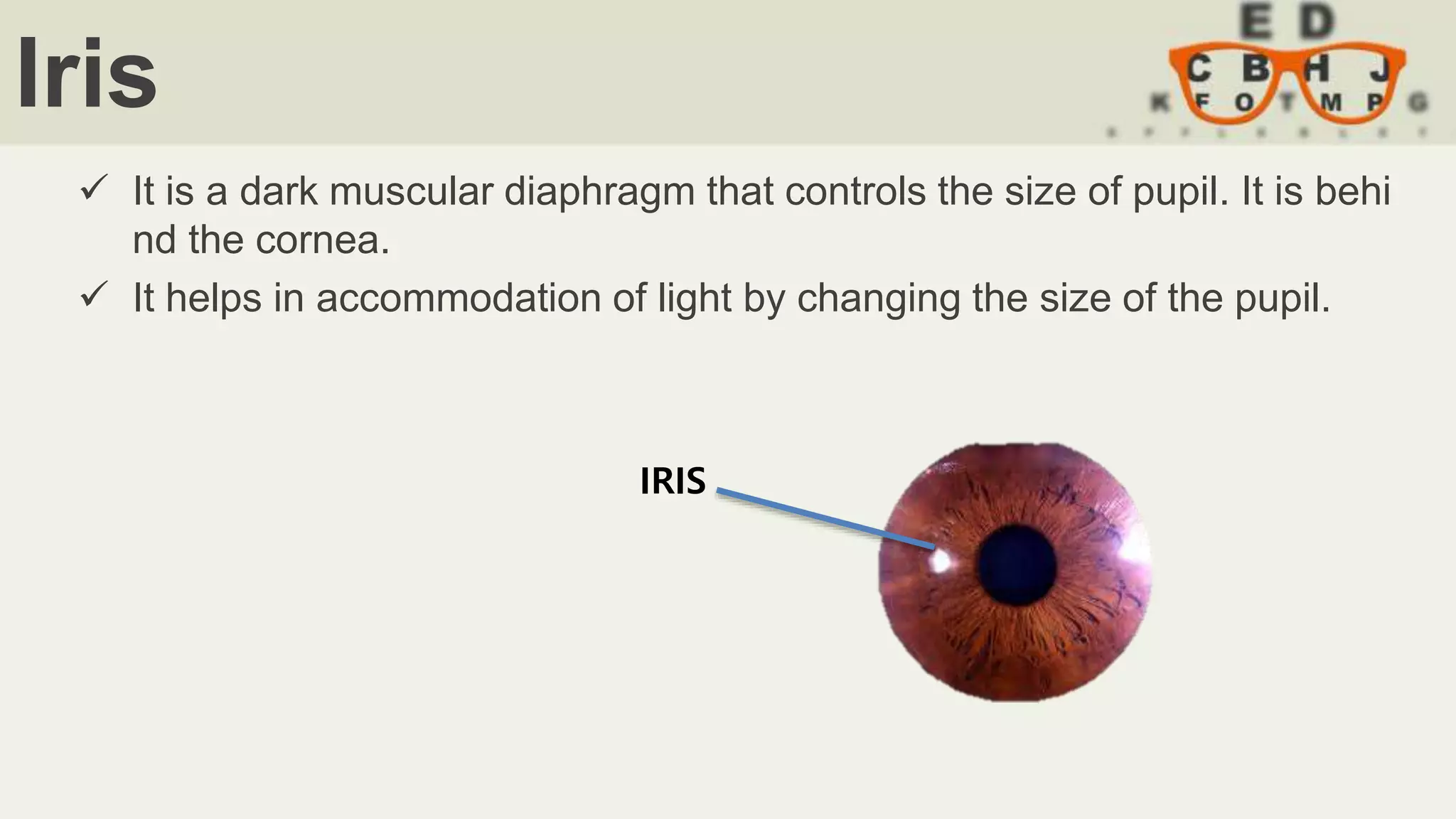
Iris
 It is a dark muscular diaphragm that controls the size of pupil. It is behi
nd the cornea.
 It helps in accommodation of light by changing the size of the pupil.
IRIS
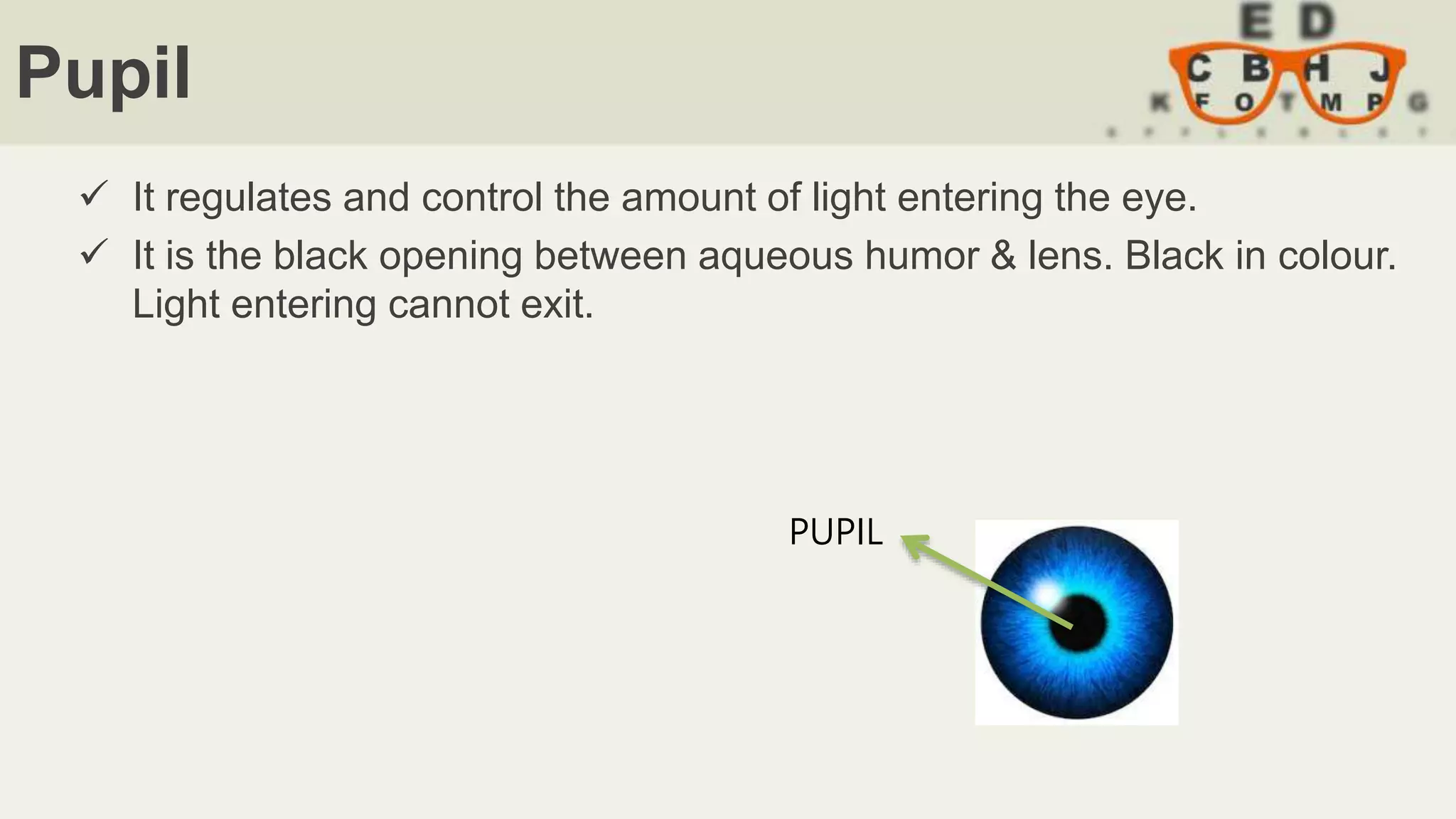
Pupil
 It regulates and control the amount of light entering the eye.
 It is the black opening between aqueous humor & lens. Black in colour.
Light entering cannot exit.
PUPIL
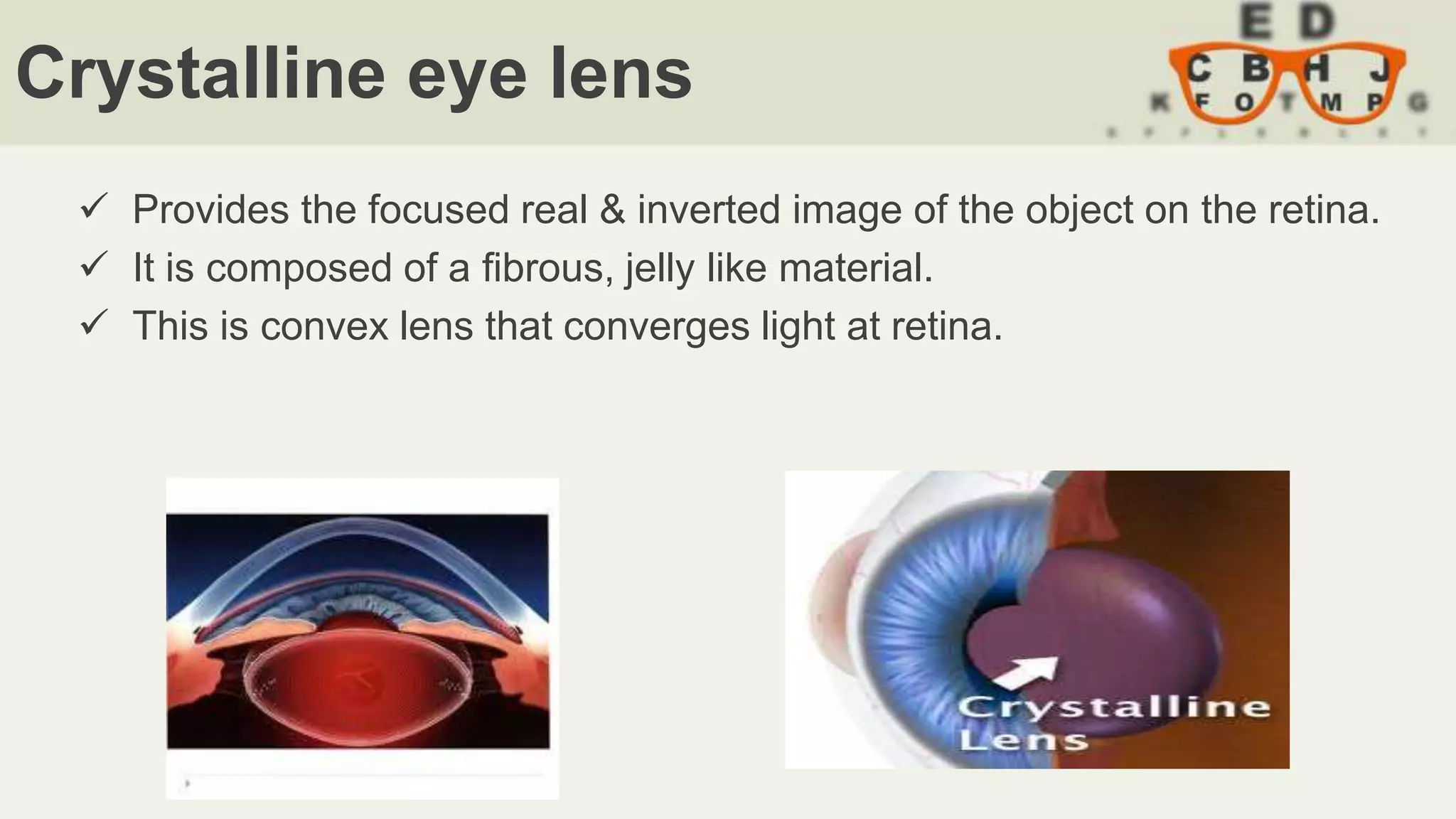
Crystalline eye lens
 Provides the focused real & inverted image of the object on the retina.
 It is composed of a fibrous, jelly like material.
 This is convex lens that converges light at retina.
Ciliary muscles
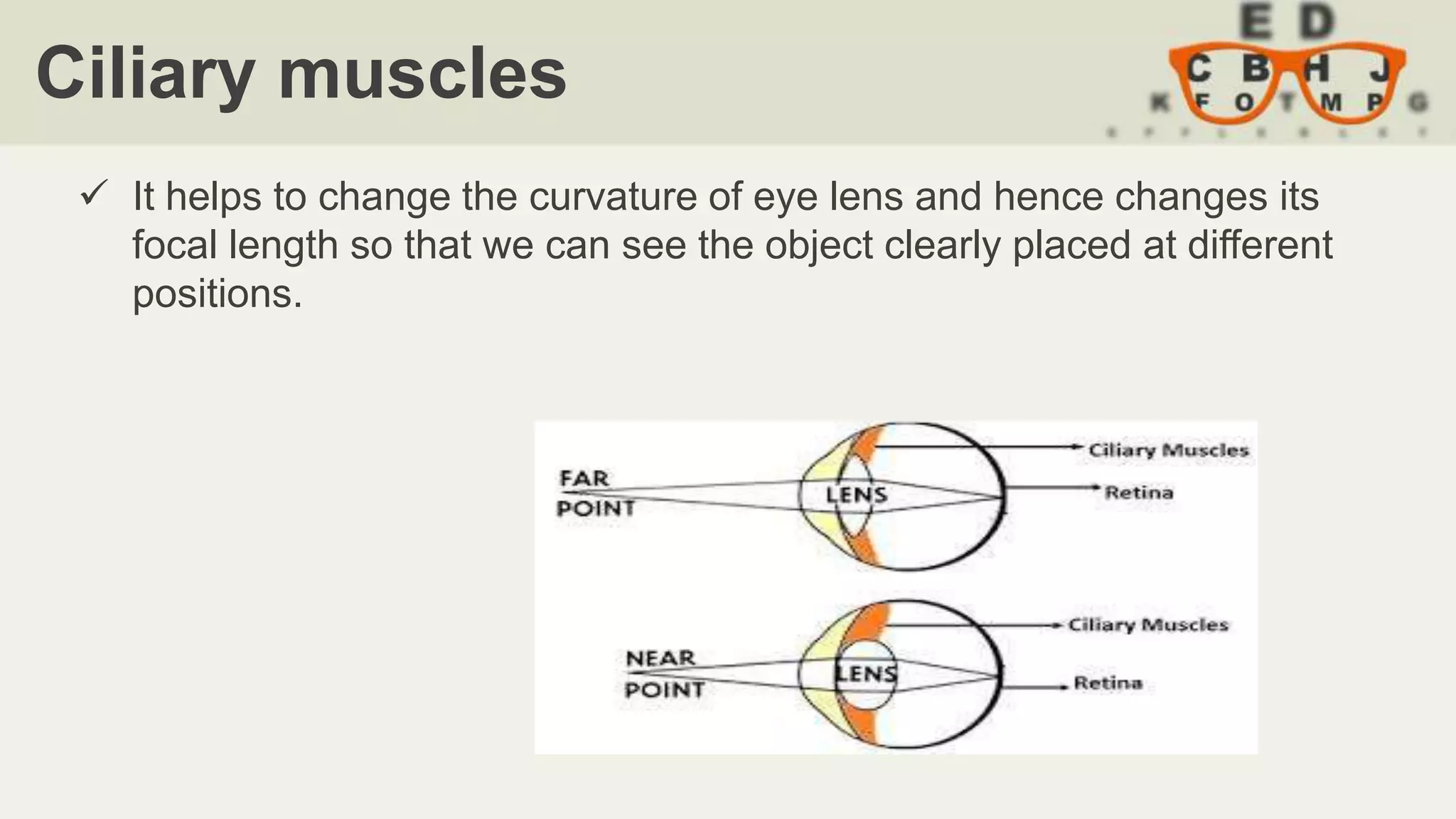
 It helps to change the curvature of eye lens and hence changes its
focal length so that we can see the object clearly placed at different
positions.
Retina
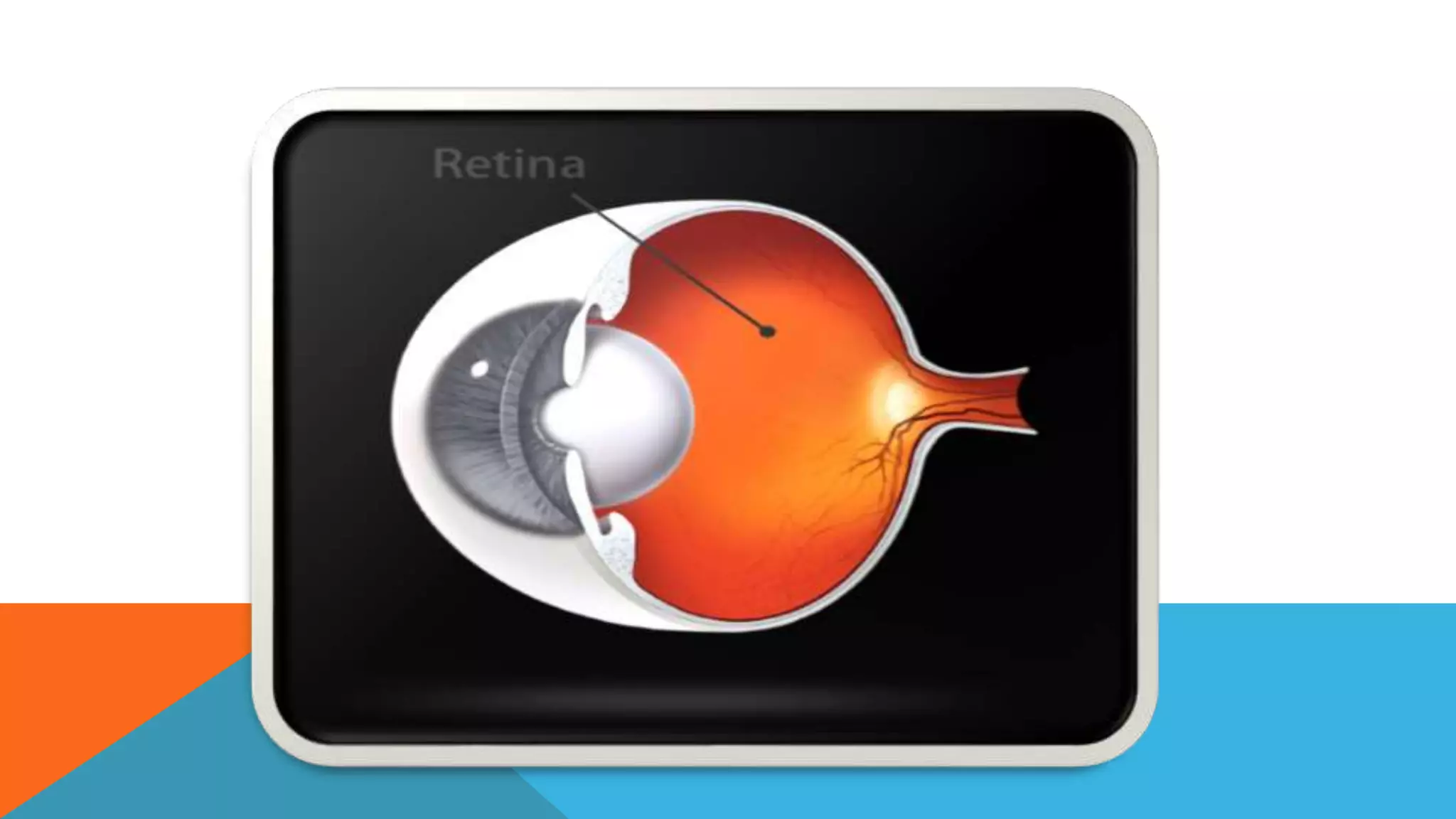
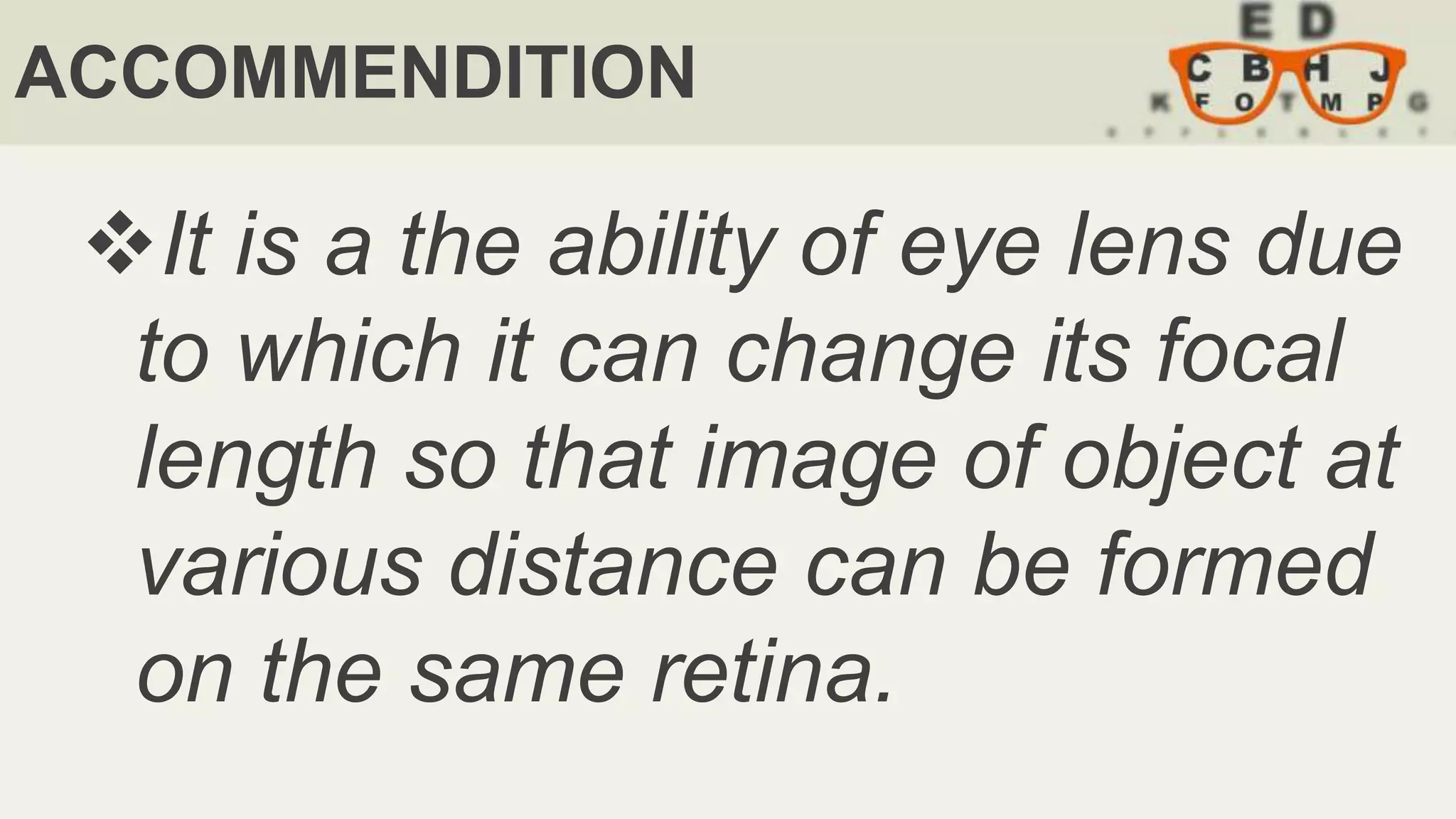
 Thin membrane with large no. of light sensitive cells.
 There are two types of photoreceptors in the human retina, rods and cones.
 Rods are responsible for vision at low light levels . They do not mediate
colour vision.
 Cones are active at higher light levels , are capable of colour vision.
 When image is formed at retina, light sensitive cells gets activated and
generate electrical
 signal. These signals are sent to brain via optic nerve. Brain analyse these
signals after which
 we perceive object as they are.
The vitreous body is the clear gel that fills the space
between the lens and the retina of the eyeball of
humans and other vertebrate
The aqueous humor is a transparent, watery fluid
similar to plasma, but containing low protein
concentrations.
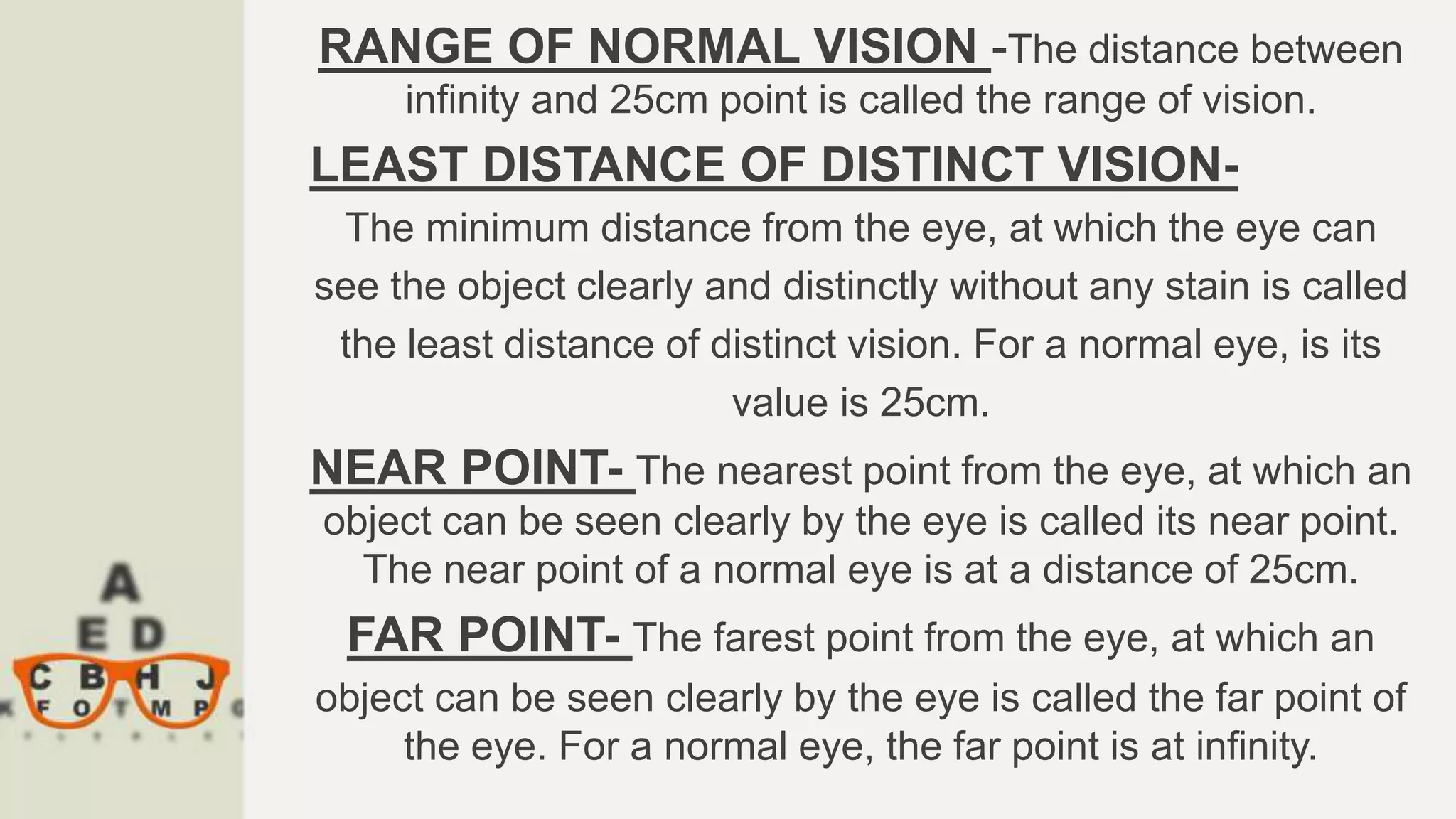
RODS-These are road-shaped cells of the retina that are
sensitive to the intensity of light
 CONES-These are cone-shaped cells of the retina that
are sensitive to the colours of light.
ACCOMMENDITION
It is a the ability of eye lens due
to which it can change its focal
length so that image of object at
various distance can be formed
on the same retina.
RANGE OF NORMAL VISION -The distance between
infinity and 25cm point is called the range of vision.
LEAST DISTANCE OF DISTINCT VISION-
The minimum distance from the eye, at which the eye can
see the object clearly and distinctly without any stain is called
the least distance of distinct vision. For a normal eye, is its
value is 25cm.
NEAR POINT- The nearest point from the eye, at which an
object can be seen clearly by the eye is called its near point.
The near point of a normal eye is at a distance of 25cm.
FAR POINT- The farest point from the eye, at which an
object can be seen clearly by the eye is called the far point of
the eye. For a normal eye, the far point is at infinity.
PERSISTENC OF VISION-The phenomenon of
the continuation of the impression of an image the
object is cut off is called persistence of vision. The
impression of the image remains on the retina for
about (1/16th) of a second. Cinematography work
on the principal of persistence of vision.
How Pupil Works ?
Example: You would have observed that when you come out of
the cinema hall after watching movie, in the bright sun light,
your eyes get closed . And when you enter the hall from the
bright light, you won'be able to see but after some time you
would be able to see.
Here the pupil of an eye provides a variable aperture, whose
size is controlled by iris.
 When the light is bright :Iris contracts the pupil, so that less light enters the
eye.
 When the light is dim : Iris expand the pupil, so that more light enters the eye.
Pupil opens completely, when iris is relaxed.
 Persistence of Vision : It is the time for which the sensation of an object conti
nue in the eye. It is about 1/16th of a second.
 Power of Accommodation : The ability of eye lens to adjust its focal length wi
th the help of ciliary muscles is called accommodation.
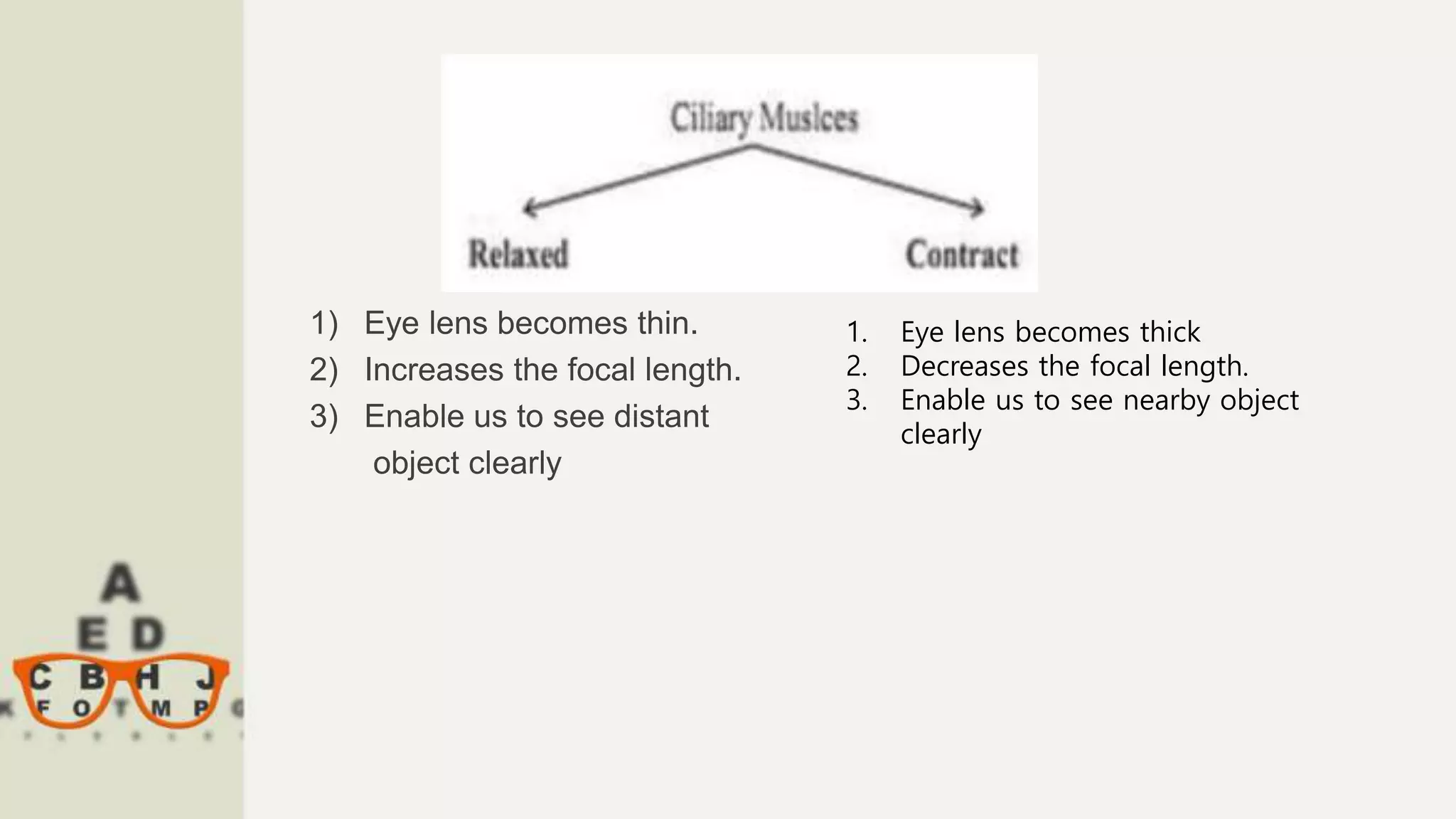
1) Eye lens becomes thin.
2) Increases the focal length.
3) Enable us to see distant
object clearly
1. Eye lens becomes thick
2. Decreases the focal length.
3. Enable us to see nearby object
clearly
DEFECT OF VISION
 A normal eye can see objects clearly at any distance between 25cm an
d infinity from the eye. Sometimes, a human eye gradually lose its pow
er of accommodation. Than we cannot see the object clearly our vision
become defective.
 There are mainly four common defect of vision which can be corrected
by the use of suitable eye glasses. There are
1. Myopia or near sightedness
2. Hypermetropia or far-sightedness
3. Presbyopia
4. Astigmatism
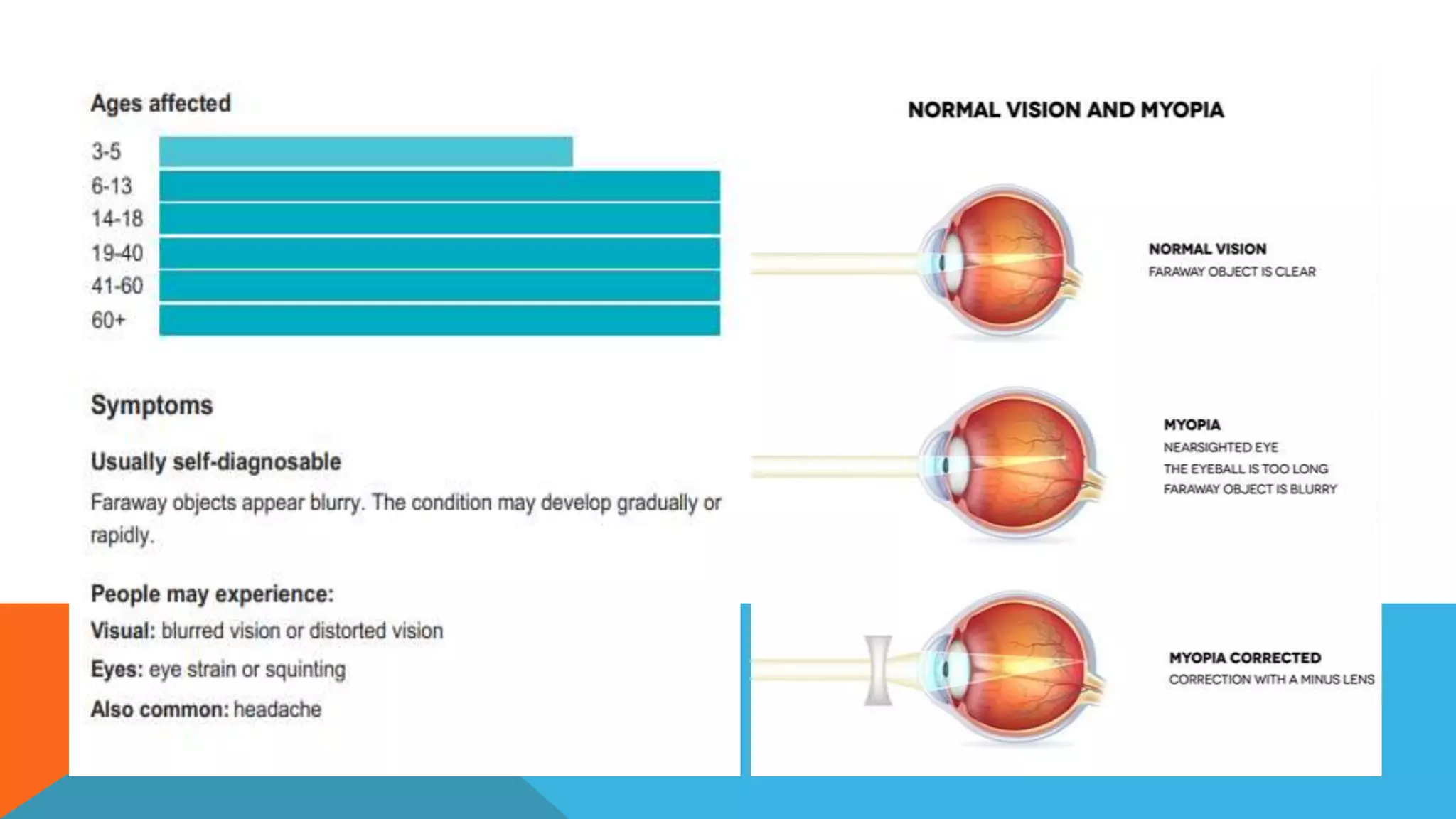
MYOPIA OR SHORT-SIGHTEDNESS
• In this defect a person can see nearby object clearly but cannot
see far off object clearly. Here, either the eyeball becomes too
longer or the focal length of the eye lens become too short.
• It can be corrected by using a concave lens of suitable focal
length.
Focal length of the correcting lens = Distance of the far point from
the eye.
LONG-DIGHTINED OR HYPERMETROPHIA
In this defect a person can see the far off object clearly but he/she cannot
see nearby object distinctly. Here, either the eyeball becomes too short or
the focal length of the focal length of the focal length of the eye lens
becomes too large. It can be corrected by using convex lens of suitable
focal length.
Focal length of correcting lens = yD/y-D
Where y = Distance of the near point from the defective eye
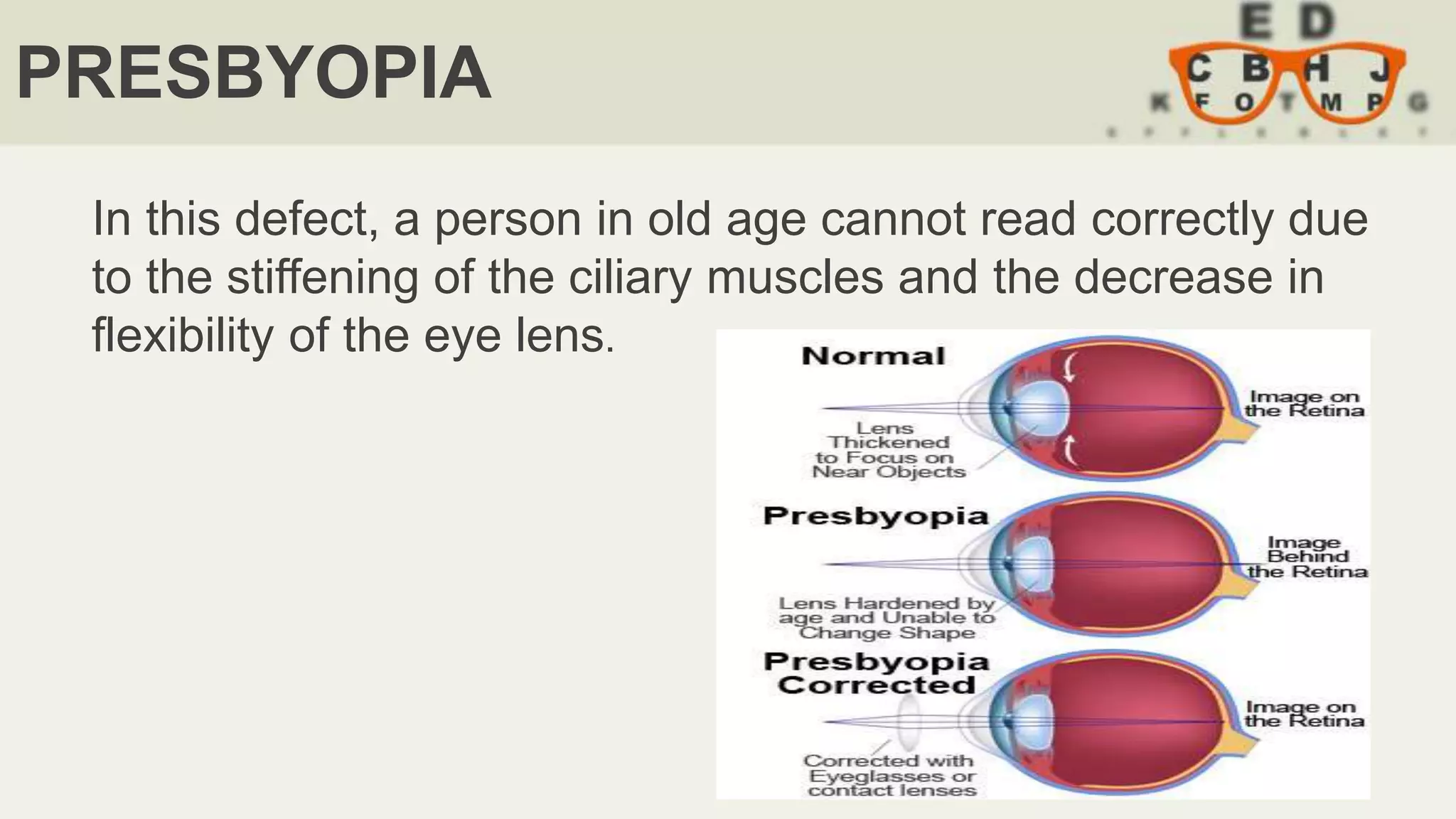
PRESBYOPIA
In this defect, a person in old age cannot read correctly due
to the stiffening of the ciliary muscles and the decrease in
flexibility of the eye lens.
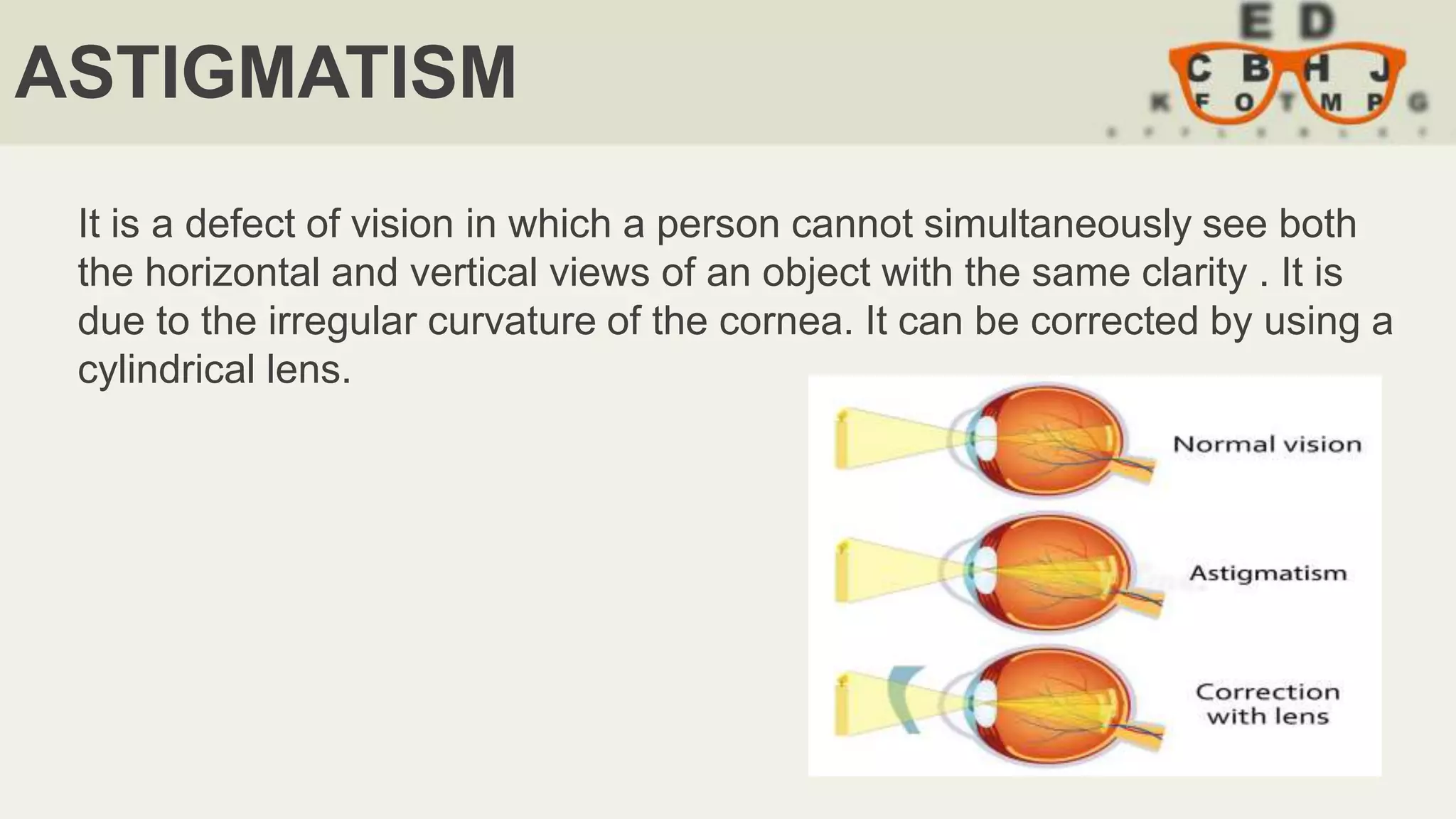
ASTIGMATISM
It is a defect of vision in which a person cannot simultaneously see both
the horizontal and vertical views of an object with the same clarity . It is
due to the irregular curvature of the cornea. It can be corrected by using a
cylindrical lens.
COTARACT
It is due to the development of hazy or opaque membrane over t
he eye lens which results in the decrease or loss of vision. It can
be cured by surgery.
BLIND SPOT AND YELLOW SPOT
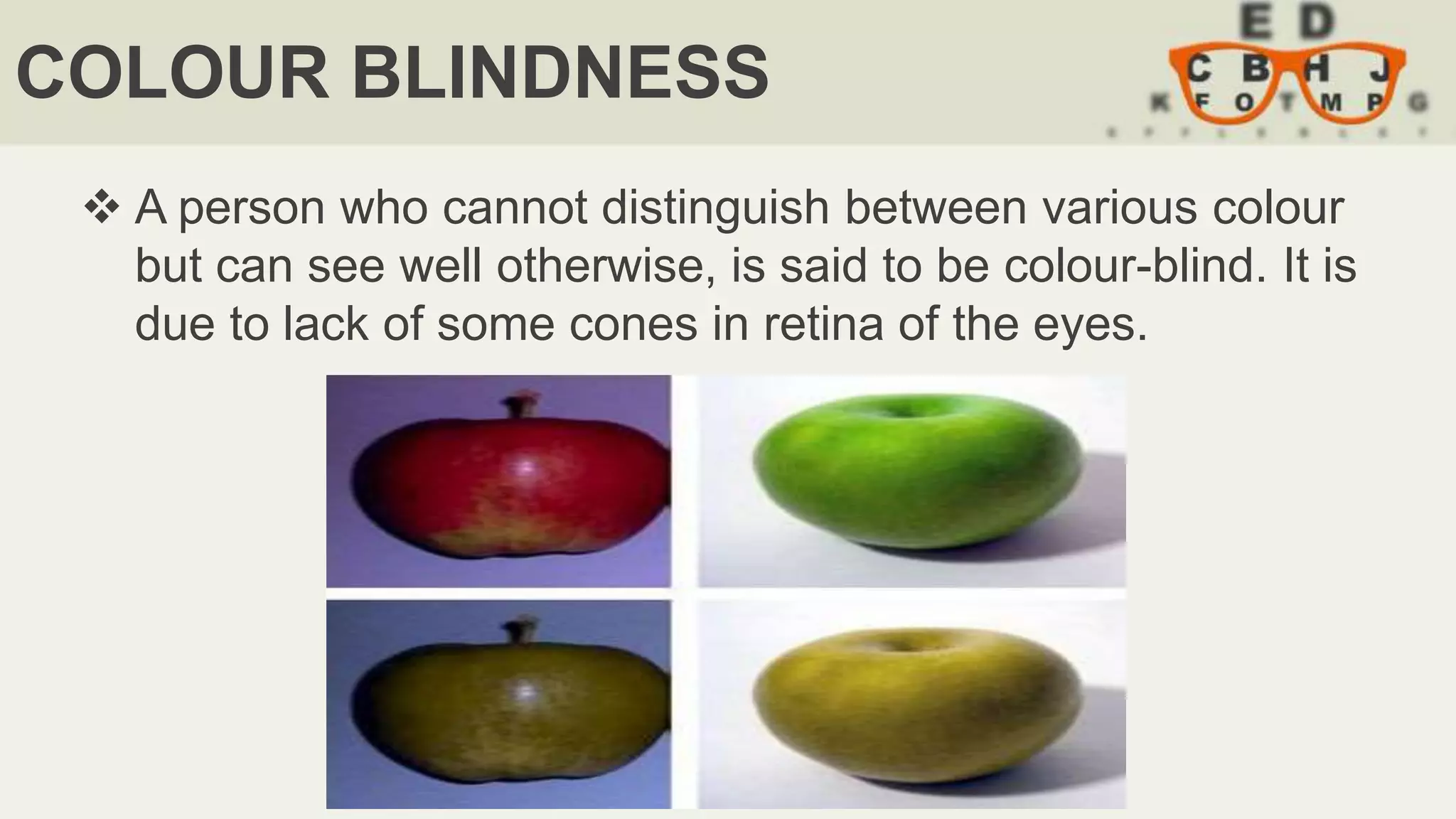
 In the region where the optic nerve enter the eyeball, there are not rods
and cones. This region is totally insensitive to light and is called blind
sport.
 Yellow spot has maximum concentration of light sensitive cells. It is
situated in center of the retina.
COLOUR BLINDNESS
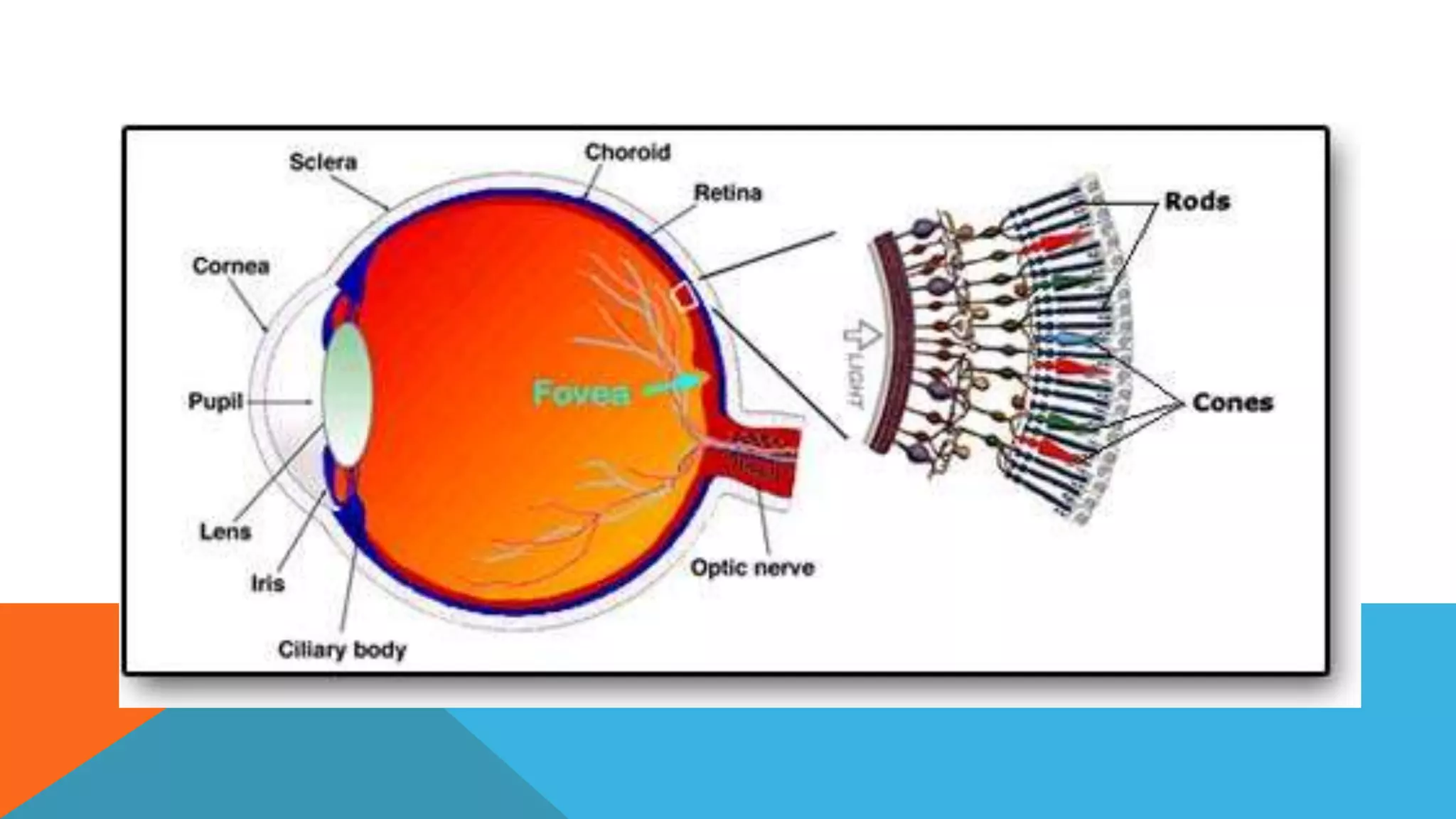
 A person who cannot distinguish between various colour
but can see well otherwise, is said to be colour-blind. It is
due to lack of some cones in retina of the eyes.
Example of an Ishihara color test plate. With properly configured computer displays
,
people with normal vision should see the number "74". Many people who are color
blind see it as "21", and those with total color blindness may not see any numbers.
THANKS FOR WATCHING
NAME – HARSHDEEP ARYAN
CLASS – 10TH B

Defect of vision

  • 2.
    INTRODUCTION  Human eyeis the optical instrument used which enables us to see.  It acts like a camera, enable us to capture the colourful picture of the surroundings. An inverted, real image on light sensitive is formed on the Retina
  • 3.
    The Various Partsof Eye and their Functions 1. Cornea 2. Eyeball 3. Iris 4. Pupil 5. Crystalline eye lens 6. Ciliary muscles 7. Retina
  • 4.
    CORNEA  It isa thin membrane through which light enters. It forms the transparent bulge  on the front of eyeball. Most of the refraction occurs at the outer surface of the cornea.
  • 5.
    Eyeball  It isa convex lens, approximately spherical in shape, with a diameter o f about 2.3cm.  It can alter its curvature with help of ciliary muscles.
  • 6.
    Iris  It isa dark muscular diaphragm that controls the size of pupil. It is behi nd the cornea.  It helps in accommodation of light by changing the size of the pupil. IRIS
  • 7.
    Pupil  It regulatesand control the amount of light entering the eye.  It is the black opening between aqueous humor & lens. Black in colour. Light entering cannot exit. PUPIL
  • 8.
    Crystalline eye lens Provides the focused real & inverted image of the object on the retina.  It is composed of a fibrous, jelly like material.  This is convex lens that converges light at retina.
  • 9.
    Ciliary muscles  Ithelps to change the curvature of eye lens and hence changes its focal length so that we can see the object clearly placed at different positions.
  • 10.
    Retina  Thin membranewith large no. of light sensitive cells.  There are two types of photoreceptors in the human retina, rods and cones.  Rods are responsible for vision at low light levels . They do not mediate colour vision.  Cones are active at higher light levels , are capable of colour vision.  When image is formed at retina, light sensitive cells gets activated and generate electrical  signal. These signals are sent to brain via optic nerve. Brain analyse these signals after which  we perceive object as they are.
  • 12.
    The vitreous bodyis the clear gel that fills the space between the lens and the retina of the eyeball of humans and other vertebrate The aqueous humor is a transparent, watery fluid similar to plasma, but containing low protein concentrations.
  • 13.
    RODS-These are road-shapedcells of the retina that are sensitive to the intensity of light  CONES-These are cone-shaped cells of the retina that are sensitive to the colours of light.
  • 15.
    ACCOMMENDITION It is athe ability of eye lens due to which it can change its focal length so that image of object at various distance can be formed on the same retina.
  • 16.
    RANGE OF NORMALVISION -The distance between infinity and 25cm point is called the range of vision. LEAST DISTANCE OF DISTINCT VISION- The minimum distance from the eye, at which the eye can see the object clearly and distinctly without any stain is called the least distance of distinct vision. For a normal eye, is its value is 25cm. NEAR POINT- The nearest point from the eye, at which an object can be seen clearly by the eye is called its near point. The near point of a normal eye is at a distance of 25cm. FAR POINT- The farest point from the eye, at which an object can be seen clearly by the eye is called the far point of the eye. For a normal eye, the far point is at infinity.
  • 17.
    PERSISTENC OF VISION-Thephenomenon of the continuation of the impression of an image the object is cut off is called persistence of vision. The impression of the image remains on the retina for about (1/16th) of a second. Cinematography work on the principal of persistence of vision.
  • 18.
    How Pupil Works? Example: You would have observed that when you come out of the cinema hall after watching movie, in the bright sun light, your eyes get closed . And when you enter the hall from the bright light, you won'be able to see but after some time you would be able to see. Here the pupil of an eye provides a variable aperture, whose size is controlled by iris.
  • 19.
     When thelight is bright :Iris contracts the pupil, so that less light enters the eye.  When the light is dim : Iris expand the pupil, so that more light enters the eye. Pupil opens completely, when iris is relaxed.  Persistence of Vision : It is the time for which the sensation of an object conti nue in the eye. It is about 1/16th of a second.  Power of Accommodation : The ability of eye lens to adjust its focal length wi th the help of ciliary muscles is called accommodation.
  • 20.
    1) Eye lensbecomes thin. 2) Increases the focal length. 3) Enable us to see distant object clearly 1. Eye lens becomes thick 2. Decreases the focal length. 3. Enable us to see nearby object clearly
  • 21.
    DEFECT OF VISION A normal eye can see objects clearly at any distance between 25cm an d infinity from the eye. Sometimes, a human eye gradually lose its pow er of accommodation. Than we cannot see the object clearly our vision become defective.  There are mainly four common defect of vision which can be corrected by the use of suitable eye glasses. There are 1. Myopia or near sightedness 2. Hypermetropia or far-sightedness 3. Presbyopia 4. Astigmatism
  • 22.
    MYOPIA OR SHORT-SIGHTEDNESS •In this defect a person can see nearby object clearly but cannot see far off object clearly. Here, either the eyeball becomes too longer or the focal length of the eye lens become too short. • It can be corrected by using a concave lens of suitable focal length. Focal length of the correcting lens = Distance of the far point from the eye.
  • 24.
    LONG-DIGHTINED OR HYPERMETROPHIA Inthis defect a person can see the far off object clearly but he/she cannot see nearby object distinctly. Here, either the eyeball becomes too short or the focal length of the focal length of the focal length of the eye lens becomes too large. It can be corrected by using convex lens of suitable focal length. Focal length of correcting lens = yD/y-D Where y = Distance of the near point from the defective eye
  • 26.
    PRESBYOPIA In this defect,a person in old age cannot read correctly due to the stiffening of the ciliary muscles and the decrease in flexibility of the eye lens.
  • 27.
    ASTIGMATISM It is adefect of vision in which a person cannot simultaneously see both the horizontal and vertical views of an object with the same clarity . It is due to the irregular curvature of the cornea. It can be corrected by using a cylindrical lens.
  • 28.
    COTARACT It is dueto the development of hazy or opaque membrane over t he eye lens which results in the decrease or loss of vision. It can be cured by surgery.
  • 29.
    BLIND SPOT ANDYELLOW SPOT  In the region where the optic nerve enter the eyeball, there are not rods and cones. This region is totally insensitive to light and is called blind sport.  Yellow spot has maximum concentration of light sensitive cells. It is situated in center of the retina.
  • 30.
    COLOUR BLINDNESS  Aperson who cannot distinguish between various colour but can see well otherwise, is said to be colour-blind. It is due to lack of some cones in retina of the eyes.
  • 31.
    Example of anIshihara color test plate. With properly configured computer displays , people with normal vision should see the number "74". Many people who are color blind see it as "21", and those with total color blindness may not see any numbers.
  • 32.
    THANKS FOR WATCHING NAME– HARSHDEEP ARYAN CLASS – 10TH B