Building Organizational Success
ITAM 2015-2020
How new technology will shape the role of the
IT Asset Manager
Building Organizational Success 2
Agenda
• The biggest trends shaping IT
• Asset Management in a Hybrid Cloud
• Consumerisation and its impact on ITAM
• The Internet of Things
• The Asset Manager’s advantage
Building Organizational Success 3
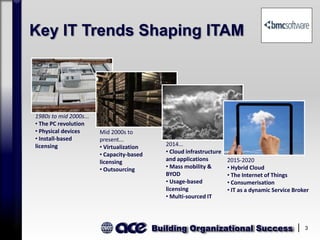
Key IT Trends Shaping ITAM
1980s to mid 2000s...
• The PC revolution
• Physical devices
• Install-based
licensing
Mid 2000s to
present...
• Virtualization
• Capacity-based
licensing
• Outsourcing
2014...
• Cloud infrastructure
and applications
• Mass mobility &
BYOD
• Usage-based
licensing
• Multi-sourced IT
?
2015-2020
• Hybrid Cloud
• The Internet of Things
• Consumerisation
• IT as a dynamic Service Broker
Building Organizational Success 4
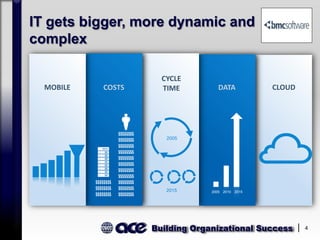
IT gets bigger, more dynamic and
complex
MOBILE COSTS
CYCLE
TIME DATA CLOUD
2010 20152015
2005
2005
Building Organizational Success 5
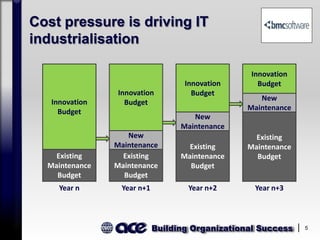
Cost pressure is driving IT
industrialisation
Existing
Maintenance
Budget
Innovation
Budget
Existing
Maintenance
Budget
Innovation
Budget
New
Maintenance Existing
Maintenance
Budget
Innovation
Budget
New
Maintenance
Existing
Maintenance
Budget
Innovation
Budget
New
Maintenance
Year n Year n+1 Year n+2 Year n+3
Building Organizational Success 6
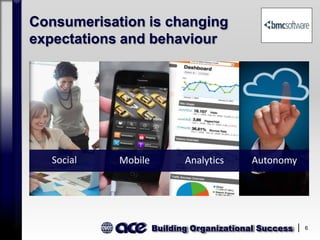
Consumerisation is changing
expectations and behaviour
Social Mobile Analytics Autonomy
Building Organizational Success 7
Connected tech is spreading
throughout the business
• Environmental monitoring and control
• Workforce automation
• Factory control systems
• RFID tags
• Vehicle trackers
• Customer experience augmentation
Building Organizational Success 8
Hybrid Cloud – basis of the IT
organisation, 2015-2020
• Private clouds
– Built by an organization exclusively to serve their own
needs
– Housed within their data centers or hosted in a location
that is effectively "on-site" to that company
• Public clouds
– Built by a 3rd party for consumption, for a fee
– These are shared resources between multiple entities.
• Hybrid clouds
– Mixed model, by which a company augments their own
private cloud with external public resources.
Building Organizational Success 9
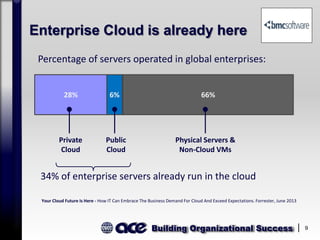
Enterprise Cloud is already here
28% 6% 66%
Private
Cloud
Public
Cloud
Physical Servers &
Non-Cloud VMs
34% of enterprise servers already run in the cloud
Your Cloud Future Is Here - How IT Can Embrace The Business Demand For Cloud And Exceed Expectations. Forrester, June 2013
Percentage of servers operated in global enterprises:
Building Organizational Success 10
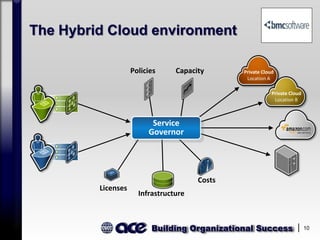
The Hybrid Cloud environment
Private Cloud
Location A
Private Cloud
Location B
Policies Capacity
Licenses
Infrastructure
Costs
Service
Governor
Building Organizational Success 11
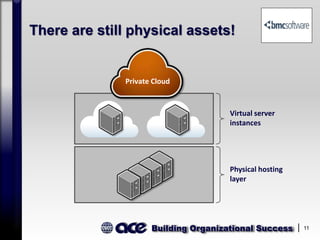
There are still physical assets!
Private Cloud
Virtual server
instances
Physical hosting
layer
Building Organizational Success 12
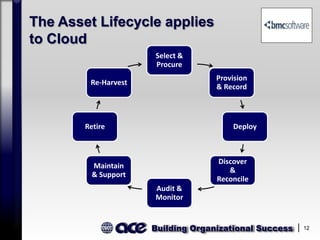
The Asset Lifecycle applies
to Cloud
Select &
Procure
Provision
& Record
Deploy
Discover
&
Reconcile
Audit &
Monitor
Maintain
& Support
Retire
Re-Harvest
Building Organizational Success 13
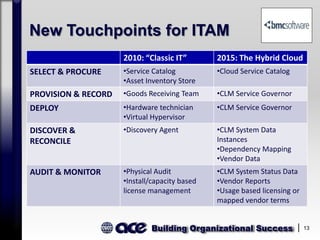
New Touchpoints for ITAM
2010: “Classic IT” 2015: The Hybrid Cloud
SELECT & PROCURE •Service Catalog
•Asset Inventory Store
•Cloud Service Catalog
PROVISION & RECORD •Goods Receiving Team •CLM Service Governor
DEPLOY •Hardware technician
•Virtual Hypervisor
•CLM Service Governor
DISCOVER &
RECONCILE
•Discovery Agent •CLM System Data
Instances
•Dependency Mapping
•Vendor Data
AUDIT & MONITOR •Physical Audit
•Install/capacity based
license management
•CLM System Status Data
•Vendor Reports
•Usage based licensing or
mapped vendor terms
Building Organizational Success 14
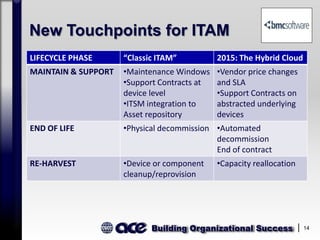
New Touchpoints for ITAM
LIFECYCLE PHASE “Classic ITAM” 2015: The Hybrid Cloud
MAINTAIN & SUPPORT •Maintenance Windows
•Support Contracts at
device level
•ITSM integration to
Asset repository
•Vendor price changes
and SLA
•Support Contracts on
abstracted underlying
devices
END OF LIFE •Physical decommission •Automated
decommission
End of contract
RE-HARVEST •Device or component
cleanup/reprovision
•Capacity reallocation
Building Organizational Success 15
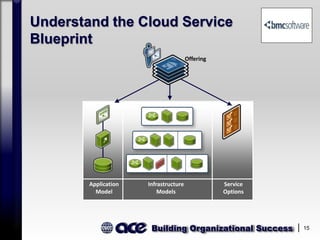
Understand the Cloud Service
Blueprint
Service
Options
Infrastructure
Models
Application
Model
Offering
Building Organizational Success 16
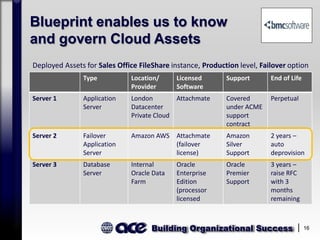
Blueprint enables us to know
and govern Cloud Assets
Type Location/
Provider
Licensed
Software
Support End of Life
Server 1 Application
Server
London
Datacenter
Private Cloud
Attachmate Covered
under ACME
support
contract
Perpetual
Server 2 Failover
Application
Server
Amazon AWS Attachmate
(failover
license)
Amazon
Silver
Support
2 years –
auto
deprovision
Server 3 Database
Server
Internal
Oracle Data
Farm
Oracle
Enterprise
Edition
(processor
licensed
Oracle
Premier
Support
3 years –
raise RFC
with 3
months
remaining
Deployed Assets for Sales Office FileShare instance, Production level, Failover option
Building Organizational Success 17
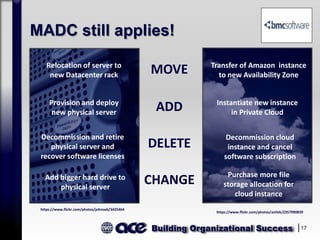
MADC still applies!
MOVE
ADD
DELETE
CHANGE
Transfer of Amazon instance
to new Availability Zone
Instantiate new instance
in Private Cloud
Decommission cloud
instance and cancel
software subscription
Purchase more file
storage allocation for
cloud instance
https://www.flickr.com/photos/johnseb/3425464
Relocation of server to
new Datacenter rack
Provision and deploy
new physical server
Decommission and retire
physical server and
recover software licenses
Add bigger hard drive to
physical server
https://www.flickr.com/photos/aztlek/2357990839
Building Organizational Success 18
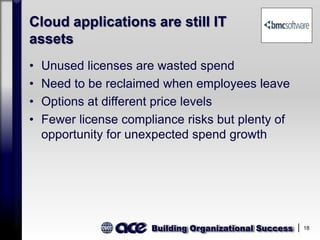
Cloud applications are still IT
assets
• Unused licenses are wasted spend
• Need to be reclaimed when employees leave
• Options at different price levels
• Fewer license compliance risks but plenty of
opportunity for unexpected spend growth
Building Organizational Success 19
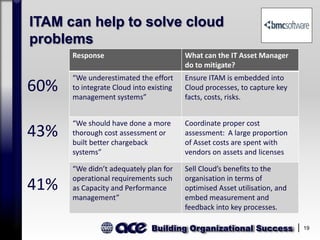
ITAM can help to solve cloud
problems
Response What can the IT Asset Manager
do to mitigate?
“We underestimated the effort
to integrate Cloud into existing
management systems”
Ensure ITAM is embedded into
Cloud processes, to capture key
facts, costs, risks.
“We should have done a more
thorough cost assessment or
built better chargeback
systems”
Coordinate proper cost
assessment: A large proportion
of Asset costs are spent with
vendors on assets and licenses
“We didn’t adequately plan for
operational requirements such
as Capacity and Performance
management”
Sell Cloud’s benefits to the
organisation in terms of
optimised Asset utilisation, and
embed measurement and
feedback into key processes.
60%
43%
41%
Building Organizational Success 20
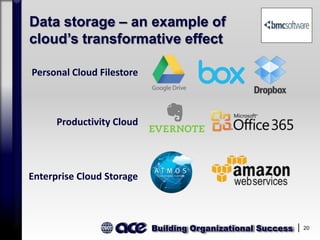
Data storage – an example of
cloud’s transformative effect
Personal Cloud Filestore
Productivity Cloud
Enterprise Cloud Storage
Building Organizational Success 21
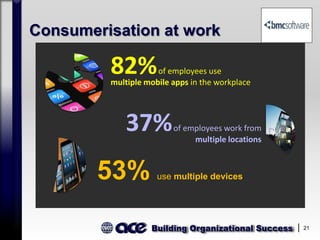
Consumerisation at work
37%of employees work from
multiple locations
82%of employees use
multiple mobile apps in the workplace
53% use multiple devices
Building Organizational Success 22
Challenges from BYOD growth
• “The unexpected consequence of BYOD is a
doubling or even tripling of the mobile workforce”
(Gartner Top 10 Strategic Technology Trends for 2014)
• Management and control vs user autonomy
• Complex ownership scenarios for devices
accessing business resources
• Software license terms may be difficult to apply
to BYOD scenarios
Building Organizational Success 23
Governing BYOD
• Source data from MDM and Enterprise
Application Store
• Work proactively with software vendors and
validate suitability of existing license models
Building Organizational Success 24
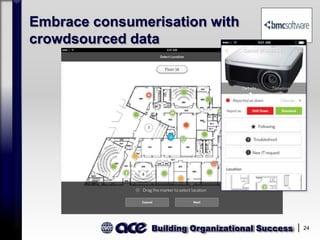
Embrace consumerisation with
crowdsourced data
Building Organizational Success 25
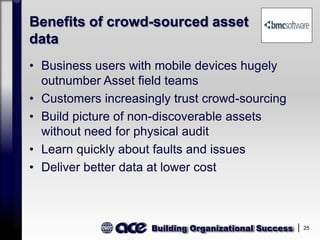
Benefits of crowd-sourced asset
data
• Business users with mobile devices hugely
outnumber Asset field teams
• Customers increasingly trust crowd-sourcing
• Build picture of non-discoverable assets
without need for physical audit
• Learn quickly about faults and issues
• Deliver better data at lower cost
Building Organizational Success 26
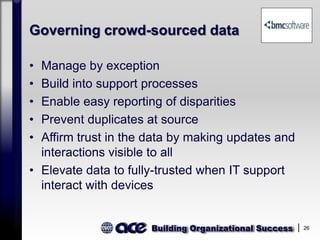
Governing crowd-sourced data
• Manage by exception
• Build into support processes
• Enable easy reporting of disparities
• Prevent duplicates at source
• Affirm trust in the data by making updates and
interactions visible to all
• Elevate data to fully-trusted when IT support
interact with devices
Building Organizational Success 27
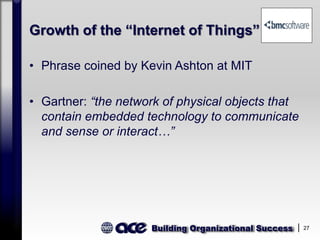
Growth of the “Internet of Things”
• Phrase coined by Kevin Ashton at MIT
• Gartner: “the network of physical objects that
contain embedded technology to communicate
and sense or interact…”
Building Organizational Success 28
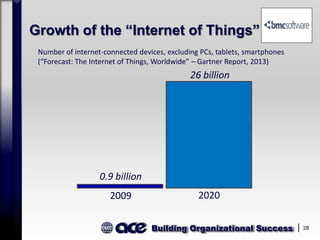
Growth of the “Internet of Things”
`
2009 2020
0.9 billion
26 billion
Number of internet-connected devices, excluding PCs, tablets, smartphones
(“Forecast: The Internet of Things, Worldwide” – Gartner Report, 2013)
Building Organizational Success 29
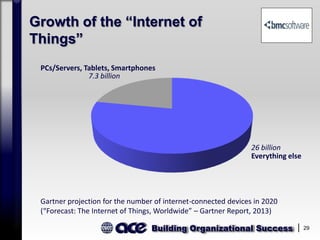
Growth of the “Internet of
Things”
26 billion
7.3 billion
Gartner projection for the number of internet-connected devices in 2020
(“Forecast: The Internet of Things, Worldwide” – Gartner Report, 2013)
PCs/Servers, Tablets, Smartphones
Everything else
Building Organizational Success 30
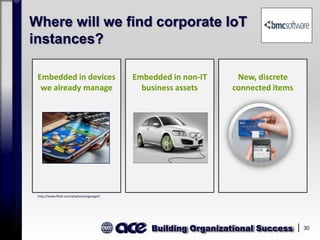
Where will we find corporate IoT
instances?
Embedded in devices
we already manage
Embedded in non-IT
business assets
New, discrete
connected items
http://www.flickr.com/photos/sergesegal/
Building Organizational Success 31
Workplace impact of the
“Internet of Things”
• Production line monitoring
• Connected vehicles
• Smart-grid technologies
• Environmental sensors
• RFID tags
95% of C-Suite executives expect their
enterprises to be using the IoT within 3 years
(“The Internet of Things Business Index – A Quiet Revolution Takes Place” – The
Economist Intelligence Unit, 2014)
Building Organizational Success 32
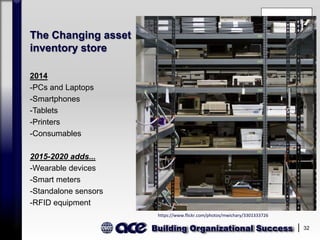
The Changing asset
inventory store
2014
-PCs and Laptops
-Smartphones
-Tablets
-Printers
-Consumables
2015-2020 adds...
-Wearable devices
-Smart meters
-Standalone sensors
-RFID equipment
https://www.flickr.com/photos/mwichary/3301333726
Building Organizational Success 33
Asset impacts of the Internet of
Things
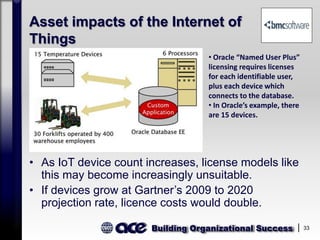
• As IoT device count increases, license models like
this may become increasingly unsuitable.
• If devices grow at Gartner’s 2009 to 2020
projection rate, licence costs would double.
• Oracle “Named User Plus”
licensing requires licenses
for each identifiable user,
plus each device which
connects to the database.
• In Oracle’s example, there
are 15 devices.
Building Organizational Success 34
IoT Risks
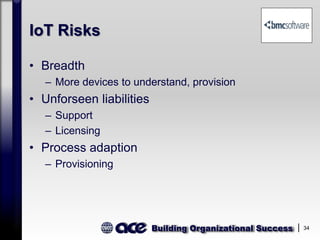
• Breadth
– More devices to understand, provision
• Unforseen liabilities
– Support
– Licensing
• Process adaption
– Provisioning
Building Organizational Success 35
Managing the IoT
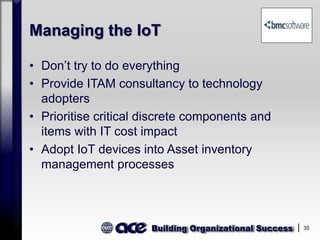
• Don’t try to do everything
• Provide ITAM consultancy to technology
adopters
• Prioritise critical discrete components and
items with IT cost impact
• Adopt IoT devices into Asset inventory
management processes
Building Organizational Success 36
Summary
• The pace of change in IT will remain rapid
• IT is expected to drive business success
• Business units outside IT are directly accessing
technology and solutions
• ITAM becomes more complex, and more multi-
layered
Building Organizational Success 37
The Asset Manager is ideally
placed…
• …to understand how the infrastructure supports the
business of IT.
• …to liaise and coordinate between different IT
functions, to find opportunities that will otherwise be
missed.
• …to learn about the core technologies in use in the
organization, and way they are evolving.
• …to help the organization understand its licensing
obligations, and how major decisions will affect them.
• …to be a key trusted source of information to the CIO
Building Organizational Success 38
Any Questions?
@JonHall_

ITAM 2015-2020: How new technology will shape the role of the IT Asset Manager

  • 1.
    Building Organizational Success ITAM2015-2020 How new technology will shape the role of the IT Asset Manager
  • 2.
    Building Organizational Success2 Agenda • The biggest trends shaping IT • Asset Management in a Hybrid Cloud • Consumerisation and its impact on ITAM • The Internet of Things • The Asset Manager’s advantage
  • 3.
    Building Organizational Success3 Key IT Trends Shaping ITAM 1980s to mid 2000s... • The PC revolution • Physical devices • Install-based licensing Mid 2000s to present... • Virtualization • Capacity-based licensing • Outsourcing 2014... • Cloud infrastructure and applications • Mass mobility & BYOD • Usage-based licensing • Multi-sourced IT ? 2015-2020 • Hybrid Cloud • The Internet of Things • Consumerisation • IT as a dynamic Service Broker
  • 4.
    Building Organizational Success4 IT gets bigger, more dynamic and complex MOBILE COSTS CYCLE TIME DATA CLOUD 2010 20152015 2005 2005
  • 5.
    Building Organizational Success5 Cost pressure is driving IT industrialisation Existing Maintenance Budget Innovation Budget Existing Maintenance Budget Innovation Budget New Maintenance Existing Maintenance Budget Innovation Budget New Maintenance Existing Maintenance Budget Innovation Budget New Maintenance Year n Year n+1 Year n+2 Year n+3
  • 6.
    Building Organizational Success6 Consumerisation is changing expectations and behaviour Social Mobile Analytics Autonomy
  • 7.
    Building Organizational Success7 Connected tech is spreading throughout the business • Environmental monitoring and control • Workforce automation • Factory control systems • RFID tags • Vehicle trackers • Customer experience augmentation
  • 8.
    Building Organizational Success8 Hybrid Cloud – basis of the IT organisation, 2015-2020 • Private clouds – Built by an organization exclusively to serve their own needs – Housed within their data centers or hosted in a location that is effectively "on-site" to that company • Public clouds – Built by a 3rd party for consumption, for a fee – These are shared resources between multiple entities. • Hybrid clouds – Mixed model, by which a company augments their own private cloud with external public resources.
  • 9.
    Building Organizational Success9 Enterprise Cloud is already here 28% 6% 66% Private Cloud Public Cloud Physical Servers & Non-Cloud VMs 34% of enterprise servers already run in the cloud Your Cloud Future Is Here - How IT Can Embrace The Business Demand For Cloud And Exceed Expectations. Forrester, June 2013 Percentage of servers operated in global enterprises:
  • 10.
    Building Organizational Success10 The Hybrid Cloud environment Private Cloud Location A Private Cloud Location B Policies Capacity Licenses Infrastructure Costs Service Governor
  • 11.
    Building Organizational Success11 There are still physical assets! Private Cloud Virtual server instances Physical hosting layer
  • 12.
    Building Organizational Success12 The Asset Lifecycle applies to Cloud Select & Procure Provision & Record Deploy Discover & Reconcile Audit & Monitor Maintain & Support Retire Re-Harvest
  • 13.
    Building Organizational Success13 New Touchpoints for ITAM 2010: “Classic IT” 2015: The Hybrid Cloud SELECT & PROCURE •Service Catalog •Asset Inventory Store •Cloud Service Catalog PROVISION & RECORD •Goods Receiving Team •CLM Service Governor DEPLOY •Hardware technician •Virtual Hypervisor •CLM Service Governor DISCOVER & RECONCILE •Discovery Agent •CLM System Data Instances •Dependency Mapping •Vendor Data AUDIT & MONITOR •Physical Audit •Install/capacity based license management •CLM System Status Data •Vendor Reports •Usage based licensing or mapped vendor terms
  • 14.
    Building Organizational Success14 New Touchpoints for ITAM LIFECYCLE PHASE “Classic ITAM” 2015: The Hybrid Cloud MAINTAIN & SUPPORT •Maintenance Windows •Support Contracts at device level •ITSM integration to Asset repository •Vendor price changes and SLA •Support Contracts on abstracted underlying devices END OF LIFE •Physical decommission •Automated decommission End of contract RE-HARVEST •Device or component cleanup/reprovision •Capacity reallocation
  • 15.
    Building Organizational Success15 Understand the Cloud Service Blueprint Service Options Infrastructure Models Application Model Offering
  • 16.
    Building Organizational Success16 Blueprint enables us to know and govern Cloud Assets Type Location/ Provider Licensed Software Support End of Life Server 1 Application Server London Datacenter Private Cloud Attachmate Covered under ACME support contract Perpetual Server 2 Failover Application Server Amazon AWS Attachmate (failover license) Amazon Silver Support 2 years – auto deprovision Server 3 Database Server Internal Oracle Data Farm Oracle Enterprise Edition (processor licensed Oracle Premier Support 3 years – raise RFC with 3 months remaining Deployed Assets for Sales Office FileShare instance, Production level, Failover option
  • 17.
    Building Organizational Success17 MADC still applies! MOVE ADD DELETE CHANGE Transfer of Amazon instance to new Availability Zone Instantiate new instance in Private Cloud Decommission cloud instance and cancel software subscription Purchase more file storage allocation for cloud instance https://www.flickr.com/photos/johnseb/3425464 Relocation of server to new Datacenter rack Provision and deploy new physical server Decommission and retire physical server and recover software licenses Add bigger hard drive to physical server https://www.flickr.com/photos/aztlek/2357990839
  • 18.
    Building Organizational Success18 Cloud applications are still IT assets • Unused licenses are wasted spend • Need to be reclaimed when employees leave • Options at different price levels • Fewer license compliance risks but plenty of opportunity for unexpected spend growth
  • 19.
    Building Organizational Success19 ITAM can help to solve cloud problems Response What can the IT Asset Manager do to mitigate? “We underestimated the effort to integrate Cloud into existing management systems” Ensure ITAM is embedded into Cloud processes, to capture key facts, costs, risks. “We should have done a more thorough cost assessment or built better chargeback systems” Coordinate proper cost assessment: A large proportion of Asset costs are spent with vendors on assets and licenses “We didn’t adequately plan for operational requirements such as Capacity and Performance management” Sell Cloud’s benefits to the organisation in terms of optimised Asset utilisation, and embed measurement and feedback into key processes. 60% 43% 41%
  • 20.
    Building Organizational Success20 Data storage – an example of cloud’s transformative effect Personal Cloud Filestore Productivity Cloud Enterprise Cloud Storage
  • 21.
    Building Organizational Success21 Consumerisation at work 37%of employees work from multiple locations 82%of employees use multiple mobile apps in the workplace 53% use multiple devices
  • 22.
    Building Organizational Success22 Challenges from BYOD growth • “The unexpected consequence of BYOD is a doubling or even tripling of the mobile workforce” (Gartner Top 10 Strategic Technology Trends for 2014) • Management and control vs user autonomy • Complex ownership scenarios for devices accessing business resources • Software license terms may be difficult to apply to BYOD scenarios
  • 23.
    Building Organizational Success23 Governing BYOD • Source data from MDM and Enterprise Application Store • Work proactively with software vendors and validate suitability of existing license models
  • 24.
    Building Organizational Success24 Embrace consumerisation with crowdsourced data
  • 25.
    Building Organizational Success25 Benefits of crowd-sourced asset data • Business users with mobile devices hugely outnumber Asset field teams • Customers increasingly trust crowd-sourcing • Build picture of non-discoverable assets without need for physical audit • Learn quickly about faults and issues • Deliver better data at lower cost
  • 26.
    Building Organizational Success26 Governing crowd-sourced data • Manage by exception • Build into support processes • Enable easy reporting of disparities • Prevent duplicates at source • Affirm trust in the data by making updates and interactions visible to all • Elevate data to fully-trusted when IT support interact with devices
  • 27.
    Building Organizational Success27 Growth of the “Internet of Things” • Phrase coined by Kevin Ashton at MIT • Gartner: “the network of physical objects that contain embedded technology to communicate and sense or interact…”
  • 28.
    Building Organizational Success28 Growth of the “Internet of Things” ` 2009 2020 0.9 billion 26 billion Number of internet-connected devices, excluding PCs, tablets, smartphones (“Forecast: The Internet of Things, Worldwide” – Gartner Report, 2013)
  • 29.
    Building Organizational Success29 Growth of the “Internet of Things” 26 billion 7.3 billion Gartner projection for the number of internet-connected devices in 2020 (“Forecast: The Internet of Things, Worldwide” – Gartner Report, 2013) PCs/Servers, Tablets, Smartphones Everything else
  • 30.
    Building Organizational Success30 Where will we find corporate IoT instances? Embedded in devices we already manage Embedded in non-IT business assets New, discrete connected items http://www.flickr.com/photos/sergesegal/
  • 31.
    Building Organizational Success31 Workplace impact of the “Internet of Things” • Production line monitoring • Connected vehicles • Smart-grid technologies • Environmental sensors • RFID tags 95% of C-Suite executives expect their enterprises to be using the IoT within 3 years (“The Internet of Things Business Index – A Quiet Revolution Takes Place” – The Economist Intelligence Unit, 2014)
  • 32.
    Building Organizational Success32 The Changing asset inventory store 2014 -PCs and Laptops -Smartphones -Tablets -Printers -Consumables 2015-2020 adds... -Wearable devices -Smart meters -Standalone sensors -RFID equipment https://www.flickr.com/photos/mwichary/3301333726
  • 33.
    Building Organizational Success33 Asset impacts of the Internet of Things • As IoT device count increases, license models like this may become increasingly unsuitable. • If devices grow at Gartner’s 2009 to 2020 projection rate, licence costs would double. • Oracle “Named User Plus” licensing requires licenses for each identifiable user, plus each device which connects to the database. • In Oracle’s example, there are 15 devices.
  • 34.
    Building Organizational Success34 IoT Risks • Breadth – More devices to understand, provision • Unforseen liabilities – Support – Licensing • Process adaption – Provisioning
  • 35.
    Building Organizational Success35 Managing the IoT • Don’t try to do everything • Provide ITAM consultancy to technology adopters • Prioritise critical discrete components and items with IT cost impact • Adopt IoT devices into Asset inventory management processes
  • 36.
    Building Organizational Success36 Summary • The pace of change in IT will remain rapid • IT is expected to drive business success • Business units outside IT are directly accessing technology and solutions • ITAM becomes more complex, and more multi- layered
  • 37.
    Building Organizational Success37 The Asset Manager is ideally placed… • …to understand how the infrastructure supports the business of IT. • …to liaise and coordinate between different IT functions, to find opportunities that will otherwise be missed. • …to learn about the core technologies in use in the organization, and way they are evolving. • …to help the organization understand its licensing obligations, and how major decisions will affect them. • …to be a key trusted source of information to the CIO
  • 38.
    Building Organizational Success38 Any Questions? @JonHall_

Editor's Notes

  • #6 We’ve seen less focus on cost cutting in recent years
  • #12 Real physical machines with real maintenance schedules, support contracts, etc
  • #16 A cloud service offering can be modelled as three fundamental parts: Application Model (e.g. Web Server, Application Server, Database Server) Infrastructure Model (the way the application model is scaled and deployed, for different purposes) Service Options (additional, more granular options such as additional capacity or support)
  • #20 A Forrester Consulting Thought Leadership Paper Commissioned By BMC SoftwareYour Cloud Future Is Here How IT Can Embrace The Business Demand For Cloud And Exceed Expectations June 2013 Answers to the question: “Thinking about your private, hybrid or public cloud services deployed so far, what lessons do you wish you had learned earlier in your planning or deployment efforts?”
  • #31 The average smartphone already contains seven sensors.TSMC is using sensor devices to build “lights-out factories” where sensors elimate the need for any employees at all
  • #33 Inventory processes will need to adapt to cover a broader range of devices, with a broader range of applications. Entirely new “end users” will emerge in the line of business
  • #34 2009 – 0.9 billion devices. 2020 – 26 billion devicesLicense count in this eaxmple is 400 + 15 = 415Would increase number of devices from 15 to 433, hence license count to almost 850.