ITSM, DevOps and Swarming
SDI19 – Tuesday 26th March 2019
Jon Hall
Principal Product Manager, Digital Service Management
© Copyright 2019 BMC Software, Inc.
@jonhall_
“When I stepped outside the box, my colleagues really
appreciated it. But management did not.
They put me back.
The people that excel and create the most value are the
ones that step outside their box”
Hank Barnes, Gartner: “Playing Outside Your Box” May 2018.
@jonhall_
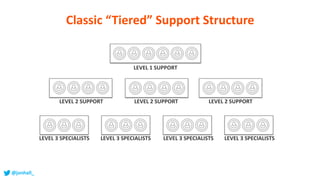
LEVEL 2 SUPPORT LEVEL 2 SUPPORTLEVEL 2 SUPPORT
LEVEL 3 SPECIALISTS LEVEL 3 SPECIALISTS LEVEL 3 SPECIALISTS LEVEL 3 SPECIALISTS
LEVEL 1 SUPPORT
Classic “Tiered” Support Structure
@jonhall_
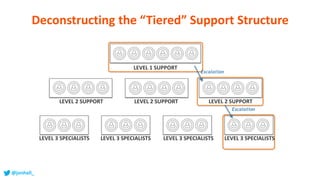
Escalation
Escalation
Deconstructing the “Tiered” Support Structure
LEVEL 2 SUPPORT LEVEL 2 SUPPORTLEVEL 2 SUPPORT
LEVEL 1 SUPPORT
LEVEL 3 SPECIALISTS LEVEL 3 SPECIALISTS LEVEL 3 SPECIALISTS LEVEL 3 SPECIALISTS
@jonhall_
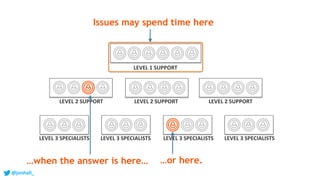
…when the answer is here… …or here.
Issues may spend time here
LEVEL 2 SUPPORT LEVEL 2 SUPPORTLEVEL 2 SUPPORT
LEVEL 1 SUPPORT
LEVEL 3 SPECIALISTS LEVEL 3 SPECIALISTS LEVEL 3 SPECIALISTS LEVEL 3 SPECIALISTS
@jonhall_
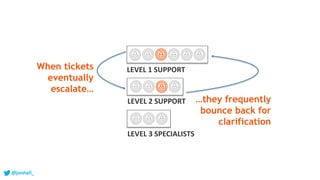
LEVEL 1 SUPPORT
LEVEL 2 SUPPORT
LEVEL 3 SPECIALISTS
When tickets
eventually
escalate…
…they frequently
bounce back for
clarification
@jonhall_
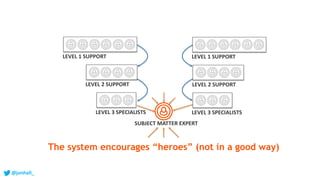
LEVEL 1 SUPPORT
LEVEL 2 SUPPORT
LEVEL 3 SPECIALISTS
LEVEL 1 SUPPORT
LEVEL 3 SPECIALISTS
LEVEL 2 SUPPORT
SUBJECT MATTER EXPERT
The system encourages “heroes” (not in a good way)
@jonhall_
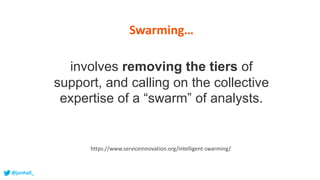
involves removing the tiers of
support, and calling on the collective
expertise of a “swarm” of analysts.
https://www.serviceinnovation.org/intelligent-swarming/
Swarming…
@jonhall_
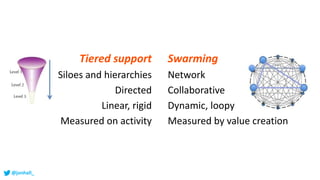
Swarming
Network
Collaborative
Dynamic, loopy
Measured by value creation
Tiered support
Siloes and hierarchies
Directed
Linear, rigid
Measured on activity
@jonhall_
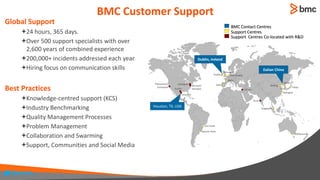
Global Support
24 hours, 365 days.
Over 500 support specialists with over
2,600 years of combined experience
200,000+ incidents addressed each year
Hiring focus on communication skills
Best Practices
Knowledge-centred support (KCS)
Industry Benchmarking
Quality Management Processes
Problem Management
Collaboration and Swarming
Support, Communities and Social Media
BMC Contact Centres
Support Centres
Support Centres Co-located with R&D
Pleasanton/
Sunnyvale
Houston
Austin
McLean/
Herndon
Lexington
Sao Paulo
Buenos Aires
Spain
Dublin
Winnersh
Amsterdam
Paris
Tel Hai
Pune
Singapore
Shanghai
Beijing
Seoul
Dalian
Tokyo
Melbourne
Houston, TX, USA
Dublin, Ireland
Dalian China
BMC Customer Support
@jonhall_
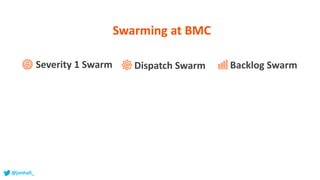
Swarming at BMC
Dispatch SwarmSeverity 1 Swarm Backlog Swarm
@jonhall_
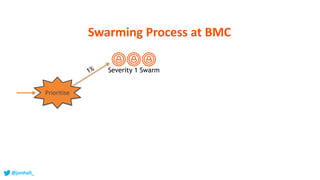
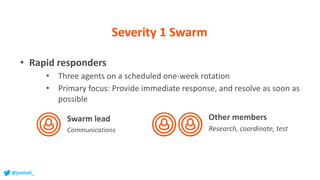
Severity 1 Swarm
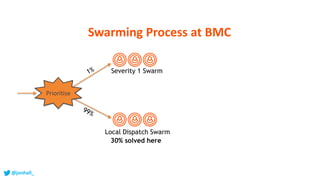
Prioritise
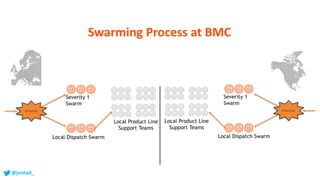
Swarming Process at BMC
@jonhall_
• Rapid responders
• Three agents on a scheduled one-week rotation
• Primary focus: Provide immediate response, and resolve as soon as
possible
Swarm lead
Communications
Other members
Research, coordinate, test
Severity 1 Swarm
@jonhall_
Severity 1 Swarm
Local Dispatch Swarm
Prioritise
30% solved here
Swarming Process at BMC
@jonhall_
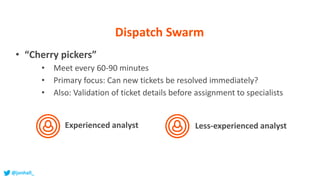
• “Cherry pickers”
• Meet every 60-90 minutes
• Primary focus: Can new tickets be resolved immediately?
• Also: Validation of ticket details before assignment to specialists
Experienced analyst Less-experienced analyst
Dispatch Swarm
@jonhall_
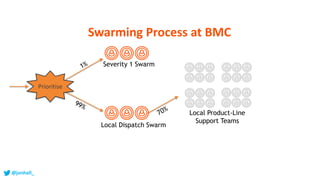
Local Product-Line
Support Teams
Severity 1 Swarm
Local Dispatch Swarm
Prioritise
Swarming Process at BMC
@jonhall_
Local Product Line
Support Teams
Severity 1
Swarm
Local Dispatch Swarm
Prioritise
Severity 1
Swarm
Local Dispatch Swarm
Prioritise
Local Product Line
Support Teams
Swarming Process at BMC
@jonhall_
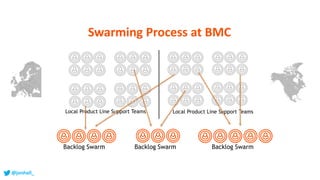
Local Product Line Support Teams Local Product Line Support Teams
Backlog Swarm Backlog Swarm Backlog Swarm
Swarming Process at BMC
@jonhall_
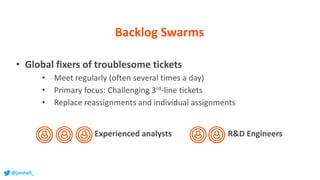
• Global fixers of troublesome tickets
• Meet regularly (often several times a day)
• Primary focus: Challenging 3rd-line tickets
• Replace reassignments and individual assignments
Experienced analysts R&D Engineers
Backlog Swarms
@jonhall_
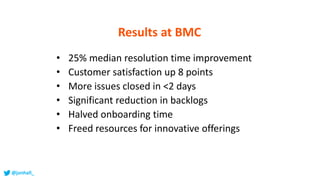
• 25% median resolution time improvement
• Customer satisfaction up 8 points
• More issues closed in <2 days
• Significant reduction in backlogs
• Halved onboarding time
• Freed resources for innovative offerings
Results at BMC
@jonhall_
• Guidelines, not rules
• Metrics had to change (swarming breaks traditional ones!)
• Some people needed help to became more customer facing
• Banned ticket tennis and direct escalations to experts
• New tooling practices, particularly mobile and chat
Things we had to do to make it work
@jonhall_
• 25% median resolution time improvement
• Customer satisfaction up 8 points
• More issues closed in <2 days
• Significant reduction in backlogs
• Halved on-boarding time
• Freed resources for innovative offerings
Results at BMC
@jonhall_
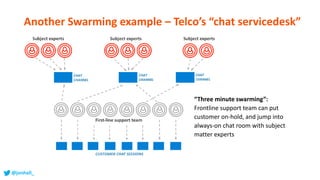
Another Swarming example – Telco’s “chat servicedesk”
@jonhall_
“Three minute swarming”:
Frontline support team can put
customer on-hold, and jump into
always-on chat room with subject
matter experts
• Suggest Swarm participants based on contributions
• Encourage and reward
• Learn from each interaction
• Improve reliance of next interaction
• “Reputation” model
Making Swarming Intelligent
@jonhall_
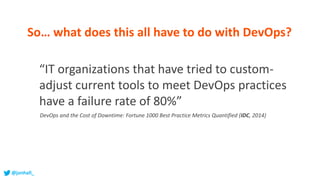
“IT organizations that have tried to custom-
adjust current tools to meet DevOps practices
have a failure rate of 80%”
DevOps and the Cost of Downtime: Fortune 1000 Best Practice Metrics Quantified (IDC, 2014)
So… what does this all have to do with DevOps?
@jonhall_
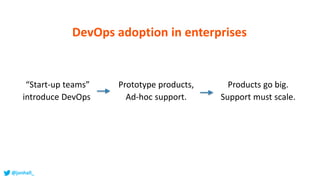
DevOps adoption in enterprises
“Start-up teams”
introduce DevOps
Prototype products,
Ad-hoc support.
Products go big.
Support must scale.
@jonhall_
@jonhall_
https://upload.wikimedia.org/wikipedia/commons/thumb/2/20/Adidas_Logo.svg/2000px-Adidas_Logo.svg.png
DevOps Enterprise Summit speakers (a sample), 2018
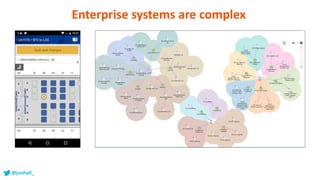
Enterprise systems are complex
@jonhall_
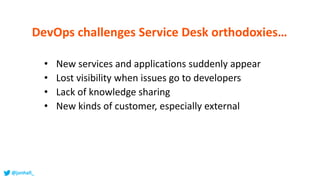
• New services and applications suddenly appear
• Lost visibility when issues go to developers
• Lack of knowledge sharing
• New kinds of customer, especially external
DevOps challenges Service Desk orthodoxies…
@jonhall_
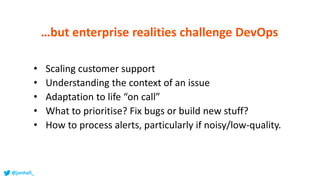
• Scaling customer support
• Understanding the context of an issue
• Adaptation to life “on call”
• What to prioritise? Fix bugs or build new stuff?
• How to process alerts, particularly if noisy/low-quality.
…but enterprise realities challenge DevOps
@jonhall_
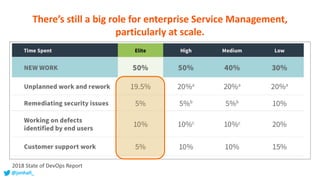
2018 State of DevOps Report
There’s still a big role for enterprise Service Management,
particularly at scale.
@jonhall_
“The enterprise space doesn’t move slowly
because they’re stupid, or they hate technology.
It’s because they have users”
Luke Kanies, Puppet Founder, Configuration Management Camp 2015, Belgium.
@jonhall_
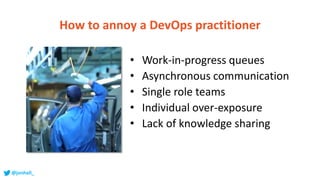
• Work-in-progress queues
• Asynchronous communication
• Single role teams
• Individual over-exposure
• Lack of knowledge sharing
How to annoy a DevOps practitioner
@jonhall_
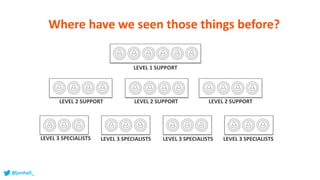
LEVEL 2 SUPPORT LEVEL 2 SUPPORTLEVEL 2 SUPPORT
LEVEL 3 SPECIALISTS LEVEL 3 SPECIALISTS LEVEL 3 SPECIALISTS LEVEL 3 SPECIALISTS
LEVEL 1 SUPPORT
Where have we seen those things before?
@jonhall_
Global car manufacturer: Connected Vehicles Division
Challenge: how to scale support to 6+ million new vehicles every year.
• “You’ve got to go where people are” – Senior developer
• Tiered support would mean 4-5 days to get to the right team
• First Responders instigate and coordinate ad-hoc swarms for big issues
• Other teams have 1 person on rotation for swarming
• Swarm grows and shrinks as necessary
• Swarm may include engineers from Amazon, Microsoft, etc.
@jonhall_
Swarming aligns really well to DevOps
• Autonomy and self-organisation
• Knowledge transfer and skills development
• ChatOps, not email
• Prevention of accumulation of queued work
• Protection of individuals from burnout
@jonhall_
• Wait… What?
• Pronounced “kuh-nev-in”
• Developed by Dave Snowden while at IBM in 1999
• Taken independent in 2005
• The word “signifies the multiple factors in our
environment and our experience that influence us in
ways we can never understand”
Swarming as a means of delivering Cynefin?
@jonhall_
@jonhall_
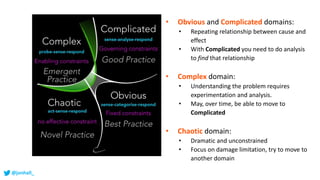
• Obvious and Complicated domains:
• Repeating relationship between cause and
effect
• With Complicated you need to do analysis
to find that relationship
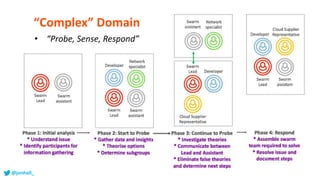
• Complex domain:
• Understanding the problem requires
experimentation and analysis.
• May, over time, be able to move to
Complicated
• Chaotic domain:
• Dramatic and unconstrained
• Focus on damage limitation, try to move to
another domain
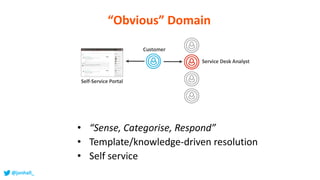
“Obvious” Domain
@jonhall_
• “Sense, Categorise, Respond”
• Template/knowledge-driven resolution
• Self service
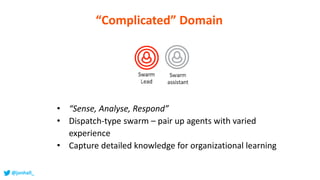
“Complicated” Domain
@jonhall_
• “Sense, Analyse, Respond”
• Dispatch-type swarm – pair up agents with varied
experience
• Capture detailed knowledge for organizational learning
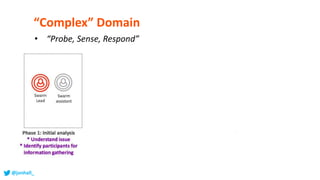
“Complex” Domain
• “Probe, Sense, Respond”
@jonhall_
“Complex” Domain
• “Probe, Sense, Respond”
@jonhall_
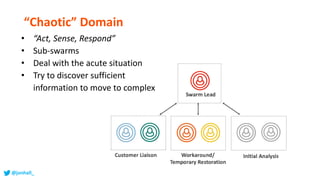
“Chaotic” Domain
• “Act, Sense, Respond”
• Sub-swarms
• Deal with the acute situation
• Try to discover sufficient
information to move to complex
@jonhall_
• May increase costs even if other metrics improve
• Can be difficult to evaluate individual contribution
• “Cradle to grave” ownership across time zones
• Some individuals may dominate
• Finding the right people for a swarm is difficult
Issues reported by Swarming early adopters
@jonhall_
“Swarming works better than conventional processes.
I am able to get multiple experiences from swarm
attendees of similar cases they have worked.
If there are no experiences, then it’s perspectives:
Decades of experience”
Senior Support Analyst, BMC
@jonhall_
“I have probably doubled my knowledge of the
products in a year because of Swarming…
and I have been here a long time”
Senior Support Analyst, BMC
@jonhall_
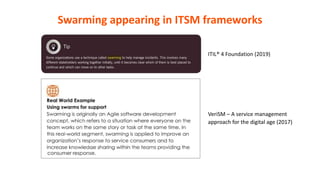
Swarming appearing in ITSM frameworks
ITIL® 4 Foundation (2019)
VeriSM – A service management
approach for the digital age (2017)
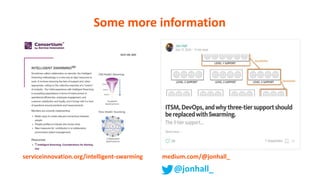
medium.com/@jonhall_serviceinnovation.org/intelligent-swarming
Some more information
@jonhall_

SDI19: Swarming and Devops for ITSM

  • 1.
    ITSM, DevOps andSwarming SDI19 – Tuesday 26th March 2019 Jon Hall Principal Product Manager, Digital Service Management © Copyright 2019 BMC Software, Inc. @jonhall_
  • 2.
    “When I steppedoutside the box, my colleagues really appreciated it. But management did not. They put me back. The people that excel and create the most value are the ones that step outside their box” Hank Barnes, Gartner: “Playing Outside Your Box” May 2018. @jonhall_
  • 3.
    LEVEL 2 SUPPORTLEVEL 2 SUPPORTLEVEL 2 SUPPORT LEVEL 3 SPECIALISTS LEVEL 3 SPECIALISTS LEVEL 3 SPECIALISTS LEVEL 3 SPECIALISTS LEVEL 1 SUPPORT Classic “Tiered” Support Structure @jonhall_
  • 4.
    Escalation Escalation Deconstructing the “Tiered”Support Structure LEVEL 2 SUPPORT LEVEL 2 SUPPORTLEVEL 2 SUPPORT LEVEL 1 SUPPORT LEVEL 3 SPECIALISTS LEVEL 3 SPECIALISTS LEVEL 3 SPECIALISTS LEVEL 3 SPECIALISTS @jonhall_
  • 5.
    …when the answeris here… …or here. Issues may spend time here LEVEL 2 SUPPORT LEVEL 2 SUPPORTLEVEL 2 SUPPORT LEVEL 1 SUPPORT LEVEL 3 SPECIALISTS LEVEL 3 SPECIALISTS LEVEL 3 SPECIALISTS LEVEL 3 SPECIALISTS @jonhall_
  • 6.
    LEVEL 1 SUPPORT LEVEL2 SUPPORT LEVEL 3 SPECIALISTS When tickets eventually escalate… …they frequently bounce back for clarification @jonhall_
  • 7.
    LEVEL 1 SUPPORT LEVEL2 SUPPORT LEVEL 3 SPECIALISTS LEVEL 1 SUPPORT LEVEL 3 SPECIALISTS LEVEL 2 SUPPORT SUBJECT MATTER EXPERT The system encourages “heroes” (not in a good way) @jonhall_
  • 8.
    involves removing thetiers of support, and calling on the collective expertise of a “swarm” of analysts. https://www.serviceinnovation.org/intelligent-swarming/ Swarming… @jonhall_
  • 9.
    Swarming Network Collaborative Dynamic, loopy Measured byvalue creation Tiered support Siloes and hierarchies Directed Linear, rigid Measured on activity @jonhall_
  • 10.
    Global Support 24 hours,365 days. Over 500 support specialists with over 2,600 years of combined experience 200,000+ incidents addressed each year Hiring focus on communication skills Best Practices Knowledge-centred support (KCS) Industry Benchmarking Quality Management Processes Problem Management Collaboration and Swarming Support, Communities and Social Media BMC Contact Centres Support Centres Support Centres Co-located with R&D Pleasanton/ Sunnyvale Houston Austin McLean/ Herndon Lexington Sao Paulo Buenos Aires Spain Dublin Winnersh Amsterdam Paris Tel Hai Pune Singapore Shanghai Beijing Seoul Dalian Tokyo Melbourne Houston, TX, USA Dublin, Ireland Dalian China BMC Customer Support @jonhall_
  • 11.
    Swarming at BMC DispatchSwarmSeverity 1 Swarm Backlog Swarm @jonhall_
  • 12.
    Severity 1 Swarm Prioritise SwarmingProcess at BMC @jonhall_
  • 13.
    • Rapid responders •Three agents on a scheduled one-week rotation • Primary focus: Provide immediate response, and resolve as soon as possible Swarm lead Communications Other members Research, coordinate, test Severity 1 Swarm @jonhall_
  • 14.
    Severity 1 Swarm LocalDispatch Swarm Prioritise 30% solved here Swarming Process at BMC @jonhall_
  • 15.
    • “Cherry pickers” •Meet every 60-90 minutes • Primary focus: Can new tickets be resolved immediately? • Also: Validation of ticket details before assignment to specialists Experienced analyst Less-experienced analyst Dispatch Swarm @jonhall_
  • 16.
    Local Product-Line Support Teams Severity1 Swarm Local Dispatch Swarm Prioritise Swarming Process at BMC @jonhall_
  • 17.
    Local Product Line SupportTeams Severity 1 Swarm Local Dispatch Swarm Prioritise Severity 1 Swarm Local Dispatch Swarm Prioritise Local Product Line Support Teams Swarming Process at BMC @jonhall_
  • 18.
    Local Product LineSupport Teams Local Product Line Support Teams Backlog Swarm Backlog Swarm Backlog Swarm Swarming Process at BMC @jonhall_
  • 19.
    • Global fixersof troublesome tickets • Meet regularly (often several times a day) • Primary focus: Challenging 3rd-line tickets • Replace reassignments and individual assignments Experienced analysts R&D Engineers Backlog Swarms @jonhall_
  • 20.
    • 25% medianresolution time improvement • Customer satisfaction up 8 points • More issues closed in <2 days • Significant reduction in backlogs • Halved onboarding time • Freed resources for innovative offerings Results at BMC @jonhall_
  • 21.
    • Guidelines, notrules • Metrics had to change (swarming breaks traditional ones!) • Some people needed help to became more customer facing • Banned ticket tennis and direct escalations to experts • New tooling practices, particularly mobile and chat Things we had to do to make it work @jonhall_
  • 22.
    • 25% medianresolution time improvement • Customer satisfaction up 8 points • More issues closed in <2 days • Significant reduction in backlogs • Halved on-boarding time • Freed resources for innovative offerings Results at BMC @jonhall_
  • 23.
    Another Swarming example– Telco’s “chat servicedesk” @jonhall_ “Three minute swarming”: Frontline support team can put customer on-hold, and jump into always-on chat room with subject matter experts
  • 24.
    • Suggest Swarmparticipants based on contributions • Encourage and reward • Learn from each interaction • Improve reliance of next interaction • “Reputation” model Making Swarming Intelligent @jonhall_
  • 25.
    “IT organizations thathave tried to custom- adjust current tools to meet DevOps practices have a failure rate of 80%” DevOps and the Cost of Downtime: Fortune 1000 Best Practice Metrics Quantified (IDC, 2014) So… what does this all have to do with DevOps? @jonhall_
  • 26.
    DevOps adoption inenterprises “Start-up teams” introduce DevOps Prototype products, Ad-hoc support. Products go big. Support must scale. @jonhall_
  • 27.
  • 28.
    Enterprise systems arecomplex @jonhall_
  • 29.
    • New servicesand applications suddenly appear • Lost visibility when issues go to developers • Lack of knowledge sharing • New kinds of customer, especially external DevOps challenges Service Desk orthodoxies… @jonhall_
  • 30.
    • Scaling customersupport • Understanding the context of an issue • Adaptation to life “on call” • What to prioritise? Fix bugs or build new stuff? • How to process alerts, particularly if noisy/low-quality. …but enterprise realities challenge DevOps @jonhall_
  • 31.
    2018 State ofDevOps Report There’s still a big role for enterprise Service Management, particularly at scale. @jonhall_
  • 32.
    “The enterprise spacedoesn’t move slowly because they’re stupid, or they hate technology. It’s because they have users” Luke Kanies, Puppet Founder, Configuration Management Camp 2015, Belgium. @jonhall_
  • 33.
    • Work-in-progress queues •Asynchronous communication • Single role teams • Individual over-exposure • Lack of knowledge sharing How to annoy a DevOps practitioner @jonhall_
  • 34.
    LEVEL 2 SUPPORTLEVEL 2 SUPPORTLEVEL 2 SUPPORT LEVEL 3 SPECIALISTS LEVEL 3 SPECIALISTS LEVEL 3 SPECIALISTS LEVEL 3 SPECIALISTS LEVEL 1 SUPPORT Where have we seen those things before? @jonhall_
  • 35.
    Global car manufacturer:Connected Vehicles Division Challenge: how to scale support to 6+ million new vehicles every year. • “You’ve got to go where people are” – Senior developer • Tiered support would mean 4-5 days to get to the right team • First Responders instigate and coordinate ad-hoc swarms for big issues • Other teams have 1 person on rotation for swarming • Swarm grows and shrinks as necessary • Swarm may include engineers from Amazon, Microsoft, etc. @jonhall_
  • 36.
    Swarming aligns reallywell to DevOps • Autonomy and self-organisation • Knowledge transfer and skills development • ChatOps, not email • Prevention of accumulation of queued work • Protection of individuals from burnout @jonhall_
  • 37.
    • Wait… What? •Pronounced “kuh-nev-in” • Developed by Dave Snowden while at IBM in 1999 • Taken independent in 2005 • The word “signifies the multiple factors in our environment and our experience that influence us in ways we can never understand” Swarming as a means of delivering Cynefin? @jonhall_
  • 38.
    @jonhall_ • Obvious andComplicated domains: • Repeating relationship between cause and effect • With Complicated you need to do analysis to find that relationship • Complex domain: • Understanding the problem requires experimentation and analysis. • May, over time, be able to move to Complicated • Chaotic domain: • Dramatic and unconstrained • Focus on damage limitation, try to move to another domain
  • 39.
    “Obvious” Domain @jonhall_ • “Sense,Categorise, Respond” • Template/knowledge-driven resolution • Self service
  • 40.
    “Complicated” Domain @jonhall_ • “Sense,Analyse, Respond” • Dispatch-type swarm – pair up agents with varied experience • Capture detailed knowledge for organizational learning
  • 41.
    “Complex” Domain • “Probe,Sense, Respond” @jonhall_
  • 42.
    “Complex” Domain • “Probe,Sense, Respond” @jonhall_
  • 43.
    “Chaotic” Domain • “Act,Sense, Respond” • Sub-swarms • Deal with the acute situation • Try to discover sufficient information to move to complex @jonhall_
  • 44.
    • May increasecosts even if other metrics improve • Can be difficult to evaluate individual contribution • “Cradle to grave” ownership across time zones • Some individuals may dominate • Finding the right people for a swarm is difficult Issues reported by Swarming early adopters @jonhall_
  • 45.
    “Swarming works betterthan conventional processes. I am able to get multiple experiences from swarm attendees of similar cases they have worked. If there are no experiences, then it’s perspectives: Decades of experience” Senior Support Analyst, BMC @jonhall_
  • 46.
    “I have probablydoubled my knowledge of the products in a year because of Swarming… and I have been here a long time” Senior Support Analyst, BMC @jonhall_
  • 47.
    Swarming appearing inITSM frameworks ITIL® 4 Foundation (2019) VeriSM – A service management approach for the digital age (2017)
  • 48.

Editor's Notes

  • #2 https://www.slideshare.net/JonHall7/is-devops-really-changing-it-support