1© 2014 Gartner, Inc. and/or its affiliates. All rights reserved. Gartner and ITxpo are registered trademarks
of Gartner, Inc. or its affiliates. For more information, email info@gartner.com or visit gartner.com.
Raise I&O agility today.
Be indispensible tomorrow.
Gartner
IT Infrastructure & Operations
Management Summit 2014
2 – 3 June  |  Berlin, Germany  |  gartner.com/eu/iom
Trip Report
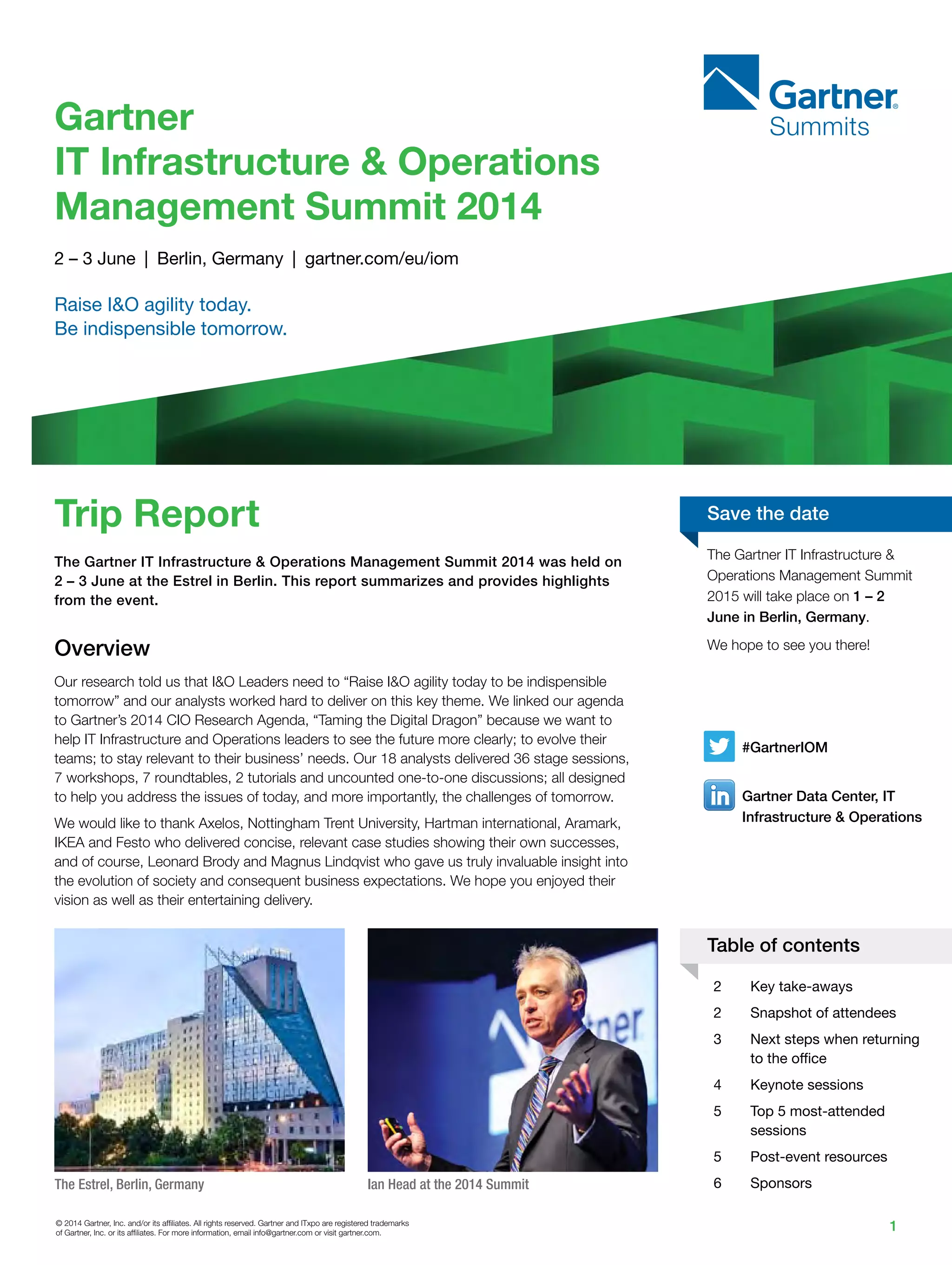
The Gartner IT Infrastructure & Operations Management Summit 2014 was held on
2 – 3 June at the Estrel in Berlin. This report summarizes and provides highlights
from the event.
Overview
Our research told us that I&O Leaders need to “Raise I&O agility today to be indispensible
tomorrow” and our analysts worked hard to deliver on this key theme. We linked our agenda
to Gartner’s 2014 CIO Research Agenda, “Taming the Digital Dragon” because we want to
help IT Infrastructure and Operations leaders to see the future more clearly; to evolve their
teams; to stay relevant to their business’ needs. Our 18 analysts delivered 36 stage sessions,
7 workshops, 7 roundtables, 2 tutorials and uncounted one-to-one discussions; all designed
to help you address the issues of today, and more importantly, the challenges of tomorrow.
We would like to thank Axelos, Nottingham Trent University, Hartman international, Aramark,
IKEA and Festo who delivered concise, relevant case studies showing their own successes,
and of course, Leonard Brody and Magnus Lindqvist who gave us truly invaluable insight into
the evolution of society and consequent business expectations. We hope you enjoyed their
vision as well as their entertaining delivery.
Save the date
Table of contents
The Gartner IT Infrastructure &
Operations Management Summit
2015 will take place on 1 – 2
June in Berlin, Germany.
We hope to see you there!
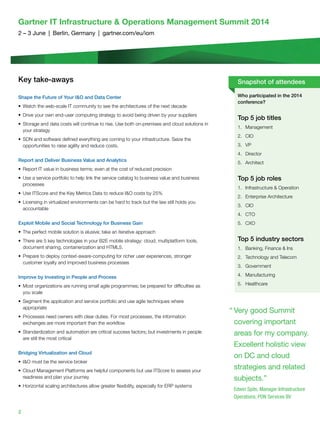
	 2	 Key take-aways
	 2	 Snapshot of attendees
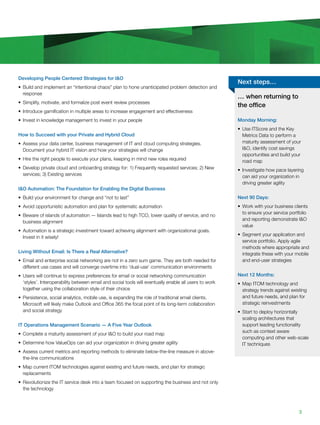
	 3	Next steps when returning
to the office
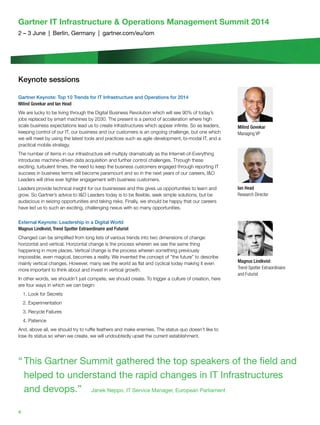
	 4 	 Keynote sessions
	 5	Top 5 most-attended
sessions
	 5	 Post-event resources
	 6 	 SponsorsIan Head at the 2014 SummitThe Estrel, Berlin, Germany
 
#GartnerIOM
 
Gartner Data Center, IT
Infrastructure  Operations
2
Gartner IT Infrastructure  Operations Management Summit 2014
2 – 3 June  |  Berlin, Germany  |  gartner.com/eu/iom
Key take-aways
Shape the Future of Your IO and Data Center
•	 Watch the web-scale IT community to see the architectures of the next decade
•	 Drive your own end-user computing strategy to avoid being driven by your suppliers
•	 Storage and data costs will continue to rise. Use both on-premises and cloud solutions in
your strategy
•	 SDN and software defined everything are coming to your infrastructure. Seize the
opportunities to raise agility and reduce costs.
Report and Deliver Business Value and Analytics
•	 Report IT value in business terms; even at the cost of reduced precision
•	 Use a service portfolio to help link the service catalog to business value and business
processes
•	 Use ITScore and the Key Metrics Data to reduce IO costs by 25%
•	 Licensing in virtualized environments can be hard to track but the law still holds you
accountable
Exploit Mobile and Social Technology for Business Gain
•	 The perfect mobile solution is elusive; take an iterative approach
•	 There are 5 key technologies in your B2E mobile strategy: cloud, multiplatform tools,
document sharing, containerization and HTML5.
•	 Prepare to deploy context-aware-computing for richer user experiences, stronger
customer loyalty and improved business processes
Improve by Investing in People and Process
•	 Most organizations are running small agile programmes; be prepared for difficulties as
you scale
•	 Segment the application and service portfolio and use agile techniques where
appropriate
•	 Processes need owners with clear duties. For most processes, the information
exchanges are more important than the workflow
•	 Standardization and automation are critical success factors; but investments in people
are still the most critical
Bridging Virtualization and Cloud
•	 IO must be the service broker
•	 Cloud Management Platforms are helpful components but use ITScore to assess your
readiness and plan your journey
•	 Horizontal scaling architectures allow greater flexibility, especially for ERP systems
Who participated in the 2014
conference?
Top 5 job titles
1.	Management
2.	CIO
3.	 VP
4.	Director
5.	Architect
Top 5 job roles
1.	 Infrastructure  Operation
2.	 Enterprise Architecture
3.	CIO
4.	CTO
5.	CXO
Top 5 industry sectors
1.	 Banking, Finance  Ins
2.	 Technology and Telecom
3.	Government
4.	Manufacturing
5.	Healthcare
Snapshot of attendees
“	Very good Summit
covering important
areas for my company.
Excellent holistic view
on DC and cloud
strategies and related
subjects.”
Edwin Spits, Manager Infrastructure
Operations, PON Services BV
3
Developing People Centered Strategies for IO
•	 Build and implement an “intentional chaos” plan to hone unanticipated problem detection and
response
•	 Simplify, motivate, and formalize post event review processes
•	 Introduce gamification in multiple areas to increase engagement and effectiveness
•	 Invest in knowledge management to invest in your people
How to Succeed with your Private and Hybrid Cloud
•	 Assess your data center, business management of IT and cloud computing strategies.
Document your hybrid IT vision and how your strategies will change
•	 Hire the right people to execute your plans, keeping in mind new roles required
•	 Develop private cloud and onboarding strategy for: 1) Frequently requested services; 2) New
services; 3) Existing services
IO Automation: The Foundation for Enabling the Digital Business
•	 Build your environment for change and “not to last”
•	 Avoid opportunistic automation and plan for systematic automation
•	 Beware of islands of automation — Islands lead to high TCO, lower quality of service, and no
business alignment
•	 Automation is a strategic investment toward achieving alignment with organizational goals.
Invest in it wisely!
Living Without Email: Is There a Real Alternative?
•	 Email and enterprise social networking are not in a zero sum game. They are both needed for
different use cases and will converge overtime into ‘dual-use’ communication environments
•	 Users will continue to express preferences for email or social networking communication
‘styles’. Interoperability between email and social tools will eventually enable all users to work
together using the collaboration style of their choice
•	 Persistence, social analytics, mobile use, is expanding the role of traditional email clients.
Microsoft will likely make Outlook and Office 365 the focal point of its long-term collaboration
and social strategy
IT Operations Management Scenario — A Five Year Outlook
•	 Complete a maturity assessment of your IO to build your road map
•	 Determine how ValueOps can aid your organization in driving greater agility
•	 Assess current metrics and reporting methods to eliminate below-the-line measure in above-
the-line communications
•	 Map current ITOM technologies against existing and future needs, and plan for strategic
replacements
•	 Revolutionize the IT service desk into a team focused on supporting the business and not only
the technology
… when returning to
the office
Monday Morning:
•	 Use ITScore and the Key
Metrics Data to perform a
maturity assessment of your
IO, identify cost savings
opportunities and build your
road map
•	 Investigate how pace layering
can aid your organization in
driving greater agility
Next 90 Days:
•	 Work with your business clients
to ensure your service portfolio
and reporting demonstrate IO
value
•	 Segment your application and
service portfolio. Apply agile
methods where appropriate and
integrate these with your mobile
and end-user strategies
Next 12 Months:
•	 Map ITOM technology and
strategy trends against existing
and future needs, and plan for
strategic reinvestments
•	 Start to deploy horizontally
scaling architectures that
support leading functionality
such as context aware
computing and other web-scale
IT techniques
Next steps…
4
Gartner IT Infrastructure  Operations Management Summit 2014
2 – 3 June  |  Berlin, Germany  |  gartner.com/eu/iom
Keynote sessions
Gartner Keynote: Top 10 Trends for IT Infrastructure and Operations for 2014
Milind Govekar and Ian Head
We are lucky to be living through the Digital Business Revolution which will see 90% of today’s
jobs replaced by smart machines by 2030. The present is a period of acceleration where high
scale business expectations lead us to create infrastructures which appear infinite. So as leaders,
keeping control of our IT, our business and our customers is an ongoing challenge, but one which
we will meet by using the latest tools and practices such as agile development, bi-modal IT, and a
practical mobile strategy.
The number of items in our infrastructure will multiply dramatically as the Internet-of-Everything
introduces machine-driven data acquisition and further control challenges. Through these
exciting, turbulent times, the need to keep the business customers engaged through reporting IT
success in business terms will become paramount and so in the next years of our careers, IO
Leaders will drive ever tighter engagement with business customers.
Leaders provide technical insight for our businesses and this gives us opportunities to learn and
grow. So Gartner’s advice to IO Leaders today is to be flexible, seek simple solutions, but be
audacious in seizing opportunities and taking risks. Finally, we should be happy that our careers
have led us to such an exciting, challenging nexus with so many opportunities.
External Keynote: Leadership in a Digital World
Magnus Lindkvist, Trend Spotter Extraordinaire and Futurist
Changed can be simplified from long lists of various trends into two dimensions of change:
horizontal and vertical. Horizontal change is the process wherein we see the same thing
happening in more places. Vertical change is the process wherein something previously
impossible, even magical, becomes a reality. We invented the concept of ”the future” to describe
mainly vertical changes. However, many see the world as flat and cyclical today making it even
more important to think about and invest in vertical growth.
In other words, we shouldn’t just compete, we should create. To trigger a culture of creation, here
are four ways in which we can begin:
	 1. Look for Secrets
	 2. Experimentation
	 3. Recycle Failures
	 4. Patience
And, above all, we should try to ruffle feathers and make enemies. The status quo doesn’t like to
lose its status so when we create, we will undoubtedly upset the current establishment.
Milind Govekar
Managing VP
Ian Head
Research Director
Magnus Lindkvist
Trend Spotter Extraordinaire
and Futurist
“	This Gartner Summit gathered the top speakers of the field and
helped to understand the rapid changes in IT Infrastructures
and devops.”  Janek Neppo, IT Service Manager, European Parliament
5
External Keynote: The Great Re-Write —
Exploring the Future of Behaviour, Technology and the Web
Leonard Brody, Business and Technology Visionary
The Main Idea:
•	 The World is changing at an unprecedented historical pace. In essence, we are rewriting the
planet from the ground up
•	 This is being driven by three main forces that have really come to light in the last 5 years:
1. Technological Cost Reduction  2. Changes in Human Behaviour 
3. The Mass Re-Deployment of Capital to back Disrupters rather than incumbents
•	 Two Main Drivers of Growth in the next 5 years will be bringing the next 5 billion people online
and the growth of the Industrial Internet bringing trillions of dumb devices online and engaged
What You Can Do To Stay Relevant in the Re:Write:
•	 After you ask “Why?” you do what you do as a business, ask the greater question which is
“What Am I? And What is the Company’s Higher Purpose?”
•	 Start to rethink the Board of Directors and Top Management of the company by having a formal
Futures Committee and Compensation structure to reward long term innovative thinking
•	 Create an Intelligence Unit in the Business who’s Job it is to know what the internal guts of the
company doesn’t know. Make no decisions without Data Scientists and Intelligence Officers
consulted
•	 Create a partnership with the Entrepreneurial Community to help develop, build and solve
problems (The Hollywood Model)
•	 Ensure you deploy a minimum of 10% of your RD spend to make these things happen. A
full audit of RD spend should be done to ensure there is no new money required to deploy in
these areas. Just better use of old money
•	 To Survive, you must accept you now run two businesses: 1. The Actual Business and
2. The Future of that Business
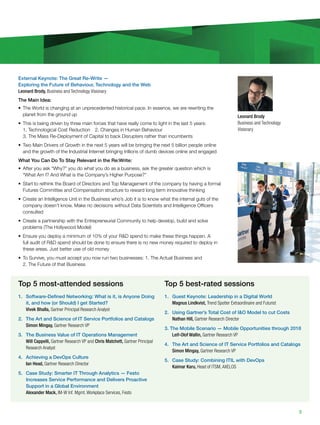
Leonard Brody
Business and Technology
Visionary
Top 5 most-attended sessions
1.	 Software-Defined Networking: What is it, is Anyone Doing
it, and how (or Should) I get Started?
Vivek Bhalla, Gartner Principal Research Analyst
2.	 The Art and Science of IT Service Portfolios and Catalogs
Simon Mingay, Gartner Research VP
3.	 The Business Value of IT Operations Management
Will Cappelli, Gartner Research VP and Chris Matchett, Gartner Principal
Research Analyst
4.	 Achieving a DevOps Culture
Ian Head, Gartner Research Director
5.	 Case Study: Smarter IT Through Analytics — Festo
Increases Service Performance and Delivers Proactive
Support in a Global Environment
Alexander Mack, IM-W Inf. Mgmt. Workplace Services, Festo
Top 5 best-rated sessions
1.	 Guest Keynote: Leadership in a Digital World
Magnus Lindkvist, Trend Spotter Extraordinaire and Futurist
2.	 Using Gartner’s Total Cost of IO Model to cut Costs
Nathan Hill, Gartner Research Director
3. The Mobile Scenario — Mobile Opportunities through 2018
Leif-Olof Wallin, Gartner Research VP
4.	 The Art and Science of IT Service Portfolios and Catalogs
Simon Mingay, Gartner Research VP
5.	 Case Study: Combining ITIL with DevOps
Kaimar Karu, Head of ITSM, AXELOS
6
Gartner IT Infrastructure  Operations Management Summit 2014
2 – 3 June | Berlin, Germany | gartner.com/eu/iom
With Thanks to our Sponsors
Premier Sponsors
Platinum Sponsors
Silver Sponsors
“ Whole experience
is reflected by great
organization. It is a
rare event on which
you can find such a
wealth of significant
topics. Most of all I
like that every topic
is contemporary
and true reflection
of challenges that
lie ahead.”
Zelimir Pecnik,
Head of IT infrastructure mgmt.
and supp, APIS IT
Customizable post-event
worksheet
Take a moment to complete
your own post-event trip report,
a valuable resource for future
reference and a great way to
share with colleagues what you
learned. Click here to access the
trip report worksheet.
Learn more with relevant
research
Want to learn more about the
topics	that	interest	you	most?	
Turn to the end of each session
presentation for a list of related
Gartner research notes. Select
Gartner research is available on
demand at gartner.com.
Post-event resources

Gartner IT Infrastructure & Operations Management Summit 2014 - Trip Report

  • 1.
    1© 2014 Gartner,Inc. and/or its affiliates. All rights reserved. Gartner and ITxpo are registered trademarks of Gartner, Inc. or its affiliates. For more information, email info@gartner.com or visit gartner.com. Raise I&O agility today. Be indispensible tomorrow. Gartner IT Infrastructure & Operations Management Summit 2014 2 – 3 June  |  Berlin, Germany  |  gartner.com/eu/iom Trip Report The Gartner IT Infrastructure & Operations Management Summit 2014 was held on 2 – 3 June at the Estrel in Berlin. This report summarizes and provides highlights from the event. Overview Our research told us that I&O Leaders need to “Raise I&O agility today to be indispensible tomorrow” and our analysts worked hard to deliver on this key theme. We linked our agenda to Gartner’s 2014 CIO Research Agenda, “Taming the Digital Dragon” because we want to help IT Infrastructure and Operations leaders to see the future more clearly; to evolve their teams; to stay relevant to their business’ needs. Our 18 analysts delivered 36 stage sessions, 7 workshops, 7 roundtables, 2 tutorials and uncounted one-to-one discussions; all designed to help you address the issues of today, and more importantly, the challenges of tomorrow. We would like to thank Axelos, Nottingham Trent University, Hartman international, Aramark, IKEA and Festo who delivered concise, relevant case studies showing their own successes, and of course, Leonard Brody and Magnus Lindqvist who gave us truly invaluable insight into the evolution of society and consequent business expectations. We hope you enjoyed their vision as well as their entertaining delivery. Save the date Table of contents The Gartner IT Infrastructure & Operations Management Summit 2015 will take place on 1 – 2 June in Berlin, Germany. We hope to see you there! 2 Key take-aways 2 Snapshot of attendees 3 Next steps when returning to the office 4 Keynote sessions 5 Top 5 most-attended sessions 5 Post-event resources 6 SponsorsIan Head at the 2014 SummitThe Estrel, Berlin, Germany   #GartnerIOM   Gartner Data Center, IT Infrastructure Operations
  • 2.
    2 Gartner IT Infrastructure Operations Management Summit 2014 2 – 3 June  |  Berlin, Germany  |  gartner.com/eu/iom Key take-aways Shape the Future of Your IO and Data Center • Watch the web-scale IT community to see the architectures of the next decade • Drive your own end-user computing strategy to avoid being driven by your suppliers • Storage and data costs will continue to rise. Use both on-premises and cloud solutions in your strategy • SDN and software defined everything are coming to your infrastructure. Seize the opportunities to raise agility and reduce costs. Report and Deliver Business Value and Analytics • Report IT value in business terms; even at the cost of reduced precision • Use a service portfolio to help link the service catalog to business value and business processes • Use ITScore and the Key Metrics Data to reduce IO costs by 25% • Licensing in virtualized environments can be hard to track but the law still holds you accountable Exploit Mobile and Social Technology for Business Gain • The perfect mobile solution is elusive; take an iterative approach • There are 5 key technologies in your B2E mobile strategy: cloud, multiplatform tools, document sharing, containerization and HTML5. • Prepare to deploy context-aware-computing for richer user experiences, stronger customer loyalty and improved business processes Improve by Investing in People and Process • Most organizations are running small agile programmes; be prepared for difficulties as you scale • Segment the application and service portfolio and use agile techniques where appropriate • Processes need owners with clear duties. For most processes, the information exchanges are more important than the workflow • Standardization and automation are critical success factors; but investments in people are still the most critical Bridging Virtualization and Cloud • IO must be the service broker • Cloud Management Platforms are helpful components but use ITScore to assess your readiness and plan your journey • Horizontal scaling architectures allow greater flexibility, especially for ERP systems Who participated in the 2014 conference? Top 5 job titles 1. Management 2. CIO 3. VP 4. Director 5. Architect Top 5 job roles 1. Infrastructure Operation 2. Enterprise Architecture 3. CIO 4. CTO 5. CXO Top 5 industry sectors 1. Banking, Finance Ins 2. Technology and Telecom 3. Government 4. Manufacturing 5. Healthcare Snapshot of attendees “ Very good Summit covering important areas for my company. Excellent holistic view on DC and cloud strategies and related subjects.” Edwin Spits, Manager Infrastructure Operations, PON Services BV
  • 3.
    3 Developing People CenteredStrategies for IO • Build and implement an “intentional chaos” plan to hone unanticipated problem detection and response • Simplify, motivate, and formalize post event review processes • Introduce gamification in multiple areas to increase engagement and effectiveness • Invest in knowledge management to invest in your people How to Succeed with your Private and Hybrid Cloud • Assess your data center, business management of IT and cloud computing strategies. Document your hybrid IT vision and how your strategies will change • Hire the right people to execute your plans, keeping in mind new roles required • Develop private cloud and onboarding strategy for: 1) Frequently requested services; 2) New services; 3) Existing services IO Automation: The Foundation for Enabling the Digital Business • Build your environment for change and “not to last” • Avoid opportunistic automation and plan for systematic automation • Beware of islands of automation — Islands lead to high TCO, lower quality of service, and no business alignment • Automation is a strategic investment toward achieving alignment with organizational goals. Invest in it wisely! Living Without Email: Is There a Real Alternative? • Email and enterprise social networking are not in a zero sum game. They are both needed for different use cases and will converge overtime into ‘dual-use’ communication environments • Users will continue to express preferences for email or social networking communication ‘styles’. Interoperability between email and social tools will eventually enable all users to work together using the collaboration style of their choice • Persistence, social analytics, mobile use, is expanding the role of traditional email clients. Microsoft will likely make Outlook and Office 365 the focal point of its long-term collaboration and social strategy IT Operations Management Scenario — A Five Year Outlook • Complete a maturity assessment of your IO to build your road map • Determine how ValueOps can aid your organization in driving greater agility • Assess current metrics and reporting methods to eliminate below-the-line measure in above- the-line communications • Map current ITOM technologies against existing and future needs, and plan for strategic replacements • Revolutionize the IT service desk into a team focused on supporting the business and not only the technology … when returning to the office Monday Morning: • Use ITScore and the Key Metrics Data to perform a maturity assessment of your IO, identify cost savings opportunities and build your road map • Investigate how pace layering can aid your organization in driving greater agility Next 90 Days: • Work with your business clients to ensure your service portfolio and reporting demonstrate IO value • Segment your application and service portfolio. Apply agile methods where appropriate and integrate these with your mobile and end-user strategies Next 12 Months: • Map ITOM technology and strategy trends against existing and future needs, and plan for strategic reinvestments • Start to deploy horizontally scaling architectures that support leading functionality such as context aware computing and other web-scale IT techniques Next steps…
  • 4.
    4 Gartner IT Infrastructure Operations Management Summit 2014 2 – 3 June  |  Berlin, Germany  |  gartner.com/eu/iom Keynote sessions Gartner Keynote: Top 10 Trends for IT Infrastructure and Operations for 2014 Milind Govekar and Ian Head We are lucky to be living through the Digital Business Revolution which will see 90% of today’s jobs replaced by smart machines by 2030. The present is a period of acceleration where high scale business expectations lead us to create infrastructures which appear infinite. So as leaders, keeping control of our IT, our business and our customers is an ongoing challenge, but one which we will meet by using the latest tools and practices such as agile development, bi-modal IT, and a practical mobile strategy. The number of items in our infrastructure will multiply dramatically as the Internet-of-Everything introduces machine-driven data acquisition and further control challenges. Through these exciting, turbulent times, the need to keep the business customers engaged through reporting IT success in business terms will become paramount and so in the next years of our careers, IO Leaders will drive ever tighter engagement with business customers. Leaders provide technical insight for our businesses and this gives us opportunities to learn and grow. So Gartner’s advice to IO Leaders today is to be flexible, seek simple solutions, but be audacious in seizing opportunities and taking risks. Finally, we should be happy that our careers have led us to such an exciting, challenging nexus with so many opportunities. External Keynote: Leadership in a Digital World Magnus Lindkvist, Trend Spotter Extraordinaire and Futurist Changed can be simplified from long lists of various trends into two dimensions of change: horizontal and vertical. Horizontal change is the process wherein we see the same thing happening in more places. Vertical change is the process wherein something previously impossible, even magical, becomes a reality. We invented the concept of ”the future” to describe mainly vertical changes. However, many see the world as flat and cyclical today making it even more important to think about and invest in vertical growth. In other words, we shouldn’t just compete, we should create. To trigger a culture of creation, here are four ways in which we can begin: 1. Look for Secrets 2. Experimentation 3. Recycle Failures 4. Patience And, above all, we should try to ruffle feathers and make enemies. The status quo doesn’t like to lose its status so when we create, we will undoubtedly upset the current establishment. Milind Govekar Managing VP Ian Head Research Director Magnus Lindkvist Trend Spotter Extraordinaire and Futurist “ This Gartner Summit gathered the top speakers of the field and helped to understand the rapid changes in IT Infrastructures and devops.”  Janek Neppo, IT Service Manager, European Parliament
  • 5.
    5 External Keynote: TheGreat Re-Write — Exploring the Future of Behaviour, Technology and the Web Leonard Brody, Business and Technology Visionary The Main Idea: • The World is changing at an unprecedented historical pace. In essence, we are rewriting the planet from the ground up • This is being driven by three main forces that have really come to light in the last 5 years: 1. Technological Cost Reduction  2. Changes in Human Behaviour  3. The Mass Re-Deployment of Capital to back Disrupters rather than incumbents • Two Main Drivers of Growth in the next 5 years will be bringing the next 5 billion people online and the growth of the Industrial Internet bringing trillions of dumb devices online and engaged What You Can Do To Stay Relevant in the Re:Write: • After you ask “Why?” you do what you do as a business, ask the greater question which is “What Am I? And What is the Company’s Higher Purpose?” • Start to rethink the Board of Directors and Top Management of the company by having a formal Futures Committee and Compensation structure to reward long term innovative thinking • Create an Intelligence Unit in the Business who’s Job it is to know what the internal guts of the company doesn’t know. Make no decisions without Data Scientists and Intelligence Officers consulted • Create a partnership with the Entrepreneurial Community to help develop, build and solve problems (The Hollywood Model) • Ensure you deploy a minimum of 10% of your RD spend to make these things happen. A full audit of RD spend should be done to ensure there is no new money required to deploy in these areas. Just better use of old money • To Survive, you must accept you now run two businesses: 1. The Actual Business and 2. The Future of that Business Leonard Brody Business and Technology Visionary Top 5 most-attended sessions 1. Software-Defined Networking: What is it, is Anyone Doing it, and how (or Should) I get Started? Vivek Bhalla, Gartner Principal Research Analyst 2. The Art and Science of IT Service Portfolios and Catalogs Simon Mingay, Gartner Research VP 3. The Business Value of IT Operations Management Will Cappelli, Gartner Research VP and Chris Matchett, Gartner Principal Research Analyst 4. Achieving a DevOps Culture Ian Head, Gartner Research Director 5. Case Study: Smarter IT Through Analytics — Festo Increases Service Performance and Delivers Proactive Support in a Global Environment Alexander Mack, IM-W Inf. Mgmt. Workplace Services, Festo Top 5 best-rated sessions 1. Guest Keynote: Leadership in a Digital World Magnus Lindkvist, Trend Spotter Extraordinaire and Futurist 2. Using Gartner’s Total Cost of IO Model to cut Costs Nathan Hill, Gartner Research Director 3. The Mobile Scenario — Mobile Opportunities through 2018 Leif-Olof Wallin, Gartner Research VP 4. The Art and Science of IT Service Portfolios and Catalogs Simon Mingay, Gartner Research VP 5. Case Study: Combining ITIL with DevOps Kaimar Karu, Head of ITSM, AXELOS
  • 6.
    6 Gartner IT Infrastructure Operations Management Summit 2014 2 – 3 June | Berlin, Germany | gartner.com/eu/iom With Thanks to our Sponsors Premier Sponsors Platinum Sponsors Silver Sponsors “ Whole experience is reflected by great organization. It is a rare event on which you can find such a wealth of significant topics. Most of all I like that every topic is contemporary and true reflection of challenges that lie ahead.” Zelimir Pecnik, Head of IT infrastructure mgmt. and supp, APIS IT Customizable post-event worksheet Take a moment to complete your own post-event trip report, a valuable resource for future reference and a great way to share with colleagues what you learned. Click here to access the trip report worksheet. Learn more with relevant research Want to learn more about the topics that interest you most? Turn to the end of each session presentation for a list of related Gartner research notes. Select Gartner research is available on demand at gartner.com. Post-event resources