Implementation of LSB Image Steganography
System using Edge detection, LZW compression
and Hybrid Encryption Methods
S. N. Rekha1
, Y. Manjula2
, M.Z. Kurian 3
PG Student (DE) Dept. of Electronics & Communication Engineering, Sri Siddhartha Institute Of Technology, Tumakuru,
Karnataka, India.
Assistant Professor, Dept. of Electronics & Communication Engineering, Sri Siddhartha Institute Of technology, Tumakuru,
Karnataka, India.
HOD, Dept. of Electronics & Communication Engineering, Sri Siddhartha Institute Of Technology, Tumakuru, Karnataka, India.
Abstract— Rapid growth of steganographic and cryptographic
techniques has a great attention in digital era. Every one need
privacy in this internet world. As number of users increases
secret communication becomes more and more important.
Transposal of data size and file quality through communication
channel plays a major challenge for steganographic technique.
Least significant bit is one of the simple and major
steganography techniques in spatial domain, insertion of data at
least significant bits has high visual quality but not robust against
distortion hence not well secured. In the proposed method, the
secret data is encrypted by using Hybrid encryption method i.e.
AES[Advance Encryption Standard] and ECC[Elliptic Curve
Cryptography] method to safe guard the secret communication.
Then, Lempel Ziv Welch technique compresses the required
amount of data to represent information quantity. Then Edge
detection technique detects the sharp feature of image to hide
secret data. The main feature of proposed method is to give
better security by using the concepts of cryptography and Image
steganography. Even though the adversaries have the knowledge
of secret information fails to extract the correct information.
Improvement may seen by comparing the results of base paper
and proposed method. Better encryption methods are considered
to provide better security along with steganography.
Keywords— Steganography, Cryptography, Hybrid encryption,
AES, ECC, LZW compression and Edge detection.
I. INTRODUCTION
In this internet era, as fast as the new technology emerges
number of users are increases at the same time eve droppers
are also increases. Hardware attacks, software attacks are
some of the threats arise during data transmission therefore
data integrity becomes more important. The demand increases
in the field of steganography and cryptography to provide
better security for secret information. Steganography is a
Greek word which means covered writing where it
concentrates on existence of message secret. Image
steganography is the way of hiding the secret data in digital
images. Cryptography is a Greek word which means hidden
writing where it concentrates on contents of message secret.
Both methods provide secret communication between sender
and receiver in the presence of adversaries.
Combining of two or more encryption methods is nothing
but hybrid encryption. Both private key and public key
cryptography is used for converting secret image from
readable into unreadable format with a good lossless
compression technique i.e. LZW and to embed the encrypted
image into the cover file better steganography technique i.e.
Canny edge detection technique is used.
After embedding large amount of data in to cover image
some changes occurred like colour, sharpness, smoothness.
Authentication of secret data, quality of stego image,
embedding capacity of cover image, robustness is some of the
factors considered to evaluate image steganography process.
II. LITERATURE SURVEY
Archana T. Chawhan, et al.,[1] presented a secure
steganography technique which includes three methods. First,
encryption is used to encode the secret data. Second, LZW
compression is used to compress the data and Third, Knight
Tour algorithm is used to generate the sequence of secret bit
stream. On comparing the results ECC technique provide more
performance and security than AES technique.
Nadeem Akhtar, et al.,[2] proposed two schemes of bit
inversion technique. In first scheme, some lsb pixels of cover
image is inverted and four patterns are checked if there is a
particular bit pattern then less number of bits is modified. In
second scheme, eight patterns are checked to modify less
number of bits compare to plain lsb method. Bits are randomly
ISBN-13: 978-1535448697
www.iaetsd.in
Proceedings of ICRMET-2016
©IAETSD 201627
distributed in cover and message image results small and large
improvement in psnr value.
Saurabh, et al.,[7] presented a new approach that contains hash
function and canny edge detection method. Firstly, canny
method is used for edge detection which detects optimal edge
i.e. good detection, localization and minimal response of cover
image. Secondly, Hash function generates a pattern that is
used to embed text data in image. High quality of stego image
is achieved. In future work can be extended to audio, video
etc.
III. PROPOSED SYSTEM
The architecture of the proposed system is designed as shown
in the Figureure. It has two phases Encoding and Decoding.
The Encoding process includes Encryption, Compression,
Edge detection and Embedding by LSB method. Decoding
process includes Extraction or de-embedding, Decompression
and Decryption.
Sender
Receiver
Figure. Proposed system design.
In the encoding process secret image is selected. If selected
secret image is colour then colour image is converted into gray
scale image. Secret image is encoded by using Advanced
encryption standard algorithm to obtain AES encrypted image.
By taking input information of AES encrypted image secret
data is again encoded by Elliptic curve cryptography technique
to get ECC encrypted image. Here plain text is converted into
cipher text.
To reduce the size encrypted image is compressed by Lempel
Ziv Welch compression technique to get compressed image.
Select the cover image, at large change in intensity of the
cover image edge pixels are identified by canny edge detection
technique then Compressed image is embed into the edge
detected cover image by least significant bit insertion method
to get stego image.
In the decoding process, stego image is extracted or de-embed
by least significant bit insertion method. Extracted image is
decompressed by Lempel Ziv Welch to get decompressed
image. This decompressed image undergoes ECC decryption
and then AES decryption to get back the secret image. Here
cipher text is converted into plain text.
The sending process consists of following procedures:
1. Encryption – In embedding phase, the image is encrypted
using different Encryption algorithms. Encryption is the
process of encoding the secret message where only authorized
persons can able to read even in the presence of third parties.
In this process the content of secret message referred as plain
text and by using different encryption algorithm cipher text is
generated and after decryption the message can be read.
Double encryption provides double security for secret data.
i.AES (Advanced Encryption Standard) Algorithm: is based
on the principle of substitution permutation network. It is used
for encryption of electronic data. This algorithm is flexible and
supports fixed key size of 128, 192 and 256 bits. However,
AES as a fixed block size and key size with minimum of 128
bits and maximum of 256 bits. Data length of 128 bit is
divided into four basic operation blocks. These blocks
arranged as a 4x4 column matrix of bytes i.e. called the state.
For full encryption, the data is passed through number of
rounds Nr (Nr=10, 12, 14).
In AES, key size specifies the number of repititions of
transformation rounds where plain text is converted in to
cipher text.
128 bit keys has 10 cycles of repetition
192 bit keys has 12 cycles of repetition
256 bit keys have 14 cycles of repetition.
Each round as many steps, in that four step are similar but
stages are different and encryption key depend itself on steps.
By applying the reverse rounds to transform to obtain original
plain text from cipher text encryption key is used. For each
round separate 128bit key is required in AES. Some of the
round steps are
Sub byte step
Shift row step
Mix column step
Add round key step
a. Sub byte step: In this step, each byte in the state is replaced
with its entry in a fixed 8 bit look up table. S; bij= s(aij)
Figure. Sub byte transformation
This operation provides non linearity from multiplicative
inverse over GF S-box is derived.
b. Shift row steps: In this step, each row bytes is cyclically
shifted from left. Each byte places are differing from each
row. By offset each row byte shifts cyclically. The main future
ISBN-13: 978-1535448697
www.iaetsd.in
Proceedings of ICRMET-2016
©IAETSD 201628
of this step is to avoid the columns being linearly independent.
Four independent block ciphers are degenerated by AES.
Figure. Shift row operation
c. Mix column Step: Fixed polynomial c(x) is multiplied with
each column of the state. It takes 4 bytes as input and 4 bytes
as output and all four bytes are affected by each input bytes.
This operation provides diffusion.
Figure. Mix column operation
d. Add round key Step: In this step, using xor operation bytes
of sub key round is combined with each byte of the state. Each
state has same size as sub key.
Figure. Add round key operation
ii.ECC (Elliptic Curve Cryptography): An Elliptic Curve
Cryptography (ECC) technique is an algebraic structure of
elliptic curves over finite fields where public key cryptography
is used. In prime case, field is defined by P and binary case,
field is defined by m and f. The elliptic curve is defined by the
constants a and b. Then cyclic subgroup is defined by its
generator point G.
Figure. Elliptic curve
It is also known as public key cryptography. The equation of
an elliptic curve is given as y2
=x3
+ax+b.
Key generation of both public key and private key is very
important. The sender will encrypt the message with public
key receiver and private key is decrypted by receiver.
To generate public key Q=d*p equation is used where
d=random number selected with on the range of 1 to n-1.
P= point on the curve
Q is the public key
d is the private key
2. Compression:- Compression method is the process
minimizing the size of the message with error free approach.
LZW is the lossless data compression technique for many
image file formats like GIF and TIFF. It is reffered as
dictionary based or substitutional encoding algorithm. LZW
coding uses fixed length code for variable sequence length. To
replace the repetitive successive characters with binary code,
dictionary table is created and table is sent to receiver side to
extract the original secret message. Decoding of LZW data is
reverse process of LZW encoding.
Amount of reducing extraneous information in an image is
known as differencing. In images adjacent pixels have slight
vary in value. We can replace the value of pixel by
differencing the pixel and adjacent pixe,l we reduce the
amount of information stored. For 8 bit gray scale images
value of pixels differenced themselves. Differencing is applied
across scan lines in horizontal plane then vertical plane. Using
LZW method differenced image is compressed more
effectively.
3. Edge detection:- It is a fundamental tool to extract and
detects the sharp feature of image at particular areas. It focuses
on the detection of points at which the brightness of an image
changes sharply, smoothly, formally with discontinuities. At
discontinuities, set of curve line segments termed as edge.
Identifying the problem of discontinuities in single dimension
signals is called step detection. Identifying the problem of
discontinuities overtime is called change detection.
ISBN-13: 978-1535448697
www.iaetsd.in
Proceedings of ICRMET-2016
©IAETSD 201629
Different types of edge detectors are: Sobles Edge Detector,
Prewitt Edge Detector, Canny Edge Detector and Zero
crossing Detectors[13].
Canny edge detector is an operator that use multistage
algorithm to identify wide range of edges in images. These
techniques extract structural information which reduces the
amount of data to be processed. Some criteria includes in this
method are
1. It detects the edges with very low error rate.
2. Operator which detects the edge point must localize on edge
center accurately.
3. Only once edge can be marked in the given image to avoid
false edges.
These needs can be achieved by using calculus of variations
where it optimizes the given function. It provide good and
reliable detection.
4. Embedding Process:- In this step encoding of image is
carried out to hide and protect the secret image inside the
cover image. The sender
uses some techniques to encode and compress the data and at
large change in intensity of the cover image edge pixels are
identified by canny edge detection technique. By least
significant bit insertion method secret image is embed into the
cover image.
The receiving process consists of following procedures:
1. Extraction Process:- In this step decoding of image is
carried out to retrieve the secret image from the stego image.
Therefore, procedure is required to extract the content of the
message. As same as the sender side first extract the content of
image by least significant bit de-embedding then decompress
the data with LZW technique. Then decrypt the secret data by
different extracting algorithms i.e. ECC decryption and AES
decryption. At the end cipher text is converted into plain text.
2. Decompression:- Extracted image is decompressed by using
Lempel Ziv Welch technique. It is the exact reverse process of
LZW compression.
3. Decryption:-To revealed secret image decompressed image
is decrypted by Elliptic Curve Cryptography decryption
algorithm again the ECC decrypted image is decrypted by
Advance encryption standard decryption algorithm. AES and
ECC Decryption is the exact reverse process of ECC and AES
Encryption. By this extracting algorithm cipher text is
converted in to plain text.
IV.SYSTEM IMPLEMENTATION
AES Encryption: is one of the cryptographic techniques. It is
also known as symmetric key algorithm. Private key is used
to encode and decode the secret image. AES operates on state
with fixed Size of 128 bits and different key length.
Depending on size of key number of repetition of
transformation rounds are decided to convert plain into cipher
text.
Figure: flow chart of AES Encryption
ECC Encryption: is also known as asymmetric key
algorithm. In finite fields ECC is based on elliptic curves of
algebraic structure. Key size is small when compare to other
techniques. It can able to compute point multiplication. Input
image information is entered to encrypt the secret data.
ISBN-13: 978-1535448697
www.iaetsd.in
Proceedings of ICRMET-2016
©IAETSD 201630
Figure: flow chart of ECC Encryption
V.RESULTS
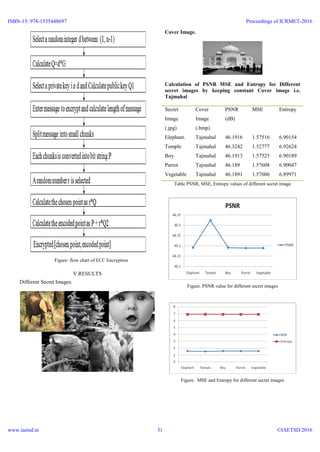
Different Secret Images.
Cover Image.
Calculation of PSNR MSE and Entropy for Different
secret images by keeping constant Cover image i.e.
Tajmahal
Secret
Image
(.jpg)
Cover
Image
(.bmp)
PSNR
(dB)
MSE Entropy
Elephant. Tajmahal 46.1916 1.57516 6.90154
Temple Tajmahal 46.3242 1.52777 6.92624
Boy Tajmahal 46.1913 1.57525 6.90189
Parrot Tajmahal 46.189 1.57608 6.90047
Vegetable Tajmahal 46.1891 1.57606 6.89971
Table PSNR, MSE, Entropy values of different secret image
Figure. PSNR value for different secret images
Figure. MSE and Entropy for different secret images
ISBN-13: 978-1535448697
www.iaetsd.in
Proceedings of ICRMET-2016
©IAETSD 201631
Simulated PSNR value for different Cover Images
Sl.
No.
Cover Image Secret
image of
size (.jpg)
[150*200]
PSNR[dB]
1. Lena(.bmp) 42.56
2. Baboon(.bmp) 41.9095
3. Pepper(.bmp) 42.4724
Table: Simulated PSNR value for different cover image.
V.CONCLUSION
In this paper, a new lsb image steganography system
using Edge detection and hybrid encryption is designed and
implemented. The secret image is firstly encoded by using
AES and ECC encryption method to secure and safeguard the
secret image. Then LZW technique compresses the secret data
to reduce information quantity. Then by using Edge detection
technique, edges are detected and secret image is embedding
in the cover image to get stego image.
Secret image is extracted from stego image by LSB
de-embedding; again the image is decompressed by LZW
decompression technique. At last image is decoded by ECC
decryption method to get ECC decrypted image. Again
decrypted image is decoded by AES Encryption method to
obtain secret image.
From the results better PSNR is obtained and data is
more secured with high quality.
References
1. Archana T Chawan, et al., “A high secure and robust lsb
image steganography using Hybrid Encryption, LZW
compression and Knight tour algorithm” Proceeding of
International Conference on Research Methods in
Engineering and Technology, ISSN: 978-151-1885-033, June
2015.
2. Nadeem Akhtar, et al., “Inverted LSB Steganography”,
International Conference on Issue and Challenges in
Intelligent Computing Techniques(ICICT), 978-1-4799-2900-
9/14@2014 IEEE.
3. B.Debiprasad, et al., “A Novel secure image steganography
method based on chaos theory in spatial domain”
International Journal of Security Privacy and Trust
Management (IJSPTM) Volume 3, No 1, February 2014.
4. Shrutika suri, et al., “Comparative analysis of steganography
for Coloured images” International Journal of Computer
Science and Engineering (IJCSE), Volume 2, Issue 4, E-ISSN
.2347-2693, April 2014.
5. P.M.Sivaraja and E.Baburaj, “Information hiding scheme for
digital images based on Genetic algorithm” Indian journal of
applied research, Volume 4, Issue 6, ISSN:2249-555X, June
2014.
6. K.S.Arora and G.Gandhi, “Enhanced steganography using K-
matrix” Research Paper International Journal of Computer
Science and Engineering (IJCSE), Volume 2, Issue 6, E-
ISSN:2347-2693, June 2014.
7. Saurabh Singh and Ashutosh Datar, “Improved hash based
approach for secure color image steganography using canny
edge detection method” by, International Journal of Computer
Science and Network Security(IJCSNS), Volume.14 no.7, July
2014.
8. Y.P.Zhang, et al., “Research on embedding capacity and
embedding efficiency of information hiding based on digital
images” International Journal of Intelligence science,
2013,3,77-85 April 2013.
9. J.J.Wang, et al., “An Adaptive matrix embedding technique
for binary hiding with an efficient LIAE algorithm” WSEAS
Transaction on Signal Processing, ISSN: 2224-3488, Issue 2,
Volume 8, April 2012.
ISBN-13: 978-1535448697
www.iaetsd.in
Proceedings of ICRMET-2016
©IAETSD 201632

Iaetsd implementation of lsb image steganography system using edge detection

  • 1.
    Implementation of LSBImage Steganography System using Edge detection, LZW compression and Hybrid Encryption Methods S. N. Rekha1 , Y. Manjula2 , M.Z. Kurian 3 PG Student (DE) Dept. of Electronics & Communication Engineering, Sri Siddhartha Institute Of Technology, Tumakuru, Karnataka, India. Assistant Professor, Dept. of Electronics & Communication Engineering, Sri Siddhartha Institute Of technology, Tumakuru, Karnataka, India. HOD, Dept. of Electronics & Communication Engineering, Sri Siddhartha Institute Of Technology, Tumakuru, Karnataka, India. Abstract— Rapid growth of steganographic and cryptographic techniques has a great attention in digital era. Every one need privacy in this internet world. As number of users increases secret communication becomes more and more important. Transposal of data size and file quality through communication channel plays a major challenge for steganographic technique. Least significant bit is one of the simple and major steganography techniques in spatial domain, insertion of data at least significant bits has high visual quality but not robust against distortion hence not well secured. In the proposed method, the secret data is encrypted by using Hybrid encryption method i.e. AES[Advance Encryption Standard] and ECC[Elliptic Curve Cryptography] method to safe guard the secret communication. Then, Lempel Ziv Welch technique compresses the required amount of data to represent information quantity. Then Edge detection technique detects the sharp feature of image to hide secret data. The main feature of proposed method is to give better security by using the concepts of cryptography and Image steganography. Even though the adversaries have the knowledge of secret information fails to extract the correct information. Improvement may seen by comparing the results of base paper and proposed method. Better encryption methods are considered to provide better security along with steganography. Keywords— Steganography, Cryptography, Hybrid encryption, AES, ECC, LZW compression and Edge detection. I. INTRODUCTION In this internet era, as fast as the new technology emerges number of users are increases at the same time eve droppers are also increases. Hardware attacks, software attacks are some of the threats arise during data transmission therefore data integrity becomes more important. The demand increases in the field of steganography and cryptography to provide better security for secret information. Steganography is a Greek word which means covered writing where it concentrates on existence of message secret. Image steganography is the way of hiding the secret data in digital images. Cryptography is a Greek word which means hidden writing where it concentrates on contents of message secret. Both methods provide secret communication between sender and receiver in the presence of adversaries. Combining of two or more encryption methods is nothing but hybrid encryption. Both private key and public key cryptography is used for converting secret image from readable into unreadable format with a good lossless compression technique i.e. LZW and to embed the encrypted image into the cover file better steganography technique i.e. Canny edge detection technique is used. After embedding large amount of data in to cover image some changes occurred like colour, sharpness, smoothness. Authentication of secret data, quality of stego image, embedding capacity of cover image, robustness is some of the factors considered to evaluate image steganography process. II. LITERATURE SURVEY Archana T. Chawhan, et al.,[1] presented a secure steganography technique which includes three methods. First, encryption is used to encode the secret data. Second, LZW compression is used to compress the data and Third, Knight Tour algorithm is used to generate the sequence of secret bit stream. On comparing the results ECC technique provide more performance and security than AES technique. Nadeem Akhtar, et al.,[2] proposed two schemes of bit inversion technique. In first scheme, some lsb pixels of cover image is inverted and four patterns are checked if there is a particular bit pattern then less number of bits is modified. In second scheme, eight patterns are checked to modify less number of bits compare to plain lsb method. Bits are randomly ISBN-13: 978-1535448697 www.iaetsd.in Proceedings of ICRMET-2016 ©IAETSD 201627
  • 2.
    distributed in coverand message image results small and large improvement in psnr value. Saurabh, et al.,[7] presented a new approach that contains hash function and canny edge detection method. Firstly, canny method is used for edge detection which detects optimal edge i.e. good detection, localization and minimal response of cover image. Secondly, Hash function generates a pattern that is used to embed text data in image. High quality of stego image is achieved. In future work can be extended to audio, video etc. III. PROPOSED SYSTEM The architecture of the proposed system is designed as shown in the Figureure. It has two phases Encoding and Decoding. The Encoding process includes Encryption, Compression, Edge detection and Embedding by LSB method. Decoding process includes Extraction or de-embedding, Decompression and Decryption. Sender Receiver Figure. Proposed system design. In the encoding process secret image is selected. If selected secret image is colour then colour image is converted into gray scale image. Secret image is encoded by using Advanced encryption standard algorithm to obtain AES encrypted image. By taking input information of AES encrypted image secret data is again encoded by Elliptic curve cryptography technique to get ECC encrypted image. Here plain text is converted into cipher text. To reduce the size encrypted image is compressed by Lempel Ziv Welch compression technique to get compressed image. Select the cover image, at large change in intensity of the cover image edge pixels are identified by canny edge detection technique then Compressed image is embed into the edge detected cover image by least significant bit insertion method to get stego image. In the decoding process, stego image is extracted or de-embed by least significant bit insertion method. Extracted image is decompressed by Lempel Ziv Welch to get decompressed image. This decompressed image undergoes ECC decryption and then AES decryption to get back the secret image. Here cipher text is converted into plain text. The sending process consists of following procedures: 1. Encryption – In embedding phase, the image is encrypted using different Encryption algorithms. Encryption is the process of encoding the secret message where only authorized persons can able to read even in the presence of third parties. In this process the content of secret message referred as plain text and by using different encryption algorithm cipher text is generated and after decryption the message can be read. Double encryption provides double security for secret data. i.AES (Advanced Encryption Standard) Algorithm: is based on the principle of substitution permutation network. It is used for encryption of electronic data. This algorithm is flexible and supports fixed key size of 128, 192 and 256 bits. However, AES as a fixed block size and key size with minimum of 128 bits and maximum of 256 bits. Data length of 128 bit is divided into four basic operation blocks. These blocks arranged as a 4x4 column matrix of bytes i.e. called the state. For full encryption, the data is passed through number of rounds Nr (Nr=10, 12, 14). In AES, key size specifies the number of repititions of transformation rounds where plain text is converted in to cipher text. 128 bit keys has 10 cycles of repetition 192 bit keys has 12 cycles of repetition 256 bit keys have 14 cycles of repetition. Each round as many steps, in that four step are similar but stages are different and encryption key depend itself on steps. By applying the reverse rounds to transform to obtain original plain text from cipher text encryption key is used. For each round separate 128bit key is required in AES. Some of the round steps are Sub byte step Shift row step Mix column step Add round key step a. Sub byte step: In this step, each byte in the state is replaced with its entry in a fixed 8 bit look up table. S; bij= s(aij) Figure. Sub byte transformation This operation provides non linearity from multiplicative inverse over GF S-box is derived. b. Shift row steps: In this step, each row bytes is cyclically shifted from left. Each byte places are differing from each row. By offset each row byte shifts cyclically. The main future ISBN-13: 978-1535448697 www.iaetsd.in Proceedings of ICRMET-2016 ©IAETSD 201628
  • 3.
    of this stepis to avoid the columns being linearly independent. Four independent block ciphers are degenerated by AES. Figure. Shift row operation c. Mix column Step: Fixed polynomial c(x) is multiplied with each column of the state. It takes 4 bytes as input and 4 bytes as output and all four bytes are affected by each input bytes. This operation provides diffusion. Figure. Mix column operation d. Add round key Step: In this step, using xor operation bytes of sub key round is combined with each byte of the state. Each state has same size as sub key. Figure. Add round key operation ii.ECC (Elliptic Curve Cryptography): An Elliptic Curve Cryptography (ECC) technique is an algebraic structure of elliptic curves over finite fields where public key cryptography is used. In prime case, field is defined by P and binary case, field is defined by m and f. The elliptic curve is defined by the constants a and b. Then cyclic subgroup is defined by its generator point G. Figure. Elliptic curve It is also known as public key cryptography. The equation of an elliptic curve is given as y2 =x3 +ax+b. Key generation of both public key and private key is very important. The sender will encrypt the message with public key receiver and private key is decrypted by receiver. To generate public key Q=d*p equation is used where d=random number selected with on the range of 1 to n-1. P= point on the curve Q is the public key d is the private key 2. Compression:- Compression method is the process minimizing the size of the message with error free approach. LZW is the lossless data compression technique for many image file formats like GIF and TIFF. It is reffered as dictionary based or substitutional encoding algorithm. LZW coding uses fixed length code for variable sequence length. To replace the repetitive successive characters with binary code, dictionary table is created and table is sent to receiver side to extract the original secret message. Decoding of LZW data is reverse process of LZW encoding. Amount of reducing extraneous information in an image is known as differencing. In images adjacent pixels have slight vary in value. We can replace the value of pixel by differencing the pixel and adjacent pixe,l we reduce the amount of information stored. For 8 bit gray scale images value of pixels differenced themselves. Differencing is applied across scan lines in horizontal plane then vertical plane. Using LZW method differenced image is compressed more effectively. 3. Edge detection:- It is a fundamental tool to extract and detects the sharp feature of image at particular areas. It focuses on the detection of points at which the brightness of an image changes sharply, smoothly, formally with discontinuities. At discontinuities, set of curve line segments termed as edge. Identifying the problem of discontinuities in single dimension signals is called step detection. Identifying the problem of discontinuities overtime is called change detection. ISBN-13: 978-1535448697 www.iaetsd.in Proceedings of ICRMET-2016 ©IAETSD 201629
  • 4.
    Different types ofedge detectors are: Sobles Edge Detector, Prewitt Edge Detector, Canny Edge Detector and Zero crossing Detectors[13]. Canny edge detector is an operator that use multistage algorithm to identify wide range of edges in images. These techniques extract structural information which reduces the amount of data to be processed. Some criteria includes in this method are 1. It detects the edges with very low error rate. 2. Operator which detects the edge point must localize on edge center accurately. 3. Only once edge can be marked in the given image to avoid false edges. These needs can be achieved by using calculus of variations where it optimizes the given function. It provide good and reliable detection. 4. Embedding Process:- In this step encoding of image is carried out to hide and protect the secret image inside the cover image. The sender uses some techniques to encode and compress the data and at large change in intensity of the cover image edge pixels are identified by canny edge detection technique. By least significant bit insertion method secret image is embed into the cover image. The receiving process consists of following procedures: 1. Extraction Process:- In this step decoding of image is carried out to retrieve the secret image from the stego image. Therefore, procedure is required to extract the content of the message. As same as the sender side first extract the content of image by least significant bit de-embedding then decompress the data with LZW technique. Then decrypt the secret data by different extracting algorithms i.e. ECC decryption and AES decryption. At the end cipher text is converted into plain text. 2. Decompression:- Extracted image is decompressed by using Lempel Ziv Welch technique. It is the exact reverse process of LZW compression. 3. Decryption:-To revealed secret image decompressed image is decrypted by Elliptic Curve Cryptography decryption algorithm again the ECC decrypted image is decrypted by Advance encryption standard decryption algorithm. AES and ECC Decryption is the exact reverse process of ECC and AES Encryption. By this extracting algorithm cipher text is converted in to plain text. IV.SYSTEM IMPLEMENTATION AES Encryption: is one of the cryptographic techniques. It is also known as symmetric key algorithm. Private key is used to encode and decode the secret image. AES operates on state with fixed Size of 128 bits and different key length. Depending on size of key number of repetition of transformation rounds are decided to convert plain into cipher text. Figure: flow chart of AES Encryption ECC Encryption: is also known as asymmetric key algorithm. In finite fields ECC is based on elliptic curves of algebraic structure. Key size is small when compare to other techniques. It can able to compute point multiplication. Input image information is entered to encrypt the secret data. ISBN-13: 978-1535448697 www.iaetsd.in Proceedings of ICRMET-2016 ©IAETSD 201630
  • 5.
    Figure: flow chartof ECC Encryption V.RESULTS Different Secret Images. Cover Image. Calculation of PSNR MSE and Entropy for Different secret images by keeping constant Cover image i.e. Tajmahal Secret Image (.jpg) Cover Image (.bmp) PSNR (dB) MSE Entropy Elephant. Tajmahal 46.1916 1.57516 6.90154 Temple Tajmahal 46.3242 1.52777 6.92624 Boy Tajmahal 46.1913 1.57525 6.90189 Parrot Tajmahal 46.189 1.57608 6.90047 Vegetable Tajmahal 46.1891 1.57606 6.89971 Table PSNR, MSE, Entropy values of different secret image Figure. PSNR value for different secret images Figure. MSE and Entropy for different secret images ISBN-13: 978-1535448697 www.iaetsd.in Proceedings of ICRMET-2016 ©IAETSD 201631
  • 6.
    Simulated PSNR valuefor different Cover Images Sl. No. Cover Image Secret image of size (.jpg) [150*200] PSNR[dB] 1. Lena(.bmp) 42.56 2. Baboon(.bmp) 41.9095 3. Pepper(.bmp) 42.4724 Table: Simulated PSNR value for different cover image. V.CONCLUSION In this paper, a new lsb image steganography system using Edge detection and hybrid encryption is designed and implemented. The secret image is firstly encoded by using AES and ECC encryption method to secure and safeguard the secret image. Then LZW technique compresses the secret data to reduce information quantity. Then by using Edge detection technique, edges are detected and secret image is embedding in the cover image to get stego image. Secret image is extracted from stego image by LSB de-embedding; again the image is decompressed by LZW decompression technique. At last image is decoded by ECC decryption method to get ECC decrypted image. Again decrypted image is decoded by AES Encryption method to obtain secret image. From the results better PSNR is obtained and data is more secured with high quality. References 1. Archana T Chawan, et al., “A high secure and robust lsb image steganography using Hybrid Encryption, LZW compression and Knight tour algorithm” Proceeding of International Conference on Research Methods in Engineering and Technology, ISSN: 978-151-1885-033, June 2015. 2. Nadeem Akhtar, et al., “Inverted LSB Steganography”, International Conference on Issue and Challenges in Intelligent Computing Techniques(ICICT), 978-1-4799-2900- 9/14@2014 IEEE. 3. B.Debiprasad, et al., “A Novel secure image steganography method based on chaos theory in spatial domain” International Journal of Security Privacy and Trust Management (IJSPTM) Volume 3, No 1, February 2014. 4. Shrutika suri, et al., “Comparative analysis of steganography for Coloured images” International Journal of Computer Science and Engineering (IJCSE), Volume 2, Issue 4, E-ISSN .2347-2693, April 2014. 5. P.M.Sivaraja and E.Baburaj, “Information hiding scheme for digital images based on Genetic algorithm” Indian journal of applied research, Volume 4, Issue 6, ISSN:2249-555X, June 2014. 6. K.S.Arora and G.Gandhi, “Enhanced steganography using K- matrix” Research Paper International Journal of Computer Science and Engineering (IJCSE), Volume 2, Issue 6, E- ISSN:2347-2693, June 2014. 7. Saurabh Singh and Ashutosh Datar, “Improved hash based approach for secure color image steganography using canny edge detection method” by, International Journal of Computer Science and Network Security(IJCSNS), Volume.14 no.7, July 2014. 8. Y.P.Zhang, et al., “Research on embedding capacity and embedding efficiency of information hiding based on digital images” International Journal of Intelligence science, 2013,3,77-85 April 2013. 9. J.J.Wang, et al., “An Adaptive matrix embedding technique for binary hiding with an efficient LIAE algorithm” WSEAS Transaction on Signal Processing, ISSN: 2224-3488, Issue 2, Volume 8, April 2012. ISBN-13: 978-1535448697 www.iaetsd.in Proceedings of ICRMET-2016 ©IAETSD 201632