Real time application in Digital
Signal Processing
Topic: Image based steganography
Group members:
Nikhil Patil-17
Omkar Rane-18
Chaitanya Deshpande-19
Kaustubh Wankhade-31
What is steganography?
➢ Steganography is the practice of concealing a file, message, image, or video within another file, message, image, or
video. The word steganography combines the Greek words steganos , meaning "covered, concealed, or protected",
and graphein meaning "writing".
➢ The first recorded use of the term was in 1499 by Johannes Trithemius in his Steganographia, a treatise on
cryptography and steganography.
➢ As the name suggests, Image Steganography refers to the process of hiding data within an image file. The image
selected for this purpose is called the cover-image and the image obtained after steganography is called the stego-
image.
➢ Steganography is the method of hiding secret data inside any form of digital media. The main idea behind
steganography is to hide the existence of a data in any medium like audio, video, image etc. When we talk about
image steganography, the idea is quite simple. Images are made up of pixels which usually refer to the color of that
particular pixel. In a greyscale (black and white) image, these pixel values range from 0-255, 0 being black and 255
being white.
HOW IT IS DONE?
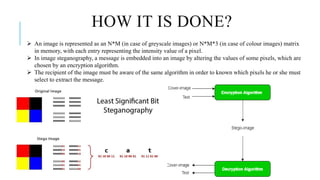
➢ An image is represented as an N*M (in case of greyscale images) or N*M*3 (in case of colour images) matrix
in memory, with each entry representing the intensity value of a pixel.
➢ In image steganography, a message is embedded into an image by altering the values of some pixels, which are
chosen by an encryption algorithm.
➢ The recipient of the image must be aware of the same algorithm in order to known which pixels he or she must
select to extract the message.
ALGORITHM FOR LSB BASED DATA
EMBEDDING
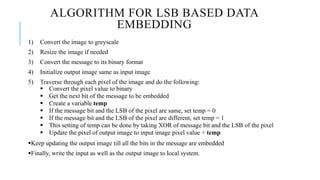
1) Convert the image to greyscale
2) Resize the image if needed
3) Convert the message to its binary format
4) Initialize output image same as input image
5) Traverse through each pixel of the image and do the following:
▪ Convert the pixel value to binary
▪ Get the next bit of the message to be embedded
▪ Create a variable temp
▪ If the message bit and the LSB of the pixel are same, set temp = 0
▪ If the message bit and the LSB of the pixel are different, set temp = 1
▪ This setting of temp can be done by taking XOR of message bit and the LSB of the pixel
▪ Update the pixel of output image to input image pixel value + temp
▪Keep updating the output image till all the bits in the message are embedded
▪Finally, write the input as well as the output image to local system.
TEXT EXTRACTION FROM LSB BASED
STEGANOGRAPHY
Extraction Process:
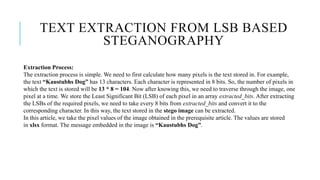
The extraction process is simple. We need to first calculate how many pixels is the text stored in. For example,
the text “Kaustubhs Dog” has 13 characters. Each character is represented in 8 bits. So, the number of pixels in
which the text is stored will be 13 * 8 = 104. Now after knowing this, we need to traverse through the image, one
pixel at a time. We store the Least Significant Bit (LSB) of each pixel in an array extracted_bits. After extracting
the LSBs of the required pixels, we need to take every 8 bits from extracted_bits and convert it to the
corresponding character. In this way, the text stored in the stego image can be extracted.
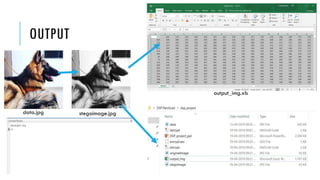
In this article, we take the pixel values of the image obtained in the prerequisite article. The values are stored
in xlsx format. The message embedded in the image is “Kaustubhs Dog”.
OUTPUT
data.jpg stegoimage.jpg
output_img.xls
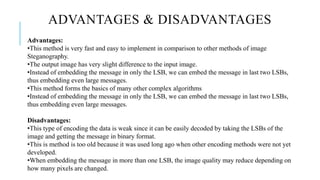
ADVANTAGES & DISADVANTAGES
Advantages:
•This method is very fast and easy to implement in comparison to other methods of image
Steganography.
•The output image has very slight difference to the input image.
•Instead of embedding the message in only the LSB, we can embed the message in last two LSBs,
thus embedding even large messages.
•This method forms the basics of many other complex algorithms
•Instead of embedding the message in only the LSB, we can embed the message in last two LSBs,
thus embedding even large messages.
Disadvantages:
•This type of encoding the data is weak since it can be easily decoded by taking the LSBs of the
image and getting the message in binary format.
•This is method is too old because it was used long ago when other encoding methods were not yet
developed.
•When embedding the message in more than one LSB, the image quality may reduce depending on
how many pixels are changed.
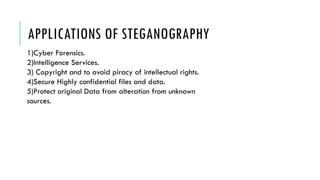
APPLICATIONS OF STEGANOGRAPHY
1)Cyber Forensics.
2)Intelligence Services.
3) Copyright and to avoid piracy of intellectual rights.
4)Secure Highly confidential files and data.
5)Protect original Data from alteration from unknown
sources.
REFERENCES
1] https://www.geeksforgeeks.org/lsb-based-image-steganography-using-matlab/
2] https://in.mathworks.com/matlabcentral/answers/65679-image-steganography-using-lsb
3] https://en.wikipedia.org/wiki/Steganography
4] https://www.youtube.com/watch?v=VBKtCCsqAtM
5] https://github.com/qrzbing/LSB-Steganography
THANK YOU

Image Based Steganpgraphy

  • 1.
    Real time applicationin Digital Signal Processing Topic: Image based steganography Group members: Nikhil Patil-17 Omkar Rane-18 Chaitanya Deshpande-19 Kaustubh Wankhade-31
  • 2.
    What is steganography? ➢Steganography is the practice of concealing a file, message, image, or video within another file, message, image, or video. The word steganography combines the Greek words steganos , meaning "covered, concealed, or protected", and graphein meaning "writing". ➢ The first recorded use of the term was in 1499 by Johannes Trithemius in his Steganographia, a treatise on cryptography and steganography. ➢ As the name suggests, Image Steganography refers to the process of hiding data within an image file. The image selected for this purpose is called the cover-image and the image obtained after steganography is called the stego- image. ➢ Steganography is the method of hiding secret data inside any form of digital media. The main idea behind steganography is to hide the existence of a data in any medium like audio, video, image etc. When we talk about image steganography, the idea is quite simple. Images are made up of pixels which usually refer to the color of that particular pixel. In a greyscale (black and white) image, these pixel values range from 0-255, 0 being black and 255 being white.
  • 3.
    HOW IT ISDONE? ➢ An image is represented as an N*M (in case of greyscale images) or N*M*3 (in case of colour images) matrix in memory, with each entry representing the intensity value of a pixel. ➢ In image steganography, a message is embedded into an image by altering the values of some pixels, which are chosen by an encryption algorithm. ➢ The recipient of the image must be aware of the same algorithm in order to known which pixels he or she must select to extract the message.
  • 4.
    ALGORITHM FOR LSBBASED DATA EMBEDDING 1) Convert the image to greyscale 2) Resize the image if needed 3) Convert the message to its binary format 4) Initialize output image same as input image 5) Traverse through each pixel of the image and do the following: ▪ Convert the pixel value to binary ▪ Get the next bit of the message to be embedded ▪ Create a variable temp ▪ If the message bit and the LSB of the pixel are same, set temp = 0 ▪ If the message bit and the LSB of the pixel are different, set temp = 1 ▪ This setting of temp can be done by taking XOR of message bit and the LSB of the pixel ▪ Update the pixel of output image to input image pixel value + temp ▪Keep updating the output image till all the bits in the message are embedded ▪Finally, write the input as well as the output image to local system.
  • 5.
    TEXT EXTRACTION FROMLSB BASED STEGANOGRAPHY Extraction Process: The extraction process is simple. We need to first calculate how many pixels is the text stored in. For example, the text “Kaustubhs Dog” has 13 characters. Each character is represented in 8 bits. So, the number of pixels in which the text is stored will be 13 * 8 = 104. Now after knowing this, we need to traverse through the image, one pixel at a time. We store the Least Significant Bit (LSB) of each pixel in an array extracted_bits. After extracting the LSBs of the required pixels, we need to take every 8 bits from extracted_bits and convert it to the corresponding character. In this way, the text stored in the stego image can be extracted. In this article, we take the pixel values of the image obtained in the prerequisite article. The values are stored in xlsx format. The message embedded in the image is “Kaustubhs Dog”.
  • 6.
  • 9.
    ADVANTAGES & DISADVANTAGES Advantages: •Thismethod is very fast and easy to implement in comparison to other methods of image Steganography. •The output image has very slight difference to the input image. •Instead of embedding the message in only the LSB, we can embed the message in last two LSBs, thus embedding even large messages. •This method forms the basics of many other complex algorithms •Instead of embedding the message in only the LSB, we can embed the message in last two LSBs, thus embedding even large messages. Disadvantages: •This type of encoding the data is weak since it can be easily decoded by taking the LSBs of the image and getting the message in binary format. •This is method is too old because it was used long ago when other encoding methods were not yet developed. •When embedding the message in more than one LSB, the image quality may reduce depending on how many pixels are changed.
  • 10.
    APPLICATIONS OF STEGANOGRAPHY 1)CyberForensics. 2)Intelligence Services. 3) Copyright and to avoid piracy of intellectual rights. 4)Secure Highly confidential files and data. 5)Protect original Data from alteration from unknown sources.
  • 11.
    REFERENCES 1] https://www.geeksforgeeks.org/lsb-based-image-steganography-using-matlab/ 2] https://in.mathworks.com/matlabcentral/answers/65679-image-steganography-using-lsb 3]https://en.wikipedia.org/wiki/Steganography 4] https://www.youtube.com/watch?v=VBKtCCsqAtM 5] https://github.com/qrzbing/LSB-Steganography
  • 12.