Computer Engineering and Intelligent Systems                                                 www.iiste.org
ISSN 2222-1719 (Paper) ISSN 2222-2863 (Online)
Vol 3, No.4, 2012

Data Security Using Cryptosteganography in Web Application
            Abhishek Patidar Gajendra Jagnade* Laxmi Madhuri Pranay Mehta Ronak Seth
                                Maharashtra Academy Of Engineering,Alandi,Pune
                         * E-mail of the corresponding author: praggroup@yahoo.com
Abstract
Data security using Cryptosteganography in web application is a web based application used to conceal
important information through hybrid cryptography and Steganography and provide means of its secure
transmission through any medium or channel .Using a web browser the user uploads the important
information and an envelope image. The same is received by the Data Shielder facade web application .The
web application sends the data and envelope image to the real Data Shielder .It generates a unique key and
encrypts the crucial data .The key is associated with a "unique id" and preserved in a store .Then the
encrypted information is embedded into the envelope image using modified BPCS technique .Finally a
stego image is generated .Data Shielder returns the "unique id" and stego image to the facade web
application .Web application further archives the stego image and unique key and allows the user to
download it. The user can simply unzip the archive and transmit the stego image through unsecured
channels like email, sockets, pen drives, cds, dvds, etc. And can keep the unique id safe. When the user
wants its data back then user needs to upload the stego image and the "unique id" to the Data Shielder
facade web application. The web application sends the unique id and stego image to the real Data Shielder.
First it finds the encryption key from the store through the unique id. Next, reversing the BPCS
Steganography, the stego image is processed and encrypted data is fetched. Finally using the encryption key
decryption is done and the crucial data is fetched back. The same is returned to the facade web application,
which is rendered to the user.
Keywords: Cryptography, Steganography, Stego- image, Threshold Value


1. Introduction
Cryptography and Steganography are well known and widely used techniques that manipulate information
(messages) in order to cipher or hide their existence respectively. This is a web application which uses
combination of Steganography and Cryptography techniques .Steganography is the art and science of
communicating in a way which hides the existence of the communication. Cryptography scrambles a
message so it cannot be understood. The Steganography hides the message for security. This paper
describes a system, which uses both Cryptography and Steganography for better confidentiality and
security. Major applications of the project are confidential communication and secret data storage which
can be used by normal people to secure their data & for military purpose, government organization, private
sector organization for security concern.
So this project aims to provide hybrid means of security and to improve existing BPCS technique for
Steganography and to develop new cryptographic algorithm.

2. Basic Concepts and Related Work
There are many aspects to security and many applications. One essential aspect for secure communications
is that of cryptography. But it is important to note that while cryptography is necessary for secure
communications, it is not by itself sufficient. There are some specific security requirements for
cryptography, including Authentication, Privacy/confidentiality, and Integrity Non-repudiation. The three
types of algorithms are described:
(i) Secret Key Cryptography (SKC): Uses a single key for both encryption and decryption.
(ii)Public Key Cryptography (PKC): Uses one key for encryption and another for decryption.

                                                    74
Computer Engineering and Intelligent Systems                                                   www.iiste.org
ISSN 2222-1719 (Paper) ISSN 2222-2863 (Online)
Vol 3, No.4, 2012

(iii)Hash Functions: Uses mathematical transformation to irreversibly "encrypt" information.
Steganography is the other technique for secured communication. It encompasses methods of transmitting a
secret message through innocuous cover carriers in such a manner that the very existence of the embedded
messages is undetectable. Information can be hidden in images, audio, video, text, or some other digitally
representative code. Steganography systems can be grouped by the type of covers used (graphics, sound,
text, executables) or by the techniques used to modify the covers
a) Substitution system.
b) Transform domain techniques.
c) Spread spectrum techniques.
d) Statistical method.
e) Distortion techniques.
f) Cover generation methods.


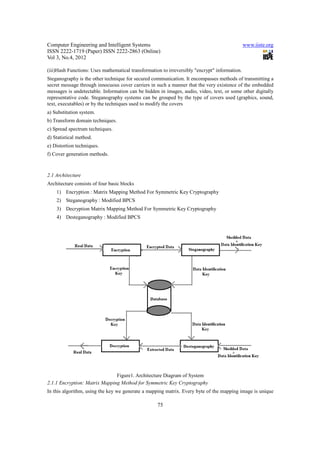
2.1 Architecture
Architecture consists of four basic blocks
    1) Encryption : Matrix Mapping Method For Symmetric Key Cryptography
    2) Steganography : Modified BPCS
    3) Decryption Matrix Mapping Method For Symmetric Key Cryptography
    4) Desteganography : Modified BPCS


                               Figure1. Architecture Diagram of System
2.1.1 Encryption: Matrix Mapping Method for Symmetric Key Cryptography
In this algorithm, using the key we generate a mapping matrix. Every byte of the mapping image is unique

                                                    75
Computer Engineering and Intelligent Systems                                                      www.iiste.org
ISSN 2222-1719 (Paper) ISSN 2222-2863 (Online)
Vol 3, No.4, 2012

and is with respect to key. The mapping matrix is of size 16 by 16.This algorithm is influenced by Applied
cryptography in Java (Partida, A.Andina, D.Atos).
Algorithm:
1) The source file is opened for reading in binary mode.
2) Every byte of the source file is read and converted into its equivalent 8-bit binary number.
3) Split the 8-bit binary number into 4-bit higher and lower nibble number.
4) Convert these two 4-bit nibbles into its equivalent decimal value.
5) With the help of these two decimal values pickup a pixel from the mapping matrix. Where higher nibble
equivalent decimal value acts as row indicator and lower nibble equivalent decimal value acts as column
indicator for mapping image.
6) Replace the original pixel with the byte selected from mapping matrix.
7) Encrypted file gets generated as the above process is repeated for all the pixels.


2.1.2 Steganography: Modified BPCS
Our new Steganography uses an image as the vessel data, and we embed secret information in the bit-
planes of the vessel. This technique makes use of the characteristics of the human vision system whereby a
human cannot perceive any shape information in a very complicated binary pattern. We can replace all of
the “noise-like” regions in the bit-planes of the vessel image with secret data without deteriorating the
image quality.This algorithm is influenced by Principle and application of BPCS-Steganography(Eiji
Kawaguchi and Richard O.Eason).This algorithm is termed as Modified “BPCS-Steganography,” which
stands for Bit-Plane Complexity Segmentation Steganography. Input data will be vessel image and data to
embed in byte format. Load the vessel image into memory. Get width and height of the memory image.
Generate a threshold value. For each pixel get red, green and blue values of current pixel .
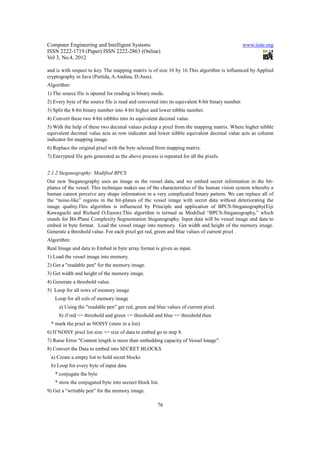
Algorithm:
Real Image and data to Embed in byte array format is given as input.
1) Load the vessel image into memory.
2) Get a "readable pen" for the memory image.
3) Get width and height of the memory image.
4) Generate a threshold value.
5) Loop for all rows of memory image
   Loop for all cols of memory image
     a) Using the "readable pen" get red, green and blue values of current pixel.
     b) if red <= threshold and green <= threshold and blue <= threshold then
 * mark the pixel as NOISY (store in a list).
6) If NOISY pixel list size >= size of data to embed go to step 8.
7) Raise Error "Content length is more than embedding capacity of Vessel Image".
8) Convert the Data to embed into SECRET BLOCKS
 a) Create a empty list to hold secret blocks
 b) Loop for every byte of input data
   * conjugate the byte
   * store the conjugated byte into secrect block list.
9) Get a "writable pen" for the memory image.

                                                      76
Computer Engineering and Intelligent Systems                                                   www.iiste.org
ISSN 2222-1719 (Paper) ISSN 2222-2863 (Online)
Vol 3, No.4, 2012

10) Loop for every element of NOISY pixel list
 a) Embed 2 bytes of data from SECRET blocks into red, green and blue bands of noisy pixel.
 b) Using the writable pen write the pixel into memory image.
11) Write back the memory image into IMAGE FILE.


                         Figure 2: Algorithm to encrypt data and embed it into image

2.1.3 Decryption: Matrix Mapping Method for Symmetric Key Cryptography
In this algorithm, using the key we generate a mapping matrix. Every byte of the mapping image is unique
and is with respect to key. The mapping matrix is of size 16 by 16.
Algorithm:
1) The encrypted file is opened for reading in binary mode.
2) Every byte of the encrypted file is read and converted into its equivalent 8-bit binary number.
3) Match the byte in the mapping matrix and find out row and column number of the matched byte.
4) Form 2 nibbles using the row number and column number. Generate a 8-bit binary number from 4-bit
higher (row) and lower (column) nibble number.
5) Substitute this generated 8 bit binary data in place of the current byte.
6) Original file gets generated as the above process is repeated for all the pixels.
Get the bytes from image using Desteganography and use the key to generate decryption matrix. Now
match the byte which we got from image with each matrix element. And get corresponding row and column
number of matched element. Convert the obtained row and column number into binary format. Deconjugate
these two numbers which represents original data.


                                                       77
Computer Engineering and Intelligent Systems                                         www.iiste.org
ISSN 2222-1719 (Paper) ISSN 2222-2863 (Online)
Vol 3, No.4, 2012

2.1.4Desteganography: Modified BPCS


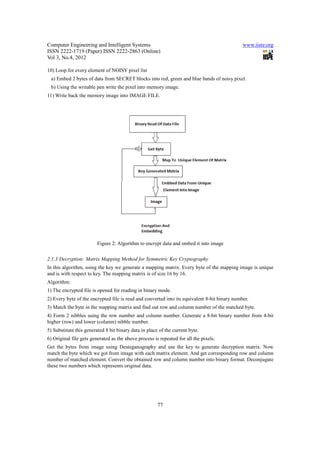
                        Figure 3. Algorithm to decrypt data and extract from image


Image having embedded data is given as input .
Algorithm:
1) Load the image into memory.
2) Get a "readable pen" for the memory image.
3) Get width and height of the memory image.
4) Generate a threshold value.
5) Loop for all rows of memory image
   Loop for all cols of memory image
     a) Using the "readable pen" get red, green and blue values of current pixel.
     b) If red <= threshold and green <= threshold and blue <= threshold then
        mark the pixel as NOISY (store in a list)
6) Loop for every element of NOISY pixel list
    a) Extract bytes of data from red, green and blue bands of noisy pixel.
    b) Deconjugate the secret blocks and form data bytes.
    c) Concatenate the data in a result buffer.

                                                     78
Computer Engineering and Intelligent Systems                                              www.iiste.org
ISSN 2222-1719 (Paper) ISSN 2222-2863 (Online)
Vol 3, No.4, 2012

7) Write back the result buffer into a FILE Input data will be image having embedded data. Load the image
into memory. Get width and height of the memory image. Generate a threshold value.


Conclusion & Future Enhancements
The work accomplished during this project can be summarized with the following points:
1) In this project we have presented a new system for the combination of cryptography and Steganography
using matrix mapping method for Symmetric Key Cryptography and modified BPCS technique for
Steganography which could be proven a highly secured method for data communication in near future.
2) Steganography especially combined with cryptography, is a powerful tool which enables people to
communicate without possible eavesdroppers even knowing there is a form of communication in the first
place. The proposed method provides acceptable image quality with very little distortion in the image.
3) The main advantage of this Cryptosteganography System is hybrid combination of cryptography and
Steganography which provides double layer security.
In future video or audio files can be used to hide data instead of images.


References
Visual Cryptography Steganography In Images, PiyushMarwaha , PareshMarwaha
A steganography implementation ,Mehboob, B. Faruqui, R.A.
Principle and application of BPCS-Steganography,Eiji Kawaguchi and Richard O.Eason,KIT,Japan
Applied cryptography in Java ,Partida, A.Andina, D.Atos-ODS , S.A.Madrid.
Data Security Using Data Hiding , Moon, S.K. Kawitkar, R.S.,PICT, Pune.
Digital steganography: hiding data within data,Artz, D.;Los Alamos Nat. Lab., NM


                                                      79
International Journals Call for Paper
The IISTE, a U.S. publisher, is currently hosting the academic journals listed below. The peer review process of the following journals
usually takes LESS THAN 14 business days and IISTE usually publishes a qualified article within 30 days. Authors should
send their full paper to the following email address. More information can be found in the IISTE website : www.iiste.org

Business, Economics, Finance and Management               PAPER SUBMISSION EMAIL
European Journal of Business and Management               EJBM@iiste.org
Research Journal of Finance and Accounting                RJFA@iiste.org
Journal of Economics and Sustainable Development          JESD@iiste.org
Information and Knowledge Management                      IKM@iiste.org
Developing Country Studies                                DCS@iiste.org
Industrial Engineering Letters                            IEL@iiste.org


Physical Sciences, Mathematics and Chemistry              PAPER SUBMISSION EMAIL
Journal of Natural Sciences Research                      JNSR@iiste.org
Chemistry and Materials Research                          CMR@iiste.org
Mathematical Theory and Modeling                          MTM@iiste.org
Advances in Physics Theories and Applications             APTA@iiste.org
Chemical and Process Engineering Research                 CPER@iiste.org


Engineering, Technology and Systems                       PAPER SUBMISSION EMAIL
Computer Engineering and Intelligent Systems              CEIS@iiste.org
Innovative Systems Design and Engineering                 ISDE@iiste.org
Journal of Energy Technologies and Policy                 JETP@iiste.org
Information and Knowledge Management                      IKM@iiste.org
Control Theory and Informatics                            CTI@iiste.org
Journal of Information Engineering and Applications       JIEA@iiste.org
Industrial Engineering Letters                            IEL@iiste.org
Network and Complex Systems                               NCS@iiste.org


Environment, Civil, Materials Sciences                    PAPER SUBMISSION EMAIL
Journal of Environment and Earth Science                  JEES@iiste.org
Civil and Environmental Research                          CER@iiste.org
Journal of Natural Sciences Research                      JNSR@iiste.org
Civil and Environmental Research                          CER@iiste.org


Life Science, Food and Medical Sciences                   PAPER SUBMISSION EMAIL
Journal of Natural Sciences Research                      JNSR@iiste.org
Journal of Biology, Agriculture and Healthcare            JBAH@iiste.org
Food Science and Quality Management                       FSQM@iiste.org
Chemistry and Materials Research                          CMR@iiste.org


Education, and other Social Sciences                      PAPER SUBMISSION EMAIL
Journal of Education and Practice                         JEP@iiste.org
Journal of Law, Policy and Globalization                  JLPG@iiste.org                       Global knowledge sharing:
New Media and Mass Communication                          NMMC@iiste.org                       EBSCO, Index Copernicus, Ulrich's
Journal of Energy Technologies and Policy                 JETP@iiste.org                       Periodicals Directory, JournalTOCS, PKP
Historical Research Letter                                HRL@iiste.org                        Open Archives Harvester, Bielefeld
                                                                                               Academic Search Engine, Elektronische
Public Policy and Administration Research                 PPAR@iiste.org                       Zeitschriftenbibliothek EZB, Open J-Gate,
International Affairs and Global Strategy                 IAGS@iiste.org                       OCLC WorldCat, Universe Digtial Library ,
Research on Humanities and Social Sciences                RHSS@iiste.org                       NewJour, Google Scholar.

Developing Country Studies                                DCS@iiste.org                        IISTE is member of CrossRef. All journals
Arts and Design Studies                                   ADS@iiste.org                        have high IC Impact Factor Values (ICV).

11.data security using cryptosteganography in web application

  • 1.
    Computer Engineering andIntelligent Systems www.iiste.org ISSN 2222-1719 (Paper) ISSN 2222-2863 (Online) Vol 3, No.4, 2012 Data Security Using Cryptosteganography in Web Application Abhishek Patidar Gajendra Jagnade* Laxmi Madhuri Pranay Mehta Ronak Seth Maharashtra Academy Of Engineering,Alandi,Pune * E-mail of the corresponding author: praggroup@yahoo.com Abstract Data security using Cryptosteganography in web application is a web based application used to conceal important information through hybrid cryptography and Steganography and provide means of its secure transmission through any medium or channel .Using a web browser the user uploads the important information and an envelope image. The same is received by the Data Shielder facade web application .The web application sends the data and envelope image to the real Data Shielder .It generates a unique key and encrypts the crucial data .The key is associated with a "unique id" and preserved in a store .Then the encrypted information is embedded into the envelope image using modified BPCS technique .Finally a stego image is generated .Data Shielder returns the "unique id" and stego image to the facade web application .Web application further archives the stego image and unique key and allows the user to download it. The user can simply unzip the archive and transmit the stego image through unsecured channels like email, sockets, pen drives, cds, dvds, etc. And can keep the unique id safe. When the user wants its data back then user needs to upload the stego image and the "unique id" to the Data Shielder facade web application. The web application sends the unique id and stego image to the real Data Shielder. First it finds the encryption key from the store through the unique id. Next, reversing the BPCS Steganography, the stego image is processed and encrypted data is fetched. Finally using the encryption key decryption is done and the crucial data is fetched back. The same is returned to the facade web application, which is rendered to the user. Keywords: Cryptography, Steganography, Stego- image, Threshold Value 1. Introduction Cryptography and Steganography are well known and widely used techniques that manipulate information (messages) in order to cipher or hide their existence respectively. This is a web application which uses combination of Steganography and Cryptography techniques .Steganography is the art and science of communicating in a way which hides the existence of the communication. Cryptography scrambles a message so it cannot be understood. The Steganography hides the message for security. This paper describes a system, which uses both Cryptography and Steganography for better confidentiality and security. Major applications of the project are confidential communication and secret data storage which can be used by normal people to secure their data & for military purpose, government organization, private sector organization for security concern. So this project aims to provide hybrid means of security and to improve existing BPCS technique for Steganography and to develop new cryptographic algorithm. 2. Basic Concepts and Related Work There are many aspects to security and many applications. One essential aspect for secure communications is that of cryptography. But it is important to note that while cryptography is necessary for secure communications, it is not by itself sufficient. There are some specific security requirements for cryptography, including Authentication, Privacy/confidentiality, and Integrity Non-repudiation. The three types of algorithms are described: (i) Secret Key Cryptography (SKC): Uses a single key for both encryption and decryption. (ii)Public Key Cryptography (PKC): Uses one key for encryption and another for decryption. 74
  • 2.
    Computer Engineering andIntelligent Systems www.iiste.org ISSN 2222-1719 (Paper) ISSN 2222-2863 (Online) Vol 3, No.4, 2012 (iii)Hash Functions: Uses mathematical transformation to irreversibly "encrypt" information. Steganography is the other technique for secured communication. It encompasses methods of transmitting a secret message through innocuous cover carriers in such a manner that the very existence of the embedded messages is undetectable. Information can be hidden in images, audio, video, text, or some other digitally representative code. Steganography systems can be grouped by the type of covers used (graphics, sound, text, executables) or by the techniques used to modify the covers a) Substitution system. b) Transform domain techniques. c) Spread spectrum techniques. d) Statistical method. e) Distortion techniques. f) Cover generation methods. 2.1 Architecture Architecture consists of four basic blocks 1) Encryption : Matrix Mapping Method For Symmetric Key Cryptography 2) Steganography : Modified BPCS 3) Decryption Matrix Mapping Method For Symmetric Key Cryptography 4) Desteganography : Modified BPCS Figure1. Architecture Diagram of System 2.1.1 Encryption: Matrix Mapping Method for Symmetric Key Cryptography In this algorithm, using the key we generate a mapping matrix. Every byte of the mapping image is unique 75
  • 3.
    Computer Engineering andIntelligent Systems www.iiste.org ISSN 2222-1719 (Paper) ISSN 2222-2863 (Online) Vol 3, No.4, 2012 and is with respect to key. The mapping matrix is of size 16 by 16.This algorithm is influenced by Applied cryptography in Java (Partida, A.Andina, D.Atos). Algorithm: 1) The source file is opened for reading in binary mode. 2) Every byte of the source file is read and converted into its equivalent 8-bit binary number. 3) Split the 8-bit binary number into 4-bit higher and lower nibble number. 4) Convert these two 4-bit nibbles into its equivalent decimal value. 5) With the help of these two decimal values pickup a pixel from the mapping matrix. Where higher nibble equivalent decimal value acts as row indicator and lower nibble equivalent decimal value acts as column indicator for mapping image. 6) Replace the original pixel with the byte selected from mapping matrix. 7) Encrypted file gets generated as the above process is repeated for all the pixels. 2.1.2 Steganography: Modified BPCS Our new Steganography uses an image as the vessel data, and we embed secret information in the bit- planes of the vessel. This technique makes use of the characteristics of the human vision system whereby a human cannot perceive any shape information in a very complicated binary pattern. We can replace all of the “noise-like” regions in the bit-planes of the vessel image with secret data without deteriorating the image quality.This algorithm is influenced by Principle and application of BPCS-Steganography(Eiji Kawaguchi and Richard O.Eason).This algorithm is termed as Modified “BPCS-Steganography,” which stands for Bit-Plane Complexity Segmentation Steganography. Input data will be vessel image and data to embed in byte format. Load the vessel image into memory. Get width and height of the memory image. Generate a threshold value. For each pixel get red, green and blue values of current pixel . Algorithm: Real Image and data to Embed in byte array format is given as input. 1) Load the vessel image into memory. 2) Get a "readable pen" for the memory image. 3) Get width and height of the memory image. 4) Generate a threshold value. 5) Loop for all rows of memory image Loop for all cols of memory image a) Using the "readable pen" get red, green and blue values of current pixel. b) if red <= threshold and green <= threshold and blue <= threshold then * mark the pixel as NOISY (store in a list). 6) If NOISY pixel list size >= size of data to embed go to step 8. 7) Raise Error "Content length is more than embedding capacity of Vessel Image". 8) Convert the Data to embed into SECRET BLOCKS a) Create a empty list to hold secret blocks b) Loop for every byte of input data * conjugate the byte * store the conjugated byte into secrect block list. 9) Get a "writable pen" for the memory image. 76
  • 4.
    Computer Engineering andIntelligent Systems www.iiste.org ISSN 2222-1719 (Paper) ISSN 2222-2863 (Online) Vol 3, No.4, 2012 10) Loop for every element of NOISY pixel list a) Embed 2 bytes of data from SECRET blocks into red, green and blue bands of noisy pixel. b) Using the writable pen write the pixel into memory image. 11) Write back the memory image into IMAGE FILE. Figure 2: Algorithm to encrypt data and embed it into image 2.1.3 Decryption: Matrix Mapping Method for Symmetric Key Cryptography In this algorithm, using the key we generate a mapping matrix. Every byte of the mapping image is unique and is with respect to key. The mapping matrix is of size 16 by 16. Algorithm: 1) The encrypted file is opened for reading in binary mode. 2) Every byte of the encrypted file is read and converted into its equivalent 8-bit binary number. 3) Match the byte in the mapping matrix and find out row and column number of the matched byte. 4) Form 2 nibbles using the row number and column number. Generate a 8-bit binary number from 4-bit higher (row) and lower (column) nibble number. 5) Substitute this generated 8 bit binary data in place of the current byte. 6) Original file gets generated as the above process is repeated for all the pixels. Get the bytes from image using Desteganography and use the key to generate decryption matrix. Now match the byte which we got from image with each matrix element. And get corresponding row and column number of matched element. Convert the obtained row and column number into binary format. Deconjugate these two numbers which represents original data. 77
  • 5.
    Computer Engineering andIntelligent Systems www.iiste.org ISSN 2222-1719 (Paper) ISSN 2222-2863 (Online) Vol 3, No.4, 2012 2.1.4Desteganography: Modified BPCS Figure 3. Algorithm to decrypt data and extract from image Image having embedded data is given as input . Algorithm: 1) Load the image into memory. 2) Get a "readable pen" for the memory image. 3) Get width and height of the memory image. 4) Generate a threshold value. 5) Loop for all rows of memory image Loop for all cols of memory image a) Using the "readable pen" get red, green and blue values of current pixel. b) If red <= threshold and green <= threshold and blue <= threshold then mark the pixel as NOISY (store in a list) 6) Loop for every element of NOISY pixel list a) Extract bytes of data from red, green and blue bands of noisy pixel. b) Deconjugate the secret blocks and form data bytes. c) Concatenate the data in a result buffer. 78
  • 6.
    Computer Engineering andIntelligent Systems www.iiste.org ISSN 2222-1719 (Paper) ISSN 2222-2863 (Online) Vol 3, No.4, 2012 7) Write back the result buffer into a FILE Input data will be image having embedded data. Load the image into memory. Get width and height of the memory image. Generate a threshold value. Conclusion & Future Enhancements The work accomplished during this project can be summarized with the following points: 1) In this project we have presented a new system for the combination of cryptography and Steganography using matrix mapping method for Symmetric Key Cryptography and modified BPCS technique for Steganography which could be proven a highly secured method for data communication in near future. 2) Steganography especially combined with cryptography, is a powerful tool which enables people to communicate without possible eavesdroppers even knowing there is a form of communication in the first place. The proposed method provides acceptable image quality with very little distortion in the image. 3) The main advantage of this Cryptosteganography System is hybrid combination of cryptography and Steganography which provides double layer security. In future video or audio files can be used to hide data instead of images. References Visual Cryptography Steganography In Images, PiyushMarwaha , PareshMarwaha A steganography implementation ,Mehboob, B. Faruqui, R.A. Principle and application of BPCS-Steganography,Eiji Kawaguchi and Richard O.Eason,KIT,Japan Applied cryptography in Java ,Partida, A.Andina, D.Atos-ODS , S.A.Madrid. Data Security Using Data Hiding , Moon, S.K. Kawitkar, R.S.,PICT, Pune. Digital steganography: hiding data within data,Artz, D.;Los Alamos Nat. Lab., NM 79
  • 7.
    International Journals Callfor Paper The IISTE, a U.S. publisher, is currently hosting the academic journals listed below. The peer review process of the following journals usually takes LESS THAN 14 business days and IISTE usually publishes a qualified article within 30 days. Authors should send their full paper to the following email address. More information can be found in the IISTE website : www.iiste.org Business, Economics, Finance and Management PAPER SUBMISSION EMAIL European Journal of Business and Management EJBM@iiste.org Research Journal of Finance and Accounting RJFA@iiste.org Journal of Economics and Sustainable Development JESD@iiste.org Information and Knowledge Management IKM@iiste.org Developing Country Studies DCS@iiste.org Industrial Engineering Letters IEL@iiste.org Physical Sciences, Mathematics and Chemistry PAPER SUBMISSION EMAIL Journal of Natural Sciences Research JNSR@iiste.org Chemistry and Materials Research CMR@iiste.org Mathematical Theory and Modeling MTM@iiste.org Advances in Physics Theories and Applications APTA@iiste.org Chemical and Process Engineering Research CPER@iiste.org Engineering, Technology and Systems PAPER SUBMISSION EMAIL Computer Engineering and Intelligent Systems CEIS@iiste.org Innovative Systems Design and Engineering ISDE@iiste.org Journal of Energy Technologies and Policy JETP@iiste.org Information and Knowledge Management IKM@iiste.org Control Theory and Informatics CTI@iiste.org Journal of Information Engineering and Applications JIEA@iiste.org Industrial Engineering Letters IEL@iiste.org Network and Complex Systems NCS@iiste.org Environment, Civil, Materials Sciences PAPER SUBMISSION EMAIL Journal of Environment and Earth Science JEES@iiste.org Civil and Environmental Research CER@iiste.org Journal of Natural Sciences Research JNSR@iiste.org Civil and Environmental Research CER@iiste.org Life Science, Food and Medical Sciences PAPER SUBMISSION EMAIL Journal of Natural Sciences Research JNSR@iiste.org Journal of Biology, Agriculture and Healthcare JBAH@iiste.org Food Science and Quality Management FSQM@iiste.org Chemistry and Materials Research CMR@iiste.org Education, and other Social Sciences PAPER SUBMISSION EMAIL Journal of Education and Practice JEP@iiste.org Journal of Law, Policy and Globalization JLPG@iiste.org Global knowledge sharing: New Media and Mass Communication NMMC@iiste.org EBSCO, Index Copernicus, Ulrich's Journal of Energy Technologies and Policy JETP@iiste.org Periodicals Directory, JournalTOCS, PKP Historical Research Letter HRL@iiste.org Open Archives Harvester, Bielefeld Academic Search Engine, Elektronische Public Policy and Administration Research PPAR@iiste.org Zeitschriftenbibliothek EZB, Open J-Gate, International Affairs and Global Strategy IAGS@iiste.org OCLC WorldCat, Universe Digtial Library , Research on Humanities and Social Sciences RHSS@iiste.org NewJour, Google Scholar. Developing Country Studies DCS@iiste.org IISTE is member of CrossRef. All journals Arts and Design Studies ADS@iiste.org have high IC Impact Factor Values (ICV).