Download to read offline
![International Journal of Engineering Research and Development
e-ISSN: 2278-067X, p-ISSN: 2278-800X, www.ijerd.com
Volume 10, Issue 11 (November 2014), PP.72-76
72
Performance Analysis of Image Enhancement Using Dual-Tree
Complex Wavelet Transform and Nonlocal Means
1
K.Dayanand, Albert Prasanna Kumar2
,
1
M.Tech Student, ECE Department, MVR College of Engineering &Technology, Vijayawada, India
2
Assistant Professor, ECE Department, MVR college of Engineering &Technology, Vijayawada, India
Abstract:- Resolution enhancement (RE) schemes which are not based on wavelets has one of the major
drawbacks of losing high frequency contents which results in blurring. The discrete wavelet- transform-based
(DWT) Resolution Enhancement scheme generates artifacts (due to a DWT shift-variant property). A wavelet-
Domain approach based on dual-tree complex wavelet transform (DT-CWT) & nonlocal means (NLM) is
proposed for RE of the satellite images. A satellite input image is decomposed by DT-CWT (which is nearly
shift invariant) to obtain high-frequency sub bands. Here the Lanczos interpolator is used to interpolate the high-
frequency sub bands & the low-resolution (LR) input image. The high frequency sub bands are passed through
an NLM filter to cater for the artifacts generated by DT-CWT (despite of it’s nearly shift invariance). The
filtered high-frequency sub bands and the LR input image are combined by using inverse DTCWT to obtain a
resolution-enhanced image. Objective and subjective analyses show superiority of the new proposed technique
over the conventional and state-of-the-art RE techniques.
Keywords:- Dual-Tree Complex Wavelet Transform (DT-CWT), Lanczos Interpolation, Resolution
Enhancement (RE), shift variant.
I. INTRODUCTION
Resolution (spatial, spectral, and temporal) is the limiting factor for the utilization of remote sensing
data by satellite imaging, etc. In satellite image Spatial and spectral resolutions are related (a high spatial
resolution is associated with a low spectral resolution and vice versa) with each other [1]. So, spectral, as well as
spatial, resolution enhancement (RE) is most by desirable. Interpolation has been widely used for RE [2], [3].
Commonly used interpolation techniques are based on nearest neighbours include nearest neighbour, bilinear,
bi-cubic, and Lanczos. The Lanczos interpolation (windowed form of a sinc filter) is superior to its counterparts
(including nearest neighbour, bilinear, and bi-cubic) because it has increased ability to detect edges and linear
features. And it also offers the best compromise in terms of reduction of aliasing, sharpness, and ringing [4].
The Methods based on vector-valued image regularization with partial differential equations (VVIRPDE) [5]
and in painting and zooming using sparse representations [6] are now state of the art in the field (i.e,mostly
applied for image in painting but can be also seen as interpolation). RE schemes which are not based on
wavelets suffer from one major drawback of losing high frequency contents which results in blurring. RE by
using wavelet domain is a new research area, and recently, many algorithms DWT [7], stationary wavelet
transform (SWT) [8], and dual-tree complex wavelet transform (DT-CWT) [9] have been proposed [7]–[11]. An
RE scheme was proposed by using DT- CWT and bicubic interpolations, and results were compared shown
superior) with the conventional schemes (i.e., nearest neighbor, bilinear, and bicubic interpolations and wavelet
zero padding) [9], More recently in [7], a scheme based on DWT and bicubic interpolation was proposed, and
results were compared with the conventional schemes and the stateof- art schemes (wavelet zero padding and
cyclic spinning [12] and DT-CWT [9]). But, DWT is shift variant, which causes the artifacts in the RE image,
and has a lack of directionality; so, DT-CWT is almost shift and rotation invariant [13]. DWT-based RE
schemes generate artifacts (due to DWT shift-variant property). In this paper, a DTCWT- based nonlocal-
means-based RE (DT-CWT-NLMRE) technique is proposed, using the DT-CWT, Lanczos interpolation, and
NLM. This DT-CWT technique is nearly shift invariant and directional selective. Moreover, DT-CWT
preserved the usual properties of perfect reconstruction with well-balanced frequency responses [13], [14].
Consequentially, DT-CWT gives better results after the modification of the wavelet coefficients and provides
fewer artifacts, as compared with traditional DWT. Since the Lanczos filter offer less aliasing, sharpness, and
minimal ringing, so, this one is the better choice for RE. NLM filtering [15] is used to further enhance the
performance of DT-CWT-NLM-RE by reducing the artifacts. The results for spatial RE of optical images are
compared with the best performing techniques [5], [7]–[9].](https://image.slidesharecdn.com/i10117276-150115033253-conversion-gate02/85/Performance-Analysis-of-Image-Enhancement-Using-Dual-Tree-Complex-Wavelet-Transform-and-Nonlocal-Means-1-320.jpg)
![Performance Analysis of Image Enhancement Using Dual-Tree Complex Wavelet Transform and Nonlocal...
73
II. LITERATURE REVIEW
Existing method:
Discrete Wavelet Transform
Stationary Wavelet Transform
Nearest neighbour based pixel insertion
Proposed method:
Resolution enhancement of low resolution satellite image base on,
Dual Tree CWT multi scale decomposition
Neighbourhood insertion with interpolation technique
Edge Preserving filter- Non local means
III. PERFORMANCE ANALYSIS OF ALGORITHMS
A. NLM Filtering
The NLM filter (an extension of neighborhood filtering algorithms) is based on the assumption that
image content is likely to repeat itself within some neighborhood (in the image) [15] and in neighboring frames
[16]. It computes denoised pixel by the weighted sum of the surrounding pixels of (within frame and in the
neighboring frames) [16]. This feature provides a way to estimate the pixel value from noisecontaminated
images. In a 3-D NLM algorithm, the estimate position i.e, of a pixel is
X(p,q) =
𝑌𝑚 𝑟,𝑠 𝐾𝑚(𝑟,𝑠)(𝑟,𝑠)∈𝑁(𝑝,𝑞)
𝑀
𝑚 =1
𝐾𝑚(𝑟,𝑠)(𝑟,𝑠)∈𝑁(𝑝,𝑞)
𝑀
𝑚 =1
(1)
Where m is the frame index, and N represents the neighborhood of the pixel at location (p, q). K values are the
filter weights, i.e.
K(r,s) = exp
− V p,q −V r,s
2
2
2σ2
×
𝑓( 𝑝 − 𝑞 2 + 𝑞 − 𝑠 2 + 𝑚 − 2) (2)
Where V is the window usually a square window centered at the pixels Y (p, q) and Y (r, s)] of pixel values
from a geometric neighborhood of pixels Y (p, q) and Y (r, s), σ is the filter coefficient, and f(.) is a geometric
distance function. K is inversely proportional to the distance between Y (p, q) and Y (r, s).
B. NLM-RE
Resolution Enhancement is achieved by modifying NLM with the following model proposed in [17]:
Lm = IJQX + n (3)
Where indicates vectorized low-resolution (LR) frame, I is the decimation operator, J is the blurring matrix,
Q is the warping matrix, X is the vectorized high-resolution (HR) im image, and n denotes the Gaussian white
noise. The aim is to restore X from a series of L.
Penalty function is defined as
∈2
= ½ 𝐼𝐽𝑄𝑥 − 𝑌𝑚𝑀
𝑚=1
2
2
+λR(x) (4)
∈fusion
2
= ½ (𝐼𝑄𝑍 −𝑀
𝑚=1 Lm)T
om(IQZ− Lm) (5)
Where M is a regularization term, λ is the scale coefficient, x is the targeted image, and is the LR input image.
The total variation kernel is chosen to replace R, acting as an image deblurring kernel by [17]. To simplify the
algorithm, a separation of the problem in (4) is done by minimizing Where Z is the blurred version of the
targeted image, and is the weight matrix, followed by minimizing a deblurring equation [11], i.e.,
∈RE
2
(X) = 𝐽𝑋 − 𝑍
2
2
+ λR(Z) (6)
Pixel wise solution of (5) can be obtained as
ẑ =
𝑌
𝑟
𝑚
𝑟,𝑠 𝐾
𝑟
𝑚
(𝑟,𝑠)(𝑟,𝑠)∈𝑁(𝑝,𝑞)
𝑀
𝑚 =1
𝐾
𝑟
𝑚
(𝑟,𝑠)(𝑟,𝑠)∈𝑁(𝑝,𝑞)
𝑀
𝑚 =1
(7)
Where the superscript r refers to the HR coordinate. Instead of estimating the target pixel position in nearby
frames, this algorithm considers that all possible positions where the pixel may appear. Therefore, motion
estimation is avoided [11]. Equation (7) apparently resembles (1), but (7) has some differences as compared
with (1). The weight estimation in (2) should be modified because is corresponding matrix O has to be of the
same size as the HR image. Therefore, a simple up scaling process to patch V is needed before computing the K.
The total number of pixel Y in (7) should be equal to the number of weights K. Thus, a zero-padding
interpolation is applied to L before fusing the images [11].](https://image.slidesharecdn.com/i10117276-150115033253-conversion-gate02/85/Performance-Analysis-of-Image-Enhancement-Using-Dual-Tree-Complex-Wavelet-Transform-and-Nonlocal-Means-2-320.jpg)
![Performance Analysis of Image Enhancement Using Dual-Tree Complex Wavelet Transform and Nonlocal...
75
Fig.4 Transformed Image
Fig.5 Biterror Image
TABLE I comparison of the existing and proposed techniques for the “cameraman.tif” image
Algorithm MSE PSNR(Db) Q-index
Lanczos 0.0253 15.9770 0.9614
DT-CWT-RE 0.0242 16.1576 0.9986
Proposed DT-CWT-RE 0.0215 16.6658 0.9986
Proposed DT-NML-CWT-RE 0.0174 17.5895 0.9999
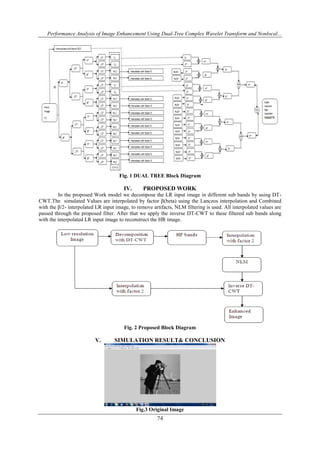
In this paper an RE technique based on DT-CWT and an NLM filter has been proposed. This technique
decomposes the LR input image using DT-CWT. By using the Lanczos interpolator Wavelet coefficients and
the LR input image was interpolated. This DT-CWT is nearly shift invariant and generates fewer artifacts as
compared with DWT. NLM filtering is used to overcome the artifacts generated by the DT-CWT and to further
enhance the performance of the proposed technique in terms of MSE, PSNR, and Qindex. Experimental results
show the superior performance of proposed techniques. DT-CWT-NLM-RE are much better than the RE images
obtained using other techniques. Table I shows that the proposed techniques provide improved results in terms
of MSE, PSNR, and Q-index [18], as compared with other techniques. It is clear that the proposed DT-CWT-RE
and DTCWT- NLM-RE schemes techniques qualitatively and quantitatively.
ACKNOWLEDGMENT
The authors would like to thank MVR college of Engineering &Technology for providing laboratory
facilities for research purpose and the higher authorities of MVR college of Engineering &Technology. I extend
my grateful thanks to Dr. KVS Prasad Krishna garu, HOD, for allowing me to use Lab.
REFERENCES
[1] Y. Piao, I. Shin, and H. W. Park, “Image resolution enhancement using inter-subband correlation in
wavelet domain,” in Proc. Int. Conf. ImageProcess., San Antonio, TX, 2007, pp. I-445–I-448.
[2] C. B. Atkins, C. A. Bouman, and J. P. Allebach, “Optimal image scaling using pixel classification,” in
Proc. Int. Conf. Image Process., Oct. 7–10, 2001, pp. 864–867.
[3] A. S. Glassner, K. Turkowski, and S. Gabriel, “Filters for common resampling tasks,” in Graphics
Gems. New York: Academic, 1990, pp. 147–165.
[4] D. Tschumperle and R. Deriche, “Vector-valued image regularization with PDE’s: A common
framework for different applications,” IEEE Trans.Pattern Anal. Mach. Intell., vol. 27, no. 4, pp. 506–
517, Apr. 2005.
[5] M. J. Fadili, J. Starck, and F. Murtagh, “Inpainting and zooming using sparse representations,”
Comput. J., vol. 52, no. 1, pp. 64–79, Jan. 2009.](https://image.slidesharecdn.com/i10117276-150115033253-conversion-gate02/85/Performance-Analysis-of-Image-Enhancement-Using-Dual-Tree-Complex-Wavelet-Transform-and-Nonlocal-Means-4-320.jpg)
![Performance Analysis of Image Enhancement Using Dual-Tree Complex Wavelet Transform and Nonlocal...
76
[6] H. Demirel and G. Anbarjafari, “Discrete wavelet transform-based satellite image resolution
enhancement,” IEEE Trans. Geosci. Remote Sens., vol. 49, no. 6, pp. 1997–2004, Jun. 2011.
[7] H. Demirel and G. Anbarjafari, “Image resolution enhancement by using discrete and stationary
wavelet decomposition,” IEEE Trans. Image Process., vol. 20, no. 5, pp. 1458–1460, May 2011.
[8] H. Demirel and G. Anbarjafari, “Satellite image resolution enhancement using complex wavelet
transform,” IEEE Geosci. Remote Sens. Lett., vol. 7, no. 1, pp. 123–126, Jan. 2010.
[9] H. Demirel and G. Anbarjafari, “Image super resolution based on interpolation of wavelet domain high
frequency subbands and the spatial domain input image,” ETRI J., vol. 32, no. 3, pp. 390–394, Jan.
2010.
[10] H. Zheng, A. Bouzerdoum, and S. L. Phung, “Wavelet based nonlocalmeans super-resolution for video
sequences,” in Proc. IEEE 17th
Int.Conf. Image Process., Hong Kong, Sep. 26–29, 2010, pp. 2817–
2820.
[11] A. Gambardella andM.Migliaccio, “On the superresolution of microwave scanning radiometer
measurements,” IEEE Geosci. Remote Sens. Lett., vol. 5, no. 4, pp. 796–800, Oct. 2008.
[12] [Online].Available:http://www.satimagingcorp.com/ [13] I. W. Selesnick, R. G. Baraniuk, and N. G.
Kingsbur, “The dual-tree complex wavelet transform,” IEEE Signal Prcess. Mag., vol. 22, no. 6 , pp.
123–151, Nov. 2005.
[13] J. L. Starck, F. Murtagh, and J. M. Fadili, Sparse Image and Signal Processing: Wavelets, Curvelets,
Morphological Diversity. Cambridge,U.K.: Cambridge Univ. Press, 2010.
[14] A. Buades, B. Coll, and J. M. Morel, “A review of image denoising algorithms, with a new one,”
Multisc.Model.Simul., vol. 4, no. 2, pp. 490– 530, 2005.
[15] A. Buades, B. Coll, and J. M. Morel, “Denoising image sequences does not require motionestimation,”
in Proc. IEEE Conf. Audio, Video SignalBased Surv., 2005, pp. 70–74.
[16] M. Protter, M. Elad, H. Takeda, and P. Milanfar, “Generalizing the nonlocal-means to super-resolution
reconstruction,” IEEE Trans. ImageProcess., vol. 18, no. 1, pp. 36–51, Jan. 2009.
[17] Z.Wang and A. C. Bovik, “A universal image quality index,” IEEE Signal Process. Lett., vol. 9, no. 3,
pp. 81–84,Mar 2002.](https://image.slidesharecdn.com/i10117276-150115033253-conversion-gate02/85/Performance-Analysis-of-Image-Enhancement-Using-Dual-Tree-Complex-Wavelet-Transform-and-Nonlocal-Means-5-320.jpg)

The document presents a novel resolution enhancement technique for satellite images using a dual-tree complex wavelet transform (DT-CWT) combined with nonlocal means (NLM) filtering. It addresses the limitations of traditional wavelet methods which generate artifacts due to their shift-variant nature, demonstrating that the proposed approach provides superior performance in image quality metrics like MSE, PSNR, and quality index compared to conventional techniques. Experimental results confirm that the DT-CWT-NLM method effectively enhances image resolution while preserving edges and minimizing artifacts.


