IOSR Journal of Electrical and Electronics Engineering (IOSR-JEEE)
e-ISSN: 2278-1676,p-ISSN: 2320-3331, Volume 11, Issue 1 Ver. II (Jan. – Feb. 2016), PP 58-66
www.iosrjournals.org
DOI: 10.9790/1676-11125866 www.iosrjournals.org 58 | Page
Power Output Maximization of A PMSG Based Standalone Wind
Energy Conversion System Using Fuzzy Logic
Ndirangu J.G1
, NderuJ.N1
, Maina C.M2
, Muhia A.M1
1
(Department of Electrical and Electronic Engineering,Jomo Kenyatta University of Agriculture and
Technology (JKUAT),Kenya)
2
(Department of Electrical and Power Engineering, Technical University of Kenya)
Abstract: This paper proposes a Fuzzy Logic Controller for Maximum Power Point Tracking of a case study
wind energy conversion system (WECS).The system consists of a standalone fixed pitch, variable speed wind
turbine directly coupled to a permanent magnet synchronous generator (PMSG), an uncontrolled diode
rectifier, a dc-dc boost converter, a fuzzy logic based controller and a load. For a given wind speed, there is an
optimum speed of rotation that gives maximum power. The aim of the maximum power point tracking controller
is to drive the WECS at the optimum speed that corresponds to maximum power at any wind speed. The
designed Fuzzy Logic Controllerdetermines the duty cycle D that yields optimum speed for maximum power
extraction from the WECS for various wind speeds. It then applies this D to the DC-DC boost converter to
control the speed of rotation of the PMSG to track maximum power point curve.Simulation results show that the
designed system is able to extract maximum power for varying wind speeds.
Keywords -Fuzzy Logic Controller, MPPT,PMSG,WECS
I. Introduction
Windcapacity is growing very quickly due to its increasingly competitive prices. During 2012, almost
45 GW began operation, and from the end of 2007 through 2012, annual growth rates of cumulative wind power
capacity averaged 25% [1]. In recent years, the production of electricity from renewable energy sources like
wind energy increases due to environmental problems and the shortage of traditional energy sources in the near
future [2]. Wind power depends mainly on geographical conditions and weather conditions. Therefore, it is
necessary to design a system capable of generating maximum power under these constraints [3]. Up to now,
most of the wind energy generation systems have been implemented in large-scale WECS in the Megawatt
level. However, small-scale WECS can provide a good alternative in urban areas and residential applications in
remote places where connection to grid is almost impossible. For small wind generation (typically less than 100
kW), a permanent-magnet synchronous generator (PMSG) connected to a diode bridge is preferred because of
its reliability, simple control, high efficiency, and low cost [4]. MPPT algorithms for WECS researched so far
are mainly classified into three categories namely Tip Speed Ratio (TSR) control, Power Signal Feedback (PSF)
controland Hill-Climb Search(HCS) Control. The TSR control method controls the rotational speed of the
generator in order to maintain TSR (the ratio between blade tip speed to the wind speed) at the optimum value in
order to extract maximum power out of the turbine. This method requires knowledge of the optimum TSR,wind
speed, and turbine speed in order to extract maximum power point[5]
In PSF control, it is required to have the knowledge of the wind turbine’s maximum power curve, and
track this curve through its control mechanisms. Using wind speed or rotor speed as an input, the reference
power is generated either using the recorded maximum power curve or using the mechanical power equation [5].
A slight variant of PSF is the optimal torque (OT) technique published in [6] which makes use of the quadratic
optimal torque curve.The HCS control (or Perturb & Observe) algorithm continuously searches for the peak
power of the wind turbine. Depending upon location of an operating point and the relation between changes in
power and speed, the tracking algorithm computes the optimum control signal in order to drive the system to the
point of maximum power [5].According to [7], there is no difference between the PSF and the OT method in
terms of the performance and the complexity of implementation.
The main advantage of HCS control over TSR and PSF control is that it neither requires knowledge of
the maximum power nor the wind velocity to determine MPP. It is independent, simple, and flexible. However,
it fails to reach the maximum power points under rapid wind variations if it is used for large and medium inertia
wind turbines. Moreover, the problem of choosing an appropriate step-size is not an easy task; where larger
step-size means faster response and less efficiency while, on the other hand, smaller step-size improves the
efficiency but slower the convergence speed [8].Hence, for conventional HCS control, there is always a tradeoff
between the tracking speed and control efficiency. Another challenge is that in the normal HCS, the direction
i.e. the sign of the next perturbation is decided by the increase or decrease in power due to the previous
perturbation. Being blind to the wind change, this rule can be misleading as the sign might get dictated by the
Power Output Maximization Of A PMSG Based Standalone Wind Energy Conversion System Usi…
DOI: 10.9790/1676-11125866 www.iosrjournals.org 59 | Page
change in wind rather than the applied perturbation. This wrong decision leads to the failure in keeping track of
maximum power point [7].
In this paper, a Fuzzy Logic Controller (FLC) is used for maximum power point tracking. Fuzzy
control works as well for complex nonlinear multi-dimensional systems, systemswith parameter variation
problem or where the sensor signals are not precise. It is basically nonlinear and adaptive in nature, giving
robust performance under parameter variation and load disturbance effect.[9] It has been shown that a properly
designed direct fuzzy controller can outperform conventional proportional integral derivative (PID)
controllers,[10]offering the following advantages: It can work with less precise inputs, does not need fast
processors, more robust than other non-linear controllers and has better stability, small overshoot, and fast
response.
II. System Description
The WECS proposed in this paper consists of a wind turbine coupled to a PMSG to power a stand-
alone system. A three-phase diode bridge rectifier is used for the AC/DC conversion. A boost converter
(DC/DC) is used to vary the rotor speed. The proposed MPPT strategy uses a fuzzy logic controller to track the
maximum power point curve of the WECS by varying the duty cycle of the DC-DC boost converter. The
proposed control algorithm is able to achieve fast dynamic responses. The block diagram of the proposed system
is shown in fig 1.
Figure1: Block diagram of the proposed system.
III. System Submodels
A. Wind Turbine Model
The mechanical power extracted by the turbine is given by: [11]
𝑃𝑚 =
1
2
𝜌𝜋𝑅2
𝑣3
𝐶𝑝 ( 1)
Where:𝑃𝑚 = Mechanical Power(W), 𝜌= Air density in kg/m3
𝑅= Radius of the turbine blade in m,𝑣 =
wind speed in m/s and 𝐶𝑝 = power coefficient.𝐶𝑝is a function of the tip speed ratio(TSR) 𝜆 as well as the blade
pitch angle 𝛽 for pitch controlled wind turbine. In this work, the case study wind turbine has a fixed pitch
hence𝛽 is set to zero.Hence𝐶𝑝 = 𝐶𝑝 𝜆 and 𝜆 =
𝑅𝜔
𝑣
where 𝜔 = rotation speed of the rotor.𝐶𝑝has a maximum
value of 0.593 known as Beltz limit.From equation (1), when controlling the wind turbine,𝐶𝑝 is useful as it is
the only variable and controllable parameter. Wind speed 𝑣 is a variable but not controllable. There is a value of
λ =𝜆 𝑜𝑝𝑡 for which 𝐶𝑝 is maximum.If λ is maintained at its optimal value 𝜆 𝑜𝑝𝑡 the power coefficient is at its
maximum value 𝐶𝑝𝑚𝑎𝑥 = 𝐶𝑝 𝜆 𝑜𝑝𝑡 thus delivering maximum power for a given wind speed𝑣. Maximum power
is given by:
𝑃𝑚𝑎𝑥 =
1
2
𝜌𝜋𝑅2
𝑣3
𝐶𝑝 𝜆 𝑜𝑝𝑡 (2)
Where
𝜆 𝑜𝑝𝑡 =
𝜔𝑅
𝑣
→ 𝜔 𝑜𝑝𝑡 =
𝜆 𝑜𝑝𝑡 𝑣
𝑅
Substituting 𝜔 𝑜𝑝𝑡 and rearranging gives:
𝑃𝑚𝑎𝑥 =
1
2
𝜌𝜋𝑅5 𝐶 𝑝𝑚𝑎𝑥
𝜆 𝑜𝑝𝑡
3 .
𝜆 𝑜𝑝𝑡
3
𝑣3
𝑅3 (3)
This equation can be expressed as:
𝑃𝑚𝑎𝑥 = 𝐾𝑜𝑝𝑡 𝜔 𝑜𝑝𝑡
3
(4)
Where 𝐾𝑜𝑝𝑡 =
0.5𝜌𝜋 𝐶 𝑝𝑚𝑎𝑥 𝑅5
𝜆 𝑜𝑝𝑡
3 and 𝜔 𝑜𝑝𝑡 =
𝜆 𝑜𝑝𝑡 𝑣
𝑅
The aerodynamic torque is given by the ratio between the power extracted from the wind 𝑃𝑚 and the turbine
rotor speed.
𝑇 𝑚 =
𝑃 𝑚
𝜔 𝑚
(5)
The optimum torque for a given wind speed is thus given by:
Power Output Maximization Of A PMSG Based Standalone Wind Energy Conversion System Usi…
DOI: 10.9790/1676-11125866 www.iosrjournals.org 60 | Page
𝑇𝑜𝑝𝑡 =
𝑃 𝑚𝑎𝑥
𝜔 𝑜𝑝𝑡
= 𝐾𝑜𝑝𝑡 𝜔 𝑜𝑝𝑡
2
(6)
By analyzing the power produced by the wind turbine at various wind and rotor speeds, it can be seen
that an optimum power coefficient constant 𝐾𝑜𝑝𝑡 exists. This coefficient shows the generated power associated
with the corresponding optimum rotor speed. It is calculated from individual wind turbine characteristics.
The power coefficient𝐶𝑝 can be utilized in the form of look-up tables or in form of a function. The
second approach is used in this paper where the power coefficient is defined as a function of the tip-speed ratio
λ and the blade pitch angle𝛽 as [12]:
𝐶𝑝 λ, 𝛽 = 0.5(
116
𝑄
− 0.4𝛽 − 5)𝑒
−
21
𝑄 (7)
Where
𝑄 =
1
1
λ+0.08𝛽
−
0.035
1+𝛽3
B. Permanent Magnet Synchronous Generator(PMSG) Model
The dynamic model of PMSG can be represented in thesynchronous reference(d-q) system using the
following equations[13]:
𝑑𝑖 𝑑
𝑑𝑡
=
1
𝐿 𝑑
(−𝑅𝑠 𝑖 𝑑 + 𝜔𝑒 𝐿 𝑞 𝑖 𝑞 + 𝑢 𝑑 ) (9)
𝑑𝑖 𝑞
𝑑𝑡
=
1
𝐿 𝑞
(−𝑅𝑠 𝑖 𝑞 + 𝜔𝑒 𝐿 𝑑 𝑖 𝑑 + 𝜓𝑓 + 𝑢 𝑞) (10)
where subscripts d and q refer to the physical quantities thathave been transformed into the d-q
synchronous rotatingreference frame, 𝑅𝑠is the stator resistance [Ω], Ldand Lqare the inductances [H] of the
generator on the d and q axis respectively, ψfis the permanent magnetic flux[Wb] and 𝜔𝑒is the electrical rotating
speed [rad/s] of thegenerator, defined by:
𝜔𝑒 = 𝑃𝜔 𝑚 (11)
Where P is the number of pole pairs of the generator. The electromagnetic torque equation is given by:
𝑇𝑒 = 1.5𝑃( 𝐿 𝑑 − 𝐿 𝑞 𝑖 𝑑 𝑖 𝑞 + 𝑖 𝑞 𝜓𝑓) (12)
The active power Pgen(W) and reactive power Qgen(VAr)of the PMSG are given respectively by:
𝑃𝑔𝑒𝑛 = 1.5(𝑢 𝑑 𝑖 𝑑 + 𝑢 𝑞 𝑖 𝑞) (13)
𝑄 𝑔𝑒𝑛 = 1.5(𝑢 𝑞 𝑖 𝑑 − 𝑢 𝑑 𝑖 𝑞) (14)
Rectifier Model
The output from the PMSG is rectified using a three-phase uncontrolled diode rectifier. The schematic
of the 3phase diode rectifier is shown in fig.2
Figure2: Schematic 3Phase Diode Rectifier
The output DC voltage 𝑉𝑑𝑐1 of the rectifier depends on the line voltage as below:[14]
𝑉𝑑𝑐1 =
3
𝜋
𝑉𝐿𝐿 =
3 2
𝜋
𝑉𝐿𝐿
𝜋
6
−𝜋
6
(15)
where𝑉𝑑𝑐1 is the rectifier output voltage and 𝑉𝐿𝐿 is the generator line to line output voltage.
𝑉𝐿𝐿 = 3𝑥 𝑉𝑔 (16)
From this, the relationship between 𝑉𝑑𝑐1 and phase voltage Vg is derived as:
𝑉𝑑𝑐1 =
3 6
𝜋
𝑉𝑔 (17)
Similarly, the relationship between 𝐼𝑑𝑐1and phase current 𝐼𝑔
𝐼𝑑𝑐1 =
𝜋
6
𝐼𝑔 (18)
The generator power output is then calculated as:
Power Output Maximization Of A PMSG Based Standalone Wind Energy Conversion System Usi…
DOI: 10.9790/1676-11125866 www.iosrjournals.org 61 | Page
𝑃𝑔 = 3𝑉𝑔 𝐼𝑔 = 𝑉𝑑𝑐1 𝐼𝑑𝑐1 (19)
The resistance value per phase of the rectifier circuit from the viewpoint of ac side is 𝑅 𝑔 while the load
resistance seen by the rectifier is 𝑅 𝑑𝑐1. These are given by:
𝑅 𝑔 =
𝑉 𝑔
𝐼 𝑔
(20)
𝑅 𝑑𝑐1 =
𝑉 𝑑𝑐 1
𝐼 𝑑𝑐 1
(21)
DC-DC Boost Converter Model
As the PMSG voltage is variable with the wind speed, the DC output power of the rectifier is also
variable. A boost DC-DC converter is used for maintaining the DC output voltage at a constant value 𝑉𝑑𝑐2.[15].
The relation between the output and input voltages and currents of the DC-DC boost converter depends
on the duty ratio D defined as a ratio of the switch on time tothe sum of the on and off times
For a constant frequency operation [14]:
𝐷 =
𝑡 𝑜𝑛
𝑡 𝑜𝑛 +𝑡 𝑜𝑓𝑓
=
𝑡 𝑜𝑛
𝑇
(22)
The output voltage and current of the boost converter are then defined as:
𝑉𝑑𝑐2 =
1
(1−𝐷)
𝑉𝑑𝑐1 (23)
𝐼𝑑𝑐2 = (1 − 𝐷)𝐼𝑑𝑐1 (24)
where𝑉𝑑𝑐2and 𝐼𝑑𝑐2 are the output voltage and current of the DC-DC boost converter respectively while 𝑉𝑑𝑐1and
𝐼𝑑𝑐1 are the input voltage and current.
If a load resistance 𝑅 𝐿is connected at the output of the DC-DC boost converter,𝐼𝑑𝑐2 can be expressed as:
𝐼𝑑𝑐2 =
𝑉 𝑑𝑐 2
𝑅 𝐿
(25)
Substituting𝑉𝑑𝑐1 and 𝐼𝑑𝑐1 in (21) we get
𝑅 𝑑𝑐1 = (1 − 𝐷)2 𝑉 𝑑𝑐 2
𝐼 𝑑𝑐 2
(26)
Using (25) we get
𝑅 𝑑𝑐1 = (1 − 𝐷)2
𝑅 𝐿 (27)
where𝑅 𝐿is the load resistance in Ohms.
Thus from the viewpoint of the rectifier, the boost converter and the load resistance 𝑅 𝐿 can be
considered a variable resistance 𝑅 𝑑𝑐1 varied by changing the duty ratio D.
The expression for the resistance 𝑅 𝑔seen by the generator can be obtained by substituting 𝑉𝑑𝑐1 and 𝐼𝑑𝑐1in terms
of 𝑉𝑔and 𝐼𝑔 giving
𝑅 𝑔 =
𝜋2
18
𝑅 𝑑𝑐1 (28)
And finally, substituting 𝑅 𝑑𝑐1 we get
𝑅 𝑔 =
𝜋2
18
(1 − 𝐷)2
𝑅 𝐿 (29)
From the foregoing analysis, it can be appreciated that the PMSG sees the rectifier and boost converter
as a variable load resistance 𝑅 𝑔 which is a function of the duty ratio D. By varying the load resistance the
generator output voltage 𝑉𝑔 can be controlled [15].
Since 𝑉𝑔is proportional to speed of rotation 𝜔,[16][17] then by controlling the duty ratio D we can be
able to control the speed of rotation 𝜔.
Fuzzy Logic Controller (FLC) Model
The inputs to the FLC are: Error 𝐸 𝑘 = 𝐼𝑟𝑒𝑓 − 𝐼𝑑𝑐 and change in this error ΔE(k) = E(k) −E(k −1).
Output is the duty cycle D that is fed to the switch of the DC-DC boost converter.
The block of the fuzzy logic controller is shown in fig3.
Figure3: Block diagram of the Fuzzy Logic Controller.
Power Output Maximization Of A PMSG Based Standalone Wind Energy Conversion System Usi…
DOI: 10.9790/1676-11125866 www.iosrjournals.org 62 | Page
Themodel of theproposed of the fuzzy logic controller is shown in fig4.
Figure4: Model of the Proposed Fuzzy Logic Controller.
The fuzzification module converts the crisp values of the control inputs i.e. error and change in error
into fuzzy values or fuzzy membership functions. The data base and the rules form the knowledge base which is
used to obtain the inference relation. The data base contains a description of input and output variables using
fuzzy sets. The rule base is essentially the control strategy of the system. Itcontains a collection of fuzzy
conditional statements expressed as a set of IF-THEN rules such as:
R(1) : If Error is Negative Large and Change in Error is Negative LargeTHEN D is Negative Large
For the given rule base, the fuzzy controller determines the rule base to be fired for the specific input
signal condition and then computes the effective control action(Duty Ratio D).The mathematical procedure of
converting fuzzy values into crisp values is known as defuzzification. Centre of Gravity (COG) defuzzification
method is used in this paper.
The designed control algorithm is as follows:
1. Measure generator speed, ω.
2. Determine the reference power using (4)
3. This power reference is then used to calculate the DCcurrent reference by measuring the rectifier
outputvoltage, Vdc1as given by:
𝐼𝑟𝑒𝑓 =
𝑃𝑟𝑒𝑓
𝑉𝑑𝑐1
4. The error between the reference dc current andmeasured dc current and the change in this error are the
inputs to the Fuzzy Logic Controller. The output of the FLC is the duty cycle of the switch controlling the
DC-DC boost converter.
The membership functions for Error (E) and Change in Error (ΔE) are constructed as fig.5
Power Output Maximization Of A PMSG Based Standalone Wind Energy Conversion System Usi…
DOI: 10.9790/1676-11125866 www.iosrjournals.org 63 | Page
Figure5: Membership functions for Error(E), Change in Error (ΔE)and Duty Ratio(D)
The rule base for the Fuzzy Logic Controller is designed as in Table 1.
Table1: Rule base for the Fuzzy Logic Controller
Error/ΔError NL NS ZE PS PL
NL NL NL NS NS ZE
NS NL NS NS ZE PS
ZE NS NS ZE PS PS
PS NS ZE PS PS PL
PL ZE PS PS PL PL
The parameters of the case study wind energy conversion system are in Table2.
Table2: Parameters of case study wind energy conversion system
Wind Turbine
Parameter Units Value
Rated Power Watts 6000
Base Wind Speed m/s 12
Air density kg/m3 1.225
Number of blades 3
Rotor Radius m 2.1
Optimum coefficient Kopt Nm/(rad/s2) 1.67E-03
PMSG
Parameter Units Value
Rated Power Watts 6000
Armature resistance Rs Ohms 0.425
Stator Inductance Ls mH 8.4
Flux linkage Wb 0.433
Rated speed, W rad/s 153
Rated Current Ia A 12
Rated Torque Nm 40
Load Resistance RL Ohms 1000
Inertia J 0.0008
Viscous Damping B 0.002
Pole Pairs 5
Static friction 0.001
IV. Simulation Results
Wind turbine power was plotted against speed of rotation for various wind speeds according to(1). The
plot is shown in figure 5.
Figure6: Turbine power vs speed of rotation for various wind speeds
Power Output Maximization Of A PMSG Based Standalone Wind Energy Conversion System Usi…
DOI: 10.9790/1676-11125866 www.iosrjournals.org 64 | Page
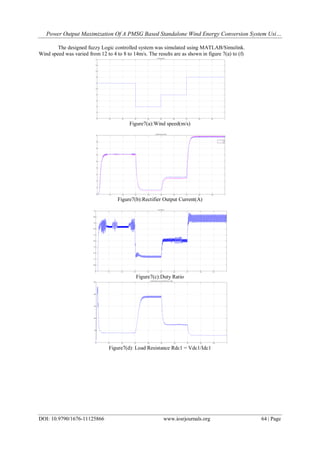
The designed fuzzy Logic controlled system was simulated using MATLAB/Simulink.
Wind speed was varied from 12 to 4 to 8 to 14m/s. The results are as shown in figure 7(a) to (f)
Figure7(a):Wind speed(m/s)
Figure7(b):Rectifier Output Current(A)
Figure7(c):Duty Ratio
Figure7(d): Load Resistance Rdc1 = Vdc1/Idc1
Power Output Maximization Of A PMSG Based Standalone Wind Energy Conversion System Usi…
DOI: 10.9790/1676-11125866 www.iosrjournals.org 65 | Page
Figure7(e):Speed of rotation (rad/s)
Figure 7(f): Power Output(Watts).
Figure 8: Power Output without MPPt(Watts).
From figure 7, for wind speeds of 8, 12 and 14m/s, the maximum power is 1785,6000 and 9550W
respectively. This is achieved at speeds of rotation of 100,153 and 180rads/s respectively. This has been
achieved as shown in Figures 8(e) and 8(f).
As the wind speed changed, the fuzzy logic controller changed the duty cycle of the DC-DC boost
converter (Figure7(c)) according to the error between the reference current and the rectifier output current (Fig.7
(b)), resulting in a variation of the load seen by the PMSG (Fig.7 (d)). As a result, the voltage at the terminals of
the PMSG changed. Since the speed of rotation is proportional to the terminal voltage, it varied accordingly
(Fig.7 (e)). Electromagnetic torque is proportional to current and thus follows current variation to track its
reference value. Consequently, the controller was able to track the reference maximum power for various wind
speeds (Fig.7 (f)).
Figure 8 shows the Power output variation without MPPT.It can be seen that the introduction of the
MPPT controller significantly increases the Power Output.
V. Conclusion
A Fuzzy Logic Controller for MPPT was designed and developed. It was shown that the designed
controller is able to track reference maximum power for the WECS with good accuracy for fluctuating wind
speeds. In this way the power output of the wind energy conversion system is maximized for varying wind
speeds.
References
[1] “Renewables global status report,” Paris, France, 2013.
[2] Huynh Quang Minh, NolletFrédéric, EssounbouliNajib andHamzaouiAbdelaziz, "Control of Permanent Magnet Synchronous
Generator Wind Turbine for Stand-alone System using Fuzzy Logic,"Atlantis Press,2011
[3] M. Stiebler, Wind Energy Systems for ElectricPower Generation, 2008.
Power Output Maximization Of A PMSG Based Standalone Wind Energy Conversion System Usi…
DOI: 10.9790/1676-11125866 www.iosrjournals.org 66 | Page
[4] AndoniUrtasun, Pablo Sanchis, and Luis Marroyo, "Small Wind Turbine Sensorless MPPT: RobustnessAnalysis and Lossless
Approach,"IEEE Transactions On Industry Applications, Vol. 50, No. 6, November/December 2014.
[5] Jogendra Singh Thongam1 and MohandOuhrouche, “MPPT Control Methods in Wind Energy Conversion
Systems,"www.intechopen.com, 2011.
[6] Morimoto S., Nakayama H., Sanada M., Takeda Y, "Sensorless outputmaximization control for variable-speed wind generation
system usingIPMSG,"IEEE Transactions on Industry Applications, Vol. 41, no. 1,2005.
[7] S.M. RazaKazmi, H. Goto, G. Hai-Jiao, and O.Ichinokura," Review and critical analysis of the research papers published till date on
maximum power point tracking in wind energy conversion system," in EnergyConversion Congress and Exposition (ECCE), IEEE,
pp. 4075-40822010.
[8] M. A. Abdullah, A. H. M. Yatim, C. W. Tan, and R. Saidur, "A review of maximumpower point tracking algorithms for wind
energy systems," Renewable and sustainable energy reviews, vol. 16, pp. 3220-3227, 2012.
[9] Abdel GhaniAissaoui and Ahmed Tahour, "Application of Fuzzy Logic inControl of Electrical," www.intechopen.com,2011.
[10] Gaurav, AmritKaur, "Comparison between Conventional PID and Fuzzy Logic Controller for Liquid Flow Control: Performance
Evaluation of Fuzzy Logic and PID Controller by Using MATLAB/Simulink," International Journal of Innovative Technology and
Exploring Engineering (IJITEE) ISSN: 2278-3075, Volume-1, Issue-1, June 2012
[11] S. Vijayalakshmi, Saikumar, Sandip and Sirdhar,"Modelling and Control of a wind turbine using permanent magnet synchronous
generator," International Journal of Engineering Science and Technology, vol. 3, no. 3,2011.
[12] Z.Lubosny,Wind Turbine Operation in Electric Power Systems, Springer , 2003
[13] Alejandro Rolan, AlvaroLuna, Gerardo Vazquez, Daniel Aguilar, Gustavo Azevedo, “Modeling of a Variable Speed Wind Turbine
with a Permanent Magnet Synchronous Generator ”IEEE International Symposium on Industrial Electronics (ISlE 2009) Seoul
Olympic Parktel, Seoul, Korea July 5-8, 2009.
[14] Muhammad H. Rashid, Power Electronics Handbook, Academic Press,2001.
[15] E. Koutroulis and K. Kalaitzakis, “Design of a maximum power tracking system for wind-energy-conversion applications,” IEEE
Trans. Ind.Electron., vol. 53, no. 2, pp. 486–494, Apr. 2006.
[16] M. B. Sharifian, Maximum power control of variable speed wind turbine connected to permanent magnet synchronous generator
using chopper equipped with superconductive inductor, Journal of Applied Sciences 9, pages 777-782,2009
[17] Huynh Quang Minh, Ngo Cao Cuong, Tran NguyenChau, "AFuzzy-Logic Based MPPT Method for Stand-Alone Wind Turbine
System,"American Journal of Engineering Research (AJER),Volume-3, Issue-9, pp-177-184,2014.

I011125866

  • 1.
    IOSR Journal ofElectrical and Electronics Engineering (IOSR-JEEE) e-ISSN: 2278-1676,p-ISSN: 2320-3331, Volume 11, Issue 1 Ver. II (Jan. – Feb. 2016), PP 58-66 www.iosrjournals.org DOI: 10.9790/1676-11125866 www.iosrjournals.org 58 | Page Power Output Maximization of A PMSG Based Standalone Wind Energy Conversion System Using Fuzzy Logic Ndirangu J.G1 , NderuJ.N1 , Maina C.M2 , Muhia A.M1 1 (Department of Electrical and Electronic Engineering,Jomo Kenyatta University of Agriculture and Technology (JKUAT),Kenya) 2 (Department of Electrical and Power Engineering, Technical University of Kenya) Abstract: This paper proposes a Fuzzy Logic Controller for Maximum Power Point Tracking of a case study wind energy conversion system (WECS).The system consists of a standalone fixed pitch, variable speed wind turbine directly coupled to a permanent magnet synchronous generator (PMSG), an uncontrolled diode rectifier, a dc-dc boost converter, a fuzzy logic based controller and a load. For a given wind speed, there is an optimum speed of rotation that gives maximum power. The aim of the maximum power point tracking controller is to drive the WECS at the optimum speed that corresponds to maximum power at any wind speed. The designed Fuzzy Logic Controllerdetermines the duty cycle D that yields optimum speed for maximum power extraction from the WECS for various wind speeds. It then applies this D to the DC-DC boost converter to control the speed of rotation of the PMSG to track maximum power point curve.Simulation results show that the designed system is able to extract maximum power for varying wind speeds. Keywords -Fuzzy Logic Controller, MPPT,PMSG,WECS I. Introduction Windcapacity is growing very quickly due to its increasingly competitive prices. During 2012, almost 45 GW began operation, and from the end of 2007 through 2012, annual growth rates of cumulative wind power capacity averaged 25% [1]. In recent years, the production of electricity from renewable energy sources like wind energy increases due to environmental problems and the shortage of traditional energy sources in the near future [2]. Wind power depends mainly on geographical conditions and weather conditions. Therefore, it is necessary to design a system capable of generating maximum power under these constraints [3]. Up to now, most of the wind energy generation systems have been implemented in large-scale WECS in the Megawatt level. However, small-scale WECS can provide a good alternative in urban areas and residential applications in remote places where connection to grid is almost impossible. For small wind generation (typically less than 100 kW), a permanent-magnet synchronous generator (PMSG) connected to a diode bridge is preferred because of its reliability, simple control, high efficiency, and low cost [4]. MPPT algorithms for WECS researched so far are mainly classified into three categories namely Tip Speed Ratio (TSR) control, Power Signal Feedback (PSF) controland Hill-Climb Search(HCS) Control. The TSR control method controls the rotational speed of the generator in order to maintain TSR (the ratio between blade tip speed to the wind speed) at the optimum value in order to extract maximum power out of the turbine. This method requires knowledge of the optimum TSR,wind speed, and turbine speed in order to extract maximum power point[5] In PSF control, it is required to have the knowledge of the wind turbine’s maximum power curve, and track this curve through its control mechanisms. Using wind speed or rotor speed as an input, the reference power is generated either using the recorded maximum power curve or using the mechanical power equation [5]. A slight variant of PSF is the optimal torque (OT) technique published in [6] which makes use of the quadratic optimal torque curve.The HCS control (or Perturb & Observe) algorithm continuously searches for the peak power of the wind turbine. Depending upon location of an operating point and the relation between changes in power and speed, the tracking algorithm computes the optimum control signal in order to drive the system to the point of maximum power [5].According to [7], there is no difference between the PSF and the OT method in terms of the performance and the complexity of implementation. The main advantage of HCS control over TSR and PSF control is that it neither requires knowledge of the maximum power nor the wind velocity to determine MPP. It is independent, simple, and flexible. However, it fails to reach the maximum power points under rapid wind variations if it is used for large and medium inertia wind turbines. Moreover, the problem of choosing an appropriate step-size is not an easy task; where larger step-size means faster response and less efficiency while, on the other hand, smaller step-size improves the efficiency but slower the convergence speed [8].Hence, for conventional HCS control, there is always a tradeoff between the tracking speed and control efficiency. Another challenge is that in the normal HCS, the direction i.e. the sign of the next perturbation is decided by the increase or decrease in power due to the previous perturbation. Being blind to the wind change, this rule can be misleading as the sign might get dictated by the
  • 2.
    Power Output MaximizationOf A PMSG Based Standalone Wind Energy Conversion System Usi… DOI: 10.9790/1676-11125866 www.iosrjournals.org 59 | Page change in wind rather than the applied perturbation. This wrong decision leads to the failure in keeping track of maximum power point [7]. In this paper, a Fuzzy Logic Controller (FLC) is used for maximum power point tracking. Fuzzy control works as well for complex nonlinear multi-dimensional systems, systemswith parameter variation problem or where the sensor signals are not precise. It is basically nonlinear and adaptive in nature, giving robust performance under parameter variation and load disturbance effect.[9] It has been shown that a properly designed direct fuzzy controller can outperform conventional proportional integral derivative (PID) controllers,[10]offering the following advantages: It can work with less precise inputs, does not need fast processors, more robust than other non-linear controllers and has better stability, small overshoot, and fast response. II. System Description The WECS proposed in this paper consists of a wind turbine coupled to a PMSG to power a stand- alone system. A three-phase diode bridge rectifier is used for the AC/DC conversion. A boost converter (DC/DC) is used to vary the rotor speed. The proposed MPPT strategy uses a fuzzy logic controller to track the maximum power point curve of the WECS by varying the duty cycle of the DC-DC boost converter. The proposed control algorithm is able to achieve fast dynamic responses. The block diagram of the proposed system is shown in fig 1. Figure1: Block diagram of the proposed system. III. System Submodels A. Wind Turbine Model The mechanical power extracted by the turbine is given by: [11] 𝑃𝑚 = 1 2 𝜌𝜋𝑅2 𝑣3 𝐶𝑝 ( 1) Where:𝑃𝑚 = Mechanical Power(W), 𝜌= Air density in kg/m3 𝑅= Radius of the turbine blade in m,𝑣 = wind speed in m/s and 𝐶𝑝 = power coefficient.𝐶𝑝is a function of the tip speed ratio(TSR) 𝜆 as well as the blade pitch angle 𝛽 for pitch controlled wind turbine. In this work, the case study wind turbine has a fixed pitch hence𝛽 is set to zero.Hence𝐶𝑝 = 𝐶𝑝 𝜆 and 𝜆 = 𝑅𝜔 𝑣 where 𝜔 = rotation speed of the rotor.𝐶𝑝has a maximum value of 0.593 known as Beltz limit.From equation (1), when controlling the wind turbine,𝐶𝑝 is useful as it is the only variable and controllable parameter. Wind speed 𝑣 is a variable but not controllable. There is a value of λ =𝜆 𝑜𝑝𝑡 for which 𝐶𝑝 is maximum.If λ is maintained at its optimal value 𝜆 𝑜𝑝𝑡 the power coefficient is at its maximum value 𝐶𝑝𝑚𝑎𝑥 = 𝐶𝑝 𝜆 𝑜𝑝𝑡 thus delivering maximum power for a given wind speed𝑣. Maximum power is given by: 𝑃𝑚𝑎𝑥 = 1 2 𝜌𝜋𝑅2 𝑣3 𝐶𝑝 𝜆 𝑜𝑝𝑡 (2) Where 𝜆 𝑜𝑝𝑡 = 𝜔𝑅 𝑣 → 𝜔 𝑜𝑝𝑡 = 𝜆 𝑜𝑝𝑡 𝑣 𝑅 Substituting 𝜔 𝑜𝑝𝑡 and rearranging gives: 𝑃𝑚𝑎𝑥 = 1 2 𝜌𝜋𝑅5 𝐶 𝑝𝑚𝑎𝑥 𝜆 𝑜𝑝𝑡 3 . 𝜆 𝑜𝑝𝑡 3 𝑣3 𝑅3 (3) This equation can be expressed as: 𝑃𝑚𝑎𝑥 = 𝐾𝑜𝑝𝑡 𝜔 𝑜𝑝𝑡 3 (4) Where 𝐾𝑜𝑝𝑡 = 0.5𝜌𝜋 𝐶 𝑝𝑚𝑎𝑥 𝑅5 𝜆 𝑜𝑝𝑡 3 and 𝜔 𝑜𝑝𝑡 = 𝜆 𝑜𝑝𝑡 𝑣 𝑅 The aerodynamic torque is given by the ratio between the power extracted from the wind 𝑃𝑚 and the turbine rotor speed. 𝑇 𝑚 = 𝑃 𝑚 𝜔 𝑚 (5) The optimum torque for a given wind speed is thus given by:
  • 3.
    Power Output MaximizationOf A PMSG Based Standalone Wind Energy Conversion System Usi… DOI: 10.9790/1676-11125866 www.iosrjournals.org 60 | Page 𝑇𝑜𝑝𝑡 = 𝑃 𝑚𝑎𝑥 𝜔 𝑜𝑝𝑡 = 𝐾𝑜𝑝𝑡 𝜔 𝑜𝑝𝑡 2 (6) By analyzing the power produced by the wind turbine at various wind and rotor speeds, it can be seen that an optimum power coefficient constant 𝐾𝑜𝑝𝑡 exists. This coefficient shows the generated power associated with the corresponding optimum rotor speed. It is calculated from individual wind turbine characteristics. The power coefficient𝐶𝑝 can be utilized in the form of look-up tables or in form of a function. The second approach is used in this paper where the power coefficient is defined as a function of the tip-speed ratio λ and the blade pitch angle𝛽 as [12]: 𝐶𝑝 λ, 𝛽 = 0.5( 116 𝑄 − 0.4𝛽 − 5)𝑒 − 21 𝑄 (7) Where 𝑄 = 1 1 λ+0.08𝛽 − 0.035 1+𝛽3 B. Permanent Magnet Synchronous Generator(PMSG) Model The dynamic model of PMSG can be represented in thesynchronous reference(d-q) system using the following equations[13]: 𝑑𝑖 𝑑 𝑑𝑡 = 1 𝐿 𝑑 (−𝑅𝑠 𝑖 𝑑 + 𝜔𝑒 𝐿 𝑞 𝑖 𝑞 + 𝑢 𝑑 ) (9) 𝑑𝑖 𝑞 𝑑𝑡 = 1 𝐿 𝑞 (−𝑅𝑠 𝑖 𝑞 + 𝜔𝑒 𝐿 𝑑 𝑖 𝑑 + 𝜓𝑓 + 𝑢 𝑞) (10) where subscripts d and q refer to the physical quantities thathave been transformed into the d-q synchronous rotatingreference frame, 𝑅𝑠is the stator resistance [Ω], Ldand Lqare the inductances [H] of the generator on the d and q axis respectively, ψfis the permanent magnetic flux[Wb] and 𝜔𝑒is the electrical rotating speed [rad/s] of thegenerator, defined by: 𝜔𝑒 = 𝑃𝜔 𝑚 (11) Where P is the number of pole pairs of the generator. The electromagnetic torque equation is given by: 𝑇𝑒 = 1.5𝑃( 𝐿 𝑑 − 𝐿 𝑞 𝑖 𝑑 𝑖 𝑞 + 𝑖 𝑞 𝜓𝑓) (12) The active power Pgen(W) and reactive power Qgen(VAr)of the PMSG are given respectively by: 𝑃𝑔𝑒𝑛 = 1.5(𝑢 𝑑 𝑖 𝑑 + 𝑢 𝑞 𝑖 𝑞) (13) 𝑄 𝑔𝑒𝑛 = 1.5(𝑢 𝑞 𝑖 𝑑 − 𝑢 𝑑 𝑖 𝑞) (14) Rectifier Model The output from the PMSG is rectified using a three-phase uncontrolled diode rectifier. The schematic of the 3phase diode rectifier is shown in fig.2 Figure2: Schematic 3Phase Diode Rectifier The output DC voltage 𝑉𝑑𝑐1 of the rectifier depends on the line voltage as below:[14] 𝑉𝑑𝑐1 = 3 𝜋 𝑉𝐿𝐿 = 3 2 𝜋 𝑉𝐿𝐿 𝜋 6 −𝜋 6 (15) where𝑉𝑑𝑐1 is the rectifier output voltage and 𝑉𝐿𝐿 is the generator line to line output voltage. 𝑉𝐿𝐿 = 3𝑥 𝑉𝑔 (16) From this, the relationship between 𝑉𝑑𝑐1 and phase voltage Vg is derived as: 𝑉𝑑𝑐1 = 3 6 𝜋 𝑉𝑔 (17) Similarly, the relationship between 𝐼𝑑𝑐1and phase current 𝐼𝑔 𝐼𝑑𝑐1 = 𝜋 6 𝐼𝑔 (18) The generator power output is then calculated as:
  • 4.
    Power Output MaximizationOf A PMSG Based Standalone Wind Energy Conversion System Usi… DOI: 10.9790/1676-11125866 www.iosrjournals.org 61 | Page 𝑃𝑔 = 3𝑉𝑔 𝐼𝑔 = 𝑉𝑑𝑐1 𝐼𝑑𝑐1 (19) The resistance value per phase of the rectifier circuit from the viewpoint of ac side is 𝑅 𝑔 while the load resistance seen by the rectifier is 𝑅 𝑑𝑐1. These are given by: 𝑅 𝑔 = 𝑉 𝑔 𝐼 𝑔 (20) 𝑅 𝑑𝑐1 = 𝑉 𝑑𝑐 1 𝐼 𝑑𝑐 1 (21) DC-DC Boost Converter Model As the PMSG voltage is variable with the wind speed, the DC output power of the rectifier is also variable. A boost DC-DC converter is used for maintaining the DC output voltage at a constant value 𝑉𝑑𝑐2.[15]. The relation between the output and input voltages and currents of the DC-DC boost converter depends on the duty ratio D defined as a ratio of the switch on time tothe sum of the on and off times For a constant frequency operation [14]: 𝐷 = 𝑡 𝑜𝑛 𝑡 𝑜𝑛 +𝑡 𝑜𝑓𝑓 = 𝑡 𝑜𝑛 𝑇 (22) The output voltage and current of the boost converter are then defined as: 𝑉𝑑𝑐2 = 1 (1−𝐷) 𝑉𝑑𝑐1 (23) 𝐼𝑑𝑐2 = (1 − 𝐷)𝐼𝑑𝑐1 (24) where𝑉𝑑𝑐2and 𝐼𝑑𝑐2 are the output voltage and current of the DC-DC boost converter respectively while 𝑉𝑑𝑐1and 𝐼𝑑𝑐1 are the input voltage and current. If a load resistance 𝑅 𝐿is connected at the output of the DC-DC boost converter,𝐼𝑑𝑐2 can be expressed as: 𝐼𝑑𝑐2 = 𝑉 𝑑𝑐 2 𝑅 𝐿 (25) Substituting𝑉𝑑𝑐1 and 𝐼𝑑𝑐1 in (21) we get 𝑅 𝑑𝑐1 = (1 − 𝐷)2 𝑉 𝑑𝑐 2 𝐼 𝑑𝑐 2 (26) Using (25) we get 𝑅 𝑑𝑐1 = (1 − 𝐷)2 𝑅 𝐿 (27) where𝑅 𝐿is the load resistance in Ohms. Thus from the viewpoint of the rectifier, the boost converter and the load resistance 𝑅 𝐿 can be considered a variable resistance 𝑅 𝑑𝑐1 varied by changing the duty ratio D. The expression for the resistance 𝑅 𝑔seen by the generator can be obtained by substituting 𝑉𝑑𝑐1 and 𝐼𝑑𝑐1in terms of 𝑉𝑔and 𝐼𝑔 giving 𝑅 𝑔 = 𝜋2 18 𝑅 𝑑𝑐1 (28) And finally, substituting 𝑅 𝑑𝑐1 we get 𝑅 𝑔 = 𝜋2 18 (1 − 𝐷)2 𝑅 𝐿 (29) From the foregoing analysis, it can be appreciated that the PMSG sees the rectifier and boost converter as a variable load resistance 𝑅 𝑔 which is a function of the duty ratio D. By varying the load resistance the generator output voltage 𝑉𝑔 can be controlled [15]. Since 𝑉𝑔is proportional to speed of rotation 𝜔,[16][17] then by controlling the duty ratio D we can be able to control the speed of rotation 𝜔. Fuzzy Logic Controller (FLC) Model The inputs to the FLC are: Error 𝐸 𝑘 = 𝐼𝑟𝑒𝑓 − 𝐼𝑑𝑐 and change in this error ΔE(k) = E(k) −E(k −1). Output is the duty cycle D that is fed to the switch of the DC-DC boost converter. The block of the fuzzy logic controller is shown in fig3. Figure3: Block diagram of the Fuzzy Logic Controller.
  • 5.
    Power Output MaximizationOf A PMSG Based Standalone Wind Energy Conversion System Usi… DOI: 10.9790/1676-11125866 www.iosrjournals.org 62 | Page Themodel of theproposed of the fuzzy logic controller is shown in fig4. Figure4: Model of the Proposed Fuzzy Logic Controller. The fuzzification module converts the crisp values of the control inputs i.e. error and change in error into fuzzy values or fuzzy membership functions. The data base and the rules form the knowledge base which is used to obtain the inference relation. The data base contains a description of input and output variables using fuzzy sets. The rule base is essentially the control strategy of the system. Itcontains a collection of fuzzy conditional statements expressed as a set of IF-THEN rules such as: R(1) : If Error is Negative Large and Change in Error is Negative LargeTHEN D is Negative Large For the given rule base, the fuzzy controller determines the rule base to be fired for the specific input signal condition and then computes the effective control action(Duty Ratio D).The mathematical procedure of converting fuzzy values into crisp values is known as defuzzification. Centre of Gravity (COG) defuzzification method is used in this paper. The designed control algorithm is as follows: 1. Measure generator speed, ω. 2. Determine the reference power using (4) 3. This power reference is then used to calculate the DCcurrent reference by measuring the rectifier outputvoltage, Vdc1as given by: 𝐼𝑟𝑒𝑓 = 𝑃𝑟𝑒𝑓 𝑉𝑑𝑐1 4. The error between the reference dc current andmeasured dc current and the change in this error are the inputs to the Fuzzy Logic Controller. The output of the FLC is the duty cycle of the switch controlling the DC-DC boost converter. The membership functions for Error (E) and Change in Error (ΔE) are constructed as fig.5
  • 6.
    Power Output MaximizationOf A PMSG Based Standalone Wind Energy Conversion System Usi… DOI: 10.9790/1676-11125866 www.iosrjournals.org 63 | Page Figure5: Membership functions for Error(E), Change in Error (ΔE)and Duty Ratio(D) The rule base for the Fuzzy Logic Controller is designed as in Table 1. Table1: Rule base for the Fuzzy Logic Controller Error/ΔError NL NS ZE PS PL NL NL NL NS NS ZE NS NL NS NS ZE PS ZE NS NS ZE PS PS PS NS ZE PS PS PL PL ZE PS PS PL PL The parameters of the case study wind energy conversion system are in Table2. Table2: Parameters of case study wind energy conversion system Wind Turbine Parameter Units Value Rated Power Watts 6000 Base Wind Speed m/s 12 Air density kg/m3 1.225 Number of blades 3 Rotor Radius m 2.1 Optimum coefficient Kopt Nm/(rad/s2) 1.67E-03 PMSG Parameter Units Value Rated Power Watts 6000 Armature resistance Rs Ohms 0.425 Stator Inductance Ls mH 8.4 Flux linkage Wb 0.433 Rated speed, W rad/s 153 Rated Current Ia A 12 Rated Torque Nm 40 Load Resistance RL Ohms 1000 Inertia J 0.0008 Viscous Damping B 0.002 Pole Pairs 5 Static friction 0.001 IV. Simulation Results Wind turbine power was plotted against speed of rotation for various wind speeds according to(1). The plot is shown in figure 5. Figure6: Turbine power vs speed of rotation for various wind speeds
  • 7.
    Power Output MaximizationOf A PMSG Based Standalone Wind Energy Conversion System Usi… DOI: 10.9790/1676-11125866 www.iosrjournals.org 64 | Page The designed fuzzy Logic controlled system was simulated using MATLAB/Simulink. Wind speed was varied from 12 to 4 to 8 to 14m/s. The results are as shown in figure 7(a) to (f) Figure7(a):Wind speed(m/s) Figure7(b):Rectifier Output Current(A) Figure7(c):Duty Ratio Figure7(d): Load Resistance Rdc1 = Vdc1/Idc1
  • 8.
    Power Output MaximizationOf A PMSG Based Standalone Wind Energy Conversion System Usi… DOI: 10.9790/1676-11125866 www.iosrjournals.org 65 | Page Figure7(e):Speed of rotation (rad/s) Figure 7(f): Power Output(Watts). Figure 8: Power Output without MPPt(Watts). From figure 7, for wind speeds of 8, 12 and 14m/s, the maximum power is 1785,6000 and 9550W respectively. This is achieved at speeds of rotation of 100,153 and 180rads/s respectively. This has been achieved as shown in Figures 8(e) and 8(f). As the wind speed changed, the fuzzy logic controller changed the duty cycle of the DC-DC boost converter (Figure7(c)) according to the error between the reference current and the rectifier output current (Fig.7 (b)), resulting in a variation of the load seen by the PMSG (Fig.7 (d)). As a result, the voltage at the terminals of the PMSG changed. Since the speed of rotation is proportional to the terminal voltage, it varied accordingly (Fig.7 (e)). Electromagnetic torque is proportional to current and thus follows current variation to track its reference value. Consequently, the controller was able to track the reference maximum power for various wind speeds (Fig.7 (f)). Figure 8 shows the Power output variation without MPPT.It can be seen that the introduction of the MPPT controller significantly increases the Power Output. V. Conclusion A Fuzzy Logic Controller for MPPT was designed and developed. It was shown that the designed controller is able to track reference maximum power for the WECS with good accuracy for fluctuating wind speeds. In this way the power output of the wind energy conversion system is maximized for varying wind speeds. References [1] “Renewables global status report,” Paris, France, 2013. [2] Huynh Quang Minh, NolletFrédéric, EssounbouliNajib andHamzaouiAbdelaziz, "Control of Permanent Magnet Synchronous Generator Wind Turbine for Stand-alone System using Fuzzy Logic,"Atlantis Press,2011 [3] M. Stiebler, Wind Energy Systems for ElectricPower Generation, 2008.
  • 9.
    Power Output MaximizationOf A PMSG Based Standalone Wind Energy Conversion System Usi… DOI: 10.9790/1676-11125866 www.iosrjournals.org 66 | Page [4] AndoniUrtasun, Pablo Sanchis, and Luis Marroyo, "Small Wind Turbine Sensorless MPPT: RobustnessAnalysis and Lossless Approach,"IEEE Transactions On Industry Applications, Vol. 50, No. 6, November/December 2014. [5] Jogendra Singh Thongam1 and MohandOuhrouche, “MPPT Control Methods in Wind Energy Conversion Systems,"www.intechopen.com, 2011. [6] Morimoto S., Nakayama H., Sanada M., Takeda Y, "Sensorless outputmaximization control for variable-speed wind generation system usingIPMSG,"IEEE Transactions on Industry Applications, Vol. 41, no. 1,2005. [7] S.M. RazaKazmi, H. Goto, G. Hai-Jiao, and O.Ichinokura," Review and critical analysis of the research papers published till date on maximum power point tracking in wind energy conversion system," in EnergyConversion Congress and Exposition (ECCE), IEEE, pp. 4075-40822010. [8] M. A. Abdullah, A. H. M. Yatim, C. W. Tan, and R. Saidur, "A review of maximumpower point tracking algorithms for wind energy systems," Renewable and sustainable energy reviews, vol. 16, pp. 3220-3227, 2012. [9] Abdel GhaniAissaoui and Ahmed Tahour, "Application of Fuzzy Logic inControl of Electrical," www.intechopen.com,2011. [10] Gaurav, AmritKaur, "Comparison between Conventional PID and Fuzzy Logic Controller for Liquid Flow Control: Performance Evaluation of Fuzzy Logic and PID Controller by Using MATLAB/Simulink," International Journal of Innovative Technology and Exploring Engineering (IJITEE) ISSN: 2278-3075, Volume-1, Issue-1, June 2012 [11] S. Vijayalakshmi, Saikumar, Sandip and Sirdhar,"Modelling and Control of a wind turbine using permanent magnet synchronous generator," International Journal of Engineering Science and Technology, vol. 3, no. 3,2011. [12] Z.Lubosny,Wind Turbine Operation in Electric Power Systems, Springer , 2003 [13] Alejandro Rolan, AlvaroLuna, Gerardo Vazquez, Daniel Aguilar, Gustavo Azevedo, “Modeling of a Variable Speed Wind Turbine with a Permanent Magnet Synchronous Generator ”IEEE International Symposium on Industrial Electronics (ISlE 2009) Seoul Olympic Parktel, Seoul, Korea July 5-8, 2009. [14] Muhammad H. Rashid, Power Electronics Handbook, Academic Press,2001. [15] E. Koutroulis and K. Kalaitzakis, “Design of a maximum power tracking system for wind-energy-conversion applications,” IEEE Trans. Ind.Electron., vol. 53, no. 2, pp. 486–494, Apr. 2006. [16] M. B. Sharifian, Maximum power control of variable speed wind turbine connected to permanent magnet synchronous generator using chopper equipped with superconductive inductor, Journal of Applied Sciences 9, pages 777-782,2009 [17] Huynh Quang Minh, Ngo Cao Cuong, Tran NguyenChau, "AFuzzy-Logic Based MPPT Method for Stand-Alone Wind Turbine System,"American Journal of Engineering Research (AJER),Volume-3, Issue-9, pp-177-184,2014.