Educational Technology: Meaning
Technology derived from Greek word “technic’’ - art or skill
“Logia”- science or study
Science Or study of an art or skill.
Educational Technology combination of terms “Education” and “Technology”
Education: the word education has been derived from the latin verb
“educare” meaning to train, to instruct, to put in, as also to draw out or to
lead forth.
Technology: it is a science of techniques and methods of doing or getting
things done related to any art, science or a particular profession .
Technology as the application of science to the needs of developing new
techniques and applying these techniques.
Educational Technology:
G.O.M leith (1975) defined
Educational Technology as an application of scientific knowledge about
learning and the conditions of learning to improve the effectiveness and
efficiency of teaching and training .
Thus it can be observed that education technology has three important
components:
Defining of educational goals in specific clear terms:
Designing of instructional strategies and learning sequences: and
Evaluation of outcomes so as to obtain indicators of success of
educational strategies.
John (1973) Educational Technology concerns the systematic use of
modern methods and technology in teaching and learning it involves
teachers in a variety of roles, some of which are traditional some still
emerging”.
National council for Educational Technology(NCET) says:
Educational technology is a means for the development, application and
evaluation of three different things:
I) Techniques:
II) ii) Systems;
III) iii) Aids to improve the process of human learning”.
The International commission on the Development of Education
“Educational technology means the intellectual and operational efforts
to re-group or to systematize application of scientific methods for the
organization of equipment and material to optimize the learning
process”.
According to UNESCO specialists, “Educational technology is a
communication process resulting form application of scientific
methods to the behavioural science of teaching and learning.
This communication process may or may not require the use of a media of
such as radio, film, television, broadcasts, and cassettes etc.
The main components of this communication process are:
Goals of behavioral objectives,
Analysis of the characteristics of learners,
Selection and organization of content,
Selection of media,
Evaluation, and
Feedback
B.P. Lulla,: Educational Technology is the application of
scientific methods and techniques to Education”.
Derik Unwin: Educational Technology is concerned with the
application of modern skills and techniques to the
requirements of Education and training”
Robert Glasser describes the process of Educational Technology
in the following components:
Different students learn in different ways and at different rates;
Different kinds of skills, abilities, knowledge and understanding are
required in different ways;
The various elements of instruction themselves have different
learning characteristics;
The elements in the learning process should not be considered
apart from each other as each has some bearing on education;
As far as possible any learning systems should be self correcting
which means that it should have some built-in arrangement of
evaluation and feedback which can be used to improve it.
Davis: Education Technology is concerned with the
problems of Education and training context, and it is
characterized by the disciplined and systematic approach to
the organization of resources for learning” (I.K. Davis,
1971)
W. Kenneth Richmond(1979) : “Educational Technology is
concerned with providing appropriately designed learning
situations which holding in view the objectives of teaching or
training bring to bear the best means of instruction”.
Richmond has stated three characteristics of Educational
technology in his definition:
Designing appropriate learning situation,
Realizing objectives of teaching or training, and
Bringing best means of instruction.
Association for Educational Communications and Technology (AECT)-
Definition and Terminology Committee:
“Educational technology is the study and ethical practice of
facilitating learning and improving performance by creating, using,
and managing appropriate technological processes and resources.”
Elements of the definition
Study:
The theoretical understanding of, as well as the practice of educational
technology, requires continual knowledge construction and refinement through
research.
“Study” refers to information gathering and analysis beyond the traditional
conceptions of research.
The research in educational technology has grown from investigations
attempting to “prove” that media and technology are effective tools for learning.
Ethical practice:
Ethics are not merely “rules and expectations” but are a basis for practice.
Facilitating:
Educational technology claims to facilitate learning rather than to cause or
control learning; that is, it can help create an environment in which learning more
easily could occur.
Facilitating includes the design of the environment, the organizing of resources,
and the providing of tools.
Learning:
The term “learning” does not connote today what it connoted forty years ago.
The simplest type of learning is retention of information.
So today, when educators talk about the pursuit of learning they usually mean
productive, active-use, deep learning.
Improving:
All Areas Of Learning( Effective Learning)
Effective learning, changes in capabilities that carry over into real-world
application.
Performance:
In the context of this definition, performance refers to the learner’s ability
to use and apply and the new capabilities gained.
The definition mentions three major functions that are integral to the
concept of Educational Technology—creating, using, and managing.
Creating:
Creation refers to the research, theory, and practice involved in the
generation of learning environments in many different settings, formal and
non-formal.
Using:
This element refers to the theories and practices related to bringing
learners into contact with learning conditions and resources.
Managing:
project management skills, content delivery system management,
personnel management and information management,
Appropriate:
The term “appropriate” is meant to apply to processes and resources,
denoting suitability for and compatibility with their intended
purposes.
Technological:
Systematic application of scientific or other organized knowledge to
practical tasks.
Processes:
A process can be defined as a series of activities directed toward a
specified result.
Resources:
The many resources for learning are central to the identity of the
field.
Specifications of the Concept
1. Meaning: how it evolved and General aspects of a concept
2. Definition: set of qualities/description By any Individual and
association towards a concept.
3. Concept: how it is? (concept)
4. Nature: Basic Qualities of a concept
5. Feature: quality aspects of the concept.(Durability)
6. Characteristics: physical and generalised aspects.
7. Scope: Coverage, Expansion and range of a concept.
8. Need: why we use it ? or essentiality.
9. Importance: Helpfulness in different situations may be in
present and future.
10.Advantages: Benefits in present.
11.Dis-advantages: concerns or problems at present.
12.Limitations: lacunae that is beyond control.
Education technology is a system of 5M’s
1. Machine
2. Materials
3. Media
4. Men
5. Methods
are interrelated and work together for fulfillment and specific Educational
objectives.
Broad views of ET
ET-1 Hardware Base: The use of equipments for presenting instructional
material such as charts, graphs, models, globe, TV, teaching machine,
projectors – (AVA)
ET-2 Software Base: Refers to the application and scientific principles to
instruction – The view of skinner, Gagne and others psychological
principles of learning are stressed.
Stimulus, response and reinforcement factors in learning-self instructional
material, CAI, PSI,.
ET-3 Modern view of ET
Incorporates both ET 1 & ET 2 through application of system
approach to Education and training.
This view implies planning, implementing and evaluating.
(Strategy – based on organization of task and relationship
centered.)
(Method – based on task centered it is wider term it intends
strategy and techniques.)
NATURE OF EDUCATIONAL TECHNOLOGY
• The process of understanding the comprehensive term
Educational Technology can be compared with the
famous story of an elephant and six blind men.
• Some called a wall, the other considers like a serpent.
some people confuse between the tail and the trunk.
• It is also true that the elephant usually walks in small
steps but sometimes if provoked by environment it also
runs in spurts (spring out, emit).
• The same thing has happened with Educational
Technology.
Technology in Education and Technology of Education
• The use of audio-visual aids, equipments,
machines etc. such a Chalkboard, over Head
Projector (OHP), TV, Computer in education
marks the "Technology in Education".
• Here more importance is given to the media
used for carrying a message.
"Technology of Education“:This approach
characterizes the methodology appropriate to
learners' needs, learning objectives, the process
of learning and teaching as well as availability of
resources.
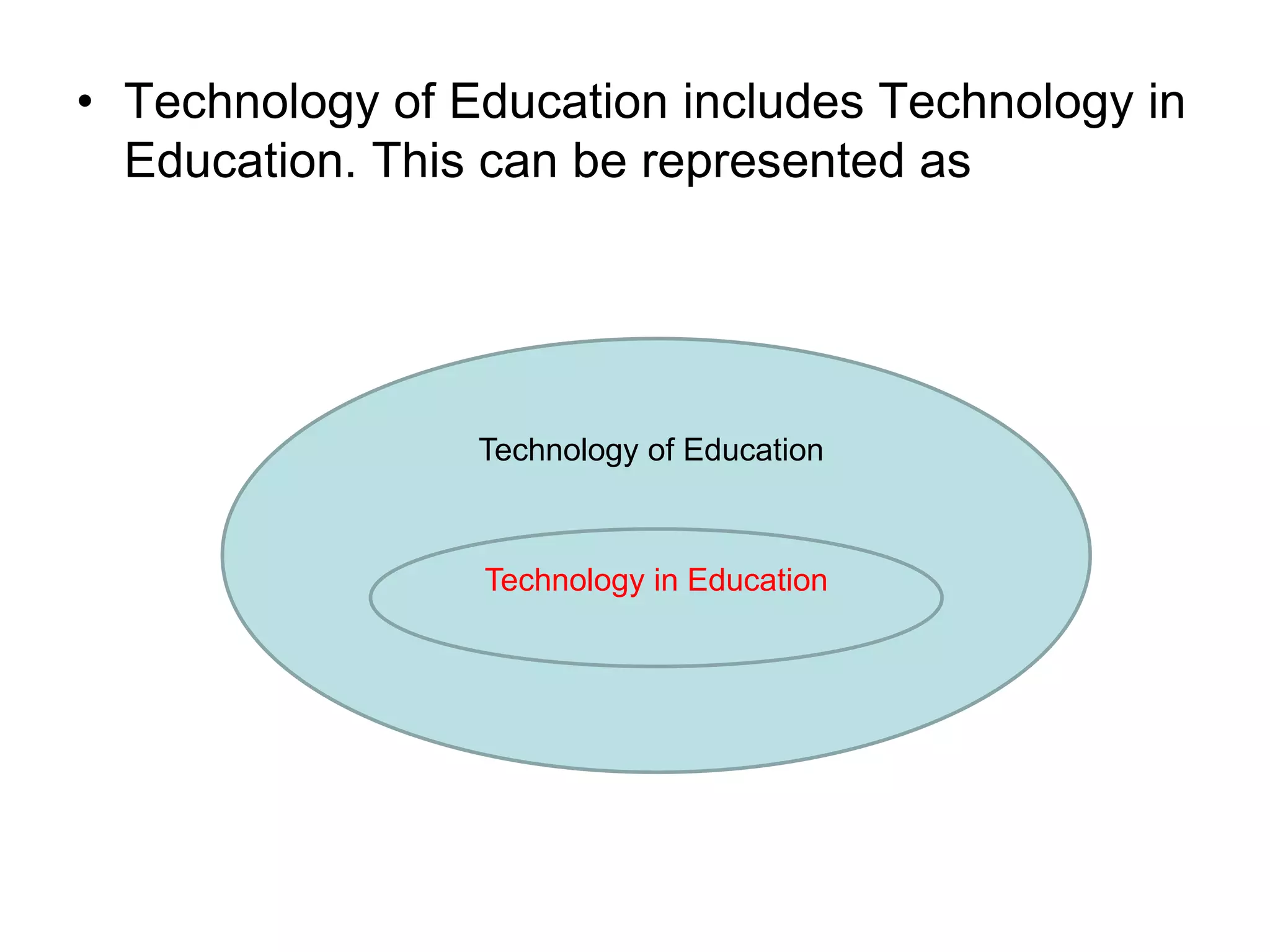
• Technology of Education includes Technology in
Education. This can be represented as
Technology in Education
Technology of Education
• The first big spun in the movement of Technology of Education
came in 1960's when B.F. Skinner propagated his theory of
Programmed Instruction.
• This gave momentum to 'Technology of Education. The concept
of Artificial lntelligence proved to be another spurt. Studies on how
“learning contributed to the development of programmes on
computer”.
• Computer based learning enhanced human learning as it takes
place through dynamic relationships.
• In the year 1949, a powerful medium like Television came to the
scene. This medium had the potential to replace all the teaching
aids available so far.
• The medium could take the learners out of the four walls of the
school. It became a very convenient mode. The live telecast
surpassed all other teaching aids including films.
• The VCR, which came next to educational scene, offered much
more control to the learner.
• CCTV
• Computers
• Mobile phones
• Projectors
• Ipods, laptop, Tablets
• E-learning
• M-learning
• Web based learning-Repositories
• MOOC
• U-Learning, Augmented reality, Wearable
Technology
• Virtual Learning, Virtual Libraries and Virtual
classes
Need of Educational Technology:
1.Make Education more productive.
2. Make Education more individualistic.
3. Give instruction a more scientific base.
4. To make instruction more powerful.
5. To make the access to Education immediate.
6. To make the access of Educational equal.
Educational Technology is important to ,
1. Identify the Educational goals and objectives of the community.
2. Develop appropriate curriculum for the achievement of the stipulated
goals.
3. Analyze the process of Teaching-learning.
4. Develop suitable Teaching-learning materials.
5. Select and develop proper Teaching-learning strategies for obtaining
maximum results.
6. Develop and select appropriate audio-visual aids.
7. Utilize effectively the hardware and software media.
8. Provide essentially feedback and control through Education.
Objectives of ET – Macro level
 Identification of Educational needs.
 Determination of the aims of Education
 Developing of suitable curriculum
 Identification of man, material resources and strategies
 Developing certain models to improve the tg –lg process.
 Identification of major constraints and the ways and means
to overcome them.
 Assisting in vocational opportunities to masses especially
neglected sectors of society.
 Managing the entire Educational system – covering
planning, implementation and evaluation phases.
Micro level
Identifying and analyzing the needs of
1. Determining classroom objectives
2. Analyzing content and organizing in proper sequence.
3. Identification of available Teaching –learning materials.
4. Analyzing the Sub systems like test, resources, materials
and methodologies.
5. Evaluating the effectiveness of class room teaching.
6. Providing appropriate feed back.
The term Education Technology is interpreted in two
distinct ways :
1. To describe the use of Technology in Education ;
2. To imply the concept with the use of Education.
The former is concerned with the use of equipment and the
latter with improving the effectiveness of learning.
Education Technology is making learning experiences practical
and therefore, better related to life’s goals. It has peeped
into the fields of motivation, sensation-perception attention,
evaluation etc.
Educational Technology can be used effectively for formal,
informal, non-formal systems of Education of whatever level
it may be.
SCOPE OF EDUCATIONAL TECHNOLOGY
Educational technology as you know is used to raise the efficiency
of education. But with the passage of time, the system of
education is facing new problems to be tackled.
So, the hardware and software of educational technology are ever
expanding. Therefore, the application of educational technology
is much more than what it was a few decades back.
Mass Education: There has been explosion of population and
knowledge. There is, therefore, a need to educate the masses.
Educational technology has a tremendous application to educate a
large section of people in a limited span of time.
In-this regard, the mass media viz.. TV radio, newspaper and other
modern technologies like computers and information technology (E-mail,
internet, mobile phone etc.) has a lot of scope.
Historical information: Such information is of tremendous importance for
the students to understand any branch of knowledge in its totality. Such
incidents when occur can be recorded with the help of audio video cassette or
documented in the form of a written or printed material. Such documents
become the source of information for learners to learn.
Costly and hazardous experiments: experiments, once conducted
carefully in the laboratory or elsewhere can be recorded with the help of new
electronic technology and be used by teachers and students for effective learning.
Gaming and simulation: This can provide a life like picture of
phenomena in three dimensions. It can also show the operation of different parts
of a phenomenon and the consequences. Children can learn, through play, many
concepts. The gaming and simulation has a great scope in the training of
military personnel and in the field of aviation.
Distance education: Educational technology with its innovative
practiced can educate the learners who cannot come to the classroom
setup for their education. In this regard programmed learning
materials, modules, contact programme, and counseling are some
innovations which can help distance learners.
Collection storing and retrieval of information: Information
can be collected with the help of this new electronic technology both in
audio and in video form. such information can be stored with magnetic
and electronic devices easily and can be retrieved within no time.
Research Information can also be collected and stored in the same
way for research. Not only quantitative data but also qualitative data
can be anlaysed and there lies the role of computer and the different
methods of data analysis methods and techniques development of
programmed learning materials, computer assisted instruction, and
computer assisted language learning packages. facilities of
INTERNET, Website, and INFLIBNET .
National Policy on Education (1986), recommends that,
“Educational Technology will be employed in the spread of
useful, information, the training and retraining of teachers, to
improve quality, sharpen awareness of art and culture,
inculcate abiding values etc., both in the formal and non-
formal sectors.
Maximum use will be made of the available infrastructure.”
The scope of Educational Technology can be accessed from the
following points:
1.Determination of Objectives:
Educational Technology provides different methods and
techniques for writing instructional objectives in
behavioural terms such as Bloom Taxonomy Mager’s
Approach and RCEM Approach.
2.Improvement in Teaching Learning Process:
It helps in improving the teaching learning process and makes it
more purposive. It tries to discuss the concept of teaching,
analysis of teaching process, variables of teaching,
phases and levels of teaching, principles of teaching,
maxims of teaching and relationship between teaching
and learning.
3.Development of Teaching Learning Material:
Teaching learning materials are also as important as anything else in
the teaching learning process. In this age of science and
technology, the materials of teaching cannot be unscientific.
Everything of the society including values of life need be reflected in
the materials. Only right type of material will be able to
modify the behaviour of the learner suitably making him a fit
person for the society.
4. Improvement in Teaching Training:
The change of environment with new curriculum and new
materials need be handled by the teachers.
Right type of training to the teachers is the need of the hour.
Educational Technology can render its valuable help in the training of
teachers also. The use of video tapes and close circuit T.V. will
help the teachers to remodel and reshape their teaching behaviours
suitably.
Smart board, LCD, Radio programmes, Mobile phones,
Blog,podcasting, E-learning, On-line learning, Web based learning,
PPT, computer software, video lessons etc.
It includes micro teaching, simulated teaching, team-
teaching, teacher effectiveness, modification of teacher-
behaviour, class-room interaction and interaction analysis,
etc.
5. Development of Teaching Learning Strategies:
A strategy plays an important role in the hands of a teacher in every learning
situation.
The strategy has to be the right one which should be according to the materials
and is able to bring about effective teaching- learning.
It tries to describe the ways and means of discovering selecting and developing
suitable strategies and tactics of teaching in terms of optimum learning and
available teaching-learning resources; the availability of the different types of
teaching methods, devices and models of teaching-their appropriate selection
and use for the optimum results.
6.Proper Use of Audio Visual Aids:
Audio Visual aids have always played an important role in the teaching-
learning process. They need be used according to the times.
The software aids, the hardware aids, the computer and other such appliances,
equipment etc., have to be used in the present type of teaching-learning
environment. Computer assisted instructions will help the learner as well as
the teacher to achieve the goals of education more conveniently.
7. Utilization of the Sub-System of Education:
Educational Technology considers education as a system operating in a
systematic and scientific way for the achievement of educational
objectives.
For the coverage of its systematic approach, it tries to include the topics
dealing with the theory and principles of a system approach, explaining
education as a system, its different sub-systems in terms of input and output.
It is helpful in solving scientifically educational administrative problems with
the help of system analysis.
8. Development of Curriculum:
Educational Technology is concerned with the designing of a suitable
curriculum for the achievement of the desired objectives.
It is helpful in describing the ways and means of the selection of
suitable learning experiences, organisation of the contents in a
suitable framework in order to bring better results. It provides the scientific
foundation to education as well as develops theories of teaching and learning.
9. Proper Use of Hardware and Software:
These days’ hardware and software are playing an effective
role in the attainment of educational objectives. Educational
Technology helps in the proper use of these aids. It tries to describe
these resources in terms of their specific functions, their
solution, proper handling and maintenance.
10. Provides Feedback:
It provides an appropriate feedback to the learners as well as
teachers for bringing necessary improvement at the preparatory and
implementation stages of their specific acts.
For this purpose, educational technology discusses the ways and
means of suitable evaluation techniques, their planning,
development selection and appropriate use in relation to the
objectives of teaching- learning system.
In this way Educational Technology is concerned with all
those who are connected in any way, directly or indirectly, to
the processes and products of education.
It teaches the teachers the art of teaching, the learners the
science of teach the educational planners the structure of
planning and administrators or managers the skill of managing
or administering the task of teaching and learning.
It works for the individualization of instructions as well for
improving the group dynamics of the class-room.
Therefore, in any way, the scope of the educational technology
should not be confined to the limited boundaries, but it should
be left free for the necessary expansion and development for
carrying out its mission, tasks and objectives.
Educational technology has passed five stages
• First stage – ET linked with Use of AV aids, charts, maps, model,
specimen.
• Second stage- ET linked with electronic revolution Hardware and
software. Projectors TV, Radio, & Tape recorder.
• Third stage- ET with mass media ‘communication revolution’ CAT
became popular.
• Fourth stage- marked by ‘Individualized instruction” system of self
learning.
• Latest concept- ET is influenced by the concept of systems of
engineering or systems approach. ET is a systematic way of
designing, carrying out and evaluating total process of teaching and
learning.
• Up to 14th century – instruction restricted to mouth and then to
manuscript.
• 15th century- printing was developed – books were printed.
• 16th century- Peter Ramus introduced text books in Higher Edn
• 17th century – John Comenius introduced text books for children
with pictures.
Evolution and development of Educational technology
Pre industrial phases
• Instruction process heavily depended upon simple things like the Slate, Book,
Black Board , chair
• Educational technology was considered synonymous to simple aids like
charts and pictures.
• Year 1873 considered as landmarks in the early history of technology of
education or audio visual education, exhibition held at Vienna international
level. (Maps, charts, text books and other equipment)
•1920- “British broadcasting corporation” started school broadcasts
• 1952- USA – 20 states had provision for broadcasting
• 1955- “Team teaching” at Harward university
•1956- B.S. Bloom and USA introduced “Taxonomy of Educational objectives”
•1960 – TV is used for educational purpose
•1960- ‘Interaction model of teaching’ by N. Flander
•1965 – “Personalized system of instruction (PSI) by. Keller
•1965 – CAT – computer functions as a tutor developed by O.K.L. Moore’
1970 – self teaching machine: by Sidney L. Pressey – Ohio state university
• 1974 – computers are used in Educational institution.
Late 1970’s – early 1980’s: programming, drill and
practice;
Late 1980’s – early 1990’s: computer based training
(CBT) with multimedia;
Early 1990’s: Internet-based training (IBT);
Late 1990’s – early 2000: e-Learning;
Late 2000: Social software + free and open content.
2005; M-learning;
Ubiquitous learning.
EVOLUTION OF EDUCATIONAL TECHNOLOGY
Human beings have the potential to create.
This potential has enabled the people to solve problems and learn from
their experiences.
The ancient man tried to communicate through verbal and non-verbal
ways, evolved language and gradually then written and printed
materials were developed.
Later on, the technology of software based on psychology and sociology
came into being. Now, we have mass learning, group learning, and
individual learning in operation.
These technologies have evolved through the past decades of the
nineteenth century. They can be placed in four phases as follows:
i) Audio-visual phase
ii) Cybernetic phase
iii) Psychology-Sociology based phase and
iv) Computer and Telecommunication phase
• Audio-visual Phase: Before the 1950's the term audio-visual
education was used for various teaching aids like blackboard, maps,
radio, films, etc. These were mainly media through which a teacher
presented his messages. The materials developed were not
systematically based on any psychological principles.
• Cybernetic Phase: The word Kybernetes in Greek, means
"steersman", which emphasises the principle of feedback and control.
The feedback refers to a kind of reciprocal interaction between two
or more events in which one activity generates a secondary action
which, in turn redirects the primary action.
• The cybernetics tradition which lays emphasis on feedback is traced
back to the Second World War where there was a need for a
systematic communication and control system. Cybernetics has been
defined as the comparative study of the human (or biological)
control mechanism and electro-mechanical control systems such as
computers.
• Cybernetic principles have some implications for learning
a) The activity involved is geared to the learner's stage of growth -physical
and cognitive in Education
• b) The learner is given an opportunity to perceive meaningful relationships
among the elements of the goal towards which he is working.
• c) The learner is provided with some criterion for indicating to specifically
what progress he is making.
• d) The learner is presented the activity both in verbal and non-verbal context
in varied situations and practice conditions.
Psychology-Sociology Based Phase: It can be traced back
to the learning theory given by Thorndike in 1913. Based on his theory,
Pressey (1926) developed a teaching machine. It provided an automatic
scoring device to the learners on immediate feedback basis. So, this was the
first step towards the formulation of systematic learning.
The theory of B.F. Skinner (1953) i.e., operant conditioning and the work of
Norman A. Crowder opened new chapters in developing Programmed
Learning Materials.
• behaviouristic psychology (Skinner et. al.) cognitive psychology
has also thrown more light on how learning takes place. Piaget
and Bruner, later day constructivist psychologists, have pointed
out that a human individual is not only "taught" by external
forces, but he also learns, constructs his own world - e.g. concept
maps etc.,
• Sociologists, particularly the School of Group Dynamics also
added insights regarding how an individual learns in a group,
through interaction with peers and others.
• Social learning theory; Bandura
• Social constructivism; Vygotski
• In brief, the social sciences -psychology, sociology, anthropology,
etc. have also contributed a lot to understanding of the teaching-
learning process and in turn influenced Educational technology.
Computer and Telecommunication Phase
• Multimedia, E-mail, internet, intranet and website are used
extensively today. There are telecommunication modes through
which instructional materials can be given to students.
• There are many computer software packages developed for
school children in many of the school subjects.
• In India we have Audio-Visual Research Centres, Educational
Media Research Centres and different Departments of
Education and Educational Technology which have been
developing software packages for the education of children.
These four phases do not have watertight compartments. The
different phases are intermingled and can help each other to
grow.
1.2 Hardware and Software – approach to education
components of ET
The term –“Educational Technology” as it is used now a day, is the result of
a new process which –as a whole, includes newly invented technical
Equipment’s, and behavioral sciences.
Education technology has two main components.
1. Hardware.
2. Software.
Hardware – This approach of Educational Technology is a by product of the
scientific and technological developments of the 20th century.
Equipment needed to use software are called hardware.
AVA like – charts, models, film strips, slides, audio cassettes ,projectors,
Radio, tape recorder, television, video, teaching machines, computers,
empty cassettes, empty floppy discs/ CDs unexposed film roll, film
projector, slide projector, over head projector, VCP, VCR, mobile
phone,etc.
Hard ware is also called of Educational Technology -1.
Software – origin to the behavioral sciences and their applied aspects
concerned to the psychology of learning.
• It originated from the efforts of skinner and other behaviorists.
Arthur Melton – software teaching technology is directly related to the
psychology of learning which comprises, behavioral changes resulting
from experience.
• Software technology sometimes referred as Instructional Technology,
Teaching Technology, and Behavioral Technology.
• Software approach is closely associated with task analysis, writing
objectives, selection of learning strategy, reinforcement of correct
responses and constant evaluation.
These materials which are actually used to teach or on which teaching
items are recorded-are called Software.
These are used with the help of hardware equipment’s. Film slides,
Computer software, recorded floppy discs, Recorded CD’s etc.
They are also called Second part of Educational Technology or ET-2.
Principles of uses Hardware and Software:
1.Principle of Purposiveness
2.Principle of economy.
3. Principle of case in the use of aids.
4. Principle of availability.
5. Principle of simplicity.
6. Principle of stimulation.
7. Principle of self-preparation
Educational usefulness:
1. They provide to individual differences of students.
2. They contribute to the economy of time, energy and
resources of teachers and students.
3. They bring clarity and vividness to the subject mater.
4. The proper use of hardware and software helps in
motivating the students.
5. Their uses help in developing and sustaining the interest
of the students.
6. They make the subject matter easy to comprehend.
7. They make the subject –matter interesting.
8. They make teaching – learning attractive, inspirational and
effective.
9. They make the subject – matter lively.
10.They provide ample opportunities for students
participation in the lesson.
Approaches of Educational Technology
: A way or means of reaching something;
1. Physical approach/Hardware approach.
2. Behavioural approach/software approach.
3. System approach/Instructional Designs.
Physical Approach:
It is known as ‘hardware approach’ to education or audio-visual aids, its origin
lies in the application of physical sciences or engineering to education and
training system.
The major assumption
1. A technology or machines is closely related to a technology of
teaching.
2. Teaching machine is the only mechanical aid to be deliberately
designed and invented to fulfill instructional requirements. All other audio-
visual aids are designed and manufactured for improving communication
system not for educational one.
Initially these machines were developed for market rather than education.
the process of teaching learning has been gradually mechanized through the
use of teaching machines, language laboratory, radio, television, tape-
recorder, video-tape and projectors.
The mechanization is being introduced by preservation
transmission and advancement of human knowledge.
The teacher can deal with larger group of students by his
discourse on radio and television.
Silveman (1963) called this type of educational technology
“Relative Technology’.
This refers to borrow and to apply technology, machines and
devices in the process of teaching and learning.
This educational technology performs a simple function in
education.
Behavioural approach:
Meaning: Behavioral approach is application of scientific knowledge and
modifying teacher’s behaviour.
It is also called as training technology and is limited to learners’ behaviour and
teaching behaviour.
Chief exponents are Amidon, Flander, Skinner, Ober and Anderson, Pavlov,
Watson, Thorndike.
Silverman (1968) termed this educational technology as 'constructive educational
technology.'
Both software and hardware approaches are so interlinked that they cannot be
separated from each other. One without the other is incomplete. It is software
approach which makes the hardware approach function well.
Fundamental Principles of Behavioural Approach:
• Teacher behaviour is observable.
• Teacher behaviour is measurable and quantifiable
• Teacher behaviour is social and psychological.
• Teacher behaviour is modifiable.
Teacher is no doubt born but they can also be made.
Objectives: Development of psychomotor skills along with cognitive and
affective domains.
Content of Behavioural approach:
Behavioral approach comprises of the following components & are
1. Meaning and definition of teachers behaviour
2. Assumptions and theories related to teacher behavior.
3. Interaction analysis of classroom behaviour of teachers – process
of observation, encoding, decoding, interpretation and evaluation
of teacher behaviours.
4. Model of classroom interaction.
5. Micro teaching
6. Simulated social skills training
7. Team group training
8. Team teaching
9. Feed back devices
10.Stress on communication. Both student and teacher
11.Teacher behaviour theories.
12.Teaching models.
13.Observation techniques
14.Analyses and modification of teacher behaviour
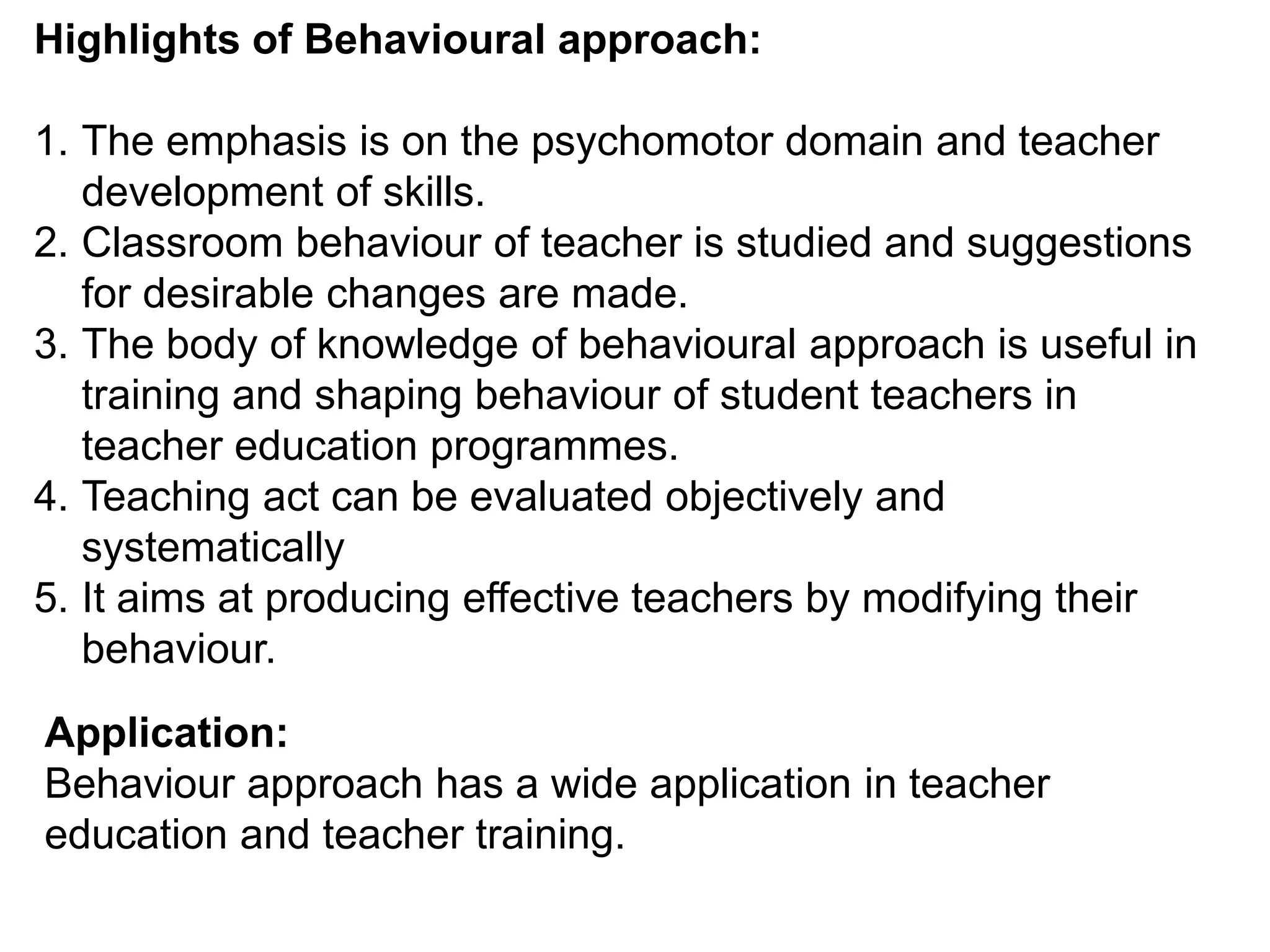
Highlights of Behavioural approach:
1. The emphasis is on the psychomotor domain and teacher
development of skills.
2. Classroom behaviour of teacher is studied and suggestions
for desirable changes are made.
3. The body of knowledge of behavioural approach is useful in
training and shaping behaviour of student teachers in
teacher education programmes.
4. Teaching act can be evaluated objectively and
systematically
5. It aims at producing effective teachers by modifying their
behaviour.
Application:
Behaviour approach has a wide application in teacher
education and teacher training.
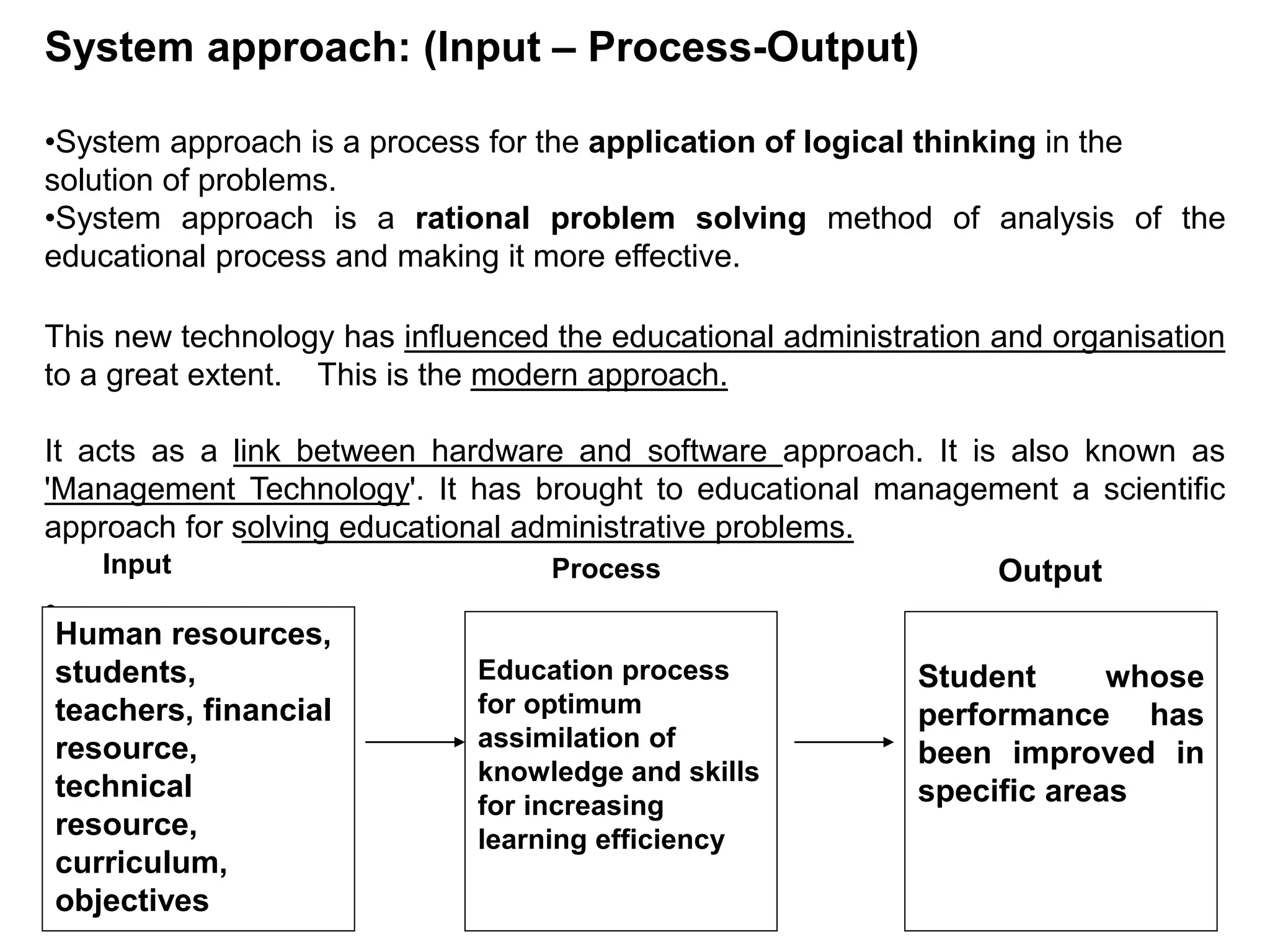
System approach: (Input – Process-Output)
•System approach is a process for the application of logical thinking in the
solution of problems.
•System approach is a rational problem solving method of analysis of the
educational process and making it more effective.
This new technology has influenced the educational administration and organisation
to a great extent. This is the modern approach.
It acts as a link between hardware and software approach. It is also known as
'Management Technology'. It has brought to educational management a scientific
approach for solving educational administrative problems.
•
Input Output
Process
Human resources,
students,
teachers, financial
resource,
technical
resource,
curriculum,
objectives
Education process
for optimum
assimilation of
knowledge and skills
for increasing
learning efficiency
Student whose
performance has
been improved in
specific areas
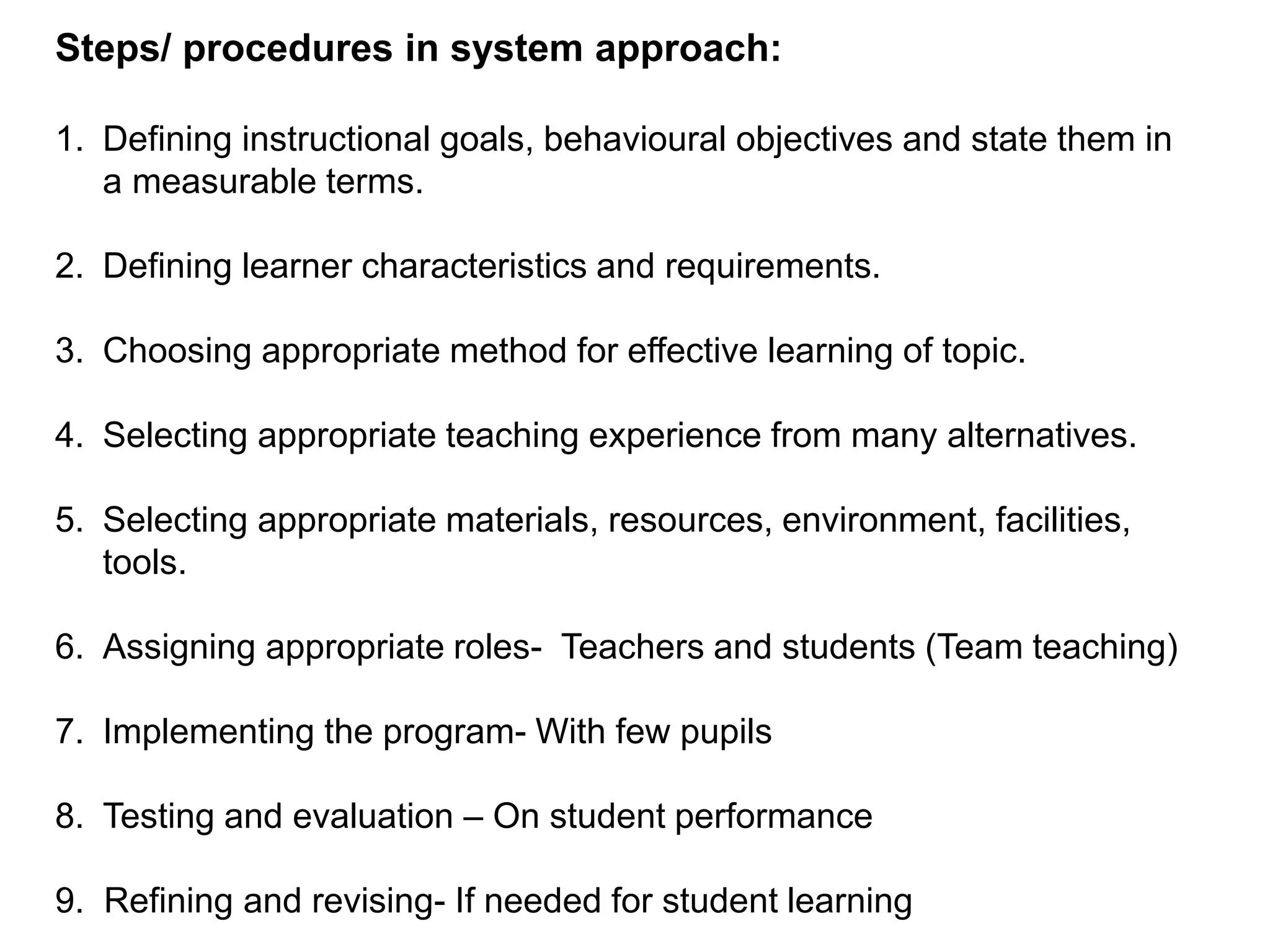
Steps/ procedures in system approach:
1. Defining instructional goals, behavioural objectives and state them in
a measurable terms.
2. Defining learner characteristics and requirements.
3. Choosing appropriate method for effective learning of topic.
4. Selecting appropriate teaching experience from many alternatives.
5. Selecting appropriate materials, resources, environment, facilities,
tools.
6. Assigning appropriate roles- Teachers and students (Team teaching)
7. Implementing the program- With few pupils
8. Testing and evaluation – On student performance
9. Refining and revising- If needed for student learning
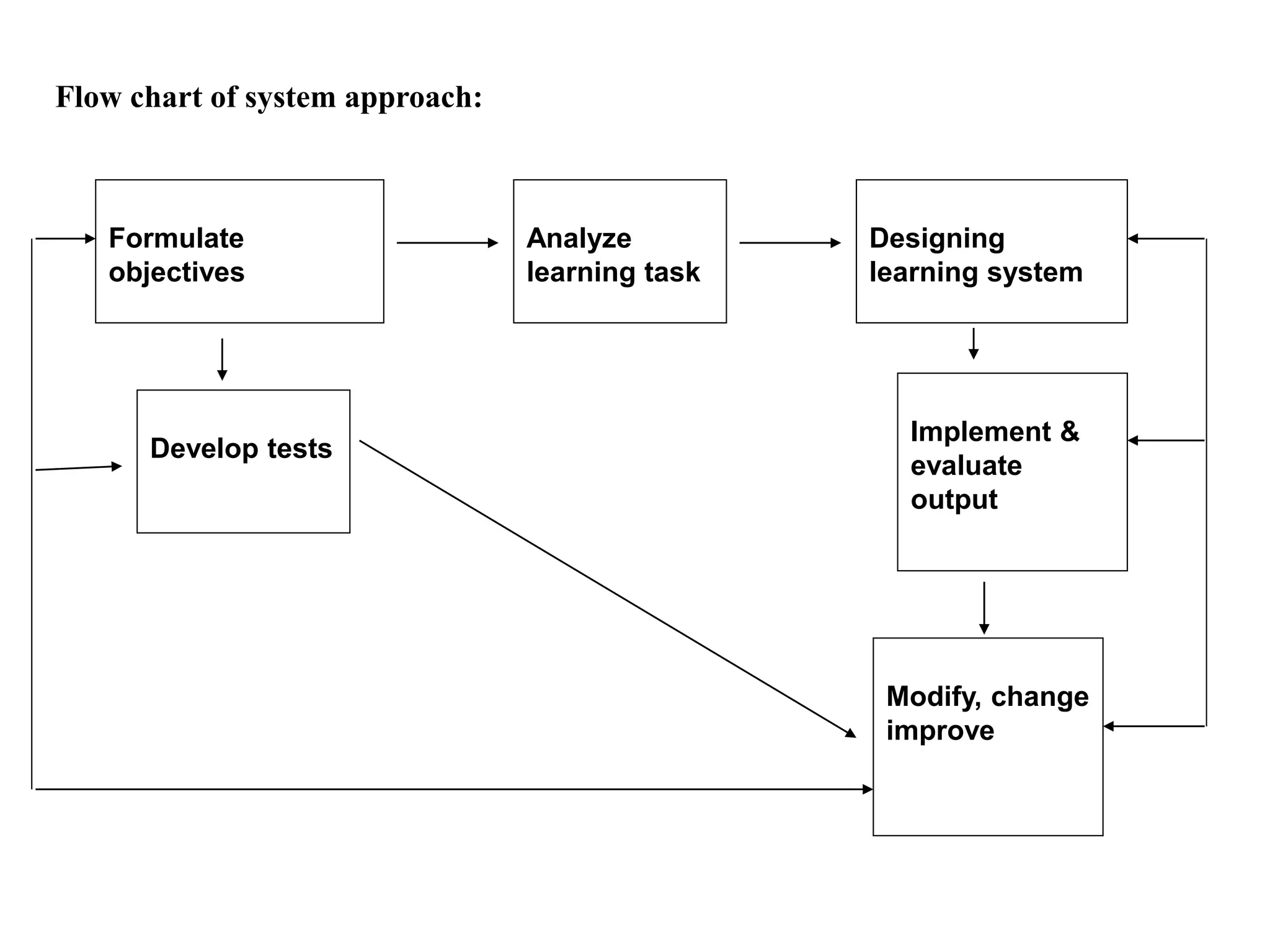
Formulate
objectives
Analyze
learning task
Designing
learning system
Develop tests
Implement &
evaluate
output
Modify, change
improve
Flow chart of system approach:
Advantages:
1. Effective planning of Educational programmes.
2. Increased control and co-ordination.
3. Maximum utilization of resources
4. It is a more effective method
5. Better training
6. Control of quantity
7. It assists in identifying suitable resources
8. It assists in making use of technological advance
9. It avoids rigidity in plan of action.
10.Fulfillment of objectives.
1.4 Relevance and utility of Education Technology to
1. Formal
2. Non formal
3. Distance education
1) Formal Education:
• Restricted time, place, person, area and in curriculum. Ex:
school, colleges, universities.
• Main motto of Formal Education “Universalization of
Education” means Education for all.
• (Drop out due to environment problem, communication
problem, approach problem etc.
• School, college Education
• Goal of universalization of primary education
• Enrolment of its’ increased –to reduce drop out rate
• Frustration of having to sit for 4 to 5 hours a day in a
classroom – child cannot take interest
• Audio aids visual aids AVA, OHP, LCD, CCTV,
Teleconferencing Online learning, computers, Internet
Formal Agencies of Educational technology.
1. NCERT – TV programmes, Radio programmes
2. Regional college’s Education – Bhopal, Ajmeer,
Bhuvaneshwar Mysore.
(Set department of Educational Technology )
3. CIET (Central institute of educational technology)
Functions: Training, production, research and evaluation
Central Institute Of Educational Technology(CIET), a consitituent unit of NCERT,
came into existence in the year 1984 with the merger of Center for Educational
Technology and Department of Teaching Aids.
CIET is a premiere national institute of educational technology.
Its major aim is to promote utilization of educational technologies viz. radio,TV,
films, Satellite communications and cyber media either separately or in
combinations.
The institute undertakes activities to widen educational opportunities, promote equity
and improve quality of educational processes at school level.
4. Department of Audio visual Aids of NCERT
5. State Department of ET- production of suitable educational
programmes for Radio and TV producing films. E.T cells – To
use mass media and modern Educational technology.
6. All India Radio and Radio broadcast centers- utilizing Radio to
broadcast lessons. (Doubts many be clarified, discussion)
7. Doordarshan Kendra – Telecast of educational programmes
8. EDUSAT:
EDUSAT, satellite launched on 20th September 2004, is the first Indian satellite built
exclusively for serving educational sector offering an interactive satellite based distance
education system for the country.
CIET (NCERT) is shouldering the responsibility of utilizing EDUSAT for school education
system through a national network.
CIET has got a Ku-band Sub Hub along with 100 terminals at various locations including,
Regional Institutes of Education (RIEs),
Demonstration and Multipurpose Experimental Schools (DMSs) attached with RIEs, Pandit
Sunderlal Sharma Central Institute of Vocational Education (PSSCIVE),
State Institute of Educational Technology (SIETs),
office at the head quarter, regional offices and some schools under Kendriya Vidyalaya
Sanghthan (KVS),
Navodya Vidyalya Samiti (NVS),
National Institute of Open Schooling (NIOS) and
Central Board of Secondary Education (CBSE),
State councils of Educational research and Training (SCERTs) and
State Institute of Education (SIEs).
The EDUSAT has the potential of its use for conventional radio and television broadcast,
interactive radio and television (phone-in and video on demand), exchange of data, audio,
video and computer conferencing and web based education.
2) Non-formal Education:
• Not only for children but also for adults, any age may have a
desire to learn.
• Books, maps, pictures, globes, tape slide programmes, radio,
television, films. Teaching machines – probably serve as better
medium of communication than teacher.- Self instructional material.
• Education is from womb to tomb every individual has the right for
education” John Dewey
• Flexibility is there
• According to will and wish of learner, learning takes place
• It is more applicable for illiterates(rural people)
• There is no age limit; it can be learnt at any time and in any
way.
Agencies:
The Satellite Instructional Television Experiment or SITE was an experimental
satellite communications project launched in India in 1975, designed jointly by
NASA and the Indian Space Research Organization (ISRO).
The project made available informational television programmes to rural India.
The main objectives of the experiment were to educate the poor people of India on
various issues via satellite broadcasting.
• N.G.O’s helps to educate adult.
• Through T.V. programmes & radio programmes-rapid changes are taking place
due to the advanced technologies in education.
• Satellite program
• Films, CD.s, projectors etc. can also be used to teach
Forms or types or agencies of Non Formal Education
1. Adult centre
2. Adults literacy programmes
3. Open school studies
4. Satellite instructional programmes
5. Programme for dropouts.
Central institute of Educational Technology,
A.V. Research centers and educational media research centers
N.C.E.R.T, and S.I.E.T (states)
3) Distance education:
• No contact of teacher and Student
• No class room situation
• There is no fixed time
• Objectives, curriculum is fixed
• It is an organized systematic educational activity
carried on outside the framework of the established formal
system.
• It is well organized system, with definite objectives, mode
of communication, content, and target population,
• Multimedia used in distance education
E.T used in Distance Education:
1. Print material: prescribed curriculum
2. Radio, broadcasting the lessons to supplement print materials. Lecture
or radio talk by experts, interview, discussion.
3. Television: In experimental, demonstration of complex or expensive
experiences, field visits.
4. Microscopic observations:
5. Advanced technical equipment
6. Industrial processes
7. Audio cassettes: conversations, information
8. Video cassettes: There is no need to wait for television programmes.
9. Satellites: INSAT IB, U.G.C, Education programmes for high schools
and undergraduate students.
10.Computers, computer managed learning electronic mode,
personalized education.
11.C.M.C (computer mediated conferencing): First it has been
experimented in the year 1990 in ohio state University. In most of the
developed countries have utilized this C.M.C. (WAN)
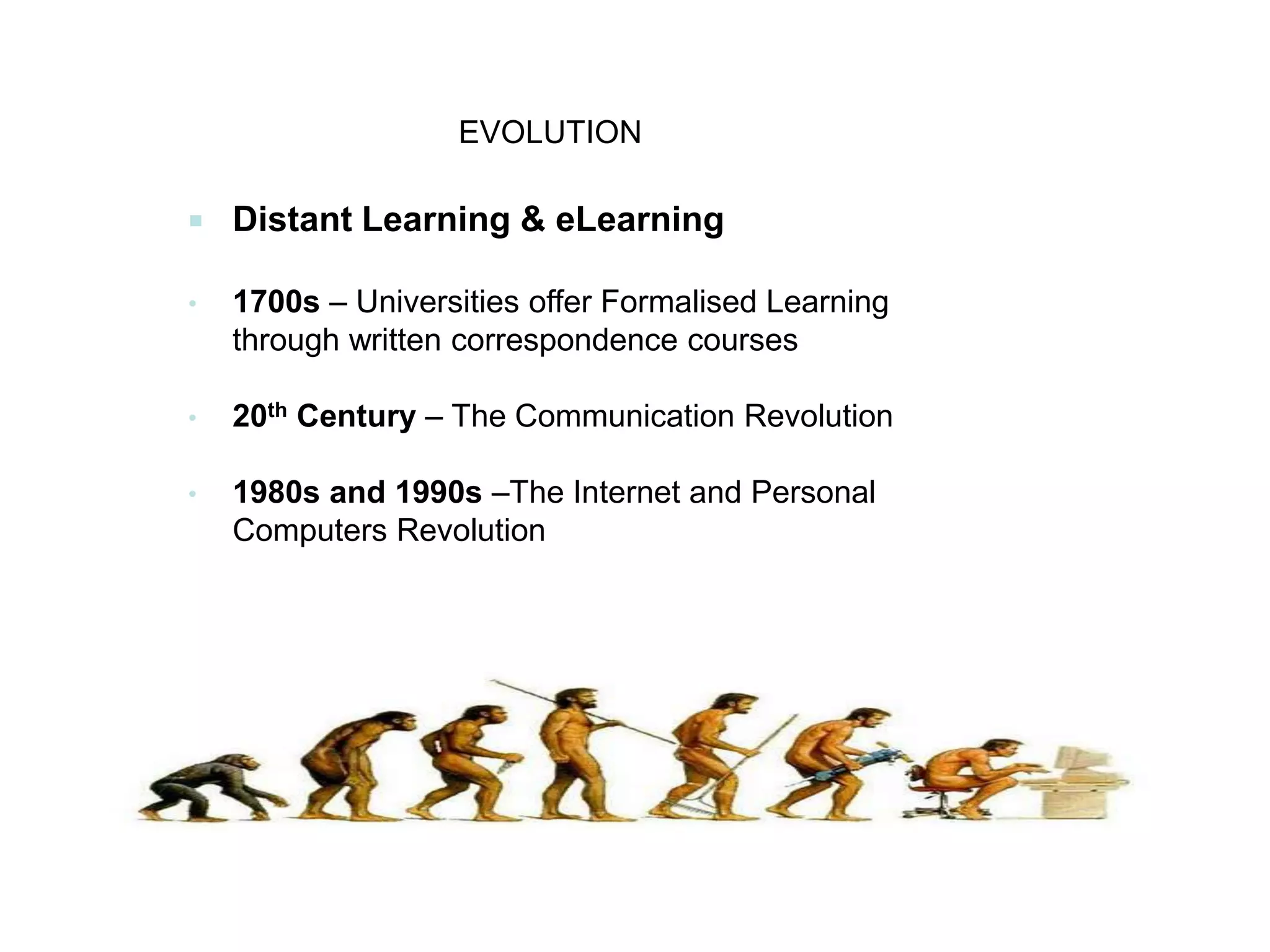
 Distant Learning & eLearning
• 1700s – Universities offer Formalised Learning
through written correspondence courses
• 20th Century – The Communication Revolution
• 1980s and 1990s –The Internet and Personal
Computers Revolution
EVOLUTION
Open Universtiy and ICT
Open University :Distance education is based upon the idea of “Isaac
Pitman”; who use to teach shorthand in Great Britan through
correspondence back in 1840’s.
The Open University in London was first to offer distance education in
year 1858.
Information Communication and Technology (ICT): Defination : “The use
of information in order to meet human need or purpose including
reference to the use of cntemporary devices such as the internet”. By
G.B.Harrison.
In 1980 personal computers opend new oppertuinites for students and by
end of 1980’s Universities started implementing ICT into their education
system.
Oppertunities Offered by Information Communication and
Technology
Many of these oppertuinites offered by ICT are compatible with almost all
devises as follows :
 Personal Computers
 Smart Phones
 Laptops
 I Pods
above mention devises can be interconnected with each other and also
compatible with any software and hardware.
Features of Information Communication and Technology
 Academic Records Online/
 Exam Results Online
Online Student Guide
Online Library
 Online Confrencing System

I unit complete 2022.PPT

  • 1.
    Educational Technology: Meaning Technologyderived from Greek word “technic’’ - art or skill “Logia”- science or study Science Or study of an art or skill. Educational Technology combination of terms “Education” and “Technology” Education: the word education has been derived from the latin verb “educare” meaning to train, to instruct, to put in, as also to draw out or to lead forth. Technology: it is a science of techniques and methods of doing or getting things done related to any art, science or a particular profession . Technology as the application of science to the needs of developing new techniques and applying these techniques.
  • 2.
    Educational Technology: G.O.M leith(1975) defined Educational Technology as an application of scientific knowledge about learning and the conditions of learning to improve the effectiveness and efficiency of teaching and training . Thus it can be observed that education technology has three important components: Defining of educational goals in specific clear terms: Designing of instructional strategies and learning sequences: and Evaluation of outcomes so as to obtain indicators of success of educational strategies. John (1973) Educational Technology concerns the systematic use of modern methods and technology in teaching and learning it involves teachers in a variety of roles, some of which are traditional some still emerging”.
  • 3.
    National council forEducational Technology(NCET) says: Educational technology is a means for the development, application and evaluation of three different things: I) Techniques: II) ii) Systems; III) iii) Aids to improve the process of human learning”. The International commission on the Development of Education “Educational technology means the intellectual and operational efforts to re-group or to systematize application of scientific methods for the organization of equipment and material to optimize the learning process”. According to UNESCO specialists, “Educational technology is a communication process resulting form application of scientific methods to the behavioural science of teaching and learning. This communication process may or may not require the use of a media of such as radio, film, television, broadcasts, and cassettes etc.
  • 4.
    The main componentsof this communication process are: Goals of behavioral objectives, Analysis of the characteristics of learners, Selection and organization of content, Selection of media, Evaluation, and Feedback B.P. Lulla,: Educational Technology is the application of scientific methods and techniques to Education”. Derik Unwin: Educational Technology is concerned with the application of modern skills and techniques to the requirements of Education and training”
  • 5.
    Robert Glasser describesthe process of Educational Technology in the following components: Different students learn in different ways and at different rates; Different kinds of skills, abilities, knowledge and understanding are required in different ways; The various elements of instruction themselves have different learning characteristics; The elements in the learning process should not be considered apart from each other as each has some bearing on education; As far as possible any learning systems should be self correcting which means that it should have some built-in arrangement of evaluation and feedback which can be used to improve it.
  • 6.
    Davis: Education Technologyis concerned with the problems of Education and training context, and it is characterized by the disciplined and systematic approach to the organization of resources for learning” (I.K. Davis, 1971) W. Kenneth Richmond(1979) : “Educational Technology is concerned with providing appropriately designed learning situations which holding in view the objectives of teaching or training bring to bear the best means of instruction”. Richmond has stated three characteristics of Educational technology in his definition: Designing appropriate learning situation, Realizing objectives of teaching or training, and Bringing best means of instruction.
  • 7.
    Association for EducationalCommunications and Technology (AECT)- Definition and Terminology Committee: “Educational technology is the study and ethical practice of facilitating learning and improving performance by creating, using, and managing appropriate technological processes and resources.” Elements of the definition Study: The theoretical understanding of, as well as the practice of educational technology, requires continual knowledge construction and refinement through research. “Study” refers to information gathering and analysis beyond the traditional conceptions of research. The research in educational technology has grown from investigations attempting to “prove” that media and technology are effective tools for learning.
  • 8.
    Ethical practice: Ethics arenot merely “rules and expectations” but are a basis for practice. Facilitating: Educational technology claims to facilitate learning rather than to cause or control learning; that is, it can help create an environment in which learning more easily could occur. Facilitating includes the design of the environment, the organizing of resources, and the providing of tools. Learning: The term “learning” does not connote today what it connoted forty years ago. The simplest type of learning is retention of information. So today, when educators talk about the pursuit of learning they usually mean productive, active-use, deep learning.
  • 9.
    Improving: All Areas OfLearning( Effective Learning) Effective learning, changes in capabilities that carry over into real-world application. Performance: In the context of this definition, performance refers to the learner’s ability to use and apply and the new capabilities gained. The definition mentions three major functions that are integral to the concept of Educational Technology—creating, using, and managing. Creating: Creation refers to the research, theory, and practice involved in the generation of learning environments in many different settings, formal and non-formal.
  • 10.
    Using: This element refersto the theories and practices related to bringing learners into contact with learning conditions and resources. Managing: project management skills, content delivery system management, personnel management and information management, Appropriate: The term “appropriate” is meant to apply to processes and resources, denoting suitability for and compatibility with their intended purposes.
  • 11.
    Technological: Systematic application ofscientific or other organized knowledge to practical tasks. Processes: A process can be defined as a series of activities directed toward a specified result. Resources: The many resources for learning are central to the identity of the field.
  • 12.
    Specifications of theConcept 1. Meaning: how it evolved and General aspects of a concept 2. Definition: set of qualities/description By any Individual and association towards a concept. 3. Concept: how it is? (concept) 4. Nature: Basic Qualities of a concept 5. Feature: quality aspects of the concept.(Durability) 6. Characteristics: physical and generalised aspects. 7. Scope: Coverage, Expansion and range of a concept. 8. Need: why we use it ? or essentiality. 9. Importance: Helpfulness in different situations may be in present and future. 10.Advantages: Benefits in present. 11.Dis-advantages: concerns or problems at present. 12.Limitations: lacunae that is beyond control.
  • 13.
    Education technology isa system of 5M’s 1. Machine 2. Materials 3. Media 4. Men 5. Methods are interrelated and work together for fulfillment and specific Educational objectives. Broad views of ET ET-1 Hardware Base: The use of equipments for presenting instructional material such as charts, graphs, models, globe, TV, teaching machine, projectors – (AVA) ET-2 Software Base: Refers to the application and scientific principles to instruction – The view of skinner, Gagne and others psychological principles of learning are stressed. Stimulus, response and reinforcement factors in learning-self instructional material, CAI, PSI,.
  • 14.
    ET-3 Modern viewof ET Incorporates both ET 1 & ET 2 through application of system approach to Education and training. This view implies planning, implementing and evaluating. (Strategy – based on organization of task and relationship centered.) (Method – based on task centered it is wider term it intends strategy and techniques.)
  • 15.
    NATURE OF EDUCATIONALTECHNOLOGY • The process of understanding the comprehensive term Educational Technology can be compared with the famous story of an elephant and six blind men. • Some called a wall, the other considers like a serpent. some people confuse between the tail and the trunk. • It is also true that the elephant usually walks in small steps but sometimes if provoked by environment it also runs in spurts (spring out, emit). • The same thing has happened with Educational Technology. Technology in Education and Technology of Education
  • 16.
    • The useof audio-visual aids, equipments, machines etc. such a Chalkboard, over Head Projector (OHP), TV, Computer in education marks the "Technology in Education". • Here more importance is given to the media used for carrying a message. "Technology of Education“:This approach characterizes the methodology appropriate to learners' needs, learning objectives, the process of learning and teaching as well as availability of resources.
  • 17.
    • Technology ofEducation includes Technology in Education. This can be represented as Technology in Education Technology of Education
  • 18.
    • The firstbig spun in the movement of Technology of Education came in 1960's when B.F. Skinner propagated his theory of Programmed Instruction. • This gave momentum to 'Technology of Education. The concept of Artificial lntelligence proved to be another spurt. Studies on how “learning contributed to the development of programmes on computer”. • Computer based learning enhanced human learning as it takes place through dynamic relationships. • In the year 1949, a powerful medium like Television came to the scene. This medium had the potential to replace all the teaching aids available so far. • The medium could take the learners out of the four walls of the school. It became a very convenient mode. The live telecast surpassed all other teaching aids including films. • The VCR, which came next to educational scene, offered much more control to the learner.
  • 19.
    • CCTV • Computers •Mobile phones • Projectors • Ipods, laptop, Tablets • E-learning • M-learning • Web based learning-Repositories • MOOC • U-Learning, Augmented reality, Wearable Technology • Virtual Learning, Virtual Libraries and Virtual classes
  • 20.
    Need of EducationalTechnology: 1.Make Education more productive. 2. Make Education more individualistic. 3. Give instruction a more scientific base. 4. To make instruction more powerful. 5. To make the access to Education immediate. 6. To make the access of Educational equal.
  • 21.
    Educational Technology isimportant to , 1. Identify the Educational goals and objectives of the community. 2. Develop appropriate curriculum for the achievement of the stipulated goals. 3. Analyze the process of Teaching-learning. 4. Develop suitable Teaching-learning materials. 5. Select and develop proper Teaching-learning strategies for obtaining maximum results. 6. Develop and select appropriate audio-visual aids. 7. Utilize effectively the hardware and software media. 8. Provide essentially feedback and control through Education.
  • 22.
    Objectives of ET– Macro level  Identification of Educational needs.  Determination of the aims of Education  Developing of suitable curriculum  Identification of man, material resources and strategies  Developing certain models to improve the tg –lg process.  Identification of major constraints and the ways and means to overcome them.  Assisting in vocational opportunities to masses especially neglected sectors of society.  Managing the entire Educational system – covering planning, implementation and evaluation phases.
  • 23.
    Micro level Identifying andanalyzing the needs of 1. Determining classroom objectives 2. Analyzing content and organizing in proper sequence. 3. Identification of available Teaching –learning materials. 4. Analyzing the Sub systems like test, resources, materials and methodologies. 5. Evaluating the effectiveness of class room teaching. 6. Providing appropriate feed back.
  • 24.
    The term EducationTechnology is interpreted in two distinct ways : 1. To describe the use of Technology in Education ; 2. To imply the concept with the use of Education. The former is concerned with the use of equipment and the latter with improving the effectiveness of learning. Education Technology is making learning experiences practical and therefore, better related to life’s goals. It has peeped into the fields of motivation, sensation-perception attention, evaluation etc. Educational Technology can be used effectively for formal, informal, non-formal systems of Education of whatever level it may be.
  • 25.
    SCOPE OF EDUCATIONALTECHNOLOGY Educational technology as you know is used to raise the efficiency of education. But with the passage of time, the system of education is facing new problems to be tackled. So, the hardware and software of educational technology are ever expanding. Therefore, the application of educational technology is much more than what it was a few decades back. Mass Education: There has been explosion of population and knowledge. There is, therefore, a need to educate the masses. Educational technology has a tremendous application to educate a large section of people in a limited span of time. In-this regard, the mass media viz.. TV radio, newspaper and other modern technologies like computers and information technology (E-mail, internet, mobile phone etc.) has a lot of scope.
  • 26.
    Historical information: Suchinformation is of tremendous importance for the students to understand any branch of knowledge in its totality. Such incidents when occur can be recorded with the help of audio video cassette or documented in the form of a written or printed material. Such documents become the source of information for learners to learn. Costly and hazardous experiments: experiments, once conducted carefully in the laboratory or elsewhere can be recorded with the help of new electronic technology and be used by teachers and students for effective learning. Gaming and simulation: This can provide a life like picture of phenomena in three dimensions. It can also show the operation of different parts of a phenomenon and the consequences. Children can learn, through play, many concepts. The gaming and simulation has a great scope in the training of military personnel and in the field of aviation.
  • 27.
    Distance education: Educationaltechnology with its innovative practiced can educate the learners who cannot come to the classroom setup for their education. In this regard programmed learning materials, modules, contact programme, and counseling are some innovations which can help distance learners. Collection storing and retrieval of information: Information can be collected with the help of this new electronic technology both in audio and in video form. such information can be stored with magnetic and electronic devices easily and can be retrieved within no time. Research Information can also be collected and stored in the same way for research. Not only quantitative data but also qualitative data can be anlaysed and there lies the role of computer and the different methods of data analysis methods and techniques development of programmed learning materials, computer assisted instruction, and computer assisted language learning packages. facilities of INTERNET, Website, and INFLIBNET .
  • 28.
    National Policy onEducation (1986), recommends that, “Educational Technology will be employed in the spread of useful, information, the training and retraining of teachers, to improve quality, sharpen awareness of art and culture, inculcate abiding values etc., both in the formal and non- formal sectors. Maximum use will be made of the available infrastructure.” The scope of Educational Technology can be accessed from the following points: 1.Determination of Objectives: Educational Technology provides different methods and techniques for writing instructional objectives in behavioural terms such as Bloom Taxonomy Mager’s Approach and RCEM Approach.
  • 29.
    2.Improvement in TeachingLearning Process: It helps in improving the teaching learning process and makes it more purposive. It tries to discuss the concept of teaching, analysis of teaching process, variables of teaching, phases and levels of teaching, principles of teaching, maxims of teaching and relationship between teaching and learning. 3.Development of Teaching Learning Material: Teaching learning materials are also as important as anything else in the teaching learning process. In this age of science and technology, the materials of teaching cannot be unscientific. Everything of the society including values of life need be reflected in the materials. Only right type of material will be able to modify the behaviour of the learner suitably making him a fit person for the society.
  • 30.
    4. Improvement inTeaching Training: The change of environment with new curriculum and new materials need be handled by the teachers. Right type of training to the teachers is the need of the hour. Educational Technology can render its valuable help in the training of teachers also. The use of video tapes and close circuit T.V. will help the teachers to remodel and reshape their teaching behaviours suitably. Smart board, LCD, Radio programmes, Mobile phones, Blog,podcasting, E-learning, On-line learning, Web based learning, PPT, computer software, video lessons etc. It includes micro teaching, simulated teaching, team- teaching, teacher effectiveness, modification of teacher- behaviour, class-room interaction and interaction analysis, etc.
  • 31.
    5. Development ofTeaching Learning Strategies: A strategy plays an important role in the hands of a teacher in every learning situation. The strategy has to be the right one which should be according to the materials and is able to bring about effective teaching- learning. It tries to describe the ways and means of discovering selecting and developing suitable strategies and tactics of teaching in terms of optimum learning and available teaching-learning resources; the availability of the different types of teaching methods, devices and models of teaching-their appropriate selection and use for the optimum results. 6.Proper Use of Audio Visual Aids: Audio Visual aids have always played an important role in the teaching- learning process. They need be used according to the times. The software aids, the hardware aids, the computer and other such appliances, equipment etc., have to be used in the present type of teaching-learning environment. Computer assisted instructions will help the learner as well as the teacher to achieve the goals of education more conveniently.
  • 32.
    7. Utilization ofthe Sub-System of Education: Educational Technology considers education as a system operating in a systematic and scientific way for the achievement of educational objectives. For the coverage of its systematic approach, it tries to include the topics dealing with the theory and principles of a system approach, explaining education as a system, its different sub-systems in terms of input and output. It is helpful in solving scientifically educational administrative problems with the help of system analysis. 8. Development of Curriculum: Educational Technology is concerned with the designing of a suitable curriculum for the achievement of the desired objectives. It is helpful in describing the ways and means of the selection of suitable learning experiences, organisation of the contents in a suitable framework in order to bring better results. It provides the scientific foundation to education as well as develops theories of teaching and learning.
  • 33.
    9. Proper Useof Hardware and Software: These days’ hardware and software are playing an effective role in the attainment of educational objectives. Educational Technology helps in the proper use of these aids. It tries to describe these resources in terms of their specific functions, their solution, proper handling and maintenance. 10. Provides Feedback: It provides an appropriate feedback to the learners as well as teachers for bringing necessary improvement at the preparatory and implementation stages of their specific acts. For this purpose, educational technology discusses the ways and means of suitable evaluation techniques, their planning, development selection and appropriate use in relation to the objectives of teaching- learning system.
  • 34.
    In this wayEducational Technology is concerned with all those who are connected in any way, directly or indirectly, to the processes and products of education. It teaches the teachers the art of teaching, the learners the science of teach the educational planners the structure of planning and administrators or managers the skill of managing or administering the task of teaching and learning. It works for the individualization of instructions as well for improving the group dynamics of the class-room. Therefore, in any way, the scope of the educational technology should not be confined to the limited boundaries, but it should be left free for the necessary expansion and development for carrying out its mission, tasks and objectives.
  • 35.
    Educational technology haspassed five stages • First stage – ET linked with Use of AV aids, charts, maps, model, specimen. • Second stage- ET linked with electronic revolution Hardware and software. Projectors TV, Radio, & Tape recorder. • Third stage- ET with mass media ‘communication revolution’ CAT became popular. • Fourth stage- marked by ‘Individualized instruction” system of self learning. • Latest concept- ET is influenced by the concept of systems of engineering or systems approach. ET is a systematic way of designing, carrying out and evaluating total process of teaching and learning. • Up to 14th century – instruction restricted to mouth and then to manuscript. • 15th century- printing was developed – books were printed. • 16th century- Peter Ramus introduced text books in Higher Edn • 17th century – John Comenius introduced text books for children with pictures.
  • 36.
    Evolution and developmentof Educational technology Pre industrial phases • Instruction process heavily depended upon simple things like the Slate, Book, Black Board , chair • Educational technology was considered synonymous to simple aids like charts and pictures. • Year 1873 considered as landmarks in the early history of technology of education or audio visual education, exhibition held at Vienna international level. (Maps, charts, text books and other equipment) •1920- “British broadcasting corporation” started school broadcasts • 1952- USA – 20 states had provision for broadcasting • 1955- “Team teaching” at Harward university •1956- B.S. Bloom and USA introduced “Taxonomy of Educational objectives” •1960 – TV is used for educational purpose •1960- ‘Interaction model of teaching’ by N. Flander •1965 – “Personalized system of instruction (PSI) by. Keller •1965 – CAT – computer functions as a tutor developed by O.K.L. Moore’ 1970 – self teaching machine: by Sidney L. Pressey – Ohio state university • 1974 – computers are used in Educational institution.
  • 37.
    Late 1970’s –early 1980’s: programming, drill and practice; Late 1980’s – early 1990’s: computer based training (CBT) with multimedia; Early 1990’s: Internet-based training (IBT); Late 1990’s – early 2000: e-Learning; Late 2000: Social software + free and open content. 2005; M-learning; Ubiquitous learning.
  • 38.
    EVOLUTION OF EDUCATIONALTECHNOLOGY Human beings have the potential to create. This potential has enabled the people to solve problems and learn from their experiences. The ancient man tried to communicate through verbal and non-verbal ways, evolved language and gradually then written and printed materials were developed. Later on, the technology of software based on psychology and sociology came into being. Now, we have mass learning, group learning, and individual learning in operation. These technologies have evolved through the past decades of the nineteenth century. They can be placed in four phases as follows: i) Audio-visual phase ii) Cybernetic phase iii) Psychology-Sociology based phase and iv) Computer and Telecommunication phase
  • 39.
    • Audio-visual Phase:Before the 1950's the term audio-visual education was used for various teaching aids like blackboard, maps, radio, films, etc. These were mainly media through which a teacher presented his messages. The materials developed were not systematically based on any psychological principles. • Cybernetic Phase: The word Kybernetes in Greek, means "steersman", which emphasises the principle of feedback and control. The feedback refers to a kind of reciprocal interaction between two or more events in which one activity generates a secondary action which, in turn redirects the primary action. • The cybernetics tradition which lays emphasis on feedback is traced back to the Second World War where there was a need for a systematic communication and control system. Cybernetics has been defined as the comparative study of the human (or biological) control mechanism and electro-mechanical control systems such as computers.
  • 40.
    • Cybernetic principleshave some implications for learning a) The activity involved is geared to the learner's stage of growth -physical and cognitive in Education • b) The learner is given an opportunity to perceive meaningful relationships among the elements of the goal towards which he is working. • c) The learner is provided with some criterion for indicating to specifically what progress he is making. • d) The learner is presented the activity both in verbal and non-verbal context in varied situations and practice conditions. Psychology-Sociology Based Phase: It can be traced back to the learning theory given by Thorndike in 1913. Based on his theory, Pressey (1926) developed a teaching machine. It provided an automatic scoring device to the learners on immediate feedback basis. So, this was the first step towards the formulation of systematic learning. The theory of B.F. Skinner (1953) i.e., operant conditioning and the work of Norman A. Crowder opened new chapters in developing Programmed Learning Materials.
  • 41.
    • behaviouristic psychology(Skinner et. al.) cognitive psychology has also thrown more light on how learning takes place. Piaget and Bruner, later day constructivist psychologists, have pointed out that a human individual is not only "taught" by external forces, but he also learns, constructs his own world - e.g. concept maps etc., • Sociologists, particularly the School of Group Dynamics also added insights regarding how an individual learns in a group, through interaction with peers and others. • Social learning theory; Bandura • Social constructivism; Vygotski • In brief, the social sciences -psychology, sociology, anthropology, etc. have also contributed a lot to understanding of the teaching- learning process and in turn influenced Educational technology.
  • 42.
    Computer and TelecommunicationPhase • Multimedia, E-mail, internet, intranet and website are used extensively today. There are telecommunication modes through which instructional materials can be given to students. • There are many computer software packages developed for school children in many of the school subjects. • In India we have Audio-Visual Research Centres, Educational Media Research Centres and different Departments of Education and Educational Technology which have been developing software packages for the education of children. These four phases do not have watertight compartments. The different phases are intermingled and can help each other to grow.
  • 43.
    1.2 Hardware andSoftware – approach to education components of ET The term –“Educational Technology” as it is used now a day, is the result of a new process which –as a whole, includes newly invented technical Equipment’s, and behavioral sciences. Education technology has two main components. 1. Hardware. 2. Software. Hardware – This approach of Educational Technology is a by product of the scientific and technological developments of the 20th century. Equipment needed to use software are called hardware. AVA like – charts, models, film strips, slides, audio cassettes ,projectors, Radio, tape recorder, television, video, teaching machines, computers, empty cassettes, empty floppy discs/ CDs unexposed film roll, film projector, slide projector, over head projector, VCP, VCR, mobile phone,etc. Hard ware is also called of Educational Technology -1.
  • 44.
    Software – originto the behavioral sciences and their applied aspects concerned to the psychology of learning. • It originated from the efforts of skinner and other behaviorists. Arthur Melton – software teaching technology is directly related to the psychology of learning which comprises, behavioral changes resulting from experience. • Software technology sometimes referred as Instructional Technology, Teaching Technology, and Behavioral Technology. • Software approach is closely associated with task analysis, writing objectives, selection of learning strategy, reinforcement of correct responses and constant evaluation. These materials which are actually used to teach or on which teaching items are recorded-are called Software. These are used with the help of hardware equipment’s. Film slides, Computer software, recorded floppy discs, Recorded CD’s etc. They are also called Second part of Educational Technology or ET-2.
  • 45.
    Principles of usesHardware and Software: 1.Principle of Purposiveness 2.Principle of economy. 3. Principle of case in the use of aids. 4. Principle of availability. 5. Principle of simplicity. 6. Principle of stimulation. 7. Principle of self-preparation
  • 46.
    Educational usefulness: 1. Theyprovide to individual differences of students. 2. They contribute to the economy of time, energy and resources of teachers and students. 3. They bring clarity and vividness to the subject mater. 4. The proper use of hardware and software helps in motivating the students. 5. Their uses help in developing and sustaining the interest of the students. 6. They make the subject matter easy to comprehend. 7. They make the subject –matter interesting. 8. They make teaching – learning attractive, inspirational and effective. 9. They make the subject – matter lively. 10.They provide ample opportunities for students participation in the lesson.
  • 47.
    Approaches of EducationalTechnology : A way or means of reaching something; 1. Physical approach/Hardware approach. 2. Behavioural approach/software approach. 3. System approach/Instructional Designs. Physical Approach: It is known as ‘hardware approach’ to education or audio-visual aids, its origin lies in the application of physical sciences or engineering to education and training system. The major assumption 1. A technology or machines is closely related to a technology of teaching. 2. Teaching machine is the only mechanical aid to be deliberately designed and invented to fulfill instructional requirements. All other audio- visual aids are designed and manufactured for improving communication system not for educational one. Initially these machines were developed for market rather than education. the process of teaching learning has been gradually mechanized through the use of teaching machines, language laboratory, radio, television, tape- recorder, video-tape and projectors.
  • 48.
    The mechanization isbeing introduced by preservation transmission and advancement of human knowledge. The teacher can deal with larger group of students by his discourse on radio and television. Silveman (1963) called this type of educational technology “Relative Technology’. This refers to borrow and to apply technology, machines and devices in the process of teaching and learning. This educational technology performs a simple function in education.
  • 49.
    Behavioural approach: Meaning: Behavioralapproach is application of scientific knowledge and modifying teacher’s behaviour. It is also called as training technology and is limited to learners’ behaviour and teaching behaviour. Chief exponents are Amidon, Flander, Skinner, Ober and Anderson, Pavlov, Watson, Thorndike. Silverman (1968) termed this educational technology as 'constructive educational technology.' Both software and hardware approaches are so interlinked that they cannot be separated from each other. One without the other is incomplete. It is software approach which makes the hardware approach function well. Fundamental Principles of Behavioural Approach: • Teacher behaviour is observable. • Teacher behaviour is measurable and quantifiable • Teacher behaviour is social and psychological. • Teacher behaviour is modifiable. Teacher is no doubt born but they can also be made. Objectives: Development of psychomotor skills along with cognitive and affective domains.
  • 50.
    Content of Behaviouralapproach: Behavioral approach comprises of the following components & are 1. Meaning and definition of teachers behaviour 2. Assumptions and theories related to teacher behavior. 3. Interaction analysis of classroom behaviour of teachers – process of observation, encoding, decoding, interpretation and evaluation of teacher behaviours. 4. Model of classroom interaction. 5. Micro teaching 6. Simulated social skills training 7. Team group training 8. Team teaching 9. Feed back devices 10.Stress on communication. Both student and teacher 11.Teacher behaviour theories. 12.Teaching models. 13.Observation techniques 14.Analyses and modification of teacher behaviour
  • 51.
    Highlights of Behaviouralapproach: 1. The emphasis is on the psychomotor domain and teacher development of skills. 2. Classroom behaviour of teacher is studied and suggestions for desirable changes are made. 3. The body of knowledge of behavioural approach is useful in training and shaping behaviour of student teachers in teacher education programmes. 4. Teaching act can be evaluated objectively and systematically 5. It aims at producing effective teachers by modifying their behaviour. Application: Behaviour approach has a wide application in teacher education and teacher training.
  • 52.
    System approach: (Input– Process-Output) •System approach is a process for the application of logical thinking in the solution of problems. •System approach is a rational problem solving method of analysis of the educational process and making it more effective. This new technology has influenced the educational administration and organisation to a great extent. This is the modern approach. It acts as a link between hardware and software approach. It is also known as 'Management Technology'. It has brought to educational management a scientific approach for solving educational administrative problems. • Input Output Process Human resources, students, teachers, financial resource, technical resource, curriculum, objectives Education process for optimum assimilation of knowledge and skills for increasing learning efficiency Student whose performance has been improved in specific areas
  • 53.
    Steps/ procedures insystem approach: 1. Defining instructional goals, behavioural objectives and state them in a measurable terms. 2. Defining learner characteristics and requirements. 3. Choosing appropriate method for effective learning of topic. 4. Selecting appropriate teaching experience from many alternatives. 5. Selecting appropriate materials, resources, environment, facilities, tools. 6. Assigning appropriate roles- Teachers and students (Team teaching) 7. Implementing the program- With few pupils 8. Testing and evaluation – On student performance 9. Refining and revising- If needed for student learning
  • 54.
    Formulate objectives Analyze learning task Designing learning system Developtests Implement & evaluate output Modify, change improve Flow chart of system approach:
  • 55.
    Advantages: 1. Effective planningof Educational programmes. 2. Increased control and co-ordination. 3. Maximum utilization of resources 4. It is a more effective method 5. Better training 6. Control of quantity 7. It assists in identifying suitable resources 8. It assists in making use of technological advance 9. It avoids rigidity in plan of action. 10.Fulfillment of objectives.
  • 56.
    1.4 Relevance andutility of Education Technology to 1. Formal 2. Non formal 3. Distance education 1) Formal Education: • Restricted time, place, person, area and in curriculum. Ex: school, colleges, universities. • Main motto of Formal Education “Universalization of Education” means Education for all. • (Drop out due to environment problem, communication problem, approach problem etc.
  • 57.
    • School, collegeEducation • Goal of universalization of primary education • Enrolment of its’ increased –to reduce drop out rate • Frustration of having to sit for 4 to 5 hours a day in a classroom – child cannot take interest • Audio aids visual aids AVA, OHP, LCD, CCTV, Teleconferencing Online learning, computers, Internet Formal Agencies of Educational technology. 1. NCERT – TV programmes, Radio programmes 2. Regional college’s Education – Bhopal, Ajmeer, Bhuvaneshwar Mysore. (Set department of Educational Technology ) 3. CIET (Central institute of educational technology) Functions: Training, production, research and evaluation
  • 58.
    Central Institute OfEducational Technology(CIET), a consitituent unit of NCERT, came into existence in the year 1984 with the merger of Center for Educational Technology and Department of Teaching Aids. CIET is a premiere national institute of educational technology. Its major aim is to promote utilization of educational technologies viz. radio,TV, films, Satellite communications and cyber media either separately or in combinations. The institute undertakes activities to widen educational opportunities, promote equity and improve quality of educational processes at school level. 4. Department of Audio visual Aids of NCERT 5. State Department of ET- production of suitable educational programmes for Radio and TV producing films. E.T cells – To use mass media and modern Educational technology. 6. All India Radio and Radio broadcast centers- utilizing Radio to broadcast lessons. (Doubts many be clarified, discussion) 7. Doordarshan Kendra – Telecast of educational programmes
  • 59.
    8. EDUSAT: EDUSAT, satellitelaunched on 20th September 2004, is the first Indian satellite built exclusively for serving educational sector offering an interactive satellite based distance education system for the country. CIET (NCERT) is shouldering the responsibility of utilizing EDUSAT for school education system through a national network. CIET has got a Ku-band Sub Hub along with 100 terminals at various locations including, Regional Institutes of Education (RIEs), Demonstration and Multipurpose Experimental Schools (DMSs) attached with RIEs, Pandit Sunderlal Sharma Central Institute of Vocational Education (PSSCIVE), State Institute of Educational Technology (SIETs), office at the head quarter, regional offices and some schools under Kendriya Vidyalaya Sanghthan (KVS), Navodya Vidyalya Samiti (NVS), National Institute of Open Schooling (NIOS) and Central Board of Secondary Education (CBSE), State councils of Educational research and Training (SCERTs) and State Institute of Education (SIEs). The EDUSAT has the potential of its use for conventional radio and television broadcast, interactive radio and television (phone-in and video on demand), exchange of data, audio, video and computer conferencing and web based education.
  • 60.
    2) Non-formal Education: •Not only for children but also for adults, any age may have a desire to learn. • Books, maps, pictures, globes, tape slide programmes, radio, television, films. Teaching machines – probably serve as better medium of communication than teacher.- Self instructional material. • Education is from womb to tomb every individual has the right for education” John Dewey • Flexibility is there • According to will and wish of learner, learning takes place • It is more applicable for illiterates(rural people) • There is no age limit; it can be learnt at any time and in any way.
  • 61.
    Agencies: The Satellite InstructionalTelevision Experiment or SITE was an experimental satellite communications project launched in India in 1975, designed jointly by NASA and the Indian Space Research Organization (ISRO). The project made available informational television programmes to rural India. The main objectives of the experiment were to educate the poor people of India on various issues via satellite broadcasting. • N.G.O’s helps to educate adult. • Through T.V. programmes & radio programmes-rapid changes are taking place due to the advanced technologies in education. • Satellite program • Films, CD.s, projectors etc. can also be used to teach Forms or types or agencies of Non Formal Education 1. Adult centre 2. Adults literacy programmes 3. Open school studies 4. Satellite instructional programmes 5. Programme for dropouts. Central institute of Educational Technology, A.V. Research centers and educational media research centers N.C.E.R.T, and S.I.E.T (states)
  • 62.
    3) Distance education: •No contact of teacher and Student • No class room situation • There is no fixed time • Objectives, curriculum is fixed • It is an organized systematic educational activity carried on outside the framework of the established formal system. • It is well organized system, with definite objectives, mode of communication, content, and target population, • Multimedia used in distance education
  • 63.
    E.T used inDistance Education: 1. Print material: prescribed curriculum 2. Radio, broadcasting the lessons to supplement print materials. Lecture or radio talk by experts, interview, discussion. 3. Television: In experimental, demonstration of complex or expensive experiences, field visits. 4. Microscopic observations: 5. Advanced technical equipment 6. Industrial processes 7. Audio cassettes: conversations, information 8. Video cassettes: There is no need to wait for television programmes. 9. Satellites: INSAT IB, U.G.C, Education programmes for high schools and undergraduate students. 10.Computers, computer managed learning electronic mode, personalized education. 11.C.M.C (computer mediated conferencing): First it has been experimented in the year 1990 in ohio state University. In most of the developed countries have utilized this C.M.C. (WAN)
  • 64.
     Distant Learning& eLearning • 1700s – Universities offer Formalised Learning through written correspondence courses • 20th Century – The Communication Revolution • 1980s and 1990s –The Internet and Personal Computers Revolution EVOLUTION
  • 65.
    Open Universtiy andICT Open University :Distance education is based upon the idea of “Isaac Pitman”; who use to teach shorthand in Great Britan through correspondence back in 1840’s. The Open University in London was first to offer distance education in year 1858. Information Communication and Technology (ICT): Defination : “The use of information in order to meet human need or purpose including reference to the use of cntemporary devices such as the internet”. By G.B.Harrison. In 1980 personal computers opend new oppertuinites for students and by end of 1980’s Universities started implementing ICT into their education system.
  • 66.
    Oppertunities Offered byInformation Communication and Technology Many of these oppertuinites offered by ICT are compatible with almost all devises as follows :  Personal Computers  Smart Phones  Laptops  I Pods above mention devises can be interconnected with each other and also compatible with any software and hardware.
  • 67.
    Features of InformationCommunication and Technology  Academic Records Online/  Exam Results Online Online Student Guide Online Library  Online Confrencing System