2 - 1
© 2014 Pearson Education
The Global
Environment and
Operations Strategy 2
2
PowerPoint presentation to accompany
Heizer and Render
Operations Management, Global Edition, Eleventh Edition
Principles of Operations Management, Global Edition, Ninth Edition
PowerPoint slides by Jeff Heyl
© 2014 Pearson Education
2 - 2
© 2014 Pearson Education
OUTLINE
▶A Global View to Operations
▶Reasons to Globalize
▶Developing Missions and Strategies
▶Strategies for Competitive
Advantage
▶SWOT Analysis and Strategy
Development
2 - 3
© 2014 Pearson Education
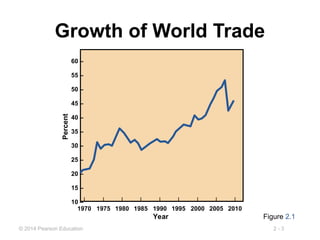
Growth of World Trade
Figure 2.1
60 –
55 –
50 –
45 –
40 –
35 –
30 –
25 –
20 –
15 –
10 –
| | | | | | | | |
1970 1975 1980 1985 1990 1995 2000 2005 2010
Year
Percent
2 - 4
© 2014 Pearson Education
Reasons to Globalize
1. Improve the supply chain
2. Reduce costs (labor, taxes, tariffs, etc.)
3. Improve operations
4. Understand markets
5. Improve products
6. Attract and retain global talent
2 - 5
© 2014 Pearson Education
Improve the Supply Chain
▶ Locating facilities closer to unique
resources
▶ Auto design to California
▶ Athletic shoe production to China
▶ Perfume manufacturing in France
2 - 6
© 2014 Pearson Education
Reduce Costs
▶ Foreign locations with lower wage rates
can lower direct and indirect costs
▶ Trade agreements can lower tariffs
▶ Maquiladoras
▶ World Trade Organization (WTO)
▶ North American Free Trade Agreement
(NAFTA)
▶ APEC, SEATO, MERCOSUR, CAFTA
▶ European Union (EU)
2 - 7
© 2014 Pearson Education
Improve Operations
▶ Understand differences between
how business is handled in other
countries
▶ Japanese – inventory management
▶ Scandinavians – ergonomics
▶ International operations can
improve response time and
customer service
2 - 8
© 2014 Pearson Education
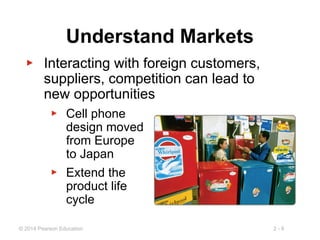
Understand Markets
▶ Interacting with foreign customers,
suppliers, competition can lead to
new opportunities
▶ Cell phone
design moved
from Europe
to Japan
▶ Extend the
product life
cycle
2 - 9
© 2014 Pearson Education
Improve Products
▶ Remain open to free flow of ideas
▶ Toyota and BMW manage joint
research and development
▶ Reduced risk, state-of-the-art design,
lower costs
▶ Samsung and Bosch jointly produce
batteries
2 - 10
© 2014 Pearson Education
Attract and Retain Global
Talent
▶ Offer better employment
opportunities
▶ Better growth opportunities and
insulation against unemployment
▶ Relocate unneeded personnel to
more prosperous locations
2 - 11
© 2014 Pearson Education
Cultural and Ethical Issues
▶ Cultures can be quite different
▶ Attitudes can be quite different
towards
► Punctuality
► Lunch breaks
► Environment
► Intellectual
property
► Thievery
► Bribery
► Child labor
2 - 12
© 2014 Pearson Education
Key Issues of Globalization
▶ National literacy rate
▶ Rate of innovation
▶ Rate of technology
change
▶ Number of skilled
workers
▶ Political stability
▶ Product liability laws
▶ Export restrictions
▶ Variations in language
► Work ethic
► Tax rates
► Inflation
► Availability of raw
materials
► Interest rates
► Population
► Number of miles of
highway
► Phone system
2 - 13
© 2014 Pearson Education
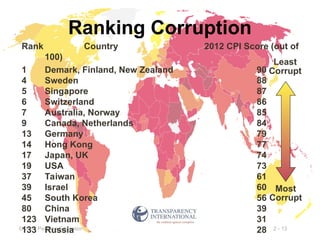
Ranking Corruption
Rank Country 2012 CPI Score (out of
100)
1 Demark, Finland, New Zealand 90
4 Sweden 88
5 Singapore 87
6 Switzerland 86
7 Australia, Norway 85
9 Canada, Netherlands 84
13 Germany 79
14 Hong Kong 77
17 Japan, UK 74
19 USA 73
37 Taiwan 61
39 Israel 60
45 South Korea 56
80 China 39
123 Vietnam 31
133 Russia 28
Least
Corrupt
Most
Corrupt
2 - 14
© 2014 Pearson Education
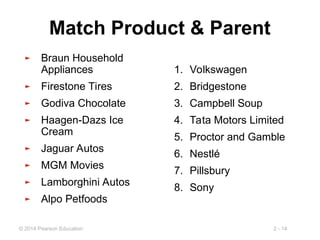
Match Product & Parent
1. Volkswagen
2. Bridgestone
3. Campbell Soup
4. Tata Motors Limited
5. Proctor and Gamble
6. Nestlé
7. Pillsbury
8. Sony
► Braun Household
Appliances
► Firestone Tires
► Godiva Chocolate
► Haagen-Dazs Ice
Cream
► Jaguar Autos
► MGM Movies
► Lamborghini Autos
► Alpo Petfoods
2 - 15
© 2014 Pearson Education
► Braun Household
Appliances
► Firestone Tires
► Godiva Chocolate
► Haagen-Dazs Ice
Cream
► Jaguar Autos
► MGM Movies
► Lamborghini Autos
► Alpo Petfoods
Match Product & Parent
1. Volkswagen
2. Bridgestone
3. Campbell Soup
4. Tata Motors Limited
5. Proctor and Gamble
6. Nestlé
7. Pillsbury
8. Sony
2 - 16
© 2014 Pearson Education
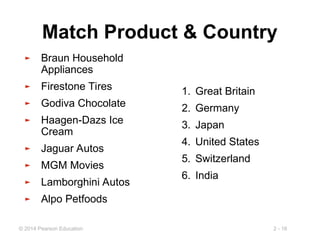
Match Product & Country
1. Great Britain
2. Germany
3. Japan
4. United States
5. Switzerland
6. India
► Braun Household
Appliances
► Firestone Tires
► Godiva Chocolate
► Haagen-Dazs Ice
Cream
► Jaguar Autos
► MGM Movies
► Lamborghini Autos
► Alpo Petfoods
2 - 17
© 2014 Pearson Education
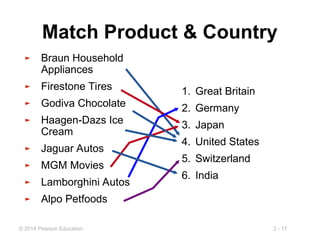
Match Product & Country
1. Great Britain
2. Germany
3. Japan
4. United States
5. Switzerland
6. India
► Braun Household
Appliances
► Firestone Tires
► Godiva Chocolate
► Haagen-Dazs Ice
Cream
► Jaguar Autos
► MGM Movies
► Lamborghini Autos
► Alpo Petfoods
2 - 18
© 2014 Pearson Education
Developing Missions and
Strategies
Mission statements tell an
organization where it is going
The Strategy tells the organization
how to get there
2 - 19
© 2014 Pearson Education
Mission
► Mission - where is the organization
going?
► Organization’s purpose for being
► Answers ‘What do we contribute to
society?’
► Provides boundaries and focus
2 - 20
© 2014 Pearson Education
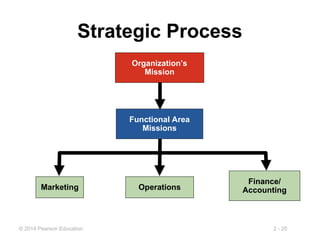
Strategic Process
Marketing Operations
Finance/
Accounting
Functional Area
Missions
Organization’s
Mission
2 - 21
© 2014 Pearson Education
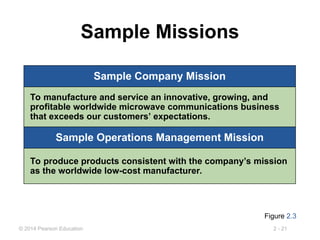
Sample Missions
Sample Company Mission
To manufacture and service an innovative, growing, and
profitable worldwide microwave communications business
that exceeds our customers’ expectations.
Sample Operations Management Mission
To produce products consistent with the company’s mission
as the worldwide low-cost manufacturer.
Figure 2.3
2 - 22
© 2014 Pearson Education
Strategy
► Action plan to achieve
mission
► Functional areas have
strategies
► Strategies exploit
opportunities and
strengths, neutralize
threats, and avoid
weaknesses
2 - 23
© 2014 Pearson Education
Strategies for Competitive
Advantage
1. Differentiation – better, or at least
different
2. Cost leadership – cheaper
3. Response – more responsive
2 - 24
© 2014 Pearson Education
Competing on Differentiation
Uniqueness can go beyond both the
physical characteristics and service
attributes to encompass everything that
impacts customer’s perception of value
► Walt Disney Magic Kingdom –
experience differentiation
► Hard Rock Cafe – dining experience
2 - 25
© 2014 Pearson Education
Competing on Cost
Provide the maximum value as
perceived by customer. Does not
imply low quality.
► Southwest Airlines – secondary airports,
no frills service, efficient utilization of
equipment
► Walmart – small overhead, shrinkage,
and distribution costs
► Franz Colruyt – no bags, no bright lights,
no music, and doors on freezers
2 - 26
© 2014 Pearson Education
Competing on Response
▶ Flexibility is matching market changes in
design innovation and volumes
▶ A way of life at Hewlett-Packard
▶ Reliability is meeting schedules
▶ German machine industry
▶ Timeliness is quickness
in design, production,
and delivery
▶ Johnson Electric,
Pizza Hut, Motorola
2 - 27
© 2014 Pearson Education © 2011 Pearson Education, Inc. publishing as
Prentice Hall
Strategy Development Process
Determine the Corporate Mission
State the reason for the firm’s existence and identify the
value it wishes to create.
Form a Strategy
Build a competitive advantage, such as low price, design, or
volume flexibility, quality, quick delivery, dependability, after-
sale service, broad product lines.
Analyze the Environment
Identify the strengths, weaknesses, opportunities, and threats.
Understand the environment, customers, industry, and competitors.
Figure 2.6
2 - 28
© 2014 Pearson Education
Strategy
Analysis
SWOT Analysis
Internal
Strengths
Internal
Weaknesses
External
Opportunities
External
Threats
Mission
2 - 29
© 2014 Pearson Education
Nike SWOT Analysis
▶ Strengths
- strong at research and development.
- Nike is a global brand.
▶ Opportunities
- to develop new products such as sunglasses and jewellery.
▶ Weaknesses
- The retail sector is very price sensitive.
▶ Threats
- The market for sports shoes and garments is very
competitive. Consumers are shopping around for a better
deal.
2 - 30
© 2014 Pearson Education
SWOT Analysis
SWOT Analysis
▶SWOT Analysis
SWOT Analysis, which is
, which is a key
tool in the strategic planning
process can also be applied to
personal career planning.
2 - 31
© 2014 Pearson Education © 2011 Pearson Education, Inc. publishing as
Prentice Hall
Strategy Development and
Implementation
▶ Identify key success factors
▶ Build and staff the organization
▶ Integrate OM with other activities
The operations manager’s job is to implement
an OM strategy, provide competitive
advantage, and increase productivity
2 - 32
© 2014 Pearson Education
Strategy Development and
Implementation
Implementation
▶Only by identifying Key Success
Factors(KSFs) and Core Competencies
can an organization achieve
sustainable competitive advantage.
▶One of the KSFs for McDonalds is
layout.
▶Core Competency for Honda is its gas-
powered engines.

Chapter number 2 operation management book

  • 1.
    2 - 1 ©2014 Pearson Education The Global Environment and Operations Strategy 2 2 PowerPoint presentation to accompany Heizer and Render Operations Management, Global Edition, Eleventh Edition Principles of Operations Management, Global Edition, Ninth Edition PowerPoint slides by Jeff Heyl © 2014 Pearson Education
  • 2.
    2 - 2 ©2014 Pearson Education OUTLINE ▶A Global View to Operations ▶Reasons to Globalize ▶Developing Missions and Strategies ▶Strategies for Competitive Advantage ▶SWOT Analysis and Strategy Development
  • 3.
    2 - 3 ©2014 Pearson Education Growth of World Trade Figure 2.1 60 – 55 – 50 – 45 – 40 – 35 – 30 – 25 – 20 – 15 – 10 – | | | | | | | | | 1970 1975 1980 1985 1990 1995 2000 2005 2010 Year Percent
  • 4.
    2 - 4 ©2014 Pearson Education Reasons to Globalize 1. Improve the supply chain 2. Reduce costs (labor, taxes, tariffs, etc.) 3. Improve operations 4. Understand markets 5. Improve products 6. Attract and retain global talent
  • 5.
    2 - 5 ©2014 Pearson Education Improve the Supply Chain ▶ Locating facilities closer to unique resources ▶ Auto design to California ▶ Athletic shoe production to China ▶ Perfume manufacturing in France
  • 6.
    2 - 6 ©2014 Pearson Education Reduce Costs ▶ Foreign locations with lower wage rates can lower direct and indirect costs ▶ Trade agreements can lower tariffs ▶ Maquiladoras ▶ World Trade Organization (WTO) ▶ North American Free Trade Agreement (NAFTA) ▶ APEC, SEATO, MERCOSUR, CAFTA ▶ European Union (EU)
  • 7.
    2 - 7 ©2014 Pearson Education Improve Operations ▶ Understand differences between how business is handled in other countries ▶ Japanese – inventory management ▶ Scandinavians – ergonomics ▶ International operations can improve response time and customer service
  • 8.
    2 - 8 ©2014 Pearson Education Understand Markets ▶ Interacting with foreign customers, suppliers, competition can lead to new opportunities ▶ Cell phone design moved from Europe to Japan ▶ Extend the product life cycle
  • 9.
    2 - 9 ©2014 Pearson Education Improve Products ▶ Remain open to free flow of ideas ▶ Toyota and BMW manage joint research and development ▶ Reduced risk, state-of-the-art design, lower costs ▶ Samsung and Bosch jointly produce batteries
  • 10.
    2 - 10 ©2014 Pearson Education Attract and Retain Global Talent ▶ Offer better employment opportunities ▶ Better growth opportunities and insulation against unemployment ▶ Relocate unneeded personnel to more prosperous locations
  • 11.
    2 - 11 ©2014 Pearson Education Cultural and Ethical Issues ▶ Cultures can be quite different ▶ Attitudes can be quite different towards ► Punctuality ► Lunch breaks ► Environment ► Intellectual property ► Thievery ► Bribery ► Child labor
  • 12.
    2 - 12 ©2014 Pearson Education Key Issues of Globalization ▶ National literacy rate ▶ Rate of innovation ▶ Rate of technology change ▶ Number of skilled workers ▶ Political stability ▶ Product liability laws ▶ Export restrictions ▶ Variations in language ► Work ethic ► Tax rates ► Inflation ► Availability of raw materials ► Interest rates ► Population ► Number of miles of highway ► Phone system
  • 13.
    2 - 13 ©2014 Pearson Education Ranking Corruption Rank Country 2012 CPI Score (out of 100) 1 Demark, Finland, New Zealand 90 4 Sweden 88 5 Singapore 87 6 Switzerland 86 7 Australia, Norway 85 9 Canada, Netherlands 84 13 Germany 79 14 Hong Kong 77 17 Japan, UK 74 19 USA 73 37 Taiwan 61 39 Israel 60 45 South Korea 56 80 China 39 123 Vietnam 31 133 Russia 28 Least Corrupt Most Corrupt
  • 14.
    2 - 14 ©2014 Pearson Education Match Product & Parent 1. Volkswagen 2. Bridgestone 3. Campbell Soup 4. Tata Motors Limited 5. Proctor and Gamble 6. Nestlé 7. Pillsbury 8. Sony ► Braun Household Appliances ► Firestone Tires ► Godiva Chocolate ► Haagen-Dazs Ice Cream ► Jaguar Autos ► MGM Movies ► Lamborghini Autos ► Alpo Petfoods
  • 15.
    2 - 15 ©2014 Pearson Education ► Braun Household Appliances ► Firestone Tires ► Godiva Chocolate ► Haagen-Dazs Ice Cream ► Jaguar Autos ► MGM Movies ► Lamborghini Autos ► Alpo Petfoods Match Product & Parent 1. Volkswagen 2. Bridgestone 3. Campbell Soup 4. Tata Motors Limited 5. Proctor and Gamble 6. Nestlé 7. Pillsbury 8. Sony
  • 16.
    2 - 16 ©2014 Pearson Education Match Product & Country 1. Great Britain 2. Germany 3. Japan 4. United States 5. Switzerland 6. India ► Braun Household Appliances ► Firestone Tires ► Godiva Chocolate ► Haagen-Dazs Ice Cream ► Jaguar Autos ► MGM Movies ► Lamborghini Autos ► Alpo Petfoods
  • 17.
    2 - 17 ©2014 Pearson Education Match Product & Country 1. Great Britain 2. Germany 3. Japan 4. United States 5. Switzerland 6. India ► Braun Household Appliances ► Firestone Tires ► Godiva Chocolate ► Haagen-Dazs Ice Cream ► Jaguar Autos ► MGM Movies ► Lamborghini Autos ► Alpo Petfoods
  • 18.
    2 - 18 ©2014 Pearson Education Developing Missions and Strategies Mission statements tell an organization where it is going The Strategy tells the organization how to get there
  • 19.
    2 - 19 ©2014 Pearson Education Mission ► Mission - where is the organization going? ► Organization’s purpose for being ► Answers ‘What do we contribute to society?’ ► Provides boundaries and focus
  • 20.
    2 - 20 ©2014 Pearson Education Strategic Process Marketing Operations Finance/ Accounting Functional Area Missions Organization’s Mission
  • 21.
    2 - 21 ©2014 Pearson Education Sample Missions Sample Company Mission To manufacture and service an innovative, growing, and profitable worldwide microwave communications business that exceeds our customers’ expectations. Sample Operations Management Mission To produce products consistent with the company’s mission as the worldwide low-cost manufacturer. Figure 2.3
  • 22.
    2 - 22 ©2014 Pearson Education Strategy ► Action plan to achieve mission ► Functional areas have strategies ► Strategies exploit opportunities and strengths, neutralize threats, and avoid weaknesses
  • 23.
    2 - 23 ©2014 Pearson Education Strategies for Competitive Advantage 1. Differentiation – better, or at least different 2. Cost leadership – cheaper 3. Response – more responsive
  • 24.
    2 - 24 ©2014 Pearson Education Competing on Differentiation Uniqueness can go beyond both the physical characteristics and service attributes to encompass everything that impacts customer’s perception of value ► Walt Disney Magic Kingdom – experience differentiation ► Hard Rock Cafe – dining experience
  • 25.
    2 - 25 ©2014 Pearson Education Competing on Cost Provide the maximum value as perceived by customer. Does not imply low quality. ► Southwest Airlines – secondary airports, no frills service, efficient utilization of equipment ► Walmart – small overhead, shrinkage, and distribution costs ► Franz Colruyt – no bags, no bright lights, no music, and doors on freezers
  • 26.
    2 - 26 ©2014 Pearson Education Competing on Response ▶ Flexibility is matching market changes in design innovation and volumes ▶ A way of life at Hewlett-Packard ▶ Reliability is meeting schedules ▶ German machine industry ▶ Timeliness is quickness in design, production, and delivery ▶ Johnson Electric, Pizza Hut, Motorola
  • 27.
    2 - 27 ©2014 Pearson Education © 2011 Pearson Education, Inc. publishing as Prentice Hall Strategy Development Process Determine the Corporate Mission State the reason for the firm’s existence and identify the value it wishes to create. Form a Strategy Build a competitive advantage, such as low price, design, or volume flexibility, quality, quick delivery, dependability, after- sale service, broad product lines. Analyze the Environment Identify the strengths, weaknesses, opportunities, and threats. Understand the environment, customers, industry, and competitors. Figure 2.6
  • 28.
    2 - 28 ©2014 Pearson Education Strategy Analysis SWOT Analysis Internal Strengths Internal Weaknesses External Opportunities External Threats Mission
  • 29.
    2 - 29 ©2014 Pearson Education Nike SWOT Analysis ▶ Strengths - strong at research and development. - Nike is a global brand. ▶ Opportunities - to develop new products such as sunglasses and jewellery. ▶ Weaknesses - The retail sector is very price sensitive. ▶ Threats - The market for sports shoes and garments is very competitive. Consumers are shopping around for a better deal.
  • 30.
    2 - 30 ©2014 Pearson Education SWOT Analysis SWOT Analysis ▶SWOT Analysis SWOT Analysis, which is , which is a key tool in the strategic planning process can also be applied to personal career planning.
  • 31.
    2 - 31 ©2014 Pearson Education © 2011 Pearson Education, Inc. publishing as Prentice Hall Strategy Development and Implementation ▶ Identify key success factors ▶ Build and staff the organization ▶ Integrate OM with other activities The operations manager’s job is to implement an OM strategy, provide competitive advantage, and increase productivity
  • 32.
    2 - 32 ©2014 Pearson Education Strategy Development and Strategy Development and Implementation Implementation ▶Only by identifying Key Success Factors(KSFs) and Core Competencies can an organization achieve sustainable competitive advantage. ▶One of the KSFs for McDonalds is layout. ▶Core Competency for Honda is its gas- powered engines.

Editor's Notes

  • #13 CPI is the Corrupt Perceptions Index calculated by Transparency International, an organization dedicated to fighting business corruption. The Index is calculated from up to 13 different individual scores. For details and the methodology, see www.transparency.org. In 2012 they changed their scoring system from “out of 10” to “out of 100”. In case students are interested, three countries tied for the lowest score in the 2012 survey with a score of 8 out of 100 – Afghanistan, North Korea, and Somalia.