HYPOTHERMIA
& COLD INJURIES
Farooq Khan MDCM
PGY-5 FRCP-EM
February 28th 2014
Background
• Definition: Core Temp <35°C
• Severity:
– Mild hypothermia: 32-35°C
• Shivering thermogenesis, amnesia, dysarthria
– Moderate hypothermia: 28-32°C
• Stupor, extinguished shivering, dysrhythmias
– Severe hypothermia: <28°C
• V-fib risk, acid base disturbance, decreased CO and CBF
DDx
• Accidental
(environmental) exposure
• Metabolic disorders
– Hypoglycemia
– Hypothyroidism
– Hypoadrenalism
– Hypopituitarism
• Hypothalamic and CNS
– Head trauma
– Tumor
– Stroke
– Wernicke encephalopathy
• Drugs
– Ethanol
– Sedatives-hypnotics
• Sepsis
• Dermal disease
– Burns
– Exfoliative dermatitis
• Acute incapacitating
illness
• Massive fluid or blood
resuscitation
• Malnutrition
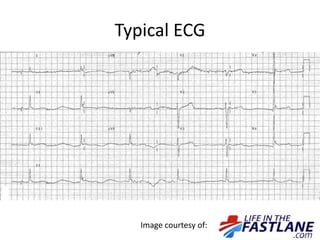
ECG
• Typical sequence is sinus brady > a fib w/ slow
ventricular response > v-fib > asystole
• Other ECG findings:
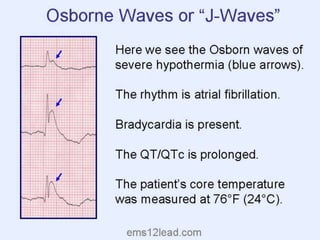
– Osborn (J) wave
– T-wave inversions
– PR, QRS, QT prolongation
– Muscle tremor artifact
– AV block
– PVCs
Typical ECG
Image courtesy of:
Supportive measures
• Handle pt gently
– V-fib may be induced by rough handling of pt due to
irritable myocardium (anecdotal)
• O2
– Hypothermia causes leftward shift of oxyhemoglobin
dissociation curve
• IVF
– Hypothermia > impaired renal concentrating ability >
cold diuresis
– Pts are prone to rhabdo
– Intravascular volume is lost due to extravascular shift
Specific therapies
• Abx
– Give if suspect sepsis (e.g. hypothermia fails to correct w/
rewarming measures)
• Thiamine
– Consider if Wernicke disease is possible cause of
hypothermia (e.g. alcoholic pt)
• Hydrocortisone
– Consider if pt has history of adrenal suppression or
insufficiency
• Thyroxine
– Consider if any suspicion for hypothyroidism/myxedema
coma
Passive Rewarming
• Consider in pt w/ mild hypothermia (>32°C)
who is able to generate intrinsic heat
• Techniques
– Removal from cold environment
– Remove wet clothing
– Insulation with blankets
Active rewarming
• Indications
– Cardiovascular instability
– Moderate to severe hypothermia (<32°C)
– Inadequate rate or failure to rewarm
– Endocrine insufficiency
– Traumatic or toxicologic peripheral vasodilation
– Secondary hypothermia impairing thermoregulation
• Rewarm trunk BEFORE the extremities
– Otherwise may lead to hypotension ("core temperature
afterdrop")
• Warmed vasodilated peripheral tissue allows cooler blood in
extremities to circulate back to core
Active External Rewarming
• Consider in:
– Moderate-severe
hypothermia
– Mild hypothermia in pt
who is unstable or
cannot generate
intrinsic heat
– Failure to respond to
passive external
rewarming
– May be ineffective in
pts w/ poor perfusion
or in cardiac arrest
• Techniques
– Warm IV bags applied
to skin
– Heating blankets
– Radiant heat
– Forced air - Bair hugger
Active Internal Rewarming
• Consider alone or
along with active
external warming in:
– Cardiovascular
instability / life-
threatening
dysrhythmias
– Severe hypothermia
– Moderate
hypothermia which
fails to respond to less
aggressive measures
• Techniques
– Warm humidified O2
– Heated IV fluids: 40-42°C
• Level 1 infuser
• Microwave on high x 2min
– Peritoneal lavage
• Encourages liver function
– Pleural lavage
• 2 large chest tubes
– GI tract lavage and
bladder lavage
• Limited area for heat exchange
and can cause Electrolyte shifts
– Bypass/ECMO/AV
Dialysis
ACLS
• CPR
– Only perform if pt truly does not have a pulse
(unnecessary CPR may lead to V-fib)
– Spend 30-45s attempting to detect respiratory
activity and pulse before starting CPR
• Pt not dead until warm and dead: 30-32°C
• Active internal rewarming indicated for
cardiac arrest
– Mediastinal and direct cardiac lavage
ACLS
• Dysrhythmias (Occur <30°C)
– Active rewarming is treatment of choice
• Most dysrhythmias (e.g. sinus brady, a-fib/flutter) require no
other therapy
• Activity of antiarrhythmics is unpredictable in hypothermia
• Hypothermic heart is relatively resistant to atropine, pacing,
and countershock
– V-fib
• May be refractory to therapy until pt is rewarmed
• Attempt a single defibrillation attempt
– If unsuccessful continue CPR and attempt defibrillation again
once temp >30C (86F)
– IV medications: increase interval between doses
FREEZING INJURIES
Background
• Results from the freezing of tissue
• It is a disease of morbidity, not mortality
• Risk correlated with temperature and wind speed
– Risk is <5% when ambient temperature (includes wind
chill) is > –15°C
– Most often occurs at ambient temp < –20°C
• Can develop w/in 2-3sec when metal surfaces
that are at or below –15°C are touched
• Most commonly affects distal part of extremities,
face, nose, and ears
Pathophysiology
• Freezing alone is usually not sufficient to
cause tissue death
– Thawing contributes markedly to the degree of
injury
– Endothelial damage, beginning at the point of
thaw, is the critical event in frostbite
• Resulting damage results in swelling, platelet
aggregation, vessel thrombosis
Zones of Injury
• Zone of Coagulation
• Most severe and usually most distal
• Damage is irreversible
• Zone of Hyperemia
• Least severe and usually most proximal
• Generally recovers w/o treatment in <10d
• Zone of Stasis
• Middle zone characterized by severe, but possibly
reversible, cell damage
• It is this zone for which treatment may have benefit
Classification
• First degree (frostnip)
– Partial-skin freezing
– Stinging and burning, followed by throbbing
– Numbness, erythema, swelling, dysesthesia,
desquamation (days later)
– Prognosis excellent
Classification
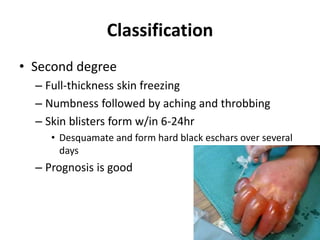
• Second degree
– Full-thickness skin freezing
– Numbness followed by aching and throbbing
– Skin blisters form w/in 6-24hr
• Desquamate and form hard black eschars over several
days
– Prognosis is good
Classification
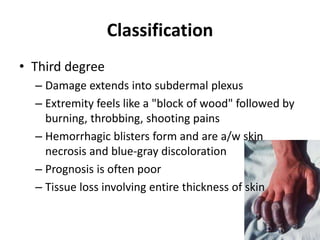
• Third degree
– Damage extends into subdermal plexus
– Extremity feels like a "block of wood" followed by
burning, throbbing, shooting pains
– Hemorrhagic blisters form and are a/w skin
necrosis and blue-gray discoloration
– Prognosis is often poor
– Tissue loss involving entire thickness of skin
Classification
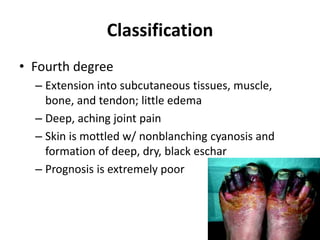
• Fourth degree
– Extension into subcutaneous tissues, muscle,
bone, and tendon; little edema
– Deep, aching joint pain
– Skin is mottled w/ nonblanching cyanosis and
formation of deep, dry, black eschar
– Prognosis is extremely poor
Pre-thaw
• Assess Doppler pulse and appearance
• Protect part – no friction massage
• Stabilize core temperature
• Address medical and surgical conditions
• Rehydrate patient
• Prevent partial thaw and refreeze
– Refreezing will cause even more severe damage
Thaw
• Analgesia
– Provide parenteral opiates
• Blocking prostaglandin, thromboxane, and arachidonic
cascade
• Ibuprofen 400mg po q8h
• Rapid rewarming is the core of therapy and should be
initiated as soon as possible
– Extremities
• Place in water w/ temperature of 37- 40°C (do not exceed 42°C)
• Leave in for 20-30min, when the extremity should become pliable
and erythematous
– Face
• Apply moistened compresses soaked in warm water
Post-thaw
• Tetanus prophylaxis
• Local wound care
– Apply topical aloe vera cream q6hr (interrupts
arachidonic acid cascade)
– Affected digits should be separated w/ cotton and
wrapped w/ sterile, dry gauze
– Dry, elevate and splint
– Blister removal is controversial
• Consider drainage of nonhemorrhagic bullae that interfere
w/ movement
• Never debride hemorrhagic bullae
Post-thaw
• Systemic care
– Hydrotherapy at 37°C tid
– Streptococcal prophylactic Pen G 500kU IV q6hr
– Intra-arterial tPA reduces digit amputation rate
– Phenoxybenzamine to reduce vasospasm
• Surgery
– Monitor compartment pressures
– Amputation
• May be required if wet gangrene or infection occurs
• Usually not performed until full demarcation occurs (3-4 wk)
Sequelae
• Acute
– Rhabdomyolysis, ATN, Electrolyte fluxes
– Core temperature afterdrop
– Compartment syndrome
• Chronic
– Neuropathic pain/dysesthesias, thermal sensitivity
– Autonomic dysfunction (Hyperhidrosis, Raynaud’s)
– MSK (atrophy, tenosynovitis, strictures, OA)
– Derm (edema, ulcers, delayed cancers)
NON-FREEZING INJURIES
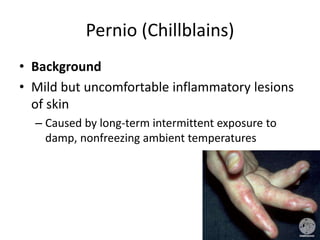
Pernio (Chillblains)
• Background
• Mild but uncomfortable inflammatory lesions
of skin
– Caused by long-term intermittent exposure to
damp, nonfreezing ambient temperatures
Pernio
• Symptoms
– Tingling, numbness, pruritus,
burning paresthesias
– Cutaneous manifestations
appear up to 12hr after acute
exposure:
– Localized edema, erythema,
cyanosis, plaques, nodules
• May progress in rare cases to
ulcerations, vesicles, and bullae
– Rewarming may result in
formation of tender blue
nodules which may persist for
days
• Treatment
• Affected skin should be
rewarmed, gently bandaged,
and elevated
• Nifedipine 20mg PO TID may be
helpful as both prophylactic and
therapeutic tx
• Topical corticosteroids and oral
steroid burst have been shown
to be useful
Cold Panniculitis
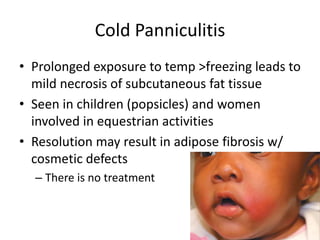
• Prolonged exposure to temp >freezing leads to
mild necrosis of subcutaneous fat tissue
• Seen in children (popsicles) and women
involved in equestrian activities
• Resolution may result in adipose fibrosis w/
cosmetic defects
– There is no treatment
Trench Foot (Immersion Foot)
• Background
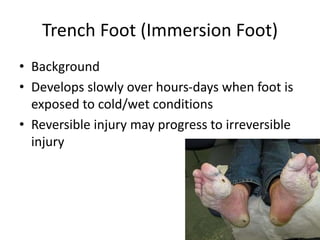
• Develops slowly over hours-days when foot is
exposed to cold/wet conditions
• Reversible injury may progress to irreversible
injury
Trench Foot
• Clinical Features
– Tingling/numbness is initial symptom
– Foot appears pale, mottled, anesthetic, pulseless, and immobile
• Initially does not change after rewarming
– Hyperemic phase begins w/in hr after rewarming
• Assoc w/ severe burning pain and reappearance of proximal sensation
– As perfusion returns to foot over 2-3d edema and possibly
bullae may form
– Anesthesia persists for weeks and may be permanent; gangrene
may occur
• Treatment
– Keep feet clean, warm, dryly bandaged, elevated
– Monitor for signs of infection
Sources
• Tintinalli
• Rosen
• WikEM: Jordan Swartz, Manpreet Singh, Ross
Donaldson

Hypothermia and cold injuries

  • 1.
    HYPOTHERMIA & COLD INJURIES FarooqKhan MDCM PGY-5 FRCP-EM February 28th 2014
  • 2.
    Background • Definition: CoreTemp <35°C • Severity: – Mild hypothermia: 32-35°C • Shivering thermogenesis, amnesia, dysarthria – Moderate hypothermia: 28-32°C • Stupor, extinguished shivering, dysrhythmias – Severe hypothermia: <28°C • V-fib risk, acid base disturbance, decreased CO and CBF
  • 3.
    DDx • Accidental (environmental) exposure •Metabolic disorders – Hypoglycemia – Hypothyroidism – Hypoadrenalism – Hypopituitarism • Hypothalamic and CNS – Head trauma – Tumor – Stroke – Wernicke encephalopathy • Drugs – Ethanol – Sedatives-hypnotics • Sepsis • Dermal disease – Burns – Exfoliative dermatitis • Acute incapacitating illness • Massive fluid or blood resuscitation • Malnutrition
  • 4.
    ECG • Typical sequenceis sinus brady > a fib w/ slow ventricular response > v-fib > asystole • Other ECG findings: – Osborn (J) wave – T-wave inversions – PR, QRS, QT prolongation – Muscle tremor artifact – AV block – PVCs
  • 5.
  • 7.
    Supportive measures • Handlept gently – V-fib may be induced by rough handling of pt due to irritable myocardium (anecdotal) • O2 – Hypothermia causes leftward shift of oxyhemoglobin dissociation curve • IVF – Hypothermia > impaired renal concentrating ability > cold diuresis – Pts are prone to rhabdo – Intravascular volume is lost due to extravascular shift
  • 8.
    Specific therapies • Abx –Give if suspect sepsis (e.g. hypothermia fails to correct w/ rewarming measures) • Thiamine – Consider if Wernicke disease is possible cause of hypothermia (e.g. alcoholic pt) • Hydrocortisone – Consider if pt has history of adrenal suppression or insufficiency • Thyroxine – Consider if any suspicion for hypothyroidism/myxedema coma
  • 9.
    Passive Rewarming • Considerin pt w/ mild hypothermia (>32°C) who is able to generate intrinsic heat • Techniques – Removal from cold environment – Remove wet clothing – Insulation with blankets
  • 10.
    Active rewarming • Indications –Cardiovascular instability – Moderate to severe hypothermia (<32°C) – Inadequate rate or failure to rewarm – Endocrine insufficiency – Traumatic or toxicologic peripheral vasodilation – Secondary hypothermia impairing thermoregulation • Rewarm trunk BEFORE the extremities – Otherwise may lead to hypotension ("core temperature afterdrop") • Warmed vasodilated peripheral tissue allows cooler blood in extremities to circulate back to core
  • 11.
    Active External Rewarming •Consider in: – Moderate-severe hypothermia – Mild hypothermia in pt who is unstable or cannot generate intrinsic heat – Failure to respond to passive external rewarming – May be ineffective in pts w/ poor perfusion or in cardiac arrest • Techniques – Warm IV bags applied to skin – Heating blankets – Radiant heat – Forced air - Bair hugger
  • 12.
    Active Internal Rewarming •Consider alone or along with active external warming in: – Cardiovascular instability / life- threatening dysrhythmias – Severe hypothermia – Moderate hypothermia which fails to respond to less aggressive measures • Techniques – Warm humidified O2 – Heated IV fluids: 40-42°C • Level 1 infuser • Microwave on high x 2min – Peritoneal lavage • Encourages liver function – Pleural lavage • 2 large chest tubes – GI tract lavage and bladder lavage • Limited area for heat exchange and can cause Electrolyte shifts – Bypass/ECMO/AV Dialysis
  • 13.
    ACLS • CPR – Onlyperform if pt truly does not have a pulse (unnecessary CPR may lead to V-fib) – Spend 30-45s attempting to detect respiratory activity and pulse before starting CPR • Pt not dead until warm and dead: 30-32°C • Active internal rewarming indicated for cardiac arrest – Mediastinal and direct cardiac lavage
  • 14.
    ACLS • Dysrhythmias (Occur<30°C) – Active rewarming is treatment of choice • Most dysrhythmias (e.g. sinus brady, a-fib/flutter) require no other therapy • Activity of antiarrhythmics is unpredictable in hypothermia • Hypothermic heart is relatively resistant to atropine, pacing, and countershock – V-fib • May be refractory to therapy until pt is rewarmed • Attempt a single defibrillation attempt – If unsuccessful continue CPR and attempt defibrillation again once temp >30C (86F) – IV medications: increase interval between doses
  • 15.
  • 16.
    Background • Results fromthe freezing of tissue • It is a disease of morbidity, not mortality • Risk correlated with temperature and wind speed – Risk is <5% when ambient temperature (includes wind chill) is > –15°C – Most often occurs at ambient temp < –20°C • Can develop w/in 2-3sec when metal surfaces that are at or below –15°C are touched • Most commonly affects distal part of extremities, face, nose, and ears
  • 17.
    Pathophysiology • Freezing aloneis usually not sufficient to cause tissue death – Thawing contributes markedly to the degree of injury – Endothelial damage, beginning at the point of thaw, is the critical event in frostbite • Resulting damage results in swelling, platelet aggregation, vessel thrombosis
  • 18.
    Zones of Injury •Zone of Coagulation • Most severe and usually most distal • Damage is irreversible • Zone of Hyperemia • Least severe and usually most proximal • Generally recovers w/o treatment in <10d • Zone of Stasis • Middle zone characterized by severe, but possibly reversible, cell damage • It is this zone for which treatment may have benefit
  • 19.
    Classification • First degree(frostnip) – Partial-skin freezing – Stinging and burning, followed by throbbing – Numbness, erythema, swelling, dysesthesia, desquamation (days later) – Prognosis excellent
  • 20.
    Classification • Second degree –Full-thickness skin freezing – Numbness followed by aching and throbbing – Skin blisters form w/in 6-24hr • Desquamate and form hard black eschars over several days – Prognosis is good
  • 21.
    Classification • Third degree –Damage extends into subdermal plexus – Extremity feels like a "block of wood" followed by burning, throbbing, shooting pains – Hemorrhagic blisters form and are a/w skin necrosis and blue-gray discoloration – Prognosis is often poor – Tissue loss involving entire thickness of skin
  • 22.
    Classification • Fourth degree –Extension into subcutaneous tissues, muscle, bone, and tendon; little edema – Deep, aching joint pain – Skin is mottled w/ nonblanching cyanosis and formation of deep, dry, black eschar – Prognosis is extremely poor
  • 23.
    Pre-thaw • Assess Dopplerpulse and appearance • Protect part – no friction massage • Stabilize core temperature • Address medical and surgical conditions • Rehydrate patient • Prevent partial thaw and refreeze – Refreezing will cause even more severe damage
  • 24.
    Thaw • Analgesia – Provideparenteral opiates • Blocking prostaglandin, thromboxane, and arachidonic cascade • Ibuprofen 400mg po q8h • Rapid rewarming is the core of therapy and should be initiated as soon as possible – Extremities • Place in water w/ temperature of 37- 40°C (do not exceed 42°C) • Leave in for 20-30min, when the extremity should become pliable and erythematous – Face • Apply moistened compresses soaked in warm water
  • 25.
    Post-thaw • Tetanus prophylaxis •Local wound care – Apply topical aloe vera cream q6hr (interrupts arachidonic acid cascade) – Affected digits should be separated w/ cotton and wrapped w/ sterile, dry gauze – Dry, elevate and splint – Blister removal is controversial • Consider drainage of nonhemorrhagic bullae that interfere w/ movement • Never debride hemorrhagic bullae
  • 26.
    Post-thaw • Systemic care –Hydrotherapy at 37°C tid – Streptococcal prophylactic Pen G 500kU IV q6hr – Intra-arterial tPA reduces digit amputation rate – Phenoxybenzamine to reduce vasospasm • Surgery – Monitor compartment pressures – Amputation • May be required if wet gangrene or infection occurs • Usually not performed until full demarcation occurs (3-4 wk)
  • 27.
    Sequelae • Acute – Rhabdomyolysis,ATN, Electrolyte fluxes – Core temperature afterdrop – Compartment syndrome • Chronic – Neuropathic pain/dysesthesias, thermal sensitivity – Autonomic dysfunction (Hyperhidrosis, Raynaud’s) – MSK (atrophy, tenosynovitis, strictures, OA) – Derm (edema, ulcers, delayed cancers)
  • 28.
  • 29.
    Pernio (Chillblains) • Background •Mild but uncomfortable inflammatory lesions of skin – Caused by long-term intermittent exposure to damp, nonfreezing ambient temperatures
  • 30.
    Pernio • Symptoms – Tingling,numbness, pruritus, burning paresthesias – Cutaneous manifestations appear up to 12hr after acute exposure: – Localized edema, erythema, cyanosis, plaques, nodules • May progress in rare cases to ulcerations, vesicles, and bullae – Rewarming may result in formation of tender blue nodules which may persist for days • Treatment • Affected skin should be rewarmed, gently bandaged, and elevated • Nifedipine 20mg PO TID may be helpful as both prophylactic and therapeutic tx • Topical corticosteroids and oral steroid burst have been shown to be useful
  • 31.
    Cold Panniculitis • Prolongedexposure to temp >freezing leads to mild necrosis of subcutaneous fat tissue • Seen in children (popsicles) and women involved in equestrian activities • Resolution may result in adipose fibrosis w/ cosmetic defects – There is no treatment
  • 32.
    Trench Foot (ImmersionFoot) • Background • Develops slowly over hours-days when foot is exposed to cold/wet conditions • Reversible injury may progress to irreversible injury
  • 33.
    Trench Foot • ClinicalFeatures – Tingling/numbness is initial symptom – Foot appears pale, mottled, anesthetic, pulseless, and immobile • Initially does not change after rewarming – Hyperemic phase begins w/in hr after rewarming • Assoc w/ severe burning pain and reappearance of proximal sensation – As perfusion returns to foot over 2-3d edema and possibly bullae may form – Anesthesia persists for weeks and may be permanent; gangrene may occur • Treatment – Keep feet clean, warm, dryly bandaged, elevated – Monitor for signs of infection
  • 34.
    Sources • Tintinalli • Rosen •WikEM: Jordan Swartz, Manpreet Singh, Ross Donaldson